
The California State Water Resources Control Board (Water Board) is advancing a process to establish permanent streamflow requirements for the Shasta and Scott rivers. The Water Board’s current work will narrow the range of flows and focus deeper investigations in a forthcoming scientific basis report and economic analysis. This report will inform the Water Board’s selection of permanent minimum baseflows. Interim flows currently in effect in the rivers expire in 2030.
The Water Board will hold a staff workshop over Zoom on April 9, 2026 at 2:00 pm, with an opportunity for public participation and verbal comments. Registration is required to attend the meeting. Written comments regarding flow requirements the Water Board should evaluate are due on April 20.
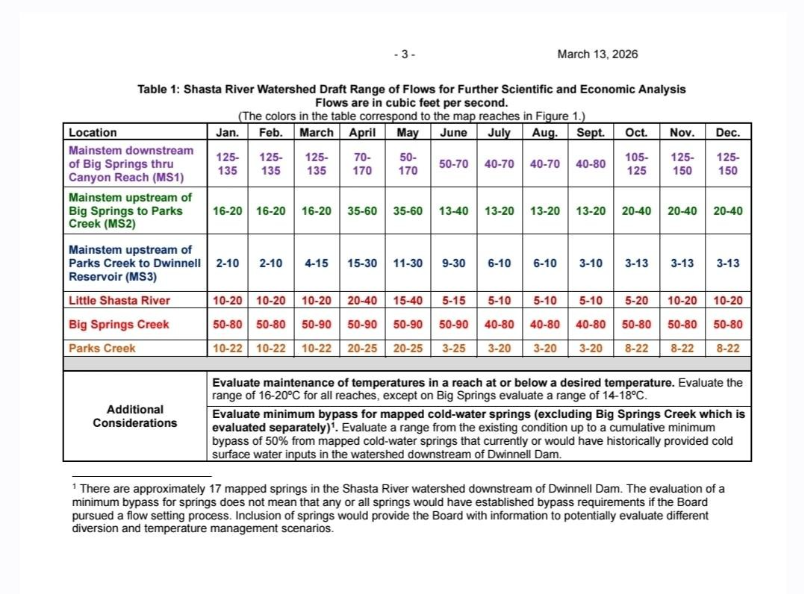
Table depicting the range of flows that the Water Board is using to establish limits on acceptable levels of flows in the Shasta River. Image: State Water Resources Control Board, from the meeting notice
The Shasta and Scott rivers are two of the state’s most viable habitats for boosting recovery of wild Chinook and coho salmon, steelhead trout, and Pacific lamprey.
The clean, cold, volcanic springs flowing from the northern flanks of Mount Shasta make the Shasta River one of the most productive spawning tributaries for anadromous fish in the Klamath basin. Estimates suggest that more than 80,000 Chinook salmon once returned every year to spawn in the Shasta River.
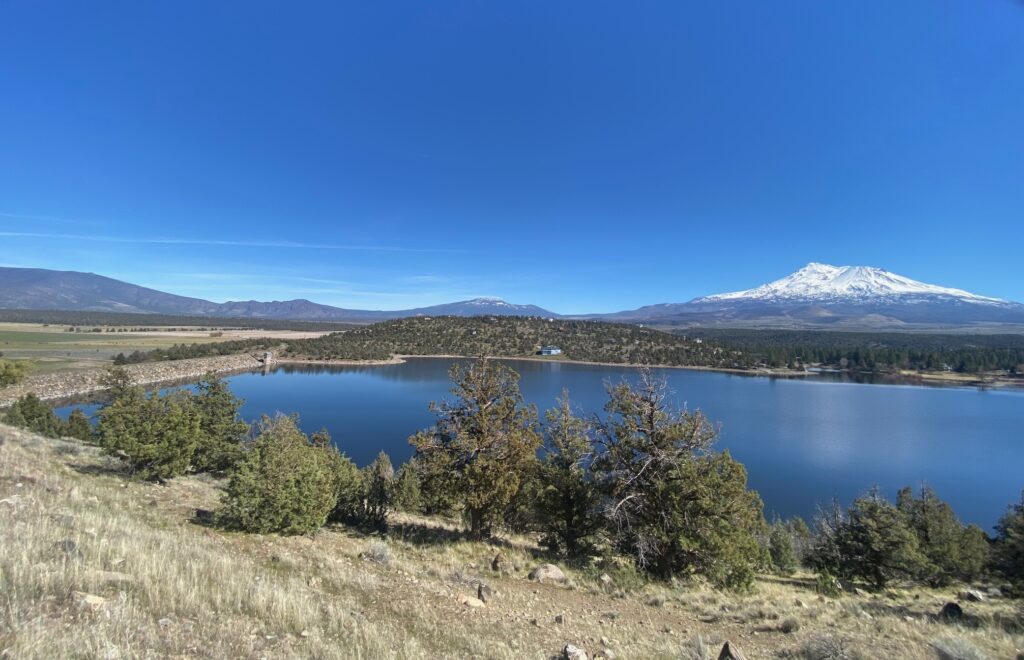
Mount Shasta behind “Lake” Shastina. Dwinnell Dam backs up the Shasta River to form this reservoir. Beautiful in the springtime, Shastina becomes putrid in the summer and fall months, severely degrading high-quality spring water that once supported abundant populations of fish. Image: Angelina Cook
The Scott River ranks among the Klamath’s top four most abundant salmon-producing tributaries. The Scott River’s gentle gradient and the extensively branched stream network in its upper reaches make it exceptionally conducive to the recovery of southern Oregon and northern California coho salmon. Scott River coho salmon are regarded as the region’s most critically threatened species. Spring-run Chinook have been extirpated from the Scott River.
Up till now, the Shasta and Scott rivers have not been subject to instream flow requirements. In 2021, river levels got so low that the Water Board was forced to adopt emergency instream flow requirements (e-regs). 2023, 2024 and 2025 were wetter water years, but low instream flows persisted. It was thus necessary for the Water Board to adopt the e-regs on an annual basis.
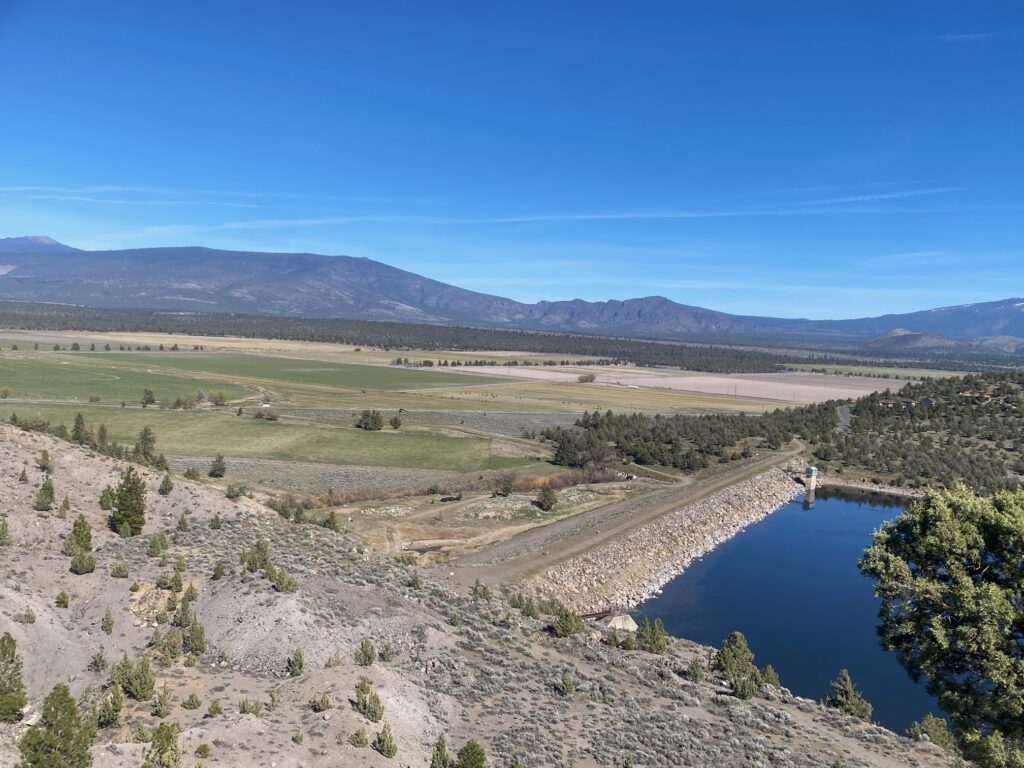
Dwinnell Dam on Shastina reservoir, with a tiny glimpse of the extensive irrigated acreage in the background. Image: Angelina Cook
Due to the inefficiency and expense of readopting e-regs on an annual basis, the Water Board initiated its process to establish permanent streamflow requirements in 2025. With five years anticipated for study and preparation prior to adoption, the State legislature passed Assembly Bill 263 in 2026. This legislation extended the e-regs until 2030. Prior to the e-regs, the only regulatory overlay governing water allocation of the Shasta and Scott rivers were water right adjudications that had no specific allocations for the rivers.
Adjudications codify river decrees that allocate surface water rights. Adjudications are generally executed once a basin has been fully developed and demands begin to perpetually outstrip supplies. The Scott River adjudication was executed in 1980, while the Shasta River adjudication was completed in 1932.
When these adjudications were executed, environmental, Tribal, and public interests were not priorities. Thus, the adjudications allocated little to no water for fish and Tribes. Recent changes in hydrological patterns, increased well drilling, and previously unregulated groundwater withdrawals have created conditions in which fully enforced adjudications still result in fully dewatered rivers.
Many Shasta River irrigators defied the e-regs in 2022. Over a two-week period, many irrigators unlawfully diverted water. The river dropped below 20 cubic feet per second (cfs) multiple times. 20 cfs is less than half the amount considered necessary for survival of salmon.
County supervisors and other elected officials applauded the violations. Yet the Water Board took note of the irrigators’ brazen defiance. Later, the State legislature passed interim flow requirements into law. It became clear that strong and decisive regulations backed by effective enforcement mechanisms and third-party compliance, are necessary to rebalance economy with ecology.
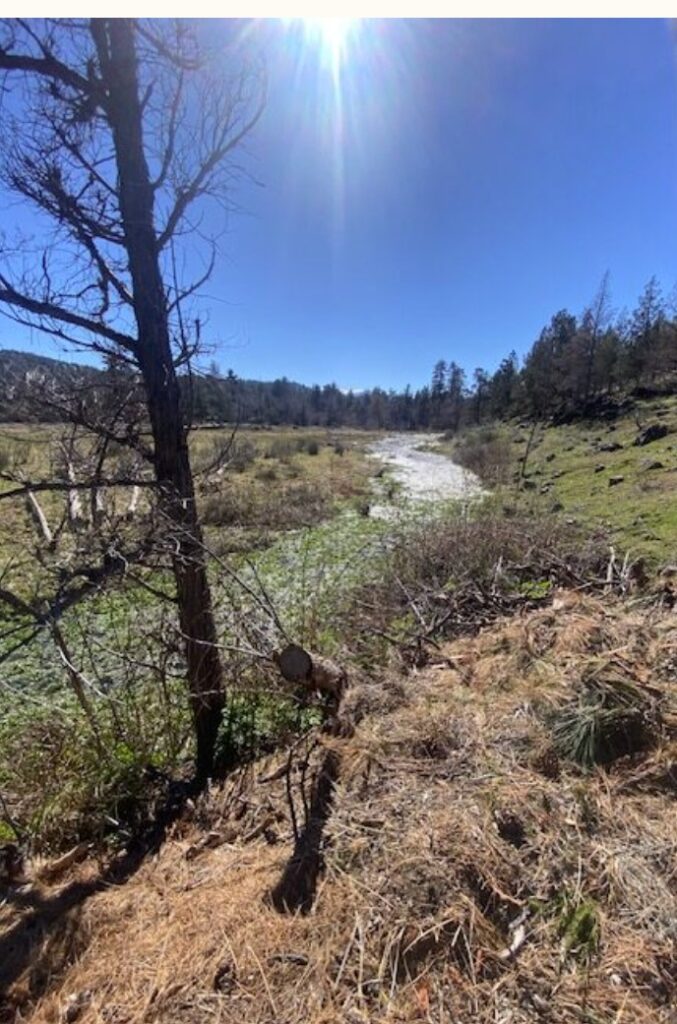
Shasta River dewatered below Dwinnell Dam. Image: Angelina Cook
By adopting minimum baseflows conducive to recovery in the Scott and Shasta Rivers, the Water Board has a once-in-a-lifetime opportunity to tip the scales of injustice back in favor of communities and the environment. In order to restore a harvestable surplus of Klamath salmon and other anadromous fish, CSPA will urge the Water Board to evaluate and adopt minimum baseflows at the highest end of the range for each identified part of each watershed. Meanwhile, Tribes and advocates for the public interest are coordinating to ensure effective compliance. They are also tracking public expenditures and evaluating agency performance in executing Tribal trust and public trust responsibilities.
Interested parties may register for the April 9 workshop at: https://waterboards.zoom.us/meeting/register/rdLjvD1nQaGYg-edV8Mv4w
Parties can email comments with the subject line of “Shasta Range of Flows-Comments” to: ScottShastaFlows@waterboards.ca.gov or mail a hard copy of them to the Water Board’s Division of Water Rights at P.O. Box 2000, Sacramento, CA 95812.