
The public comment period for Pacific Gas & Electric Company’s (PG&E) license surrender application (LSA) for the Potter Valley Project (PVP) was extended to December 19, 2025. A wide array of Tribal Nations, agencies, NGOs and individuals submitted comments, likely totaling well over a thousand. While many comments expressed support for the LSA, there were a large number of people in opposition.
I filed an intervention on behalf of California Sportfishing Protection Alliance and also submitted a personal comment in support of the LSA. Then I headed up to the mainstem Eel River to get reacquainted with the watershed and its aging infrastructure.
First, I made my way up to Lake Pillsbury to get eyes on Scott Dam. This was not as easy as I thought it would be. PG&E has fenced off most of the riparian corridor below the dam. It has also posted many “No Trespassing” signs throughout the reach. After hiking upstream a bit, I was able to scramble up a hill on the north side of the river. Up close, Scott Dam definitely looks like it was built in 1921. The dam is 138 feet high and 850 feet long. Scott Dam is the end of the line for the few migrating salmonids that swim up the old fish ladder downstream at Cape Horn Dam.
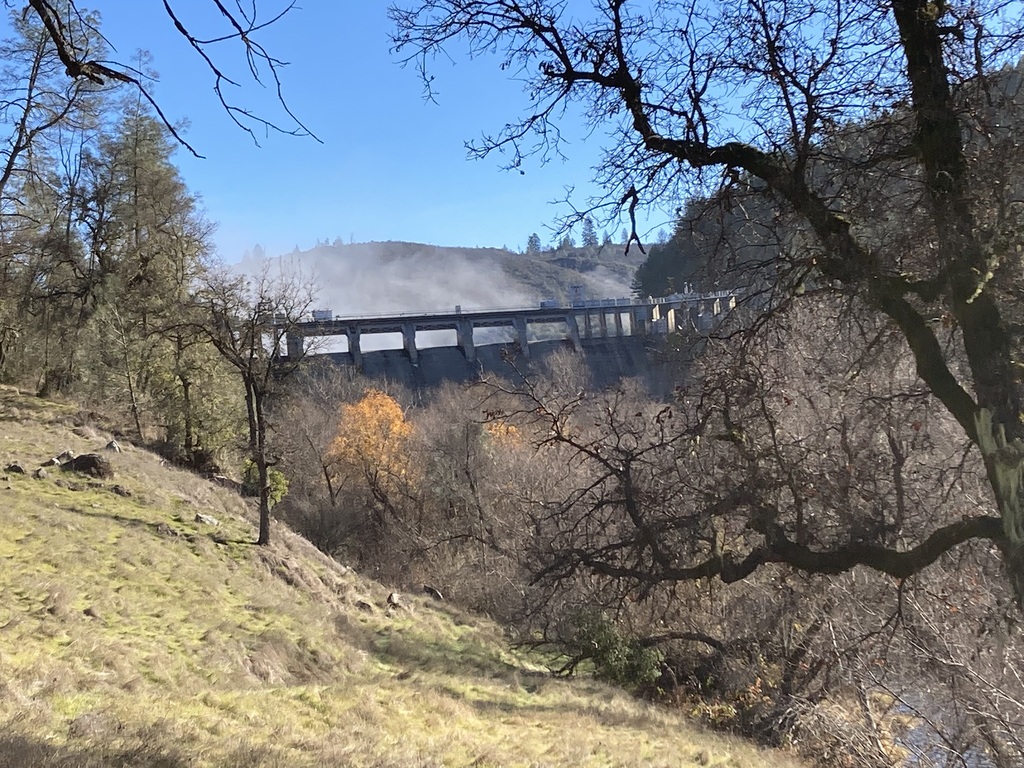
Partial view of Scott Dam from the Eel River canyon in 2025. Image: Eric Woodruff
I marveled at the potential habitat between Cape Horn and Scott dams while putting along Eel River/Elk Mountain Rd. As a resident of Santa Rosa, it’s exciting to think about someday having a shot at an adult steelhead in that reach while camping at Trout Creek Campground. That spot is a mere 1½ hour drive from my home. This of course assumes that dam removal will allow the fisheries of the mainstem Eel to recover enough to allow fishing upstream of Cape Horn Dam.
As I made my way back down the canyon toward Cape Horn Dam, I spotted a mountain lion moving down the riparian corridor on the south side of the river. By the time I got my phone camera out and ready, it had vanished into the dense, coniferous forest. But it reminded me of the biodiversity that the Eel River facilitates. I also observed tule elk and raptors in the river canyon.
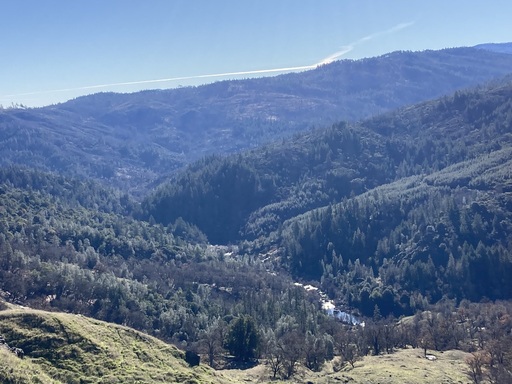
A view of the Eel River from Elk Mountain Road in 2025. Image: Eric Woodruff
After I arrived downstream at Cape Horn Dam, I got out and hiked the area to get a feel for the infrastructure. It had been a few years since I’d laid eyes on it. I was taken aback at how old it looked. This dam was built in 1907. There is a 434-foot “pool-and-weir-type” fish ladder, complemented by a corrugated pipe designed for passage of Pacific lamprey. “The path of the ladder is roughly U-shaped, with the entrance located approximately 80 feet downstream from the toe of the dam and the exit at the west end of the dam crest” (PG&E, 2023).
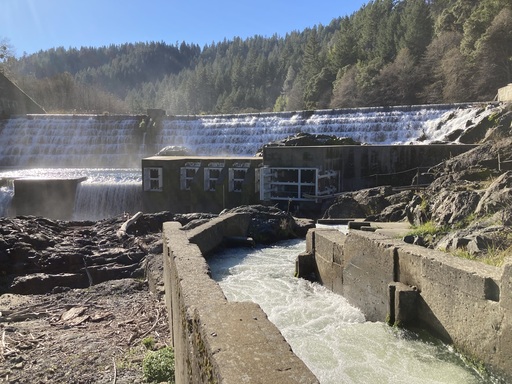
The fish ladder at Cape Horn Dam on the Eel River in 2025. Image: Eric Woodruff
The fish ladder is 40 feet high. “[I]t is comprised of 49 pools, each measuring 8 feet long, 4 to 10 feet wide, and 3 to 4 feet deep” (PG&E, 2023).
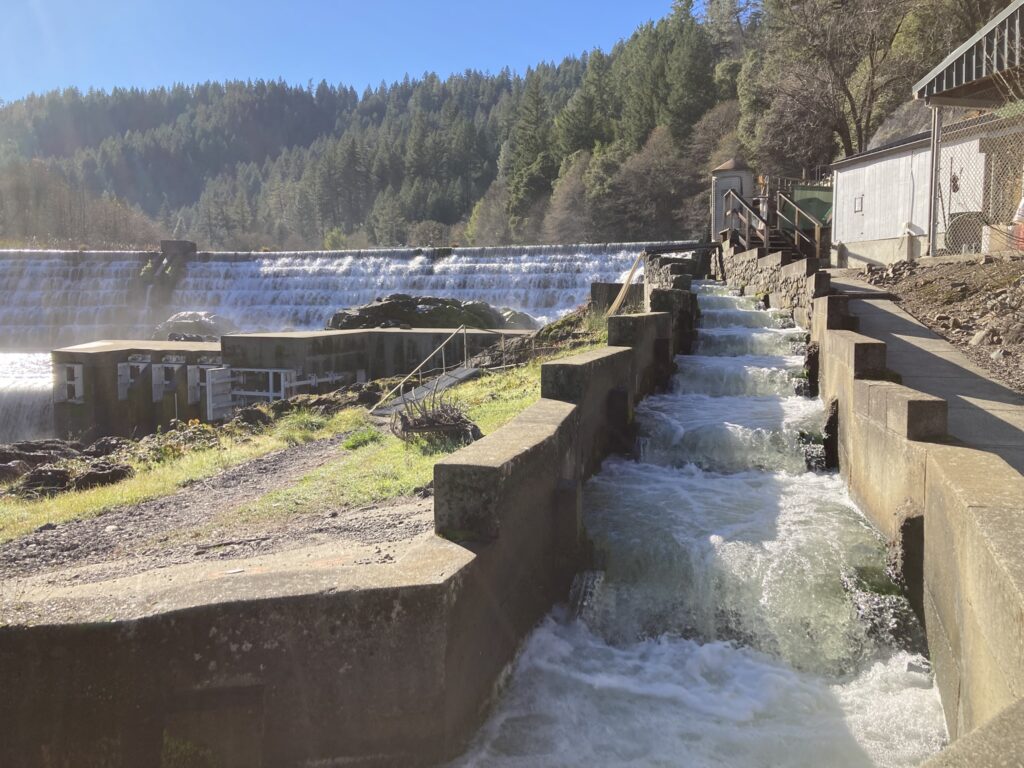
The fish ladder at Cape Horn Dam as it approaches the crest of Van Arsdale Reservoir in 2025. Image: Eric Woodruff
Visually, the fish ladder presents itself as a bad relic from the Old West. As I observed and took pictures, I did not see any fish traveling up or down the fish ladder. The count for this year’s fall-run of Chinook salmon swimming up the ladder is 969 (PG&E, 2025). This is a relatively good number for recent years. Yet it is a small amount compared to the thousands that enter the system each year. During the 2024 fall-run, sonar data counted over 18,000 adult Chinook salmon in the Eel River watershed (CalTrout, 2025).
The fish ladder becomes non-operational in high flows. In addition, high flow events have damaged the structure several times in the last decade to the point the fish ladder was not usable by fish for several months during key fish migration periods.
The intake structure to the Potter Valley Powerhouse sits 400 feet upstream of Cape Horn Dam, on the southwest bank of Van Arsdale Reservoir. “[T]he intake consists of two fish screen bays, an inclined plane screen in each bay, an Archimedes screw pump, and a fish return channel” (PG&E, 2023). From there, water is diverted 9,257-feet through two parallel sets of tunnels, conduits, and penstocks to the Potter Valley Powerhouse. Penstocks are the pipes leading into powerhouses that pressurize water to turn turbines at high speed.
Discharge from the Potter Valley Powerhouse forms the East Branch Russian River. Water not diverted for irrigation in Potter Valley flows into Lake Mendocino. From Lake Mendocino, the U.S. Army Corps of Engineers releases water through Coyote Valley Dam into the upper mainstem of the Russian River.
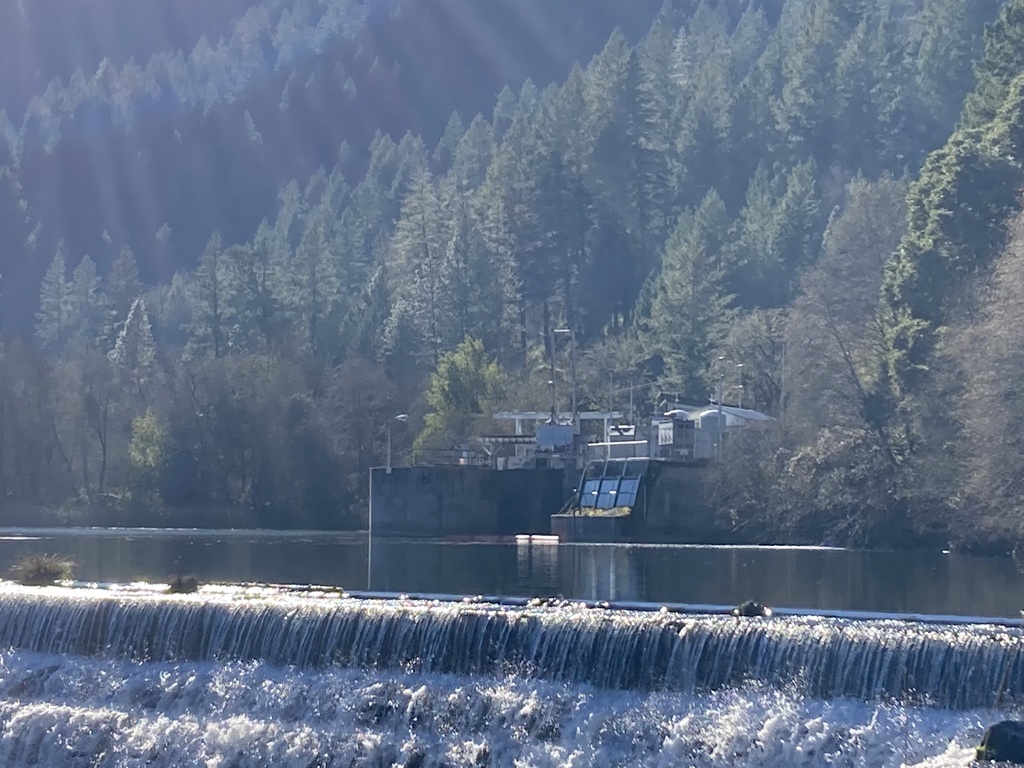
The water diversion intake from the Eel River/Van Arsdale Reservoir in 2025. Image: Eric Woodruff
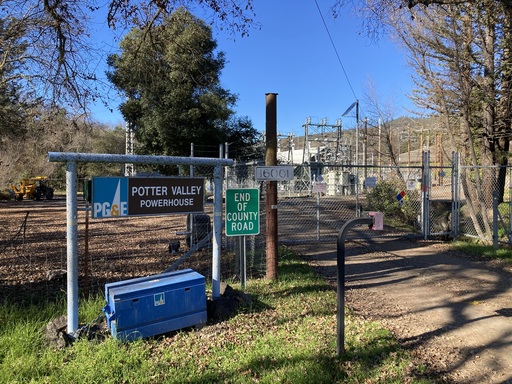
The Potter Valley Powerhouse, where diverted water from the Eel River is discharged into the East Branch of the Russian River in 2025. Image: Eric Woodruff
After getting reacquainted with the PVP, I continued north on Highway 101. I followed the South Fork Eel River to where it joins the mainstem Eel. I then traveled all the way to the mouth of the Eel River at the Pacific Ocean. This excursion was a good reminder of the journey that Eel River salmon, steelhead, and lamprey endure through their lifecycles. I remembered the potential for these fish to push even further into the upper reaches of the Eel River and its tributaries. It is very exciting to think about the possibilities that will occur after the dams are removed.
On my way back home, I stopped by the Mendocino County Board of Supervisors building in Ukiah. There I attended an Eel/Russian Project Authority (ERPA) meeting. The subject of the meeting was an update on the proposed New Eel/Russian Facility (NERF). This new diversion facility will use some of the existing Potter Valley Project infrastructure to continue to divert water from the Eel River to the Russian River. Following the removal of the two Eel River dams, the diversions will occur during the rainy season.
To my surprise, the Mendocino County Board of Supervisors voted unanimously to advance the next stages of designing and planning the NERF. The Mendocino County supervisors understand that the NERF diversion is their best shot at maintaining some of their imported Eel River water supply. This sober and pragmatic assessment contrasts with many of the comments in opposition to dam removal.
Some of the comments opposing dam removal expressed the opinion that there would no longer be any water exported from the Eel River to the Russian River watershed without the dams. The most notable of these came from the United States Department of Agriculture, whose December 19 comments inaccurately announced: “The proposed dam removal and cessation of project operations will effectively cut off access to the lifeblood agricultural producers need to feed the country and world: water.” (USDA comments, FERC eLibrary no. 20251219-5299, p. 1). In the face of such disinformation, there may need to be more public education and outreach efforts regarding the two dams that are part of the Potter Valley Project.
Scott Dam and Cape Horn Dam are both unsafe and money sinks. Required improvements and continued maintenance for them would exceed the benefits they offer. PG&E has made it abundantly clear that it does not want to continue paying for and operating the dams, and does not want the liability of continuing to own them.
My travel up north and participation in the meeting reminded me that northern Californians are coming to understand the promise and reality of dam removal. What happens next with the Potter Valley Project is likely to showcase the potential of undammed rivers. It is also likely to teach a wide array of proponents how to communicate with the public in the face of those for whom opposition to dam removal is an ideological crusade.
References
2023 Federal Energy Regulatory Commission. PG&E’s License Surrender Application. https://elibrary.ferc.gov/eLibrary/filelist?accession_number=20250725-5175&optimized=false&sid=2afa46a5-82f2-415b-8414-87f2311bd0dd
2025 Friends of the Eel River. Fish Count (from the) 2025-2026 Migration Season. https://eelriver.org/the-eel-river/#fishcount
2025 CalTrout. Strong Salmon Run and Restoration Funding Flow into the Eel River, Amidst Third Consecutive State Commercial Fishery Closure. https://caltrout.org/news/strong-salmon-run-restoration-funding-flow-into-the-eel-river-amidst-third-consecutive-state-commercial-fishery-closure