
It’s the time of year when I start to think about spring-run Chinook salmon. As the warm temperatures of spring begin to melt the snowpack, cold and clear water flows from the southern Cascades and Lassen foothills. This seasonal change initiates the return of adult Central Valley spring-run Chinook to hold and then spawn in their natal streams.
Located in Tehama County, California, Deer and Mill Creeks are significant tributaries of the lower Sacramento River. Along with Butte Creek, Deer and Mill Creeks are two of only a handful of streams that still support self-sustaining runs of spring-run Chinook salmon.
“The Central Valley spring-run Chinook salmon Evolutionarily Significant Unit (ESU) is listed as threatened under the State and Federal Endangered Species Acts. Both Deer and Mill Creeks are considered conservation strongholds for this ESU” (National Fish Habitat Partnership, 2024). What’s more, these are some of the last wild populations of spring-run in California.
Spring-run Chinook have a particular ecological niche. Unlike their fall-run cousins, they enter freshwater when reproductively immature. Spring-run hold in deep, cold pools through the summer until they are finally ready to spawn in the fall. Their success relies heavily on the consistent, cool flows that streams like Deer and Mill Creeks can provide.
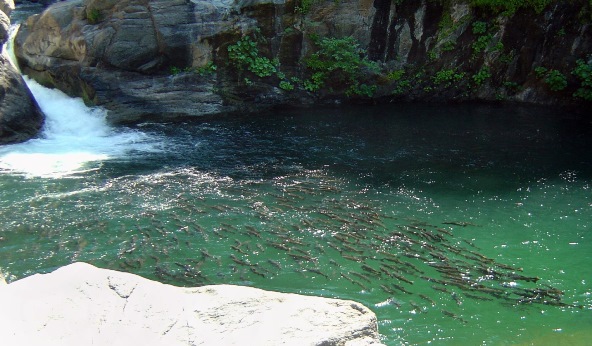
Spring-run Chinook hold in a deep, cold pool in Butte Creek. Image: California Department of Fish and Wildlife
“19th-century spring-run Chinook salmon were once as abundant as fall-run Chinook in the Central Valley, numbering approximately one million returning adults per year. Over the past forty years, annual abundance has varied considerably, from highs around 30,000 fish to lows of about 3,000 fish. Since 2012, population estimates have plummeted” (California Trout, 2022). The chart below reveals how disturbingly low the escapement counts are:
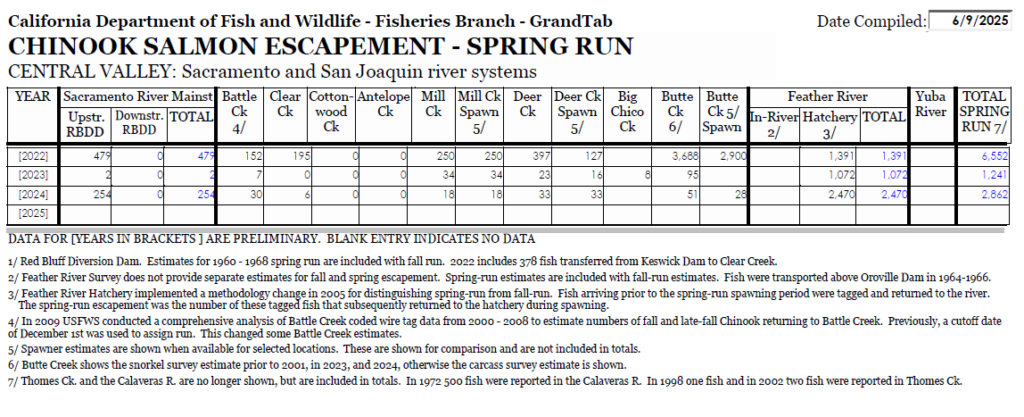
A segment of the California Central Valley Escapement chart from June 9, 2025. Image: California Department of Fish and Wildlife
There have been a series of fish passage improvements planned on Deer Creek and Mill Creek over the past decade. Some have been completed.
In Deer Creek, fish passage at Stanford-Vina Ranch Irrigation Company’s diversion dam desperately needs to be modernized. Moreover, flows released past the diversions of Deer Creek Irrigation District and Stanford-Vina Ranch Irrigation Company need to support all life stages of Central Valley spring-run Chinook.
In Mill Creek, a fish passage improvement at Ward Dam was completed in 2016. “The upgrades and modifications to the fish ladder, fish screen, and water diversion infrastructure provide improved passage for adult migration upstream and juvenile migration downstream of Ward Dam. This project was constructed in summer/fall 2015” (National Fish Habitat Partnership, 2024).
The Upper Dam on Mill Creek sits ~ 5.4 miles upstream of its mouth at the lower Sacrament River. In 2021, a study conducted by the California Department of Fish and Wildlife (CDFW) reported that the fish ladder at Upper Dam “did not meet CDFW and [National Marine Fisheries Service] NMFS criteria for the full range of fish passage flows” (CDFW, 2021).
Since then, Los Molinos Mutual Water Company and partnering agencies made improvements to fish passage at Upper Dam by upgrading diversion facilities, improving downstream passage, and addressing sediment deposition (Hardwick, 2021).
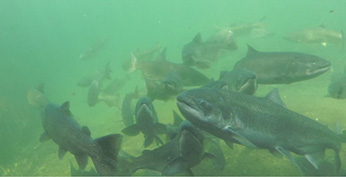
A migrating pod of spring-run Chinook in upper Deer Creek. Image: California Department of Fish and Wildlife
Adding to the urgency is drought stress. In some drought years, allowed agricultural diversions exceed total available unimpaired stream flow regulations in both creeks. “In addition, agricultural diversions contribute to increased water temperatures, resulting in thermal stress for adult and juvenile spring-run, increased predation on juvenile spring-run, and in some cases mortality” (CDFW, 2026).
The State Water Board passed emergency regulations to allow passage of spring-run in drought years 2015, 2021, and 2022. These emergency regulations mandated strict water diversion cuts, enforced minimum flow requirements, and allowed for voluntary, local water-sharing agreements.
Currently, CDFW, the National Oceanic and Atmospheric Administration (NOAA), and UC Davis are engaged in urgent measures to save some of the last remaining Central Valley spring-run Chinook. Fisheries biologists have captured juvenile fish from Mill, Deer and Butte creeks for a conservation hatchery broodstock program that safeguards the genetic integrity of the species.
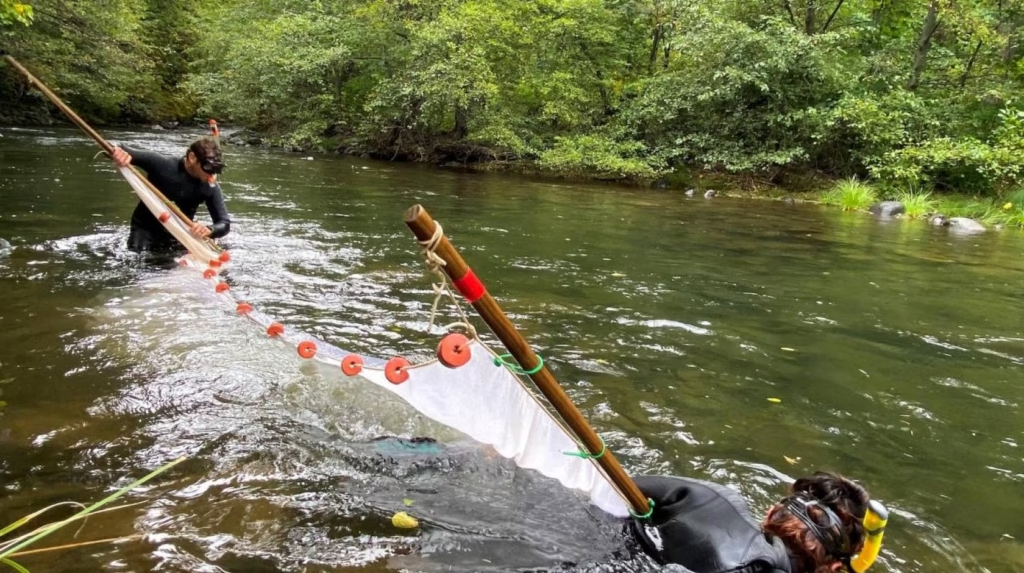
California biologists collect young spring-run Chinook salmon in Deer Creek, a tributary of the Sacramento River, on Oct. 10, 2023. Image: Peter Tira, California Department of Fish and Wildlife
Through the hatchery and habitat restoration efforts, scientists “improve the odds of the fishes’ survival in the wild” and “use hatchery offspring to restore genetically diverse and locally adapted populations of spring-run Chinook in California’s rivers” (UC Davis, 2023).
Hopefully, the perceived need to capture and nurture spring-run will be short-lived. There is habitat in both Deer Creek and Mill Creek to support wild spring-run. Solving the problem of their depressed populations also involves providing the flows and rearing habitat that juvenile salmon need as they migrate through the Sacramento River and the Delta.
References and additional information:
https://fishhabitat.org/waters-to-watch/detail/mill-creek-and-deer-creek-california
https://wildlife.ca.gov/Drought/Projects/Deer-Creek