
The 43rd annual Salmonid Restoration Federation (SRF) conference will take place in Redding from April 28 to May 1, 2026. The conference is a great opportunity to learn about native species of anadromous fish and hands-on and regulatory efforts to increase their populations. CSPA will make several presentations at this year’s conference.
The Salmonid Restoration Federation formed in 1986 to help practitioners advance the art and science of habitat restoration. SRF promotes watershed restoration, stewardship, and recovery of California’s native salmon, steelhead, and trout populations through education, collaboration, and advocacy. SRF’s annual conferences provide a forum for information exchange, project updates, networking, and strategy development.
Tours
The conference generally begins with field trips to visit interesting sites in the region. Field tours this year include:
- Salmon habitat on the Trinity River with the Trinity River Restoration Program
- Habitat restoration on Clear Creek with the Bureau of Reclamation and U.S. Fish & Wildlife Service (FWS)
- A post-fire fish passage project on the western slopes of Mount Lassen with Environmental Science Associates and FWS
- A side-channel boat tour of the Sacramento River with the North State Planning Collective and California State University (CSU) Chico
- Battle Creek floodplain restoration with River Partners and CalTrout
- Former dam footprints on the Klamath River with U.S. National Oceanic and Atmospheric Administration (NOAA) Fisheries and Yurok Tribe
- The Scott River salmon habitat restoration progress in Klamath tributaries with the Scott River Watershed Council, Yurok Tribe, The Nature Conservancy, and CalTrout
Tours occur on April 28 and 29, 9 am – 5 pm. Pre-registration is required.
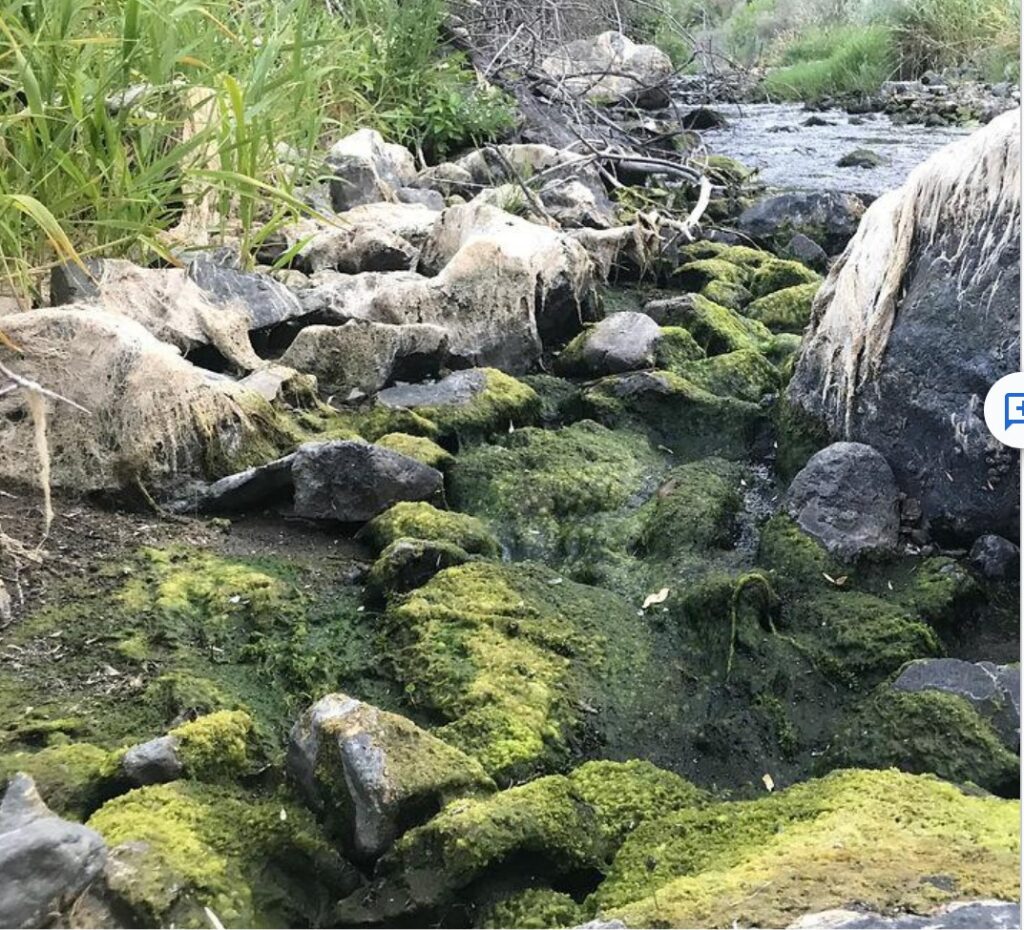
Dewatering event on the Shasta River in 2021 that led to the California State Water Resources Control Board’s emergency instream flow regulations. Image: Nick Joslin, Friends of the Shasta River
Workshops
Workshops occur from 9 am – 5 pm on April 28 and 29. The schedule consists of individual presentations that are pertinent to the overall workshop theme. This year’s workshops are:
Real Water for Fish – This workshop will be a deep dive into the obscure realm of water use accounting, agency performance, and regulatory compliance. Matt Clifford of Trout Unlimited will start the day with a primer on California water law. Nathaniel Kane of Environmental Law Foundation will discuss instream flow setting and enforcement processes in the Shasta and Scott Rivers. Nick Joslin of Friends of Shasta River will investigate the unintended consequences of certain publicly-funded restoration projects. Konrad Fisher of Water Climate Trust will examine the efficacy of public funds earmarked for species recovery. Amy Campbell of The Nature Conservancy will discuss lessons learned on instream flow dedications (called 1707s, because they relate to California Water Code Section 1707). Finally, CSPA’s Executive Director, Chris Shutes, will describe methodologies for setting instream flow requirements and opportunities for asserting higher flows. This can be accomplished by navigating the U.S. Federal Energy Regulatory Commissions (FERC) hydropower dam-relicensing process.
Fish and Fire – This workshop explores the dynamic between fire management and aquatic ecosystem restoration. Presentations will explain how historical fire exclusion and suppression fuel catastrophic wildfires. The practices then add insult to injury by polluting streams with sediment and fire retardant in the aftermath. Presentations will also highlight efforts to reintroduce fire as a periodic element into the forest landscape. These efforts fertilize healthy forests and minimize the negative impacts of unsustainable forest management on fish and aquatic organisms.
Dam Removal Project Manager Training – In this two-day workshop on April 28 and 29 facilitated by Meghan Quinn of American Rivers, participants will learn about FERC’s license surrender process. The workshop features coalition partners working to amplify community and tribal interests in PG&E’s process to decommission its Battle Creek Hydroelectric Project. Activities include a field-trip to the South Fork Battle Creek to visit the former location of Inskip Dam, the site of California’s most recent dam removal.
Uses of Water – Nexus Between Water Quality and Quantity – This workshop is coordinated by Sherri Norris of the California Indian Environmental Alliance. The workshop will explore the Beneficial Use doctrine, methodologies for developing and implementing Total Maximum Daily Loads (TMDLs), and Tribal Beneficial Use (TBU) designations. Presenters will discuss the challenges of turning TBUs into practical tools for improving equity and sustainability in California’s water management.
Sessions
Concurrent sessions occur on April 30 and May 1. They last three hours and feature cross-disciplinary speakers with diverse backgrounds. Agency personnel, restoration practitioners, policy makers, planners, biologists, academics, tribal members, and community representatives will explore a range of topics. The 12 sessions include:
Democracy in the Balance – Keiko Mertz of Friends of the River will facilitate a conversation about environmental non-profits on the front lines of California water and salmon policy. The protection of human rights and environmental quality increasingly falls to community groups in the absence of political will and consistently effective government agencies. This session will mostly feature voices from nongovernmental organizations (NGOs). It will discuss strategies to avoid construction of harmful new infrastructure and practical actions toward salmon recovery at the watershed scale.
Springing into Action: Spring Chinook Reintroduction in the Klamath Basin Post Dam Removal – Shari Anderson of Lazuli Ecological Services and Craig Tucker of Suits and Signs will facilitate discussion of efforts to restore spring-run Chinook to the upper Klamath watershed following dam removal. Only small populations of spring-run salmon remain in the lower tributaries of the Klamath system. The spring-run salmon was once the most abundant run in the Klamath. The session will convene representatives from the Department of Water Resources, FWS, the Karuk Tribe, and NGOs.
Other sessions:
- Exploration of Native Fishes in California Waters
- A River Reborn: Restoration and Monitoring in the Former Footprint of Klamath Dams
- It Takes a Watershed: Projects, Approaches, and Strategies for Restoring Streamflow and Managing Water Supplies
- Changing the Current: Lightning Tales from a New Generation
- Evaluating Process Based Restoration as a Method to Restore Ecosystem Resilience
- Against the Current: The Critical Need for Large-Scale Floodplain Reconnection in the Central Valley
- Restoring Riparian Habitats: Successes, Challenges, and Practical Guidance for Practitioners
- Science and Research to Inform Management
- Assessing Restoration Outcomes
- Restoration Strategy, Implementation, and Collaboration
Plenary – Four dynamic featured speakers will be announced soon.
Poster session – A major event at the conference is the ever-informative poster session. This is a chance to speak with presenters. Many of them will also have posters on display.
Make your reservation soon!
Fish huggers of all varieties always find this conference is a great opportunity for education and networking. Register by February 27 to get the best rates. Registration options include individual tours and workshops. Learn more and register at: www.calsalmon.org/conferences/43rd-annual-salmonid-restoration-conference.
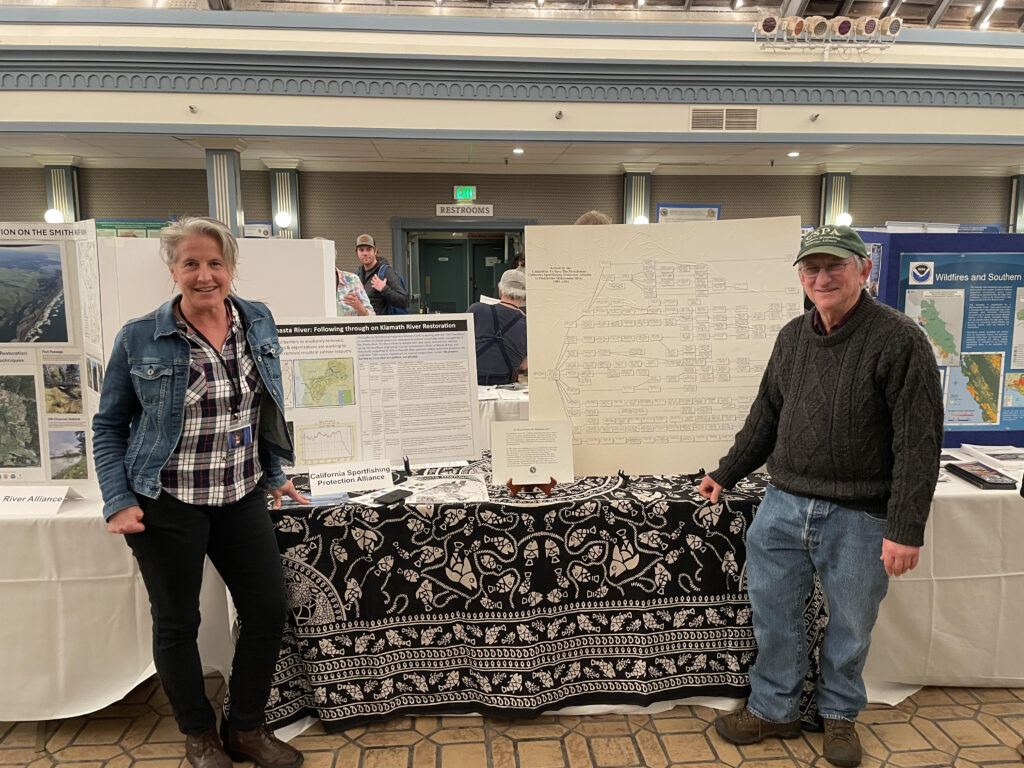
Angelina Cook, Restoration Associate for CSPA (left) and Chris Shutes, Executive Director of CSPA (right), display CSPA posters at the 2025 Salmon Restoration Federation conference in Santa Cruz. Image: Angelina Cook
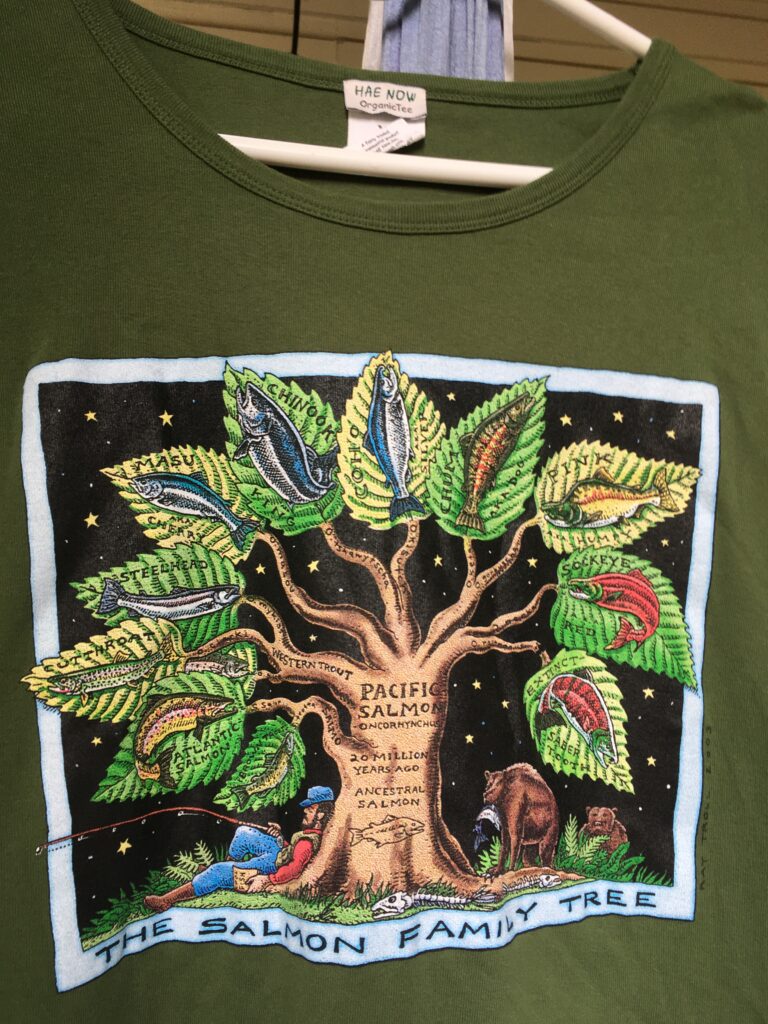
A classic example of Salmon Restoration Federation conference merchandise. Image: Angelina Cook
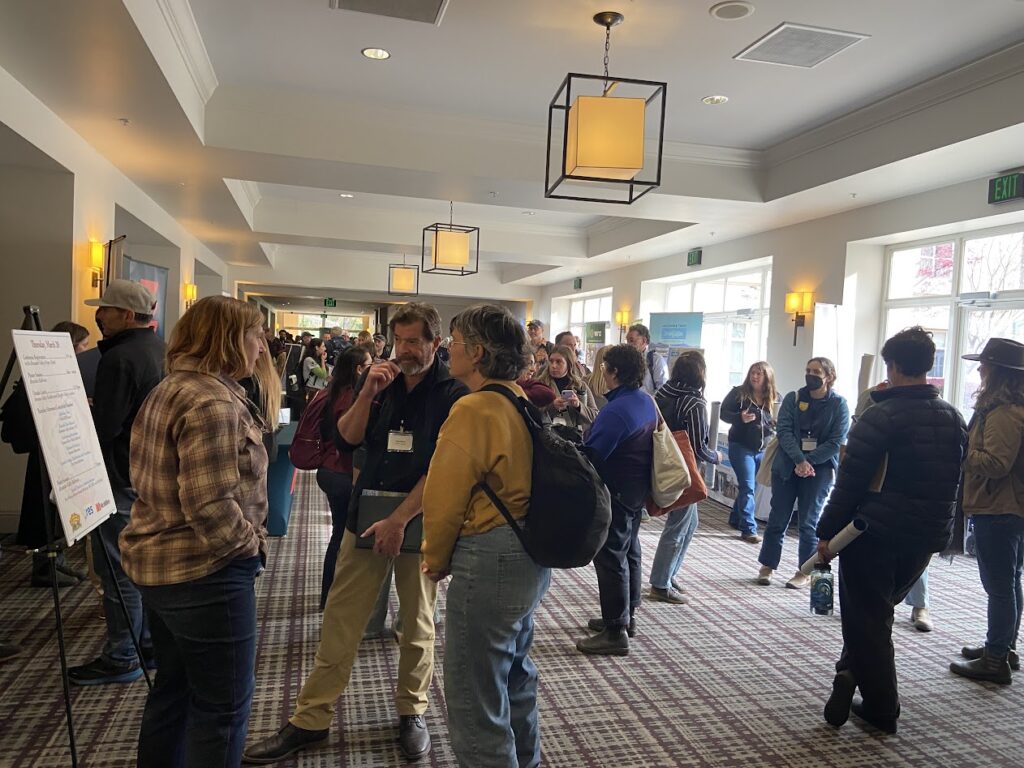
Poster session at the 2024 SRF Conference. Image: Eli Assarian
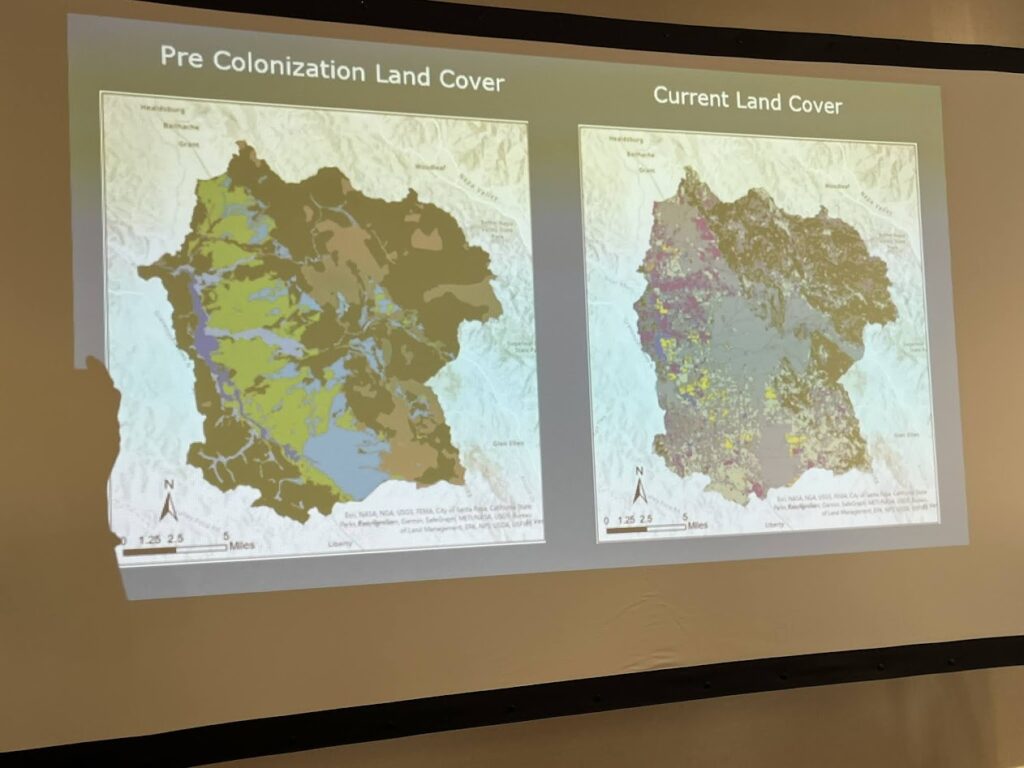
Slide depicting the comparison between a precolonial and a modern
map of California from the 2024 SRF conference. Image: Eli
Assarian
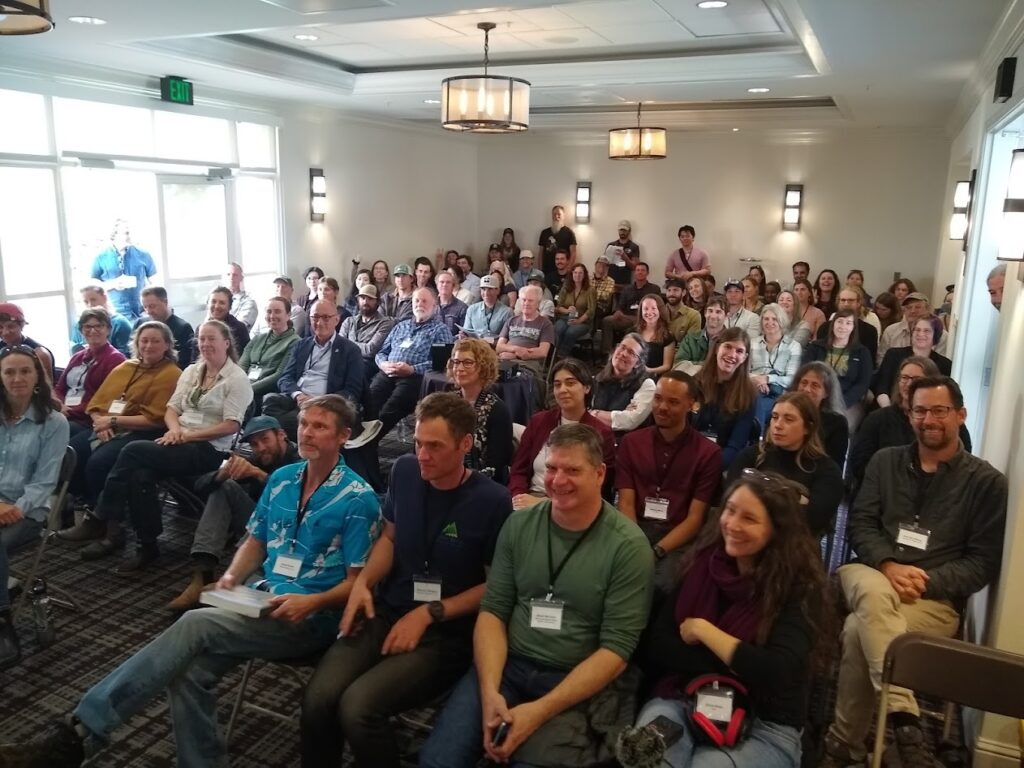
A happy audience eagerly awaits the next presenter at the 41st annual
SRF Conference. Image: Eli Assarian
The audience at the 41st annual SRF Conference. Image: Eli Assarian
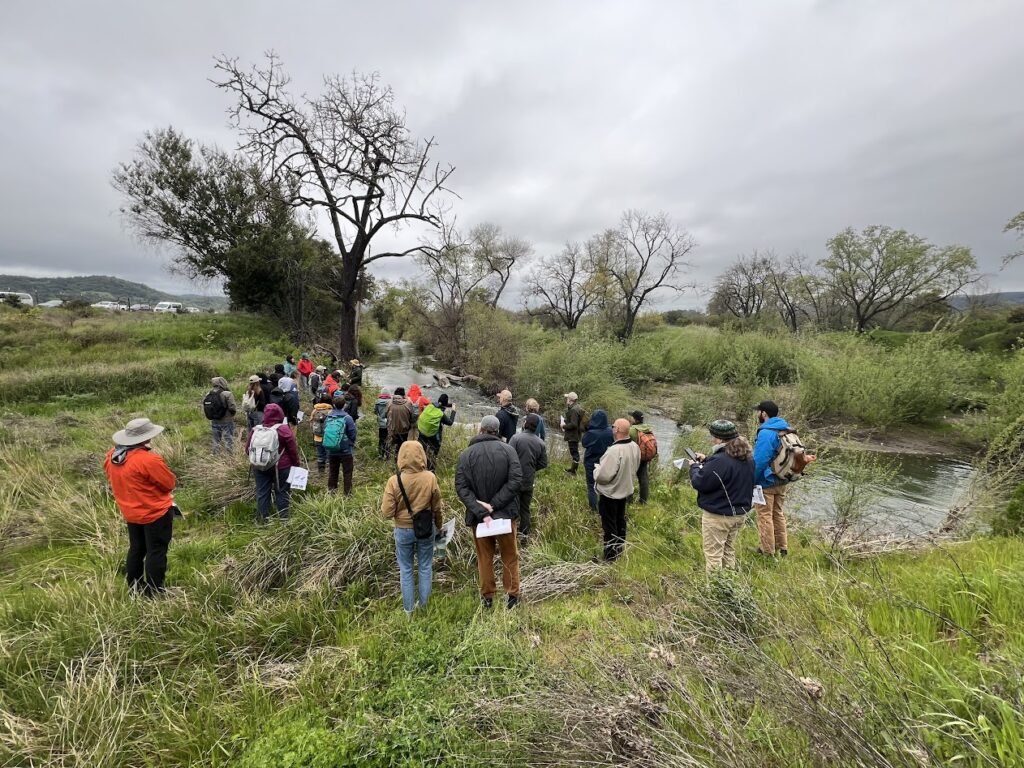
Habitat restoration field tour at the 2024 SRF Conference. Image: Eli Assarian