
A 2/12/26 letter from four San Joaquin Valley congressmen pleaded with Governor Newsom to waive a Delta outflow requirement in 2026. The requirement is the “Port Chicago standard” in Water Rights Decision 1641 (D-1641), in effect since 2000. Additional letters from the “Coalition for a Sustainable Delta” and from Westlands Water District made similar requests.
The letters seek to immediately jettison one of the few existing rules that protects flow and water quality in the Bay-Delta estuary.
The common talking point of the letters is how exporting or storing required flow to San Francisco Bay would avoid the “loss” of 600,000 acre-feet of water. We’re talking about water committed to protecting fish, wildlife, and water quality. Exporters have no right to this water.
Sunset on the Suisun Marsh in Solano County, a critical part of the San Francisco Bay-Delta estuary ecosystem. Image: Paul Hames/California Department of Water Resources
Coveting the Fishes’ Water
The effort to strongarm water dedicated to ecosystem protection is not a new practice.
In February 2023, following copious January rains, Governor Newsom carried over the 2021-2022 “drought emergency” to virtually command the State Water Board to waive the Port Chicago flow requirement. See https://calsport.org/water-for-fish-gulped-by-delta-pumps-cspa-objects-to-circular-excuses/. Fortunately, abundant precipitation in March 2023 filled reservoirs, and export pumps could not capture most of the huge flows into San Francisco Bay.
As a result, a whole lot of juvenile salmon made it through the Bay and out to the Pacific Ocean in 2023, and we’re likely to have a real salmon season in California in 2026 for the first time in three years.
Flow Is Still the Master Variable
The development of D-1641 can be traced back to the 1980s and 1990s. The principles adopted in 1995 (see Figure 1) remain relevant today. Extensive research over the years has reinforced the significance of freshwater flow into and through the Bay-Delta Estuary.
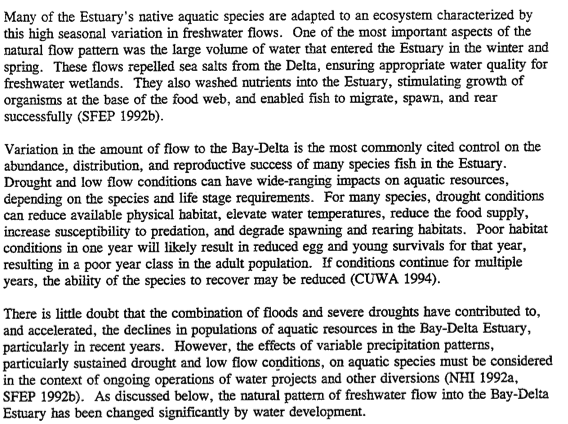
Figure 1. State Board 1995 statement on the importance of freshwater flow to the Bay-Delta Estuary. Source
We now know that the various D-1641 standards were insufficient to save Delta smelt. This once-abundant fish species is found only in this estuary. Delta smelt have become almost extinct in the wild. Under D-1641 as implemented, salmon have not recovered. California’s salmon fishery suffered closure in 2008-2009 and 2023-2025.
Now some water development interests want all the freshwater Bay-Delta inflow they can grab. Their rationale is that D-1641 standards have not met environmental goals. It’s a very old refrain: devote too little water to the estuary, then propose to take it away because too little isn’t effective.
The Port Chicago Standard
Decision 1641 adopted the Port Chicago standard (shown in D-1641 Table 4) to ensure that some winter-spring freshwater inflow to the Delta reaches the Bay in wet water years. It requires a specific amount of outflow to the Bay based on the previous month’s total Delta inflow (i.e., Eight River Index). The wetter the previous month, the more Delta outflow is required. The standard can also be met by maintaining a certain level of salinity at the Port Chicago gage in the Bay; thus, the name Port Chicago standard.
The Port Chicago standard provides certainty of early season benefits for the ecosystem and water quality. It is one of the few regulatory requirements in the Delta that shifts some of the risks away from fish. It places some risk on diversions and storage in the event that an early wet season turns dry. Most Delta protections are weighted later in the season, s when it is clearer how wet or dry the water year will be.
In wetter years when the Port Chicago standard is triggered, the standard is typically met by uncaptured freshwater inflow from natural precipitation events in the Central Valley watershed. In some years, operators of state and federal reservoirs must release stored water to meet the standard. Regardless, the volume of water that the standard requires is a small percentage of what the reservoirs capture and the exporters divert.
Of Salmon and Cantaloupes
For decades, water users throughout the state have argued that the benefits to fish from Delta outflow do not justify the use of water. More recently, some have claimed that leaving water in the river does not qualify as “reasonable use” under the California Constitution.
It is much more difficult to provide clear, measurable evidence of how freshwater flow benefits fish than it is to show the effect of a certain amount of water on growing cantaloupes. Ecosystems cannot be easily reduced to unit costs. When advocates for developed water use insist that standards require direct, immediate proof of benefit, they are essentially promoting a bias that prioritizes diverting and consuming water over maintaining the ecosystem.
“Reasonable” does not mean “easy to quantify.”
Outdated Water Rules?
Another recurring theme among those who support increased developed water use is the argument that science supporting flow is “outdated.” They claim the correlation between flow and ecosystem benefits has weakened, even as abundant newer science shows the opposite.
Part of the problem is that flow starvation has degraded the Bay-Delta ecosystem for so long. A degraded system is slower to show a positive response, for example, to wet water years. Additionally, depressed numbers of adult spawners limit the ability of fish to have strong annual rebounds even in good water conditions. This has been extensively documented in the California Fisheries Blog.
If overall flow starvation continues for a long enough time, the limited improvement when flow is abundant becomes a self-fulfilling prophesy.
Suborning Violation of Basic Environmental Safeguards
Over the past 30 years, an enormous amount of time and money have been invested to demonstrate the importance of freshwater flow to estuaries in general and the Bay-Delta estuary in particular. Much of that effort has been the work of the State Water Board staff. Yet the State Water Board finds itself under constant pressure to buckle under every time a lawmaker, lawyer, general manager, or hired scientist proffers a new theory about why flow doesn’t matter.
The letters linked above are just the latest example of the permanent effort to grab more water from the public trust.
There will always be a subset of operators, owners, and contractors of existing water projects, and of proposed projects like the Delta Conveyance Project, that do not quietly play by the rules. Anyone who thinks that powerful interests will not strategically and relentlessly try to grab more water is just not paying attention.
[Editor’s note: on February 19, 2026, the State Water Board wrote a letter in response to Westlands Water District declining to make the requested change.]