
The updated Bay-Delta Plan will set flows into San Francisco Bay, through the Delta estuary upstream, and in the Sacramento Valley rivers that flow into the Delta. On December 12, 2025, the State Water Resources Control Board (the Board) issued two major documents that describe its latest proposal for an update. These are the Revised Draft Plan and a partially Recirculated Substitute Environmental Document (SED). The latter analyzes the Revised Draft Plan.
In the two documents, the Board solidifies a decision to adopt voluntary agreements proposed by the state’s major water users. Over January 2026, CSPA worked overtime to turn the direction of the Board in favor of an updated Bay-Delta Plan that would restore the Bay-Delta estuary.
But in Board hearings on the Revised Draft Plan that took place from January 28 to 30, some Board members framed the voluntary agreements as an experiment that the Board would try to see if it works. It is only an experiment in the same sense that trying to turn lead into gold is an experiment. As the Board has stated and restated over the last 15 years, there is no substitute for flow.
There has been no update of Bay-Delta Plan for these geographic areas for 30 years. The voluntary agreements would prolong the wait for adequate flows for another eight years at minimum, and likely another seven years after that. This would allow weak flow requirements in the watershed as the backdrop to major water developments that various parties have proposed. Such developments include the Sites Reservoir, the Delta tunnel, and a gold rush of new water rights to recharge groundwater depleted by irresponsible pumping. With adequate flow requirements for Sacramento Valley and the Bay-Delta estuary, these and other major water developments would not pencil out.
The Revised Draft Plan offers far less flow than the Board and countless others have repeatedly said is necessary to restore a Bay-Delta ecosystem that is in crisis. Analysis performed in the Recirculated SED shows that over all types of water years, the voluntary agreements’ average statewide water cost, or reduction in water available for water supply, is 1%. Some areas of the state would end up with more water under the voluntary agreements than without them.
The second piece of the Revised Draft Plan is a new proposal for water rights holders that do not have a voluntary agreement. It would also apply to all water right holders as a “backstop” if the voluntary agreements fall apart. The 2025 backstop, or “regulatory pathway,” reduces the flow requirement from what the Board proposed in its first Draft SED in 2023.
In 2023, the Board proposed to require flows through the Delta equivalent to 55% of the unimpaired flows. Unimpaired means the flows that would occur if there were no dams or diversions in the watershed. The 2025 Revised Draft Plan would instead require 55% of the unimpaired flow in the wettest third of water years, 45% in the middle third of water years, and 35% in the driest third of water years. This would have an average annual water cost throughout the watershed of 5%. But the Board announced plans to adopt it only for non-voluntary agreement parties and as a backstop for others if the voluntary agreements fail.
On January 28, CSPA made a presentation to the State Water Board asking directly why the Board’s “balancing” of uses could only justify a 1% water cost. CSPA also presented a football-style scorecard that covered 15 years of evolution for major categories of issues related to the Bay-Delta Plan. The scorecard is shown in table form below.
The Revised Draft Plan labels the new flow regime for the regulatory pathway as 55% with Water Supply Adjustments (WSAs). The shorthand for the alternative is written “55wWSA”.
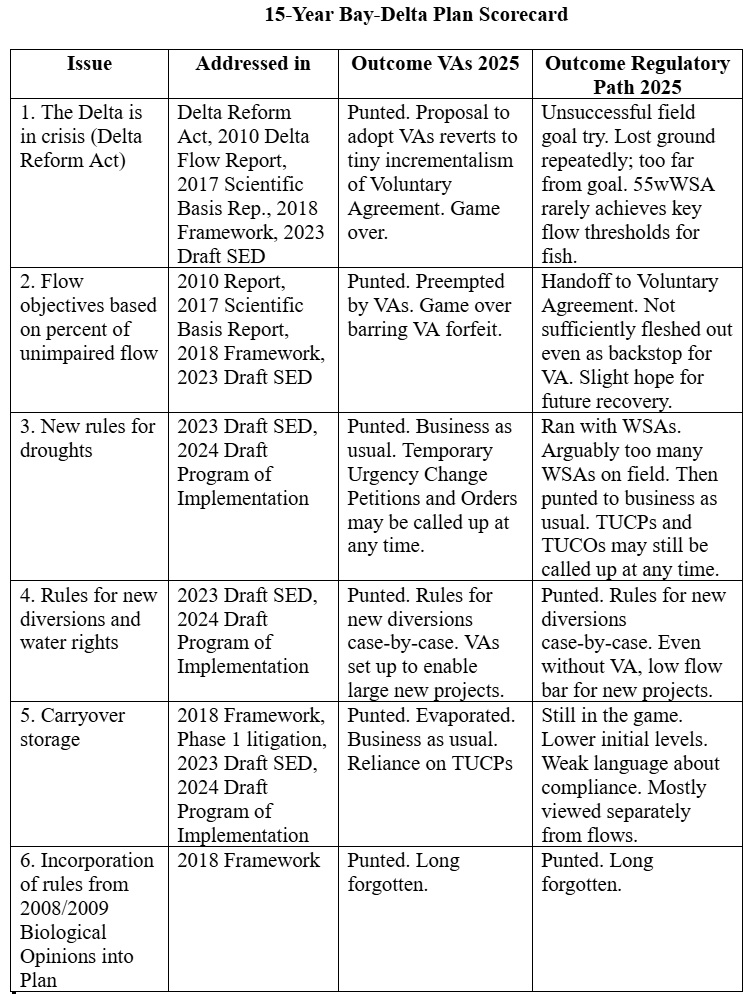
In the scorecard, Voluntary Agreements are written as the term “VAs.”
On February 2, 2026, CSPA joined seven other organizations in submitting comments on the Revised Draft Plan and the Recirculated SED. Those comments can be found here.