
As the irrigation season proceeds, eyes are on the Klamath Basin. Removal of four dams recently opened over 400 miles of habitat for salmon and steelhead. Annual snowpack was so dismal that it has already disappeared from the upper basin. State agencies are currently advancing long-term policies to limit river dewatering in key Klamath tributaries. But the Trump administration is flexing federal muscle to siphon off instream flow at the headwaters of the Klamath River’s mainstem.
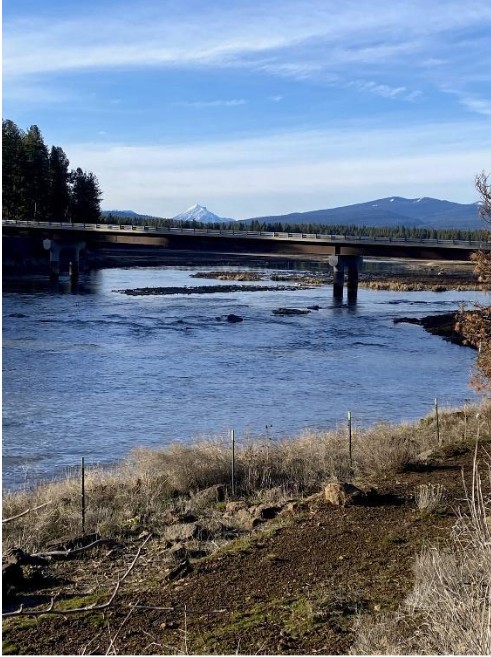
Klamath River, upstream of the former JC Boyle Dam, with Mount McLoughlin in the background. Image: Angelina Cook
The U.S. Bureau of Reclamation (Reclamation) formed the Klamath Project in 1905. The Project currently delivers water to approximately 230,000 acres in Klamath County in southern Oregon and Siskiyou and Modoc counties in northern California. The Klamath Project was a flagship experiment in the early days of America’s industrialization.
In the Klamath Basin, Reclamation drained, canaled, levied, stored, allocated, paved and mono-cropped vast wetlands. Reclamation later made land grants available for settlers and veterans returning home from World Wars I and II. Retrofitting barracks that were previously used for a Japanese internment camp in Tulelake, Reclamation provided housing for land grantees who could then develop livelihoods by growing food.
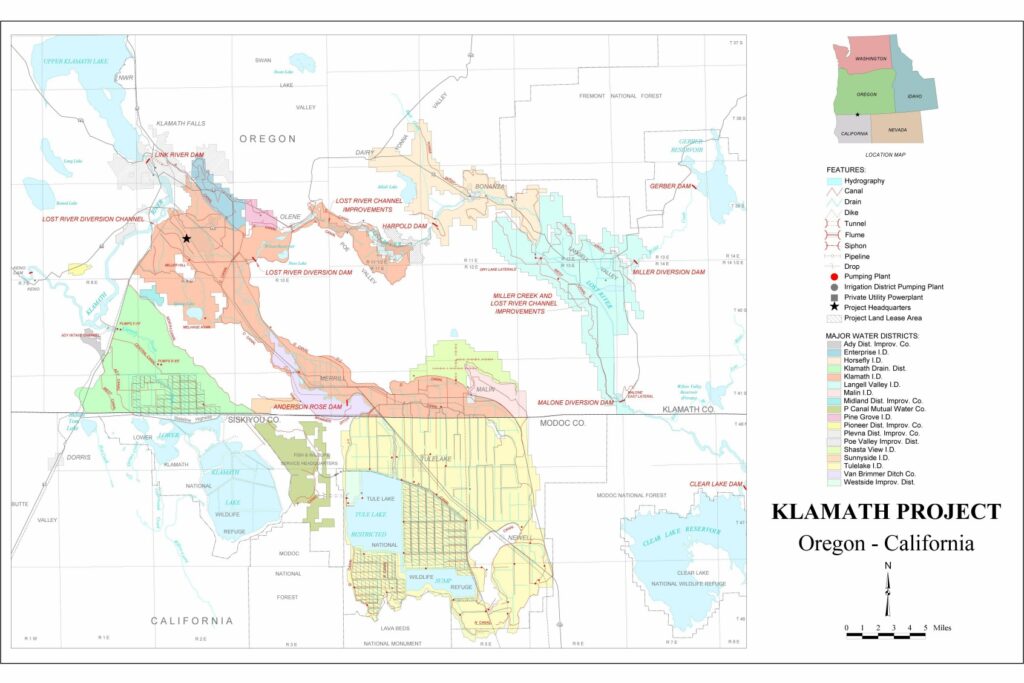
Klamath Project Area 1905. Image: U.S. Bureau of Reclamation
Reclamation announced 2026 Project allotments in April. It allocated 221,000 acre-feet from the Upper Klamath Lake, 63% of the “normal” allocation. In addition, Reclamation allocated 35,000 acre-feet from Gerber Reservoir and 35,000 acre-feet from Clear Lake Reservoir. The combined 70,000 acre-feet represents full allocation from these sources. In total, Reclamation plans to deliver 291,000 acre-feet of water. This water will primarily be used for agricultural irrigation. It will also be used to add water to the Tule Lake National Wildlife Refuge near Tulelake, California and Lower Klamath National Wildlife Refuge in northeast California and southern Oregon.
To avoid the conflicts typically triggered by reduced water allocations, the federal government issued $19.1 million in drought mitigation funds to compensate farmers for reducing irrigated acreage. Money is being dispersed by the Klamath Project Drought Response Agency in Klamath Falls, Oregon. This agency is responsible for enrolling applicants and distributing funds. Irrigators can apply for this “agricultural welfare” at klamathwaterbank.com.
If the Trump administration gets its way, pending revisions to the implementation of the Endangered Species Act (ESA) will enable Klamath Project administrators to decline reducing irrigation allocations to protect imperiled species by next year.
The U.S. Department of Interior Solicitor’s May 2025 Updated Analysis and Reclamation’s January 2026 Reassessment of Discretion Report share a common assertion. They hold that contractual obligations to fulfill Klamath Project deliveries override public trust obligations to protect threatened and endangered species. These memos interpret case law and statutory legal developments to require full irrigation deliveries, no matter what hydrological or biological changes have taken place since the Klamath Project was authorized.
Reclamation has sent letters to the National Marine Fisheries Service and the U.S. Fish & Wildlife Service informing these agencies that Reclamation is preparing a new Biological Assessment consistent with full irrigation deliveries. The Biological Assessment will evaluate the potential effects of a new Proposed Action on federally listed species. Reclamation anticipates having a complete ESA Section 7 consultation initiation package by the end of 2026. If the Department of Interior is successful, new operating criteria will be official in time for Interior to make full water allocations in the 2027 irrigation season.
Meanwhile, the Yurok Tribe, the Pacific Coast Federation of Fishermen’s Associations, Institute for Fisheries Resources, and nonprofit Earthjustice are challenging the Trump administration’s attempts to gut the ESA. The action, Yurok Tribe et al. v. the U.S. Bureau of Reclamation, Case 3:19-cv-04405-WHO, seeks to stop the institutionalized over-allocation and under-regulation of water in the Klamath Basin. The lawsuit is before Judge William Orrick, a senior U.S. judge for the Northern District of California. It asks that the Court vacate the Trump administration’s 2025 Updated Analysis and the 2026 Reassessment Report. Parties are scheduled to appear in court on this matter on June 10, 2026.
An earlier lawsuit, Case No. No. 23-15499, filed in 2023, concerns whether the ESA overrides adjudicated water rights. It is still pending in the U.S. Court of Appeals for the Ninth Circuit.