
On October 1, 2026, the North Coast Regional Water Quality Control Board (Regional Board) conducted a hearing regarding water quality in the Scott River and Shasta River. The Regional Board considered a five-year extension of conditional waivers for the Total Maximum Daily Loads (TMDLs) issued under the Waste Discharge Requirement program. The Regional Board gave itself three years to complete a process to set enforceable standards for water quality in the rivers.
TMDLs set limits for measures of water quality called parameters. The Regional Board adopted TMDLs in 2006 for the parameters of temperature and sediment in the Scott, and in 2007 for temperature and dissolved oxygen in the Shasta. However, the Regional Board allowed what are called waivers for these requirements, to give people in the watershed time to comply. Repeated waivers have delayed implementation of the TMDLs since 2006. That is two decades of harm to native species of fish and other flora and fauna in these rivers.
Over the past few years, impairments related to Harmful Algal Blooms (HABs) have developed in the Scott, justifying an additional TMDL for nitrates. However, such a TMDL has yet to become official.
Waste Discharge Requirements (WDRs) are the policy mechanism that empowers the Water Boards to enforce water quality laws enshrined in the Porter-Cologne Water Quality Act. Porter-Cologne is California’s version of the federal Clean Water Act. Regional water quality control boards currently administer WDR’s through the state’s Irrigated Lands Regulatory Program.
Conditions in the Shasta and Scott once provided ideal habitat for Chinook and coho salmon spawning and rearing. However, conditions have become so dire that the Regional Board has initiated a process to replace TMDL waivers with WDR permits. Once enacted, the WDRs will mandate full implementation of the TMDLs.
The WDR agenda items on October 1 drew an audience of approximately 75 people, representing farmers, irrigators, environmental advocates, and Tribes. Comments from diverse points of view conveyed exasperation with the dysfunctional process thus far. Many ranchers continue to claim that WDRs are not necessary and could be detrimental to their operations. Environmentalists urged the board to reduce the timeframe of any waiver extension and enforce the WDRs as swiftly and effectively as possible.
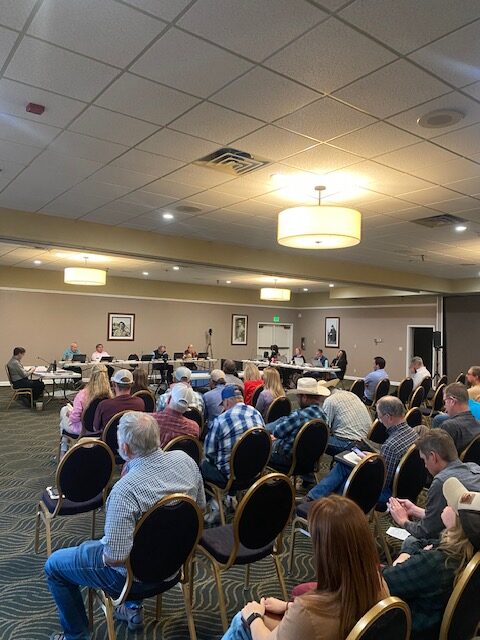
North Coast Regional Water Quality Control Board meeting in Yreka on Oct. 1 drew a robust crowd. Image: Angelina Cook
After the TMDL waiver extension agenda item, Regional Board staff presented the draft General WDR permit language and accompanying Environmental Impact Report. Materials are available for public review, and written comments are due on November 17, 2026.
Conditional waivers allow compliance on a voluntary basis by inviting irrigators to conform to better farm management practices outlined in farm management plans. Enrolled ranchers draft the plans, and Regional Board staff approves them. Under a waiver, little to no follow-up occurs after a plan is approved. There is little to ensure that irrigators are achieving the target water quality benchmarks. Under a WDR permit, follow-up does occur to verify if irrigators are achieving compliance.
When TMDLs were initially adopted in the Shasta and Scott watersheds, pollution of the rivers by heat, sediment, and animal waste was common practice. The massive Klamath fish kill that precipitated removal of the Klamath River dams had occurred on the mainstem just a few years prior, in 2002.
Adjudications of the water rights in the Shasta and Scott watersheds were an early sign that state agencies would need to regulate water quantity allocations in both basins. TMDLs were an early sign that, eventually, state agencies would also need to regulate water quality.
Additional attempts to advance water regulations in the Shasta and Scott watersheds include the Sustainable Groundwater Management Act (SGMA) and, most recently, emergency minimum instream flow (MIF) requirements. If effective WDR implementation had occurred as intended 20 years ago, or even 10 years ago, the Klamath basin could have been further along the salmon recovery trajectory. Instead, the Scott and Shasta rivers now face the tremendous taxpayer expense and regulatory regimes associated with SGMA and emergency MIFs. Regulation is the consequence of failed voluntary implementation strategies like Local Cooperative Solutions.
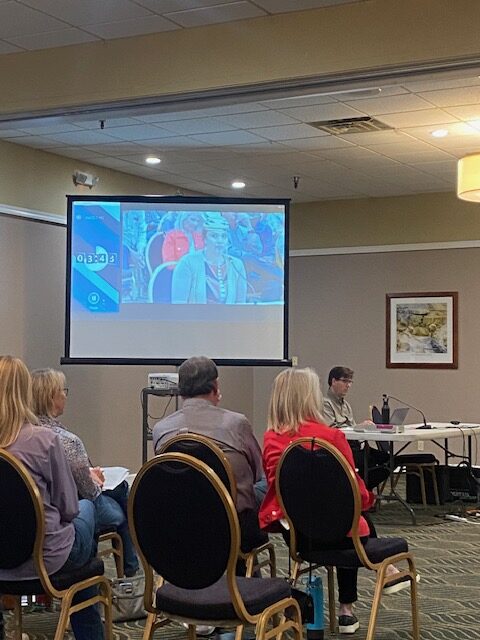
A member of the Karuk Tribe delivering public testimony at the Regional Water Board meeting. Image: Angelina Cook
At the October 1 meeting, Regional Board member Molli Meyers supported public comments that expressed concern for dragging the WDR permitting process out too long. She said that she does not want to perpetuate agency ambivalence about law enforcement, and that she supports limiting the waiver extension timeframe to expedite WDR passage.
Regional Board senior engineer and geologist staff Chris Watt explained the rationale for the proposed five-year extension timeline. He stated that minimum 18 months would be needed for adoption, and another 18 months for enrollment. Board member Hector Bedolla expressed support for a three-year timeline. He also reiterated public comments that called for publication of data in the interim, to determine if conditional waivers are achieving program objectives.
One public commenter, Regina Chichizola, reported that water quality data related to the Smith River TMDL is available to the public in the form of an annual report. She recommended that such a report be available for the Shasta and Scott as well.
After some deliberation, a motion was made to extend the Shasta and Scott TMDL conditional waivers for another three years, to bridge the gap between expiration of the former waivers in November 2026 and the time when the new WDRs can be adopted. The motion carried unanimously, with Board member Gregory Giusti absent and Chairwoman Alexandra Hart recused.
In weighing the pro-water quality vs. anti-regulatory sentiments that drive local water politics, decision-makers must acknowledge that agencies have already given ranchers 20 years to reduce pollution with limited oversight. Instead of demonstrating willingness to self-regulate, the majority of agricultural water users in both basins have spent the past two decades heavily exercising historic their water right privileges, regardless of drought, dwindling snowpack, imperiled species, and shifting hydrological patterns. These actions are much louder than words.
Agency intervention and oversight, and penalties for non-compliance, are indeed required. These rivers remain strongholds for native salmon. In order to continue to be viable habitats, the State must hold agricultural producers that use water from the rivers accountable.