
In the context of fisheries management, a Remote Site Incubator (RSI) is a device that incubates salmonid eggs in a streamside setting before releasing the incubated fry into nearby habitat. The Russian River Coho Salmon Captive Broodstock Program in California is one program that uses RSIs. This program involves spawning adult broodstock at Warm Springs Hatchery in Geyserville and transferring the eyed eggs to a streamside incubator. There they hatch and begin early development in the target watershed.
An RSI acts as a sort of small portable hatchery. It provides a protected place for fertilized eggs to hatch using water from the target watershed. Fish hatch and begin development in the stream where they will be released. RSIs are thought to improve natal imprinting and expose young fish to more natural conditions earlier in life. The process chooses sites along streams with reliable flow, suitable water temperatures, and nearby habitat during summer months. This provides newly released fry with a strong chance of survival.
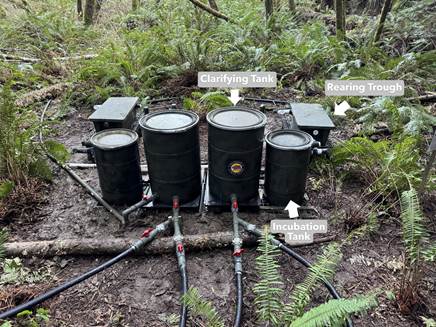
Remote Site Incubator designed by William Boucher in 2025. Image: William Boucher
I sought to better understand the work involved in planning, constructing, installing, operating, and monitoring RSIs. So I interviewed fisheries biologist and good fly-fishing buddy Will Boucher of the Gold Ridge Resource Conservation District (GRRCD) in West Sonoma County. Boucher has helped implement and refine RSIs in the Russian River watershed. He has been heavily involved in local salmon recovery efforts for over a decade. We met during my stint with California Sea Grant’s Russian River Salmon and Steelhead Monitoring Program in 2017.
Boucher helped implement a pilot RSI in the Russian River watershed in 2025. He used approximately 4,500 coho salmon eggs in this initial effort, with egg-to-fry survival exceeding 80%. That successful pilot effort helped support expansion of the RSI system in 2026. The expansion included the installation of a second RSI to increase capacity and operational flexibility.
“Since last year’s operations, Gold Ridge RCD and [California] State Parks have made several infrastructure improvements to the RSI system. The most notable was the installation of a second RSI unit.” (Boucher, 2026). This allowed the incubation of about 25,000 eggs this year. The U.S. Army Corps of Engineers (USACE) provided these eggs through the Russian River Coho Captive Broodstock Program headquartered at Warm Springs Hatchery.
Selecting a site for RSIs is strategic. Boucher chose a site in a headwater reach of a Russian River tributary. He explained that “RSIs are best installed in headwaters where risk of equipment failure due to high flows is reduced.” Stream gradient is also important for gravity fed headwater flows in and out of the RSI. I was surprised when Boucher mentioned that his RSIs are completely “off-grid,” operating without pumps, cooling devices, or solar panels. The natural flow of the stream and the cooling effect of the canopy provides an optimum scenario for imprinting.
Boucher added that the Coho salmon eggs “hatch and develop for around 30 to 40 days inside of the RSI and are then released in the watershed.” He said that this methodology increases the likelihood that the released coho salmon will “act more like wild fish.” These fish are never fed. They persist solely on the nutrients provided in their yolk sac. Around the time they finish absorbing their yolk sac, they begin foraging for food. The initiation of foraging coincides with the release of fry from the RSIs.
Since last year’s trial run, Boucher has made significant enhancements to the RSIs. By adding a rearing trough downstream of each incubation tank, the modified configuration has “resulted in a form of natural sorting, with fish distributing themselves according to developmental stage and behavior. Earlier-stage fish generally remain in the calmer incubation tank, while individuals showing more advanced swim-up behavior move into the rearing trough with horizontal flow. This has provided a useful, behavior-based way to distinguish less developed fish from those nearing release readiness.” (Boucher, 2026).
In February of 2026, 24,205 eggs were transferred from the Warm Springs Hatchery facility to the target site in two batches. The hatch rate of the two batches was about 94%. The egg-to-fry survival rate was about 89%, resulting in the release of roughly 21,526 fry into the creek last March.
Water quality conditions inside of the RSIs were generally suitable for the development of the eggs. “Dissolved oxygen remained consistently high throughout the rearing period, while water temperatures were generally suitable but slightly on the warmer end. The mid-March heatwave did result in elevated water temperatures and a slight decline in dissolved oxygen, but conditions remained in a range that did not appear to cause major concern during operations.” (Boucher, 2026).
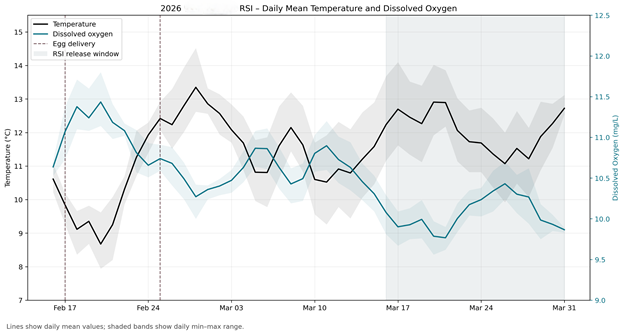
Daily Mean Temperature and Dissolved Oxygen of RSIs in 2026. Image: William Boucher
The project will now shift to post-release monitoring. The monitoring will include snorkel surveys through the summer in order to document juvenile abundance and distribution. “That effort will be followed by a genetic sampling effort informed by juvenile abundance and distribution observed during snorkel surveys. Tissue samples will be submitted to the U.S. National Oceanic and Atmospheric Administration (NOAA) Southwest Fisheries Science Center in La Jolla. They will go to the genetics lab for genotyping and pedigree analysis. This will allow us to assign fish origin and estimate the relative contribution of RSI-origin juveniles compared to natural production.” (Boucher, 2026).
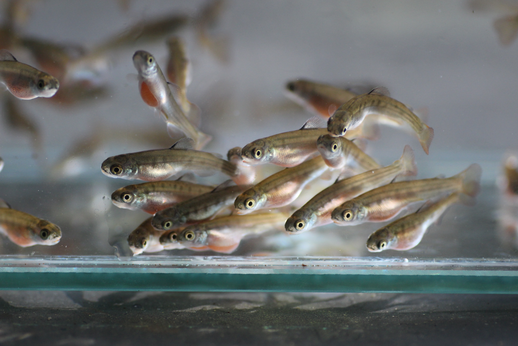
Coho salmon fry in RSI incubator tank in 2026. Image: William Boucher
The installation, monitoring, and operation of the two RSIs is made possible by a collaboration of GRRCD with state and federal agencies. Funding for the project is provided by California State Parks. Federal permits were granted from NOAA and USACE. The California Department of Fish and Wildlife (CDFW) issued state permits. See table below for permitting information:
Federal and State Permitting Table
| NOAA & USACE Permits: | CDFW Permits: |
| Hatchery Genetics Management Plan (HGMP) | California Endangered Species Act Memorandum of Understanding (CESA MOU) |
| 10(a)(1)(A) Scientific Purposes Permit | Scientific Collecting Permit |
References and additional information:
Email correspondence and phone interviews with William Boucher, fisheries biologist with Gold Ridge Resource Conservation District, conducted by Eric Woodruff on April 15, 2026.