
The California Department of Fish and Wildlife’s (CDFW’s) Heritage and Wild Trout Program (the Program) manages designated waters for wild trout species. The term “wild trout” means a fish born and reared in a specific location without human intervention. The term “heritage trout” refers to trout that have lived in a specific location since prehistoric times.
The Heritage and Wild Trout Program is an example of how a state agency, nonprofit organizations, and the public can collaborate on conservation and education efforts. CDFW established the Program in 1971 with the help of CalTrout, a San Francisco nonprofit seeking to ensure healthy waters and wild fish. Together, the two entities have broadened the Program’s coverage area and mission through the decades.
Now the Program monitors and protects 46 streams and 17 lakes or lake complexes. The designated waters in the Program are home to non-native wild trout, native trout, and heritage trout. CDFW selected the waters for the Program because these waters are aesthetically pleasing and environmentally productive streams and lakes. Program waters are managed exclusively for wild trout. CDFW manages the trout populations with appropriate regulations so anglers do not reduce the populations by taking fish.
CDFW engages with the public to explore these areas. One of the more well-known efforts is the Heritage Trout Challenge. Anglers must catch six of the 11 native California trout from their historic drainages and photograph them to earn a personalized certificate with artistic depictions of the trout they caught. To date, over 600 applicants have completed the Heritage Trout Challenge. In the years to come, CDFW hopes to add more waters to its list and expand public knowledge about native trout species and habitats.
Designated waters for native trout species in the Program are grouped by region. The list includes, in part, the Lower McCloud River, the Fall River Complex, and the Upper Klamath River in the Northern Region; the Middle Fork of the Feather River, the North Fork of the American River, and the North Fork of the Mokelumne River in the North Central Region; Lake Solano and Putah Creek in the Bay Delta Region; and the Middle Fork of the San Joaquin River, the Middle Fork of the Stanislaus River, and the Tuolumne River in the Central Region. The Program also covers the South Coast Region, which extends from Santa Barbara to San Diego counties, and the Inland Deserts Region, which includes Riverside and San Bernardino counties.
“One of the things I really appreciate about this program is its unique balance between wild and native trout conservation, angler engagement, and the promotion of exceptional angling opportunities,” said Shay Mussulman, Inland Fisheries Program Manager for CDFW.
Mussulman is also the Fisheries Branch Tribal Coordinator for the CDFW’s Office of Tribal Affairs, which shares information with and responds to Tribes. The Program is also a point of interaction with Tribes.
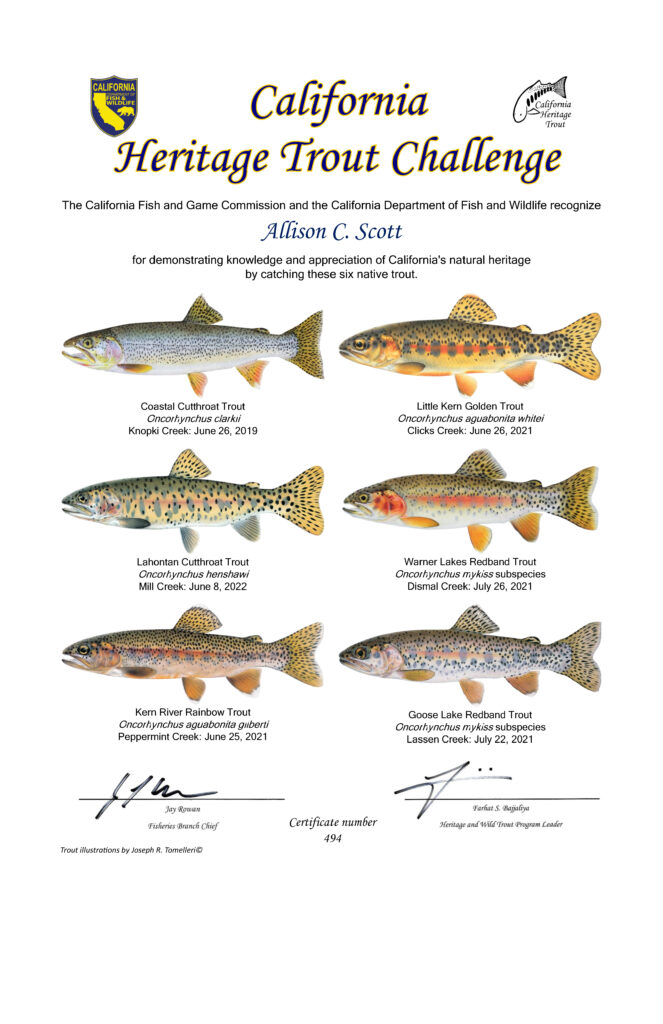
A sample of tailored artwork available if an angler completes the Heritage Trout Challenge. Image: California Department of Fish and Wildlife
How the Program has evolved
In 2007, the Program added seven positions, resulting in a total of 13 fisheries biologists across the state. The Program publishes an Annual Survey Summary Report, which highlights its key accomplishments and activities. Since 2021, the Program’s reports have a comprehensive, statewide format. These better reflect its efforts across the state. The Program has also developed Fisheries Management Guidelines for designated waters. The Program receives a minimum of $2 million annually from CDFW’s Hatchery and Inland Fisheries Fund. This fund contains the monies from deposit fees to issue sport fishing licenses.
“For decades, this has been a reliable source of money. In 2026, with 13 staff and other expenses, that money doesn’t go as far as it used to. This forces us to have an increased reliance on external funding sources, including partnerships with nonprofits, to meet the Program’s mandates,” said Farhat Bajjaliya, the Statewide Inland Trout Coordinator for CDFW. Bajjaliya oversees the Heritage and Wild Trout Program, including the Heritage Trout Challenge.
CalTrout has supported the Program directly by paying for equipment and covering the cost of mule teams to haul fisheries monitoring gear into the wilderness. It has also supported summer interns to join the Program crews doing trout surveys across the state in support of managing and designating future wild trout waters.
“In addition we have worked closely with CDFW staff in recent years on the trout fishing regulation simplification process to make regulations more science-based, consistent, and easier for anglers to understand. We continue to work with them to tweak regulations for specific waters as needed,” said Patrick Samuel, Senior Scientist for CalTrout.
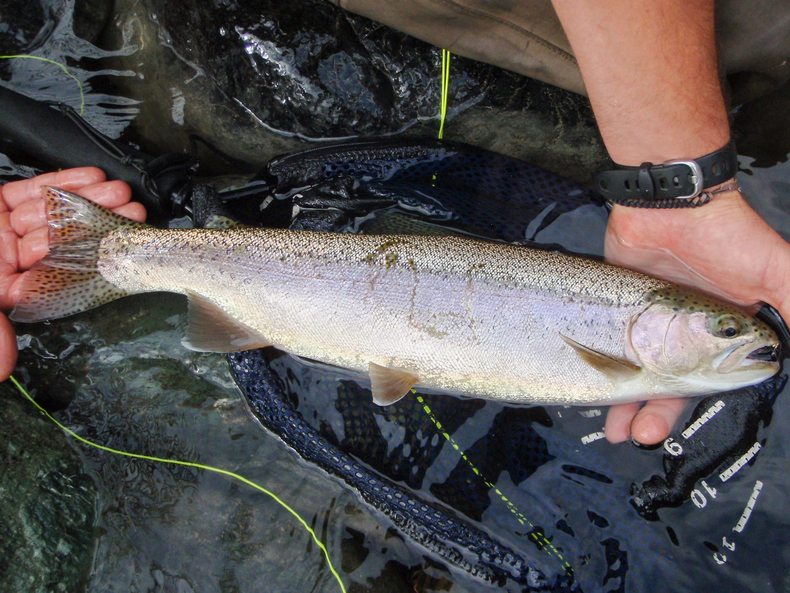
A Coastal Rainbow trout (Oncorhynchus mykiss irideus) found in a Heritage and Wild Trout Program survey, from Upper Stony Creek in Glenn County. Image: California Department of Fish and Wildlife
Current projects
At the moment, CalTrout staff are working closely with the Program staff at state and regional levels to gather data and research for CalTrout’s State of the Salmonids III (SOSIII) report. This is a statewide status assessment of each of California’s 32 kinds of salmon, steelhead, and trout.
“The expertise of the wild trout biologists and other CDFW staff working on these species is invaluable for this effort. Their knowledge helps us make sure we have the most comprehensive and best available scientific information to underpin the assessments. The SOSIII report will be released in Spring 2027. As a result of the effort, we will have a roadmap for recovering our inland native trout species to implement, which will help us (CalTrout) achieve our organizational mission,” said Samuel.
One of the successes of the Program is that it achieves a high amount of work every year, given its limited resources. This is reflected in the annual reports.
“We’re always surprised by what we’ve been able to achieve statewide,” said Bajjaliya.
Mussulman said one of the most important things that CDFW gains from the Program is an understanding of the power of coordination and communication.
“That’s critical to getting the work done. CalTrout and our other partners relate different perspectives, priorities, cultures, and ways of wanting to do things. This gives CDFW the chance to develop better projects by working together,” said Mussulman.
Mussulman particularly mentioned the involvement of Trout Unlimited, an Arlington, Virginia-based conservation nonprofit. The organization has a Bay Area office in Emeryville.
Their staff and volunteers assisted with meadow restoration work in the Kern Plateau at the eastern end of the Kern River watershed.
“Trout Unlimited’s efforts helped us confirm the presence of brown trout (Salmo trutta) in golden trout (Oncorhynchus aguabonita) habitat. That allows us to come up with plans for addressing the issues that arise,” said Mussulman.
Golden trout are native to California, while brown trout are not.
Both Mussulman and Samuel also mentioned a joint effort between CalTrout and CDFW in the Eastern Sierra. The two entities are pioneering techniques to de-water and remove
non-native Brook trout (Salvelinus fontinalis) and hatchery-raised strains of rainbow trout (Oncorhynchus mykiss) from historical Lahontan Cutthroat trout (Oncorhynchus clarkii henshawi) habitat. That way, Lahontan Cutthroat trout, a species classified as threatened under the federal Endangered Species Act, can be re-introduced locally without competition.
Samuel said CalTrout is watching native inland trout species, especially endemic species limited to only portions of their historical ranges. They want to see how well these species are able to persist in the face of a changing climate without targeted management and restoration.
“The SOSIII report will provide a blueprint as to what efforts are needed and where they are needed, to address specific threats to our native trout and help these species recover. For example, CalTrout has been working for many years with CDFW staff and other partners to restore healthy meadows that slowly meter out cold, clean water even during summer and fall months that our native trout depend upon,” said Samuel.
An example of this phenomena occurred near Mount Shasta. CalTrout staff and CDFW biologists worked together to design and implement a pool enhancement project. This project directly supported recovery of McCloud River Redband trout (Oncorhynchus mykiss calisulat) by offering deep pools and cover to sustain them during drought periods.
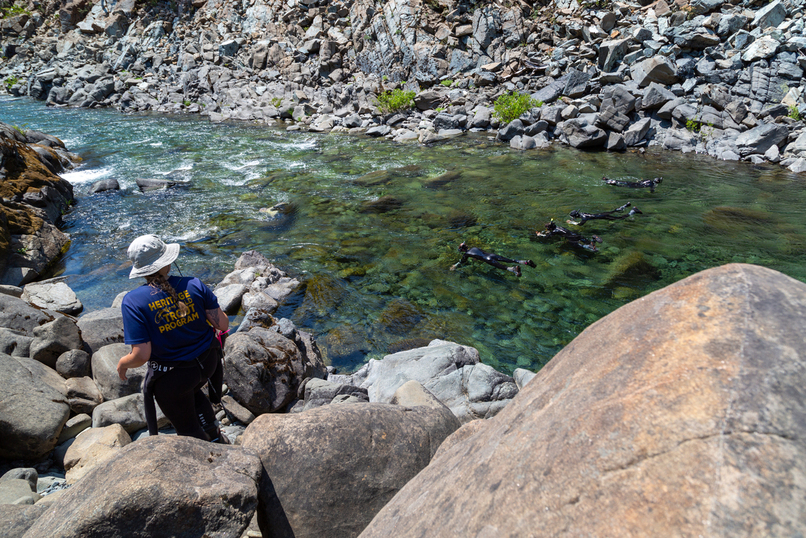
CDFW employees participate in a snorkel survey for the Heritage and Wild Trout Program on the North Fork of the Smith River in Del Norte County, California in June 2023. Image: Travis VanZant and California Department of Fish and Wildlife
Conservation depends on anglers
Long-term conservation depends on an engaged and diverse angling community.
“With fishing license sales declining over time, recruiting and retaining anglers is critical if we want the sport, and the support it provides, in forms of funding, public support, stewardship, etc., to persist,” said Bajjaliya.
CDFW’s Bajjaliya added that effective advocacy for fisheries requires broad participation.
“There is real strength in numbers. Fostering respect across different angling approaches helps build that unified base,” he added.
This is one of the reasons that the Program expects consumptive use. The term “consumptive use,” when applied to fish, means the removal of fish from their aquatic habitats for human consumption. As a note, the term “consumptive use” when applied to water means the removal of water from waterways for human and agricultural use.
Bajjaliya added that conservation success depends on people as much as it does on science.
“It’s OK for anglers to participate in consumptive use where regulations allow for it. Those individuals really represent an important and unrecognized portion of the angling base. We believe in fostering mutual respect across angling groups, whether that’s catch-and-release or consumptive,” said V
One of the ways that CDFW gathers information about anglers and their catches is through the California Inland Recreational Angler Survey (CIRAS). This is a mobile-friendly web platform that enables anglers to report their catch and share feedback with CDFW. CIRAS provides tools like the “Ready to Fish” dashboard, where anglers can sort Program data by fish species, water name, or area. That helps them plan trips across the state.
“In many ways, CIRAS represents a modernization of the traditional Angler Survey Box (ASB) system,” said Mussulman.
The ASB is a network of over 200 metal angler survey boxes. Anglers submit paper survey slips to record information about their fishing experiences.
Mussulman said CIRAS expands participation, improves data quality, and creates a more accessible, two-way connection between anglers and CDFW.
Bajjaliya and Mussulman agreed that the Program makes it a CDFW mission to recruit and mentor new anglers. This is especially true for youth and individuals from historically unrepresented communities in the fishing world.
“We want to show people how to get into the sport. We want to promote practices that are consistent with regulations and local conditions. Call it “ethical angling,” said Bajjaliya.
Program staff enjoy engaging with and supporting organizations that work on native trout restoration and conservation. For example, in 2024, a wide range of fly fishing clubs assisted with three to four-day surveys of the Kern Plateau. The list included Sierra Pacific Flyfishers, Santa Barbara Flyfishers, Sespe Flyfishers, Long Beach Casting Club, Aguabonita Flyfishers, Fresno Flyfishers for Conservation, and Kern River Flyfishers, as well as anglers unaffiliated with these groups.
“Working together like that creates a culture of respect and inclusivity across different organizations. That’s what makes the Heritage and Wild Trout Program relevant. The goodwill, trust, and knowledge we gain remains a reason for CDFW to continue it,” said Bajjaliya.
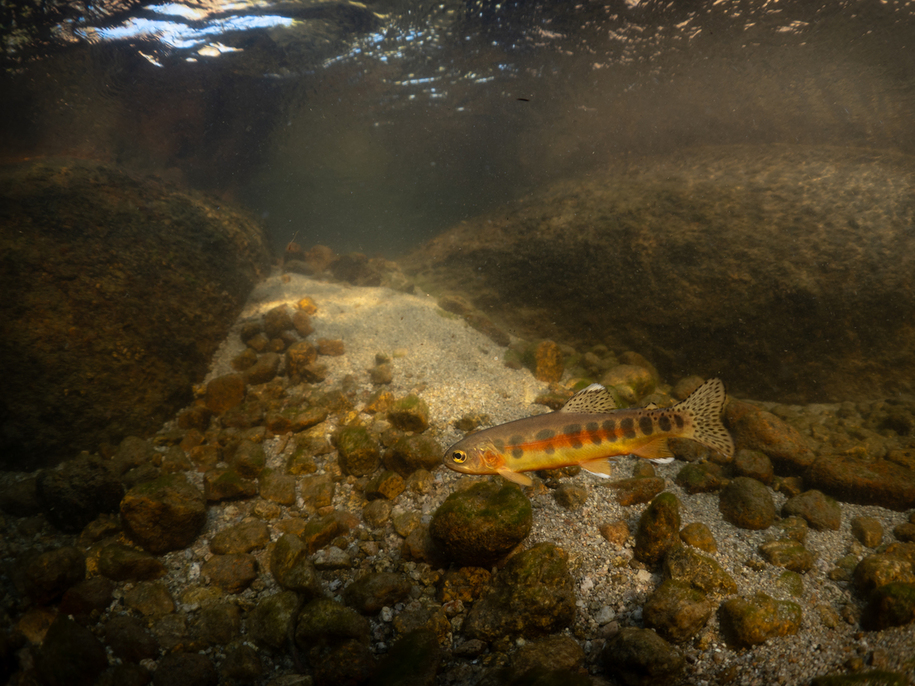
California golden trout (Oncorhynchus aguabonita), which is native to the Sierra Nevada mountains. Image: California Department of Fish and Wildlife