
California is world-renowned as an environmental leader. Yet agencies are reluctant to enforce laws that ensure people and fish have clean water. Those who advocate for salmon recovery and track agency performance on reversing damage to aquatic ecosystems can attest: the enactment of environmental regulations does not guarantee that those laws will get enforced. Enforcement requires adequate manpower and financial resources. Sometimes it requires collaboration with the right partners.
The Scott and Shasta rivers have been oversubscribed for more than half a century. State courts ruled on the water rights for these rivers over 50 years ago. The U.S. Environmental Protection Agency added these rivers to its Clean Water Act list of impaired waterways over 20 years ago. Yet more than two decades of having restricted Total Maximum Daily Loads (TMDLs) have not sufficiently protected water supplies for non-irrigation beneficial uses.
In 2014, the California Legislature passed the Sustainable Groundwater Management Act (SGMA). This act regulates groundwater to avoid aquifer depletion and safeguard surface flows where the flows are interconnected to groundwater. Up till now, this legislation has proved insufficient to offset the effects of large diversions. In 2021, the State Water Resources Control Board adopted emergency instream flow requirements for the Scott and the Shasta.
The Water Board renewed these requirements for three years in a row for both rivers. In 2025, the California Legislature passed AB 263, to extend the streamflow requirements for another five years. This bridged the gap until 2030 when the Water Board is scheduled to adopt permanent flow requirements.
At every stage, the State allocated public funds to implement the new legislation chronicled above. Only the streamflow requirements show signs of hope as a viable regulatory strategy. to replenish water and maintain water quality in the Shasta and Scott basins during irrigation season. Numeric flow requirements limit overallocation of water and prohibit the dewatering of salmon stronghold rivers. Yet problems remain.
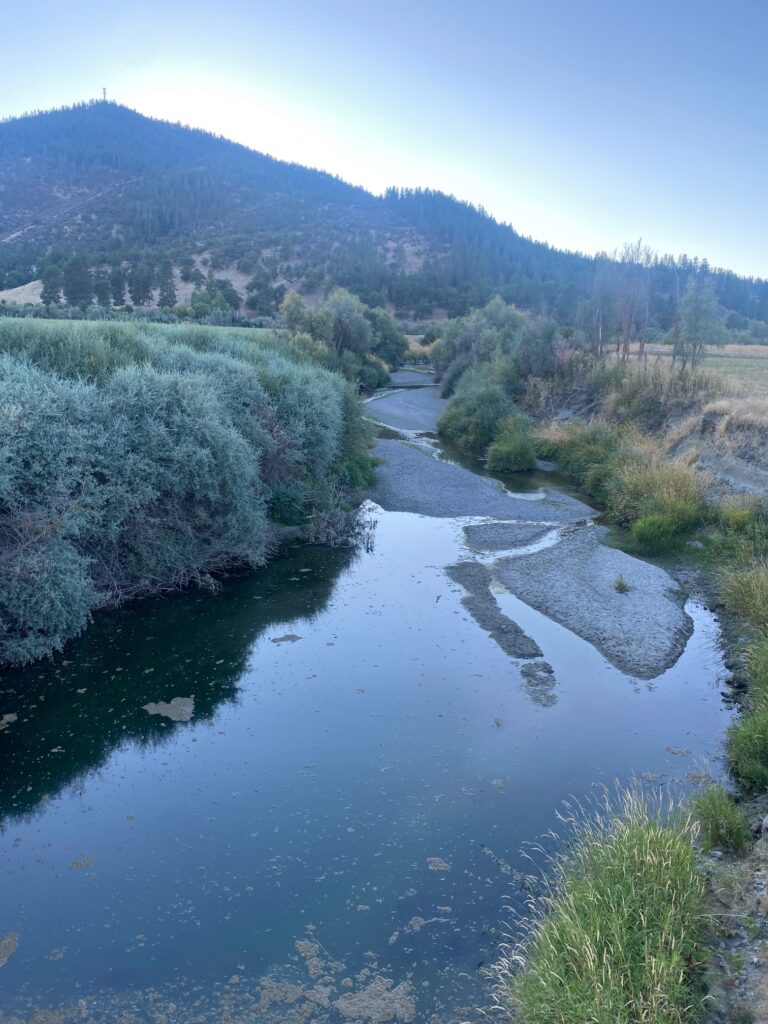
Scott River mainstem from bridge at Ft. Jones looking west on August 27, 2026, with USGS flow gage recording 7 cubic feet per second (cfs). Image: Angelina Cook
Legal and technical staff from the State Water Resources Control Board’s Division of Water Rights and Office of Enforcement, and from the North Coast Regional Water Quality Control Board have been administering curtailments in the Shasta and Scott since 2021. The minimum instream flows established in the Water Board’s temporary flow regulations for the Scott River during the month of August is 30 cubic feet per second (cfs):

Table of instream flow requirements for the Scott River that the State Water Control Board issued on June 10, 2026. Image: California State Water Control Board
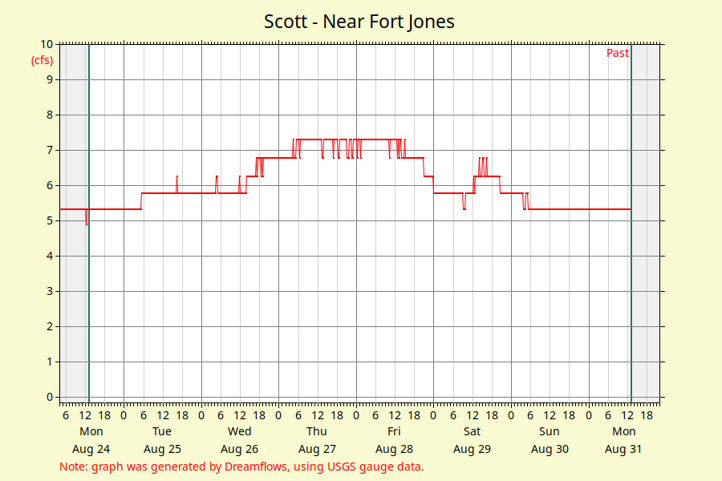
The actual average streamflow in the Scott River in August 2026 hovered around 6 cfs as demonstrated by flow data monitored at the USGS Ft. Jones gage. Image: Dreamflows, at https://www.dreamflows.com/graphs/day.196.php.
Telling irrigators to reduce their diversions is not popular. Many people in Siskiyou County are opposed to enforcement of environmental laws. To address this obstacle, the State Water Board devised a voluntary mechanism called Local Cooperative Solutions (LCS). The idea is to increase enrollment in the water use reduction program. LCS applicants commit to reduce irrigation water by about 30%. In return, the Water Board does not curtail enrolled ranches. LCS enrollment rates in 2026 were higher than any prior year. So, once the rivers’ flows dwindled, the Water Board had limited means for curtailment. Consequently, the Scott River, one of the Klamath River’s most important tributaries for endangered coho spawning, flowed far below the legal requirement for the entire month of August in 2026.
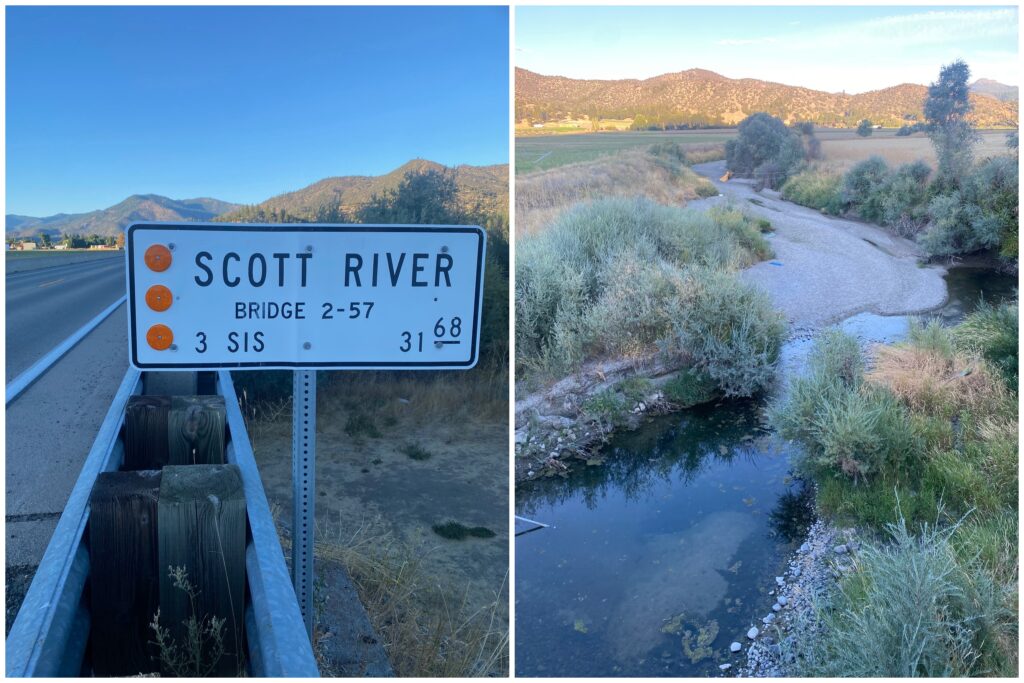
Left: Scott River signpost near bridge at Ft. Jones. Right: Scott River mainstem at Ft. Jones looking east at its height for August 27, 2026, with USGS flow gage recording of 7 cfs. Both images: Angelina Cook
Several other agricultural water right holders did not apply for LCSs. This meant they are subject to curtailment. Seven of these right holders openly violated the curtailment order. The State Water Board issued Notices of Violation (NOVs), including to the Scott Valley Irrigation District, which serves 25 agricultural water users irrigating 3000 acres of cropland. The State Water Board has discretion to issue penalties to violators. These penalties generally reflect irrigator response after receiving an NOV.
There is a different unmet water quality obligation involving recovery of endangered species. To accommodate this, the North Coast Regional Water Quality Control Board facilitates biweekly Shasta-Scott Subgroup meetings that are open to the public. Public servants with diverse authorities often attend. This includes personnel from California Department of Fish and Wildlife, Scott Valley and Shasta Valley Watermaster District, and Siskiyou County Groundwater Sustainability Agency.
There is apathy, avoidance, and despondency at meetings. Typically, public and Tribal water advocates press agencies on how they are going to resolve the flow discrepancy. They see shoulders shrug, heads tilt, defenses rise, and hands go up. Agency representatives suggest that all that can be done has been done. There is no discussion of redirecting funds for more effective enforcement, higher penalties for transgressors, or incentives for drought-tolerant crop alternatives. There is no talk of campaigns to raise awareness of how excessive diversions negatively impact the natural environment and human communities, especially indigenous groups.
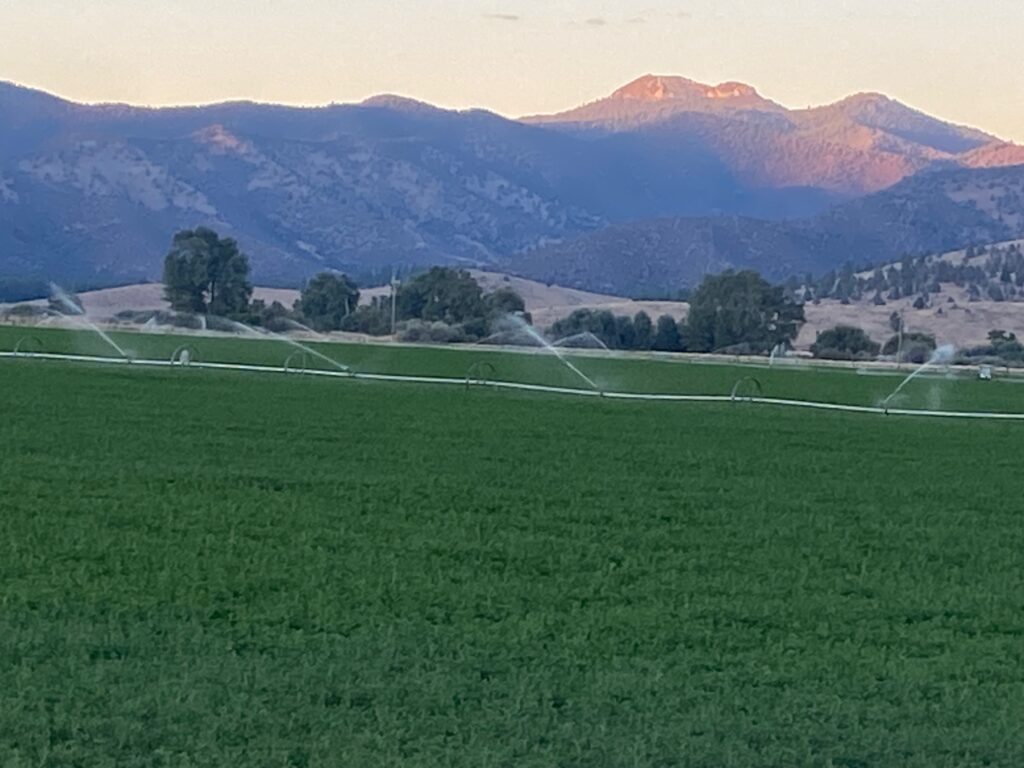
Vast fields of alfalfa receiving ample irrigation in the Scott Valley on Aug. 27, 2026, when instream flow requirements were 23 cfs short of the minimum requirement. Image: Angelina Cook
Legitimate environmental leaders do not enable extinction of a keystone species and deny their duty to ensure water supplies for non-irrigation beneficial uses. Legitimate water policies do not funnel taxpayer dollars on sustainable water management and endangered species protection for consecutive decades without achieving structural progress. For California to walk its talk on climate resilience and environmental leadership, state and local agencies must rediscover their purpose. They must come up with new solutions that work. They must regulate public resources on behalf of the public trust.