
As autumn begins, I think about fall-run Chinook salmon and their steelhead cousins swimming close behind. One place I love fly fishing this time of year is the lower Feather River. Most fly fishers refer to this season as “the egg bite,” as salmonids change their diet from aquatic insects to the thousands of loose salmon eggs drifting downstream from spawning activity in redds.
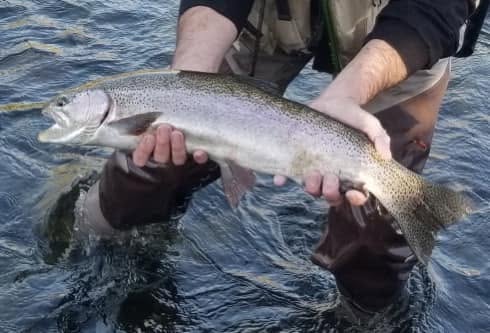
A female lower Feather River steelhead. Photo taken in 2022. Image: Eric Woodruff
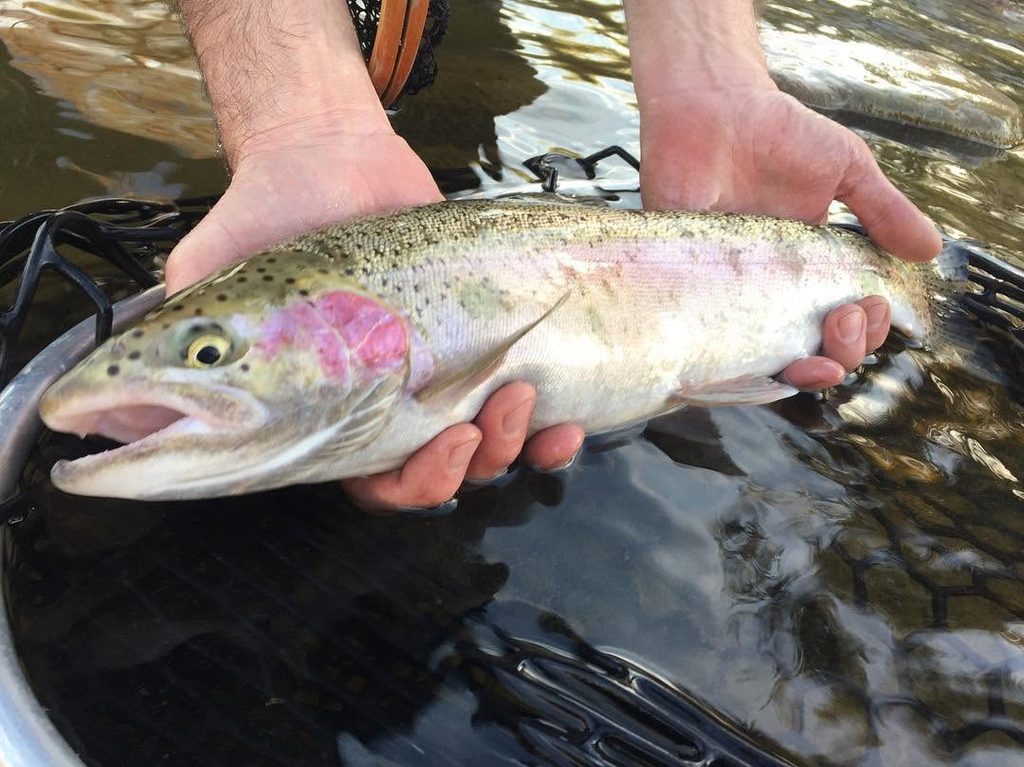
A male lower Feather River steelhead. Photo taken in 2018. Image: Eric Woodruff
For years, I have been heading to reaches of the lower Feather River between Oroville Dam and the confluence with the lower Sacramento River in Verona. This is a great destination to observe fall-run Chinook salmon activity. During prolific fall runs, this stretch of water can feel like Alaska. From the banks of the river, one can see thousands of Chinook salmon migrating upstream. The fish spawn in the Feather River Fish Hatchery or naturally in the tailouts downstream of the hatchery.
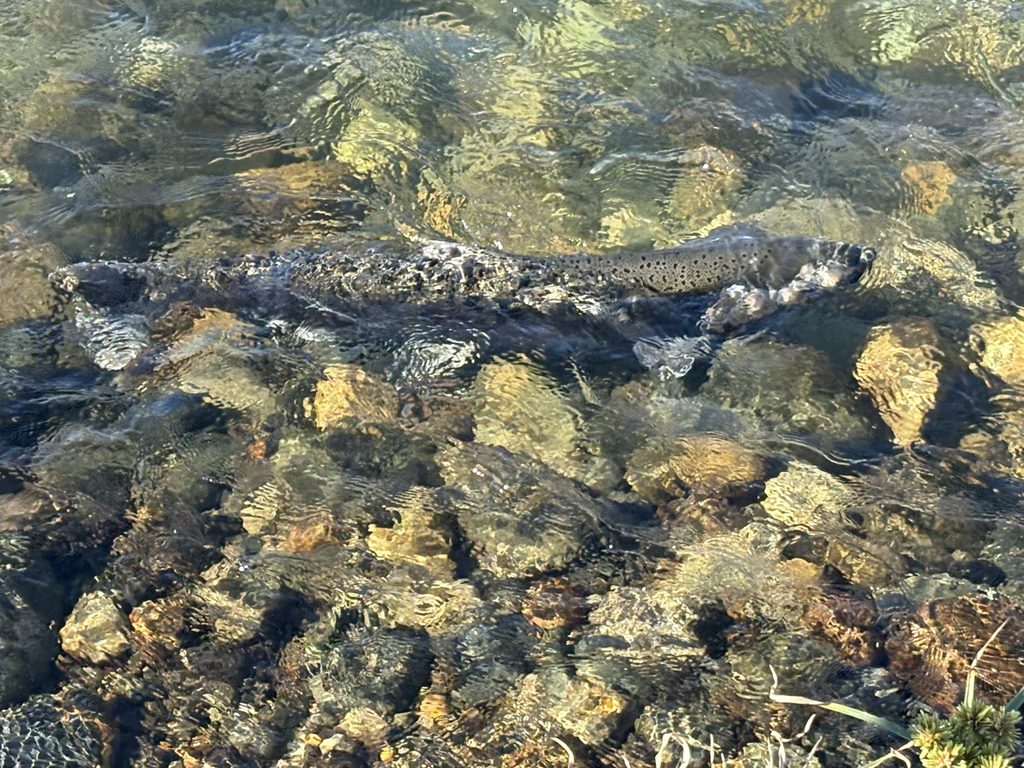
An adult Chinook salmon holding in a run on the lower Feather River. Photo taken in 2026. Image: Eric Woodruff
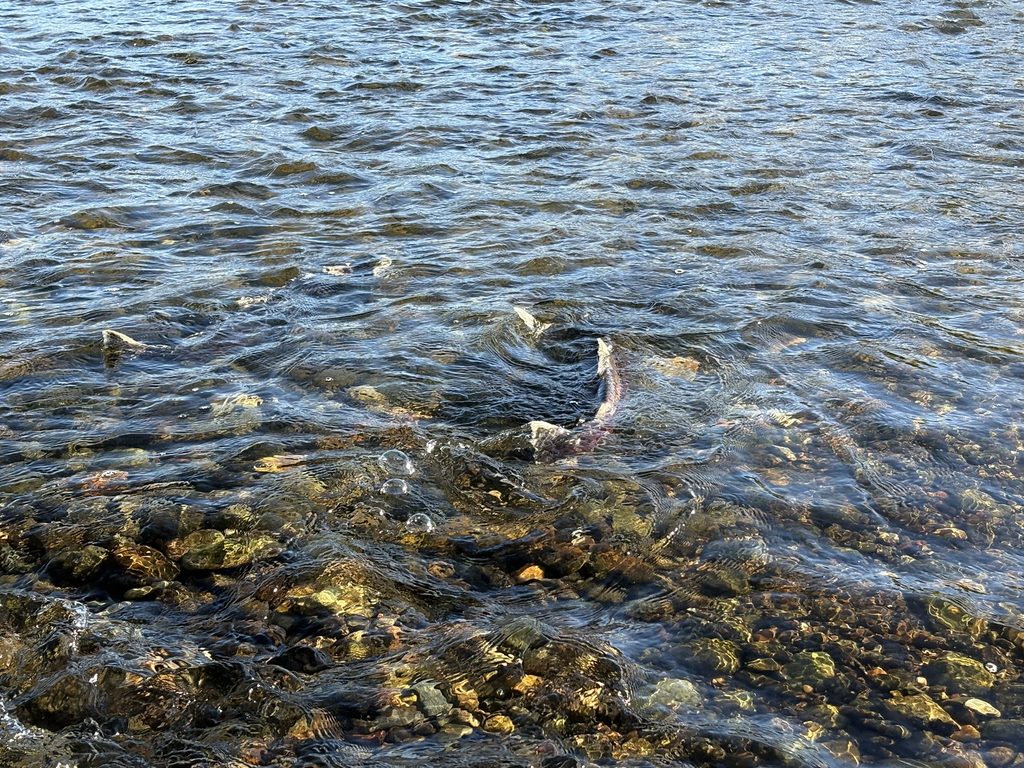
Adult Chinook salmon prepare to spawn in a tailout in the lower Feather River. Photo taken in 2026. Image: Eric Woodruff
Before the construction of Big Bend Powerhouse on the North Fork Feather River in 1908 and the completion of Canyon Dam at Lake Almanor in 1914, Chinook salmon and steelhead migrated through the Sacramento–San Joaquin Delta and up the Feather River into the Sierra Nevada mountains. In the North Fork Feather River, “extensive cold-water springs provided year-round flows with temperatures not higher than sixty degrees Fahrenheit” (Yoshiyama et al., 2001). Suitable temperatures and a spring-fed summer baseflow of about 800 cubic feet per second (cfs) allowed spring-run Chinook to hold in pools over summer. More recently, recorded data from the 1940s and 1950s indicates the lower Feather River supported spring and fall runs of up to 86,000 Chinook salmon annually.
In 1957, the Federal Energy Regulatory Commission (FERC) issued a license to the California Department of Water Resources (DWR) for the Oroville Facilities Hydroelectric Project (FERC Project 2100). “Construction of the Project began in 1961 and was completed in 1968. Project features include: Oroville Dam and Reservoir with a storage of 3.5 million acre-feet and a surface area of 15,180 acres; Hyatt Power Plant with a generation capacity of 645 megawatts (MW); Thermalito Diversion Pool; Thermalito Diversion Pool Power Plant with a generation capacity of 3 MW; Thermalito Forebay; Thermalito Power Plant with a generation capacity of 114 MW; and the Thermalito Afterbay” (California Water Boards, 2026).
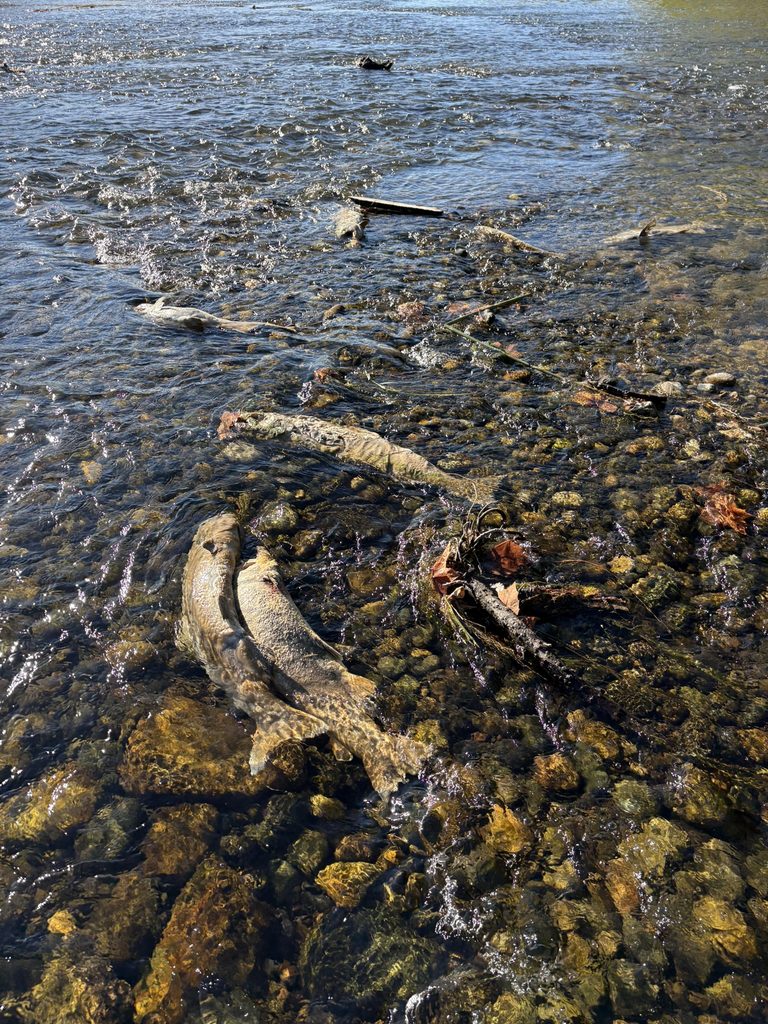
Post spawn Chinook salmon carcasses in the lower Feather River. Photo taken in 2026. Image: Eric Woodruff
In 1966, construction of the Feather River Fish Hatchery commenced just downstream of Oroville Dam. Along with the facility, a massive fish barrier was built to steer migrating fish into the hatchery by way of a 1,000-foot-long fish ladder (CDFW, 2026). In 1967, the California Department of Fish & Wildlife (CDFW) began hatchery operations in an effort to mitigate the loss of natural spawning and rearing habitat associated with the Oroville project.
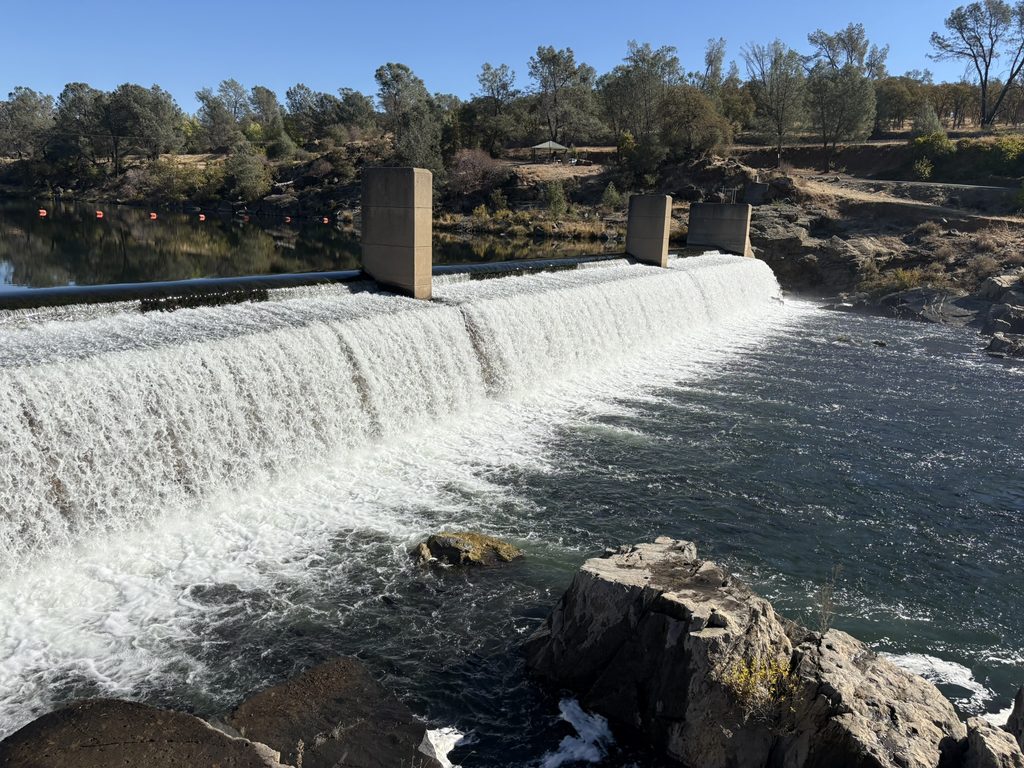
The fish barrier just downstream of Oroville Dam. Photo taken in 2026. Image: Eric Woodruff
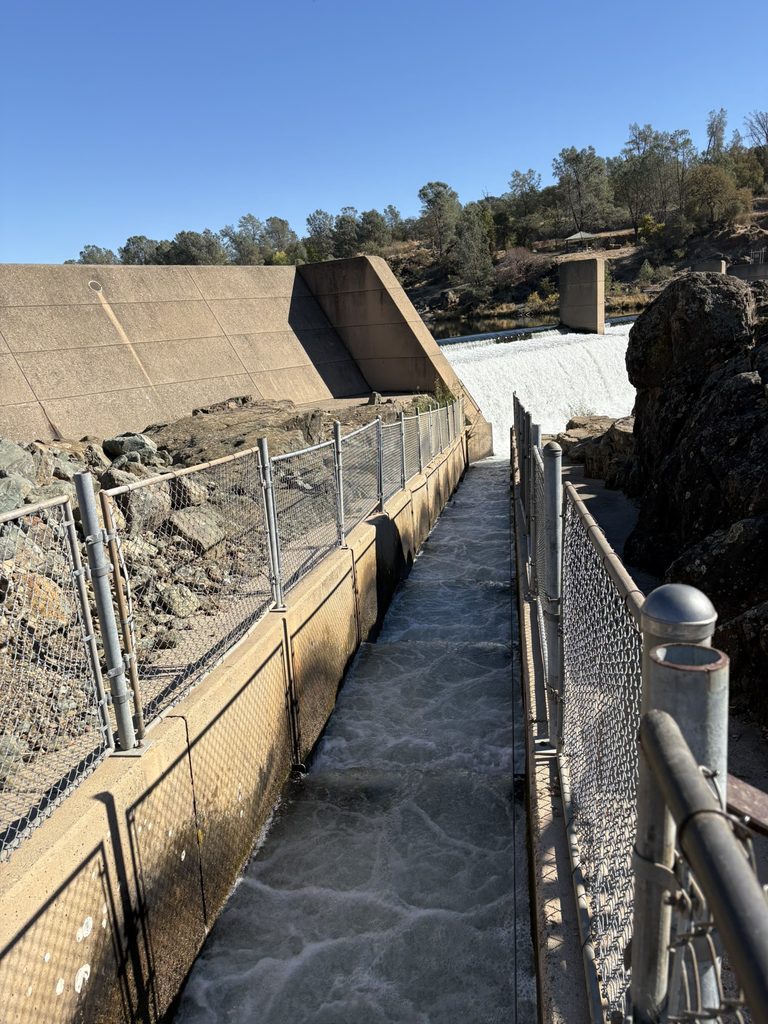
Entrance of the fish ladder to the Feather River Fish Hatchery facility. Photo taken in 2026. Image: Eric Woodruff
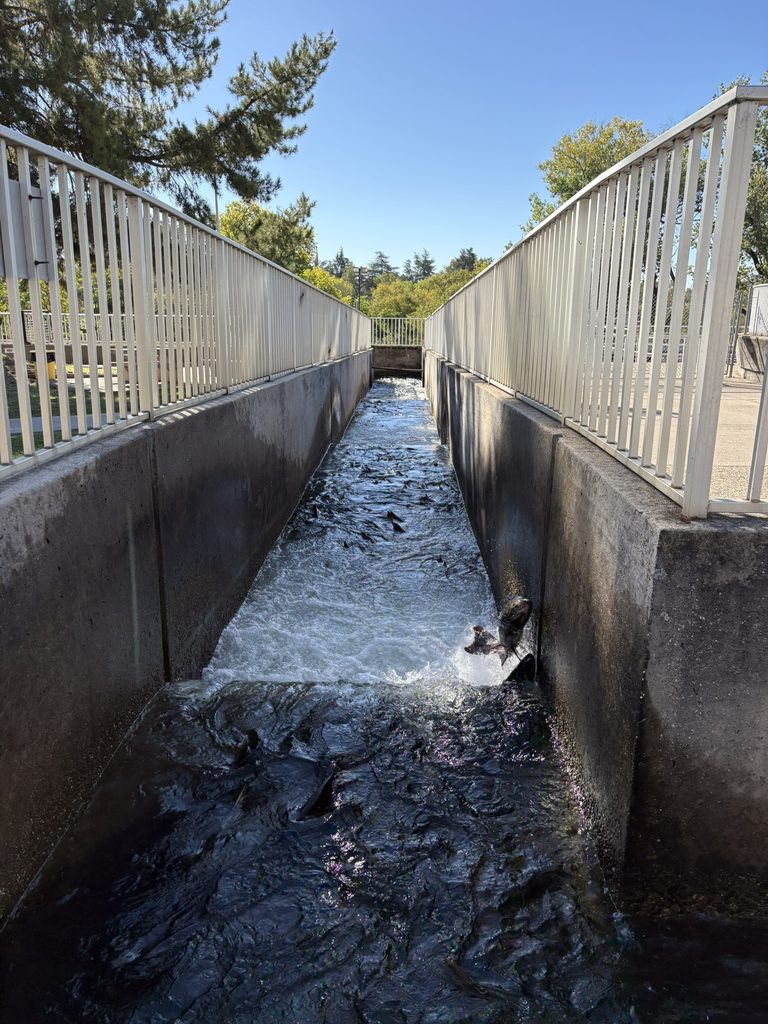
An adult Chinook salmon jumps up a step in the fish ladder. Photo taken in 2026. Image:
Eric Woodruff
Today, Chinook salmon spawning in the lower Feather River are restricted to approximately 25 miles of river downstream of Oroville Dam. It is important to note that the Feather River Fish Hatchery produces up to 6 million Chinook salmon smolts annually (CalFish, 2018). Overall, the lower Feather River “contributes about 20-25% of the total salmon production in the Central Valley; most are ‘fall-run’ Chinook salmon” (Cannon, 2017).
In 2025, 57,299 adult Chinook salmon were counted at the Feather River Fish Monitoring Station:39,587 fall-run and 17,712 spring-run (Bacher, 2025). However, overall escapement rates are low. For example, if 6 million Chinook smolts were produced and released from the hatchery and only 57,299 adult Chinook salmon made it back to spawn, the escapement rate in the lower Feather River would be a dismal 0.95%.
“DWR’s Feather River Fish Monitoring station tracks abundance, run timing, and origin (hatchery or natural) of steelhead and Chinook salmon populations” (DWR, 2026). Adult salmonid escapement counts between March 4 and October 24, 2026, are as follows:
• Spring-run Chinook salmon (March 4 through June 30): 8,519
• Fall-run Chinook salmon (July 1 through present): 77,541
• Steelhead: 428 (DWR, 2026)
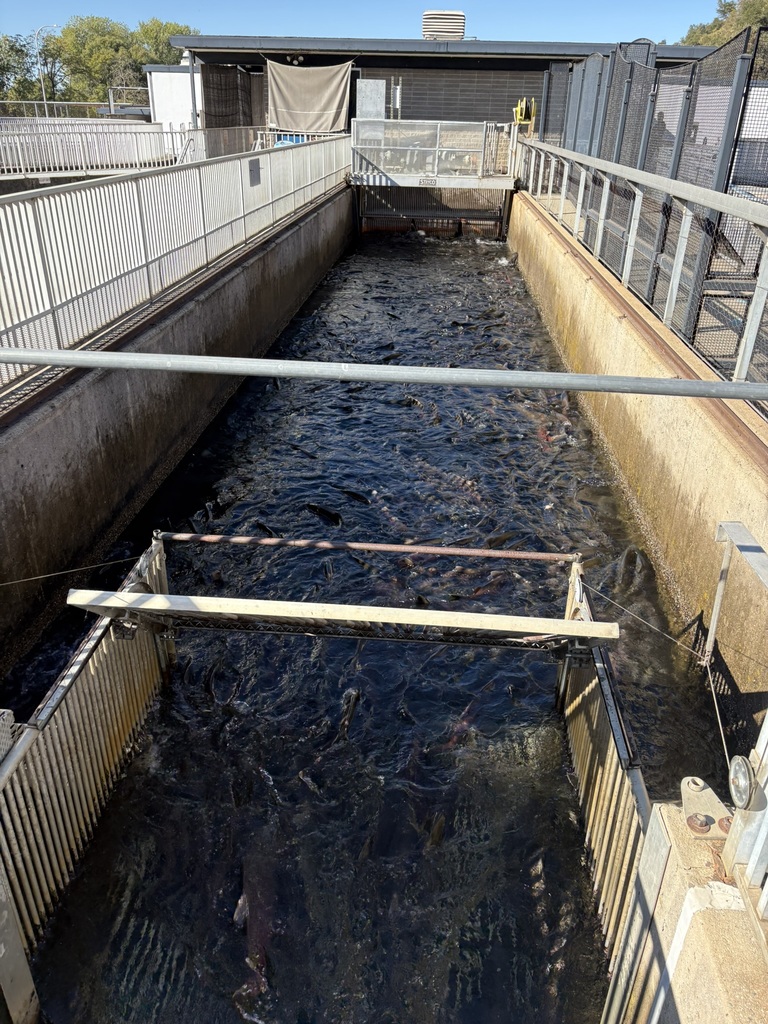
A very crowded gathering tank at the Feather River Fish Hatchery. Photo taken in 2026. Image: Eric Woodruff
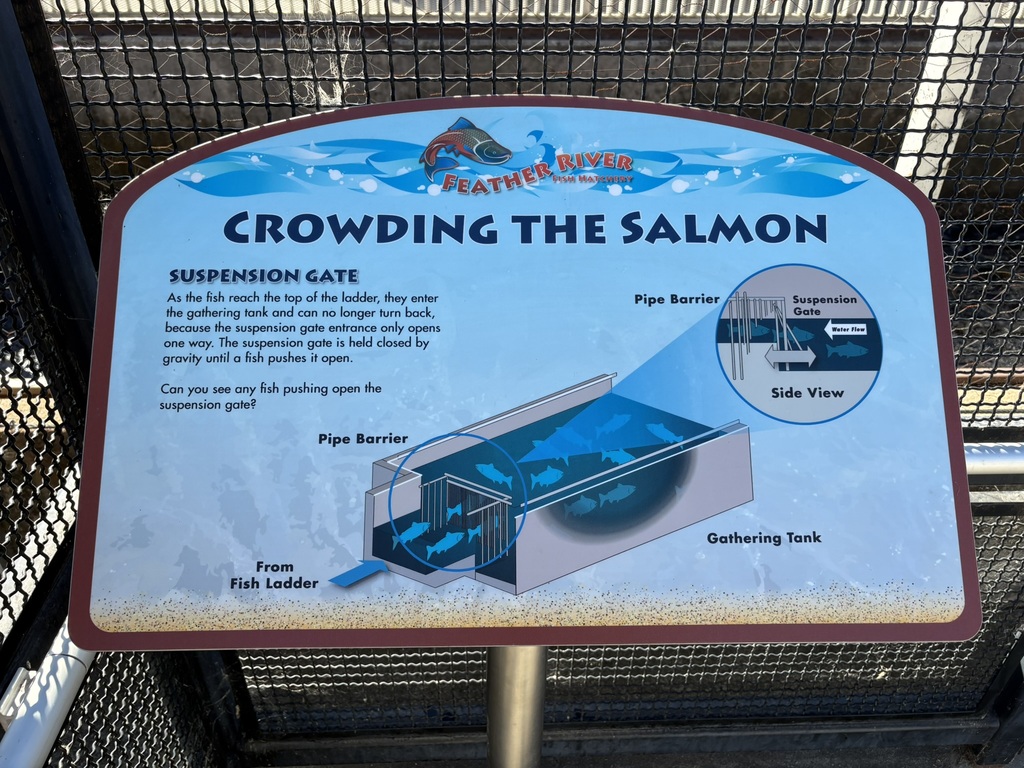
An informative sign at the Feather River Fish Hatchery. Photo taken in 2026. Image: Eric Woodruff
DWR is currently conducting a North Fork Feather River Salmon Reintroduction Feasibility Study, which I covered in a previous article here.
Looking to the future, several priorities will be important:
First, improving water management. For decades, CSPA has advocated for the protection of suitable temperatures through the summer and for restoring winter and spring flows. Balancing water budgets for the benefit of salmonids is one of CSPA’s most important campaigns.
Second, increasing natural spawning. Long-term Chinook salmon resilience depends on successful natural reproduction, juvenile survival, and genetic diversity.
Third, restoring rearing and spawning habitat. DWR’s continued gravel placement can increase natural spawning downstream of the hatchery. Maintaining side channels and reconnecting floodplains will also increase habitat and refugia for juvenile Chinook salmon and steelhead.
Fourth, preparing for climate change. Warm water temperatures, extended drought periods, atmospheric rivers, and erratic ocean conditions make Chinook salmon escapement less predictable than it was in past decades. Restoration strategies include greater and more reliable carryover storage in Oroville Reservoir to protect water temperatures in the lower Feather River. They also include the reintroduction of spring-run Chinook salmon to the upper North Fork Feather River.
The annual trips I make to the lower Feather River keep me hopeful. It’s hard not to feel excited when observing thousands of Chinook salmon returning in the fall. I am also always reminded of the successful steelhead trips during egg bites past. The lower Feather River is a fun place to fly fish and can be very productive — if you time it right.
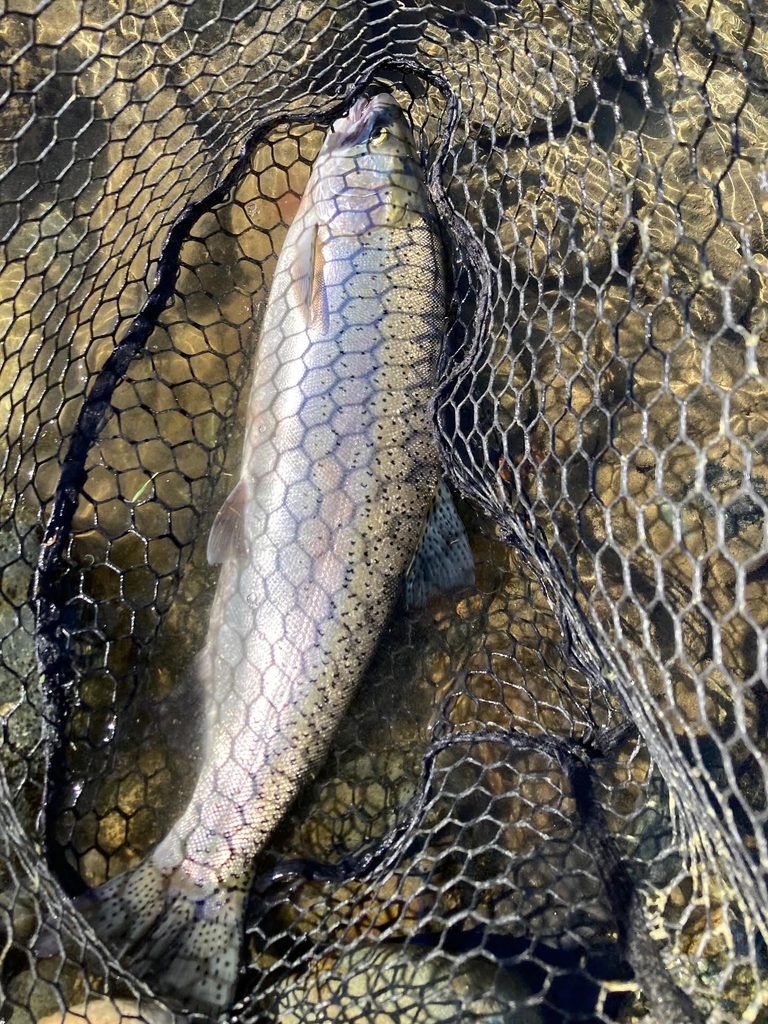
A female hatchery steelhead from the lower Feather River. Photo taken in 2025. Image: Eric Woodruff
If you share these sentiments about the lower Feather River, please consider donating. CSPA prides itself on keeping a close eye on California’s most important rivers and ensuring that stream flow conditions support our underwater friends.
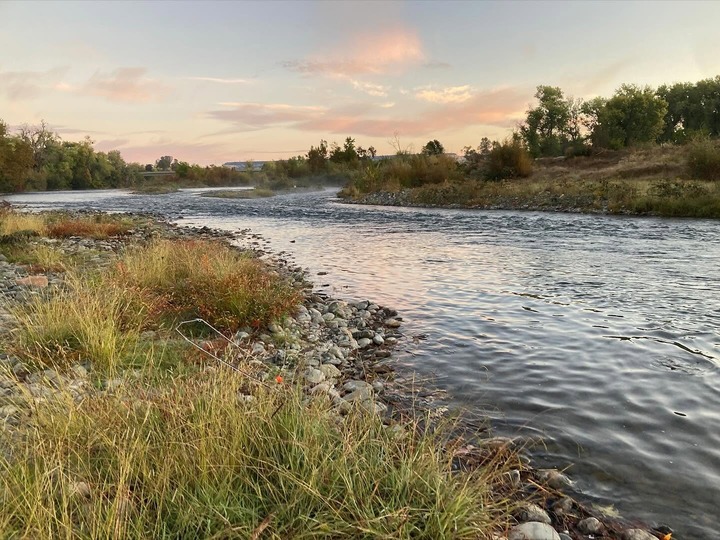
Just after sunrise on the lower Feather River. Photo taken in 2025. Image: Eric Woodruff
References and additional information:
https://nrm.dfg.ca.gov/FileHandler.ashx?DocumentID=3563
https://wildlife.ca.gov/Fishing/Hatcheries/Feather-River
https://www.calfish.org/Portals/2/Programs/CentralValley/FeatherHat/2018_FRFH_SpawningProtocol.pdf
https://donorbox.org/donate-to-the-california-sportfishing-protection-alliance