
The Marin Municipal Water District (Marin Water) is a public utility that provides water to 190,000 residents in central and south Marin County. Marin Water is proposing what it terms an “Atmospheric River Capture (ARC) Project” to divert rainwater from atmospheric river events (rainstorms) during the North Bay’s rainy season. The publicity for the Project suggests that it would capture water sourced from the Russian River in Sonoma County during atmospheric rivers and convey the water for storage in the existing Nicasio Reservoir in Marin County.
In reviewing the Project, it seems much more likely that either:
- an atmospheric river that filled the Russian River would also fill Nicasio Reservoir, or
- Marin Water would need to divert water from the Russian River when an atmospheric river was not occurring in either watershed.
The Project
The ARC Project would involve the installation of a new 13-mile, 36-inch diameter pipeline to connect the existing North Marin Aqueduct to Nicasio Reservoir in western Marin County. Marin Water already receives water from the Russian River to Marin County through the North Marin Aqueduct, mostly in the dry season. However, under existing conditions Marin Water does not store water from the Russian River. It delivers Russian River water directly to its customers.
The Project’s stated objective is to store surplus winter water for later use during dry months and drought years. By storing water that would otherwise flow to the ocean, the Project would increase Marin’s available supply (Marin Water’s ARC Project webpage, 2026). Marin Water states that the yield of stored water in Nicasio Reservoir would be up to 3,800-acre feet of water in a dry year (Marin Water’s ARC Project webpage, 2026).
Environmental Review
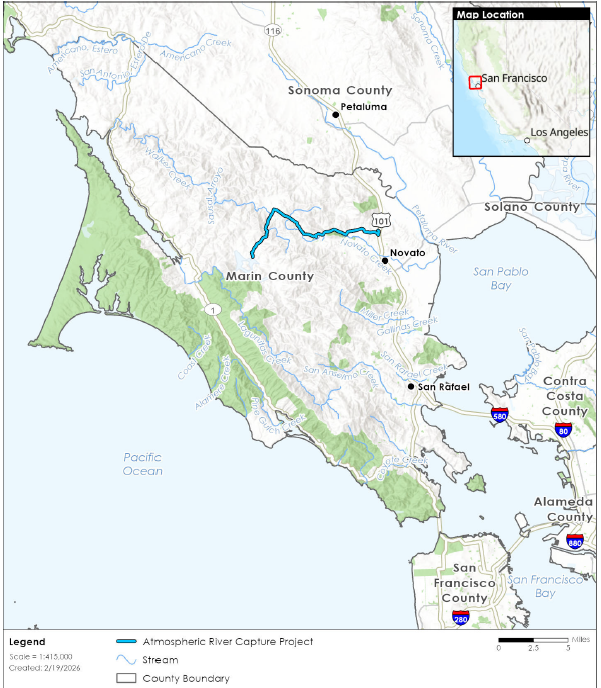
Map of Project Location, from the Notice of Preparation of Environmental Impact Report for the Atmospheric River Capture Project, March 13, 2026. Image: Marin Municipal Water District
In March 2026, Marin Water issued its Initial Study Checklist (ISC) and Notice of Preparation (NOP) of the upcoming Environmental Impact Report (EIR) for the ARC project, pursuant to the California Environmental Quality Act (CEQA). The ISC and NOP describe Marin Water’s initial plans for constructing the ARC facilities. They also discuss the studies that the district will conduct for the EIR.
Along its proposed new pipeline west of the city of Novato, Marin Water plans to construct two pump stations, a 5-million-gallon water tank, and a dechlorination facility. Marin Water projects that the capacity of the pump stations and the pipeline will be 30 million gallons per day. This means the conveyance capacity of the new pipe will be about 92 acre-feet of water per day.
The Conditions for Diversion to Storage
The Marin Water webpage for the proposed ARC Project states:
“The Project would generally operate only when all of the following infrequent but critical conditions are present:
- Low storage levels across Marin Water’s reservoirs
- An extended dry period in Marin with little to no rain in the forecast
- Forecasted atmospheric river storms in Sonoma County’s Russian River watershed that elevate river flows”
Marin Water provides no analysis of how “infrequent” this combination of conditions would actually be. In fact, it is highly unlikely that the three sets of conditions would ever occur together. It is even more unlikely that enough events involving all three factors would occur for 36 days in a single season. It would take 36 days to supply the ARC Project’s 3800 acre-foot maximum at the pipeline’s capacity of 92 acre-feet per day.
Practical Analysis
Nicasio Reservoir is less than 30 miles from the point of diversion from the Russian River near Forestville. This project assumes that an atmospheric river would result in rain in the Russian River watershed while there was no rain in the watershed that drains into Nicasio Reservoir.
It is much more likely that if it was raining hard enough to qualify as an “atmospheric river” in the Russian River watershed, it would be raining hard at Nicasio Reservoir too. If there were a single atmospheric river event in the Russian River watershed that caused high flow at Forestville, it would be extremely unlikely that event would last for 36 days without any rain at Nicasio. It would be even more unlikely that these conditions would repeat a second or third time in a wet season.
It is much more likely that there would be a several-day atmospheric river event, or simply a rainstorm, in the Russian River watershed followed by receding stream flows. Such receding flows are what this project seems designed to divert, in spite of its marketing as an “atmospheric river capture” project.
Closing Thoughts
In sum, the conditions under which Marin Water might seek to divert water from the Russian River to storage are unlikely to occur during atmospheric rivers. Naming its Project an “Atmospheric River Capture” Project is branding. The diversion capacity of the Project would be tiny. And atmospheric rivers that hit the Russian River would likely hit Nicasio as well.
Marin Water customers should be asking whether a $214 million project that captures only a little water at a time and that would likely have water available mostly when it’s not needed is the right investment for water supply reliability. (Cost source: Point Reyes Light, 4/1/26)
Marin Water expects to issue its draft EIR for the ARC Project in summer or fall of 2026. Once published, a public comment period will open for 45 days. Future ARC announcements and updates can be found here:
https://marinwater.org/yourwater/atmospheric-river-capture-arc-project/.
References and additional information:
https://www.ptreyeslight.com/news/marin-water-proposes-nicasio-capture/