
You may have seen golden mussels mentioned on your local news or on the website of a state agency. Wherever you heard of them first, you are now aware that California is at the beginning of a long fight. The objective is to protect waterways and water infrastructure from a takeover by golden mussels.
The golden mussel (Limnoperna fortunei) is native to China. This small, invasive freshwater mussel presents multiple risks to native species of fish. The golden mussel can colonize, or encrust, over the surface of a lake bed, dock, component of water infrastructure, or boat relatively quickly. This makes such surfaces dangerous for fish to cross. The tips of the mussel’s shells are sharp, and can cut a fish’s belly. Cuts like these can lead to fungal infections. They can also increase the risk of predation.
Golden mussels graze on phytoplankton and zooplankton, feeding at and near the base of the open-ocean network (pelagic) food web. This reduces the supply of food for many native fish species. The mussel’s selective grazing can also increase algal blooms, some of which kill fish. Golden mussels also filter water so that they render it clear. The change makes it easier for predators like eagles to see native fish species in rivers and lakes.
Krysten Kellum, Information Officer for the Office of Communication, Education and Outreach of the California Department of Fish and Wildlife (CDFW), said golden mussels can filter an entire reservoir within a few days.
“Since they (the golden mussel) can occur in very high densities, they are also outcompeting other benthic organisms for space, even smothering them,” said Kellum.
The term “benthic” means the ecological zone at the lowest level of a body of water or waterway, like a lakebed or riverbed.
Kellum added that when large encrustations of golden mussels’ reef-like structures grow in a stream or river, the increase in organic matter shifts varied microhabitats and their diversity to monocultures of species. This slowly eliminates aquatic species diversity.
Mussel size and spread
Newly settled golden mussels are usually less than 0.5 millimeters long. The adults typically grow to a length of between 1 and 2.5-3.5 centimeters. The maximum size of a golden mussel is just over 4 cm.
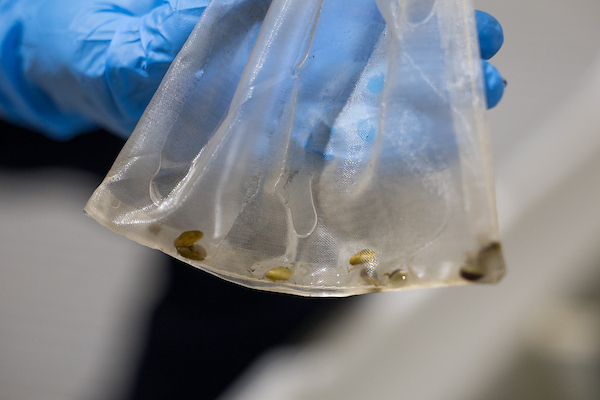
A bag of golden mussels taken from a biobox at the DWR South Bay Pumping Plant in Alameda County. Image: Xavier Mascareñas/DWR
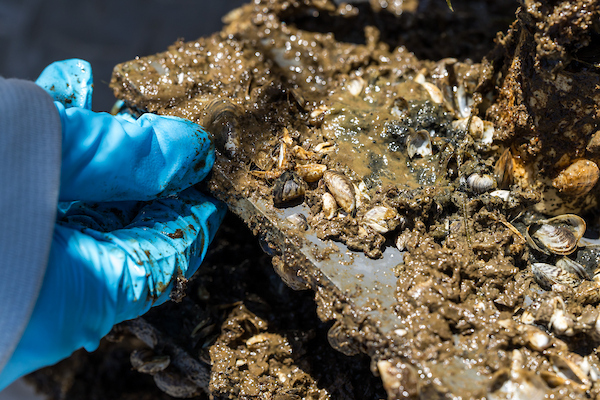
DWR Environmental Scientist Lauren Miles inspects a mussel plate and collects data for invasive species detection at Pyramid Lake in Los Angeles County. Golden mussels and quagga mussels have been found at Pyramid Lake. Image: Xavier Mascareñas/DWR
“Golden mussels were carried across the Pacific Ocean and discharged into California waters in a ship’s ballast water in 2024. This was also their introduction to North America. [The arrival via ballast water] is the same vector [cause] that introduced zebra and quagga mussels into North America,” said Andrew Cohen, Director and Lead Scientist at the Center for Research on Aquatic Bioinvasions (CRAB), a Richmond-based nonprofit.
Since 1997, at least 14 scientific papers have been published regarding the potential invasion of North America by golden mussels, after an introduction via ballast water.
“Stopping them would not have been hard, yet nothing was done. There has been a complete, utter, and abject failure by the U.S. government, via the U.S. Environmental Protection Agency and the U.S. Coast Guard, and the State of California, to provide meaningful regulation of ballast water discharge. We can expect the arrival of additional, and possibly even more damaging, ballast water invaders to continue if we don’t finally force the federal agencies to do their job,” said Cohen.
After the 2018 passage of the federal Vessel Incidental Discharge Act (VIDA), aka Title IX of the Frank LoBiondo Coast Guard Authorization Act, only the federal government is authorized to regulate ballast water discharges.
Since it is unlikely that the State of California and the federal government will be able to eradicate the golden mussel, the goal will be to manage and reduce existing populations.
The golden mussel is small and contains little meat, making it a poor source of food. Encouraging consumption of the species will not prove fruitful.
To Cohen’s knowledge, golden mussels are now present in the southern Delta, in the canals of State of California and federal water projects, and in the Contra Costa Water District. They are also in several reservoirs that are part of the named projects.
The California Department of Water Resources (DWR) said that as of May 2026, the northernmost point at which golden mussels have been found is in the State Water Project downstream of the Delta from Clifton Court Forebay, in Contra Costa County. This site is approximately 10 miles northwest of Tracy. Golden mussels can be found going south as far as Silverwood Lake in San Bernardino County.
Cohen said golden mussels are more likely to be abundant on warmer, slower moving rivers and in lakes and ponds than in faster moving or cold-water streams and rivers.
Measures available to stop the overland spread of the golden mussel between watersheds in the U.S. include inspecting, treating, and quarantining boats.
“(These measures) may be of some practical help or they may, in practice, be no help at all. We have no data on that one way or the other. However, if government agencies are going to spend public money or time on this, or require or encourage members of the public to spend their own money or time on this, then the agencies should focus on the measures that are most likely to be helpful. (They should) avoid measures which have been demonstrated to be no help at all,” said Cohen.
Cohen added that certain measures could theoretically stop the overland spread of the golden mussel. Helpful steps would include prohibiting the transport of any boat between any two water bodies that are not hydrologically or hydraulically connected, requiring that any boat that is to be moved between such water bodies be quarantined on land for a sufficiently long time to kill any attached mussels, and effectively enforcing these prohibitions and requirements.
Agencies involved in reducing golden mussel populations
Numerous California State agencies are involved in managing the spread of golden mussels, including CDFW, DWR, and the California Department of Parks and Recreation (State Parks).
CDFW has developed a website about the species. It issues press releases about them as well as posts on social media. State Parks now mandates owners of motorized recreational vehicles in freshwater to purchase and display a $16 mussel fee sticker. This must be purchased through the California Department of Motor Vehicles. DWR has created a website about invasive mussel mitigation, which addresses golden mussels.
Tanya Veldhuizen is Special Projects Section Manager in the Environmental Assessment Branch of DWR. She said that agency is concerned that golden mussels could impede the delivery of water through the State Water Project (SWP), California’s primary water infrastructure.
“With increased monitoring and maintenance, the mussels will have an economic impact to the State Water Project and the cost to deliver water supply to 27 million Californians and 750,000 acres of farmland. The costs for mitigation measures to protect SWP infrastructure from the golden mussel are being tracked. These costs are expected to increase as a result of designing and installing protective measures at SWP pumping plants, fish facilities and other critical water delivery structures,” said Veldhuizen.
Biofouling impacts, defined as the impact of an accumulation of objects like live mussels on an object’s surface, are predicted to be similar to those of quagga and zebra mussels. Issues may include the fouling of trashracks, screens, and strainers, clogging of small diameter pipelines including intake lines, fouling of the walls of larger diameter pipelines and the canal liner, fouling of water quality equipment, and fouling of fish screens. DWR will be making adjustments to inspection and maintenance procedures at SWP pumping plants to minimize the effects of mussel biofouling.
So far, DWR has observed limited impairment of equipment functions. Examples include fouled fish louvers and flow meter gauges. A fish louver is a set of vertical slats set on a diagonal across a flow field to cause turbulence. Fish usually avoid the feature.
DWR is working to implement protective measures and maintain operational capacity. Its ways to address the issue include fire, installing medium pressure ultraviolet (UV) disinfection units on small diameter cooling, and service water lines inside of SWP pumping and hydropower plants.
“These UV systems kill the veliger, or larval life stage. (That prevents) settlement inside of these critical pipelines. We are evaluating the use and feasibility of anti-fouling coatings. We are conducting research on the use of chlorine, copper and hot water in small diameter piping systems to control mussel fouling and settlement,” said Veldhuizen.
On a statewide level, state agencies, counties, cities, municipalities, and utility districts cover the costs for mussel monitoring. They also pay for inspections and prevention programs like watercraft inspection and public outreach. DWR has invested about $3.3 million annually for additional early detection monitoring and prevention at SWP facilities. It has formed partnerships with State Parks, Los Angeles County Parks, and East Bay Parks that manage SWP recreation facilities.
The money to pay for DWR’s share of early detection monitoring and watercraft inspections comes from a combination of the 29 SWP contractor agencies and the Quagga/Zebra Prevention Grant Fund, funded by sale of the mussel fee sticker. Veldhuizen said that at this time, DWR has seen no documented evidence that golden mussels have negatively impacted salmonids or other native fish species in California. There is a site at which DWR is measuring how much additional work they cause.
Golden mussels have encrusted the fish screens that divert fish into DWR’s Skinner Fish Protection Facility. The facility is located in the southern portion of the Delta near Byron. DWR staff regularly power wash and hand scrape the fish screens/louvers to remove attached mussels. DWR is now conducting research on pesticides like potassium chloride that only kill mussels and are not harmful to fish.
“These potential pesticides are required to go through the regulatory approval process. The research and regulatory approval process may take several years,” said Veldhuizen.
Notes for boaters and anglers
The most common way that invasive mussels are unintentionally moved between waterbodies that are not hydrologically or hydraulically connected is by attaching to and traveling with watercraft and related equipment. This activity is called “hitchhiking.” Anglers and boaters should contact the managing agency of the water body they intend to visit to learn launching requirements and potential closures.
Helpful actions could include cleaning, draining, and drying all watercraft and equipment. These steps are covered in the “Clean. Drain. Dry” procedure relayed by the nonprofit Stop Aquatic Hitchhikers.
Cohen said the problem is that State agencies recommend or require or conduct hot water treatments that studies have shown to be completely ineffective.
“On one video, probably the most commonly used one, my estimate of the contact time between the hot water spray and any point on the hull was about 1/5 of a second. I believe that other demonstration videos show something similar. The videos typically show longer contact with certain parts of a boat, like the gimbals (which help move motors). The published scientific studies state that at least 10 seconds of contact with a spray of 140°F water is needed to produce 100% mortality of zebra mussels. At least 5 seconds of contact is needed for 100% mortality of quagga mussels. 1 second of contact produces zero mortality,” said Cohen.
Another issue is addressing carpeted runners. A stored boat may sit on such runners in a trailer.
It is difficult to inspect carpeted runners effectively for very small mussels. It is also challenging to spray every spot within carpeted runners with hot water for 10 seconds each.
Golden mussels may also hide in gimbals, the water channels in water-cooled boat engines, through which they could be transported to new locations. They may hide in water channels through which water is piped in to keep bait or fish wet, ballast tanks in waterskiing boats, and parts that hook the boat to a trailer. All of these components are hard to clean.
Cohen said he did not know any of any chemical treatments that have been found to be useful and safe for treating entire boats.
“There may be chemical treatments that have been used and been useful for more specific uses in some circumstances,” said Cohen.
A perspective from State Parks and funding availability
State Parks is currently coordinating with entities beyond CDFW and DWR regarding golden mussels. These include the U.S. Bureau of Reclamation, U.S. Fish and Wildlife Service (FWS), and other state, federal, and local agencies. State Parks organizes this coordination through FWS’s Aquatic Invasive Species Program.
State Parks’ program to award grants for prevention is the Quagga and Zebra Mussel Infestation Prevention Grant Program. This program has awarded close to $28.8 million since it started in 2014. The program is now undergoing regulatory updates pursuant to Assembly Bill 149. The updates will expand the program’s scope beyond quagga and zebra mussels. The program will then include all invasive freshwater mussel species, including golden mussels.
The resources that State Parks has from sales of the mussel fee sticker vary from year to year. For state fiscal year 2023-2024 (July 1, 2023 to June 30, 2024), the total was a bit over $3.48 million. But in the next fiscal year, 2024-2025, the total was drastically down, just a bit over $1.07 million. For fiscal year 2025-2026, the partial total from July 1, 2025 to September 30, 2025 is $480,816.
State Parks’ Division of Boating and Waterways (DBW) administers the monies from the grant program. There are two tiers of this program. Tier 1 is for planning and assessment projects. Such projects support the development or improvement of a prevention plan. Tier 2 is for implementation projects. These support the implementation of an approved prevention plan.
“To qualify for Tier 2 funding, applicants must upload their prevention plan and a signed acceptance letter from CDFW into the DBW’s Online Grant Application system,” said Adeline Yee, Information Officer II, Communications and Marketing Division of California State Parks.
Every Tier 2 grant recipient has to participate in at least three public outreach events addressing the impacts of mussel infestations. They can conduct events in person or virtually. The awardees must also install physical signage at the reservoir(s). In addition, they have to post information about their grant project on their website within the first year of the grant award.
In addition to grantee outreach requirements, DBW conducts its own outreach and education efforts. This includes participation in boat shows and grantee-hosted events. DBW also provides outreach materials, including signage and handout materials, to local and federal agencies.
So far, State Parks has received feedback from boaters and the recreational public that has generally indicated people now have more awareness of watercraft inspection procedures and the risks associated with quagga and zebra mussel infestations.
“Over the past several years, prevention messaging has become more visible at reservoirs, marinas, and public events. Boaters are increasingly familiar with inspection requirements prior to launching,” said Yee.
She added that the primary responsibility for implementing public outreach campaigns, conducting inspections, and delivering on-the-ground education rests with the managers of local water bodies.
“These agencies design and execute outreach strategies tailored to their facilities and communities, including signage, public events, media engagement, and direct boater interaction. DBW supports these efforts through grant funding, program guidance, and the development and distribution of educational materials. While DBW plays an oversight and support role, the day-to-day implementation of inspection and prevention activities occurs at the local level,” said Yee.