
It takes effort to keep hatchery salmon safe, particularly from live disease-causing agents like bacteria, viruses, and microorganisms, which collectively are called pathogens. The fish hatcheries run by federal and state agencies employ different techniques to ensure the health of California’s salmon populations.
In California, the two agencies involved in this effort are U.S. Fish and Wildlife Service (FWS) and the California Department of Fish and Wildlife (CDFW).
FWS and CDFW regularly communicate about salmon and steelhead pathogens in California’s Central Valley. They often run into similar pathogen issues. They also share potential solutions, according to Krysten Kellum, an Information Officer for the Office of Communication, Education and Outreach at CDFW.
The work at Coleman National Fish Hatchery
Coleman National Fish Hatchery, operated by FWS, is located near Anderson, California on Battle Creek, a tributary of the Sacramento River. Battle Creek enters the Sacramento River just downstream of two dams, Shasta Dam, completed in 1945, and Keswick Dam, completed in 1950. Shasta and Keswick dams block access for Chinook salmon to the historical spawning grounds upstream of them, in the Pit River, the McCloud River, and the northern end of the Sacramento River. Thus, the Coleman hatchery helps maintain salmon populations in the Sacramento River system.
Coleman holds approximately 13 million hatchery Chinook salmon. Currently, some adult salmon and steelhead swim up Battle Creek to spawn upstream of the hatchery. FWS uses year-round filtration and ozone treatment of the hatchery’s water supply to protect Coleman’s hatchery salmon from the pathogens that wild salmon may have been carried upstream. FWS also directly treats the eggs that it harvests at the hatchery to prevent transmission of pathogens from hatchery-bred adults to the eggs.
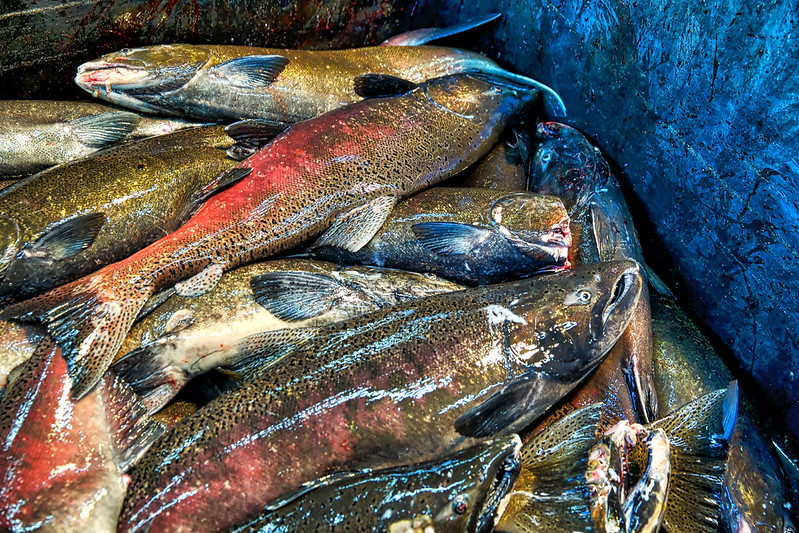
Fall-run Chinook salmon being processed at Coleman National Fish Hatchery. Image: USFWS/Steve Martarano
There are facilities at the Coleman hatchery that filter the water that enters the hatchery. Additional facilities then disinfect the water using ozone gas. Filtration removes sediment. Ozone gas kills pathogens like microorganisms. Together, the two methods provide the hatchery with clean water.
“In addition, the hatchery also uses disinfectants on equipment and gear to reduce cross-spreading of pathogens amongst hatchery operations. All groups of fish are sampled for fish pathogens before they are released, in accordance with U.S. Fish and Wildlife Service policy,” said Ron Stone, Supervisory Fishery Biologist at California Nevada Fish Health Center. The Center is a biological life sciences laboratory located near Coleman. The Center provides fish health services to federally funded national fish hatcheries in California, Nevada, and southern Oregon.
It is above all the presence of wild salmon and steelhead upstream that makes the elaborate filtration and ozone system at Coleman necessary. Other salmon and steelhead hatcheries in California don’t currently have wild salmon and steelhead that pass upstream.
The need for extensive water treatment has become a major issue in considering whether to provide fish passage upstream of other hatcheries. For example, a pilot reintroduction of winter-run Chinook salmon in the McCloud River has stalled in part because of concerns that the Livingston Stone Fish Hatchery at the base of Shasta Dam does not have a filtration and ozone system like that at Coleman. Thus, pathogens introduced into the McCloud River could find their way downstream through Shasta Reservoir and into the water supply at the Livingston Stone hatchery. A temporary fix has been to treat salmon eggs for pathogens in the Livingston Stone hatchery and inject the treated eggs into the gravel in the McCloud River, rather than transporting adult fish to the McCloud and allowing them to spawn.
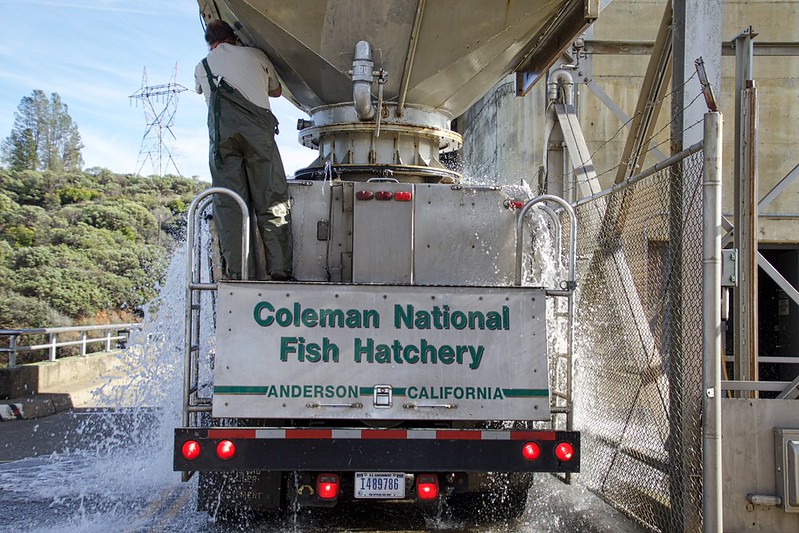
The elevator docks at a waiting USFWS tanker truck before transport to Livingston Stone Hatchery. Image: USFWS/Steve Martarano
Similar concerns have arisen in discussions of reintroducing salmon and/or steelhead upstream of the Merced River Hatchery near Snelling, California and the Mokelumne River Fish Hatchery at the base of Camanche Dam, east of Lodi, California.
Ensuring the health of the hatchery fish assists in maintaining the health of the entire Chinook salmon population downstream of Shasta Dam.
“Once released, wild fish and hatchery fish populations cohabitate in the natural environment. (FWS) considers them to be one population with regard to the potential impact of pathogens. They encounter the same water, face the same predators, and must navigate the same rivers and oceans,” said Stone.
Stone said that, once in the river, wild and hatchery fish experience similar stressors and have similar responses when infected with common pathogens. FWS experts are not sure whether pathogens more heavily affect wild fish or hatchery fish in once hatchery fish enter a river. It is the concentration of fish in a hatchery that makes pathogens so dangerous there.
CDFW’s strategies at Feather River Fish Hatchery
CDFW’s closest anadromous fish hatchery to Coleman is the Feather River Fish Hatchery (FRFH) in Oroville. This facility is approximately 255 river miles away from Coleman.
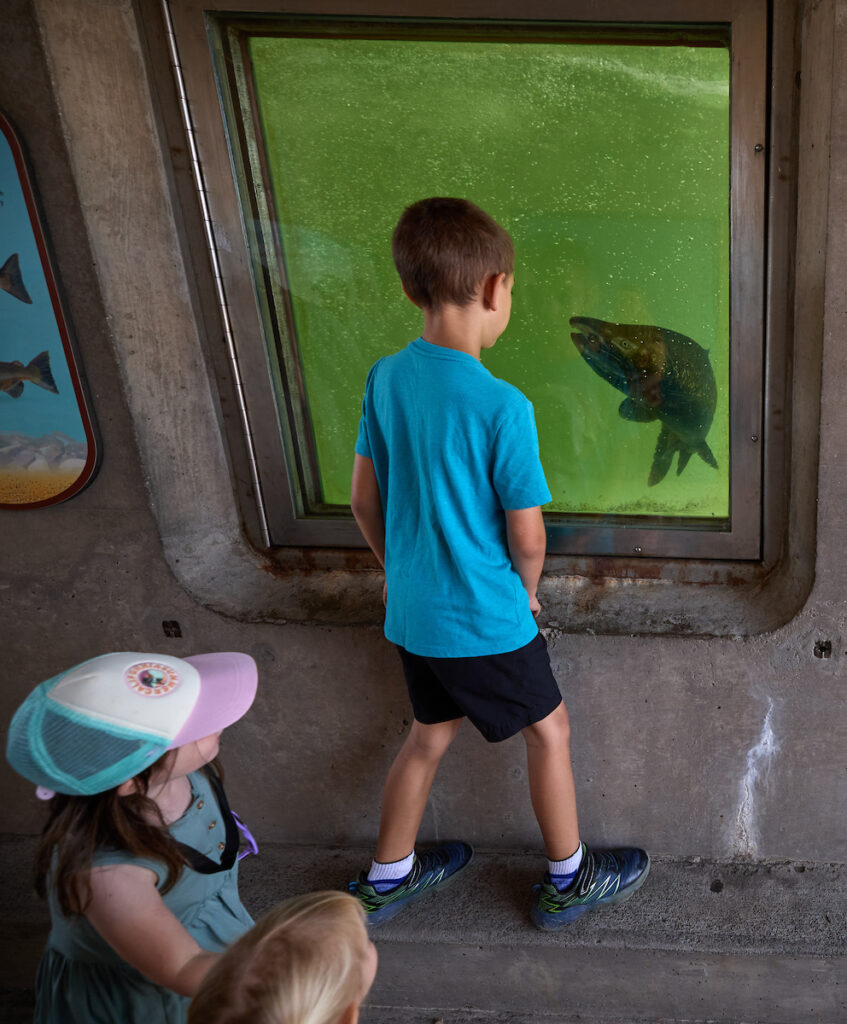
Children look through an underwater viewing window at a Chinook salmon swimming up the fish ladder at the Feather River Fish Hatchery during the Oroville Salmon Festival in September 2023. Image: Fred Greaves/California Department of Water Resources
“During spawning (season), CDFW tries to minimize any pathogens’ transfer to eggs. For example, CDFW drains (and tests) ovarian fluid prior to fertilization. CDFW also performs an iodine bath immediately after fertilization. These actions help to minimize any surface pathogens before incubation,” said Kellum.
CDFW performs annual fish health certifications on each species reared at Feather River. It also performs pre-release assessment on juvenile salmon within two weeks of being released to ensure the fish are free from disease. Kellum said disease outbreaks can happen at any point, even during planned releases. On occasion, CDFW prioritizes the treatment of disease outbreaks over releases.
The pathogens that cause disease
There is a long list of pathogens that are common in the Sacramento River, the Feather River, the American River, the Klamath River, and the San Joaquin River.
According to Brett Galyean, Project Leader at Coleman National Fish Hatchery Complex, it is difficult to determine and quantify the impacts of these pathogens exclusively on wild fish.
“The list of pathogens persisting in these watersheds includes Infectious hematopoietic necrosis virus (IHNV), Flavobacterium columnare (columnaris), Ceratanova shasta, Tetracapsuloides bryosalmonae, and Ichthyophthirius multifiliis (ich),” said Galyean.
Infectious hematopoietic necrosis virus (IHNV), which affects young salmonid fishes worldwide, can cause hemorrhaging, anemia, fading of the gills, skin darkening, bulging of the eyes, abdominal distension, and death. Fish that survive after contracting IHNV can covertly carry the virus.
Flavobacterium columnare causes infection that can kill fish, especially when they are stressed by high water temperatures.
Ceratonova shasta (syn. Ceratomyxa shasta) is carried by a host worm that particularly infects juvenile salmon. It can lead to lethargy, skin darkening, kidney pustules, and death. Its effects are made worse by high water temperatures.
Tetracapsuloides bryosalmonae causes kidney disease.
“Ich” can lead to anorexia, discoloration, and abnormal activity, like isolation. Its effects too worsen in conditions of high water temperatures.
Spironucleus spp., a disease that is not on the list, negatively affects a fish’s gastrointestinal tract.
Other pathogens that present a concern, especially in the Sacramento River watershed, include Flavobacterium psychrophilum, or bacterial coldwater disease; Ichthyobodo necator, or Costia, and Saprolegnia spp., a water mold-like organism.
These three pathogens cause infection, and can also lead to death.
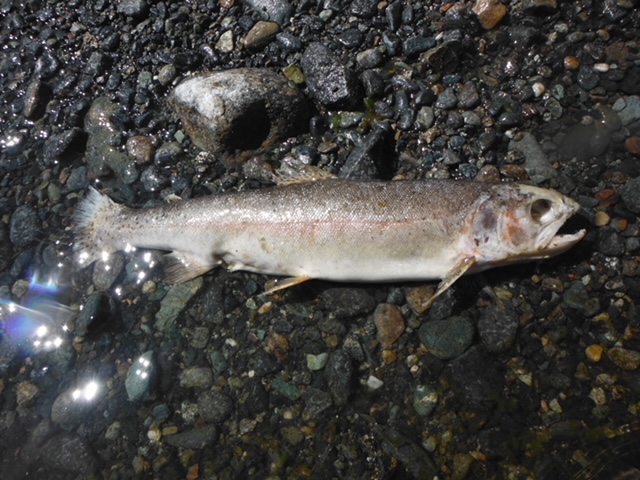
Dead juvenile salmon in a Klamath tributary during late summer, when river conditions were exceptionally dry and warm. The fish appears to have died from Ich or gill rot. Image: Amber Jamieson.
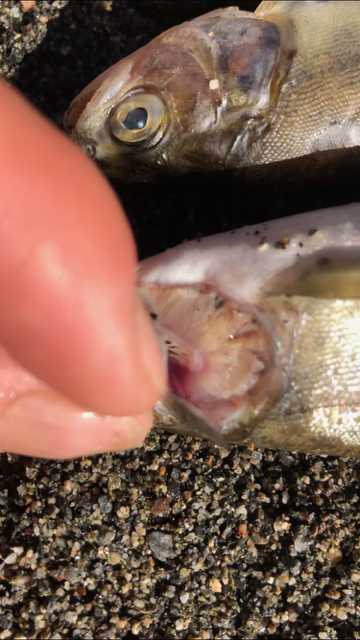
Close-up of dead juvenile salmon gills likely infected with Columnaris. Image: Amber Jamieson
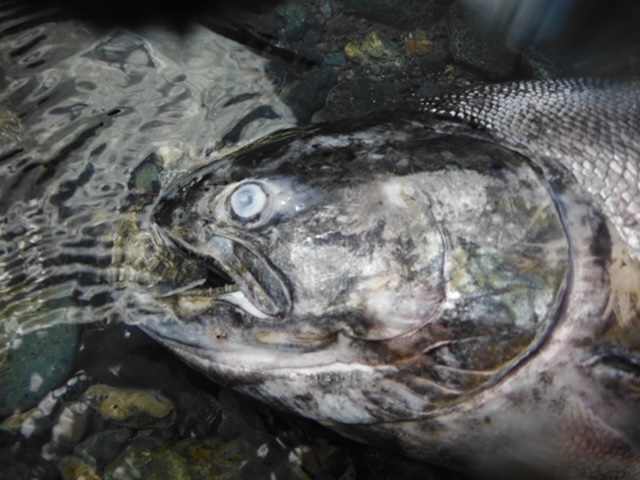
Diseased and deceased adult salmon taken on the banks of the Salmon River, prior to spawning. Image: Amber Jamieson.
A few notes about work on the Klamath River
There has been an ongoing multi-agency monitoring effort on the Klamath River of both out-migrating juvenile salmon and returning adults. This effort has involved federal, State, Tribal, and university partners.
“Out-migration monitoring efforts examine the prevalence, severity and spore concentration of C. shasta, while returning adults are monitored for Ich and Columnaris, primarily,” said Stone.
More information about these programs is available at FWS’s Arcata Fish and Wildlife Office website, the Fisheries department pages on the website for the Yurok Tribe, and pages on Fish Pathogen Monitoring Studies at Oregon State University’s Department of Microbiology.
“Similar efforts are occurring in the Feather River as well, looking to C. shasta in out-migrating salmon,” said Stone.
Warmer water temperatures can increase infection
Many bacteria and parasites thrive in warmer water temperatures. Colder water is optimal for other pathogens.
There is limited surveillance on the impacts of disease on fish in the wild. This often makes it difficult to determine which pathogens are of greater concern. But warm water itself is the primary concern. Warm water stresses fish, making then more susceptible to pathogens.
Stone said some pathogens are obligate pathogens. That means a fish gets infected after it experiences a primary stressor.
“Typically, we (at Coleman) see more fish health issues in the summertime, when water temperatures are warmer, 65 degrees Fahrenheit or higher. The primary reoccurring fish pathogen we see at this time of the year (fall) at the hatchery is Columnaris, a highly contagious bacterial infection,” said Galyean.
There are increasing predictions that the coming rainy season in California will feature extreme El Niño conditions. There is the potential that warm, wet conditions may reduce snowmelt. This could present a heightened risk that pathogens may affect both wild and hatchery fish. High water temperatures in the Klamath after early snowmelt in spring 2026 contributed to high infection rates of C. Shasta in juvenile salmon.
An El Niño year can also pose problems for juvenile salmon in the Pacific Ocean. This is because warmer ocean waters tend to be poor habitat for the type of prey that salmon need to grow and mature once they reach saltwater. CSPA and other nonprofits that advocate for native fish will be reviewing the research on this year’s El Niño conditions, to better understand the weather phenomenon’s effects and potential solutions.