
In the mid to late 1980s, the Great Lakes region began addressing the spread of zebra and quagga mussels. These two species are not native to the U.S. They have done an enormous amount of ecological damage in the Great Lakes and their tributaries.
The federal government and States in the Great Lakes region have made incredible progress in monitoring the populations of zebra and quagga mussels. They have also assessed these species’ impacts and slowed the spread of these mussels. All of these efforts offer California some paths forward.
Both zebra and quagga mussels belong to the family Dreissinidae. They are called dreissenid mussels. These two species are native to eastern Europe and western Asia.
Golden mussels belong to the family Mytilidae. They are called mytilid mussels. Golden mussels are native to China and parts of southeast Asia.
All three of these mussel species spread quickly. They encrust and clog water infrastructure, such as pipes and screens. They outcompete native flora and fauna for available food. They also compete with one another.
Quagga mussels appear to have first arrived in southern California in 2007. Zebra mussels appear to have first arrived in San Benito County in 2008. The California Department of Fish and Wildlife (CDFW) and other entities in California have been working to limit the spread of zebra and quagga mussels in the State for approximately two decades. The actions that California has taken to counter zebra and quagga mussels will also provide ideas about how California should address golden mussels.
Mussel history
Zebra mussels arrived in the Great Lakes in the mid-1980s. Quagga mussels came a few years later, in the late 1980s. Both species were introduced through ballast water from transoceanic vessels. Dreissenid mussels have negatively affected the Great Lakes in many ways, such as:
- carpeting the floor of the large water bodies and their slow-moving tributaries. This has reduced and changed habitats for native species and for introduced but commercially important species like Chinook salmon.
- increasing water transparency. Dreissenid mussels filter water to feed on phytoplankton.
- causing the development and spread of large, toxic algal blooms.
- outcompeting native mussels and other filter feeders.
Dreissenid mussels have disrupted and altered native food webs. This has changed the diets of native fish species, such as lake whitefish (Coregonus clupeaformis). This bottom-dwelling fish is a keystone species for the Great Lakes. Lake whitefish are a local icon that are beloved by local anglers.
Dreissenid mussels have also negatively affected introduced fish species, including Chinook salmon, coho salmon, and steelhead trout. The changes have reduced fish reproductive capacity. They may be contributing to seasonal nutritional deficits for newly hatched fish of some species.
Dr. Ashley Elgin is a research ecologist for the U.S. National Oceanic and Atmospheric Administration (NOAA). She works at the Great Lakes Environmental Research Laboratory in Muskegon, Michigan.
Elgin studies the benthic, or bottom, layer of the Great Lakes. Elgin said it is concerning that dreissenid mussels currently make up over 95 percent of the benthic biomass in all of the Great Lakes, except Lake Superior.
“California is in a better position than we were to deal with invasive mussels. That’s because the states out West are now more organized for early detection and rapid response. Decades ago, we were caught off guard,” said Elgin.
Vigilance and responsiveness are the key to coping with invasive mussels.
“You want to monitor populations of every water body they inhabit. That way, you can figure out what effects they are having. I primarily focus on understanding impacts,” said Elgin.
For the last decade, Elgin has focused her research on Lake Michigan. This water body reached a peak population of zebra and quagga mussels in the late 2000s.
“Quagga mussels peaked in 2008 in the mid-depth zone (of Lake Michigan) and then started to decline,” said Elgin.
For the last two years, Elgin’s team has been doing research to develop tools for underwater vehicles. Her team’s implement works by lifting mussels from the lakebed using a belt and then passing them through a crushing mechanism.
“We crush the mussels and leave the remains. Some fish eat them. A host of other benthic invertebrates and bacteria feed on them. This creates a lot of decaying material,” said Elgin.
Right now, Elgin’s team is monitoring the water of Lake Michigan at different levels. They are searching for the larval form of zebra and quagga mussels. The individual larvae are called veligers.
A veliger larva is very small, usually 0.1-0.2 millimeters (mm) in diameter. They are released between late spring and early summer. Mussel veligers drift through the water as they consume phytoplankton and grow.
Elgin said there is a lot of international collaboration with Canada and European countries. These entities are also affected by the spread of zebra and quagga mussels.
“These species have brought many researchers together. Reading different reports and listening to different scientists is helpful for figuring out solutions,” said Elgin.
Elgin added that she recently joined a Golden Mussel Coordination Group. Researchers and managers from multiple U.S. States have joined the group to share information and ideas. Dr. Susan Pasko, Executive Secretary of the Aquatic Nuisance Species Task Force, for the U.S. Fish and Wildlife Service, is the head of the Coordination Group.
Thoughts from an entrepreneur
Dr. Lewis Steven Beckham is the founder of Barnacle Blocker, LLC, a Florida-based company that manufactures an invasive mussel deterrent called Mussel Stopper. He currently lives in Cortez, Florida, a small Gulf Coast fishing village a bit north of Sarasota. Despite the fact that he is far from California, Beckham is aware of the problems that the golden mussel can cause.
His product is an insoluble, crayon-like substance which contains beeswax, soy wax, and capsaicin pepper extract.
“It’s an all-natural product. You apply it on the surface of the material where you don’t want mussels to attach,” said Beckham.
Tests of Mussel Stopper in Lake Mead and Lake Powell showed nearly 100 percent efficacy for a three-year period.
“Veliger forms of many mussel species, including zebra, quagga, and golden mussels, send out proteinaceous threads called byssals. This allows them to attach to different surfaces,” said Beckham.
A mussel retracts its byssal very quickly if it encounters capsaicin.
“They don’t like it, because it’s very spicy,” said Beckham.
Zebra mussels only attach to hard surfaces, while quagga mussels will attach to mud. Beckham is looking into whether golden mussels will attach to soft surfaces.
It can be problematic to coat every possible surface with Mussel Stopper, because of the cost and effort. Mussels can even attach to one another.
Beckham said mussel removal can be very expensive and dangerous if large equipment gets colonized by mussels.
He has seen huge gantry cranes colonized by clumps of quagga mussels on the Davis Dam, which is downstream from the Hoover Dam. Some of these clumps get as big as soccer balls.
“Periodically they raise the components and clear them. At one point when they were doing that, the metal parts were almost totally full of mussels. The weight almost broke the crane,” said Beckham.
Beckham would like to see if his product could be utilized by CDFW and where it would be effective. He is currently exploring these possibilities.
Developing policy
Greg McClinchey is the Director of Policy and Legislative Affairs for the Great Lakes Fishery Commission (the Commission). This bi-national commission of the U.S. and Canada coordinates fisheries research and controls invasive species such as sea lamprey that affect both countries.
McClinchey said the dreissenid mussels in the Great Lakes and the move of the golden mussel east reminds him of the spread of the invasive sea lamprey. That species devastated the Great Lakes in the 1950s.
“The Great Lakes Fishery Commission and the federal government came together to prevent the entire fishery from collapsing. We now have that species under control. Before the Commission came along, there wasn’t a lot of coordination,” said McClinchey.
McClinchey is hopeful about a new piece of legislation introduced in the U.S. House of Representatives in November 2025, the “Save the Great Lakes Fish Act of 2025.” This bill may be a way to counter invasive mussels in the Great Lakes.
“This would amend the Great Lakes Fishery Act of 1956 by helping the Commission develop methods to combat invasive mussels. It would allocate $50 million over 10 years to come up with a control program,” said McClinchey.
Reducing invasive mussel populations is important if the Commission wants to preserve species of lake whitefish.
“The whitefish fishery alone is worth a great deal to States in this area. In addition, there is a spiritual element to preserving this species’ habitat for many Tribal communities,” said McClinchey.
McClinchey said the Canadian Standards Association, a government body that develops national standards, is currently engaged in work to find different ways to clean boats.
“We’re watching what they come up with, to see if those methods would work in the U.S.,” said McClinchey.
Public outreach that works
Tim Campbell is the Aquatic Invasive Species Outreach Specialist for the Wisconsin Sea Grant. His job involves finding ways to engage with the public about invasive and harmful species.
The Wisconsin Sea Grant is a statewide research, education, and outreach program based at the University of Wisconsin-Madison. It is part of the same national network of 34 university-based programs as California Sea Grant. Wisconsin Sea Grant is funded through NOAA’s National Sea Grant Program and matching contributions from participating States and the private sector.
Campbell said it is hard to find out what works to get anglers and boaters to stop spreading invasive mussels.
“There are so many different messages out there. With so many messages, it’s hard to know what is breaking through and sticking with boaters,” said Campbell.
The two that he has found that have stuck in the minds of boaters nationally are “Stop Aquatic Hitchhikers” and “Clear – Drain – Dry,” to ensure boats are not carrying invasive mussels.
“You want campaigns that are short, easy to remember, and action-oriented. The campaigns need to tell you what to do,” said Campbell.
These two particular campaigns have been in existence since 2002. No one had previously evaluated their effectiveness before Campbell’s study published in early 2026.
“When you combine the two campaigns together, that seems to move the needle to change people’s behavior the most. Their boating history, education, and experience were not significant factors,” said Campbell.
Campbell said campaigns that encourage productive conversations have positive social and prevention effects. This is because people like to learn about what works and talk about how they have made contributions.
“Discussing only the negative effects of the mussels can be less effective, because that can push people away. (That also can make it) seem like there is nothing they can do,” said Campbell.
About 10 years ago, Wisconsin Sea Grant produced a number of items for boaters and anglers as conversation starters.
“Signs providing information at boat landings have been most effective. We also produced floating keychains, hats, fishing jerseys, and (drink) coozies – all reminders to stop Aquatic Invasive Species (AIS) while boating,” said Campbell.
In addition, Wisconsin Sea Grant developed and continues to develop posts that it shares on social media channels. Examples include the “Clean – Drain – Dry” videos that it airs on its YouTube channel.
“The majority of people want to do the right thing. We need to give them the knowledge and the tools to do it,” said Campbell.
There are thousands of lakes in Wisconsin that invasive mussels could colonize. Technically, all of these lakes have regulations.
“It’s the enforcement at each landing that is difficult. That’s why we’ve really leaned on developing a personal responsibility approach. But we’re aware of the limitations of that,” said Campbell.
One issue is that it is hard to be 100 percent effective in cleaning a boat.
“If we get more people to clean it to a 95 percent mark, that will reduce invasion risk. But the question is what we should do if that 5 percent margin isn’t enough, if a vessel or equipment is still hosting invasive mussels,” said Campbell.
Campbell added that it may be helpful to address classes of vessel owners differently.
“A large boat that might have been slipped a long time is more likely to have attached mussels. But many of our boaters are day users. (They are) mostly likely to only have attached plants or residual water. So that’s something to look at, how size and time in the water affect what a vessel or equipment owner choose to do. Collecting this information gives us a path to suggest options for cleaning, draining, and drying, which will vary for boats of different sizes,” said Campbell.
Conclusion
Grasping the lessons of the Great Lakes make take a different perspective, especially under the Trump administration. It is likely that the federal administration will decrease funding for research and invasive mussel species removal in this region. This means the progress in the region may be stalled. California may see past work as outdated and insufficient in terms of modeling. Yet there are numerous points illustrated in the article above that are “timeless” reminders of what can be accomplished with collaboration. These include:
- Understanding the history of the golden mussel and other species similar to it, in areas outside California
- Developing conversations with technology businesses and producers of mussel prevention applications
- Realizing that complementary federal and State legislation helps address invasive mussel species
- Participating in international discussions about invasive mussels, including with countries in which an invasive mussel species is native to the area
- Paying attention to public outreach programs that were effective, determining whether there should be regional tailoring for California audiences, and recognizing limitations in terms of cost and partnerships. There may be potential for both financial contributions and public outreach efforts with companies that have an interest in encouraging boating and fishing to continue in California.
As the State of California progresses toward limiting the spread of the golden mussel, it will also be in a position to show states in the Great Lakes region what it has learned. This will promote conservation of native species across the U.S.

A solid carpet of quagga mussels in 45m of water in southern Lake Michigan. Image: Inspired Planet Productions

A rock encrusted with quagga and zebra mussels collected in Saginaw Bay of Lake Huron. Image: GLERL/NOAA

Dr. Ashley Elgin, research ecologist at NOAA’s Great Lakes Environmental Research Laboratory in Ann Arbor, stands on the deck of the R/V Laurentian, the Lab’s research vessel, during a mussel survey cruise. Image: GLERL/NOAA

Barnacle Stop®/Mussel Stopper, in a 65 gram plastic applicator. The beeswax-based product is designed for DIY use underwater. A diver can apply an initial coating or touch up wear spots. Image: Barnacle Blocker, LLC

A cleaning station near Elton Creek, in central Wisconsin. Image: Molly McKay/Wisconsin Sea Grant

A “Stop Aquatic Hitchhikers Campaign” booth at an event to celebrate Lake Michigan Day in Wisconsin. Image: Wisconsin Sea Grant
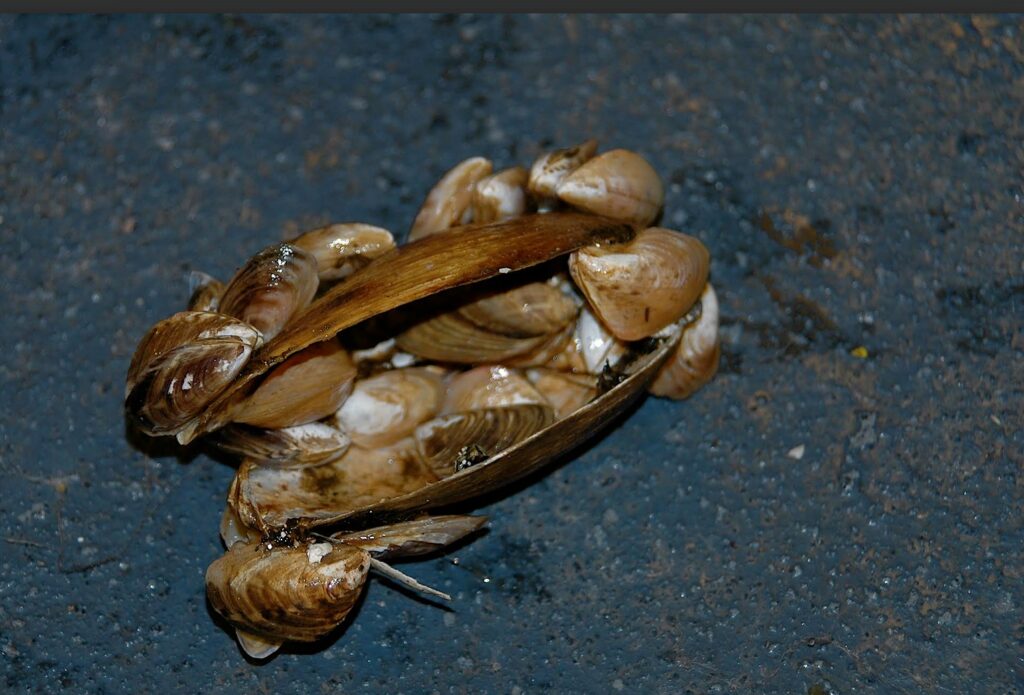
Smaller quagga mussels encrust another mussel’s shell, with the specimens coming from Lake Huron. Image: Dr. Charles Krueger/Great Lakes Fishery Commission

Erika Jensen, Executive Director of the Great Lakes Commission (left), talks with Michigan Governor Gretchen Whitmer (right). The Great Lakes Commission is an organization that promotes stewardship of the Great Lakes. Image: Great Lakes Commission