
The spike-toothed salmon (Oncorhynchus rastrosus) was a roughly 7-foot-long species that lived along the Pacific Coast and Japan five million years ago. This history of this species, particularly its evolution and extinction, reveals that it is difficult to predict the results of climate change.
Data from spike-toothed salmon fossils, reviewed with information from biological studies of modern fish, share clues about how we can protect and restore habitats for extant species. Ensuring there are viable habitats for modern-day species like Chinook salmon could give us more time and populations to understand how and why fish are changing.
The spike-toothed salmon went extinct toward the end of the Early Pliocene, a period that lasted between 5.33 and 2.58 million years ago. It could not survive during a period of global cooling, said Dr. Edward Davis, Professor in the University of Oregon’s Department of Earth Sciences. Davis is also the Condon Fossil Collection Director at the University of Oregon’s Museum of Natural and Cultural History.
“We think it was too big to come up rivers, at a time when the rivers were drying up. It was really the climate that was the deciding factor. It wasn’t predation. Since this species got so big, it had few predators,” said Davis.
The spike-toothed salmon evolved to grow to between 5 feet and 9 feet long because larger females lay more eggs.
“Bigger salmon don’t have bigger eggs. They just have more eggs. So larger female spike-toothed salmon could have more babies. The larger size resulted in a higher survival rate for the fish’s young,” said Davis.
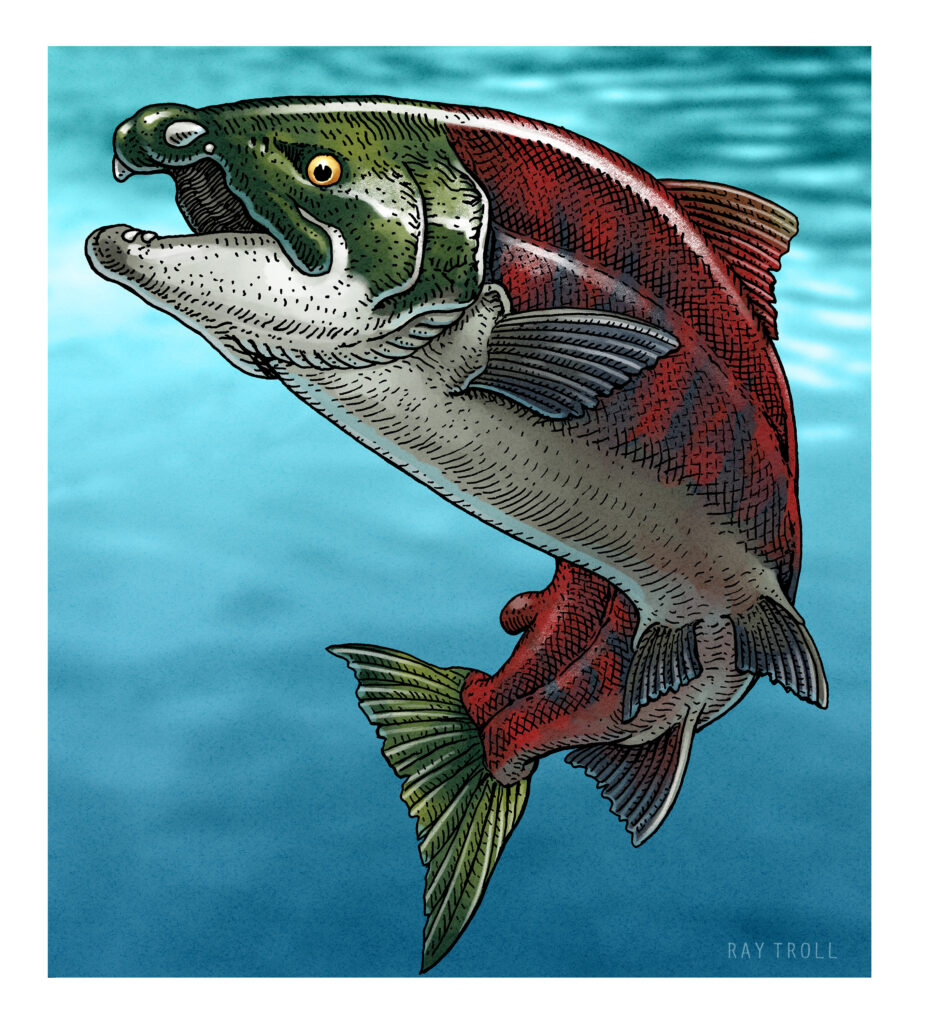
Spike-toothed salmon, as illustrated by artist Ray Troll. Image: Ray Troll
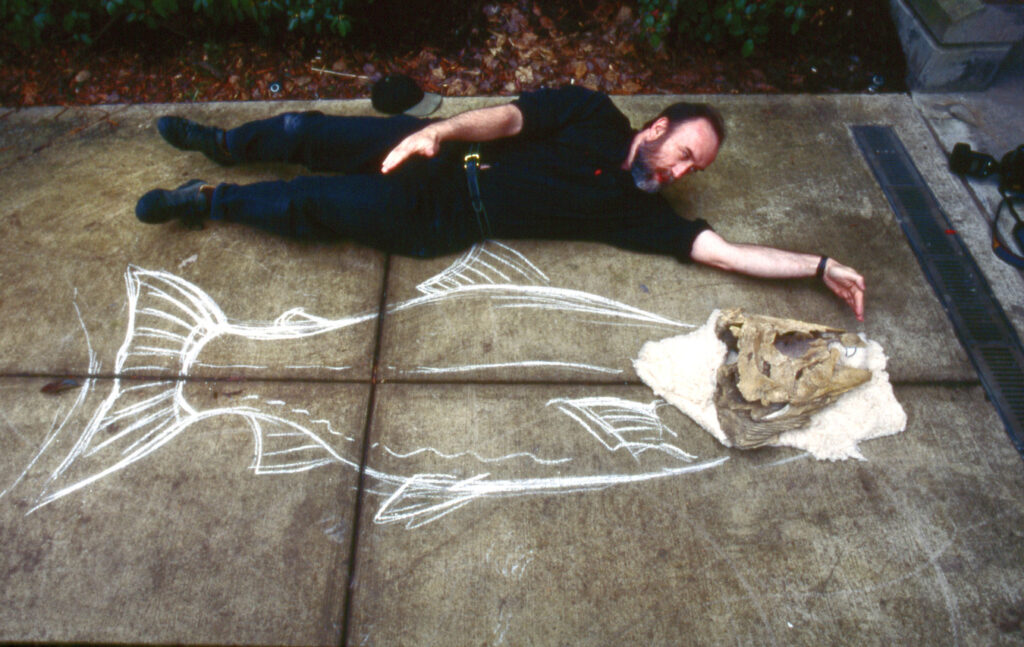
Artist Ray Troll with the fossilized head of a spike-toothed salmon and a chalk outline of this species. Image: Ray Troll
A picture of the past
The spike-toothed salmon was a filter feeder. It fed on zooplankton and phytoplankton. The habitat of the species included the Pacific Coast of North America, from British Columbia down to Baja California. The spike-toothed salmon also lived on the Pacific Coast of Japan. The species appears to have been anadromous, like modern salmon today.
Yet in California and the Pacific Northwest, the habitat of the spike-toothed salmon was warmer and wetter than it is today. Take the Central Valley of California. Here, the spike-toothed salmon lived in large, fast-moving rivers in a huge expanse stretching east to the Sierra Nevada mountain range. The rivers in this area flowed west, into the Pacific Ocean.
Five million years ago, the mountains that make up the Pacific Coast Range did not exist. The Pacific Coast Range is comprised of two ranges. These are the Northern Coast Range, which begins on the coast of Del Norte County and runs south to the northern part of the San Francisco Bay Area, and the Southern Coast Range, which begins in the San Francisco Bay Area and runs south to Santa Barbara County.
The mountains in the Pacific Coast Range parallel the Pacific Coast. These mountains formed later, between three to four million years ago. Since there were no coastal mountains, there was no retention of the precipitation coming off the Pacific Ocean. This meant the air over California’s Central Valley was wetter and milder than it is today.
“At this point in time, westerly winds coming off the Pacific Ocean caused the ocean to pull away from the coast. When the ocean does that, it’s backfilled by the deep water. The deep water is nutrient-rich and has a higher salt content than water above it. This environment provided an opportunity for more plankton to become available to juvenile and adult spike-toothed salmon in the Pacific Ocean. The natural cycle that occurred every year for salmon, in terms of them feeding and maturing in the Pacific Ocean, was more productive than it is today,” said Davis.
One of the challenges for the spike-toothed salmon was dry periods.
“In this warmer climate, more water would evaporate. However, there would also be more rain during storms. The challenge for the spike-toothed salmon was finding a way to travel down the rivers or swim up the waterfalls during dry periods,” said Davis.
There are three major physical differences between the spike-toothed salmon and modern salmon species:, the anatomy of the gill rakers, the morphology of the teeth, and overall size.
Gill rakers are bony processes that stick out from the branchial arches, the gill arches of fish. The gill arches are “loops” just behind the throat of a fish. These loops support the fish’s gills. Spike-toothed salmon had more gill rakers than modern salmon species. They also had larger gill rakers than modern salmon.
“The spike-toothed salmon had more gill rakers than any other known species of salmon, even the sockeye salmon (Oncorhynchus nerka). (The sockeye) has the most of any living species. Gill rakers form a straining basket in the throat of the fish and are used for collecting plankton as food. This is how we know that the species largely ate plankton. (They were) the reason that the original describers of the species chose “rastrosus” as the species epithet. Rastrosus is Latin for “rake-like” or “full of many rakes,’” said Dr. Brian Sidlauskas, Director of the Biodiversity Research Institute at Tulane University and Curator of Tulane University’s Royal D. Suttkus Fish Collection.
The spike-toothed salmon had a single spike-tooth about two inches long almost on the tip of its beak, on both sides of its mouth.
“The teeth were highly distinctive, with a single very large tooth projecting laterally out of the upper jaw, and a couple of other tiny teeth in the same orientation. This is really different from other salmons, which typically have smaller and more numerous teeth projecting vertically into the mouth rather than laterally away from it,” said Sidlauskas.
The spike teeth and small teeth near them may have been useful to males in fighting for females. Females may have used their spike teeth to dig a large redd, or nest, for their eggs.
Davis said the spike-toothed salmon did not grow these spikes until adulthood.
“They grew the spike teeth when they swam inland to spawn. The closest living relative of the spike-toothed salmon is the sockeye salmon. This species grows a big beak when it returns to its natal waterways to spawn,” said Davis.
The spike-toothed salmon was the largest salmon species to live on Earth.
“It reached nearly three meters in length, more than eight feet. (This is) about twice as large as the biggest living species of Pacific salmon, King Salmon (Oncorhynchus tshawytscha),” said Sidlauskas.
The spike-toothed salmon’s vertebrae were the same size as human vertebrae. There is a miniature version of the spike-toothed salmon known from Idaho. This was present in a lake where the population appears to have gotten trapped.
About 2.6 million years ago, the Great Ice Age began. This caused rivers in Pacific states like Oregon and California to dry up. At the same time, volcanic activity pushed up mountain ranges in the Pacific Northwest and Oregon. In Oregon, the mountain range that developed was the Cascade Mountain Range, which stretches from northern California up to central British Columbia. In California, the two mountain ranges that developed were the northern Coast Range and the southern Coast Range.
The new mountains captured the precipitation coming off the Pacific Ocean. They started to cast a “rain shadow” to the east. This meant interior areas in the Pacific Northwest and California saw less rainfall. The lower amount of water in rivers made it harder for spike-toothed salmon to travel up the rivers to spawn. This presented significant challenges for survival.
Where we – and salmon – are now
Earth is currently in an Ice Age, which began 2.6 million years ago. Yet Earth’s climate has been warming in recent decades. As a result, geologists place Earth as in an interglacial period, a warmer period of an Ice Age. Increases in greenhouse gas emissions and the depletion of the ozone layer makes it difficult to predict how natural habitats and salmon themselves will change.
“Further warming could mean that sea levels will rise. Rising sea levels means more frequent changes in river paths. As rivers jump course to the sea, fish may adapt to gradual changes. Sudden shifts may prevent them from ever reaching their spawning grounds,” said Dr. Juan Liu.
Liu is an Assistant Adjunct Professor in the Department of Integrative Biology and Assistant Curator at the University of California Museum of Paleontology at the University of California, Berkeley.
Davis said one of the factors that determines the sex of salmon in an area is the temperature of the water.
“If it’s too hot, all of the eggs in clutches of a river can become one sex or the other. Having eggs be largely female one year and largely male another would be detrimental toward a continuation of the population,” said Davis.
Theoretically, because California’s climate is getting warmer, modern salmon species could get larger. They could start to look more like spike-toothed salmon, perhaps minus the many and larger gill rakers and the spike teeth. Yet a modern study from Oregon suggests another outcome, for a different species.
Lessons from the coastal cutthroat trout
The coastal cutthroat trout (Oncorhynchus clarkii clarkii) is getting smaller. This information comes from data in studies done in H.J. Andrews Experimental Forest. The Andrews Forest Program at this site is administered cooperatively by the U.S. Department of Agriculture’s Forest Service’s Pacific Northwest Research Station, Oregon State University, and the Willamette National Forest. Funding for research at this site comes from the National Science Foundation and the Pacific Northwest Research Station.
“We’re seeing a decline in size in this species, although the pattern is not uniform across all salmonids. As in Pacific salmon, larger females produce more and larger eggs, increasing juvenile survival,” said Dr. Ivan Arismendi, Associate Professor in the Department of Fisheries, Wildlife, and Conservation Sciences at Oregon State University.
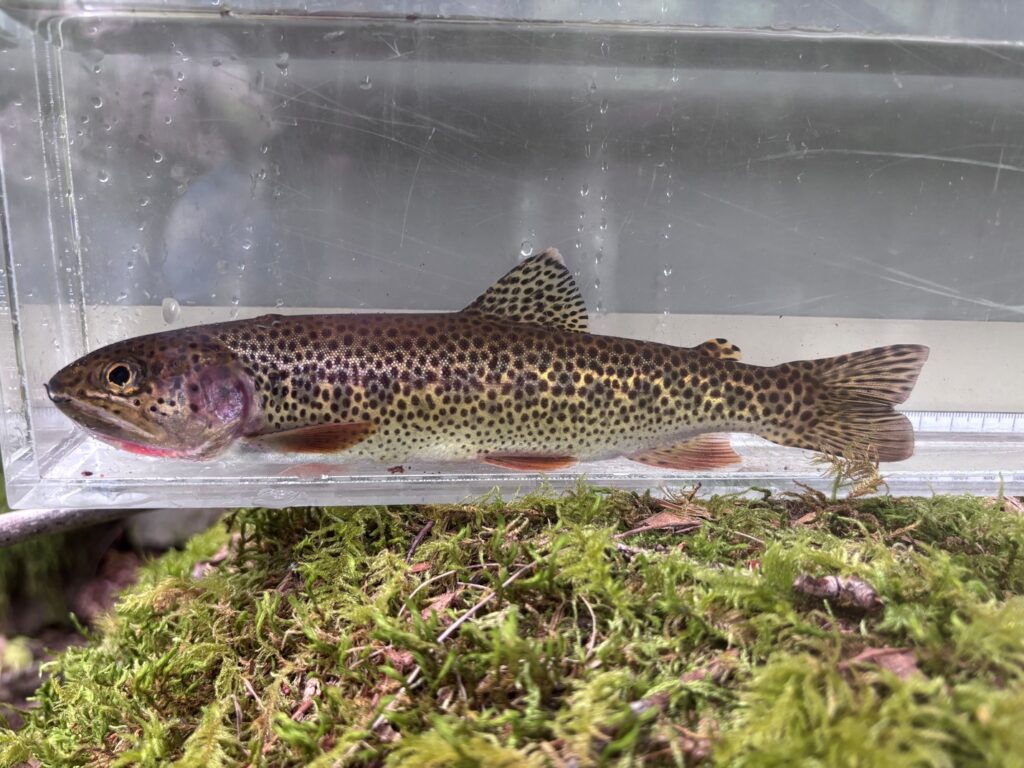
Coastal cutthroat trout (Oncorhynchus clarkii), aka Oncorhynchus clarkii clarkii, from Mack Creek in H.J. Andrews Experimental Forest in Oregon. Image: Ivan Arismendi
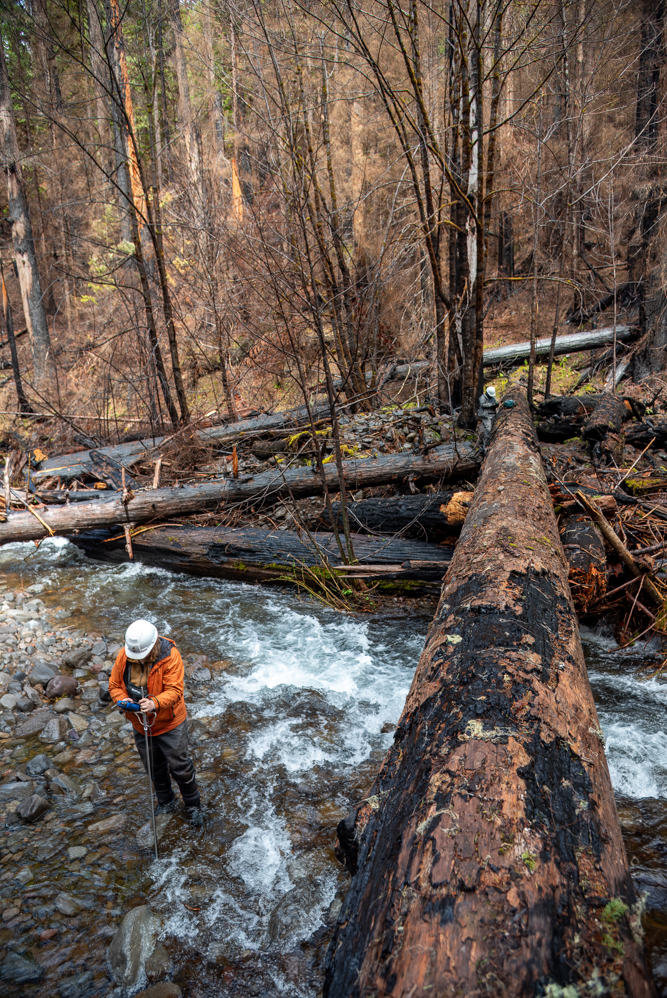
Researchers in Lookout Creek, eight months after the 2023 Lookout Fire. Image: Benjamin E. Nash
All animals in Andrews Experimental Forest are protected, meaning that people are not allowed to fish in the rivers and streams in the forest. This means that anglers removing larger trout is not a factor affecting research findings.
“We have 37 years of data and there’s evidence that climate change is likely causing species here to get smaller. We’re trying to figure out why it’s happening,” said Arismendi.
Hypotheses have focused on lower streamflow in summer and early fall because of decreases in snowpack in winter.
“With lower streamflow there’s less space to maintain these populations. So, that can affect body size as fish will compete for space and limited food sources during a maximum five-to-seven-year life span. The rivers at the Andrews forest are really pristine and there was a fire in 2023, and a flood a long time back, in 1996. These events usually cause some stress, but can also be beneficial for trout,” said Arismendi.
The Lookout Creek watershed covers the whole H.J. Andrews Forest. Arismendi said continuing to protect this watershed may help researchers start to narrow down why the species here are getting smaller.
“There might be low flow in some areas, leading to warmer temperatures in summer,” said Arismendi. Riparian trees offer shade and instream cover when they fall due to age or stressful events like fire or pathogens.
“The main thing that needs to happen, for us to pinpoint why the coastal cutthroat trout is getting smaller, is to protect the watershed to isolate purely climatic from other confounding factors. We need to keep the conditions as natural as possible. We need to create long-term protection for this species by minimizing additional stress, so we let them cope with only natural stressors,” said Arismendi.
He and other biologists at Oregon State University are also studying salamanders in the forest.
“One of the reasons to study other species, such as amphibians, is that they are also sensitive to water temperature and water quality. So they would be affected similarly by these stressful events,” said Arismendi.
The coastal cutthroat trout of Andrews Forest are resident populations and not anadromous. In fact, they can stay in the same area for their whole life. Often, they do not move more than 200 meters from where they were born. The researchers know this because they tag fishes every year and find them during the next consecutive years in the same place.
“When we release them, we use proper techniques that cause the least harm and minimize stress. We want these populations to persist, so we can learn from them. When it comes to conserving populations, the idea is to think like you are a fish,” said Arismendi.
Species like coastal cutthroat trout and salmonids need a good place to live, with shade and cool water, food, and protection from predators.
Right now, it is unclear how coastal cutthroat trout and other salmonids will adapt to conditions in the future. Researchers want to learn and understand how and why these changes in size are happening. Then they can help forest managers to make decisions that ensure these populations and their needs persist over time. That is increasingly difficult in a time when human actions, like major changes in land and water uses, can have impacts very far away.
The promises of AI, radiology, and encouraging citizen scientists
Members of the public may be surprised to know that museum curators and biologists sometimes use computed tomography (CT) scans to learn more about fish.
At the University of Oregon Museum of Natural and Cultural History, Davis and graduate students use CT scans to see inside spike-toothed salmon bones without damaging them. The images help scientists understand how the fish in question became a fossil, what diseases it suffered, and what injuries it incurred. The last category helps scientists learn more about how the fish lived: what it ate, what conflicts it had with predators or other members of its species, and how its actions, like making a redd, might have worn down its bones.
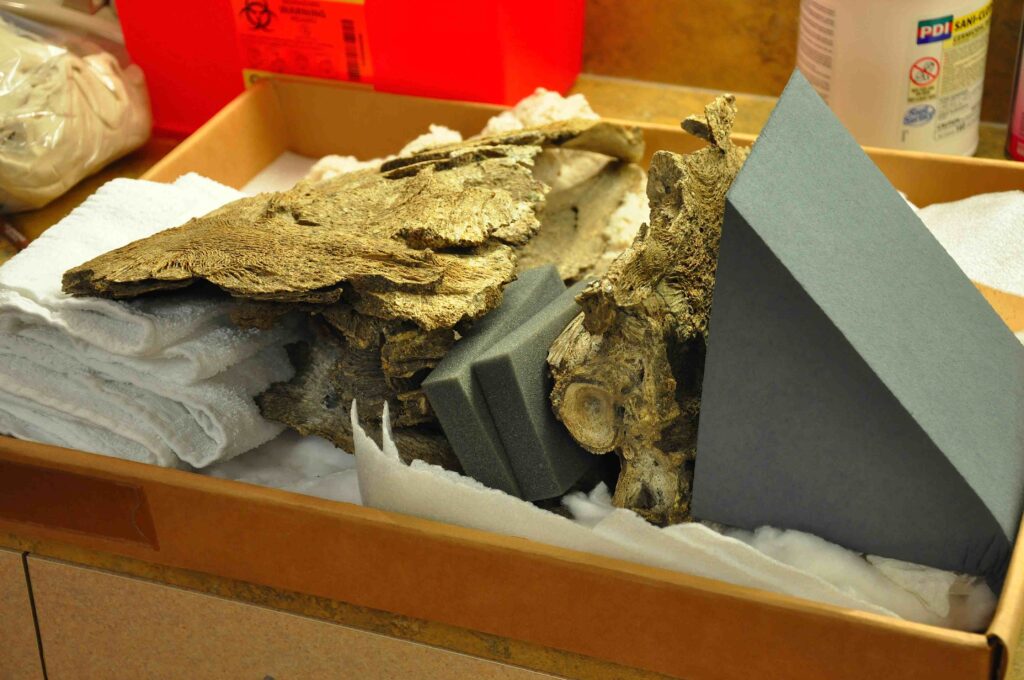
Fossilized remains of the spike-toothed salmon. Image: University of Oregon Museum of Natural and Cultural History
There are a number of spike-toothed salmon fossils in the Pacific Northwest and California. Yet the set of these remains is not so large to train Artificial Intelligence (AI) to the extent that AI can accurately recreate a “typical” spike-toothed salmon skull with great accuracy. That may change in the future, as more spike-toothed fossils are identified and digitized, from museum, university, and private collections.
Liu said California has some of the best protections for fossils in the country. Federal, state, county, and local laws guard fossils on all public lands. A permit is required to collect such remains. However, an individual can request permission to collect from the agency that manages the lands.
Liu said individuals who are interested in fossil collecting, especially to donate remains to museums and universities, should know that fish have more bones than other vertebrates. This means chances are high that a person looking for fossils will come across the fossil remains of a fish.
All jawed fish, including species of salmon, have skulls. A fish skull is relatively easy to identify as belonging to a fish because of the shape and the presence of certain elements, like the operculum, or gill cover. This is a series of bones that protect the gills.
“The challenge is that many fish fossils appear as a single, isolated bone. It is also helpful to know that fish skull bones are flat, when compared with those of tetrapods, vertebrates with four limbs, that evolved from fish. In addition, fish vertebral body (individual bones of their spinal column) tend to be concave on both ends,” said Liu.
Liu said people who find fossils can use the app iNaturalist to view fossils found in their local area. This will show them what fish used to live in the area in the past.
“There is a lot to explore out there. Even as a beginner, looking at fossils and comparing them to modern species, will offer (science) substantial foundational knowledge,” said Liu.

A graduate student at the University of Oregon prepares spike-toothed salmon remains for a computed tomography (CT) scan. Image: University of Oregon Museum of Natural and Cultural History
Final Thoughts
As the University of Oregon’s Dr. Davis aptly noted, “A change of nine degrees over 5 million years is one thing. A two to three degree change over the course of 200 years is another.” Today’s salmon do not have millions of years to respond to a climate that is warming at an unprecedented rate. Hopefully, some of them can adapt quickly enough to preserve them in relative abundance.
Special thanks to artist Ray Troll for authorizing the use of his depictions of spike-toothed salmon, the Museum of Natural and Cultural History of the University of Oregon, for providing images and information, and Dr. Julia Sankey, Emerita Professor in Paleobiology/Climate Crisis/Geology at California State University, Stanislaus, Turlock, also for providing information.