
As the State Water Resources Control Board considers the development of Tribal Beneficial Uses (TBUs), it is a good idea to look at how Native American people throughout California uphold and celebrate their fishing traditions. It comes with the season. November is recognized as National Native American Heritage Month. Across California’s 109+ Native American groups, fishing traditions are a way to continue culturally significant foodways. Fishing links people with one another.
Fishing creates cultural practices that people mark through cleaning, cooking, drying, and honoring caught fish. People also recognize the importance of fish through traditional arts, like basket-weaving, as well as songs, dance, and stories. Fishing provides ways to be present in and understand the natural environment. It gives people opportunities to share time together and develop and use new and traditional fishing technologies.
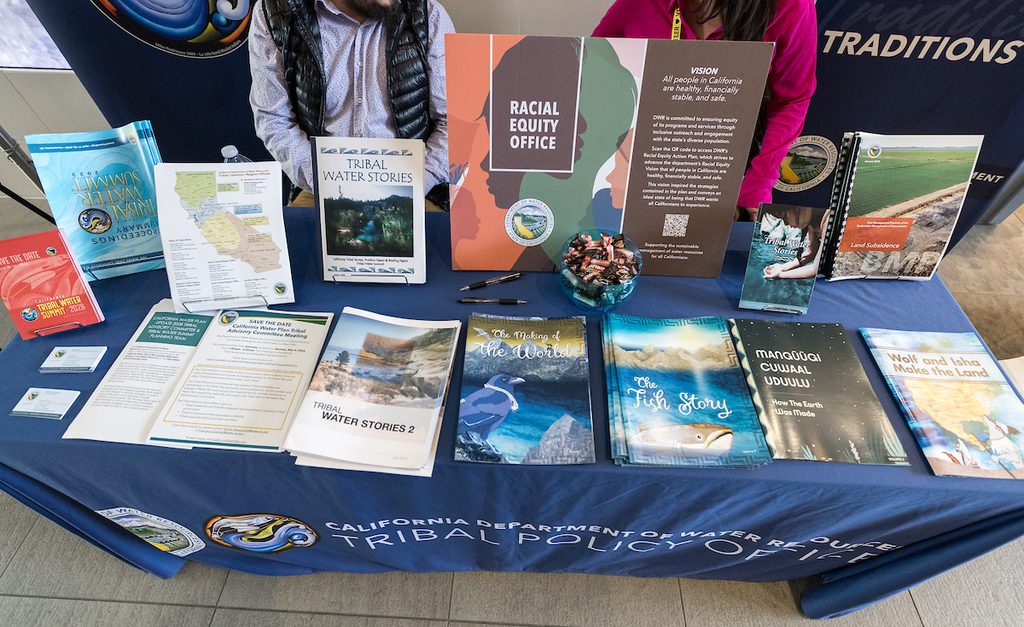
Materials published by the Department of Water Resources Office of Tribal Affairs, other state agencies and Tribal leaders, available in April 2026 at the California Tribal Nations Summit held by the Governor’s Office at the California Natural Resources Agency in Sacramento. Image: Nick Shockey/California Department of Water Resources
The 2020 U.S. Census shows that California has one of the largest populations of Native Americans (9.9 percent of the national total) in the U.S. To a non-indigenous person, native groups’ traditions might not be so visible. Reading materials from indigenous people’s websites and books, and asking good questions, create space to learn more about how Native American groups fish today.
There is no one way to do things. Native American groups and individuals in California differ widely from one another. One historical fact to know is that the U.S. Bureau of Indian Affairs (BIA) implemented a policy called “Termination” which lasted from the 1940s into the 1960s. The policy ended federal government’s supervision of Native American Tribes. It also encouraged Native American individuals and groups to assimilate into the general American population. This meant that many Native American people were pushed to abandon their cultural and religious traditions, some of which involved fish.
At the same time, between the late 1940s and early 1950s, the BIA engaged in a program called Urban Relocation. This program encouraged Native American people to leave rural reservations and move to urban areas. The program brought a number of Native American people and groups to California from other places. Such peoples have their own fishing traditions. Those may be different from those of groups that have been in California since before European colonization.
One result of these and other federal and State policies is that Native American fishing traditions in California are diverse. Some mirror precolonial practices. Others are fragmented. Still others come from different regions, like the American Southwest.
Personal stories are important. Learning from another person, face to face, will often provide a deeper understanding than any document. In addition, when a person listens to a friend, partner, or colleague, they can learn by doing: mirroring an individual’s example, helping someone catch a fish, and enjoying smoked fish by a river or lake.
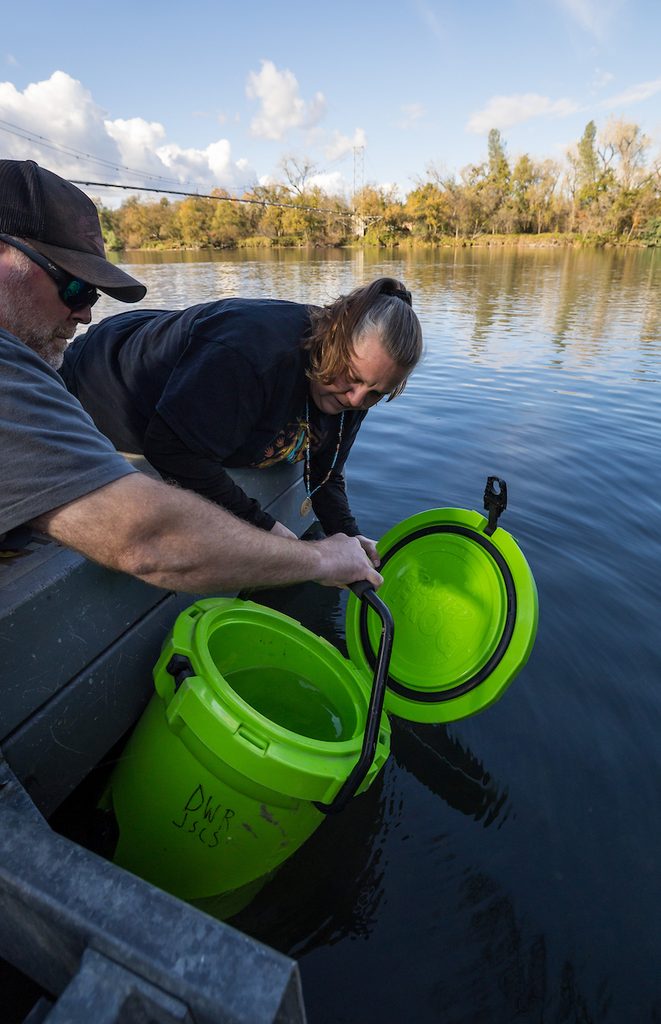
Cassandra Curl (right), with the Winnemem Wintu Tribe, and Justin Call, Environmental Scientist, in 2025, working on the California Department of Water Resources’ Juvenile Salmonid Collection System (JSCS) Pilot Project, a partnership with NOAA Fisheries, the California Department of Fish and Wildlife, the Winnemem Wintu Tribe and others. Curl and Call are releasing fish at a site below where they were captured in the upper McCloud Arm of Shasta Reservoir. The study was designed to evaluate the feasibility and viability of collecting juvenile salmonids as they emigrate out of their historical habitat upstream from Shasta Dam. Image: Xavier Mascareñas/California Department of Water Resources
The present deserves attention
Many social sciences books, classes, and museums cover Native American traditions as if Native American peoples are a remnant from the past. This is a disrespectful and inaccurate way to talk about indigenous individuals and groups. California is home to a large number of living Native American individuals, communities, and Tribes. Native American groups may be recognized or unrecognized by the State of California and the BIA.
It is a better idea to review materials about Native American peoples created in the past alongside people and groups that are here today. For example, university and government archives contain a wealth of historical and anthropological documents. These materials should not be ignored. It is helpful to know who wrote them, what inaccuracies they may contain, and how the papers, documents, and artifacts relate to current fishing traditions.
Take the papers of one of the founding scholars of American anthropology, Alfed Lewis Kroeber. Between the late 1800s and into the mid-1900s, Kroeber conducted fieldwork with several groups who lived along the Klamath River. His notes are relevant in terms of considering cultural practices at that point in history, and also in terms of understanding some of the prejudices of past anthropologists. Yet Amy Bowers Cordalis’s book “The Water Remembers: My Indigenous Family’s Fight to Save a River and a Way of Life” (2025) provides a good contemporary perspective about how members of the Yurok Tribe fish for and see Chinook salmon in the Klamath River.
Another good source to learn about how the Yurok Tribe sees fishing is the Tribe’s website. The Yurok Tribe’s website has a Fisheries section in which the Tribe lays out rules for fishery harvest. In the Yurok Tribe’s 2025 fall fishery harvest rules, the Tribe spelled out the terms for the Elder’s/Disabled Fishery. That year, the Tribe allocated 300 adult fall Chinook salmon for distribution to Yurok Tribal elders.
Tribal fisheries department staff harvested and processed fish with help from the U.S. Department of Agriculture’s Food Sovereignty Program. The Tribe’s practical explanation of the Elder’s/Disabled Fishery conveys a significant message. Elders are to be respected, in a physical way, by providing a traditional food to them, local Chinook salmon. The respect is also shown by the publication of rules regarding the allocation. The announcement is visible to all members of the Tribe.
The Yurok Tribe has faced significant legal, logistical, and environmental challenges to fish Chinook salmon for at least 150 years. Highly documented problems began with the establishment of commercial canneries at the mouth of the Klamath River in 1876. The canneries continued operating until 1933. The Yurok Tribe was prohibited from fishing in this area so that the commercial canneries would succeed.
In later decades, the U.S. government and the State of California waged legal battles to restrict the Yurok Tribe from fishing for salmon. They passed regulations and instructed and allowed law enforcement bodies to intimidate members of the Yurok Tribe and stop them from catching salmon. The fights continued into the 1990s, even after the Yurok Tribe won the right to fish in this river in the U.S. Supreme Court case Mattz v. Arnett (1973). After this point, salmon populations in the river decreased because of water diversions for agriculture, the obstacles of dams, and poor water quality exacerbated by hydropower dams (removed in 2023 and 2024). The salmon population in the Klamath River got so low that the Yurok Tribe had to close their fishery.
The fact that there are now enough salmon for the Yurok Tribe to have a fishery harvest and provide salmon to elderly members of the Tribe is a victory.
Organizing and filtering information about fishing
Often, a Western fishing resource, like a book on how to catch different fish in California, will organize information by species of fish. A chapter on a certain species will contain information about that fish’s lifecycle, habitat, what lures work for it, and how the fish’s environment has been affected by forces like climate change. Native American resources about fish may discuss fish and fishing differently. For example, take Paul D. Campbell “Survival Skills of Native California” (1999). This book is a huge compendium of past and present knowledge from individuals and Tribes who consider themselves natives of California.
Most of the information about fishing is found in discussions of technologies used to catch fish: fishing traps, fishing nets, harpoons, angling, and fish poison. Native authors also share relevant information in a section on fish and shellfish preparation. The book organizes the information around people, especially cultural traditions that they began in the past and have carried on into the present.
People who are interested in learning more about how Native American groups and individuals see fish and fishing should expect to discover information in spots that might be new to them. Take the Salmon Run, a recent activity put on by the Environmental Department of the Quartz Valley Indian Reservation (QVIR) in Fort Jones. The QVIR is in the Scott Valley area of Siskiyou County. Children engage in a “Salmon Run” across the reservation to celebrate the outmigration of adult salmon from inland rivers to the ocean. This activity incorporates the excitement of physical movement to show a tie between people and fish.
Another example comes from the Winnemem Wintu Tribe, who live near the Winnemem Waywaket (McCloud River). They believe that their members are tied to salmon. The Tribe’s website states: “The Nur, or salmon, are an integral part of our lifeway and of a healthy Winnemem Waywaket watershed. We believe that when the last salmon is gone, humans will be gone too. Our fight to return the Nur to the Winnemem Waywaket is no less than a fight to save the Winnemem Wintu Tribe.”
A third example comes from the Tribal Fisheries website of the Karuk Tribe. The Karuk Tribe live in rural Siskiyou and Humboldt counties. On this page, the Karuk Tribe teaches readers more about their Spring Salmon Ceremony. During this ritual, members of the Tribe did not fish throughout much of the Klamath basin. This helped spring-run Chinook salmon make their way upriver to spawn. After the conclusion of the ceremony, Karuk people used dip nets, fish traps, and weirs to collect salmon. The website explains that due to the decline in salmon returns, tribal fisheries management looks different today. This is because the Karuk Tribe combines traditional ecological knowledge with Western science.
These examples and others are good starting points to read, discuss, and find ways to listen. These starting points also present avenues to explain how non-Tribal environmental and fishing advocates work with Tribes. In-person exchanges and long-term discussions have improved how diverse advocates work with Tribes on plans to manage water temperature and find other ways to preserve habitats for native fish species.
There are many Tribes and Native American individuals across California who work to improve conditions for fish. Some of their efforts focus on advocating for clean water, to encourage more regulations and higher penalties for those who dump toxic pollutants into rivers or whose actions worsen erosion. Other efforts center on dam removal, to allow native fish species to reach their historical and precolonial spawning grounds. Native American groups and individuals also generally support work to eradicate litter in natural areas near rivers and tributaries and replant or seed such areas with native plants. Such actions improve the conditions in rivers and tributaries for fish, and the species that they eat or the species that consume them.
All of the advocacy and sharing of knowledge increases the chances that there will be significant populations of healthy native fish species in California for decades to come. When Native American people amplify their voices as advocates, this empowers both them as individuals, Tribes, and Western culture. A growing number of people are listening to indigenous leaders for their thoughts on cultural reparations in the post-industrial era, and ideas about how to improve equity in watershed and fisheries management.
What you can do now
In the past five years, one of the major victories for Tribes in northern California was the long-awaited removal of the last four dams in the Klamath River. These dams were JC Boyle, Copco No. 1, Copco No. 2, and Iron Gate. The demolition of the dams occurred between 2023 and 2024. For decades, the Klamath Tribes (the government of the Klamath, Modoc, and Yahooskin-Paiute people), the Yurok Tribe, the Karuk Tribe, and the Hoopa Valley Tribe had encouraged the removal of these dams. They had done this through supporting the actions of Tribal leaders and the work of non-indigenous non-governmental organizations (NGOs). The restoration of the Klamath River constitutes the largest salmon restoration project in U.S. history.
Now, the designation of Tribal Beneficial Uses – ways that Tribes form cultural, spiritual, subsistence, and other relationships with water – is an effective avenue to amplify Tribal authority. Everyone can support such designations.
Everyone can also support Tribal interests by urging the Water Board to follow through on maintaining adequate flows in the Shasta and Scott Rivers. They can accomplish this by advocating for a functional implementation of Assembly Bill 263. California Governor Gavin Newsom signed this bill into law on September 25, 2026. The point of this bill is to keep emergency water rules for the Shasta and Scott River watersheds in place until January 1, 2031 or until the Water Board adopts permanent “instream flow” rules. The Water Board is required to provide yearly public updates and opportunities for public comment in this process. Reading the updates at the Water Board’s Scott and Shasta rivers webpage, and subscribing to updates at the bottom of that page, as well as sharing public comments, are a good way for people to keep informed and assist.
For more information about Tribal Beneficial Uses, please see CSPA Restoration Associate Angelina Cook’s August 2026 article.
For more information about effective measurements to functionally implement AB 263, see Angelina Cook’s November 2025 article.
For more information about replanting native plants along the Eel River, see CSPA Administrative and Policy Associate Jessica Zimmer’s March 2026 article.