Sacramento River Salmon Redd Dewatering – Fall 2025

I have previously reported on the dewatering of fall-run salmon redds in the upper Sacramento River near Redding during the early fall spawning season. Redd dewatering has a significant negative effect on salmon egg and fry production that translates to lower annual escapement and significantly contributes to the multi-decade decline in the population (Figure 1).

Figure 1. Escapement to the upper Sacramento River natural spawning area 1952-2024.

October is the peak in the fall-run Chinook salmon spawning season (Figure 2).  During early November 2024, the Bureau of Reclamation reduced Keswick Dam releases from the October average of 7000 cfs to 4000 cfs.  The flow reduction reduced water levels in the upper river spawning grounds below Keswick Dam from approximately the 11-ft water surface elevation (stage) to about the 8.5 ft level, a drop of about 2.5 feet.  In 2025, nearly identical flow management led to the same redd dewatering conditions (Figure 3). With most of salmon redds constructed in the 1-to-3 ft depth range, most were dewatered or only slightly watered and thus susceptible to high-egg-mortality conditions (low flow, warm water, low oxygen, and sedimentation).

The flow management strategy was also employed in recent wet years 2017 and 2019, although a more benign strategy was employed in historical wet year 2011 (Figure 4).  The issue has attracted inter-agency study and mention, but actions necessary to reduce the problem have been limited.

Figure 2. Stage and water temperature in the Sacramento River below Keswick Dam in fall 2024. Grey box denotes period when most fall run salmon spawn in the upper Sacramento River.

Figure 3. Stage and water temperature in the Sacramento River below Keswick Dam in fall 2025. Grey box denotes period when most fall run salmon spawn in the upper Sacramento River.

Figure 4. Stage and water temperature in the Sacramento River below Keswick Dam in fall of wet years 2011, 2017, and 2019.

American River Salmon Update – Spawning Season, November 2025

In a 10/19/2023 post and a 11/21/2024 post, I discussed how the lack of access to Folsom Reservoir’s deep cold-water pool results in delayed natural and hatchery spawning of American River fall-run salmon.  Delays, and spawning in warmer water, cause reductions in spawning success, smolt production, recruitment into harvestable fishery stocks, and spawning escapement (run size) to the American River.  Lower salmon contributions from the American River significantly reduce California coastal and river salmon fishery stocks.  Poor production in the American River contributed to the closure of California salmon fisheries in 2023-2025.

During the 2020-2022 drought, Reclamation released water from the lower-level power bypass (sacrificing hydropower production) to provide the cold water (<55ºF) salmon needed for spawning in the ten-mile spawning reach from Nimbus Dam (near Fair Oaks gage) to the William Pond gage (Figure 1).  This is the prime spawning reach for salmon in the lower American River.  However, in the fall of the wetter years 2023-2025, Reclamation did not use the power bypass to release cold water (Figures 2 and 3), despite higher storage levels than during the drought (Figure 4).  The lack of cold water delayed natural spawning and hatchery egg taking, to the detriment of egg viability, fry production, and smolts reaching the ocean.

Ultimately, the number of adult salmon returning to the American River to spawn (escapement) is the important measure of success.  There are many factors that may contribute to the number of returns.  Recent returns are up (Figure 5).  The 2023 and 2024 returns were good despite having been the product of the 2020-2022 drought reproduction (Figurer 6).  Closed fisheries in 2023 and 2024 contributed to higher escapements.

I also believe efforts to improve fall water temperatures below Folsom during the drought improved both the wild and hatchery components of escapement.  I remain concerned that a return to warmer fall water temperatures will hinder future escapement.

I am also concerned with apparent efforts to sustain higher fall 2025 reservoir levels (see Figure 4) by reducing tailwater stream flow rates (Figure 7).  Such low flows reduce the quantity and quality of salmon spawning habitat.  Many critical spawning side channels become dewatered at such low flows1.  Main channel velocities, substrate, and depths are also compromised at low flow rates.

Reclamation  also reduced funding for the salmon hatchery and for river habitat projects in 2025, and will likely do the same in subsequent years.  This strategy will not help to recover American River salmon stocks to levels that once again can contribute toward commercial and recreational salmon fisheries.

Figure 1. Map of three CDEC gaging stations on the lower American River.

Figure 2. Average daily water temperatures in Nov-Dec period at William Pond gage 2021-2025. Red line (55ºF) denotes upper safe level for Chinook spawning.

Figure 3. Average daily water temperatures in November period at Fair Oaks gage 2021-2025. Red line (55ºF) denotes upper safe level for Chinook spawning.

Figure 4. Late summer and fall Folsom Reservoir water storage (acre-feet) 2021-2025.

Figure 5. Adult salmon escapement estimates for the American River 1975-2024. Source: Grand Tab.

Figure 6. American River spawner/recruit relationship – { log10(escapement) -3.5]. Number is year of escapement (recruits). Color denotes water year type two years prior. Red is dry, green is normal, and blue is wet. Note escapement in 2023 and 2024 are red, denoting spawning and rearing occurred two years earlier in dry water years.

Figure 7. Streamflow (daily average) in the American River at Fair Oaks gage Aug-Nov period 2021-2025.

Prognosis for the 2026 Salmon Season

Since the year 2000, Fall Run Salmon adult escapement (run total) to the Sacramento River system (mainstem and tributaries) dropped from a peak of 400,000-800,000 to 100,000 or less (Figure 1).  The lowest escapement, near 50,000 in 2009, occurred with the fishery closed.  More recently, escapement fell below 100,000 in 2017 and 2022, with the fishery open.  With the fishery closed in 2023 and 2024, escapement increased to near 150,000, allowing for a very limited recreational fishery in 2025.

The fishery harvests are about 50% of the fishable stock (or what could be available for escapement, see Figure 2).   A normal fishery would lead to escapements under 100,000 in recent years.  These escapement levels would likely lead the Pacific Fisheries Management Council and California Fish and Game Commission to restrict the fishery again in 2026.

However, the agencies may be inclined to allow a fishery with some restrictions based on positive trends in habitat conditions and the higher jack salmon numbers in the limited 2025 fishery.  Water years 2023 and 2024 were relatively wet, which often leads to good survival conditions, and is likely to lead to a projection of good salmon numbers available in 2026.

I am inclined to greater optimism for 2026, as I was in 2025,1 because of the likely higher numbers of salmon in the ocean and potentially returning to the rivers next year.  The various factors supporting my reasoning are summarized below:

  1. Jack numbers were up based on escapement surveys, agency test fisheries, and the limited 2025 fishery.
  2. Brood years 2023 and 2024, which will make up much of the fishable stock in 2026, likely had good survival and production in wet year 2023 and above-normal water years 2024 and 2025 (compared to dry years 2020-2022). Fishery impacts to these broodyears were also minimal in 2024 and 2025.
  3. Hatchery smolt production in 2023-2025 was also good, with some improvements over the 2020-2022 drought years. Hatchery smolts released to the rivers near the hatcheries likely had a much improved survival rate in 2023-2025 over that in the drought years, because of higher transport flows.  Millions of hatchery smolts trucked to Bay and coast pens for release also had improved survival compared to river releases.
  4. Fishery restrictions in 2023-2025 likely improved wild salmon spawning numbers, leading to good wild salmon recruitment in the three wetter years.
  5. A 2026 fishery would likely benefit from good overall broodyear 2023 and 2024 survival and production.
  6. My estimate of the fishable stock of broodyears 2022-2024 in the ocean is 400,000-800,000 two-to-four year-old salmon. Under a 50% harvest, escapement in 2026 would be 200,000-400,000 (likely somewhat less, as not all the fishable stock would spawn in 2026).  I support this hypothesis with a descriptive Spawner-Recruit model that I developed (Figure 3) that has reasonably predicted escapement in the past several years.

If the fishery remains restricted for a fourth year in a row, escapement could reach or exceed 500,000 adult salmon, a number far in excess of the management target escapement of 120,000-180,000.  Such a case would unnecessarily deprive commercial and recreational fisheries of the potential harvest of 200,000 or more adult salmon in the ocean and rivers in 2026.

I remain concerned with the potential adverse effects on wild salmon stocks from fishery harvest (Figure 4). Limiting wild salmon harvest by adjusting fishery timing and location, restricting catches to marked hatchery fish (mark-selective fishery rules), and improving spawning, rearing, and migrating habitat, could help address these issues.

I am also concerned with the poor returns (escapement) from the Coleman Hatchery’s in-river smolt releases that result in low fishery contributions, low escapement (Figure 5), and high rates of adult spawner straying to other spawning streams.  To address this problem agencies have considered higher smolt production, increased near-hatchery releases, trucking smolts to Bay-Delta-Coast, transporting eggs to Coleman from other hatcheries, hatchery fry releases to river floodplain and estuary habitats, reducing in-river predators, and improving migrating habitat during smolt releases.  All of these measures could help minimize the extent of this problem.

Figure 1. Note the very high escapement around the turn of the century. The improvement is attributable to the wet decade (1995-2005), increased hatchery production, trucking hatchery smolts to the Bay-Delta, and more protective management of fisheries and water supply. Subsequent poor escapement periods are generally attributed to multiyear drought impacts and over-fishing of drought-impacted salmon broodyears.

Figure 2. A 50% harvest rate is about what has occurred over the recent decade under normal fishery regulations.

Figure 3. This complicated semi-quantitative spawner-recruit model display attempts to show that a normal spawner-recruit relationship is overwhelmed by hatchery, harvest, and water-year hydrology effects on recruitment. I predict 2026 escapement (recruits) with a normal fishery will fall into the green box (200,000-400,000) because 2023 and 2024 were wetter (blue) water years. Without a fishery, escapement would be near or above 500,000, a number well above the target escapement.

Figure 4. These spawner estimates for the upper Sacramento River represent the natural spawning escapement of the mainstem Sacramento River. The decline in this escapement component is considered a key factor in the overall decline of the Sacramento River fall-run salmon population. The decline is generally attributed to increasingly poor habitat conditions (water flows and temperature, pollution, predation, and water diversions) and over-harvest of wild or natural-born fish in the fishery.

Figure 5. Adult fall-run salmon returns to the Coleman Hatchery in the upper Sacramento River have been below 10,000 for several years. Preliminary estimates for 2025 indicate sharply higher returns to the Coleman Hatchery (near 40,000 or higher), the result of good hatchery smolt survival, no fishery for three years, and good river conditions this summer and fall.

The 2025 Sacramento River Salmon Run – Early Summer Conditions were poor

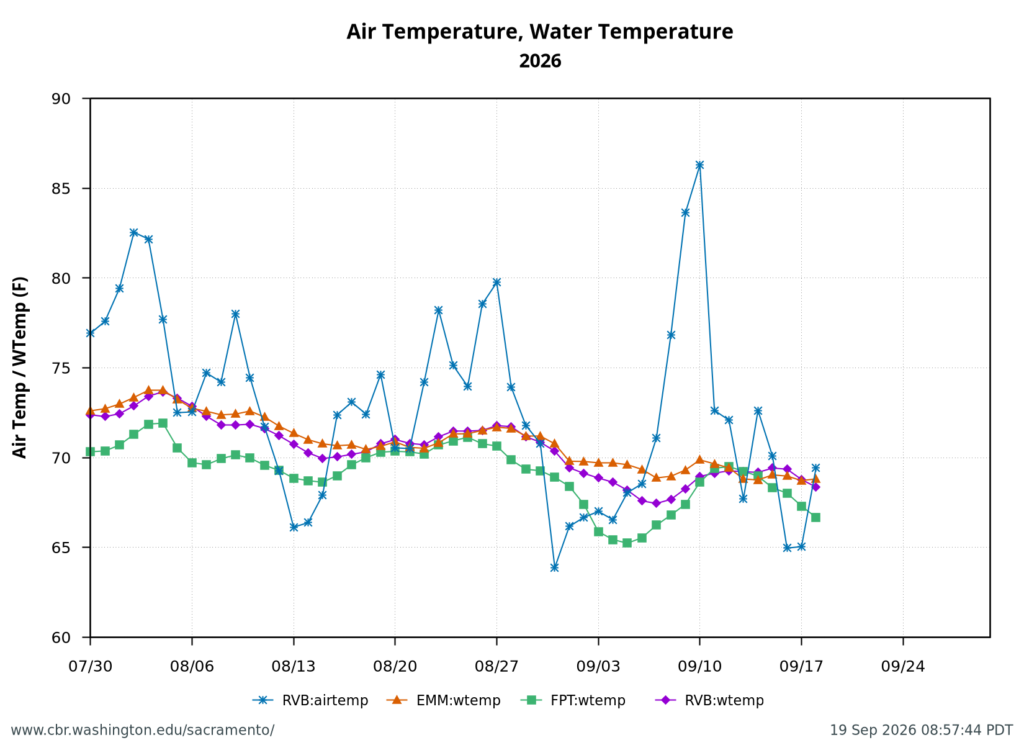
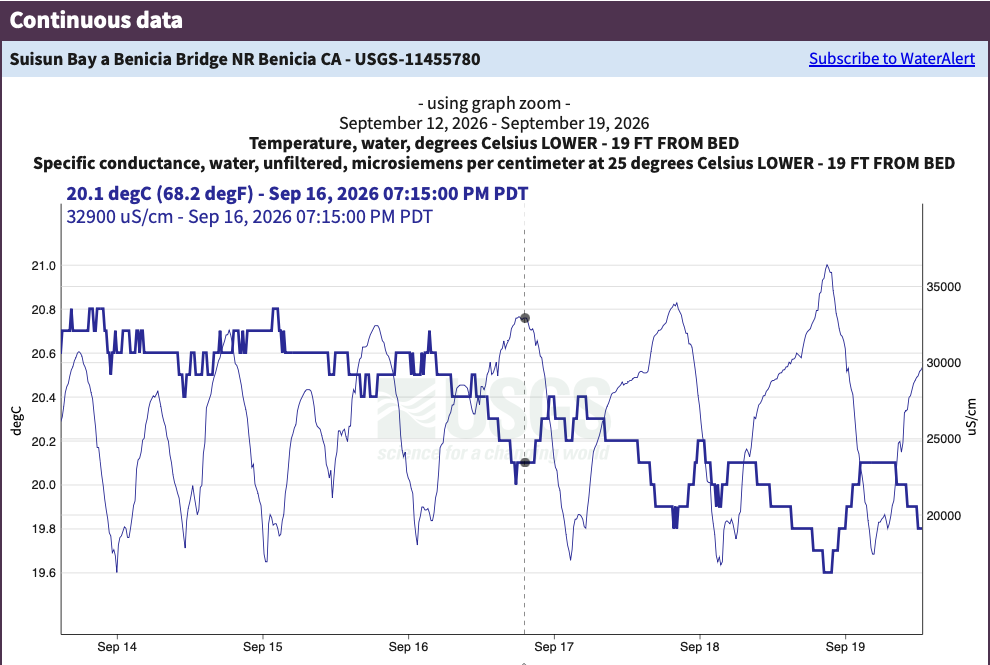
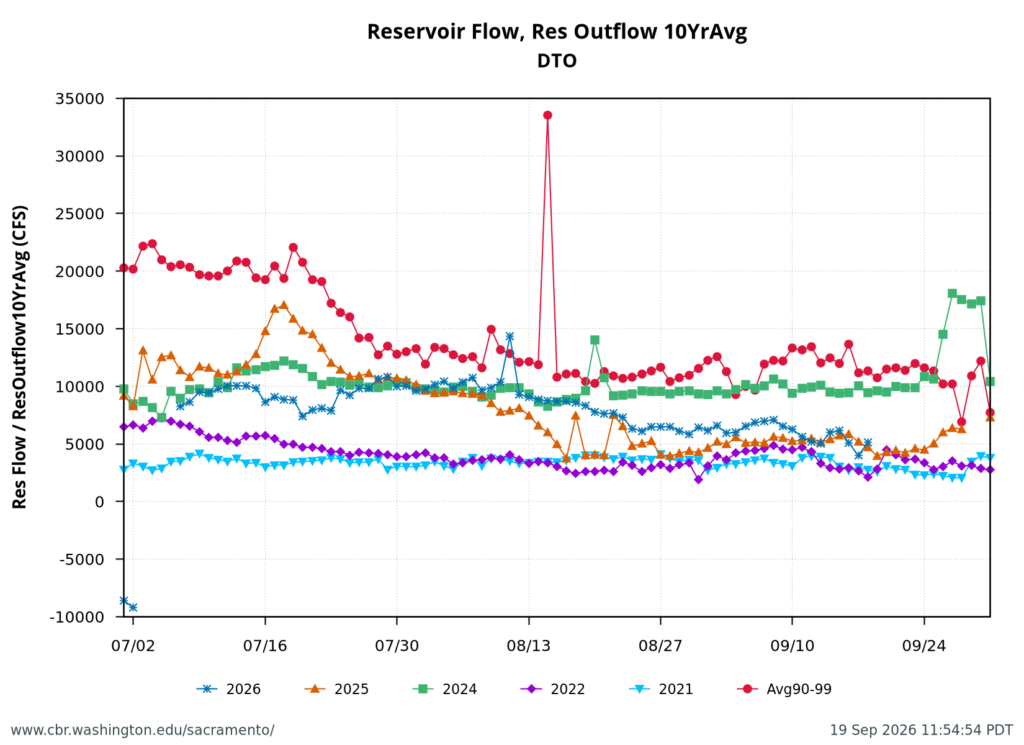
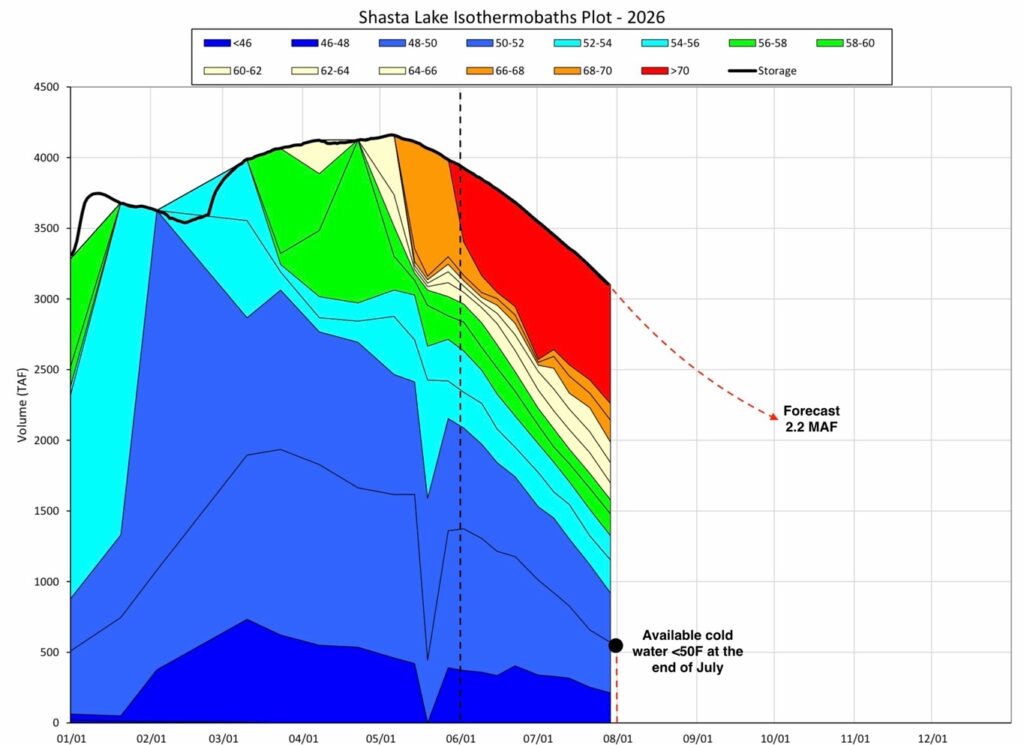
The limited 2025 salmon fishing season opened in mid-July and continues through October on the Feather, American, and Mokelumne rivers.  Early summer (July-August) conditions were tough for the beginning of the run and early fishing.  The river, Delta, and Bay in August were too warm despite three wet years in a row with above average reservoir storage and below normal summer air temperatures.

The lower Sacramento River was too warm (Figure 1). Flows dropped in mid-August with two-thirds of reservoir releases being diverted before reaching the Delta.  Water temperatures were above the 20ºC standard to protect salmon during their run from the ocean to the rivers.  River flow should be near 10,000 cfs to maintain the water temperature standard.

The Delta was too warm (Figure 2).  Water temperatures in August reached the 22ºC level, considered highly stressful and avoided by salmon, as Delta inflow dropped from 20,000 cfs to 10,000 cfs.  Delta inflow at Freeport should be about 20,000 cfs for good fishing conditions.

The Bay was too warm (Figure 3).  Water temperatures exceeded 22ºC, and dissolved oxygen fell to near the standard of 6 mg/ l.  Delta outflow fell to near 4000 cfs, while south Delta exports exceeded 10,000 cfs.  Delta outflow should be around 10,000 cfs for good fishing conditions.

Figure 1. Lower Sacramento River streamflow and water temperature in July-August 2025.  Red line is the water quality standard for water temperature.

Figure 1. Lower Sacramento River streamflow and water temperature in July-August 2025. Red line is the water quality standard for water temperature.

Figure 2. Streamflow and water temperature of the Sacramento River at northern entrance to the Delta over the past 30 days.

Figure 3. Water temperature and dissolved oxygen concentration in the east Bay in July-August 2025.

California Salmon Fisheries in 2025

Graph showing 2025 SI forecast

The government forecast for adult fall-run salmon available along the coast to target for harvest in 2025 is 165,655 (black dot is number for 2025 in above Figure 1).  That number is only slightly higher than the 122,000 target minimum to allow some harvest.  The fishery was closed in 09, 10, 23, and 24.  The model used for the estimate is crude at best – based primarily on two-year-old escapement the prior year.

I have my own model based on the number of spawners (escapement) three years earlier (Figure 2).  The model did pretty well predicting 2023 and 2024.  For 2025 I guessed as best I could and came out with similar numbers as the government.  There are probably between 150 and 250 thousand salmon out there this summer available for salmon fisheries.

My guess is that the government is not going to offer a salmon fishery this year based on the poor numbers in the fishable stock, the predominance of hatchery fish, and record low numbers of wild salmon stocks.  Though a reasonable conclusion under the present circumstances, I think it is a mistake for the following reasons.

  1. Though spawner numbers were low in drought year 2022, conditions in winter-spring of wet year 2023 were very good (a blue year) for juvenile survival to the ocean.
  2. Most of the 20 million or so fall-run hatchery smolts were released to good river or Bay conditions in 2023. Millions were released to net pens in coastal waters near the Golden Gate Bridge, in Half Moon Bay, and in Monterey Bay locations where salmon smolt survival has been exceptionally high.
  3. The Mokelumne River Hatchery has been producing record runs of fall run salmon in recent years by releasing millions of smolts to Bay and Coastal waters.
  4. The fishery has been closed for two years, leaving more fish from brood years 2021-to-2023 in the fishable stock.
  5. Ocean conditions in 2023 and 2024 were relatively good.
  6. Water year 2025 is shaping up to be a relatively wet year providing good conditions for returning adult salmon.
  7. Overall, many hatchery-produced salmon would simply go to waste and compete with wild salmon for precious spawning habitat.

One caveat remains – the poor state of wild, naturally spawning salmon.  Their populations likely would suffer from the loss of spawners to harvest.

Therefore I recommend consideration of a mark-selective fishery that allows harvest only of hatchery fish with adipose fin clips, but that requires release of unmarked salmon (hatchery and wild).  California steelhead fisheries have such regulations.  Many coho and chinook salmon fisheries in the Pacific Northwest have such regulations.  Special regulations on season, area, and size can serve to protect non-target salmon such as spring-run and winter-run listed salmon or recovering Klamath River salmon.  Such a fishery should be experimental, with an extra dose of monitoring, assessment, progress reporting, stakeholder involvement, and adaptive management.

The fishery harvest would be severely limited, as only about 25% of hatchery smolts are marked.  Only about one in five salmon caught will have an adipose fin removed allowing harvest, reflecting 25% proportional marking and 20% of the harvestable fish being wild or natural born.  This may limit the feasibility of commercial fisheries and result in greater effort and fish handling.

Overall, such a limited fishery would likely be better than none at all when measured in terms of cultural and socioeconomic value.

Spawner-recruit relationship graph for Sacrament River Fall Run Chinook Salmon