Predator Fish Control Again Rears Its Ugly Head

The predator-control movement in the Delta got started around the turn of this century when efforts were initiated to reduce the Central Valley Striped Bass population by removing them from Clifton Court Forebay in the South Delta and by stopping the hatchery and pen rearing supplementation programs. Efforts under the Central Valley Project Improvement Act of 1992 (CVPIA), specifically the Anadromous Fish Restoration Program (AFRP), were beginning to make progress at restoring Central Valley fish populations including winter, spring, fall, and late-fall run Chinook, Steelhead, sturgeon, and Striped Bass. Of course, these efforts had been enormously aided by Mother Nature in the form of a series of wet years following the disastrous 1987-1992 drought that precipitated the CVPIA (and many of the endangered species listings).

Striped Bass supplementation had reached its apex. Hatchery raised yearlings were stocked by the millions. Millions of wild young stripers salvaged at South Delta federal and state pumps were placed in pens in the Bay and fed for one to two years and then released.

The end of the wet years and the beginning of the Pelagic Organism Decline in the early 2000s brought out “predator control” for the Central Valley. Federal and state water contractors planted the seed as their Delta diversions reached record levels of 6 million acre-ft. The first effort was to develop a predator removal program at the State Water Project’s Clifton Court Forebay in the south Delta. A further effort forced California Department of Fish and Wildlife (CDFW) to prepare a Habitat Conservation Plan (HCP) for its Striped Bass Supplementation Program (which was approved and the program continued for several years). CDFW did not undertake predator removal in the Forebay.

The 2007-2009 drought brought a water contractor sponsored lawsuit against CDFW, and when that failed, an approach to the California Fish and Game Commission to eliminate sportfishing regulation restrictions on Striped Bass. Relying on sound science, the Commission unanimously rejected their efforts.

The recent Bay Delta Conservation Plan (BDCP) included predator control at “hotspots” in the Delta. But BDCP has been cast aside in favor of Governor Brown’s “water fix.”

This past week FISHBIO Inc., a major contractor for the water districts in the Central Valley, posted “Can Predator Control Help California’s Native Fishes?”1 The post relates the passage of a bill in the House specifically regarding predator control to protect endangered species. While most (hopefully the Senate) will see the bill as part of the water contractors’ “smoke screen”, the bill exemplifies continued efforts on the part of water contractors in the Central Valley to place the blame and solution elsewhere. The post relates about a recent San Joaquin restoration program meeting where information on predators was presented. No mention was made of the recent record low flows in the San Joaquin or the fact that salmon numbers are directly related to flows, or that salmon cannot survive their migrations in the warm polluted waters of the San Joaquin in drier years.

The post mentions a modeling study that shows Striped Bass could eat all the San Joaquin salmon. However, it fails to mention the abundance of young hatchery salmon prey dumped into streams at the same time that Striped Bass and other predators are attracted into the cooler tributaries by the same warm polluted waters of the San Joaquin that block young salmon from moving to the ocean. It fails to acknowledge that upstream dams intercept the early natural pulse flows of cold water that would enable wild salmon fry to move out of the tributaries before waters warm sufficiently for predators to become active. It fails to mention that Striped Bass are also at record low levels. It fails to mention that hundreds of thousands of recovery program hatchery smolts have been dumped into the San Joaquin that serve to encourage predators to switch to salmon (these hatchery fish should be barged to and through the Delta to the Bay – an action that should be funded by the water contractors). And, for the record, it ignores the fact that aquatic life is a mutual eating society and hatchery salmon and steelhead smolts prey on wild salmon fry.

The post concludes with “This month’s actions to amend the Commerce, Justice and Science Appropriation Act may finally open the door to predator control programs in California – a hopeful step towards remedying a long-term problem that continues to spin out of control.” FISHBIO had better prepare for interviews on FOXNEWS.

(AUTHOR’S NOTE: predators including native fishes, birds, and marine mammals, as well as non-native fish like the Striped Bass and other state protected gamefish, take a huge toll on our native endangered salmon, steelhead, trout, smelt, and sturgeon. Predation is probably a primary causal factor as an indirect effect of water diversions on native fish. What is needed is a comprehensive recovery program like that on the Columbia River2. That program addresses the full spectrum predators like pikeminnow, terns, cormorants, marine mammals, and even non-native shad, stripers, smallmouth, walleye, and northern pike. However, unlike California erratic efforts to manage fisheries, the Columbia success-story, at least to date, can be attributed to progressive water management and hatchery-wild fish, science-based, recovery programs.)

Are Winter and Spring Run Salmon being protected below Shasta? Absolutely Not!

By now it is common knowledge that 95% of last year’s endangered Winter Run Chinook salmon production in Sacramento River below Shasta-Keswick Dams was lost due to low flows and high water temperatures in summer. Large losses also occurred to Spring Run and Fall Run salmon. As they did last year, the US Fish and Wildlife Service, National Marine Fisheries Service, US Bureau of Reclamation, California Department of Fish and Wildlife, and California State Water Resources Control Board are managing water releases from Shasta Reservoir to ensure flows and water temperatures are adequate for Spring Run and Winter Run salmon spawning adults and eggs and alevins in gravel beds. This year they all assured us they had adequate water and cold water pool to maintain flow and cool water temperatures to protect the salmon in the upper spawning reach near Redding. They acknowledged there was insufficient water to protect the lower spawning reach below Redding (down to Red Bluff).

Already two months into the irrigation season and after a quarter million acre-feet of water released to water contractors (about 10% of Shasta storage and 25% of the cold water pool), Reclamation has determined they overestimated the available amount of cold water pool and their ability to maintain flow and water temperatures for salmon into the fall. Fearing the worst, storage releases have been reduced, and protective water temperature limits in the Redding spawning reach have been raised to conserve the cold water pool.

We only have to look at the State Board’s own science review of water temperature effects on salmon1  to see if water management in the spawning reach is protecting salmon.

  1. Mean Weekly Maximum Water Temperature (MWMT) should not exceed 13C (55.4F) – generally referred to as 56°F limit.
    1. Keswick Dam releases have been slightly higher than 56°F MWMT.
    2. Sacramento River compliance point above Clear Creek has MWMT of 60°F.
    3. Clear Creek upstream of mouth has a MWMT greater than 60°F.
    4. Sacramento River below Clear Creek at Anderson has MWMT OF 62°F.
  2. Daily maximum water temperature should not exceed 13.5-14.5°C (56-58°F) from fertilization through fry development.
    1. Keswick releases have reached 56°F.
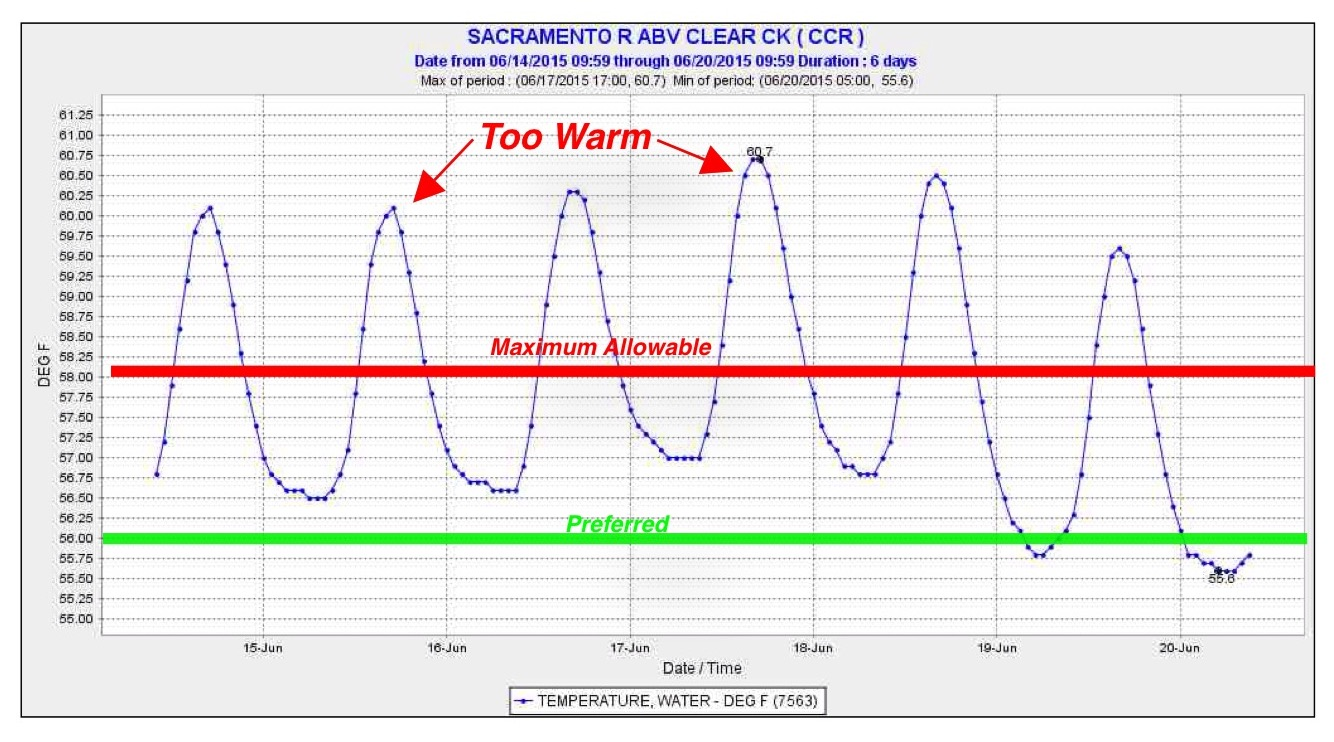
    2. Sacramento River at compliance point above Clear Creek has reached 60.7°F.
    3. Sacramento River below Clear Creek at Anderson has reached 62°F.
  3. Optimal temperatures for egg incubation is <13°C (55°F).
    1. Exceeded throughout spawning reach.
  4. Water temperature when pre-spawning mortality of adult Chinook becomes pronounced in ripe adult salmon – 13-15.5°C (55-60°F)
    1. Exceeded throughout spawning reach.

Obviously the 56-60°F maximum daily water temperatures in the primary spawning reach above the mouth of Clear Creek at Redding are a concern. The State Board has raised compliance from 56°F to 58°F in attempt to conserve cool water through the summer. They have also reduced allowed Keswick releases from 8000-9000 cfs to 7500 cfs for the summer to save storage and the cold water pool. Reclamation is keeping Keswick releases near 7000 cfs.

Our concern is for pre-spawn ripe adult mortality and egg viability, as well as egg viability and embryo survival in redds. The agencies seem to think maximum daily temperatures near 60°F are ok, when they are not. Destroying this year’s egg production before the cold water pool is exhausted should not be the approach. Maximum temperatures should not exceed 56°F above Clear Creek. A maximum temperature of 58°F should be the absolute limit.

Far more important is the water temperatures in the redds, which tend to occur in shallow pool tailouts that are often warmer than average river temperatures. There must be a margin of protection for this difference. Redd temperatures should also be carefully monitored.

Clear Creek at Redding Tempratures

Hatchery Reform – Part 4

Previously… Part 1: Central Valley Salmon and Steelhead Hatchery Program ReformPart 2: Hatchery Reform, & Part 3: Hatchery Reform

Golden Gate Salmon Association (GGS) Project D.3 Improve Trucking Techniques for Hatchery Salmon Background and Scientific Analysis December 4, 20131

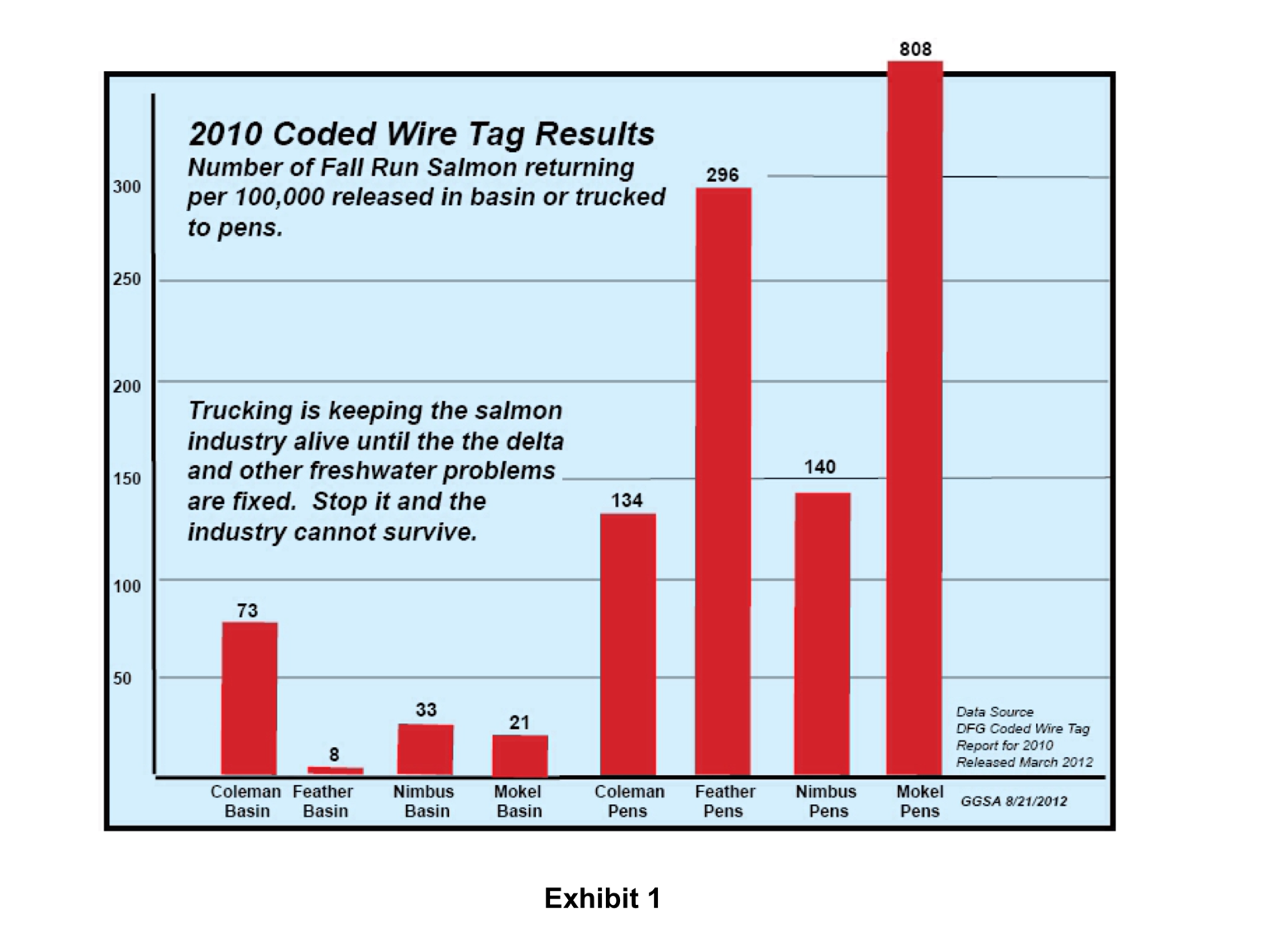
The goal of this project is to improve trucking results especially at the Federal Coleman Hatchery on Battle Creek where there are poor hatchery returns and high straying rates from trucking… The survival of trucked and acclimated fish was substantially higher than that of fish released at the hatchery basin. The combined average trucking improvement from all the hatcheries was 3.49 to 1. The improvements ranged from a high of 71 to 1 at the Feather River hatchery to a low of 1.8 to 1 at Coleman. These figures mean trucking produces many thousands of additional adults for harvest or for return. But, the returns are still very low when compared to the losses that are avoided by trucking the fish around the rivers and the Delta. Studies of the mortality of juveniles migrating down the Sacramento River and through the Delta range up to 90%. Avoiding this loss indicates that the survival of trucked fish should be more in the order of 10 to 1 over basin released fish. Current science cannot explain this difference. More research is needed.

Clearly, their Exhibit 1 below depicts the benefits of trucking in avoiding the many risks in the up to 200 mile trip to the Ocean for Central Valley salmon. Trucking bypasses much of risk, but results in high straying rates. As described previously, barging and out-planting offer potential reduction in straying without giving up the huge advantage in survival and production.

Exhibit 1

Smolt Production from hatchery adults. Kathryn E. Kostow , Anne R. Marshall and Stevan R. Phelps. 2011.2 Naturally Spawning Hatchery Steelhead Contribute to Smolt Production but Experience Low Reproductive Success

Our data support a conclusion that hatchery summer steelhead adults and their offspring contribute to wild winter steelhead population declines through competition for spawning and rearing habitats.

There is considerable scientific study that indicates that the offspring of hatchery salmon and steelhead have lower reproductive success than wild native fish. Wild native fish have many general and locally adapted traits that are often missing in hatchery fish. For Central Valley salmon and steelhead, many of these native traits were lost long ago. Tribes in northern California hope to bring some traits back from wild salmon sent from California to New Zealand a hundred years ago. Recently, special traits involving greater growth and longevity of Lahontan Cutthroat Trout were restored to Pyramid Lake in Nevada from an outside source.

In the end, we can only hope that restored “wild” populations will begin the natural selection process in restoring traits that contribute to higher survival and production. At minimum, hatcheries should discontinue practices that degrade natural diversity and genetic inheritance, and should focus on improving diversity and traits that enhance the ability to survive Valley conditions now and in the future.

Hatchery Reform – Part 3

Previously… Part 1: Central Valley Salmon and Steelhead Hatchery Program Reform & Part 2: Hatchery Reform

Contingency Release Strategies for Coleman National Fish Hatchery Juvenile Fall Chinook Salmon due to Severe Drought Conditions in 20141

“Substantial data are available to show that transporting Coleman NFH fall Chinook salmon to the west Delta would likely produce substantial increases in ocean harvest opportunity but will also result in a significant increased rate of straying as they mature and return to freshwater. The levels of straying anticipated are likely to compromise some of the hatchery objectives, including contributions to harvest in the upper Sacramento River and the ability to collect adequate broodstock at the Coleman NFH in future years, particularly 2016. Although the levels of straying anticipated from releasing fish into the West Delta are unfavorable, this release strategy may in fact represent the best possible option when faced with the possibility of losing the entire 2013 production year. In future years, under less extreme conditions, the standard protocol for releasing Chinook from the Coleman NFH will continue to be on-site releases into Battle Creek.”

There are two measures the Coleman Hatchery could adopt that would help to alleviate the straying problem associated with out-planting hatchery production. (1) Barging smolts to the Bay from Knights Landing area (above the mouth of the Feather River) would help imprint smolts on the Sacramento River. During barging, water is continually circulated through the fish tanks unlike during trucking. (2) Fry out-planting to the Yolo Bypass (Sacramento River source-water) would produce more natural smolts that would be less inclined to stray.

“The 1988-1992 period represents the most recent extended severe drought in the Central Valley. At that time the Service released nearly the entire production of fall Chinook to off-site locations to circumvent poor conditions in the lower Sacramento River and Delta. Conditions in the river and Delta were poorest during the spring of 1992 emigration season. Releases from the Coleman NFH into the West Delta in 1992 survived at a rate nearly 18 times higher than releases into Battle Creek, with a commensurate increase in ocean harvest. Owing to their markedly improved survival, West Delta releases from that same year also outperformed on-site releases in regards to returns to the hatchery. More than twice as many adult returns to the Coleman NFH in 1994 resulted from West Delta releases as compared to releases conducted into Battle Creek. If the Coleman NFH had released all production on-site in 1992 the hatchery would not have had sufficient returns of adults to meet production targets in 1994.”

Similar results are likely for the 2012-2015 drought. Despite these facts, there are many people who believe straying is unacceptable. These individuals hold out hope that “wild” Fall Chinook may someday recover in the Valley. To keep up such hopes we should adopt the two recommendations above, as well as continue to improve spawning and rearing habitats in the rivers. Our best hope for wild native genetic fish recovery is to incorporate natural habitats above the dams in trap-and-haul projects. At present, Fall Run Chinook and Steelhead are generally not being actively considered for these new programs.

“Implementation and Contingencies: The Service and California Department of Fish and Wildlife (CDFW) have coordinated a schedule for the delivery (trucking) of hatchery production from the five state and federal hatcheries to acclimation net pens in the west Delta. However, if a precipitation event occurs in March or April, environmental conditions/criteria may be re-assessed and if none of the criteria above are forecast to occur, then groups of Coleman NFH fall Chinook salmon juveniles meeting appropriate size criteria for an on-site release (i.e., at or about 90/lb) may be released into Battle Creek per usual procedures. Further, criteria are expected to be assessed during the three following periods: mid-March, first of April, and mid-April. If criteria above are not met or expected to be met within a three week window, then on-site releases of appropriately sized fish will also occur shortly thereafter. Criteria may also be re-assessed one to two weeks prior to scheduled trucking dates and, again, if criteria above are not met or not predicted to be met within a three week window, then on-site releases of those groups of fish will be considered to instead occur on-site shortly thereafter. If during any of these assessments, existing/predicted conditions are expected to meet the criteria triggering consideration of the alternative release strategy, then preparations will begin, continue, or be implemented to truck appropriate groups of fish to the acclimation net pens in the west Delta as scheduled.”

These drought-year plans focus on early river releases and trucking to the west Delta. Both of these options will lead to poor survival. Instead, fry-fingerling out-planting to the Yolo Bypass, Sutter Bypass, and Bay-Delta should be considered for Jan-Feb. Barging to the Bay should be considered for Mar-Apr smolt releases. If trucking is retained, it should be further to the west (e.g., Collinsville or Pittsburg), not Rio Vista which is in the zone of influence of the South Delta Export pumps.

Hatchery Selection. Oregon Department of Fish and Wildlife. 2011.2

“Our results support the finding outlined by others that even contemporary hatchery practices (e.g. using wild brood stock, pairwise matings) can produce fish that have lowered reproductive success in the wild. This evidence suggests that hatcheries may need to consider how to replicate the intricacies of natural breeding behaviors if they are to produce fish for supplementation programs that truly help recover endangered populations.”

In-hatchery replication of natural breeding behavior is another complicated subject worth further consideration in Central Valley hatchery programs. For more on the subject see: http://www.hatcheryandwild.com .

This post is part of a 4 part series on hatchery reform, check back into the California Fisheries Blog over the next week for Part 4.

A New Paradigm for Sacramento River Basin Salmon Habitat Restoration

Nearly everyone supports the concept of restoring salmon and their habitats within the existing geographic range of the Central Valley.  But why is it so difficult to implement relatively low-cost, simple actions that would unquestionably benefit salmon?  The following is a recent example of the problem and its ultimate, surprising solution.

In 1986, a colleague (Dick Painter) with the Department of Fish and Game [now Department of Fish and Wildlife (DFW)], through a lot of planning and hard work, created an excellent salmon habitat project in a side channel on the main stem Sacramento River in Redding, California.  Many years later, I named this area “Painter’s Riffle” in recognition of the dedicated biologist.  The modified channel worked well for many years but, inevitably, the habitat quality diminished due to lack of fresh gravel replenishment that would have been historically provided from upstream areas prior to construction of Shasta and Keswick dams.  Nevertheless, the area proved beneficial for 25 years by being hydraulically connected to the main river and provided habitats for the river’s four runs of salmon and steelhead.  This circumstance changed dramatically after the City of Redding widened the Highway 44/299 Bridge spanning the Sacramento River just upstream of Painter’s Riffle.  As is now usual and customary for such in-river projects, DFW required the bridge contractor to lay clean spawning gravels in the riverbed (amounting to 20,000 cubic yards) as a platform to commence work.  The concept being, after the bridge project was complete, high reservoir releases from Shasta Dam would eventually wash those gravels downstream and contribute to new salmon spawning areas.  The strategy worked … somewhat.  The gravel mobilized en masse during March of 2011 when Shasta Reservoir went into flood-control releases and 50,000 cubic feet per second surged into the river below Keswick Dam.  The gravels placed under the highway project flushed downstream, but left 8,000 cubic yards in the channel’s entrance, forever plugging Painter’s Riffle.

In early February 2013, while driving across the new Highway 44/299 Bridge, I looked downstream and could readily see what had happened — Painter’s Riffle had been hydraulically disconnected from the river.  I drove to the site (a City of Redding municipal park) to take some photographs and measurements.   That night, I wrote a Proposal to restore the site to its original ecological function and presented the concept to the City of Redding, obtaining its support.  However, when I met with DFW representatives (including a “Habitat Restoration Coordinator”) to garner the agency’s support, you would have thought I’d wacked a hornet’s nest!  My read on the less-than-enthusiastic response was that any “outsider” involvement and alternative scientific perspectives in their internal plans for salmon restoration were unwelcomed.  This was revealed months after my original Painter’s Riffle proposal when a radically different proposal for the site surfaced and was sanctioned by the fish agencies.  They recommended slicing a 10-foot wide trench through the same side channel and only allowing it to function at flows above 10,000 cfs, instead of my submittal which recommended the channel perform at 3,250 cfs, or the minimum reservoir releases.  In my written response to the agencies’ proposal, I explained that winter-run Chinook salmon redds would become stranded and eggs would perish in the side channel if the fish spawned during normal flows above 10,000 cfs (among many other problems).  After many months of valuable time lost, logical minds prevailed and the agencies’ proposal was quietly removed from consideration.

To gain momentum, the project needed an advocate and was proposed to the Golden Gate Salmon Association’s (GGSA Interview) Task Force which includes the three fish agencies:  DFW, USFWS, & the National Marine Fisheries Service (NMFS).  DFW & NMFS representatives were contemplatively silent, but a USFWS representative asserted he had already looked at the site and the gravels appeared to be too large for suitable salmon spawning (paradoxically, in direct conflict with DFW’s in-river project gravel requirements).  The effort was rapidly dying on the vine and, without badly-needed support, GGSA was forced to put the proposal on the back burner.

Trying a different venue, the project was presented to northern California water districts.  Surprisingly, the Glenn-Colusa Irrigation District (GCID), located nearly 100 river miles downstream of Painter’s Riffle said they would champion the cause (aka, do the on-the-ground work).  At this point, with the winds shifting once again in the salmon’s favor, GGSA went to the U.S. Bureau of Reclamation (USBR) and requested their staff to take the task on as part of GGSA’s Salmon Plan.  They were successful.  Although it was still 2013, the reality of the extensive regulatory permitting hurdles forced USBR staff to eventually concede that it would be impossible to implement the project until the following year, even though low river flows (Shasta Reservoir releases) due to the severe drought would have provided perfect conditions for construction.  Regrettably, the salmon would have to wait until the fall of 2014.

As anticipated from long-range weather forecasts, the heavy rains never arrived during the winter of 2013-2014, but the meetings, conference calls, and draft environmental documents on the proposed Painter’s Riffle project came on like a deluge.  The scales were now tipping against restoration.  In fact, except for GCID, USBR, and GGSA, it seemed no fish entity would formally support the project.  For example, the USFWS suggested “pre-project monitoring” be conducted at the sealed-off side channel before any gravel was moved, perhaps for many years.  Undefined “concerns” were voiced about effects on threatened and endangered fish, but without remedial recommendations and recognition of the benefits.   With this much resistance, it seemed as though we were proposing to build a new waste-water treatment plant on the river that would spew raw sewage into the middle of prime salmon habitats.  The quagmires of state and federal bureaucracies were sucking the enthusiasm for the restoration effort down into the black hole of oblivion.  Nevertheless, after numerous speed bumps in the process and a seemingly endless series of meetings and conference calls, the log jam broke and key pragmatic agency individuals came on board with the project.

Now, at this late date, with renewed zeal, a Herculean effort was set in motion by USBR and GCID staff who worked overtime to update and finalize the numerous regulatory permits to implement the project in the fall of 2014.  But wait, not so fast!  This simple project almost came to a screeching halt when Endangered Species Act restrictions nearly imposed insurmountable obstacles to conduct the in-river work.  At the 11th hour, several knowledgeable, rational DFW biologists stepped up to the plate and delivered on all fronts with support, cooperation, and assistance resulting in NMFS allowing the work to proceed.

Once NMFS gave its blessing, the field implementation to restore Painter’s Riffle went into overdrive because of advanced planning and the due diligence of highly experienced GCID heavy equipment operators.  Two massive front-end loaders, a D-6 cat bulldozer, and an excavator simultaneously went into close-quarter action.  Their execution was well choreographed with all four earth-moving machines weaving up and down and across Painter’s Riffle.  Each operator knew the movements of others through radio communication, hand signals, or most often, years of experience in skilled operation of the machines.  It was mesmerizing to watch the quick transformation of the river channel:  Video of Equipment in Action

With everything going smoothly and swiftly, Mother Nature had another plan.  One of the largest storms to hit northern California in years (ironically, in a fourth-consecutive drought year) slammed into the area during the two weeks of construction.  With heavy rains and winds pummeling the equipment crew, they relentlessly proceeded nonstop during permitted hours.  And, to be sure, this was no ordinary storm.  The so-called “Atmospheric River” or “Pineapple Express” parked itself on top of Redding for an extended period and localized flooding was reported everywhere.  Caltrans even made an emergency stop at the job site to clear plugged culverts spewing heavy rain runoff in the municipal park.  Although Shasta Reservoir was extremely low due to the three prior years of drought, the downstream re-regulating Keswick Dam suddenly had to increase water releases due to localized flooding concerns in the vicinity of the dam.  River flows at the construction site increased dramatically, jeopardizing the work in progress … but the crew diligently kept on working and completed the project ahead of schedule and below budget.

Ultimately, all involved agencies, groups, and individuals praised the project and the unprecedented collaboration.  The finished product is anticipated to benefit the Sacramento River’s four runs of Chinook salmon and steelhead.  As a result, new salmon restoration projects are planned for implementation this and next year … using more-active stakeholder involvement and “outsiders” perspectives.  Perhaps there is hope for salmon after all:  Video of Completed Project

The completed Painter’s Riffle Project.

The completed Painter’s Riffle Project.