I have previously reported on the dewatering of fall-run salmon redds in the upper Sacramento River near Redding during the early fall spawning season. Redd dewatering has a significant negative effect on salmon egg and fry production that translates to lower annual escapement and significantly contributes to the multi-decade decline in the population (Figure 1).

Figure 1. Escapement to the upper Sacramento River natural spawning area 1952-2024.
October is the peak in the fall-run Chinook salmon spawning season (Figure 2). During early November 2024, the Bureau of Reclamation reduced Keswick Dam releases from the October average of 7000 cfs to 4000 cfs. The flow reduction reduced water levels in the upper river spawning grounds below Keswick Dam from approximately the 11-ft water surface elevation (stage) to about the 8.5 ft level, a drop of about 2.5 feet. In 2025, nearly identical flow management led to the same redd dewatering conditions (Figure 3). With most of salmon redds constructed in the 1-to-3 ft depth range, most were dewatered or only slightly watered and thus susceptible to high-egg-mortality conditions (low flow, warm water, low oxygen, and sedimentation).
The flow management strategy was also employed in recent wet years 2017 and 2019, although a more benign strategy was employed in historical wet year 2011 (Figure 4). The issue has attracted inter-agency study and mention, but actions necessary to reduce the problem have been limited.
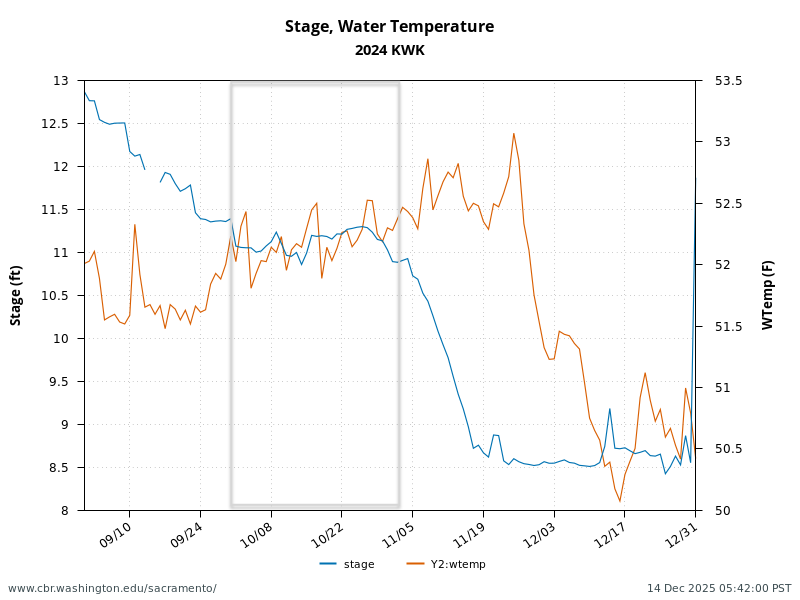
Figure 2. Stage and water temperature in the Sacramento River below Keswick Dam in fall 2024. Grey box denotes period when most fall run salmon spawn in the upper Sacramento River.
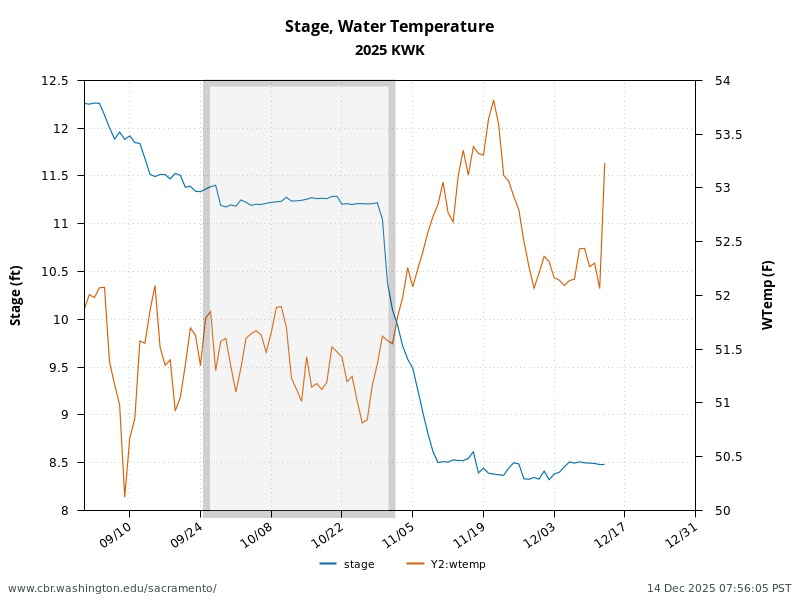
Figure 3. Stage and water temperature in the Sacramento River below Keswick Dam in fall 2025. Grey box denotes period when most fall run salmon spawn in the upper Sacramento River.
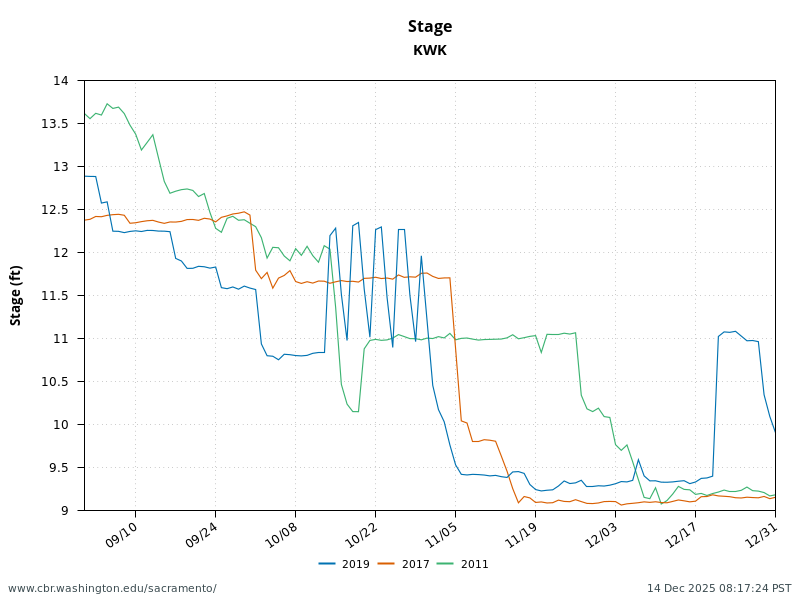
Figure 4. Stage and water temperature in the Sacramento River below Keswick Dam in fall of wet years 2011, 2017, and 2019.