Welcome to the California Fisheries Blog

The California Sportfishing Protection Alliance is pleased to host the California Fisheries Blog. The focus will be on pelagic and anadromous fisheries. We will also cover environmental topics related to fisheries such as water supply, water quality, hatcheries, harvest, and habitats. Geographical coverage will be from the ocean to headwaters, including watersheds, streams, rivers, lakes, bays, ocean, and estuaries. Please note that posts on the blog represent the work and opinions of their authors, and do not necessarily reflect CSPA positions or policy.

More on Spill

In a recent post I suggested “spill” (targeted reservoir releases) to enhance salmon production in Central Valley rivers. Well, it is now time to employ spill to help Winter Run and Spring Run Chinook salmon in the upper Sacramento River below Shasta near Redding. Waiting for El Niño to help these fish may be too late. Confidence and early indications that El Niño will come this winter should make the necessary commitment for spill now more palatable. Spill releases could have already been made from Shasta Reservoir with these recent storms to support emigration of young salmon from the spawning and rearing reach.

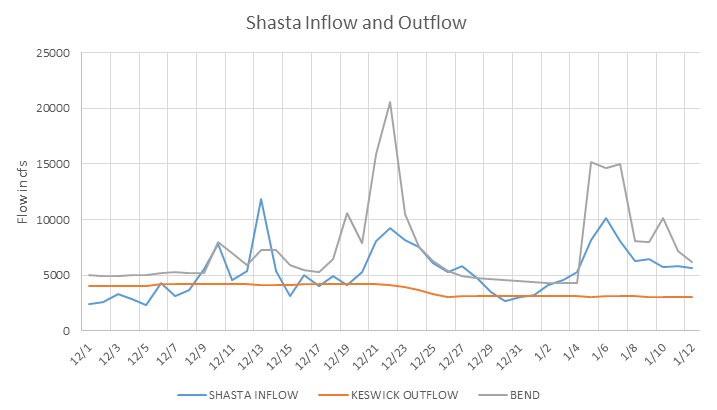
After the salmon spawning, irrigation, and water transfer season ended in October, there have only been minimum flows and no spills to enhance young salmon emigration. Flow from Shasta-Keswick (river mile 302) has remained near the minimum requirement of 4000 cfs (Figure 1).

Recent Storms – December 2015

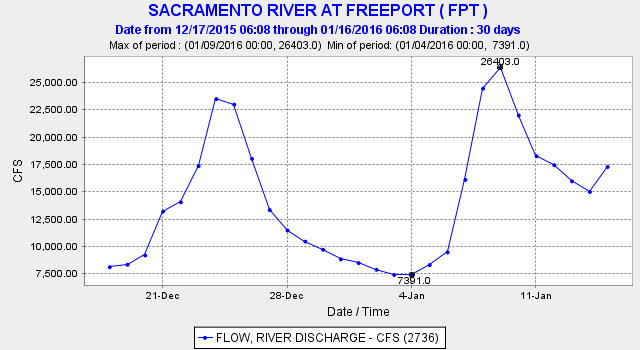
The recent storms have sharply increased flow in the Sacramento River downstream of the spawning reach at Bend Bridge at river mile 258 (Figure 2) below the input of four large creeks entering the Sacramento River below Redding (Figure 3). Inflow to Shasta Reservoir has nearly quadrupled during the two storms, reaching 8,000-10,000 cfs. A prescriptive “spill” release of 5-10% of inflow (500-1000 cfs) is needed. That would raise Keswick releases to about 5000 cfs, which would help stimulate emigration from the spawning reach into the higher flow reach below the tributaries, and down into and through the Delta.

December 2003 Case Study and Precedent

December 2003 had similar circumstances. Screw trap catch of Winter Run salmon at Knights Landing (RM 90) had a sharp increase coincident with flow increases in December 2003 (Figure 4). Spill in December 2003 (Figure 5) helped increase the river flow.

Concern for Young Salmon in the Delta

Higher freshwater inflows from the storms in 2015 have already pushed the Low Salinity Zone out of the Delta into Suisun Bay. Winter Run and Spring Run salmon (as well as Late Fall smolts and Fall Run fry) are likely now entering the Delta in large numbers (comparable monitoring results from 2003-4 are shown in Figure 6). Spill wouldl help move fish through the Delta and west to the Bay. The Delta Cross Channel remains open, allowing the emigrating salmon to spread into the Central Delta. This increases the need for spill to keep these fish moving west before the DCC is closed and south Delta exports divert freshwater inflow and emigrating salmon away from the Bay and toward the Delta pumps.

Spill is also needed from other reservoirs on the Feather, Yuba, and American Rivers that have also received significant inflow during the recent storms. Spill from these reservoirs is needed to stimulate migration of young salmon from their tailwaters as well as to contribute more to the combined Delta inflow and outflow.

Though it is a hard decision not to store all of the inflow from these first storms of the season in reservoirs, releasing 5-10% as spill would go a long way to help saving the wild endangered salmon that depend on the early winter flows.

Graph of releases from Keswick fall 2015

Figure 1. Flow releases to Sacramento River from Keswick Reservoir fall 2015. Minimum prescribed outflow to Sacramento River is approximately 4000 cfs in drought years like 2015. Keswick Dam is at rivermile 302, nine miles below Shasta Dam.

Graph of flow spike

Figure 2. Flow in the Sacramento River at Bend Bridge (RM 258) 44 miles below Keswick Dam fall 2015. Flow spikes from recent storms come from local tributary creeks upstream of Bend Bridge.

Map of winter run spawning location

Figure 3. Location of Winter Run spawning and rearing reach (green hatched line) below Keswick Dam (RM 302) near Redding, CA. Four major tributary creek inputs are shown below Redding. The mouths of Cottonwood and Battle Creeks are about RM 270.

Graph of catch index in Knights Landing

Figure 4. Catch index of older juvenile (non-fry) in Knights Landing (RM 90) rotary screw trap Oct 2003-Mar 2004. Source: http://www.science.calwater.ca.gov/pdf/ewa /support_docs_110804/Salmon%20Criteria%20Figures%201_2_Chappell.pdf

Graph flow from Keswick 2003

Figure 5. Flow releases to Sacramento River from Keswick Reservoir fall 2003. Releases were approximately doubled to 9000 cfs at mid-month, ostensibly to help stimulate young salmon emigration and allow greater Delta exports 1.

Graph of trawls 2004

Figure 6. Catch index of older juvenile (non-fry) in trawls and seines in the Sacramento River near Sacramento, Oct 2003-Mar 2004. Source: http://www.science.calwater.ca.gov/pdf/ewa /support_docs_110804/Salmon%20Criteria%20Figures%201_2_Chappell.pdf

  1. High exports in December03-January04 did result in substantial counts of juvenile Winter Run salmon at South Delta Fish Salvage Facilities during the period.

Spill and Salmon Survival

In an earlier post, I suggested “spill” to help recover salmon in the Central Valley. Spill is nomenclature used for reservoir releases. In this case I refer to spill as reservoir releases to help juvenile salmon emigrate from spawning reaches below dams to the ocean. On the Columbia River, “spill” refers to reservoir releases around hydropower turbines usually through spillways. Such spills have been used successfully on the Columbia River to avoid turbine passage that may kill young salmon and to create flows through and below reservoirs to reduce young salmon mortality by shortening their emigration time. On the Sacramento and other Central Valley rivers, “spill” releases can go through hydropower turbines because young salmon start their emigration below the dams. Young salmon have been found to emigrate during flow pulses, with survival directly related to the amount of flow.

More “spill” below the rim dams is needed in the Central Valley to increase survival of naturally produced (wild) salmon and steelhead. Spills help young salmon emigrate from tailwater spawning and rearing reaches below dams to the Delta, Bay, and ocean. Both timing and magnitude are important. Timing relates to when the young salmon are ready to migrate and to natural flow pulses in the Valley. Magnitude is simply how much flow, which relates to precipitation and available reservoir storage supply.

Timing

Most of the Chinook salmon runs emigrate to the San Francisco Bay-Delta as fry soon after hatching. Some migrate as sub-yearling fingerlings and smolts1 while a few migrate as yearling smolts.

Winter Run Salmon

Winter Run hatch in late summer and early fall in the Sacramento River below Shasta and Keswick reservoirs. They usually emigrate as fingerlings and pre-smolts to the Delta when the river cools, especially during the first flow pulses in late fall and early winter. In drier years they may not emigrate until February or even March. Generally they move down to the Delta in the first flow pulse in December (Figure 1).

Late Fall Run Salmon

Late Fall Run also hatch in winter in the Sacramento River below Shasta and Keswick reservoirs. They usually emigrate as yearling smolts in late fall or early winter, at the same time as the Winter Run. Unlike Winter Run, they are often fully developed smolts and thus migrate quickly to the ocean.

Spring Run Salmon

Spawned in early fall, Spring Run hatch and migrate as fry and fingerlings with the first pulse of flow in late fall and early winter. Some migrate as presmolts and smolts in spring.

Fall Run Salmon

Spawned in fall, Fall Run hatch and emigrate as fry in winter during flow pulses. Some emigrate as fingerlings and pre-smolts in spring.

Catch index graph

Figure 1. Older Juvenile Catch Index for the Knights Landing rotary screw trap October through March 2000-2003. Older juveniles are generally Winter Run and Late Fall Run. (Source: http://www.science.calwater.ca.gov/pdf/ewa/support_docs_110804/ Salmon%20Criteria%20Figures%201_2_Chappell.pdf)

Steelhead

Steelhead spawn in winter and spring and emigrate as smolts after rearing in Valley rivers for one to three years. They migrate to the ocean during winter and spring flow pulses.

Spill Recommendations

To illustrate my recommendations, I focus on 2015 – a drought year with very limited reservoir supply and managed spill potential. Such years would be considered worst case scenarios for applying spill prescriptions. Yet despite limited potential in 2015, there were opportunities with the available supplies and precipitation to provide spill that would have substantially benefited salmon. Below are charts of flows for drought water year 2015 that depict the effects of two storm periods on Delta inflow and outflow. Delta inflow came primarily from runoff in un-dammed tributaries. Figure 2 depicts Delta inflow at Freeport with two distinct pulses of storm flow. These same flow pulses are apparent as Delta outflow to the Bay in Figure 3.

2015 Delta inflow graph

Figure 2. Delta inflow in water year 2015. (Source: CDEC)

2015 Delta outflow graph

Figure 3. Delta outflow in water year 2015. (Source: CDEC)

Below Shasta-Keswick in the lower Sacramento River, there was no winter storm flow (Figure 4). There were only two small managed flow increases of about 1000 cfs for three or four days each (a total of about 15,000 acre-ft), because Shasta held nearly all of its inflow from the two storm periods (Figure 5). Shasta inflow reached over 20,000 cfs for six days in each of the storms (Figure 6). Out of approximately 1,500,000 acre-ft of new storage inflow, Reclamation released only15,000 acre-ft (1%) of storm inflow for salmon.

A spill prescription of just 5% of inflow below Shasta-Keswick in the primary nursery for Winter Run salmon could have provided an increased 3000-4000 cfs of “spill” for seven days, instead of the 1000 cfs increases. Instead of going into the irrigation season at 2.72 million acre-ft, in storage, Shasta would have started at 2.67 million acre-ft. Given the potential benefit of the flow releases, this prescription even for a drought year is more than reasonable.

This example is for the fourth year of drought, when the reservoir began the winter at only 25% of capacity. In wetter years when storage is over 50% capacity, spills of 10% should be considered.

The same circumstances and potential benefits occur below other large Central Valley storage reservoirs, especially Oroville Reservoir on the Feather River and Folsom Reservoir on the American River. Spills of 5% in low storage years and 10% in higher storage years are reasonable prescriptions for their depressed salmon and steelhead populations.

Graph of Reservoir releases from Shasta-Keswick

Figure 4. Reservoir releases from Shasta-Keswick in water year 2015. Only two small releases were made in the storm periods.

Graph of Shasta Reservoir storage

Figure 5. Shasta Reservoir storage in water year 2015. The two storm periods added nearly 1.5 million acre-feet of water to the reservoir.

Graph of Shasta inflow

Figure 6. Shasta Reservoir inflow in water year 2015.

  1. Smolts are larger (3-6 inches in length) juveniles physiologically ready for entry to salt water.

Saving Wild Salmon in Dry Years

I support a radical measure for saving wild salmon production in dry years in some Central Valley rivers under special circumstances: capturing wild juvenile salmon in rivers and transporting them to the Bay. This strategy has been employed in dry years on the Columbia River system, and by East Bay Municipal Utility District (EBMUD) in the present drought on the lower Mokelumne River. Under existing conditions in dry years, over 80% of Central Valley salmon fry, parr, and smolts are lost between spawning grounds and their San Francisco Bay target summer nursery. Without natural winter and spring pulse flows, few young wild salmon are able to navigate and survive to the Bay. Much of the production is lost in winter at the fry stage, which is the natural stage for Central Valley spring-run and fall-run Chinook to migrate to the Bay. Less but still important production is lost during the spring fingerling, pre-smolt, and smolt migration stages. In contrast, the hatcheries bypass the many river and Delta sources of mortality by rearing fry in raceways and trucking smolts to the Bay. It’s no wonder 90% of the salmon along the coast are from hatcheries.

Both practices (transport of hatchery and wild juveniles) should only be used in drier years, when there are minimal winter-spring river flows to naturally transport salmon. However, in drought years when reservoir inflows are low, transporting young salmon to the Bay may be necessary. Millions of wild, naturally-produced fry, parr, and smolts could be saved in each of the Central Valley spawning rivers. Huge numbers of young wild salmon are produced even in drought years in rivers such as the Yuba, American, Mokelumne, and Stanislaus that might otherwise be wasted when the Sacramento and San Joaquin rivers trickle into and through the Delta.

The process of trapping and hauling young salmon was perfected on the Columbia River in recent decades1. Capture of young salmon in the rivers at dams and water diversions is feasible and cost-effective. Many wild salmon fry can be captured at large fish screened diversions with fish bypasses (e.g., Daguerre Dam on Yuba River; GCID diversion on Sacramento River). Young salmon can also be captured in rivers below spawning reaches. For example, on the American River at Watt Avenue and the Yuba River at Hallwood Avenue, there are ideal locations with existing screw traps for indexing young salmon production that could be expanded to capture most of the production in low-flow conditions.

I have seen such bank-to-bank capture systems in Alaska on large very popular fishing rivers. The traps and supporting infrastructure are readily available. Peak trap catch of wild salmon is February-March, when hatchery transport trucks are largely unused, waiting for April-May hatchery transport season ().

Barging from the lower rivers to the Bay in lieu of trucking would help minimize subsequent straying of adults. Sacramento Valley salmon can be “barged” from Knights Landing; Feather-Yuba River salmon from Verona; and American River salmon from Discovery Park.

For more on trap capture systems including the Alaska examples see the following sources:
http://www.sf.adfg.state.ak.us/FedAidPDFs/FRED.011.pdf
http://www.adfg.alaska.gov/static/home/library/PDFs/afrb/toddv1n2.pdf
https://redoubtreporter.wordpress.com/2010/06/30/one-fish-two-fish-red-fish-new-fish-—-smolt-project-monitors-kasilof-river/
http://www.stateofthesalmon.org/fieldprotocols/downloads/SFPH_p8.pdf

trap capture system

  1. Many of the mainstem dams on the Columbia have been retrofitted with smolt capture systems. Captured fish are passed safely downstream around turbines or barged-trucked to the estuary.

Trap and Haul and Reservoir Populations of Chinook Salmon

In a recent paper, Martin Perales, Jay Rowan, and Dr. Peter Moyle call attention to existing naturally breeding populations of Chinook salmon in Central Valley reservoirs.1 Though the California Department of Fish and Wildlife no longer stocks salmon in reservoirs that are capable of reproducing, residual salmon are now surviving in some reservoirs and spawning upstream, and these authors are concerned that these fish could interbreed with salmon that were transported from downstream of these reservoirs. The abstract for their paper opines: “the possibility of behavioral and genetic interactions may lead to complications of restoration efforts via trap and haul programs. The full extent of this phenomenon needs to be documented before trap and haul programs are initiated to reintroduce salmon above reservoirs.”

There are two major efforts substantially underway to trap and haul salmon past major Central Valley rim dams: the Yuba Salmon Partnership Initiative’s plan to move salmon upstream of New Bullards Bar Reservoir on the North Yuba River, and the Bureau of Reclamation’s effort to move salmon upstream of Shasta Reservoir. Both of these programs will take ten years or more to be fully implemented, if indeed they are implemented at all.

There are no Chinook in New Bullards Bar Reservoir.

There is a substantial population of fall-run Chinook in Shasta Reservoir, many of which migrate up the Upper Sacramento River to spawn. Elsewhere, CSPA has advocated that the Bureau consider the McCloud River upstream of McCloud Reservoir as a potential target location for winter-run Chinook. The concern expressed by Perales, Rowan and Dr. Moyle is one reason why that potential location might be worth a second look: the upper McCloud is not accessible to fish that swim upstream from Shasta Reservoir.

The authors also point out that study of these “adfluvial” populations of Chinook may provide insight into the possible behavior and potential success of trapping and hauling Chinook from downstream of the reservoirs. There is some opportunity for this: in ongoing FERC licensing processes, CSPA proposed studying the spawning of Chinook (as well as trout) in the Tuolumne River that move upstream from Don Pedro Reservoir.

But let’s also not get carried away with the concern, or the potential value of existing reservoir populations of Chinook. The “complications” of interbreeding with residual reservoir salmon are among dozens of potential issues and problems that must be addressed and resolved for a program to move winter-run Chinook above Shasta Reservoir to succeed. And the numbers of Chinook salmon moving upstream from Central Valley reservoirs are generally small.

Any reintroduction of salmon upstream of rim dams will require ongoing improvement and adaptation. Any good program will set up management to solve problems, based in substantial part on monitoring of what fish in the river actually do. We should prepare for and embrace the uncertainty and the challenges. We won’t know how reintroduced salmon will behave, and we won’t even know let alone solve all the problems before we start.

If we stop to study “the full extent” of every issue before we move forward, no reintroduction programs upstream of rim dams are likely to happen at all, ever.

Genetics Matters

Showing the catch

Recent catch of Pilot Peak Lahontan Cutthroat at Pyramid Lake.

In a recent post I brought up the subject of using the right breed of Spring Run Chinook for restoring San Joaquin salmon.1 Breeding (genetics) is important when introducing hatchery fish to a natural system. For salmon, the idea is to match the native fish as closely as possible, because the native fish have adapted to the specific river conditions. Researchers have found that salmon in a river system go back to where they were born because of that adaptation. In Alaska, biologists found that salmon were adapted to specific small tributaries on larger rivers, and identified all sorts of locally adapted traits.

Decades ago, the native Lahontan cutthroat in the Pyramid Lake-Truckee River-Lake Tahoe watershed were wiped out and subsequently replaced by another nearby stock. But these fish did not grow to the large size of the native fish. Then, two decades ago the US Fish and Wildlife Service found some of the original native stock that had been transplanted to Colorado. So US Fish and Wildlife brought the native stock back, and the Paiute Hatchery now uses them. They are now naturally reproducing in the Truckee River immediately upstream from Pyramid Lake.2