Fall Run Salmon Spawn 2018

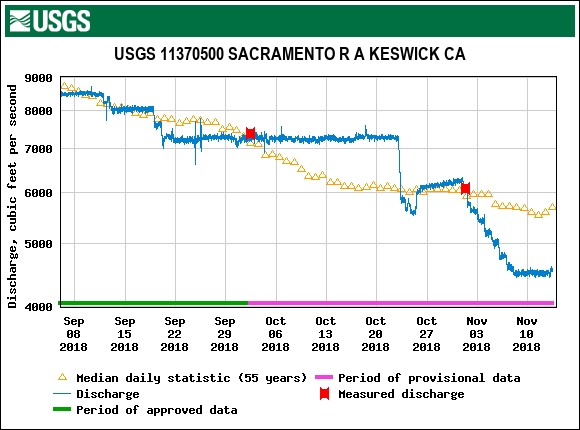
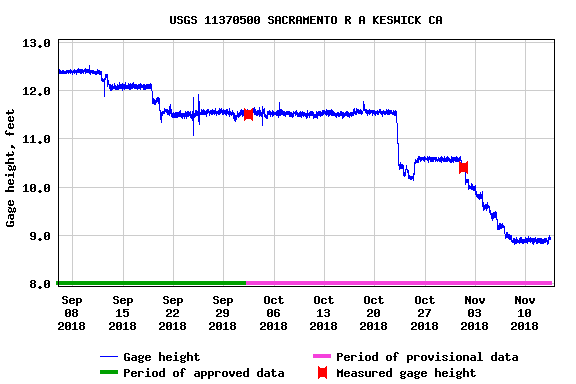
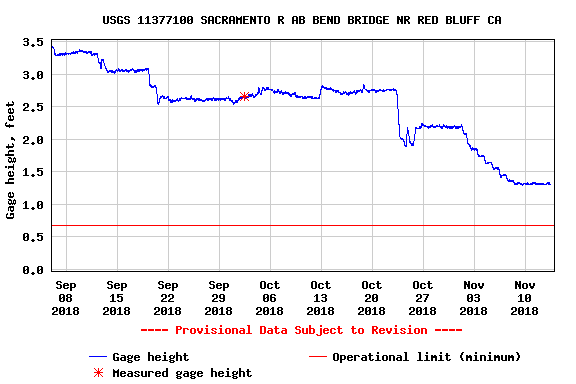
In a past May 2018 post I described how fall-run salmon redd dewatering was a key factor in the poor wild salmon production in the Sacramento River during the two prominent salmon population crashes in the past decade. This problem is again occurring in fall 2018 (Figures 1-3). The close to 50% drop in flow releases from Shasta Dam since late October and the corresponding 2-to-3 foot drop in water level is causing redd stranding of spring-run and fall-run salmon in the spawning grounds of the Sacramento River below Shasta.1

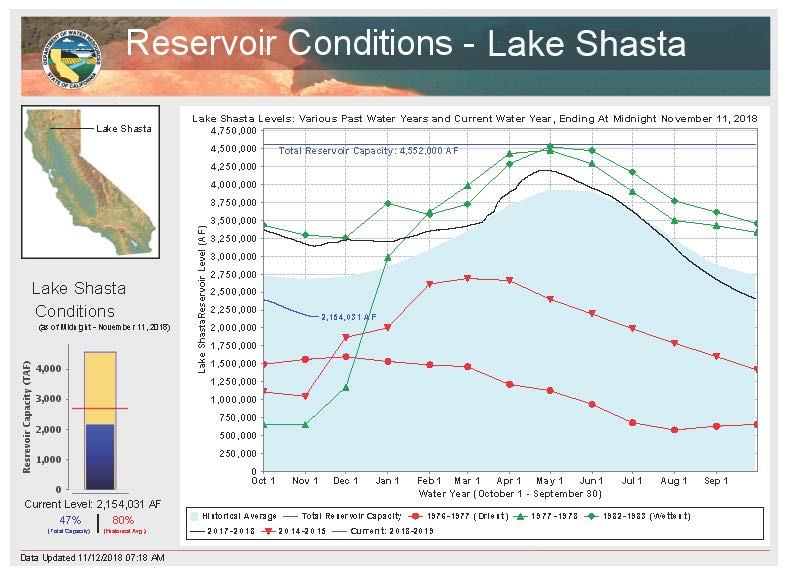
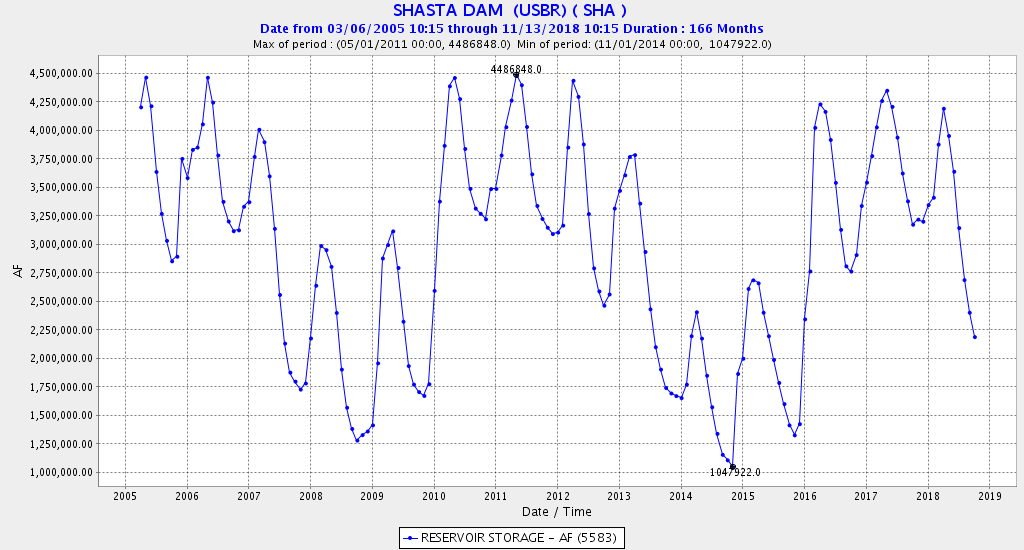
Despite nearly filling this past spring, Shasta Reservoir was drawn down over the summer and fall (Figures 4 and 5). The decline is unprecedented and is more typical of critical drought years. I recognize the concern for Shasta storage, but Reclamation’s decision to provide 100% water allocations under low snowpack conditions has again compromised Sacramento River salmon production.

Figure 1. River flow (cfs) below Shasta/Keswick in the Sacramento River in fall 2018 along with long term average.

Figure 2. Water surface elevation in Sacramento River below Keswick Dam at upper end of prime salmon spawning reach in fall 2018.

Figure 3. Water surface elevation in Sacramento River near Red Bluff at lower end of prime salmon spawning reach in fall 2018.

Figure 4. Shasta Reservoir information in 2018.

Figure 5. Monthly Shasta reservoir storage 2005-2018.

Central Valley Spring Run Salmon – Record Low Run

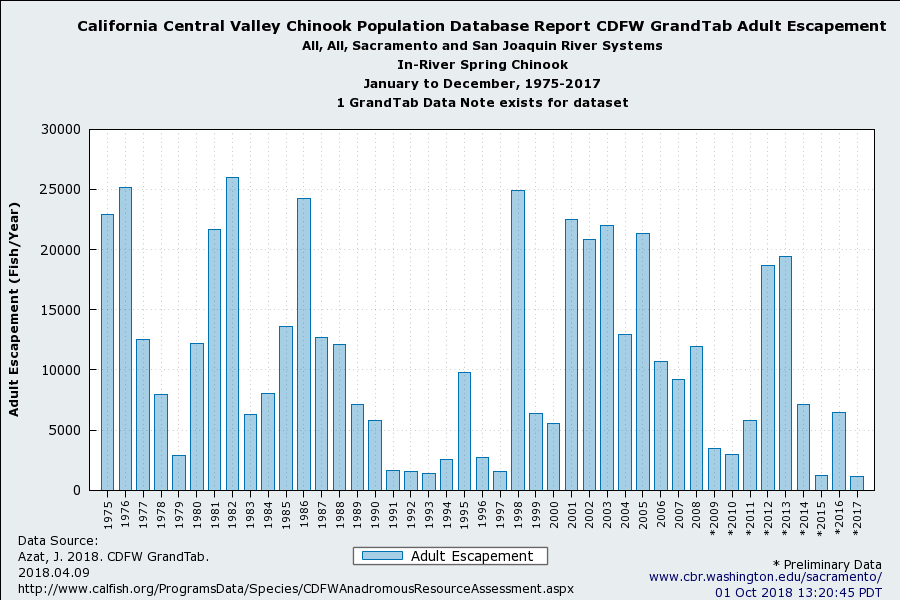
In a 10/31/17 post, I described record low spring-run Chinook salmon runs in Sacramento Valley rivers in 2017, with emphasis on the Feather River, the largest component of the Central Valley spring-run population. In this post, I update information on Central Valley spring-run. The combined Central Valley runs of spring Chinook salmon were indeed at record low levels in 2017 (Figure 1). The run total includes escapement to all Central Valley streams that host spring-run salmon, including Battle Creek, Clear Creek, Butte Creek, Antelope Creek, Big Chico Creek, Cottonwood Creek, Mill Creek, Deer Creek, Antelope Creek, Feather River-Yuba River, and the mainstem Sacramento River.1

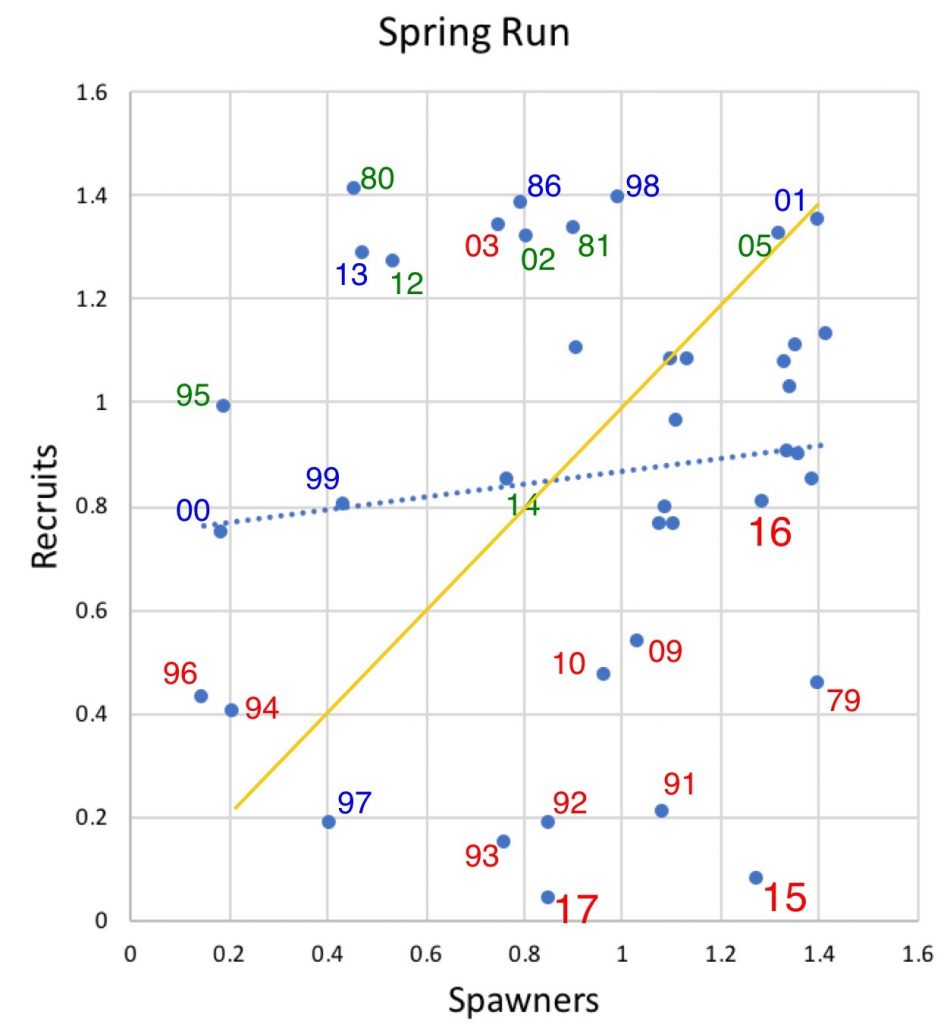
I plotted these numbers in a spawner-recruit relationship, with spawners being recruits three years earlier (Figure 2). The water year type during the first winter-spring following spawning is shown in Figure 2 by color. Winter-spring conditions reflect early rearing and emigration conditions in spawning rivers, as well as conditions in rivers downstream an in the Bay-Delta.

Factors contributing to poor recruitment in the eight critically dry years in the observed period include low river flows, high water temperatures, excessive predation, loss at water diversions, and low turbidity, all factors that are inter-related. Poor ocean conditions and hatchery operations also were likely factors, which may also be related directly or indirectly to river flows.

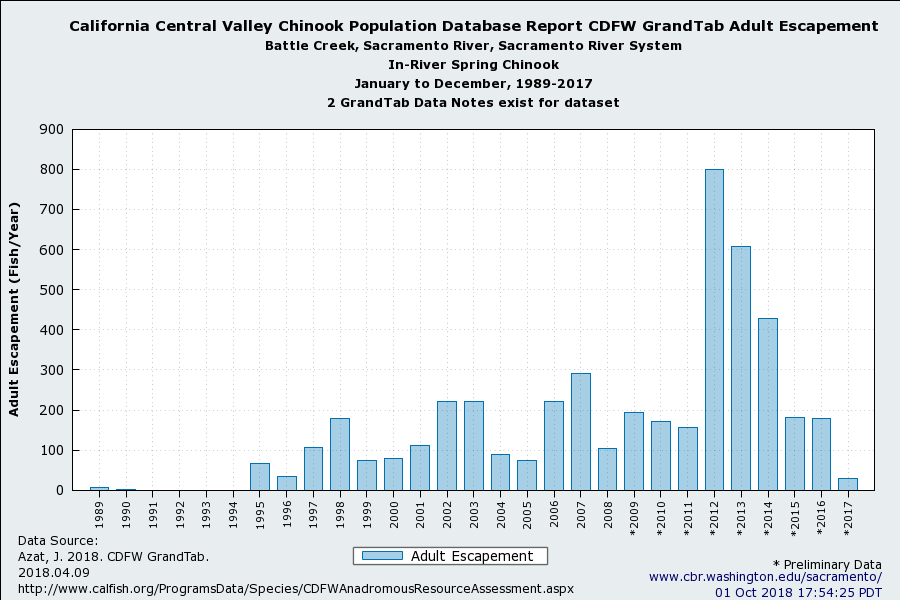
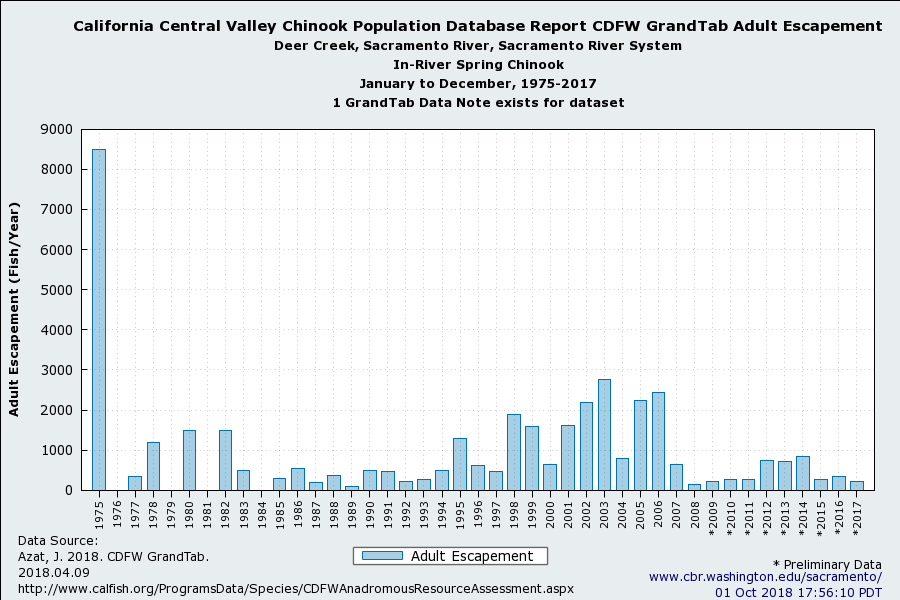
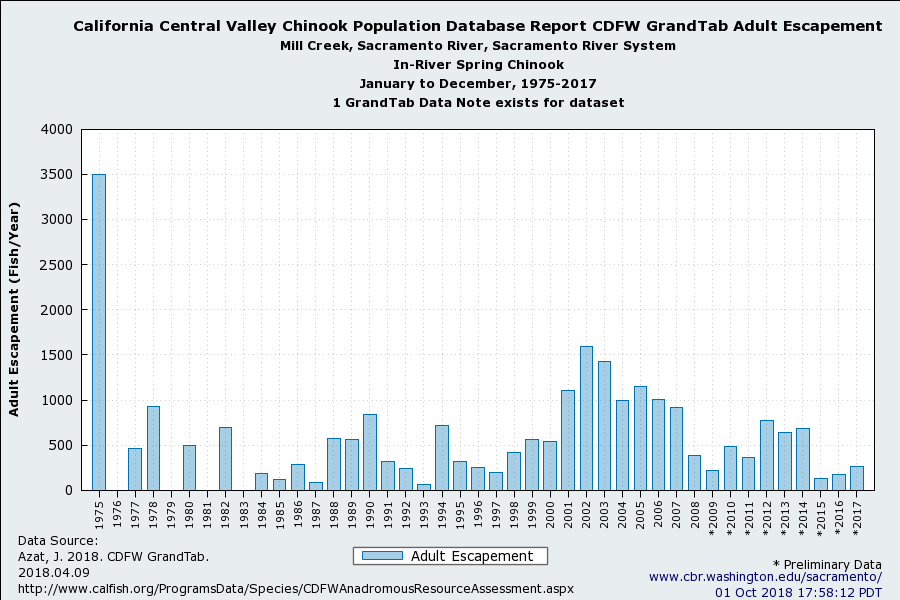
Most recent recovery efforts and planning have focused on habitat restoration.2 My own focus has been on poor river conditions (low flows and high water temperatures) and related predation.3 My reasoning is based on escapement trends over the past decade that indicate sharply dropping escapement during dry year low-flow conditions in most of the spawning rivers (Figures 3-5).

Figure 1. Spring run salmon in-river escapement (spawning run size) in the Central Valley from 1975 to 2017.

Figure 2. Spawner-recruit relationship for Central Valley river escapement of spring-run Chinook salmon. Recruits represent spawner escapement for that year. Spawners are recruits from three years prior. Numbers are log10 of escapement minus three. Red represents dry years during winter-spring after fall spawn. Blue represents wet years. Green represents normal years. Blue dotted line is statistical trend line. Yellow line is replacement level. Note eight points in bottom-right quadrant represent winter-springs of critically dry drought years (77, 89-91, 07-08, 13, and 15).

Figure 3. Battle Creek spring run salmon escapement from 1989 to 2017.

Figure 4. Deer Creek spring run salmon escapement from 1975 to 2017.

Figure 5. Mill Creek spring run salmon escapement from 1975 to 2017.

Tag Code #060448

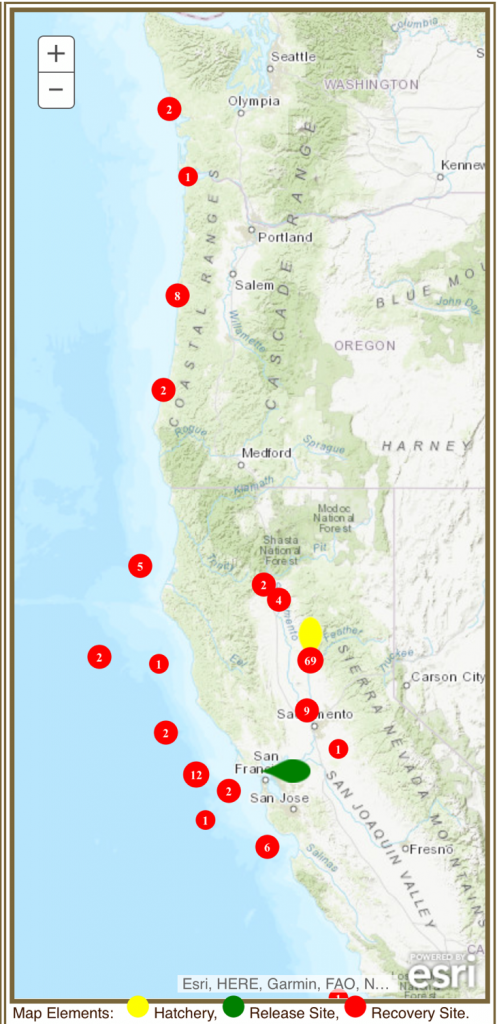
In the spring of 2014, 11,791 Feather River fall run Chinook smolts with tag code #060448 were trucked from the Feather River Hatchery and released to net pens in northern San Francisco Bay near Tiburon, California and the Golden Gate Bridge.  It was the middle of the historic 2012-2015 drought.  Somehow, an estimated 323 of these fished survived (2.74%) to be recovered in fisheries, spawning grounds, and hatcheries, including 68 back to the Feather River Hatchery (Figure 1).  The return rate for the Tiburon released smolts was over ten times that of the Feather River releases, five times that of Delta net pens, and over twice that of eastern San Pablo Bay pen releases (Table 1).  Similar results occurred from 2013 and 2015 Tiburon releases.  Results were even better from smolts barged from the Feather River to the Golden Gate in 2013.1

One wonders whether trucking and barging millions of smolts reared at the Feather and American River hatcheries would lead to more salmon commercial and sport fishery catches and improved spawning runs in the Feather and American rivers, especially during droughts.  Salmon run collapses during the 2007-2009 and 2013-2015 droughts were often blamed on poor ocean conditions, as well as poor river conditions.  Concerns of potential straying are unfounded, as all the Bay releases of Feather and American hatcheries have low straying rates (see Figure 1 for example).  Do we want a better return on our Central Valley salmon hatchery investments?

Table 1.  Number released and estimated %return from 2014 Feather River smolt releases.2
Release Location Total Released Percent Return
Tiburon Net Pens 11,791 2.74
Lower Feather River 1,230,000 0.01-0.19
West Delta Net Pens 201,000 0.55
San Pablo Bay Net Pens 6,900,000 0.19-1.30
Lake Oroville 127,000 0.0
Total 8,400,000 0.0-2.74

Figure 1. Tag return locations from #060448 Tiburon release. Source: rmis.org

  1. http://calsport.org/fisheriesblog/?p=1052
  2. Note: not all returns have been analyzed and recorded; further returns are expected from various 2017 tag-recovery sources. Data source: rmis.org

Klamath River Fall Chinook Salmon – Fall 2018 Update

The Klamath River is closed to salmon fishing again this fall after the number of fish caught reached the small allotted quotas1. Poor run size (escapement) continues to be a problem, especially for the Scott River, a major spawning tributary of the Klamath. The 2015-2017 Scott run was approximately 2000 spawners, as compared to over 12,000 in 2014. Few fall-run salmon have been counted in the Scott this fall, compared to 4500 on the Shasta River. A past post describes the problem in detail.

The key factor in the decline of Scott fall Chinook has been poor late summer and early fall flows. Low flows do not allow adult salmon to ascend the Scott from the Klamath. This not only hurts that year’s Scott run, but out-year Scott (and Klamath) returns two to five years later.

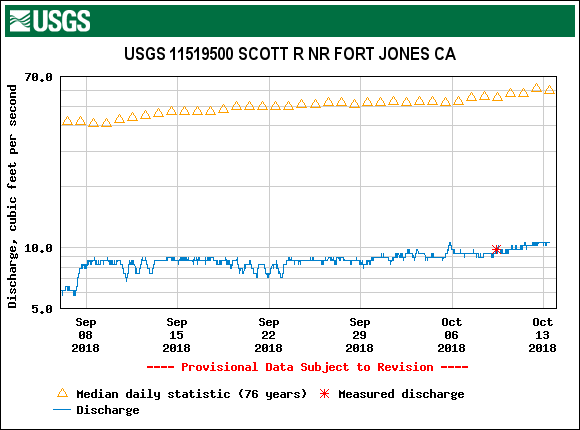
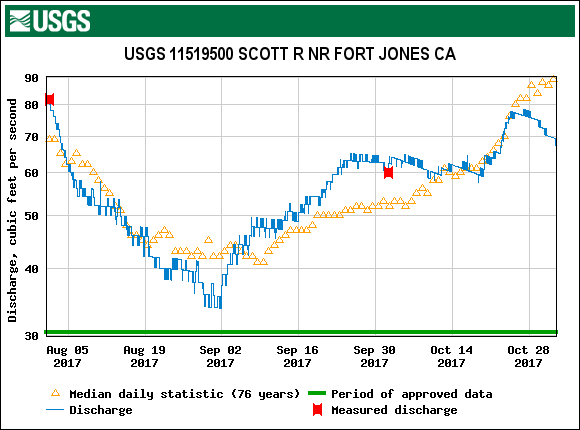
The problem is especially acute this fall, with flows less than 10 cfs, less than 20% of the historical average (Figure 1). In fall 2017, flows were near or above average (Figure 2), leading to a small increase in the run to 2500, despite poor flows during the 2013-2015 drought. The strong 2014 run also helped.

The solution is simple: stop irrigating pastures and hayfields in Scott Valley after September 1. Many ranchers do, especially for hayfields, but not all. If that is not possible, there are many idle wells of 5-10 cfs capacity each that could pump water into the river to keep the river adequately watered, with little threat to subsequent winter groundwater recharge. A battle is brewing over Scott River water use and the public trust salmon resources.

Figure 1. Scott River flows fall 2018.

Figure 2. Scott River flow in fall 2017.

No Funding Help for Central Valley Salmon Hatcheries: Sacramento Valley Salmon Recovery Program and Proposition 3 Strike Out

California’s salmon hatchery programs badly need major projects and upgrades.  The future of wild and hatchery salmon runs, as well as commercial and sport fisheries in California, depends on these programs.  However, hatchery programs are operated and funded under antiquated water project mitigation programs that lack a progressive approach (and funding) for hatcheries in salmon ecosystems in California.  And neither the Sacramento Valley Salmon Recovery Program (SVSRP) nor Proposition 3 includes investments in hatcheries.

California Salmon Hatcheries:

  • Iron Gate Hatchery: Coho, Fall Chinook and Steelhead (Klamath River)
  • Trinity River Hatchery: Coho, Fall Chinook, Spring Chinook and Steelhead (Trinity River)
  • Nimbus Hatchery: Fall Chinook and Steelhead (American River)
  • Mokelumne Hatchery: Fall Chinook and Steelhead (Mokelumne River)
  • Merced Hatchery: Fall Chinook (Merced River)
  • Feather River Hatchery: Fall Chinook, Spring Chinook and Steelhead (Feather River)
  • Coleman National Fish Hatchery: Fall Chinook, Late-fall Chinook and Steelhead (Battle Creek)
  • Livingston Stone National Fish Hatchery: Winter Chinook (Sacramento River)

The California Hatchery Review Project and Hatchery Science Review Group (HSRG)1 identified major problems/issues, goals, and expectations related to California salmon hatcheries:

  • Serious loss and degradation of habitat limits natural production of salmon and steelhead in California.
  • Hatchery program goals have been consistently expressed in terms of juvenile production rather than adult production.
  • Program purposes have not been clearly defined.
  • Hatchery monitoring and evaluation programs and Hatchery Coordination Teams are needed.
  • Program size has been set independent of any consideration of potential impacts of hatchery fish on affected natural populations.
  • Off-site releases promote unacceptable levels of straying among populations.
  • Marking/tagging programs are needed for real-time identification of all hatchery-origin Chinook salmon returning to hatchery facilities.
  • Standards for fish culture, fish health management and associated reporting are inadequate and need to be improved.
  • Populations and population boundaries have not been established for non-listed species and are needed for effective development of integrated hatchery programs.
  • Harvest management of Sacramento River Fall Chinook should account for the productivity of naturally-spawning adults.

Program goals:

  • Improving the efficiency of hatchery operations
  • Reducing the impact of hatcheries on natural populations
  • Supporting commercial, tribal, and recreational fisheries

Expectations from hatchery programs:

  • Reduction in the domestication of hatchery fish
  • Reduction in the negative impacts of hatchery fish on natural spawning populations
  • Improved prospects for the long-term successful coexistence of hatchery and natural fish

NMFS’s Salmon Recovery Plan, in addition to supporting the recommendations of the HSRG, also promotes the following action:  “Develop and implement an ecosystem based management approach that integrates harvest, hatchery, habitat, and water management, in consideration of ocean conditions and climate change (Lindley et al. 2009).”

Because scientific studies have shown that hatcheries reduce the long-term fitness and survival of salmon species, and California’s listed salmon and steelhead cannot be sustained without hatcheries, it is imperative that hatchery programs be upgraded to safeguard the future of salmon in California.  One way to accomplish this goal and the others described above is to adopt the goals and objectives of a Conservation Hatchery Strategy.

First, there needs to be a shift away from hatcheries as mitigation for long-ago-built dams and water diversions, and a shift toward hatcheries contributing directly to salmon recovery and conservation.  Dumping tens of million salmon and steelhead hatchery smolts at the eight hatcheries or trucking some to the Bay may sustain a minimal coastal fishery, but it will not bring recovery or delisting of endangered populations.  Conservation hatcheries are a necessary tool for salmon recovery.

The eight hatchery programs need funding to convert them to conservation hatcheries.  That funding could come from the SVSRP and resource agency programs, and future ballot initiatives, as well as mitigation programs.  At a minimum, the SVSRP should be integrated into an ecosystem-based management approach that includes conservation hatcheries.