Improving Water Temperature Management in Sacramento River Below Shasta for Salmon

Background

The Sacramento River below Shasta-Keswick near Redding is the spawning reach of Winter-Run Chinook salmon in summer. Winter-Run originally spawned in the cold, spring-fed reaches upstream of Shasta Reservoir. Since Shasta Dam’s construction over a half century ago, Winter-Run have spawned below in Shasta’s cold tailwater. However, in some dry years the cold water has run out and the Winter-Run spawn has failed, as was the case in late summer 2014. There simply are not sufficient guarantees in the State Water Right Order 90-5 (WRO-90-5) or the NMFS Biological Opinion (BO) to protect the Winter-Run: there weren’t in 2014 and there aren’t in 2015. Winter-Run need cold water (<56°F) through the summer to protect spawning adults, eggs laid in gravel, and fry developing in gravel beds throughout their spawning reach upstream of Red Bluff. In nearly all years there is sufficient cold water in Shasta to sustain cold water through the summer above Red Bluff, especially after construction of the Shasta Dam Temperature Control Device (TCD), which allows conservation of the coldest water in Shasta through the summer. The problem is that the cold water cannot be conserved because of downstream demands on the water.

Downstream agricultural demands force the release of too much of the Shasta cold water pool in spring and summer, which in drier years like 2014 and 2015 results in exhaustion of the cold water pool by late summer. To complicate matters, warmer Trinity water is brought over for release below Shasta to meet some of the downstream demands, thus requiring even more of the Shasta cold water pool to maintain target temperatures above Red Bluff. Shasta releases also are highest in warm afternoons to meet peak power demands; this release pattern also requires more from the cold water pool.

The federal and state agencies develop a plan to operate the system each year in the winter prior to the irrigation season. Based on what they know and forecast for the upcoming season, they develop a plan to maintain cold water through the summer for the salmon, as well as a forecasted water supply for downstream users. Both the WRO-90-5 and BO contain provisions that allow the targets for salmon temperatures to be modified in dry years to allow downstream water users a portion of their normal water supply.

WRO-90-5 allows weakening of targets for water temperature by moving the compliance point upstream from Red Bluff, sometimes as far as Redding. In 2015 the State Board in a Temporary Urgency Change Order allowed the target temperature to be raised to a daily average of 58°F in Redding.

The Problem

Both the 2014 and 2015 plans failed to meet their objectives for a multitude of reasons, least among them inaccurate information and poor planning tools (e.g., mathematical models). Lack of conservative conditions in the plan and follow-up conservative decision-making were the key problems. In 2014, the plan and operational failure led to the loss of most of the 2014 Winter-Run salmon production; the Winter-Run perished in low flows and high water temperatures in late summer in the small spawning reach upstream of Highway 44 in Redding. By late spring of 2015, it became apparent, as predicted by CSPA and others, that the Bureau had allocated spring releases (already made to downstream users) based on a forecast that overestimated the size and quality of the Shasta cold water pool . So the State Board allowed the Bureau of Reclamation to adopt a new temperature management plan, raising the target to an average daily temperature of 58°F even in the tiny amount of the Sacramento River between Keswick Dam and Clear Creek.

What more can be done?

First, rescind the weakened numeric target because it does not protect salmon eggs and newly newly hatched fry. The 56°F target must be reinstated as far downstream as possible. The SWRCB should at the very least ensure that maximum water temperatures never exceed 58°F and that average daily and weekly average maximums do not exceed 56°F.

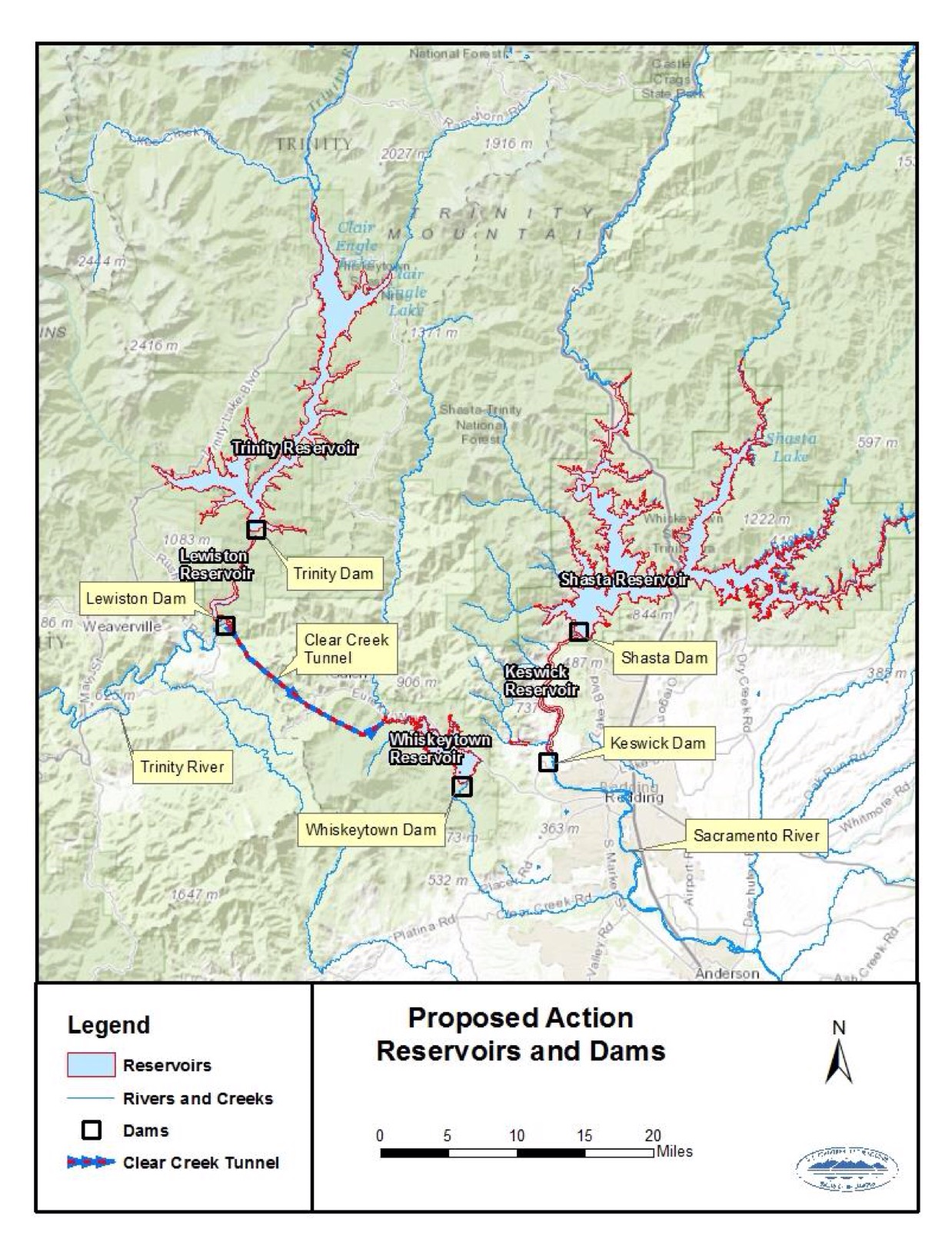
Minimum water temp chartSecond, reduce the input of warmer Trinity water via Whiskeytown and the Spring Creek Powerhouse. The chart of present conditions below shows that the warmer Trinity water entering Keswick Reservoir below Shasta makes up over 20% (1500/7000) of the water entering the Redding reach. Ensuring that the Redding reach target is maintained requires that more 50°F cold-water pool water from Shasta be mixed into the TCD than would be necessary to maintain the mandatory 58°F average daily target at Redding (CCR location) without the Trinity water. Cutting the Trinity input at this time would be especially prudent. Low flows in the Trinity (460 cfs release to river, compared to 1500 cfs diversion to Sacramento River) are contributing to disease and die-off of salmon in the lower Klamath-Trinity system. {Note: it may not be possible to reduce Trinity inputs without increasing Shasta releases because salmon have or are now spawning at these flows. Cutting Trinity inflow could still reduce demand on Shasta cold water pool water even if Trinity flow cuts are made up by Shasta water.}

This map depicts conditions in the first week of August 2015.  Daily average Shasta releases to Keswick Reservoir are approximately 5500 cfs. Daily average Whiskeytown releases to Keswick are 1500 cfs.  Keswick release is approximately 7000 cfs.  The daily range in water temperatures is shown by location in magenta.  Gaging and recording stations are blue dots (from CDEC).

This map depicts conditions in the first week of August 2015. Daily average Shasta releases to Keswick Reservoir are approximately 5500 cfs. Daily average Whiskeytown releases to Keswick are 1500 cfs. Keswick release is approximately 7000 cfs. The daily range in water temperatures is shown by location in magenta. Gaging and recording stations are blue dots (from CDEC).

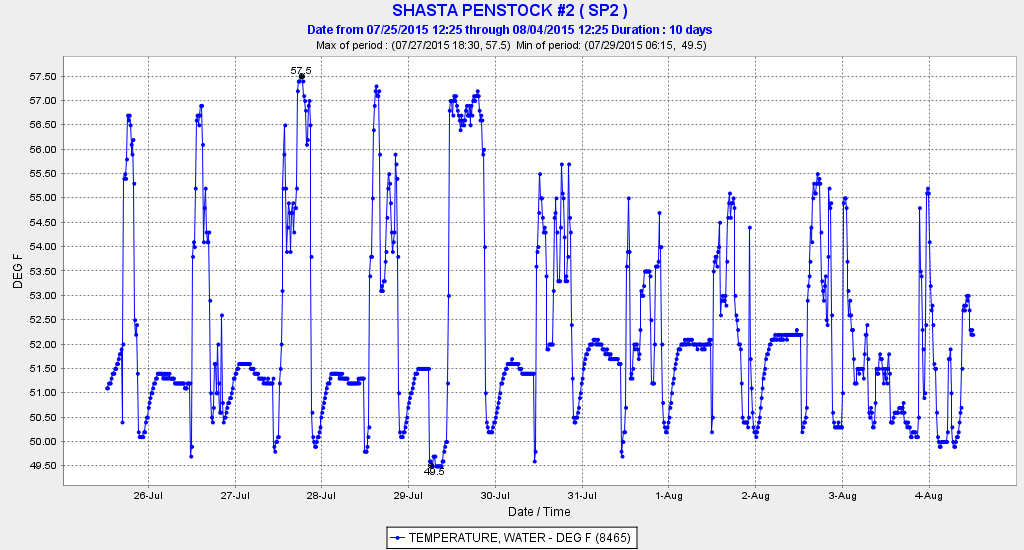
Third, reduce hourly peaking power releases from Shasta, because water released through the Shasta powerhouses is pulled from relatively high in the water column, and is thus relatively warm. Data from the past several days indicates Reclamation may already be instituting this measure – see figures below.

Water temperature recordings from one of five Shasta Dam penstocks over past ten days note high daytime water temperatures..  Lower maximum temperatures in last five days may be from reduced daytime releases or changes in TCD operation (see chart below).

Water temperature recordings from one of five Shasta Dam penstocks over past ten days note high daytime water temperatures.. Lower maximum temperatures in last five days may be from reduced daytime releases or changes in TCD operation (see chart below).

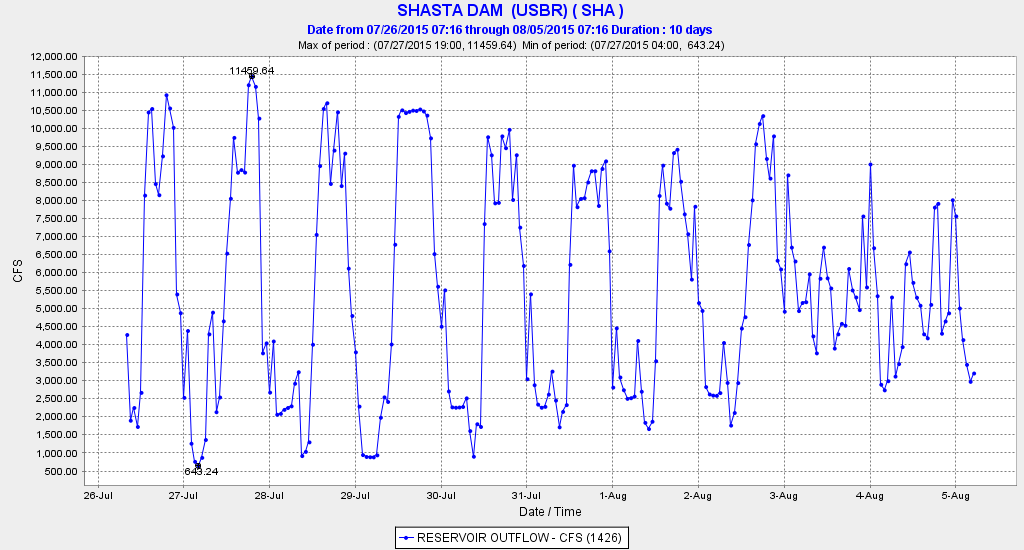
Note high daytime releases to meet peak power demands.  Note Reclamation has altered the normal pattern in the last two days, which apparently further reduced release water temperature (see chart above).

Note high daytime releases to meet peak power demands. Note Reclamation has altered the normal pattern in the last two days, which apparently further reduced release water temperature (see chart above).

In summary, saving Winter Run Chinook salmon this summer demands immediate action. This will require one or more of the following: reduced reservoir releases to downstream users, less transfer of warm water from Trinity Reservoir (via Whiskeytown and Spring Creek Powerhouse), reduced power generation, less peaking power operation, and/or the bypass of releases past Shasta’s power generation facilities (use of Shasta Dam’s lower level outlet).

Wild Salmon – A Superfood

salmon for dinnerRecently, I had fresh, wild, troll-caught1 Coho from Costco ($4.99/lb whole) with wild rice and fresh strawberry walnut salad. The salmon was truly delicious as is the usual case with fresh, wild, troll-caught salmon.

Wild salmon like this is a “Super Food”.

“Salmon is a great source of protein and is packed with omega-3 fatty acids, which are associated with a healthy heart and brain function. Look for wild salmon to get the biggest health boost.” http://partnersinhealth.kaiserpermanente.org/july-2015/national/10-superfoods-that-pack-a-nutritional-punch-nat-july2015#sthash.hUM61ZOx.dpuf.

“Fatty ocean fish such as salmon and tuna are high in omega-3 fatty acids and can help reduce cholesterol levels, especially when you eat fish instead of saturated fats from red meats. Herring, trout and sardines are also high in omega-3s. Fish is also high in protein and minerals.”
http://nutrition.about.com/od/cardiovascular/ss/Super-Foods-that-Lower-Cholesterol.htm#step10

Having wild salmon available in markets is a very strong reason for upgrading the Central Valley Fall Run Chinook Salmon hatchery program, as I have advocated in earlier posts. Demand for salmon will be increasing as more and more Californians become health conscious. With the public recognition that farmed salmon are not “wild” salmon, there will be further pressure to increase production of “wild”, “free range” salmon in our coastal waters. Central Valley salmon hatcheries can help meet this need.

Approximately 90% of the coastal “wild, free-range” salmon come from the many federal, state, and tribal hatcheries on Pacific Coast rivers.

However, hatchery salmon and the fisheries they support can be a threat to native non-hatchery wild salmon runs, many of which have been listed as threatened or endangered under federal and state endangered species acts. Fishery harvest pressure on these non-hatchery “wild” salmon like the listed Winter Run and Spring Run Chinook of the Sacramento River, potentially put these runs at greater risk of extinction. With the greater risk comes fishery restrictions and less harvest of hatchery salmon, and the need for careful planning and management of the hatchery programs and fishery harvest. Harvest can be focused on times and locations where endangered salmon are least frequently present, but often this may not be possible. Other measures such as gear and catch restrictions, terminal fisheries, and mark-selective fisheries could be employed, making it possible to “have our salmon and eat them too!”

  1. Troll-caught salmon are from regulated commercial fisheries in coastal waters from California to Alaska. They are caught live on trolling lines (in contrast to gill nets) and placed immediately on ice. I avoid purchasing “wild” salmon products from Russia or China that are available in grocery stores, because they come from “unregulated” fisheries, possibly even illegally from North American waters. Gill nets up to 50-miles long have been found fishing in ocean waters. I never purchase farmed salmon, which have little of the nutritional benefits of wild salmon.

Trap-and-Haul of Salmon/Steelhead Around Instream Barriers

By Don Beyer
Dams, impassable falls, and other instream barriers such as reduced flow, high temperature, poor water quality block or impede the migration of salmonids. The following are brief summaries of several case studies in Washington State where trapping and transport around these barriers has had encouraging results.

Recovery of Baker River Sockeye Salmon

Baker River is a tributary to the Skagit River in northern Washington State. Sockeye salmon have a very challenging life history in that they need a lake for young rearing prior to smolt outmigration to the ocean. Before the development of two hydroelectric dams, the native Baker Sockeye salmon used natural Baker Lake for spawning and rearing. After the two dams were constructed (the first dam, Lower Baker, was completed in 1925 below the lake, the upstream dam was completed at Baker Lake outlet in 1959) the sockeye salmon migrations were nearly completely blocked. Natural spawning habitat was destroyed upstream of the upper dam. The adult returns of sockeye salmon prior to the dams were estimated by the Washington Department of Fish and Wildlife1 to be about 20,000 fish but the returns fell to a low of about 99 fish in 1985.

Considerable efforts have gone into research and development of ways to facilitate both upstream and downstream passage around the two dams. The current efforts include improved trap-and-haul operation facilities below the lowermost dam, trucking to artificial spawning beaches (also newly improved) located on Baker Lake, and a new conservation hatchery next to the spawning beaches. Some adults are also released into Baker Lake to spawn naturally in Baker River and its tributaries upstream of the lake. Downstream smolt migration has been improved by trapping outmigrating smolts at both dams and transporting by truck for release below the lowermost dam. The outmigrant collection facilities have been upgraded with nets behind each dam that guide the outmigrants to the traps where they are collected and transported below the lowermost dam.

These improvements have resulted in a record run of 22,500 adult sockeye in 2010. The Washington Department of Fish and Wildlife2 forecast for returns in 2015 is 46,268 adults. The improved runs have resulted in removal of the Baker River sockeye from the Endangered Species Act candidate list. In addition, the current runs support both a tribal fishery (in downstream areas) and sport fishery (in downstream areas and in Baker Lake).

Adult Salmon/Steelhead Trap and Haul – South Fork Skykomish River at Sunset Falls

The South Fork Skykomish River joins the North Fork near Index, Washington. Combined, the two forks form the Skykomish River, which eventually flows into Puget Sound (as the Snohomish River) at Everett, Washington. This Snohomish River basin supports significant runs of coho salmon, Chinook salmon, chum salmon, pink salmon, steelhead, and cutthroat trout. Sunset Falls (near Index) is the first of three steep gradients that historically formed a totally impassable barrier to upstream migration of adult salmonids. The drainage area upstream of these barriers is about 350 square miles which has many mainstem and tributary areas that are favorable for spawning and rearing of anadromous fish.

The Washington Department of Fish and Wildlife (at the time they were the Washington Department of Fisheries) built a trap and haul facility below Sunset Falls in 1958. Trapped adult anadromous fish are captured and transported by truck to an area above the uppermost falls. These fish then migrate further upstream to spawn naturally.

The trap and haul approach has been in operation since 1958 and has passed an average of 25,000 total fish (all species) per year. This average has increased in recent years (to 46,000) due to large increases in pink salmon returns3.

Cowlitz River Fish Transport

The Cowlitz River is a major tributary to the Lower Columbia River that supports major runs of salmon and steelhead. Upstream passage of adult fish was blocked by construction of Mayfield Dam which began operation in 1963. Initial attempts to pass adults upstream were made by capturing adult fish below the dam and transporting them upstream. Outmigrants were passed around the dam through a bypass system. The situation became more complex when Mossyrock Dam (upstream of Mayfield Dam) began operation in 1968. At the same time, a barrier dam was constructed downstream of Mayfield Dam to channel fish into a newly constructed hatchery. This hatchery, one of the largest in the world, was mainly composed of concrete raceways for holding of adults and rearing of juveniles. In addition, another hatchery, primarily dedicated to production of steelhead, was constructed downstream. This hatchery has large rearing ponds for the juvenile steelhead rather than concrete raceways.

The operation of the barrier dam provided the opportunity to utilize fish for production in the hatchery or to move adults to upstream areas to naturally spawn. The challenge then was to have the outmigrants successfully migrate downstream through the reservoirs and dams.

The success of the two hatcheries has been monitored and evaluated over the years since they began operation until the mid-1990s. During this period, the mainstem below the barrier dam supported an intense sport fishery which in some years had been very good and other years not so good (mixed results that have been attributed to a number of factors including the fish handling/hatchery conditions, ocean survival, commercial/sport fisheries downstream, volcanic eruptions (i.e., Mt. St. Helens in 1980), and others). This fishery continues to the present day.

Although the fish management approach to the Cowlitz River evolved over a number of years, the situation changed when another dam (Cowlitz Falls Dam) was completed 1994. This dam is located upstream of the Mossyrock reservoir. With the current operation of the three dams, a new emphasis was placed on natural production of fish in upstream areas. Adults are transported from the downstream barrier dam to areas upstream of the Cowlitz Falls Dam where they can naturally spawn. They are also transported to the Tilton River, a tributary to the Mossyrock reservoir.

Outmigrating juveniles are funneled into bypass flumes at the Cowlitz Falls Dam where they are passed downstream to a fish collection facility. At the facility, fish are marked with various methods including coded wire tags implanted in the snout of the fish that allows for later identification. Some are radio tagged for research purposes.

Upstream migrating adults originating from above the dams captured at the barrier dam can then be transported above the Cowlitz Falls Dam with natural production (unmarked) fish. Fish marked originally at the hatchery can also be kept for production at that facility.

The Cowlitz River situation can best be described as an evolving process that is moving in a favorable direction. The fish management approach has maintained and, in some instances (such as increased limit sizes), improved the very active sport fishery in the downstream areas. Improvements in utilizing the areas upstream of the dams for natural production should assist in further expansion of the fisheries resources in the Cowlitz River basin while increasing natural production.
Corps gears up for summer fish operations – June news release

Sorry to say this is not in California – it’s the Columbia River system with its eight major mainstem dams.1  Summer “spills” have been the heart of the Columbia salmon recovery because they have helped smolts reach the ocean. The cost of “spills” is primarily lost hydropower to federal and state utilities. That was the price for keeping all the dams.

In the Central Valley the dams were built for hydropower, flood control, and water supply. Here we have Settlement Contractors with water rights that preceded the dams, who agreed to contracts that allowed the dams to be built. These folks come first in line when it comes to federal and state water rights to stored water. After these folks come the big water districts and urban water contractors of the Central Valley Project and the State Water Project.

The Columbia dams also have fish ladders that allow adult salmon to reach tributaries and headwaters and require smolts to pass the dams to reach the ocean. In the Central Valley we have wild and hatchery salmon populations below the large dams, and there are no fish ladders. (Note there are also no ladders on the big Grand Coulee and Hells Canyon Columbia system dams.)

The equivalent action of “summer spills” on the Columbia would be “spring spills” from Central Valley reservoirs. However, with stored water over-appropriated (even in most flood years when too little storage is carried over for the following year), there really is no water for “spring spills” without taking water away from people, mostly irrigators, who expect to get that water. (Note there are some higher flow requirements on the Sacramento and San Joaquin rivers and from the Delta in wetter years, but these are not near the amount of water in “spills”.)

Would Central Valley salmon benefit from “spring spills”? Yes, substantially, especially in non-flood wet and normal years. Obviously, there would be insufficient water for “spills” in some drier years and even in some normal years.

What do they do on the Columbia River in dry years? They have a smolt collection and transport program that collects wild and hatchery smolts and transports them with trucks and barges around the dams and to the estuary.

The federal recovery plan for Central Valley salmon does not include either spills or transport, but instead requires trap-and-haul above the dams. This is important and likely essential to prevent extinction of some salmon races (e.g., winter and spring run), but we also need spill and transport programs downstream of the dams. If we want to retain these fisheries, we must invest in spill and transport programs now. These programs, like those on the Columbia, should be paid for by those benefitting from the flood control, electricity, water supply and recreation provided by the dams.

Listen to the River

In 1992, the Central Valley Project Improvement Act (CVPIA) was enacted by Congress and resulted in the development of an Anadromous Fish Restoration Program (AFRP) to double the anadromous fish populations in the Central Valley by 2002. Astoundingly, after twenty-three years and more than $1,000,000,000 spent, extensive monitoring studies and the use of alleged “adaptive management”, the salmon runs have not only not doubled in size, but have declined. Most notably, there is no measureable progress toward delisting any of the threatened or endangered anadromous fish, and the fall-run Chinook, the most abundant among the four salmon runs, have now dropped even further from historical levels. Some individuals have even recently suggested that the fall run may warrant listing as an endangered species (Williams 2012) … not exactly a glowing success story for salmon restoration (or an efficient expenditure of money).

Because of this poor track record, an independent peer review (“Listen to the River”) of the CVPIA fisheries program was conducted in 2008 and was highly critical of the government agencies’ implementation of the anadromous fish restoration efforts. For example,

“Yet it is also far from clear that the agencies have done what is possible and necessary to improve freshwater conditions to help these species weather environmental variability, halt their decline and begin rebuilding in a sustainable way. A number of the most serious impediments to survival and recovery are not being effectively addressed, especially in terms of the overall design and operation of the Central Valley Project system.” (Cummins et al. 2008)

In particular, the review criticized the failures of implementing an effective, scientifically valid adaptive management program:

“The absence of a unified program organized around a conceptual framework is one of the reasons the program appears to be a compartmentalized effort that lacks strategic planning and decision-making. As a result the program is unable to address the larger system issues, has a disjointed M&E [monitoring and evaluation] program, exhibits little of the traits expected from effective adaptive management, and is unable to effectively coordinate with related programs in the region. An uncoordinated approach also creates boundaries to the free flow of useful information and program-wide prioritization. We observed that most researchers and technicians seemed unclear how or even whether their local efforts related to or contributed to the overall program.” (Cummins et al. 2008)

The “Listen to the River” report provided numerous recommendations to improve implementation of the CVPIA AFRP. Included among those suggestions was development and utilization of an effective adaptive management program. Surprisingly, it has now been seven years since the review panel’s report and all proposals put forth remain unimplemented by the involved agencies. When a newspaper reporter recently queried Bob Clarke, fisheries program supervisor for the U.S. Fish and Wildlife Service (USFWS), concerning the lack of progress and excessive funds expended in the AFRP, the response was that officials are still working to change the way they prioritize restoration. Clarke said: “It’s a process, unfortunately it’s not a process that allows you to get your results immediately,”1 Seven years? … It should have been done in seven months. A subsequent Redding Record Searchlight Newspaper Editorial2 on the topic responded that “those responsible have offered excuses, not explanations” and maybe what the AFRP needs “are fewer administrators and more field work”. It’s hard to disagree with that opinion. In an astonishing example, an examination of a portion of the annual AFRP budget in 2014 revealed that a total of $2,794,625 was expended on state and federal staff. Most of those funds were spent on so-called “Habitat Restoration Coordinators”.

AFRP Org ChartIt’s difficult to comprehend how one individual could work 52 weeks a year “coordinating” very few, if any, actual restoration projects in such small regions. Furthermore, with redundancy in the AFRP, both USFWS and the California Department of Fish and Wildlife have “Habitat Restoration Coordinators” overlapping within the same watersheds. Frankly, some of these efforts could probably be handled by an experienced individual during Saturday afternoons and serve as a “facilitator” to expedite projects, instead of a “coordinator” impeding progress with an added layer of bureaucracy. A suggested alternative approach would be to reorganize the program as shown below. This one example would allow more than $2,000,000 to be reallocated to actual salmon habitat restoration projects every year. Many more examples exist.

Proposed AFRP Org ChartDick Pool, President of Water4Fish and a long-time promoter for salmon restoration, recently summed up the problem: “The CVPIA program needs a major restructuring. For the last ten years, the salmon industry, Congress and many others have advocated the money be spent on ‘On the Ground’ projects in the river and in the Delta which deal with the real problems. So far there has been no change in the program.” After 23 years, it is time to listen to the river, implement a new approach, use true adaptive management, and place the needs of the salmon in front of building larger state and federal bureaucracies.

References

Arthur, D. 2015. “$1 Billon Later, Salmon are Still in Peril”. Redding Record Searchlight, May 17, 2015.

Redding Record Searchlight Editorial. 2015. “Agencies finally getting it – fish need cold water.” June 5, 2015.

Cummins, K., C. Furey, A. Giorgi, S. Lindley, J. Nestler, and J. Shurts. 2008. Listen to the River: An Independent Review of the CVPIA Fisheries Program. Prepared for the U.S. Bureau of Reclamation and the U.S. Fish and Wildlife Service. December 2008. 51 p. plus appendices.

Williams, J.G. 2012. Juvenile Chinook salmon (Oncorhynchus tshawytscha) in and around the San Francisco estuary. San Francisco Estuary and Watershed Science 10(3). October 2012.

  1. “$1 Billon Later, Salmon are Still in Peril”. Article by Damon Arthur, Redding Record Searchlight, May 17, 2015.
  2. June 5, 2015