Welcome to the California Fisheries Blog

The California Sportfishing Protection Alliance is pleased to host the California Fisheries Blog. The focus will be on pelagic and anadromous fisheries. We will also cover environmental topics related to fisheries such as water supply, water quality, hatcheries, harvest, and habitats. Geographical coverage will be from the ocean to headwaters, including watersheds, streams, rivers, lakes, bays, ocean, and estuaries. Please note that posts on the blog represent the work and opinions of their authors, and do not necessarily reflect CSPA positions or policy.

Hatchery Reform – Part 4

Previously… Part 1: Central Valley Salmon and Steelhead Hatchery Program ReformPart 2: Hatchery Reform, & Part 3: Hatchery Reform

Golden Gate Salmon Association (GGS) Project D.3 Improve Trucking Techniques for Hatchery Salmon Background and Scientific Analysis December 4, 20131

The goal of this project is to improve trucking results especially at the Federal Coleman Hatchery on Battle Creek where there are poor hatchery returns and high straying rates from trucking… The survival of trucked and acclimated fish was substantially higher than that of fish released at the hatchery basin. The combined average trucking improvement from all the hatcheries was 3.49 to 1. The improvements ranged from a high of 71 to 1 at the Feather River hatchery to a low of 1.8 to 1 at Coleman. These figures mean trucking produces many thousands of additional adults for harvest or for return. But, the returns are still very low when compared to the losses that are avoided by trucking the fish around the rivers and the Delta. Studies of the mortality of juveniles migrating down the Sacramento River and through the Delta range up to 90%. Avoiding this loss indicates that the survival of trucked fish should be more in the order of 10 to 1 over basin released fish. Current science cannot explain this difference. More research is needed.

Clearly, their Exhibit 1 below depicts the benefits of trucking in avoiding the many risks in the up to 200 mile trip to the Ocean for Central Valley salmon. Trucking bypasses much of risk, but results in high straying rates. As described previously, barging and out-planting offer potential reduction in straying without giving up the huge advantage in survival and production.

Exhibit 1

Smolt Production from hatchery adults. Kathryn E. Kostow , Anne R. Marshall and Stevan R. Phelps. 2011.2 Naturally Spawning Hatchery Steelhead Contribute to Smolt Production but Experience Low Reproductive Success

Our data support a conclusion that hatchery summer steelhead adults and their offspring contribute to wild winter steelhead population declines through competition for spawning and rearing habitats.

There is considerable scientific study that indicates that the offspring of hatchery salmon and steelhead have lower reproductive success than wild native fish. Wild native fish have many general and locally adapted traits that are often missing in hatchery fish. For Central Valley salmon and steelhead, many of these native traits were lost long ago. Tribes in northern California hope to bring some traits back from wild salmon sent from California to New Zealand a hundred years ago. Recently, special traits involving greater growth and longevity of Lahontan Cutthroat Trout were restored to Pyramid Lake in Nevada from an outside source.

In the end, we can only hope that restored “wild” populations will begin the natural selection process in restoring traits that contribute to higher survival and production. At minimum, hatcheries should discontinue practices that degrade natural diversity and genetic inheritance, and should focus on improving diversity and traits that enhance the ability to survive Valley conditions now and in the future.

Delta science – so much talk!

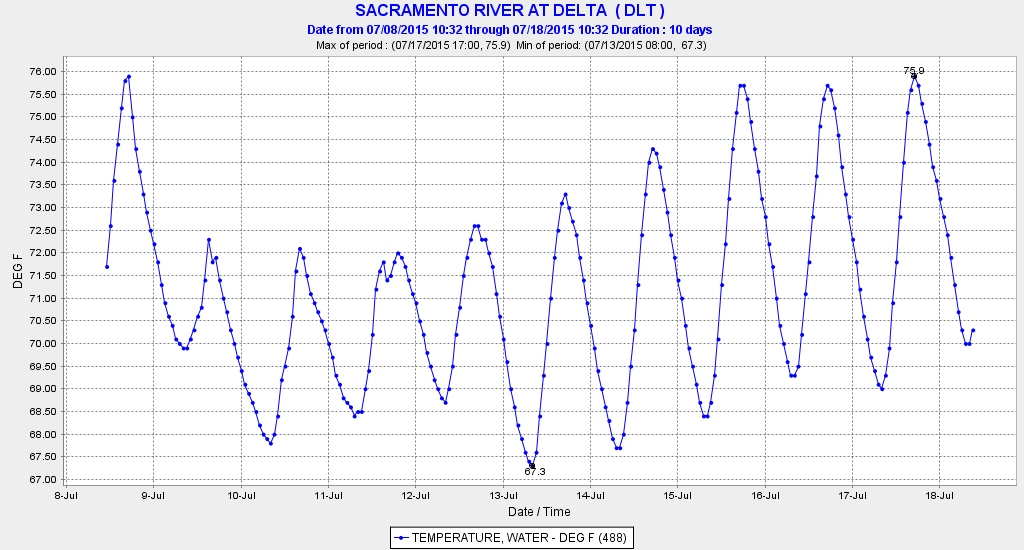
As we enter the second year of Temporary Urgency Changes for Delta operations, the State Water Board is leaving Delta fish with no protection from our waste and the summer heat while allowing the storage and diversion of millions of acre-feet of water for cities and farms. Little or no water left the Delta for the Bay this spring, and even less will leave this summer. The Smelt Working Group charged with protecting two species of endangered smelt is about to take its summer hiatus as South Delta water temperature hits 25°C. The State Board has recently been forced to reduce Shasta Reservoir agricultural releases for fear of running out of cool water for winter run salmon again this summer.

The State Board’s “drought relief” orders keep little water reaching the Bay and allow salt water to encroach into the Delta. The False River Barrier has been installed to keep salt out of south Delta water diversions at the expense of north Delta habitat. Interior, USFWS, NMFS, EPA, and CDFW, our resource protection agencies, have “concurred” with the Temporary Urgent Change Petitions from Reclamation and CDWR, and the State Water Board has complied. 1

Meanwhile, the remnants of the Delta Smelt population have become isolated in the Sacramento Deep Water Ship Channel. Reclamation scientists assure us that the smelt will be fine and will descend into the cooler water at the bottom of the channel. The lack of smelt in their traditional designated critical habitat of Suisun Bay and the western Delta low-salinity-zone is apparently not a concern.

In the midst of all this “devastation”, the Delta Science Program held a Delta Challenges Workshop this past March.

“On March 16, 2015 the Delta Stewardship Council’s Delta Science Program hosted a workshop to summarize the risks and challenges facing the Bay-Delta system. These challenges include a multitude of stressors that threaten our ability to achieve the Delta Plan’s coequal goals. Numerous reviews, reports and articles describe the stressors and risks facing the contemporary Delta, but this information is spread across diverse publications, journal articles, and lengthy technical reports. The information has not yet been presented in a highly concise, readable way by an independent set of distinguished science experts.” 2


The Workshop

Dr. Moyle suggested that we prepare for the worst: “We have to prepare for the extinction of Delta smelt: “It seems very likely to happen in the next year or two,” Dr. Moyle said. “The Fall Midwater Trawl index has never been lower, we’re basically not getting any in any of our samples, and then most recently, the Kodiak Trawl sampling has found very few, even in places they normally aggregate.” He noted that the results of the most recent Kodiak Trawl, a survey aimed at catching smelt in the places where they’re supposed to be, and where they have been in the past, were pretty dismal. “They got 6 smelt, 4 females and 2 males. So the smelt are pretty much gone from this system. We don’t know yet but they could easily have reached a threshold that they can’t get back over, that they can’t survive. We need to be thinking now of answers to questions like: how will we know when the smelt is extinct in the wild? Who declares that? How can the captive populations present in Byron, how can these captive populations be used for re-introduction when better conditions return, at least temporarily, or even should they? And how does management of the Delta change if the Delta smelt are gone? What do we do, essentially, in the absence of Delta smelt?”

Others spoke on adaptive management: “Dr. Goodwin asked Maria Rea about doing large landscape-scale experiments. “To really do an experiment on the scale that needs to be done, and it’s an experiment so you don’t necessarily know what the outcome is, that puts people making decisions in a very difficult position, and I just wonder, how, as a science/policy/management community, what needs to be done to allow these landscape-scale experiments to go on?”

“We do need to get better at experimentation,” Maria Rea answered, noting that with salmon, they’ve done a bunch of tagged fish studies, some with active adaptive management. “The Vernalis Adaptive Management Program had an active component to it, but the number of fish tagged was insufficient to allow any real conclusions to be drawn from that, and so I think we’ve got quite a bit of work to do to. If we’re going to do a large-scale experiment and actually manipulate the system, then let’s make sure we’re growing enough fish and getting enough tags to put in the system that will actually be able to deduce something from the data that we get.”

The need for more money for more science came up: Dr. Luoma noted that since between 1997 and 2010, there was a large injection of science into the system, tens of millions of dollars. “That was a sign of what we need to keep things moving rapidly,” he said. “That money has dried up … If we’re going to really continue on this journey of trying to make progress, it’s obvious we need a big injection of science somewhere managed by the science program. We need an injection of science that allows us all to work together. That’s desperately needed now or else we’re just going to start flailing.”

“We need to explore performance measures, of having something that we can track that helps the policy makers understand the question, what has to happen next. “I think it was Bill Dennison who ran that workshop several years ago, showed us what you can do with a really organized system of performance measures that gets the public involved, gets the policy makers involved. We can do that, we just haven’t done it. I think this is something we really have to focus on doing right.”

Of course, there is always the concept that the Delta continues to evolve and remains hard to understand: Dr. Mike Healey began by noting that one of Jim Cloern’s comments especially resonated with him. “His comment that the Delta is a continually evolving system and we’re never going to be able to fully pin it down. Several people have been talking about wicked problems. Wicked problems have a formal definition in planning and management, and one of the characteristics of wicked problems is that they can’t be solved, they can only be managed. I think that’s probably what we’re looking at is coming up with a system of management that will be hopefully be relatively effective, rather than imagining that we can clearly define this problem and ultimately provide a solution.”

Then there is always the “reality check” and a “happy place somewhere down the road”:
“Once you’ve answered that question, you need to then concern yourself with what’s actually feasible but most of us want something that we’re really not going to be able to get, so we’re going to need to be able to make a reality check and decide what among the things we’d like to have we can actually accomplish, and then the final question is, how do we get to where we want to go from where we are now? And I think we still have a lot of work to do on those latter three questions,” he said. “We’re not anywhere near coming up with the final management plan for this problem as yet, I don’t think,” he said. “But I hope that whatever we can come up with can make some kind of a contribution to making progress, down the road towards that happy place.”

A potential for “boldness” from “outsiders” who can provide a “fresh look” at the problems:
“I really think there is an opportunity here for some boldness, and I hope that we as a foursome will be a bit bold,” he said. “I really do hope that we basically embrace ideas that we can agree upon and present them to you as things that would be the next steps moving forward, or at least our ideas of what that might be, because we need to move beyond just simply continuing to monitor this system. We really need to begin to actually implement some projects, some experiments, and really move that next step down the road to actually beginning to deal with some of the changes that are being imposed on the system and seeing if we can come up with a better and more beneficial ending with some of our attempts. I know it’s fraught with lots of difficulty, and we’re going to make lost of mistakes, but I think we need to be bold and move forward. And hopefully we can give you some ideas on how we think that might be best done.”

And finally, “something learned”, “fun”, and a “ridiculous challenge”:
After public comment, Letty Belin with the Department of the Interior then gave some final thoughts. “I think it’s been an extraordinary day,” she said. “I bet you there’s not a single person in this room that hasn’t learned something significant. I’m still amazed that we got this incredibly talented and experienced panel to accept what I acknowledge is a ridiculous charge. If I had this assignment, I would first turn it back to the teacher and say this is impossible, you cannot summarize this stuff in 15 to 20 pages, and then I’d ask what size can the font be, can it be like .333 but anyway I know it’s particularly fun to hear your reactions and use words like fun.

“I can’t tell you how important I think this effort is,” she continued. “I think it’s going to be incredibly helpful, because policy making in such a complex scientific environment, we need guideposts and people, you all who have both the scientific expertise and the wisdom gained through that, we really are fortunate to be able to get your expertise, so thank you so much.”

Not a word on the drought or changes to Delta water quality standards, or the effects of having no freshwater flow into the Bay.

  1. At a State Board drought workshop earlier this year, the Board chairperson asked the NMFS representative what “concurrence” meant. The NMFS rep responded by stating he had looked up the definition in a dictionary, but they really did not understand its meaning in this case.
  2. http://mavensnotebook.com/2015/04/24/delta-challenges-workshop-part-4-fish-birds-and-habitat/

Hatchery Reform – Part 3

Previously… Part 1: Central Valley Salmon and Steelhead Hatchery Program Reform & Part 2: Hatchery Reform

Contingency Release Strategies for Coleman National Fish Hatchery Juvenile Fall Chinook Salmon due to Severe Drought Conditions in 20141

“Substantial data are available to show that transporting Coleman NFH fall Chinook salmon to the west Delta would likely produce substantial increases in ocean harvest opportunity but will also result in a significant increased rate of straying as they mature and return to freshwater. The levels of straying anticipated are likely to compromise some of the hatchery objectives, including contributions to harvest in the upper Sacramento River and the ability to collect adequate broodstock at the Coleman NFH in future years, particularly 2016. Although the levels of straying anticipated from releasing fish into the West Delta are unfavorable, this release strategy may in fact represent the best possible option when faced with the possibility of losing the entire 2013 production year. In future years, under less extreme conditions, the standard protocol for releasing Chinook from the Coleman NFH will continue to be on-site releases into Battle Creek.”

There are two measures the Coleman Hatchery could adopt that would help to alleviate the straying problem associated with out-planting hatchery production. (1) Barging smolts to the Bay from Knights Landing area (above the mouth of the Feather River) would help imprint smolts on the Sacramento River. During barging, water is continually circulated through the fish tanks unlike during trucking. (2) Fry out-planting to the Yolo Bypass (Sacramento River source-water) would produce more natural smolts that would be less inclined to stray.

“The 1988-1992 period represents the most recent extended severe drought in the Central Valley. At that time the Service released nearly the entire production of fall Chinook to off-site locations to circumvent poor conditions in the lower Sacramento River and Delta. Conditions in the river and Delta were poorest during the spring of 1992 emigration season. Releases from the Coleman NFH into the West Delta in 1992 survived at a rate nearly 18 times higher than releases into Battle Creek, with a commensurate increase in ocean harvest. Owing to their markedly improved survival, West Delta releases from that same year also outperformed on-site releases in regards to returns to the hatchery. More than twice as many adult returns to the Coleman NFH in 1994 resulted from West Delta releases as compared to releases conducted into Battle Creek. If the Coleman NFH had released all production on-site in 1992 the hatchery would not have had sufficient returns of adults to meet production targets in 1994.”

Similar results are likely for the 2012-2015 drought. Despite these facts, there are many people who believe straying is unacceptable. These individuals hold out hope that “wild” Fall Chinook may someday recover in the Valley. To keep up such hopes we should adopt the two recommendations above, as well as continue to improve spawning and rearing habitats in the rivers. Our best hope for wild native genetic fish recovery is to incorporate natural habitats above the dams in trap-and-haul projects. At present, Fall Run Chinook and Steelhead are generally not being actively considered for these new programs.

“Implementation and Contingencies: The Service and California Department of Fish and Wildlife (CDFW) have coordinated a schedule for the delivery (trucking) of hatchery production from the five state and federal hatcheries to acclimation net pens in the west Delta. However, if a precipitation event occurs in March or April, environmental conditions/criteria may be re-assessed and if none of the criteria above are forecast to occur, then groups of Coleman NFH fall Chinook salmon juveniles meeting appropriate size criteria for an on-site release (i.e., at or about 90/lb) may be released into Battle Creek per usual procedures. Further, criteria are expected to be assessed during the three following periods: mid-March, first of April, and mid-April. If criteria above are not met or expected to be met within a three week window, then on-site releases of appropriately sized fish will also occur shortly thereafter. Criteria may also be re-assessed one to two weeks prior to scheduled trucking dates and, again, if criteria above are not met or not predicted to be met within a three week window, then on-site releases of those groups of fish will be considered to instead occur on-site shortly thereafter. If during any of these assessments, existing/predicted conditions are expected to meet the criteria triggering consideration of the alternative release strategy, then preparations will begin, continue, or be implemented to truck appropriate groups of fish to the acclimation net pens in the west Delta as scheduled.”

These drought-year plans focus on early river releases and trucking to the west Delta. Both of these options will lead to poor survival. Instead, fry-fingerling out-planting to the Yolo Bypass, Sutter Bypass, and Bay-Delta should be considered for Jan-Feb. Barging to the Bay should be considered for Mar-Apr smolt releases. If trucking is retained, it should be further to the west (e.g., Collinsville or Pittsburg), not Rio Vista which is in the zone of influence of the South Delta Export pumps.

Hatchery Selection. Oregon Department of Fish and Wildlife. 2011.2

“Our results support the finding outlined by others that even contemporary hatchery practices (e.g. using wild brood stock, pairwise matings) can produce fish that have lowered reproductive success in the wild. This evidence suggests that hatcheries may need to consider how to replicate the intricacies of natural breeding behaviors if they are to produce fish for supplementation programs that truly help recover endangered populations.”

In-hatchery replication of natural breeding behavior is another complicated subject worth further consideration in Central Valley hatchery programs. For more on the subject see: http://www.hatcheryandwild.com .

This post is part of a 4 part series on hatchery reform, check back into the California Fisheries Blog over the next week for Part 4.

A New Paradigm for Sacramento River Basin Salmon Habitat Restoration

Nearly everyone supports the concept of restoring salmon and their habitats within the existing geographic range of the Central Valley.  But why is it so difficult to implement relatively low-cost, simple actions that would unquestionably benefit salmon?  The following is a recent example of the problem and its ultimate, surprising solution.

In 1986, a colleague (Dick Painter) with the Department of Fish and Game [now Department of Fish and Wildlife (DFW)], through a lot of planning and hard work, created an excellent salmon habitat project in a side channel on the main stem Sacramento River in Redding, California.  Many years later, I named this area “Painter’s Riffle” in recognition of the dedicated biologist.  The modified channel worked well for many years but, inevitably, the habitat quality diminished due to lack of fresh gravel replenishment that would have been historically provided from upstream areas prior to construction of Shasta and Keswick dams.  Nevertheless, the area proved beneficial for 25 years by being hydraulically connected to the main river and provided habitats for the river’s four runs of salmon and steelhead.  This circumstance changed dramatically after the City of Redding widened the Highway 44/299 Bridge spanning the Sacramento River just upstream of Painter’s Riffle.  As is now usual and customary for such in-river projects, DFW required the bridge contractor to lay clean spawning gravels in the riverbed (amounting to 20,000 cubic yards) as a platform to commence work.  The concept being, after the bridge project was complete, high reservoir releases from Shasta Dam would eventually wash those gravels downstream and contribute to new salmon spawning areas.  The strategy worked … somewhat.  The gravel mobilized en masse during March of 2011 when Shasta Reservoir went into flood-control releases and 50,000 cubic feet per second surged into the river below Keswick Dam.  The gravels placed under the highway project flushed downstream, but left 8,000 cubic yards in the channel’s entrance, forever plugging Painter’s Riffle.

In early February 2013, while driving across the new Highway 44/299 Bridge, I looked downstream and could readily see what had happened — Painter’s Riffle had been hydraulically disconnected from the river.  I drove to the site (a City of Redding municipal park) to take some photographs and measurements.   That night, I wrote a Proposal to restore the site to its original ecological function and presented the concept to the City of Redding, obtaining its support.  However, when I met with DFW representatives (including a “Habitat Restoration Coordinator”) to garner the agency’s support, you would have thought I’d wacked a hornet’s nest!  My read on the less-than-enthusiastic response was that any “outsider” involvement and alternative scientific perspectives in their internal plans for salmon restoration were unwelcomed.  This was revealed months after my original Painter’s Riffle proposal when a radically different proposal for the site surfaced and was sanctioned by the fish agencies.  They recommended slicing a 10-foot wide trench through the same side channel and only allowing it to function at flows above 10,000 cfs, instead of my submittal which recommended the channel perform at 3,250 cfs, or the minimum reservoir releases.  In my written response to the agencies’ proposal, I explained that winter-run Chinook salmon redds would become stranded and eggs would perish in the side channel if the fish spawned during normal flows above 10,000 cfs (among many other problems).  After many months of valuable time lost, logical minds prevailed and the agencies’ proposal was quietly removed from consideration.

To gain momentum, the project needed an advocate and was proposed to the Golden Gate Salmon Association’s (GGSA Interview) Task Force which includes the three fish agencies:  DFW, USFWS, & the National Marine Fisheries Service (NMFS).  DFW & NMFS representatives were contemplatively silent, but a USFWS representative asserted he had already looked at the site and the gravels appeared to be too large for suitable salmon spawning (paradoxically, in direct conflict with DFW’s in-river project gravel requirements).  The effort was rapidly dying on the vine and, without badly-needed support, GGSA was forced to put the proposal on the back burner.

Trying a different venue, the project was presented to northern California water districts.  Surprisingly, the Glenn-Colusa Irrigation District (GCID), located nearly 100 river miles downstream of Painter’s Riffle said they would champion the cause (aka, do the on-the-ground work).  At this point, with the winds shifting once again in the salmon’s favor, GGSA went to the U.S. Bureau of Reclamation (USBR) and requested their staff to take the task on as part of GGSA’s Salmon Plan.  They were successful.  Although it was still 2013, the reality of the extensive regulatory permitting hurdles forced USBR staff to eventually concede that it would be impossible to implement the project until the following year, even though low river flows (Shasta Reservoir releases) due to the severe drought would have provided perfect conditions for construction.  Regrettably, the salmon would have to wait until the fall of 2014.

As anticipated from long-range weather forecasts, the heavy rains never arrived during the winter of 2013-2014, but the meetings, conference calls, and draft environmental documents on the proposed Painter’s Riffle project came on like a deluge.  The scales were now tipping against restoration.  In fact, except for GCID, USBR, and GGSA, it seemed no fish entity would formally support the project.  For example, the USFWS suggested “pre-project monitoring” be conducted at the sealed-off side channel before any gravel was moved, perhaps for many years.  Undefined “concerns” were voiced about effects on threatened and endangered fish, but without remedial recommendations and recognition of the benefits.   With this much resistance, it seemed as though we were proposing to build a new waste-water treatment plant on the river that would spew raw sewage into the middle of prime salmon habitats.  The quagmires of state and federal bureaucracies were sucking the enthusiasm for the restoration effort down into the black hole of oblivion.  Nevertheless, after numerous speed bumps in the process and a seemingly endless series of meetings and conference calls, the log jam broke and key pragmatic agency individuals came on board with the project.

Now, at this late date, with renewed zeal, a Herculean effort was set in motion by USBR and GCID staff who worked overtime to update and finalize the numerous regulatory permits to implement the project in the fall of 2014.  But wait, not so fast!  This simple project almost came to a screeching halt when Endangered Species Act restrictions nearly imposed insurmountable obstacles to conduct the in-river work.  At the 11th hour, several knowledgeable, rational DFW biologists stepped up to the plate and delivered on all fronts with support, cooperation, and assistance resulting in NMFS allowing the work to proceed.

Once NMFS gave its blessing, the field implementation to restore Painter’s Riffle went into overdrive because of advanced planning and the due diligence of highly experienced GCID heavy equipment operators.  Two massive front-end loaders, a D-6 cat bulldozer, and an excavator simultaneously went into close-quarter action.  Their execution was well choreographed with all four earth-moving machines weaving up and down and across Painter’s Riffle.  Each operator knew the movements of others through radio communication, hand signals, or most often, years of experience in skilled operation of the machines.  It was mesmerizing to watch the quick transformation of the river channel:  Video of Equipment in Action

With everything going smoothly and swiftly, Mother Nature had another plan.  One of the largest storms to hit northern California in years (ironically, in a fourth-consecutive drought year) slammed into the area during the two weeks of construction.  With heavy rains and winds pummeling the equipment crew, they relentlessly proceeded nonstop during permitted hours.  And, to be sure, this was no ordinary storm.  The so-called “Atmospheric River” or “Pineapple Express” parked itself on top of Redding for an extended period and localized flooding was reported everywhere.  Caltrans even made an emergency stop at the job site to clear plugged culverts spewing heavy rain runoff in the municipal park.  Although Shasta Reservoir was extremely low due to the three prior years of drought, the downstream re-regulating Keswick Dam suddenly had to increase water releases due to localized flooding concerns in the vicinity of the dam.  River flows at the construction site increased dramatically, jeopardizing the work in progress … but the crew diligently kept on working and completed the project ahead of schedule and below budget.

Ultimately, all involved agencies, groups, and individuals praised the project and the unprecedented collaboration.  The finished product is anticipated to benefit the Sacramento River’s four runs of Chinook salmon and steelhead.  As a result, new salmon restoration projects are planned for implementation this and next year … using more-active stakeholder involvement and “outsiders” perspectives.  Perhaps there is hope for salmon after all:  Video of Completed Project

The completed Painter’s Riffle Project.

The completed Painter’s Riffle Project.

Hatchery Reform – Part 2

Previously… Part 1: Central Valley Salmon and Steelhead Hatchery Program Reform

Environmental Factors Affecting Smoltification and Early Marine Survival of Anadromous Salmonids. 1980. GARY A. WEDEMEYER, RICHARD L. SAUNDERS, and W. CRAIG CLARKE1.

“There is reason to suspect that in many cases apparently healthy hatchery fish, though large and silvery, are not actually functional smolts and their limited contribution to the fishery, even when stocked into the same rivers from which their parents were taken, results from their being unprepared to go to sea. This failure to produce good quality smolts probably arises from an incomplete understanding of exactly what constitutes a smolt, as well as from a lack of understanding of the environmental influences that affect the parr-smolt transformation and which may lead, as a long term consequence, to reduced ocean survival.”

This paper is over thirty years old (1980), yet it still rings true. It is most certainly a complicated subject that is an on-going concern in hatchery science and management. There remains room for improvement if funding is available for hatchery program upgrades.

“In the absence of complicating factors such as altered river and estuarine ecology, smolt releases should be timed to coincide as nearly as possible with the historical seaward migration of naturally produced fish in the recipient stream, if genetic strains are similar. At headwater production sites, much earlier release may be called for… The desired result is that hatchery reared smolts which are genetically similar to wild smolts enter the sea at or near the same time.”

It has been apparent for many decades that Central Valley Fall Run and Spring Run Chinook have a classic “ocean-type” life-history pattern, wherein young spawned in the fall head to the ocean early in their first year rather than as yearlings. Even within the ocean-type, Central Valley Fall Run have two types: one has fry rearing in the estuary (Bay-Delta) and the other in rivers. Of these two types, Valley hatcheries have chosen to manage for the latter. Hatcheries pump out smolts by the millions in April and May, on top of a smaller number of “wild” river-smolts. I believe the “river-smolt” type has been the minority contributor at least since all the dams were built. There simply is not enough river habitat, and what there is has been severely degraded by dams, water management, and physical habitat damage (e.g., levees and land use). The majority contributor is the Bay-Delta or “estuary-smolt” type. Fry that move to the estuary in December-January grow quickly and enter the ocean as smolts in March, a month or more before the river-type. This is a huge advantage for the estuary-type. The hatchery programs could focus more effort on this type by out-planting fry to the estuary or lower river floodplains immediately above the estuary (e.g., Yolo Bypass). Experimental out-planting of hatchery fry to rice fields in the Yolo Bypass has proven promising2. There are also many natural habitats in the lower river floodplains and Bay-Delta that could accommodate out-planting.

This post is part of a 4 part series on hatchery reform, check back into the California Fisheries Blog over the next week for Parts 3 and 4.