Welcome to the California Fisheries Blog

The California Sportfishing Protection Alliance is pleased to host the California Fisheries Blog. The focus will be on pelagic and anadromous fisheries. We will also cover environmental topics related to fisheries such as water supply, water quality, hatcheries, harvest, and habitats. Geographical coverage will be from the ocean to headwaters, including watersheds, streams, rivers, lakes, bays, ocean, and estuaries. Please note that posts on the blog represent the work and opinions of their authors, and do not necessarily reflect CSPA positions or policy.

Delta April Bloom Related to Low Exports and San Joaquin Pulse Flow

A San Joaquin River pulse flow and low Delta exports in April have led to a plankton bloom in the Central Delta. The pulse flow (Figure 1) and low exports (1500 cfs) were the result of two drought-related actions of the State Water Resources Control Board in its April 6, 2015 Temporary Urgency Change Order. The bloom is a consequence of low net transport flows in central Delta channels toward the south Delta export pumps and of the water habitat thus being allowed to “stew” with nutrients from the San Joaquin River. Chlorophyll levels rose with the onset of the pulse flow and recently have begun to decline with the end of the pulse flow (Figures 4-10). Chlorophyll levels were much lower in the west, north, east, and south parts of the Delta and in Suisun Bay, when compared to the central Delta. This process was described by Arthur and Ball (1977)1

“During spring through fall, export pumping from the southern Delta caused a net flow reversal in the lower San Joaquin River, drawing Sacramento River water across the central Delta to the export pumps. The relatively deep channels and short water residence time apparently resulted in the chlorophyll concentrations remaining low from the northern Delta and in the cross-Delta flow to the pumps.”

Such a spring bloom is important because it stimulates Delta productivity that is key to native Delta fish survival and production. Lack of Delta productivity over the past several decades (Figure 2) has been related to the Pelagic Organism Decline and near extinction of Delta Smelt (Jassby et al 2003)2. Low chlorophyll levels are also related to poor zooplankton growth rates (Figure 3).

Figure 1.  San Joaquin River inflows into the Delta at Vernalis during April 2015.

Figure 1. San Joaquin River inflows into the Delta at Vernalis during April 2015.

Figure 2. Spring Delta chlorophyll levels below 10 micrograms per liter are considered low primary productivity. (Source: Jassby et al. 2003)

Figure 2. Spring Delta chlorophyll levels below 10 micrograms per liter are considered low primary productivity. (Source: Jassby et al. 2003)

Figure 3.  Zooplankton growth rates peak above chlorophyll levels above 10 micrograms per liter.  (Source: Jassby et al. 2003)

Figure 3. Zooplankton growth rates peak above chlorophyll levels above 10 micrograms per liter. (Source: Jassby et al. 2003)

Figure 4.  The six stations with chlorophyll data presented in the following charts from west to east are: •ANH – Antioch •BLP – Blind Point •OSJ – Old River at Franks Tract • PPT – San Joaquin River at Prisoners Point •HLT – Middle River at Holt •TRN – Turner Cut

Figure 4. The six stations with chlorophyll data presented in the following charts from west to east are:
• ANH – Antioch
• BLP – Blind Point
• OSJ – Old River at Franks Tract
• PPT – San Joaquin River at Prisoners Point
• HLT – Middle River at Holt
• TRN – Turner Cut

Figure 5.  Antioch chlorophyll levels April 2015.

Figure 5. Antioch chlorophyll levels April 2015.

Figure 6.  Blind Point chlorophyll levels April 2015.

Figure 6. Blind Point chlorophyll levels April 2015.

Figure 7.  Old River chlorophyll levels April 2015.

Figure 7. Old River chlorophyll levels April 2015.

Figure 8.  Prisoners Point chlorophyll levels April 2015.

Figure 8. Prisoners Point chlorophyll levels April 2015.

Figure 9.  Middle River chlorophyll levels April 2015.

Figure 9. Middle River chlorophyll levels April 2015.

Figure 10.  Turner Cut chlorophyll levels April 2015.

Figure 10. Turner Cut chlorophyll levels April 2015.

  1.   Arthur, J, and M. Ball. 1977. Planktonic Chlorophyll Dynamics in the Northern San Francisco Bay and Delta. Fifty-eighth Annual Meeting of the Pacific Division of the American Association for the Advancement of Science, San Francisco State University, San Francisco, California, June 12-16, 1977.  http://downloads.ice.ucdavis.edu/sfestuary/conomos_1979/archive1029.PDF 
  2. Jassby, A., J. Cloern, and A. Muller-Solger. 2003.  Phytoplankton fuels Delta food web.  California Agriculture 57(4): 104-109.

April Delta Smelt Update

The chart below shows the recent record low catch of Delta smelt in the recent early April Kodiak Trawl by the California Department of Fish and Wildlife.  Trawls at 40 locations in the estuary collected a single Delta smelt, the fewest ever collected.  This result is consistent with other recent surveys, including the 2014 Fall Midwater Trawl (lowest in the historical record), the late April 2015 Smelt Larva Survey and early April 20 mm Survey.  Delta smelt, once the most numerous species in the estuary, is now hovering on the brink of extinction.  Longfin smelt are not far behind.  Yet the State Water Board continues to weaken already inadequate criteria established to protect these and other species.

Kodiak Trawl Survey

April Spring Tide in Delta

Under Weakened Delta Standards

To save water, the State Water Board’s April 6 Drought Order reduced the Delta outflow standard to 4000 cfs Net Delta Outflow Index (NDOI) and allowed the Delta salinity standard compliance point to move upstream to near Rio Vista. Normally the NDOI would be 7100 cfs, and the salinity compliance would be further downstream toward Collinsville. South Delta exports are limited in the Order to 1500 cubic feet per second (cfs).

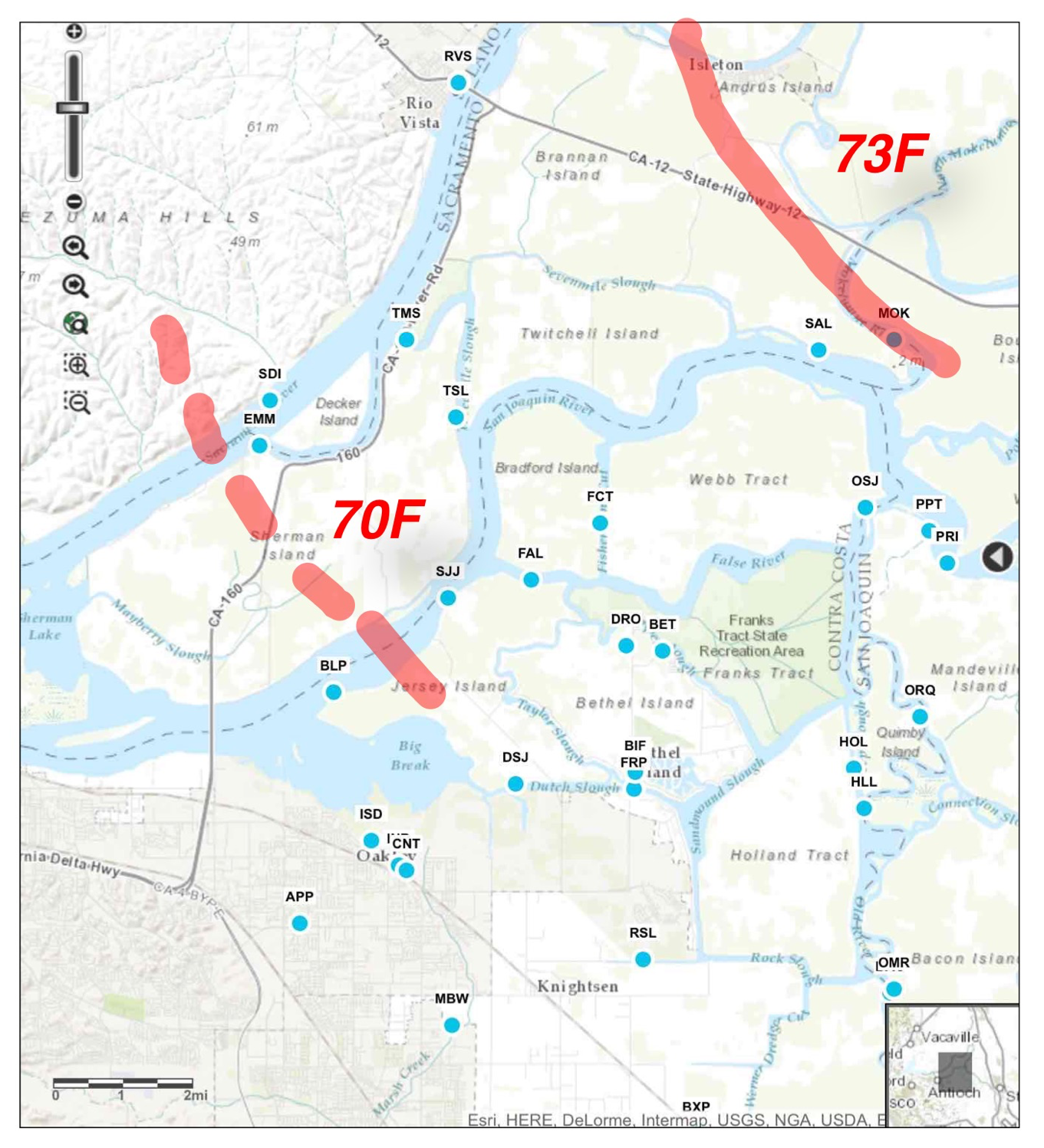
I provide the following picture of Delta conditions during a mid-April spring tide (strong incoming tide phase).

(Map source: USGS map of Delta gage locations.)

(Map source: USGS map of Delta gage locations.)

The magenta and light green lines represent, respectively, the high tide upstream salt-intrusion limit of X2 (2640 EC salinity) and upper extent of the Low Salinity Zone (LSZ) (500 EC salinity). The red and blue arrows represent the net tidally filtered (average daily) flows in cfs for their locations. The dark green region represents an area of strong plankton bloom determined from mid-April chlorophyll measurements.

There are a number of important points about this picture and what it depicts:

  1. The Order requires NDOI of 4000 cfs. Reclamation’s calculated NDOI on April 16 was 4966 cfs1. The USGS measured the actual Net Delta Outflow on April 16 as -3741 cfs. Outflow is negative because the high spring tide overcomes the freshwater inflows to the Delta.
  2. The spring tide also moves X2 and the LSZ upstream into the central area of the Delta.
  3. Longfin and Delta smelt young tend to concentrate in the area of X2 and upstream to the head of the LSZ (light green line). One reason for this is that it puts them in the zone of high estuary productivity (high chlorophyll and turbidity), where their potential for higher growth and survival is greater.
  4. Net negative flows draw smelt into the central Delta including Franks Tract, a notorious habitat of predatory fish. The smelt (and the LSZ and its plankton bloom) are also being drawn south in Old and Middle Rivers to the south Delta federal and state export pumps. Water pulled from the central Delta is replaced by water from the Sacramento River near Rio Vista, which becomes poor smelt habitat because it is fresh and warm, and has low turbidity and productivity.

In addition to restoring Delta flow and salinity requirements that were weakened by the State Board’s April 6, 2015 Order, what else should be done to reduce these negative effects on the LSZ and smelt during drought conditions?

  • During spring tides, more real Delta outflow is needed. This can come in two ways: 1) more inflow (reduce upstream Valley diversions); or 2) reduced Delta exports and diversions.
  • Install a False River flow barrier (on north side of Bethel Island), which would stop tidal pumping of X2 water from the Jersey Point area of the west Delta into Franks Tract in the central Delta. (Note that tidal flow would then be forced up the San Joaquin channel on north side of Bradford Island and Webb Tract.)
  • Open the Delta Cross Channel (part of the day) in the north Delta to increase freshwater inflow to lower San Joaquin channel in the central Delta. Since salmon tend to migrate at night, daytime Delta Cross Channel openings draw fewer young salmon from the Sacramento River.
  • Install the Head-of-Old-River flow barrier (location is south and east of the map area) to increase freshwater flow from the San Joaquin River into the central Delta.

Yuba River Steelhead

I have fished and studied the Lower Yuba River above Marysville for nearly 20 years. This tailwater fishery below Englebright Dam is one of California’s best wild trout fisheries, rivaling that of the Keswick tailwater on the lower Sacramento River below Redding. Both are nearly as good and as popular as the Deschutes River in north-central Oregon, a tributary of the Columbia River. All three rivers are national treasures above and below their dams. But it is the tailwater fisheries that provide for healthy, fast-growing populations of wild resident trout that thrive on nearly perfect year-round conditions for growth: controlled flows, cool water temperatures, and abundant food. Each river has abundant salmon eggs, fry, and flesh that supplement the highly productive waters from their reservoirs.

The Yuba tailwater Rainbow Trout fishery also benefits from Daguerre Dam, a sediment retention and irrigation diversion dam located about halfway up the 20-miles of lower river from Marysville. This small dam blocks runs of migratory predators and competitors from entering the upper tailwater reach. Striped Bass, American Shad, and Sacramento Pikeminnow are very abundant below Daguerre, especially in spring. Adult Chinook Salmon, Steelhead, and Rainbow Trout readily pass upstream through Daguerre’s two fish ladders, while the others do not. The resident trout thrive in the predator-free reach above Daguerre.

Wild Steelhead, the anadromous form of Rainbow Trout, do not thrive in the Lower Yuba River (nor lower Sacramento), however. Yuba River Steelhead are in the Central Valley Steelhead grouping listed as threatened under the federal Endangered Species Act. The reason is simply that they must pass downstream to the ocean as young and back as adults. The odds of making the journeys are slim, especially for the young. Research has shown that the numbers of young trout drop precipitously below Daguerre, ostensibly from predation1. Steelhead young are adapted to migrating to the ocean during the high winter-spring rain-snowmelt season. With the large Bullards Bar Reservoir holding back the much of the seasonal high flows for summer irrigation, especially in dry years, Steelhead young have a tough time surviving the journey to the ocean.

yuba steelheadThe small numbers of Steelhead I have caught or seen caught, or observed while snorkeling, are most often hatchery fish, likely strays originating from the Feather River Hatchery. In fact, a small percentage of the resident trout above and below Daguerre are hatchery steelhead that did not migrate to the ocean (photo at right). Hatchery smolts released in the lower Feather River near the mouth of the Yuba often move up the Yuba.

So how can we improve the Steelhead population and protect the wild trout fishery in the lower Yuba River?

  1. There need to be habitat improvements: instream wood, riparian vegetation, side channels, and spawning gravel are generally or locally lacking in the lower Yuba, especially below Englebright and Daguerre dams.
  2. Hatchery Steelhead smolts should not be released in the lower Feather River; instead they should be trucked to Sacramento River, then barged to the upper Bay.
  3. Wild fry, fingerling, and smolt Steelhead/Rainbow Trout can be captured as they pass downstream at Daguerre Dam, and then trucked/barged to upper Bay.
  4. Predators should be removed from lower Yuba below Daguerre Dam by operating weir traps during dry springs. Striped Bass can be relocated to San Francisco Bay.
  5. Project operations can reduce stranding. Steelhead (and salmon) fry are stranded in large numbers on floodplains and river bars after infrequent winter-spring storms (see charts below). Upstream dam releases should increase before and after storms to better ramp flows to reduce stranding and other detrimental effects of sudden high flows.
  6. Anglers should be encouraged to keep hatchery trout and steelhead (adipose fin-clipped fish) caught on the lower Yuba.
  7. Wild adult Steelhead should be used in a conservation hatchery component of the Feather River Hatchery to help restore wild Yuba/Feather Steelhead. Wild Steelhead can also be restored to river above Englebright and Bullards Bar dams in a trap-and-haul program as prescribed in federal Recovery Plan for Central Valley Steelhead.

Yuba Near Smartville

Deer Creek near Smartville

Can Winter Run Chinook Salmon be Saved in 2015?

Various resource agencies are scrambling to protect Winter Run Chinook Salmon this year after last year’s debacle, in which water “saved” in Shasta Reservoir wasn’t cold enough to keep Winter Run eggs and fry alive1. Higher, colder flows are necessary to keep the eggs and fry alive in their spawning and early rearing areas near Redding, but were unavailable last summer because Shasta’s cold-water pool was depleted by the end of August.

The five charts included below tell the story of what happened last year. In summary, these are the main reasons why the Bureau of Reclamation ran out of cold water in Shasta Reservoir…

  • First, approximately 200,000 acre-feet (AF) of cold-water pool storage was released to senior water rights contractors in May. (Amount calculated from Figure 1 and Table 1).
  • Second, approximately 500,000 AF of cold-water pool storage was released in June and July that could be argued was needed for maintaining river temperature control below Redding. However, I would argue that given the precarious state of the Shasta cold-water pool in June and July, federal and state agencies should have released less (to maintain 58°F at Clear Creek instead of the chosen target temperature of 56°F) to sustain Shasta’s cold-water pool. My guess is they could have saved 2000 cfs or about 240,000 AF of total storage in June and July. This water would have come out of the Sacramento River Settlement Contractors’ 560 TAF deliveries for June-July (Table 1).
  • Third, somewhat less cold-water pool water could have been saved in early weeks of August.

If the Bureau of Reclamation had saved this 440,000 AF from May-July (about a third of deliveries), there would have been no extreme mortalities of Winter Run Chinook Salmon in the late August-October period from low flows and high water temperatures. Contractors could have made up some of their loss in the late August-October period when higher colder flows would have been released from Shasta for fish. If Sacramento River contractors were unable to use this water late in season, the water could have been used to maintain Delta water quality standards or left as carryover storage in Shasta Reservoir.

In summary, cold-water pool releases from Shasta Reservoir from May through August of 2014 were too great to support the cold water resource, resulting in the loss of much of the year’s production of Winter Run eggs and fry to low flow, warm water conditions. In similar conditions in 2015, releases for contractor irrigation deliveries should be reduced in order to sustain Shasta’s cold-water pool through the summer. Such protections should be the cornerstone of the Drought Operations Plan being developed by the agencies. NMFS and DFW should not approve the Plan without this element to protect Winter Run.

Figure 1

Figure 1. Mainstem flow of the Sacramento River below Redding, May-Sept 2014. Flows generally reflect releases from Shasta Reservoir. (Source: USGS Mobile Data Site)

Figure 2

Figure 2. Mainstem Sacramento River flows at Wilkins Slough gage below most of the contractor diversions. (Source: USGS Mobile Data Site)

Figure 3

Figure 3. Power-Point slide of risk to Winter Run adults, eggs, and fry as a function of water temperature in Shasta Reservoir releases (as measured Keswick Reservoir releases – KWK).2

Figure 3

Figure 4. Power-Point slide of risk to Winter Run eggs as a function of water temperature in Shasta Reservoir releases (as measured Keswick Reservoir releases – KWK) and temperature in the river below the mouth of Clear Creek near Redding.3

Table 1

Table 1. Water deliveries from Reclamation to Sacramento River contractors in 2014.
(Source: http://www.usbr.gov/mp/cvo/vungvari/table_28_2014.pdf)

  1. See, for instance, https://cdfgnews.wordpress.com/2015/01/26/agencies-taking-measures-to-protect-winter-run-chinook-preparing-to-release-approximately-600000-fish/
  2. Source: NOAA’s National Marine Fisheries Service’s (NMFS) Update to the State Water Resources Control Board by Garwin Yip, February 18, 2015
  3. Source: NOAA’s National Marine Fisheries Service’s (NMFS) Update to the State Water Resources Control Board by Garwin Yip, February 18, 2015