Welcome to the California Fisheries Blog

The California Sportfishing Protection Alliance is pleased to host the California Fisheries Blog. The focus will be on pelagic and anadromous fisheries. We will also cover environmental topics related to fisheries such as water supply, water quality, hatcheries, harvest, and habitats. Geographical coverage will be from the ocean to headwaters, including watersheds, streams, rivers, lakes, bays, ocean, and estuaries. Please note that posts on the blog represent the work and opinions of their authors, and do not necessarily reflect CSPA positions or policy.

What is wrong with NDOI?

Delta outflow is the amount of fresh water that exits the Delta for San Francisco Bay. Freshwater outflow is the most important ecological function other than perhaps the tides for the Bay-Delta Estuary. The Net Delta Outflow Index (NDOI) is the parameter that is used as a measure of Delta outflow to manage the ecology, water supply, and water quality of the San Francisco Bay-Delta Estuary. NDOI is a number estimated from a crude set of variables, some measured and some guessed. It is a relic of the past and deserves a quiet burial, the sooner the better. Continuing its use is meaningless, unreasonable, harmful, injurious, and unnecessary.

The NDOI or QOUT is calculated as follows:

QOUT = QTOT + QPREC – QGCD – QEXPORTS – QMISDV1

Where:

  • QOUT Net Delta outflow at Chipps Island
  • QTOT Total Delta inflow
  • QPREC Delta precipitation runoff estimate
  • QGCD Delta-wide gross channel depletion estimate (consumptive use)
  • QEXPORTS Total Delta exports and diversions/transfers
  • QMISDV flooded island and island Storage diversion

All of these parameters are estimates themselves subject to gross errors, which compound to make NDOI useful only as a gross indicator of freshwater outflow to San Francisco Bay.

The main use of NDOI is in Bay-Delta water quality standards and drought emergency change orders:

“ The Delta outflow objectives included in the Bay-Delta Plan and D-1641 for the February through June time frame are identified in footnote 10 of Table 3 and Table 4 of footnote 10. Pursuant to footnote 10, the minimum daily NDOI during February through June is 7,100 cfs calculated as a 3-day running average. This requirement may also be met by achieving either a daily average or 14-day running average EC at the confluence of the Sacramento and San Joaquin Rivers of less than or equal to 2.64 millimhos per centimeter (mmhos/cm) (Collinsville station C2)… The minimum Delta outflow levels specified in Table 3 are modified as follows: the minimum Net Delta outflow Index (NDOI) described in Figure 3 of Decision 1641 during the months of February and March shall be no less than 4,000 cubic-feet per second (cfs) on a monthly average. The 7-day running average shall not be less than 1,000 cfs below the monthly average.”2

Reliance on NDOI is one thing, but using 3-day, 7-day, and monthly average limits borders on insidious. Government agencies have long recognized this and a decade ago commissioned the US Geological Survey to measure Delta outflow with UVM meters that measure water column velocities in real time.
.
The new measurement is defined as Net Delta Outflow or NDO3.

Net Delta Outflow

We compared the two parameters for the month of March, 2015. The differences in the parameters as seen in the chart below are significant and appear to be related to the fact that NDOI does not incorporate tidal effects. NDO indicates that outflow is much reduced by high “spring” tides that effectively block freshwater outflow to the Bay. The effect is real and roughly amounts to over 100,000 AF of freshwater flow that did not make it to the Bay in March, which resulted in greater saltwater intrusion and degradation of the Bay-Delta Estuary, as well as degradation of Low Salinity Zone habitat quality and quantity.

March 2015 NDO vs NDOI

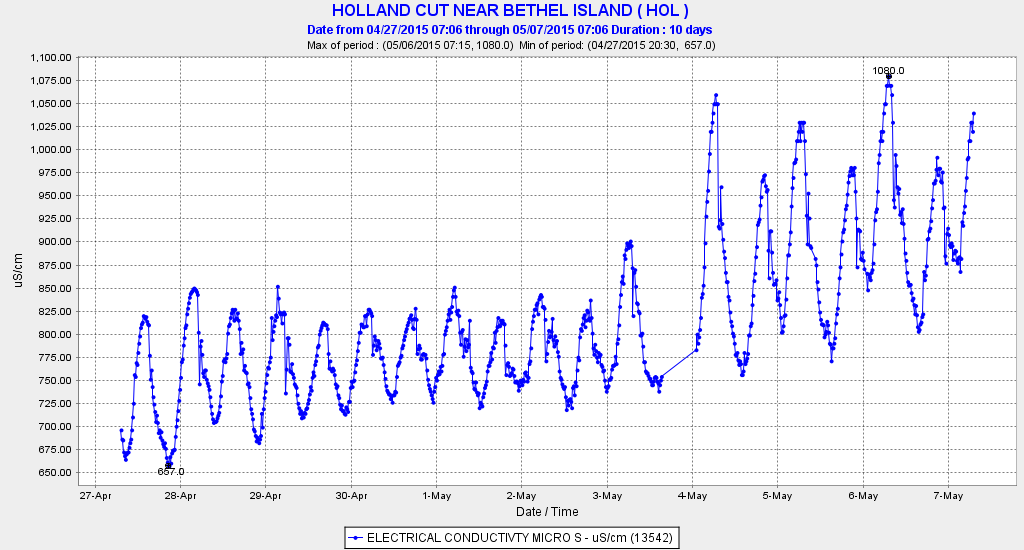
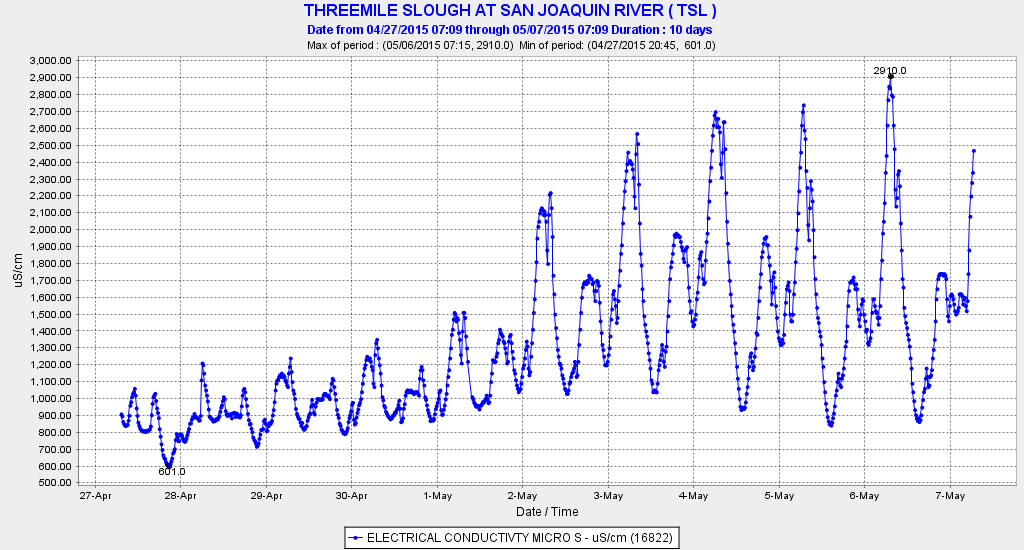
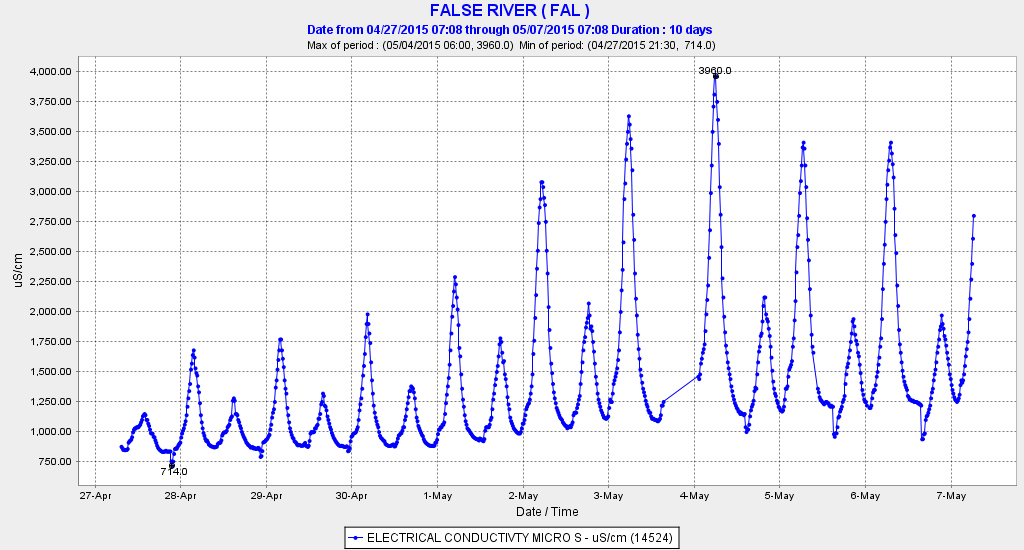
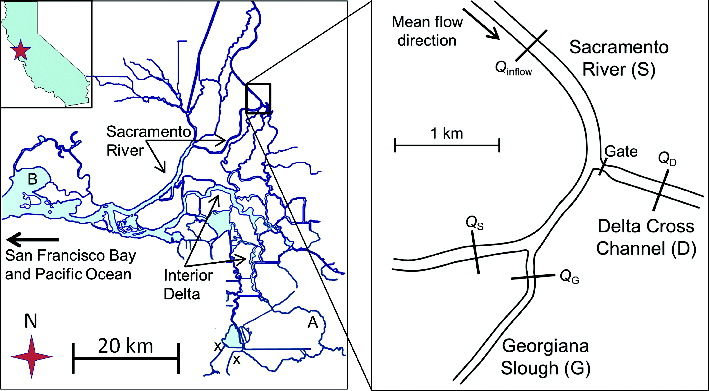
The effect also leads to saltwater intrusion into the central Delta via False River. Delta exports pull some of their water from the west Delta to the south Delta pumping plants via False River. The chart below shows higher salinity water entering False River during high tides with peaks in salinity during spring tides and low NDOs. The salt from these intrusions degrades Delta water quality and the quality of water exported from the Delta to Southern California. The salt is also a signature of the Low Salinity Zone, which is the primary nursery area for Delta Smelt, Longfin Smelt, and many other Delta fish. Pulling LSZ water into the central Delta kills many Longfin and Delta smelt.

False River

It is no longer reasonable to manage Delta outflow and exports with rules that include the NDOI. A vast array of flow, salinity, temperature, turbidity, chlorophyll, dissolved oxygen, and radio-tagged fish detection meters allow instantaneous management of the Delta. Changes are hung up on antiquated Delta standards that are frequently relaxed by the State Water Resources Control Board to satisfy the insatiable water demands of the state and federal water projects and their contractors. The NDOI needs a quick burial. If the Board can issue temporary drought emergency change orders involving the NDOI, why can’t it rely on better measurement to better protect, if only temporarily, the beneficial uses of the state’s water supply?

  1. Source:  http://www.water.ca.gov/dayflow/ndoVsNdoi/
  2.  Source: SWRCB March 5 Temporary Urgency Change Order for Central Valley Project and State Water Project
  3.  http://www.water.ca.gov/dayflow/ndoVsNdoi/

Are Longfin Smelt Going Extinct?

long fin smelt

Longfin Smelt are a native Bay-Delta fish and are listed under the California Endangered Species Act as “threatened”. Like the Delta Smelt, Longfin have undergone dramatic declines over the past several decades starting with the 1987-92 drought, then the 2001-2005 dry period, the 2007-09 drought, and the most recent 2012-15 drought (Figure 1). A strong recovery occurred in the wet years of 1995-2000. Modest recoveries occurred in 2006 and 2011 (wet years).

The Winter Kodiak Trawl Survey of adult Longfin Smelt provides the first clue as to how the population is faring in the 2015 drought after the second lowest fall index on record. The number of adult Longfin captured in the three winter surveys (Jan-Mar) are low but not unlike other low abundance years in the past decade (Figure 2).

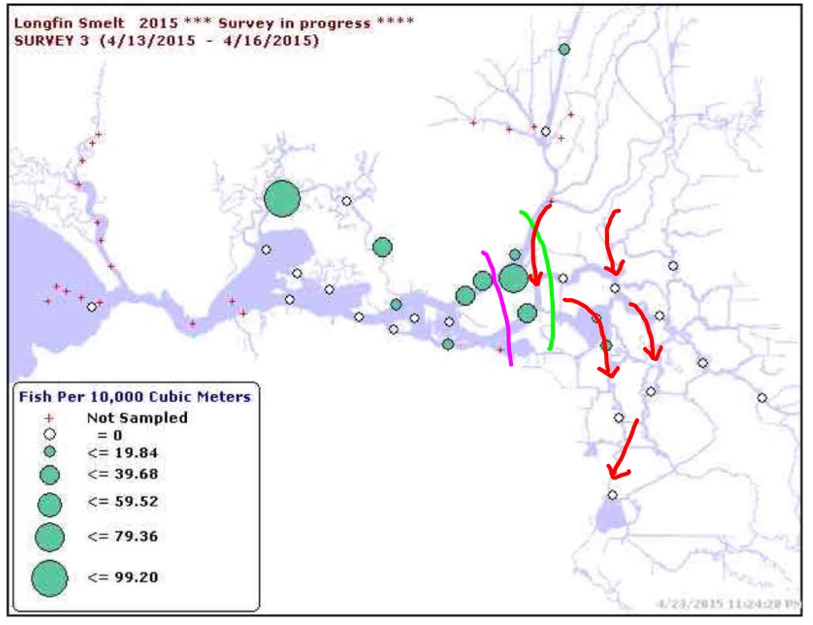
Another indicator is results of the Smelt Larval Survey. The abundance and distribution of larvae in the Bay-Delta is representative of spawning success and potential of this year’s production to contribute to the population. So far in March 2015, survey capture densities have been generally below 100 per 1000 cubic meter sampled (Figures 3 and 4). These densities were slightly lower than for the same surveys in 2014 (Figures 5 and 6). Much higher densities occurred in years 2009-2013 (not shown).

The Juvenile or 20-MM Smelt Survey is another indicator of how Longfin Smelt are faring. Its first survey was recently completed (Figure 7), and the densities are again down from 2014 (Figure 8). Densities in 2014 and 2015 are again significantly lower than in surveys over the previous decade (not shown).

Based on these trends, we can expect another poor recruitment year, perhaps even a record low Fall Index. The population was able to rebound after low Fall indices in 1992 and 2007. It remains to be seen whether the population can rebound after declining since 2006 and after record low numbers of larvae and juveniles in 2014 and 2015. As in 2014, water quality standards for Delta outflow and exports, as well as salinity, have been relaxed, which will further stress the population toward possible extinction. This “canary in the coal mine” for the San Francisco Bay-Delta Estuary, like the Delta Smelt, remains on “life support”.

We will keep you posted as to how the year progresses for Longfin Smelt. To keep up to date on upcoming surveys, check out CDFW’s web site. (https://www.dfg.ca.gov/delta/data/)

Longfin Smelt Fall Midwater Trawl Index – 1967-2013.

Figure 1. Longfin Smelt Fall Midwater Trawl Index – 1967-2013. The 2014 Index was 16. (CDFW data)

Figure 2.  Catch of adult Longfin Smelt in Winter Kodiak Trawl Survey, Jan-Mar 2015.

Figure 2. Catch of adult Longfin Smelt in Winter Kodiak Trawl Survey, Jan-Mar 2015.

Figure 3.  Longfin Smelt catch distribution in Smelt Larval Survey #5,  early March 2015.  (CDFW data summary)

Figure 3. Longfin Smelt catch distribution in Smelt Larval Survey #5, early March 2015. (CDFW data summary)

Figure 4.  Longfin Smelt catch distribution in Smelt Larval Survey #6,  late March 2015. (CDFW data summary)

Figure 4. Longfin Smelt catch distribution in Smelt Larval Survey #6, late March 2015. (CDFW data summary)

Figure 5.  Longfin Smelt catch distribution in Smelt Larval Survey #5,  early March 2014.  (CDFW data summary)

Figure 5. Longfin Smelt catch distribution in Smelt Larval Survey #5, early March 2014. (CDFW data summary)

Figure 6.  Longfin Smelt catch distribution in Smelt Larval Survey #6,  late March 2015.  (CDFW data summary)

Figure 6. Longfin Smelt catch distribution in Smelt Larval Survey #6,
late March 2015. (CDFW data summary)

Figure 7.  Longfin Smelt catch distribution in 20-mm Survey #1,  mid March 2015.  (CDFW data summary)

Figure 7. Longfin Smelt catch distribution in 20-mm Survey #1, mid March 2015. (CDFW data summary)

Figure 8.  Longfin Smelt catch distribution in 20-mm Survey #1,  mid March 2014.  (CDFW data summary)

Figure 8. Longfin Smelt catch distribution in 20-mm Survey #1, mid March 2014. (CDFW data summary)

Mokelumne River Steelhead Management

The Mokelumne Hatchery releases approximately 100-200 thousand hatchery steelhead to the lower Mokelumne each winter, yet runs remain small with several hundred fish or less.  Why is that?  The answer is pretty straightforward:  the smolts released have little chance to reach the ocean and those that do have little chance finding the Mokelumne on their return as adults.

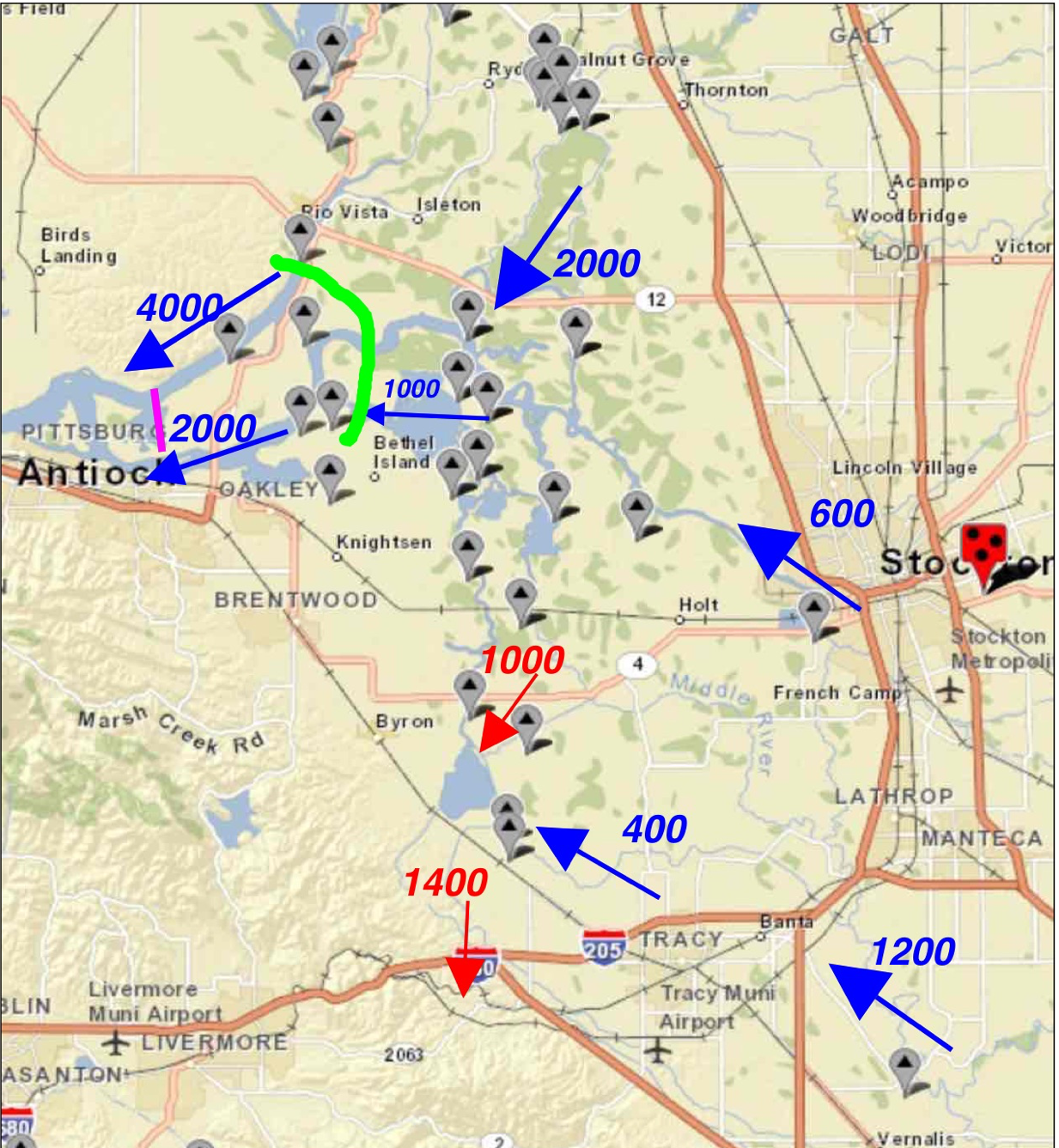
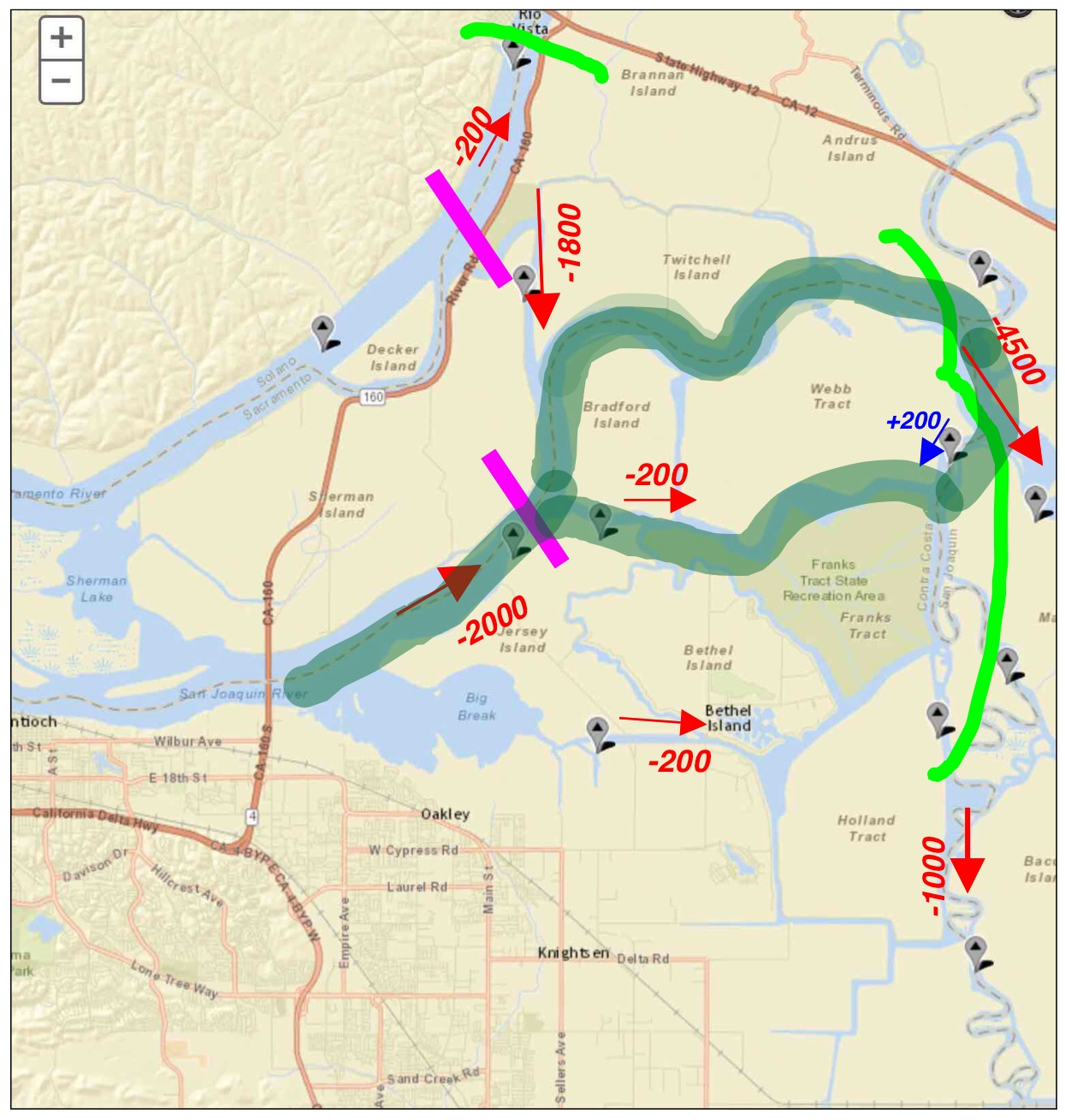
The figure below depicts the primary causal mechanism.  With the Delta Cross Channel closed in winter and spring, the smolts and adults must migrate via the lower San Joaquin River.  The problem is that flows in the San Joaquin below the Mokelumne forks are negative in drier years because of Delta exports.  The negative flows are shown as the red arrow at Prisoners Point.

Mokelumne Steelhead Migration

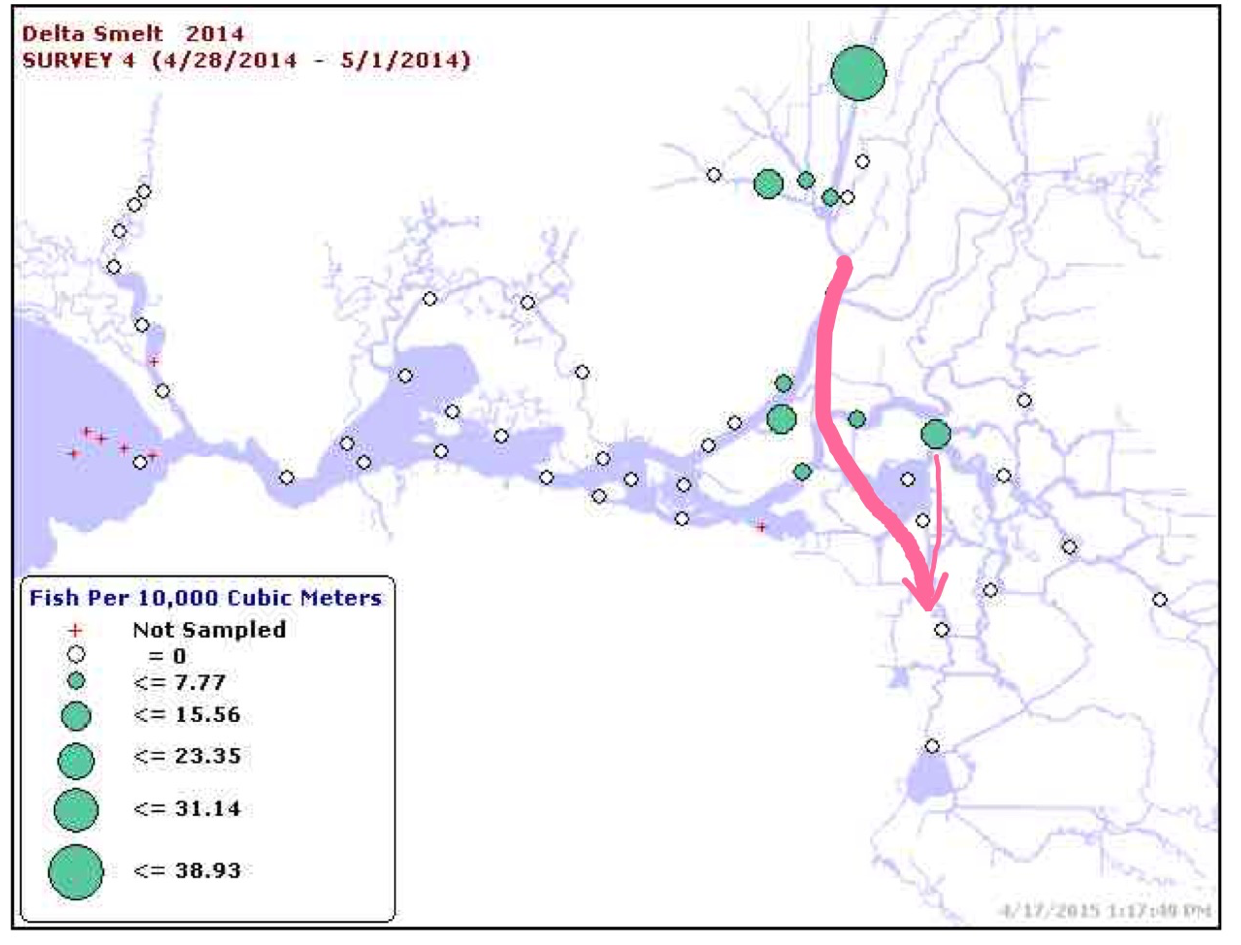
Wild and hatchery smolts reaching the San Joaquin follow the river “downstream” to the South Delta export pumps.  Many of the approximately 1800 hatchery smolts “salvaged” since February at the export pumping plants are likely Mokelumne hatchery smolts released in February near Lodi.

Likewise, adult steelhead migrating upstream from the Bay into the Delta in winter and spring cannot find the Mokelumne because its water signature in drier years has been taken almost entirely to the South Delta export pumps.

Solutions:

  1. Hatchery smolts can be barged from the Mokelumne Forks to the upper Bay. Some trucking to the Bay has been attempted in past years.
  2. Wild smolts can be collected at Woodbridge Dam traps in drier years and transported to the upper Bay.
  3. Adults returning in winter and spring should be provided olfactory attraction by insuring minimum positive daily average downstream flows in the lower San Joaquin at Prisoners Point and Jersey Point at least for a portion of each month in winter and spring.
  4. In the long term, spring operations at the Delta export pumps need to be reduced so that outmigrating salmon and steelhead from the San Joaquin basin as well as the Mokelumne follow water from their natal rivers to the Bay, not to the pumps.

American River Steelhead Management

14" Wild SteelheadThe 14-inch “half-pounder” hatchery steelhead in photo at right was caught in the lower American River in early March. It was likely one of 430 thousand stocked last June into the American River as fingerlings when Nimbus hatchery water was predicted to be too warm to sustain the fish through the summer. “Half pounder” is the name given to young steelhead that spend a few months in coastal waters before returning as premature adults to their natal rivers. This fish actually weighed about a pound. This “half-pounder” life history strategy is more frequent in North Coast steelhead, and may reflect the Eel River origin of the American River hatchery stock.1

Other young hatchery steelhead from last June’s releases have remained in the river and are about 12 inches in length. These “smolts” have yet to go to ocean. If they had been released from the hatchery normally in February, they would only be about 8-10 inches (four to the pound). Instead, they flourished in the lower American, feasting on aquatic insects, salmon eggs and fry, and other abundant food. They are common throughout the upper 10-miles of river below salmon spawning riffles. Winter water temperatures (50-55F) and flows have been ideal for growth. Last summer’s water temperatures remained near optimal (<68F) all summer in the upper portion of the ten mile reach, while reaching 72-74F on occasion in the lower reach (USGS gage data). At one inch soon after birth, they have grownabout one inch per month, which is ideal for trout and yoFishermenung steelhead.The native American River steelhead are “spring” run like the many larger fresh (bright) adults I have caught over the past two decades in the river from March-June. The bright steelhead at left was caught in June. Whether a remnant run or some genetic material remains in the population from these fish is unknown.

The native Central Valley steelhead are also spring spawners as opposed to the present winter spawning stock, which tend to be in poor condition (often spent – already spawned) during the winter fishery. The spent hatchery fish in photo at right caught in early March near Nimbus Hatchery was in poor condition.Central Valley SteelheadWith record low numbers of winter (Dec-Feb) steelhead reaching the hatchery this year2 , maybe it is time to rethink steelhead management on the lower American River.


Some suggestions follow:

  • “The current broodstock for this program should be replaced with an alternative broodstock that is more appropriate for the American River.” California Hatchery Review Project – Appendix VIII Page 20 Nimbus Fish Hatchery Steelhead Program / June 2012 (http://cahatcheryreview.com). Being the only out-of-basin origin stock in the Central Valley, the present American River Hatchery stock is a threat to all native Central Valley steelhead populations (genetics). Given the very low population abundance of the American (Nimbus Hatchery) stock, this would be a good time to change (replace) the present genetic stock. This could be accomplished by designating the Nimbus Steelhead Hatchery as a “conservation hatchery” to be populated by “natural origin” fish from various sources including other Central Valley rivers, selected American River steelhead (e.g., spring run), or native American River trout from above Folsom Reservoir. This change could be implemented immediately.
  • Hatchery releases in the immediate future could be of spring-early summer fingerlings, to allow natural adaptation and imprinting on the river. Yearling releases to the river should cease because yearling hatchery fish compete with and prey upon wild steelhead and salmon fry. If yearling releases are made, the smolts should be trucked to Discovery Park and then barged to the upper Bay.
  • Wild, natural steelhead spawning and rearing habitat should be restored on the upper ten miles of river below Nimbus Dam. This would include restoration of side channel spawning and rearing habitat. It may also include a weir with a ladder in the middle of the 20-miles of the lower river to keep out competitors and predators including striped bass, smallmouth bass, tule perch, American shad, pikeminnow, and suckers3. It must also include careful management of the cold water stored in Folsom Reservoir and flows in the lower American River .
  • Catch-and-release fishing should continue on wild fish with limited harvest on hatchery fish.4
  • To ensure protection of the new “wild” or “natural” stock, a trap and haul program5 to establish a natural spawning and rearing population above Folsom Reservoir should be considered as recommended in the Central Valley Salmon and Steelhead Recovery Plan6 and OCAP Biological Opinion regarding operation of the Central Valley Project’s American River Division7.

More on the American River and Central Valley steelhead in forthcoming posts.

Are Delta Smelt Going Extinct?

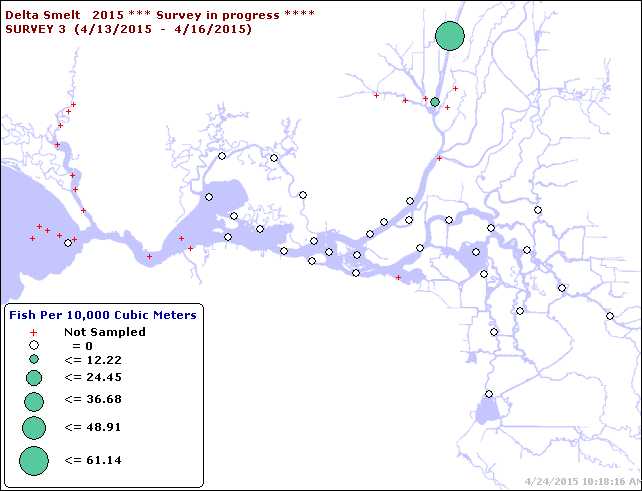
Recently Dr. Peter Moyle (UC Davis) suggested we “prepare for the extinction of delta smelt”1. Record low summer and fall abundance indices in 2014 following declines over the past decade in the key survey indices have led to major concerns about the future of this endangered species. The first three survey of this winter’s trawl survey brought record lows for January and March (Figure 1). Dr. Moyle and many others are particularly concerned with the March catch of only six adult smelt.

Winter Kodiak Trawl Survey, Delta Smelt Adults

Figure 1. Catch statistics from Winter Kodiak Trawl Survey Jan-Mar 2002-2015. (CDFW data)

Will the record low numbers of Delta Smelt adults be sufficient to bring some recovery when the rains come again as in 2010 and 2011, the last two years with abundant rain and snow before the present drought? As Dr. Moyle pointed out, it is too early to tell. March larval smelt surveys in 2010 and 2011 captured few larvae, as have larval surveys so far this March. This year is different in that the present drought continues whereas the previous drought ended in 2010 and 2011.

Will another year of drought spell disaster for the smelt? That very well may be the case if the State Water Resources Control Board accepts the recent Temporary Urgency Change Petition submitted by the US Bureau of Reclamation and the California Department of Water Resources to change Delta water quality standards. The petition requests relaxation of Delta inflow, outflow and salinity standards, all of which are designed to protect water quality and Delta fish and their habitats, in order to sustain water deliveries to water contractors during the present drought. The changes will undoubtedly lead to higher losses of smelt and further degradation of their freshwater and low-salinity habitat, which could lead to even sharper declines than those apparent during the present and previous droughts. Stay tuned, as we will be keeping close track of events and the Delta Smelt, as well as preparations for their possible extinction.