Welcome to the California Fisheries Blog

The California Sportfishing Protection Alliance is pleased to host the California Fisheries Blog. The focus will be on pelagic and anadromous fisheries. We will also cover environmental topics related to fisheries such as water supply, water quality, hatcheries, harvest, and habitats. Geographical coverage will be from the ocean to headwaters, including watersheds, streams, rivers, lakes, bays, ocean, and estuaries. Please note that posts on the blog represent the work and opinions of their authors, and do not necessarily reflect CSPA positions or policy.

My comments on: “SLDMWA Response to Environmentalists’ August 9, 2016 Request to the SWRCB for Even More Water Aimed at Protecting Delta Smelt”

On August 11, Jason Peltier, executive director of the San Luis-Delta Mendota Water Authority, offered comments on a letter from environmental groups to the State Board that requested more water for Delta Smelt. Below, I provide some of Mr. Peltier’s statements, and a response to each:

1. “As environmental special interests request the State Water Resources Control Board expand failed policies on Delta Smelt, Californians are calling on the Board to implement new science-based, common sense approaches to protect the species. It is disheartening to see once credible environmental organizations calling for a “more of the same” approach – one that has so miserably failed for a quarter century – in a misguided attempt to help the imperiled delta smelt.”


Comment: The environmental organizations were proposing what the state has also offered as its new strategy for the Delta Smelt. It is not the old misguided “failed” strategy of diverting more and more water and providing less and less Delta outflow to the Bay. The state’s new strategy derives from some of the same actions suggested in this past April’s science workshop on Delta Smelt held at UC Davis, which Mr. Peltier attended.

2. “[t]he Projects have compensated for Mother Nature’s stinginess with water released from reservoirs, making the Delta far fresher than it would have been naturally.”

Fact: Just the “natural” summer inflow to Shasta Reservoir in the past four years of drought nearly equaled the amount allocated for summer Delta outflow. If you add up all the Central Valley’s “natural” inflow it would far exceed the Delta outflow allotted, even without accounting for use above the rim reservoirs.

3. “This dedication of water for fish from what was stored for drought relief has resulted in unprecedented socio-economic and environmental harms to towns, farms, and numerous species living in the largest wetlands in the West.”

Fact: Most of the water stored is for agriculture and released for agriculture. Mr. Peltier’s organization is simply last in line for stored water and thus gets less water allocated during droughts. In June and July, nearly 30,000 cfs of water was released on average from Central Valley reservoirs, but only 7000-8000 cfs reached the Bay to repel salt intrusion. Because Shasta releases were reduced to protect salmon (not smelt), Mr. Peltier’s organization was unable to receive more than a minimal allocation. Again, this is because its water rights are junior to those of other users, not because of water allocated to smelt (none).

4. “Since the most severe cuts were imposed on the Projects nine years ago, less water has been diverted, and thus more Projects’ water has gone out to the ocean, than at any other time in the past 35 years.”

Fact: Seven of the last nine years were drought years. The only water consistently reaching the ocean in large amounts during those seven years was uncontrolled river flows and reservoir spills during and after sporadic winter storms. The only reservoir water that reached the ocean (Bay) in those seven dry years was the water necessary to hold back salt intrusion into the Delta so Delta diversions and exports remained possible.

5. “Farmers, fishermen, and environmentalists – everyone that truly cares about the status of our imperiled fisheries – should be furious.”

Comment: The fishermen and environmentalists are “furious” because of government mismanagement of the Shasta Reservoir cold water pool that has nearly wiped out the Sacramento salmon runs, and because of the weakening of Delta water quality standards in 2014 and 2015 that allowed excess salt into the Delta and just about exterminated the Delta smelt population.

6. “Decades old state and federal policies have failed and brought delta smelt and salmon to the brink of extinction. The last thing we need is more of the same.”

Comment: Yes, decades-old policies of increasing exports from the Delta has brought near-extinctions. It started with the massive State Water Project that came on line in the 1970’s. Yes, the last thing we need is “more of the same” – increasing exports promised with the WaterFix.

7. “Like delta smelt, we need shelter, we need food, and we need safety from predators, toxics, and invasion. The state and federal regulatory agencies have ignored for far too long the full needs of delta smelt, only willing to do what is easy, and we have all suffered for it.”

Fact: Delta smelt need the cool, brackish, wind-blown turbid waters of Suisun Bay provided when Delta outflow is sufficient to keep the low salinity zone out of the warm, confined channels of the Delta and away from its massive export pumps.

8. “We can continue to ignore decades of sound scientific advice, or we can embark on a bold new initiative, one that is transparent and inclusive of stakeholders working with state and federal agencies to save delta smelt.”

Comment: We have ignored the scientific advice. It has always been there. What “bold new initiative?”

9. “Now is not the time for desperate action, it is the time for thoughtful action.”

Fact: Giving the Delta Smelt 1000 or 2000 cfs in June and July this year – instead of nothing (Delta outflow was allocated to repel salt) – would entail only 3-6% of the water released from reservoirs and 5-10% of Delta inflow. After all, the Delta Reform Act of 2009 mandates that the state must implement the “co-equal” goals of providing a reliable water supply and protecting, restoring and enhancing the Delta ecosystem.

American River Salmon and Steelhead

 Sacrificed and Unprotected

Where are the newspaper articles about the American River “trout?”1 Water supplies and fish are suffering all across the Central Valley, but there is no mention of American River salmon and steelhead being sacrificed so that southern California reservoirs can be filled.

The Santa Clarita Valley Signal reported on August 31, 2016:

“Castaic Lake’s water levels increased due to a rainfall and snowpack in Northern California. Castaic Lake is part of the California State Water Project and is maintained by the California Department of Water Resources as one of the state’s 34 storage facilities. Water collected by the agency is moved around the state to provide drinking and agricultural water to two-thirds of California’s inhabitants. On average, Castaic Lake holds 264,908 acre-feet of water during this time each year. It is currently holding 241,689 acre-feet of water, which is 120,467 acre-feet more than the lake was holding this day in 2015.” 2

Yes, Southern California reservoirs are being filled at the expense of northern California reservoirs (Figure 1). Folsom Reservoir in particular was drained of over half its water over the summer, which has put this year’s steelhead and salmon spawns at great risk, not to mention future water supply and hydroelectric production needed by the Sacramento region.

Figure 1. Reservoir levels in acre-feet of storage from May-August 2016.

Figure 1. Reservoir levels in acre-feet of storage from May-August 2016.

While regional water districts are screaming foul about the declining level of storage in Folsom and San Luis reservoirs, no one seems concerned about the American’s salmon and steelhead. We can understand (but not accept) the sacrifices in the extremes of the 2012-2015 drought (Figure 2), but not in 2016 a normal water year for the American River (Figure 3). Because Reclamation has drawn down Folsom Reservoir too far even in 2016, it lost the ability to use the available cold-water pool to maintain downstream cool river water temperatures (Figure 4). Also because Reclamation drew down the reservoir level, it allowed a provision for extreme conditions to kick in: an allowed increase in the water temperature requirement from 65°F to 68°F at Watt Avenue (Figure 5). That change in the federal biological opinion for operation of Folsom Reservoir (Figure 6) is designed for extraordinary circumstances and should not have occurred in 2016.

Reclamation has also made little progress toward other requirements to fix the Folsom problem (as shown in Figure 7).

After four years of drought and the mismanagement of Folsom Reservoir this summer by Reclamation, we can expect greatly reduced natural production of salmon and steelhead from the American River in the coming years.

For more information on this subject check out: http://www.safca.org/protection/NR_Documents/LARTF_2014_09_ Folsom_TCD_VPD_Ghoring.pdf .

Figure 2. Water temperature in the American River at William Pond Park at the downstream end of the river’s spawning reach in 2015. Red lines depict water temperature objectives set for salmon and steelhead spawning and rearing.

Figure 2. Water temperature in the American River at William Pond Park at the downstream end of the river’s spawning reach in 2015. Red lines depict water temperature objectives set for salmon and steelhead spawning and rearing.

Figure 3. Water temperature in the American River at William Pond Park at the downstream end of the river’s spawning reach in 2016. Red lines depict water temperature objectives set for salmon and steelhead spawning and rearing.

Figure 3. Water temperature in the American River at William Pond Park at the downstream end of the river’s spawning reach in 2016. Red lines depict water temperature objectives set for salmon and steelhead spawning and rearing.

Figure 4. Water temperature of water released from Folsom Reservoir April-August 2016. Red line is maximum temperature objective. Note July 13 attempt to release water from lower colder-water level outlet.

Figure 4. Water temperature of water released from Folsom Reservoir April-August 2016. Red line is maximum temperature objective. Note July 13 attempt to release water from lower colder-water level outlet.

colder-water level outlet. Figure 5. Water temperature in the American River at Watt Avenue in 2016. Green line is normal objective. Red line is relaxed standard for drought years.

Figure 5. Water temperature in the American River at Watt Avenue in 2016. Green line is normal objective. Red line is relaxed standard for drought years.

Figure 6. NMFS Biological Opinion excerpt from p615.

Figure 6. NMFS Biological Opinion excerpt from p615.

Figure 7. NMFS Biological Opinion excerpt from p616.

Figure 7. NMFS Biological Opinion excerpt from p616.

Figure 8

Stanislaus Trout (Steelhead)

An August 18, 2016 article in the Calaveras Enterprise (“Trout population plummets”) and an August 15, 2016 post on the Fishbio blog describe a recent decline in numbers of trout in the lower Stanislaus River. Fishbio pegged the cause of the problem on to four years of drought and to the fact that the Bureau of Reclamation allowed New Melones Reservoir to fall in storage so far as to lose its cold water pool needed for trout production. As reported in the Enterprise, the Oakdale Irrigation District and South San Joaquin Irrigation District issued a statement arguing that “flawed science” in the National Marine Fisheries Service’s 2009 biological opinion issued for the operation of the Central Valley causes federal dam operators to release water in ways that do not benefit steelhead and trout. The Enterprise quotes the Districts as stating: “The current flow standards are destroying the fisheries that they are intending to protect and doing so at the expense of Central Valley agribusiness and urban interests, who also depend upon a healthy and sustainable river.” 

The irrigation districts would prefer that the water released for fish be allocated instead to their constituents. Lost in the discussion is the notion that reducing river flows is not the only way to maintain storage levels in New Melones Reservoir. If the irrigation districts had taken less water over four years of drought, the cold water pool in New Melones could have ended up, in 2015, in much better shape. But the Districts lay the decline of “trout” at the feet of the biological opinion. The fish flow prescriptions biological opinion are not designed for “trout.” They are designed for steelhead migration to the Bay-Delta and ocean. The biological opinion prescribes multi-day spring pulses in flow up to several thousand cubic feet per second to stimulate steelhead (and juvenile salmon) emigration toward the ocean. It states in part:

Objective: To maintain minimum base flows to optimize CV steelhead habitat for all life history stages and to incorporate habitat maintaining geomorphic flows in a flow pattern that will provide migratory cues to smolts and facilitate out-migrant smolt movement on declining limb of pulse. 1

Steelhead need stimulus to migrate. They need the benefits of higher velocities and more turbid water to migrate successfully. Without stimulus, potential steelhead will stay and become resident trout. Mother Nature has given them the inherent knowledge that to go without the flow is to die along the way.

Flow in the Stanislaus River is controlled by operations of New Melones Reservoir (Figure 1). The premise of the article and post is that reservoir drawdown from pulsed flow releases caused the high water temperatures in the lower Stanislaus River that resulted in high trout mortality and the low numbers of trout observed in the snorkel surveys. There is no doubt that low reservoir levels led to warmer water being released into the lower Stanislaus from Goodwin Dam. The information presented in the Fishbio post and report shows clearly that water temperatures were 5 to 10°F higher than normal in the lower Stanislaus, reaching the stressful level of 65°F or even higher downstream of Goodwin Dam at Orange Blossom Bridge (Figure 2). The water temperature criteria prescribed in the biological opinion for the summer at Orange Blossom Bridge is 65°F. The reservoir did fall dangerously low in 2015 (Figure 3).

Figure 1. Map of lower Stanislaus River with USGS gaging stations.

Figure 1. Map of lower Stanislaus River with USGS gaging stations.

Figure 2. Daily average water temperature (°F) in the lower Stanislaus River at Orange Blossom Bridge 2011-2016

Figure 2. Daily average water temperature (°F) in the lower Stanislaus River at Orange Blossom Bridge 2011-2016

Figure 3. New Melones Reservoir storage in acre-feet 2011-2016.

Figure 3. New Melones Reservoir storage in acre-feet 2011-2016.

The Fishbio report relates that water temperature becomes a problem when summer storage falls into the 300-500 thousand ac-ft range.  It would also appear that levels of 500-600 thousand acre-feet, such as those that occurred in summer 2014 and 2016, also lead to elevated water temperatures based on a close look at Figures 2 and 3.

A factor not mentioned by Fishbio is that streamflow in the lower Stanislaus in summer 2015 was lower in 2015, 150-200 cfs, compared to 200 cfs or higher in other summers of the 2011-2016 period (Figure 4).  Such lower flows can also contribute to higher water temperatures.  Lower flows can also affect “trout” survival by significantly reducing rearing space and quality.

A factor that Fishbio did mention was a possible “increase in downstream migration.”  After all, the flow pulses were prescribed to stimulate steelhead smolt emigration.  Flow pulses in combination with higher water temperatures may have stimulated outmigration resulting in lower total numbers.

The main theme of the irrigation districts and Fishbio is that by not providing the pulse flows in spring, it would save up to 100 thousand acre-feet of storage, thus keeping the reservoir higher and water temperatures lower in the river below.  But again, what is missing from the discussion is the effect of reservoir operation on the whole process, and especially on storage.  That effect can be seen in Figures 5a and 5b.  The natural flow regime is highly modified.  The natural winter high flows are retained by the reservoir and released in spring and summer.  Releases to irrigators from storage in 2015 over the April – September irrigation season amounted to approximately four hundred thousand acre-feet (see Figure 3), most of which came from storage carried over from previous years, which made up much of the cold water pool.  This repeated the pattern of previous years, when in fact deliveries to the districts were even higher.  With so little water left in storage by 2015, the districts had no one left to take water from but the fish.

Figure 4. Daily average streamflow (cfs) in the lower Stanislaus River at Orange Blossom Bridge from 2011-2016.

Figure 4. Daily average streamflow (cfs) in the lower Stanislaus River at Orange Blossom Bridge from 2011-2016.

Figure 5. New Melones Reservoir inflow (blue line) and outflow (orange line) in water year 2015 (top) and 2016 (bottom). Note prescribed fall and spring pulse flow releases for salmon and steelhead.

Figure 5. New Melones Reservoir inflow (blue line) and outflow (orange line) in water year 2015 (top) and 2016 (bottom). Note prescribed fall and spring pulse flow releases for salmon and steelhead.

Low San Luis Reservoir

Tim Quinn, Executive Director of the Association of California Water Agencies (ACWA), is trying again, as in so many of his blog posts, to hornswoggle us into believing that many of this year’s water woes have been caused by “overzealous” fish protections.1 His August 17, 2016 post on the Association of California Water Agencies (ACWA) website is focused on why San Luis Reservoir in the San Joaquin Valley has such low water storage this summer. San Luis storage went from 50% of capacity at 1 million acre-feet (MAF) at the beginning of April to 0.2 MAF (10% of capacity) at the beginning of August. All to human use.

Mr. Quinn correctly points out that lack of federal Delta exports to San Luis was due to a concerted effort by the Bureau of Reclamation to conserve Shasta Reservoir’s storage and cold-water pool to save this year’s spawn of winter-run salmon in the Sacramento River below Shasta. In 2016, federal and state agencies were gravely concerned about protecting this year’s spawn of winter-run salmon below Shasta. The past two years’ spawns had been wiped out after Shasta ran out of cold water. So after Shasta filled and spilled in late March, releases to the Sacramento River were limited to retain Shasta’s cold-water pool to sustain salmon through the summer (Figure 1). Releases (Shasta reservoir outflow) from the first of April through the end of July were about 700,000 acre-feet less than normal, saving reservoir storage and the cold-water pool. Instead of falling to 2.9 (MAF) of storage (64% of capacity) at the end of July as would more typically have been the case, Shasta was drawn down only to about 3.6 MAF (80% of capacity).

Figure 1. Sacramento River flow below Shasta/Keswick reservoirs near Redding. Red lines depict normal-release-pattern river flows at Redding.

Figure 1. Sacramento River flow below Shasta/Keswick reservoirs near Redding. Red lines depict normal-release-pattern river flows at Redding.

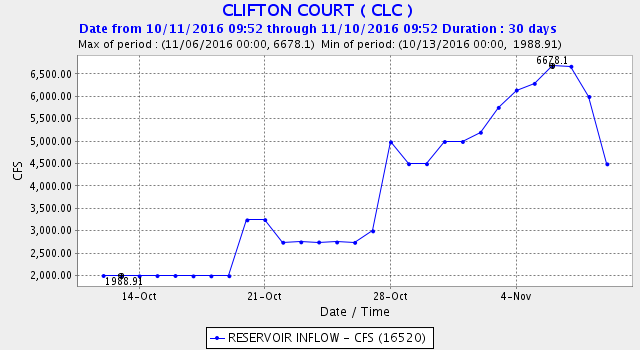
But there is more to the story. Sacramento Valley water contractors still took their normal allotments from the reduced Sacramento River supply, leaving little for San Luis. State Water Project contractors exported near the maximum from their Delta diversion facilities at Clifton Court this summer, using Oroville Reservoir water, while federal exports were less than 50%. Federal Folsom Reservoir water was used for Delta outflow requirements so that State Water Project exports could be accomplished (the feds owed the state water from 2015). Folsom, which started the year nearly full at 850 TAF, is now only at 40% of capacity and has once again closed its marinas. Ironically, enough water has flowed from the Delta this summer to (State Water Contractor) Metropolitan Water District’s Diamond Valley Reservoir in southern California to allow the Met to open its Diamond Valley marinas.

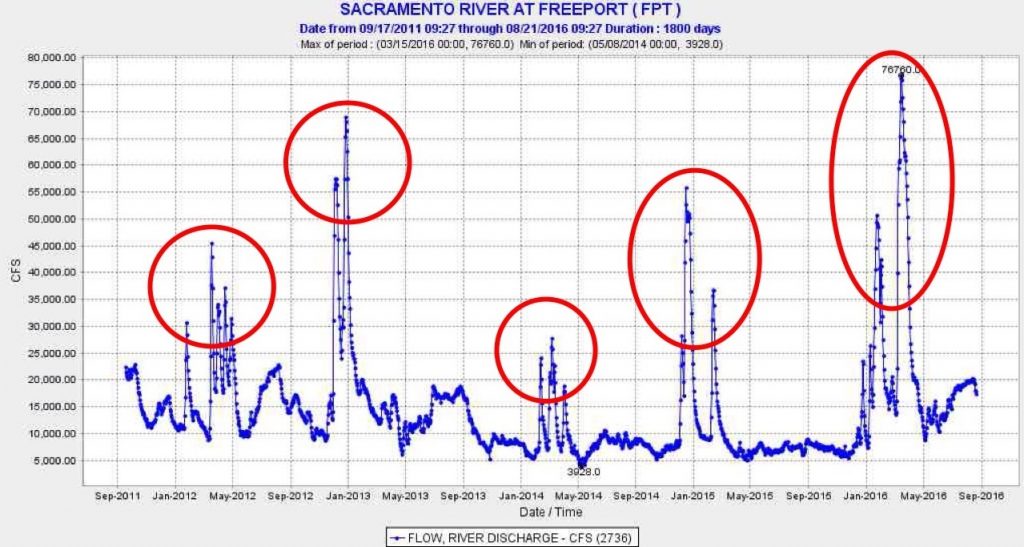
Just to be equitable, Mr. Quinn doesn’t blame only the salmon. He also blames the San Luis problem on the fact that “federal officials over-cautiously kept [Delta] pumping levels very low to protect Delta smelt” during winter storm pulses (Figure 2). He correctly states that restrictions on the federal and state water projects in the biological opinion for Delta smelt kept winter exports from the Delta at 20-70% of capacity. But again, where’s the context? Project operation in 2014 and 2015 just about obliterated the last remnant Delta smelt, and the some of the few pesky smelt that survived were indeed found to be spawning in the central Delta, not far from the export pumps, during the winter. Before we throw around adverbs like “over-cautiously,” perhaps we should balance with “recklessly” when we talk about what happened to bring us to a situation that demands such caution.

Figure 2. Storm pulses in the last five years from the Sacramento River into the Delta.

Figure 2. Storm pulses in the last five years from the Sacramento River into the Delta.

Mr. Quinn further states:

This scenario underscores the peril of regulatory agencies focusing almost exclusively on species protection at the expense of water supply. Moreover, efforts to protect endangered fish virtually always narrowly focus on a single element – temperature control or flows – while failing to address other important factors affecting the species. Allowing a single-stressor approach to drive water management decisions only serves to maximize conflict between species protection and water supply, while failing to adequately serve either. And we continue to lose water supply every day as a result.

Well, the water is needed by all the fish species, including all six listed species. It is needed for habitat, water quality, and all ecosystem functions in the rivers, Delta, and Bay.

About half of the water that hits the watershed eventually does reach the Bay as Delta outflow in the drier years, primarily during infrequent winter storms (Figure 2). Much of the rest of the outflow is needed to repel saltwater intrusion into the Delta, so that the water in the state and federal canals is not too salty to export. Annual runoff to the Bay ranges from about 5 to 10 MAF in these drier years. The State Water Board’s staff has said that the estuary needs 75% of unimpaired runoff to be healthy.

During winter storm pulses in a year that follows a dry year sequence, about 60-80% of the water (immediate rain and later snowmelt) is captured in Mr. Quinn’s constituents’ Central Valley rim reservoirs for summer use. In 2015, it was even worse: approximately 50% of the inflow to the Delta from the Central Valley in 2015 occurred during two storm periods. Most of the inflow came from undammed streams and local runoff, while the major reservoirs were capturing 80-90% of their inflow.

The big storms carry the offspring of salmon, steelhead, and sturgeon to the Bay, and represent most of the Bay’s freshwater inflow for the year. With the reservoirs capturing most of the inflows in the really bad years like 2015 , the rivers downstream of the major reservoirs, streams like the Sacramento, Feather, America, Mokelumne, Stanislaus, Tuolumne, Merced, and San Joaquin, get little winter water for fish spawning, rearing, and migrations.

The flow in rivers, the Delta, and the Bay directly or indirectly controls or partially controls all the stressors affecting the listed species. Flow even controls the water districts’ favorite stressor, predation.

Now, Mr. Quinn and his colleagues want us to pay untold billions of dollars for the California “Waterfix,” so they can take more water, especially during the infrequent storms in dry year winters. In the two storm pulses in winter 2015, the WaterFix Tunnels could have been operating at near capacity for about 30 days to take an added approximately 500 TAF, or about 20% of the total from the two storm pulses of Delta outflow. Instead of half the Valley inflow reaching the Bay, only 40% would make it due to the new Tunnels.

Green Sturgeon Status – late summer 2016

Young green sturgeon captured in Red Bluff trap. This specimen is quite large as most of the green sturgeon caught in the screw traps in late spring and early summer average one inch in length. Source .

Young green sturgeon captured in Red Bluff trap. This specimen is quite large as most of the green sturgeon caught in the screw traps in late spring and early summer average one inch in length. Source1 .

In an August 15, 2016 post on its Pacific Southwest Region website, the US Fish and Wildlife Service observed that the numbers of young green sturgeon have gone up this year in trap collections below the Red Bluff Diversion Dam.2 The article notes that this could represent an increase in the population. Joe Heublein, NMFS’s Green Sturgeon Recovery Coordinator, is also cautiously optimistic, according to the article.

Since 2012, gates at the Red Bluff dam have not hindered adult sturgeon from moving upstream past the dam to reach spawning grounds. Since 2016 was the first non-drought year since 2012, it seems likely that there should be an increase in the capture of recently spawned juveniles migrating downstream past the dam.

Missing from the story, however, is the fact that these juvenile sturgeon faced a particularly tough journey between Red Bluff and the Bay this summer, as discussed in my previous post on green sturgeon. Low flows and high water temperatures were a serious problem for the young sturgeon in the lower reaches of the Sacramento River in 2016. Unless their downstream rearing and migratory habitat is improved, the green and white sturgeon populations will have a bleak future.

The presence of young is a good sign. The species is long-lived, and thus it is not too late to recover this state and federally listed endangered fish. Getting rid of the Red Bluff diversion Dam five years ago was a big first step. The focus now should be on late spring through summer Lower Sacramento River habitat.

Since the beginning of summer 2016, conditions have improved (Charts 1 and 2). In August, flows at Wilkins Slough increased to 5000-7000 cfs, and water temperatures were down near 70°F. In late May and June, water temperatures at Red Bluff (Chart 3) were near lethal (68°F) for the really small fish, and were most likely worse not far downstream (Chart 2). Now temperatures are closer to the Basin Plan’s prescribed 56°F at Red Bluff and 68°F at Wilkins Slough.

The initial problem this year was the result of reduced releases from Shasta Reservoir to save its cold water pool for winter-run salmon, combined with normal agricultural water allocations in the Sacramento Valley. Recent improvements are the result of the normal late summer reductions in irrigation demands. In the future, Basin Plan objectives should be met by a reduction in Sacramento Valley water allocations when water is not sufficient to allow higher overall summer reservoir releases from Shasta.

Chart 1. River flow at Wilkins Slough (RM 125) late spring through summer 2016.

Chart 1. River flow at Wilkins Slough (RM 125) late spring through summer 2016.

Chart 2. Water temperature at Wilkins Slough (RM 125) late spring summer 2016.

Chart 2. Water temperature at Wilkins Slough (RM 125) late spring summer 2016.

Chart 3. Water temperature in Sacramento River at Red Bluff from late spring through summer 2016.

Chart 3. Water temperature in Sacramento River at Red Bluff from late spring through summer 2016.