Sometimes it doesn’t take a lot of water.

In a May 29 post, I discussed how a small diversion of cold water from the West Branch of the Feather River sustains the Butte Creek spring-run Chinook salmon, the largest spring-run salmon population in the Central Valley. In a May 8 post, I described how the Shasta River, despite its relatively small size, produces up to half the wild fall-run Chinook salmon of the Klamath River. In both examples, it is not the amount of water, but the quality of the water and the river habitat that matters. In the former case, man brought water to the fish. In the latter, man returned water and habitat to the fish.

While both examples are remarkable given the relatively small amount of water involved, the relatively small restoration effort required on the Shasta River and the minimal effect on agricultural water supply make it almost unique.

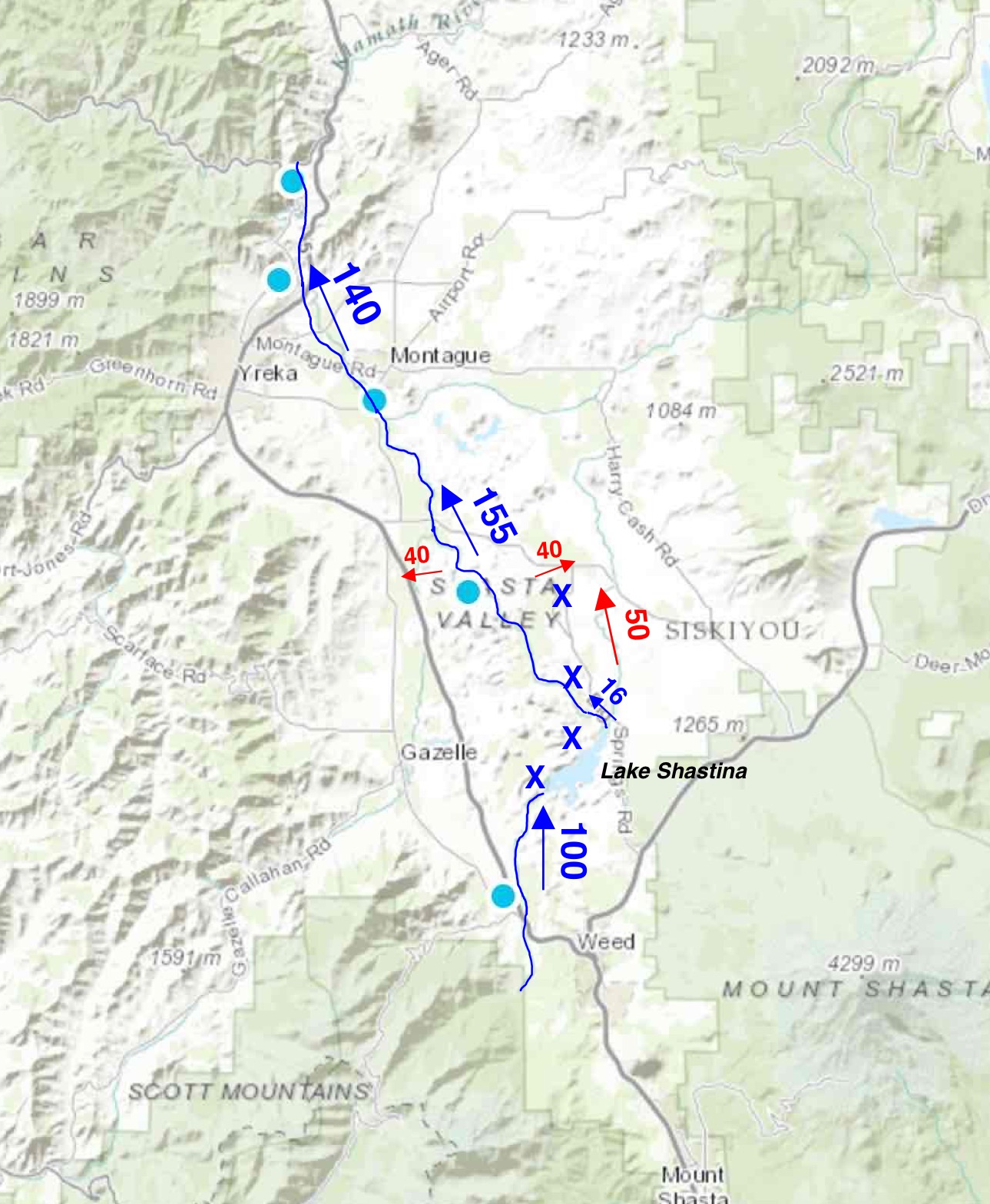
Just take a look at the present late May 2017 hydrology of the Klamath River (Figure 1). There was only 140 cfs flowing in the lower Shasta River. At the same time, there was 25,000 cfs flowing in the lower Klamath, 2000 cfs in the upper Klamath below Irongate Dam, and 2000 cfs in the Scott River. What is different is that most of the Shasta flow is spring fed, some of which is sustained through the summer. Of the roughly 300 cfs base flow in the river in late May 2017, about 200 was from springs (Figure 2). By mid-summer, flow out of the Shasta River into the Klamath will drop to about 50 cfs, with agricultural diversions from the Shasta at about 150 cfs. October through April streamflow is generally sufficient to sustain the fall-run salmon population. Summer flows are no longer sufficient to sustain the once abundant Coho and spring-run Chinook salmon.

Figure 1. Lower Klamath River with late May 2017 streamflows in red. Note Shasta River streamflow was only 140 cfs near Yreka, California. Data source: CDEC.

Figure 2. Selected Shasta River hydrology in late May 2017. Roughly 150 cfs of the 300 cfs total basin inflow is being diverted for agriculture, with remainder reaching the Klamath River. Red numbers are larger diversions. The “X’s” denote major springs. Big Springs alone provides near 100 cfs. Of the roughly 100 cfs entering Lake Shastina (Dwinnell Reservoir) from Parks Creek and the upper Shasta River and its tributaries, only 16 cfs is released to the lower river below the dam. Red numbers and arrows indicate larger agricultural diversions. Up to 15 cfs is diverted to the upper Shasta River from the north fork of the Sacramento River, west of Mount Shasta.

Protecting Salmon Summer 2017

In a June 2 post I wrote about protecting Sacramento River salmon and sturgeon in spring 2017. The topic shifts to summer in this post. Summer (July-September) river conditions are also important for sustaining salmon and sturgeon. There are numerous sensitive summer life-history stages with well recognized tolerance limits:

  • Adult holding and spawning winter-run salmon. (July-August 60oF)
  • Eggs and embryo winter-run salmon. (July-Sept 56oF)
  • Rearing fry and fingerling winter-run salmon. (July-Sept 60oF)
  • Rearing fingerling and pre-smolt late fall-run salmon. (July-Sept 60oF)
  • Over-summering and migrating spring-run and fall-run salmon smolts and juvenile sturgeon. (July-Sept 65oF)
  • Migrating pre-spawning adult spring-run and fall-run salmon. (July-Sept 68oF)
  • Holding pre-spawning adult spring-run and fall-run salmon. (July-Sept 60oF)
  • Spawning adult spring-run salmon. (Aug-Sept 56oF)

State water right orders, federal salmon biological opinions, and the Sacramento River Basin Plan all recognize these uses and tolerances by setting summer water temperature targets of 56oF for the Red Bluff (river mile 243) reach and 68oF at Wilkins Slough (river mile 125). Further conditions are set upstream as far as Keswick Dam (river mile 300).

In this post, I focus on the summer spawning run of fall-run salmon of the Sacramento River. Fall-run make up the vast majority of Sacramento River salmon, as well as the Central Valley salmon population. Better summer conditions in 2017, especially with a record-high water supply, should help produce more salmon and bring about a recovery of the depressed ocean and river fisheries.

Adult fall-run migrate from the ocean through the Bay-Delta and begin spawning in the upper river (river mile 200-300) in September continuing through December. Summer river conditions during their upriver spawning run, pre-spawn holding, and spawning are important factors in the ultimate success of the spawning run (i.e., smolt production and future runs).1

To protect the spawning run we should focus on two key objectives:

  1. Maintain water temperature below 60oF in the spawning reach to protect holding adult salmon.
  2. Maintain water temperature below 68oF in the migrating corridor to protect migrating adult salmon.

Spawning Reach Summer Protection

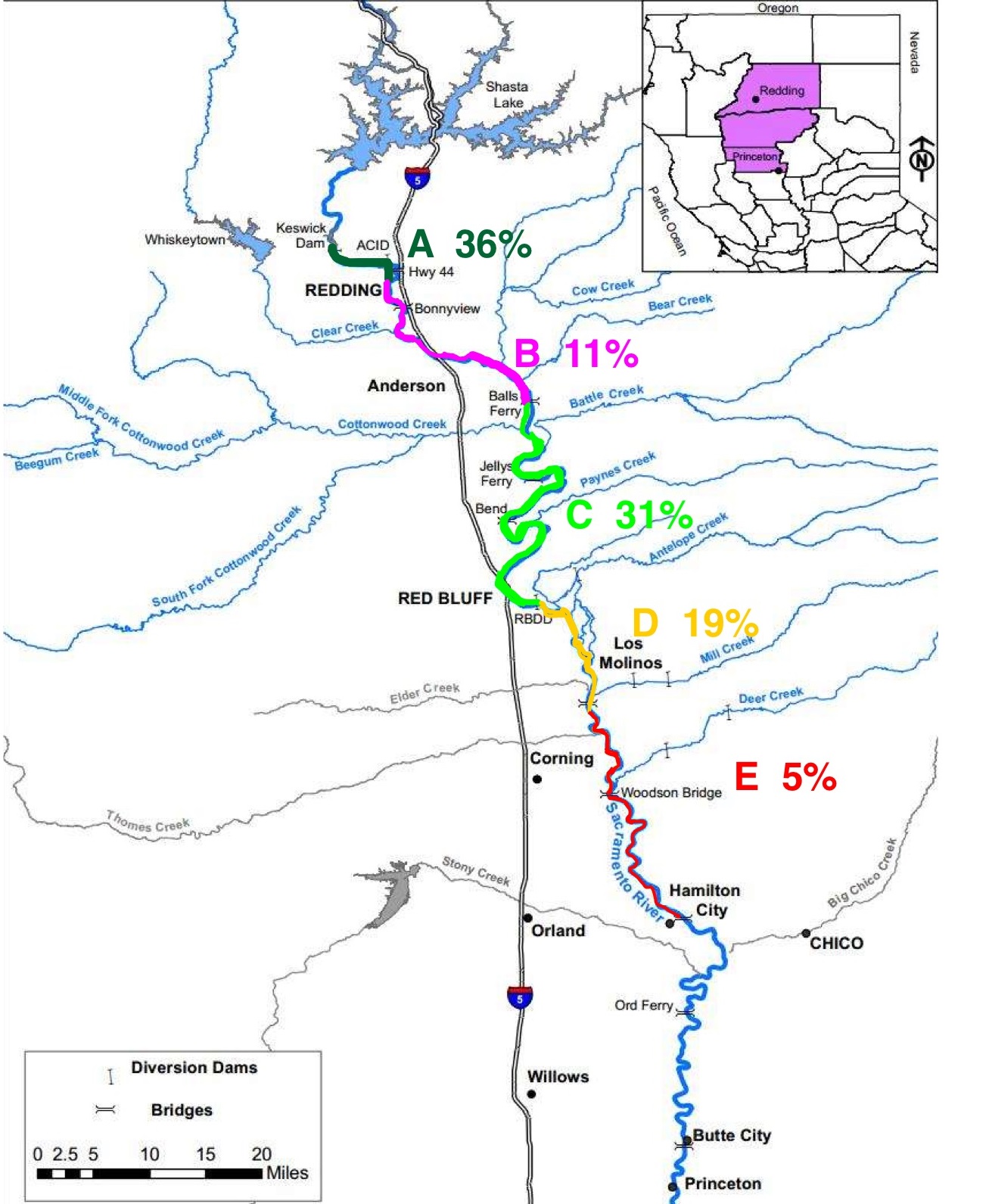
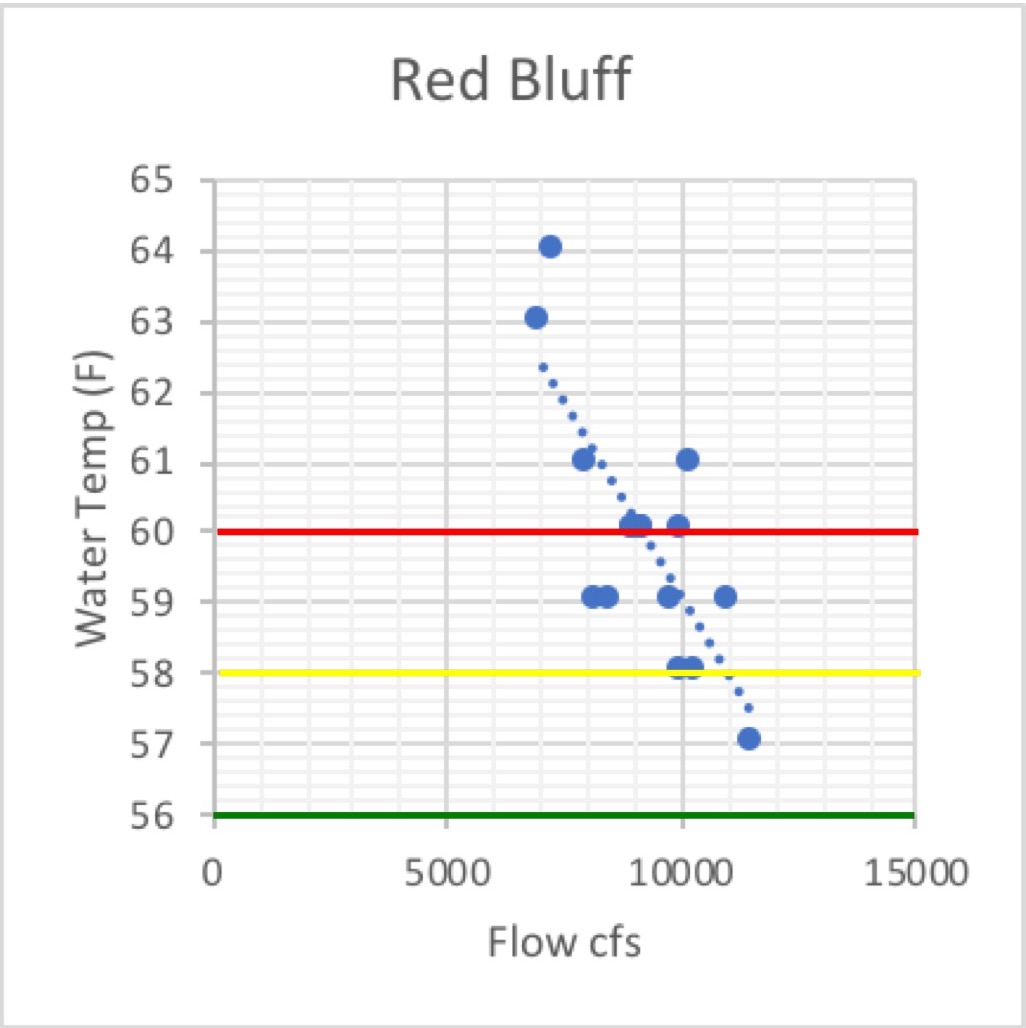
The fall-run spawning reach is from Hamilton City upstream to Keswick Dam: river mile 200 to 300 (Figure 1). Spawning winter-run are protected with a 56oF daily-average limit above Balls Ferry (RM 276). With potentially over half the fall-run spawning below Balls Ferry, a 60oF limit is needed down to Hamilton City (RM 200). Historical water temperatures at Red Bluff (RM 243) show that the Basin Plan 56oF target at Red Bluff was rarely achieved, but that the 60oF limit was achieved except in some critically dry years (Figure 2). Allowing for a 2-degree leeway to maintain the 60oF limit downstream 40 miles to Hamilton City, a 58oF limit was not achieved except in some wetter years. Maintaining a 60oF limit at Hamilton City would take flows of 10,000 cfs or more at Red Bluff (Figure 3).

Migrating Reach Summer Protection

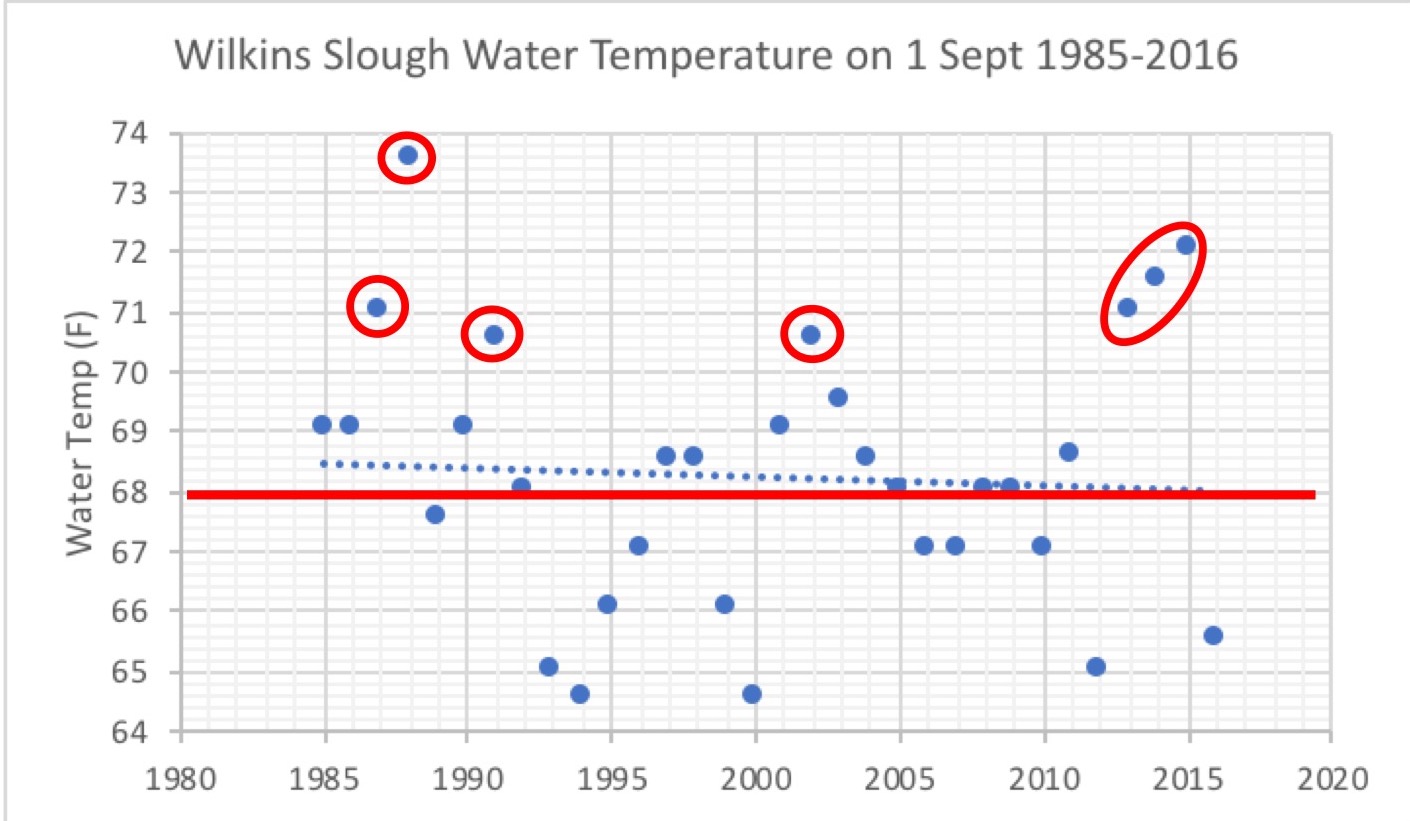
The fall-run migration reach to the spawning grounds above Hamilton City (RM 200) is approximately 100 miles above the mouth of the Feather River at Verona. Historical water temperature data from the Wilkins Slough gage (RM 125) show that the 68oF daily average objective was often not met, especially in critically dry years (Figure 4). Maintaining a 68oF limit near Wilkins Slough in the lower Sacramento River would take flows of 7,000 cfs or more at the Wilkins Slough gage (Figure 5). Maintaining a 68oF limit at Verona below the mouth of the Feather River would take up to 15,000 cfs at the Verona gage (Figure 6).

Conclusions and Recommendations

  • Maintain summer water temperature at Red Bluff below a daily-average limit of 58oF with flows from 10,000 to 12,000 cfs as necessary, to protect holding pre-spawn and early spawning adult fall-run salmon.
  • Maintain summer water temperature at Wilkins Slough on the lower Sacramento River below a daily-average limit of 68oF with flows from 7000 to 8000 cfs as necessary, to protect migrating adult fall-run salmon.
  • Maintain summer water temperature at Verona on the lower Sacramento River below a daily-average limit of 68oF with flows from 10,000 to 15,000 cfs (including Feather River flows) as necessary, to protect migrating adult fall-run salmon.

These recommendations are consistent with Basin Plan objectives for Sacramento River water temperature.

Figure 1. Sacramento River salmon spawning reaches: Keswick Dam (rm 300) downstream to Hamiltom City (rm 200). The proportion of the total salmon spawning is shown by five river segments (A-E). Source: CDFW.

Figure 2. Daily average water temperature of the Sacramento River at Red Bluff (rm 243) on September 1 2001-2016. Red circles denote critical water years. Red line denotes upper tolerance limit for holding prespawn adult salmon. Yellow line denotes Red Bluff level necessary to meet objective at Hamilton City (rm 200). Green line denotes Basin Plan objective for Red Bluff.

Figure 3. Red Bluff daily average water temperature versus flow for September 1 2001-2016. Red line is water temperature limit for Red Bluff. Yellow line denotes Red Bluff level necessary to meet objective at Hamilton City (rm 200). Green line denotes Basin Plan objective for Red Bluff.

Figure 4. Daily average water temperature of the Sacramento River at Wilkins Slough (rm 125) on 1 September 1985-2016. Red circles denote critical water years. Red line denotes upper tolerance limit for holding prespawn adult salmon.

Figure 5. Daily average water temperature of the Sacramento River at Wilkins Slough (rm 125) on September 1 1985-2016. Red line denotes upper tolerance limit for holding prespawn adult salmon.

Figure 6. Water temperature (oC) and flow (cfs) of the Sacramento River at Verona (rm 80) from July 2014 to June 2017. Source: USGS.

Protecting Salmon and Sturgeon May-June 2017

Despite a record water supply in 2017, water operations in the Sacramento Valley are already threatening salmon and sturgeon because water managers are not meeting flow and water temperature targets and regulators are not enforcing them.

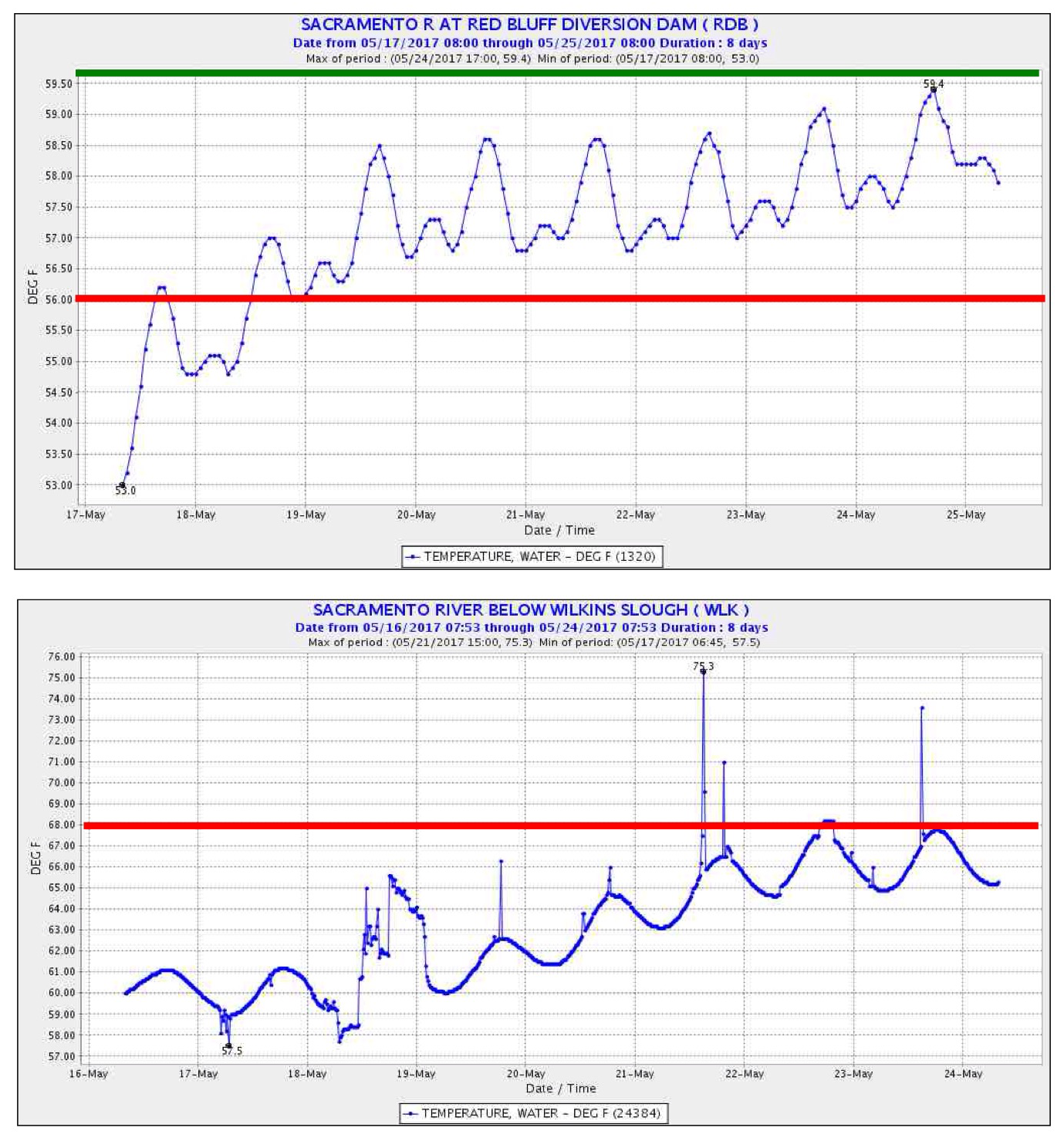
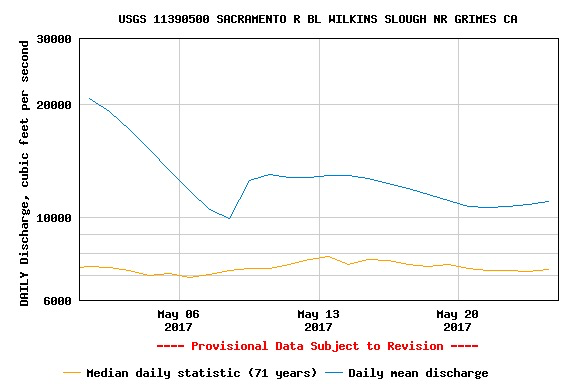
The water temperature of the Sacramento River at Red Bluff (river mile 240) exceeds the target of 56oF in the Salmon Biological Opinion, water right permits, and Basin Plan (Figure 1a).  The water temperature at Red Bluff (Figure 1a) is also approaching the 60oF tolerance limit for salmon and sturgeon eggs and embryos.  The water temperature in the lower Sacramento River at Wilkins Slough (river mile 125) exceeds the 65oF tolerance limit for sturgeon larvae and approaches the 68oF Basin Plan tolerance limit for migrating juvenile and adult salmon and sturgeon (Figure 1b).  To protect migrating salmon and sturgeon, water managers need to maintain a flow in the lower Sacramento River of at least 10,000 cfs through the summer of this very wet year (Figure 2).

Figure 1. Sacramento River water temperature at (a) Red Bluff (river mile 240) and (b) Wilkins Slough (river mile 125) during May 2017. Red lines depict Basin Plan targets. Source: CDEC.

Figure 2. Mean daily river flow in the lower Sacramento River at Wilkins Slough (river mile 125) during May 2017. Source: USGS.

Fundamental Needs of Central Valley Fishes – Part 1d: Summer River, Delta, and Bay Freshwater Flows

In the coming months and years, regulatory processes involving water rights, water quality, and endangered species will determine the future of Central Valley fishes.

To protect and enhance these fish populations, these processes will need to address four fundamental needs:

  1. River Flows
  2. River Water Temperatures
  3. Delta Outflow, Salinity, and Water Temperature
  4. Valley Flood Bypasses

In this post, I summarize a portion of the issues relating to River Flows: Summer Flows. Previous posts covered fall, winter, and spring flows.

Summer flows have long been neglected in water management and water quality standards. This absence is a major factor in the decline of salmon, steelhead, sturgeon, Delta smelt, and other Delta native fishes.

Summer River Flows

River flows in summer drive many natural ecological processes in the Central Valley related to reservoir tailwater spawning, egg incubation, and over-summer rearing in Valley rivers. Valley rim dam releases are prescribed to meet these needs as well as water supply demands. All four salmon runs, steelhead, Pacific lamprey, and white and green sturgeon are dependent on river flows in summer. Below Shasta Reservoir on the Sacramento River, flow is necessary to sustain (1) salmon eggs/embryos, fry, fingerlings, and smolts of winter-run salmon, (2) juvenile fall-run, spring-run, and late-fall-run salmon; (3) juvenile steelhead, and (4) newly hatched fry of green and white sturgeon. Below Oroville and Folsom reservoirs, flow is needed to sustain juvenile steelhead as well as numerous over-summering smolts and pre-spawn adults of both spring-run and fall-run salmon. The Sacramento and San Joaquin Basin Plan (Central Valley Basin Plan) prescribes water quality objectives to protect these beneficial uses. The applicable key water quality objectives are for water temperature and streamflow.

During the dry summer season, much of the Central Valley and Bay-Delta water supply and environmental needs depend on water releases from storage reservoirs. Reaches above the reservoirs and non-dammed streams depend on springs and snowmelt. Like spring-run salmon in un-dammed tributaries, spring-run adults downstream of rim dams, most notably on the Sacramento, Feather, and Yuba rivers, must hold over the summer awaiting their September-October spawning season. Winter-run salmon continue to spawn into August in the Sacramento River below Shasta; their progeny, and the progeny of those that spawned earlier in the summer, are sustained by cold-water dam releases as embryos in gravel beds.

Throughout the summer, winter-run fry move out of their redds downstream of Shasta. Water released from Shasta must be sufficient in amount and cold enough to sustain salmon eggs/embryos, fry, fingerlings, smolts, and over-summering and newly arriving adults, as well as young steelhead. Sufficient river flows are necessary in over 200 miles of the lower Sacramento River to keep water temperatures below lethal levels for salmon, trout, and sturgeon. Adult fall-run salmon, whose migration begins in summer, need cool water (<70°F) to commence their run from the Bay up the river.

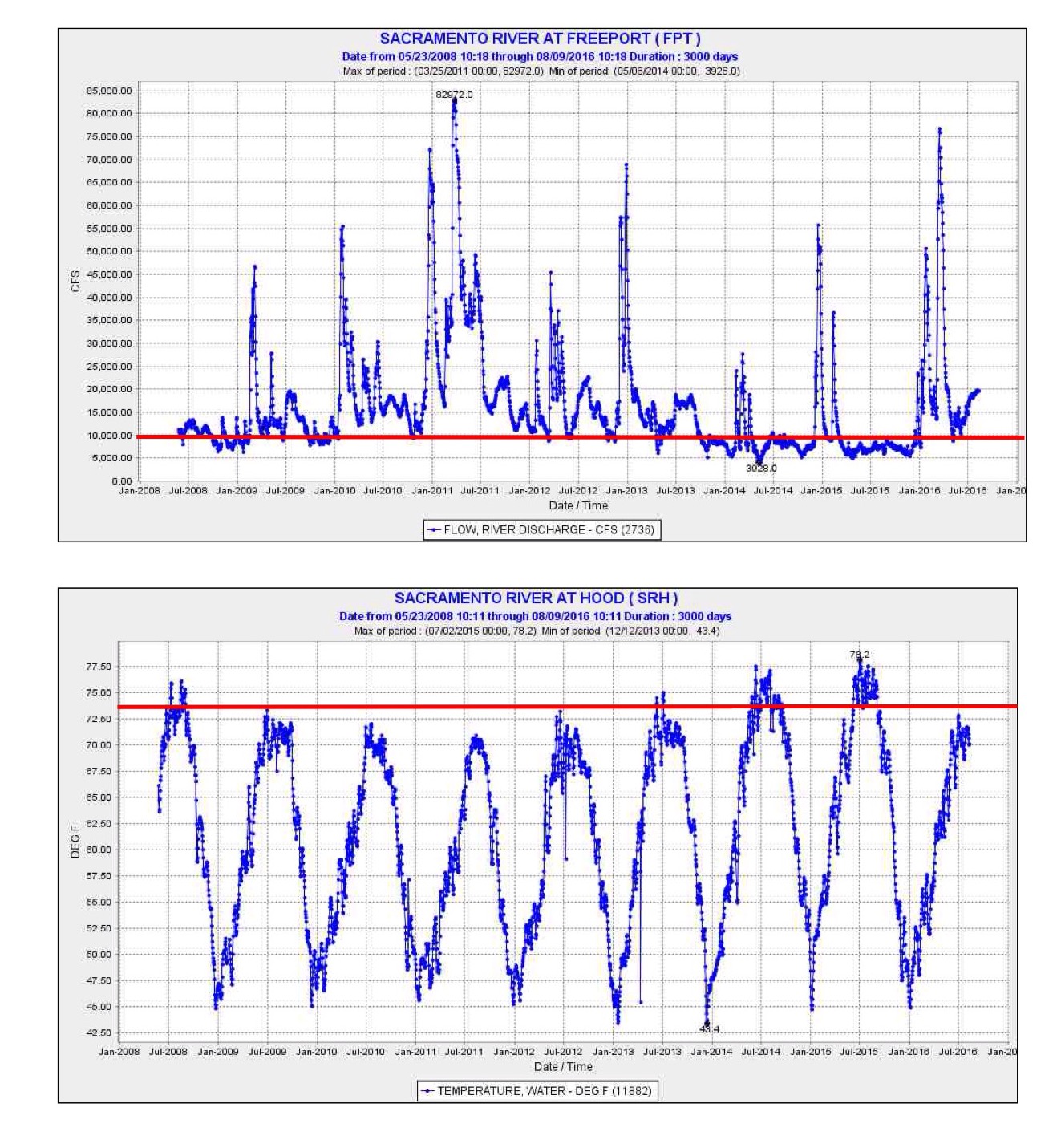
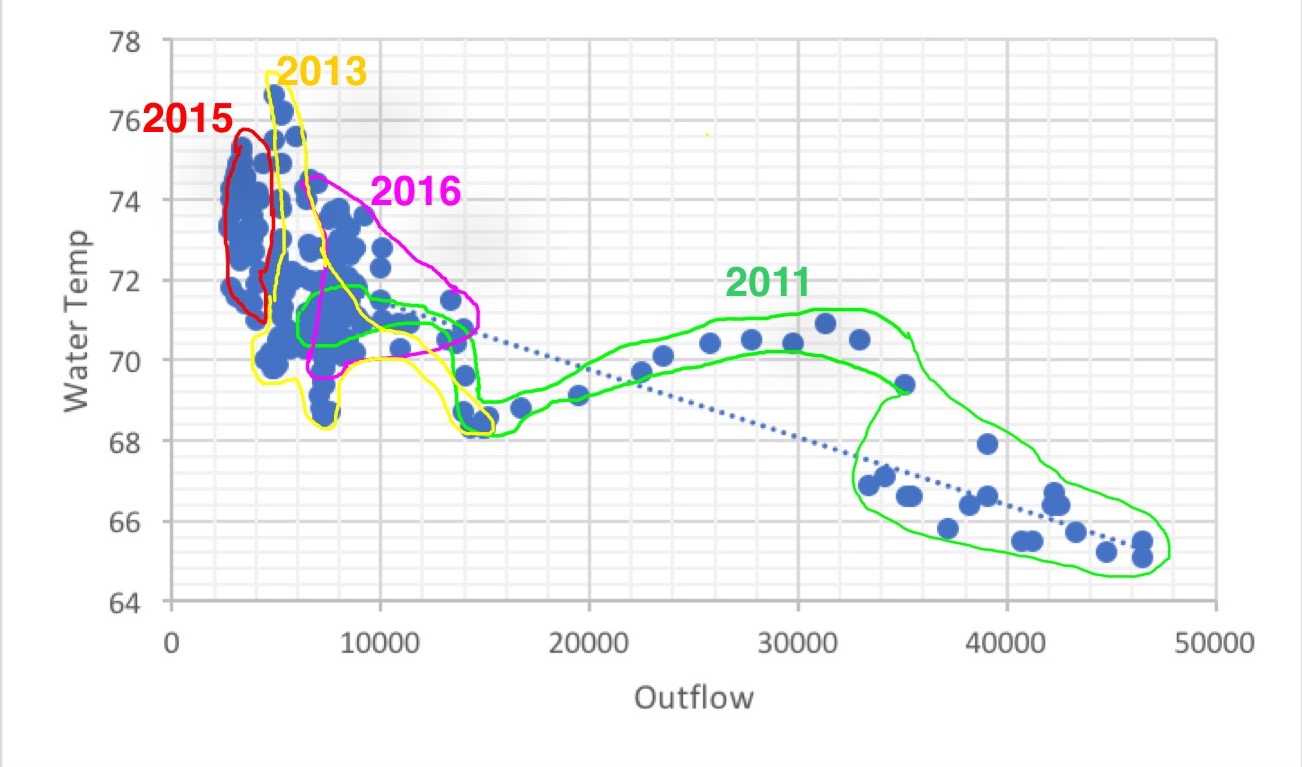
The Central Valley water quality plan’s limit of 68°F for the river is rarely enforced. Sacramento River flows of 6000-8000 cfs downstream of the major irrigation diversions are necessary to maintain the required water temperature, but these flows and are met only in wet years (Figure 1). The same holds true for the San Joaquin River, where low flows and high temperatures in late summer hinder that river’s salmon runs. Summer river flows into the Delta are also important in maintaining water temperatures within sustaining levels for Delta smelt (<73°F). Under low Delta inflows, not only is the smelt critical habitat warmer (Figure 2), but it is further upstream in the Delta, away from cooler Bay breezes. Further, during the summer, Delta water temperatures reach critical levels (>73°F) far more often under low Delta outflows (~5000 cfs) than moderate outflows (~10,000 cfs) (Figure 3).

In summary, river flows and water temperatures in summer are critical habitat needs. These needs require stronger summer flow standards and additional management attention to protect the salmon, steelhead, sturgeon, smelt and other species dependent on Central Valley and Bay-Delta habitats during summer portions of their life cycles.
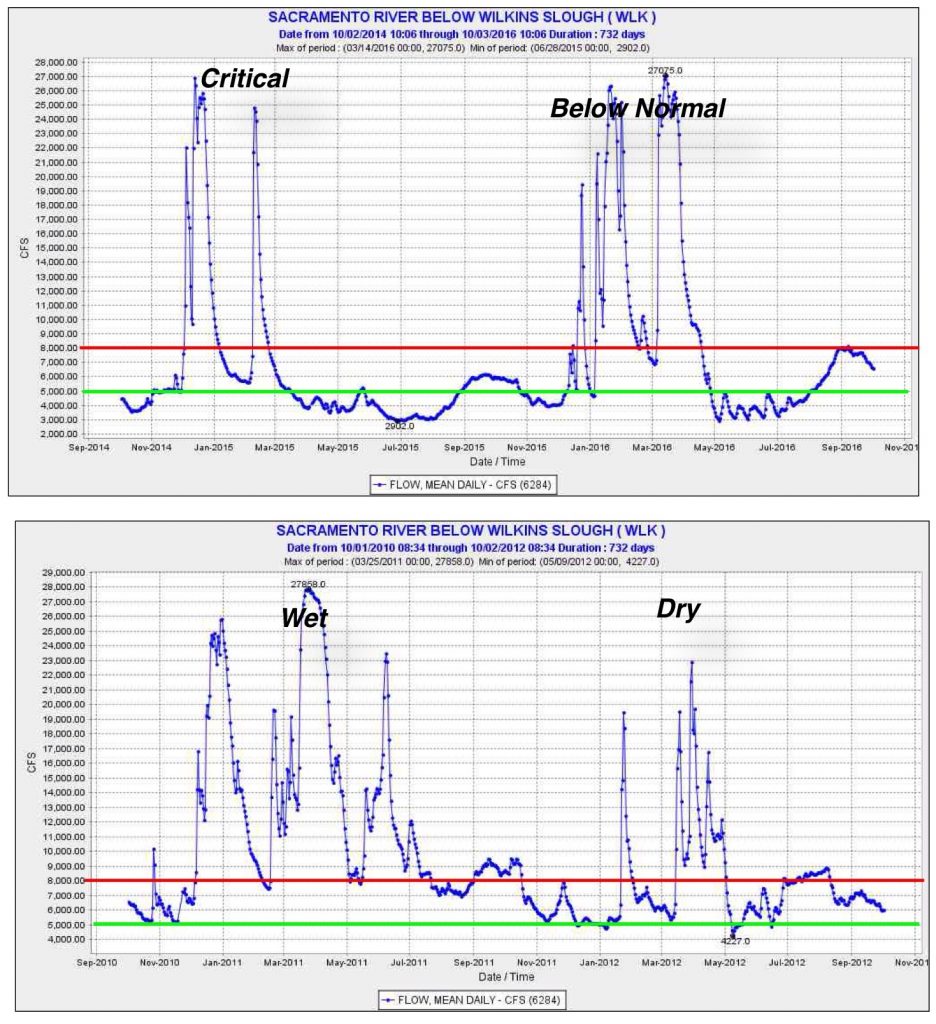
Figure 1. River flow (cfs) in lower Sacramento River below major irrigation diversions in four recent years representing four water-year types. Green line represents minimum flow needed to maintain essential ecological processes in the lower river and Bay-Delta. Red line represents preferred minimum level protecting ecological processes. Summer flow is generally depressed even in wet years.
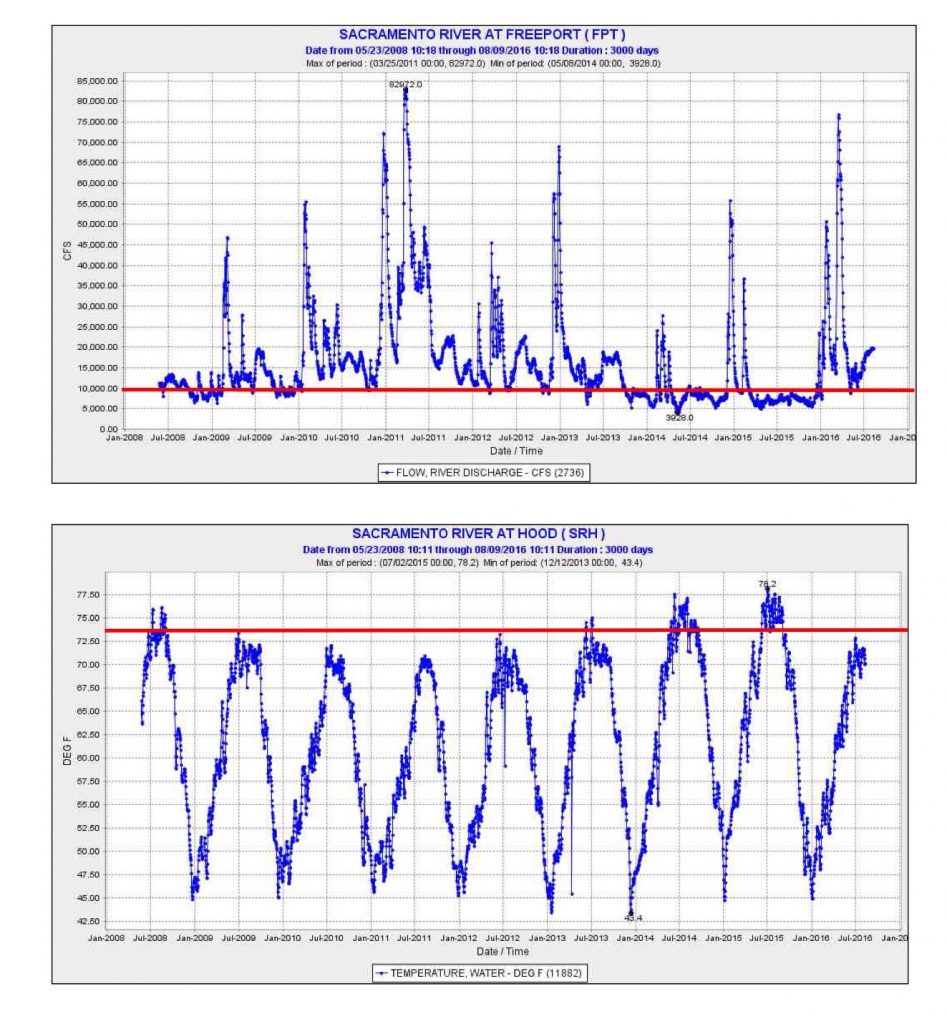
Figure 2. Water temperature in the north Delta channel of the Sacramento River 2008-2016. Red line denotes 73°F limit of sustainability for Delta smelt.
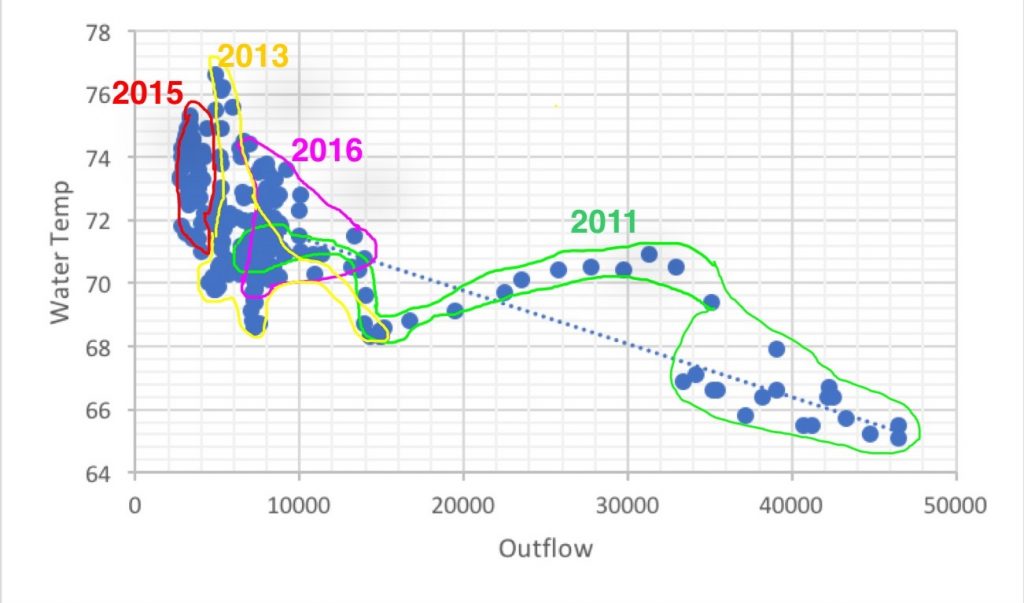
Figure 3. Delta outflow and water temperature (daily average) at Rio Vista in the north Delta channel of the Sacramento River in summer (mid-June to mid-August) of four recent years: critically dry years 2013 and 2015, below normal year 2016, and wet year 2011. Note that the daily averages are not independent from one another within years, and the effect of air temperature is not shown. Regardless, the effect of flow on water temperature, particularly in the readily controllable flow range of 5,000-15,000 cfs, appears significant among years. Source: CDEC.
 

More on Delta Science

More Delta ScienceI have written often on Delta science and what has been or could be learned from science to support water management.  Yet another biennial Delta science conference, the 9th, was held this past November.  This year’s conference theme was: “Science for Solutions:  Linking Data and Decisions.”  Another year has passed, and more has been studied and learned.  More dots have joined the dozens of previous dots in data charts from annual surveys of Delta organisms and habitat conditions.  More dots lament the loss of water and habitat.  The huge Delta Science Program has progressed yet another year.

Opening Talk

In Phil Isenberg’s opening talk, “A Guide for the Perplexed”, the former legislator and former chair of the Delta Stewardship Council suggested that scientists learn to smile more.  He asked: “Why should science be involved in policy anyway?”  He talked about how policy makers view science.  (Obviously, many are perplexed.)  He forgot that the universe and Mother Nature are vastly mysterious things, which are often more complicated than human understanding, but sensitive to human actions at the same time.  Yes, science is perplexing.

Mr. Isenberg talked about “independent science” and “combat science,” as though they were two different things.  To borrow a legal term, science is not self-executing.  Then he asked: “How do we know when we are using the best-available science”?  His answer: “When it is good enough to avoid doing something stupid.”  Clearly, we have yet to reach that point.  The problem has been in choosing to do the best thing, not that good choices or unknown or not “available.”  He then quoted Churchill:  “America will always do the right thing after trying everything else first”At least we have gotten past the point where we thought the world is flat.  It is all very perplexing.

Mr. Isenberg concluded by suggesting: “It’s the notion that scientists live looking farther out than the rest of us do with the gift of foresight that if properly utilized, can inform, educate, and ultimately motivate policy makers.”   He forgets that ultimately policy makers must trust scientists to get the job done.  Example: the Trinity Project and the atomic bomb in the 1940’s.  As long as water managers and policy makers lead the science, the Delta’s problems will not be solved.

The Delta Science Program

Clifford Dahm, former lead scientist for the Delta Stewardship Council, spoke on his Delta Science Program, which was forced upon us in the 2009 Delta Reform Act to ensure water and environmental policy are guided by the “highest caliber” science.  He spoke on the program’s Independent Science Board, outsiders who meet once a year to review “our science”.  He spoke on their Adaptive Management Program, which ensures that we evaluate everything and learn nothing.  He spoke on the program’s efforts to coordinate science and inform decision makers, and to develop and implement the Delta Science Plan and promote the Science Action Agenda.  He talked about their modeling efforts: “There’s just a lot of ways that modeling could be moved forward, and I hope that in the next two years, we can actually come back to you and say that some of our modeling efforts have shown greater fruition as time goes on.  We were talking about the idea of potentially a modeling center or a co-laboratory to get modelers together.”  Those would be the two years after which we will have new water quality standards, new biological opinions, and new tunnel-boring machines in the Delta, as well as several newly extinct native fish species.  They would also be the two years after 20 years of effort starting with the CalFed Bay-Delta Program.

A Great Question

U.C. Davis fisheries biologist Peter Moyle then addressed the question:  “How has your research program and the data it has produced over the last 35 years been used to develop solutions for conserving aquatic resources in Delta?”  He quoted the 1998 Strategic Plan:

This strategic plan, if followed, should lead to an orderly and successful program of adaptive ecosystem restoration….  The Strategic Plan Core Team has high expectations for the Ecosystem Restoration Program.  There is no turning back and the team anticipates that in 20-30 years many habitats will be restored, endangered species will become abundant enough to be delisted, and conflicts will be lessened , even in the face of population growth and increasing demands on resources.

In addressing the posed question, he then remarked:

In retrospect, now that almost 20 years has past since that was written, the statement almost seems tongue in cheek because clearly that has not happened.  I continue to help write reports that recommend how to improve the Delta ecosystem and frankly I don’t see much progress being made, as the delta smelt trends so eloquently attests…  the reality is that the Delta has continued to deteriorate as a habitat for native fishes, despite my research and despite many proposals for solutions.

His experience, like that of so many other long-time Delta scientists, is that few if any of the specific recommendations in the Strategic Plan have been implemented or completed.  Science has done its job, and scientists have long awaited action.  Policy makers and managers have failed us, not the science.

The use of science in complex public policy decision making

Chair of the State Water Board Felicia Marcus spoke on the use of science in decision making.  She suggested to scientists:  “Dare to recommend, but don’t decree …  Retain your scientific integrity but dare to make recommendations.  At the same time, own your power and be responsible with it and have empathy for the decision makers who have to balance, even as you would have them respect you.”  This is a very tough sell for scientists who have not been listened to for decades.  What will she and her Board do with two more rounds of recommendations on the Delta tunnels and the Bay-Delta Plan?  Will her Board be as transparent and methodical in their balancing as the scientists are in making their recommendations?

Chair Marcus further stated:

We’re entering the era of adaptive management that requires all of the above as well as integrating social sciences into our work … To make adaptive management work, we all have to learn how to be better ‘egosystem’ managers in order to be better ecosystem managers in the real world over time, versus lurching from sound bite to sound bite or wringing our hands that other players just don’t get it.

Sorry, but that’s not the problem.  It gives the policy makers and the managers too much credit and scientists too little.  Very few scientists think that managerial ignorance or lack of cognition is the biggest problem.  Rather, it’s that scientists have endured decades of adaptive management in which their lessons and caveats have on the whole been subsumed to the social sciences of politics and economics.  There are plenty of scientists throughout the resource agencies and non-profit groups who are extremely articulate and who have great senses of humor and social skills.   That hasn’t changed the outcomes: fish and other parts of the Bay-Delta aquatic ecosystem are in crisis, and the agricultural economy and other values against which the ecosystem is “balanced” are thriving..  And that balance sheet is really nothing to smile about.