Increasing Salmon Production in the Central Valley

The state of California has a comprehensive Water Plan to provide a guide for the state’s future water supply.  Why is there no state Salmon Plan?  California also has a plan to restore Bay-Delta habitat called California EcoRestore.  Why not a SalmonRestore, or at least a comprehensive salmon plan as a part of EcoRestore?

Much of the key to increasing salmon production in the Central Valley is to increase flows in rivers and Delta inflow and outflow.  Another key element is to improve reservoir management for water temperatures and the protection of spawning habitat downstream of dams.  Water in sufficient quantity and of sufficient quality is indispensable.

In addition to better water management, the state needs a plan to implement five basic physical approaches to increasing salmon production in the Central Valley.

  1. Restore River Rearing Habitat – Restore river corridor and side-channel rearing habitat in the mainstem rivers and tributaries
  2. Restore Floodplain Rearing Habitat – Increase volitional access of juvenile salmon to the Valley’s agricultural floodplain through gated weirs; enhance such rearing habitat, and implement strategies to reduce stranding of adult and juvenile salmon in that habitat.
  3. Restore Spawning Habitat – Restore salmon spawning habitat in the mainstem rivers and their tributaries by introducing spawning gravel and improving other physical aspects of channel habitat.
  4. Implement Upstream and Downstream Trap and Haul Capture juvenile salmonids and transport them from existing spawning areas downstream in dry years when low flows and resulting high water temperatures are unsuitable for volitional downstream migration and survival. Capture and transport adult salmon to upper watersheds above impassable dams, and capture and transport their juvenile progeny back downstream of those dams to locations where high survival is likely.
  5. Increase Hatchery Contributions – Increase the number of hatchery smolts that reach the ocean, while minimizing negative effects of hatcheries on wild salmon populations.

Available options in each of the five categories are virtually limitless, as are the potential costs and benefits.

The National Marine Fisheries Service has a Recovery Plan for salmonid species that are listed as threatened or endangered under the Endangered Species Act.  Such recovery is valuable and important.  But fisheries agencies also can and must do better in supporting the commercial and recreational fishing industries that depend largely on fall-run salmon that are not listed under the ESA.  A state Salmon Plan should be part of the strategy, and the sooner the better.


Wild Central Valley Salmon: Managers Missing an Opportunity

This winter and early spring of 2020 have been drier than normal in the Central Valley. However, precipitation in January, March, and now April provided opportunities to greatly enhance this year’s brood of fall and spring run salmon success. Water managers missed these opportunities by capturing all the water in reservoirs. What happened to prescribed spring flow pulses for salmon in state and federal plans? Is holding the promised water back the “best science”?1 No.

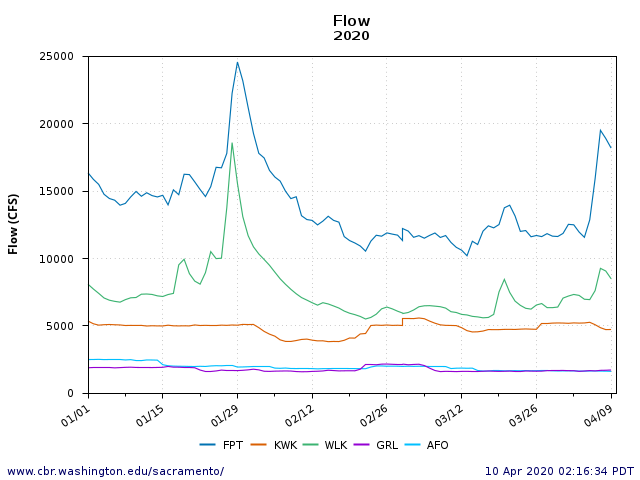
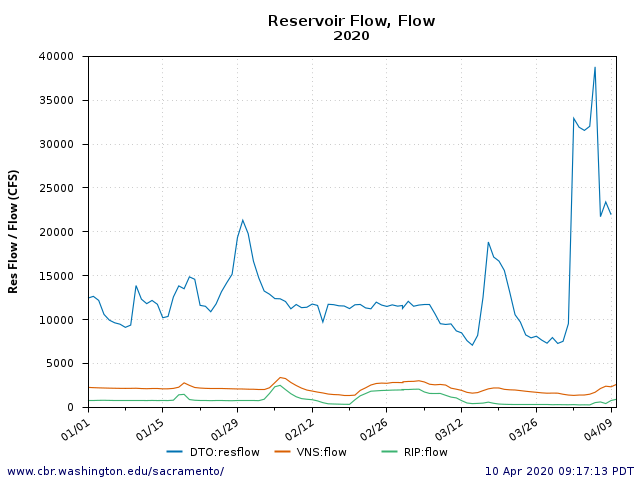
Shasta, Oroville, and Folsom reservoirs, the largest in Sacramento Valley, have released no flow pulses since January 1 to the Sacramento, Feather, and American rivers (Figure1). These are the rivers with the state’s biggest runs of fall-run and spring-run salmon. These three reservoirs now hold 6.5 million acre-feet (MAF) of stored water, over 95% of average for this date. Also available is 2 MAF of water now stored in Trinity Reservoir, which is at 109% of average for this date. Local rainfall and un-dammed tributaries have provided three significant flow pulses in lower rivers and the Delta, but these pulses have not touched the spawning and rearing grounds just downstream of the major dams.

Figure 1. Streamflow (cfs) in the upper section of the lower Sacramento River below Shasta (KWK – Keswick), the middle section of the lower Sacramento River (WLK – Wilkins), the lower section of the lower Sacramento River (FPT – Freeport), the lower Feather River (GRL – Gridley), and the lower American River (AFO – Fair Oaks).

The lower San Joaquin River watershed had a similar record this year, with minimal contribution to Delta inflow and outflow or to flow pulses from reservoirs (Figure 2).  The watershed’s largest reservoir, New Melones on the Stanislaus River, has 121% of average for the date with 1.9 MAF of water in storage.  New Melones did provide a small release in early February and appears to be ramping up releases in early April.  But the State Water Board has already written a letter to the Bureau of Reclamation calling Reclamation out for failing to maintain required flows in the lower San Joaquin River.

Figure 2. Streamflow (cfs) in the lower San Joaquin River (VER – Vernalis), the lower Stanislaus River (RIP – Ripon), and Delta outflow (DTO).

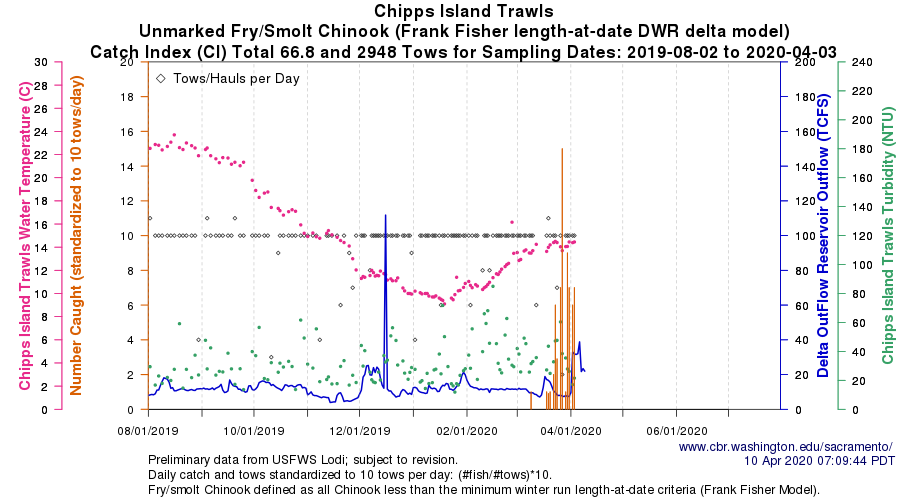
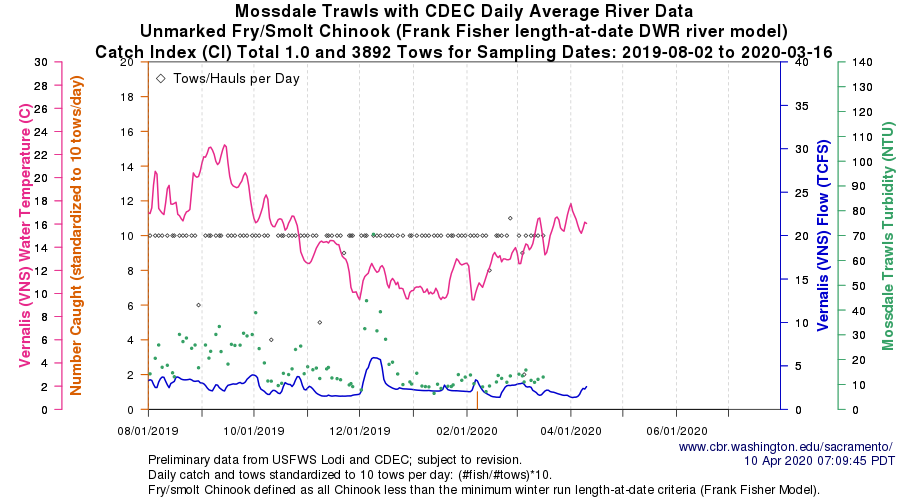
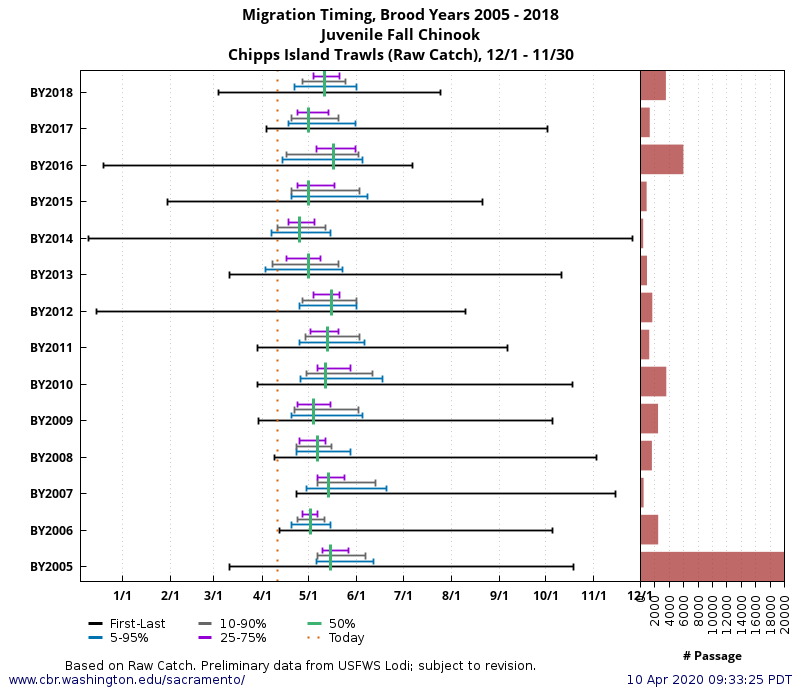
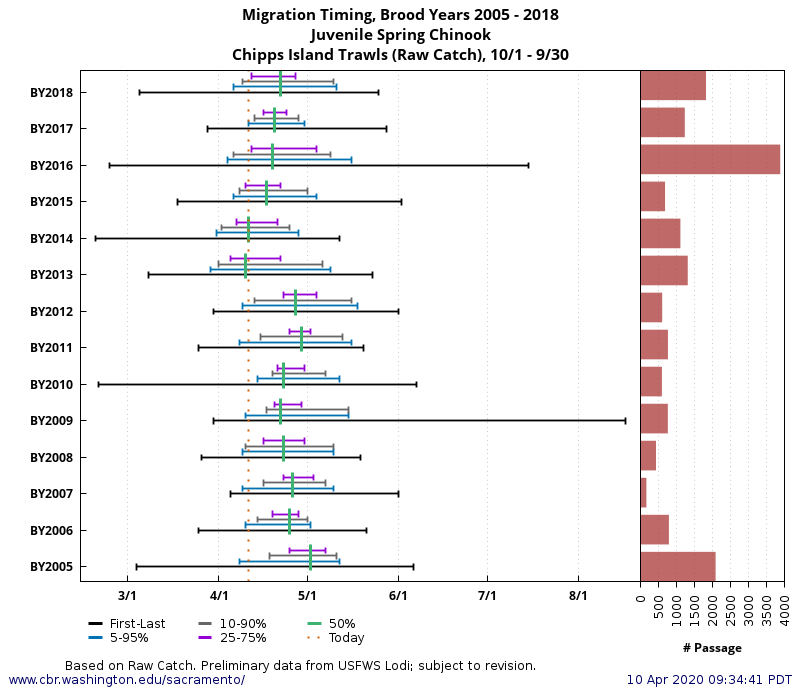
The river flow and Delta outflow pulses in early April have spurred the annual exodus of juvenile spring and fall run salmon from the Delta (Figure 3).  It is important to get as much of the river juvenile salmon production into the Delta as soon as possible to take advantage of this critically-timed pulse in Delta outflow.  The tailwaters of the large dams holds tens of millions of wild fry and juvenile salmon (30-50 mm in length) that need to get downstream to grow and to emigrate into and through the Delta.  These young salmon need reservoir releases to encourage their emigration and improve their growth and survival.  Most importantly, pulses will piggy-back on the present April pulse in Delta outflow.  This need is most pronounced in the San Joaquin salmon watersheds, where flows have been low and few salmon have reached the Delta (Figure 4).  The need to support the fall-run and spring-run salmon emigration extends at least through April and into May, including over 20 million hatchery salmon smolts released from tributary hatcheries (Figures 5 and 6).

Figure 3. Catch of juvenile salmon at exit from the Delta at Chipps Island In 2020.

Figure 4. Catch of juvenile salmon in the lower San Joaquin River at Mossdale at entrance to the Delta In 2020. Note catch was only one so far in 2020.

Figure 5. Timing of the fall-run salmon exiting the Delta in brood years 2005-2018 (2006-2019).

Figure 6. Timing of the spring-run salmon exiting the Delta 2006-2019.


Winter 2020 – Salmon need winter flow pulses

In a February 2019 post, I discussed the importance of winter flows for fall-run salmon in the Central Valley. The peak fry emergence from gravel spawning beds is in winter. Millions of fry move to river margins to await flow pulses to carry them from upper main river and tributary spawning grounds to lower river floodplain, Delta, and Bay nurseries. Without such pulses, the fry stay in the cold rivers competing for limited food and habitat, which leads to poor overall survival and fewer smolts reaching the ocean.

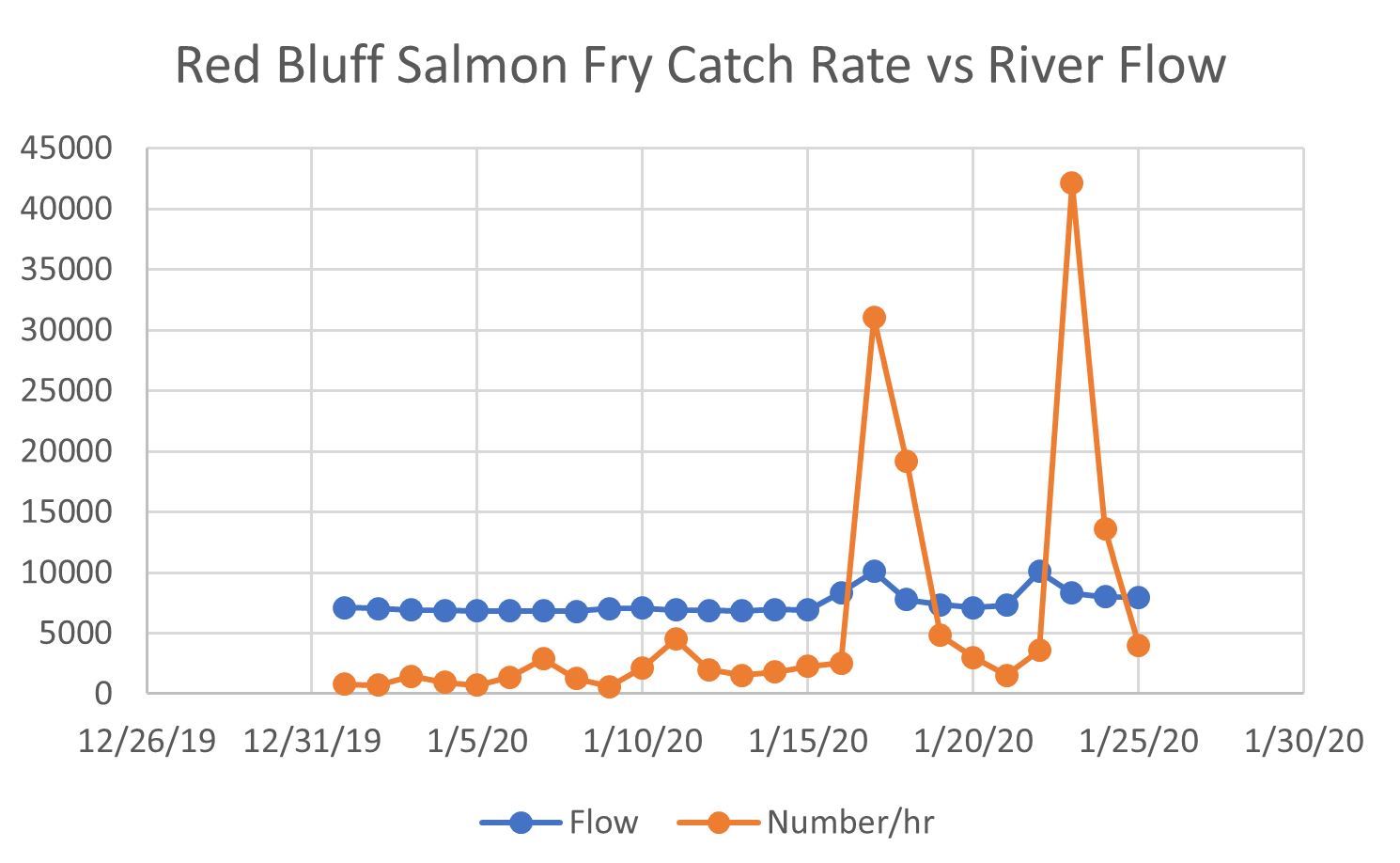
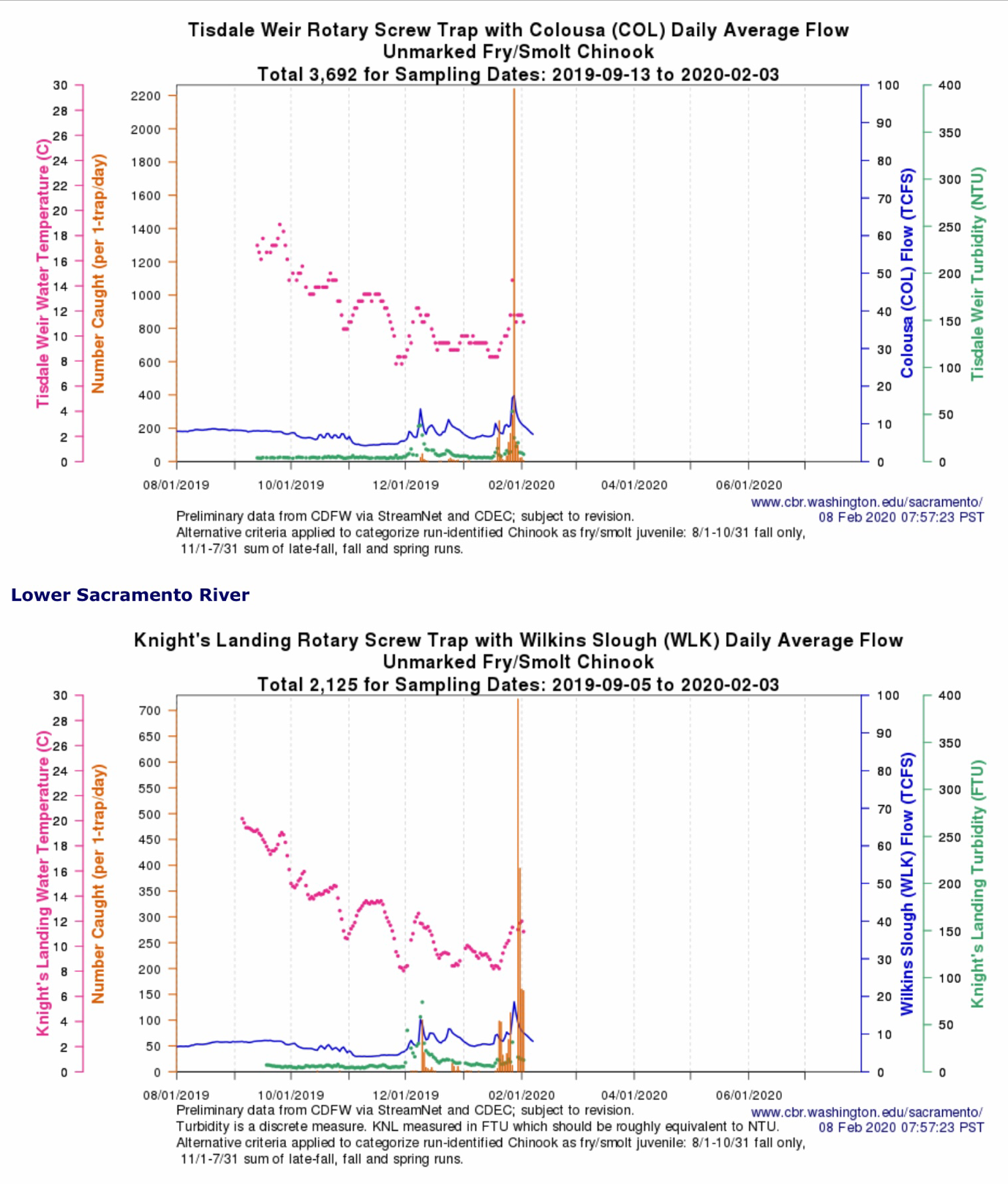
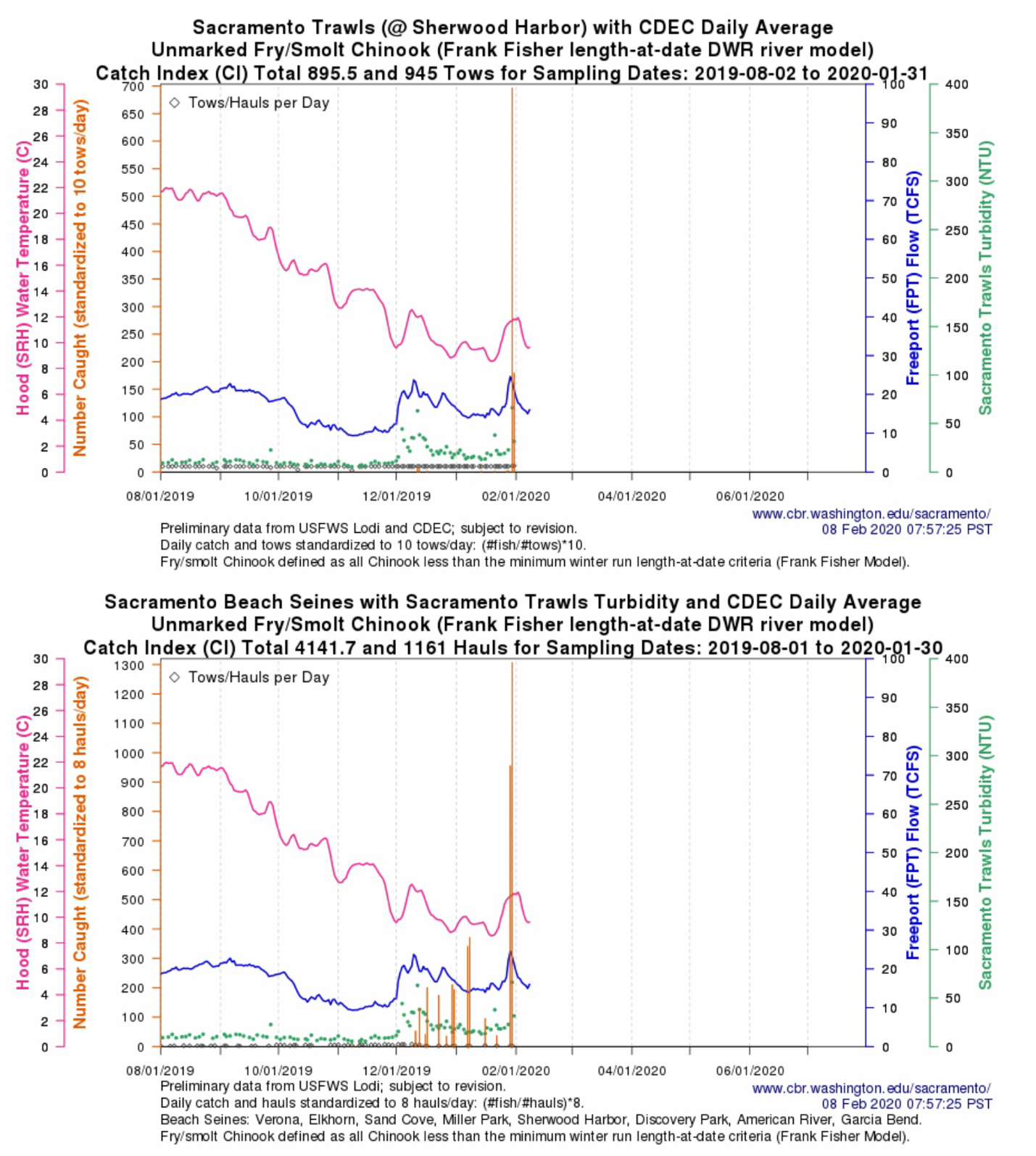
Two January storms in 2020 show the importance of flow pulses for the emigration of fall-run salmon fry (Figures 1-3). Figure 1 shows fry moving downstream from spawning grounds above Red Bluff. Figure 2 shows fry reaching the lower river 100+ miles downstream of Red Bluff. Figure 3 shows fry reaching the north Delta near Sacramento.

What is missing is reservoir releases through tailwater spawning grounds during the storms that create pulses from tributary inflow further downstream. The tributary inflow moves fry downstream from the tributaries. It also moves fry from the mainstem rivers downstream once fry reach the river reaches downstream of the tributaries. But reservoirs capture almost all the flow on the mainstem rivers upstream of the tributaries. During early winter storms, fry aren’t stimulated to move out of the spawning reaches directly downstream of dams.

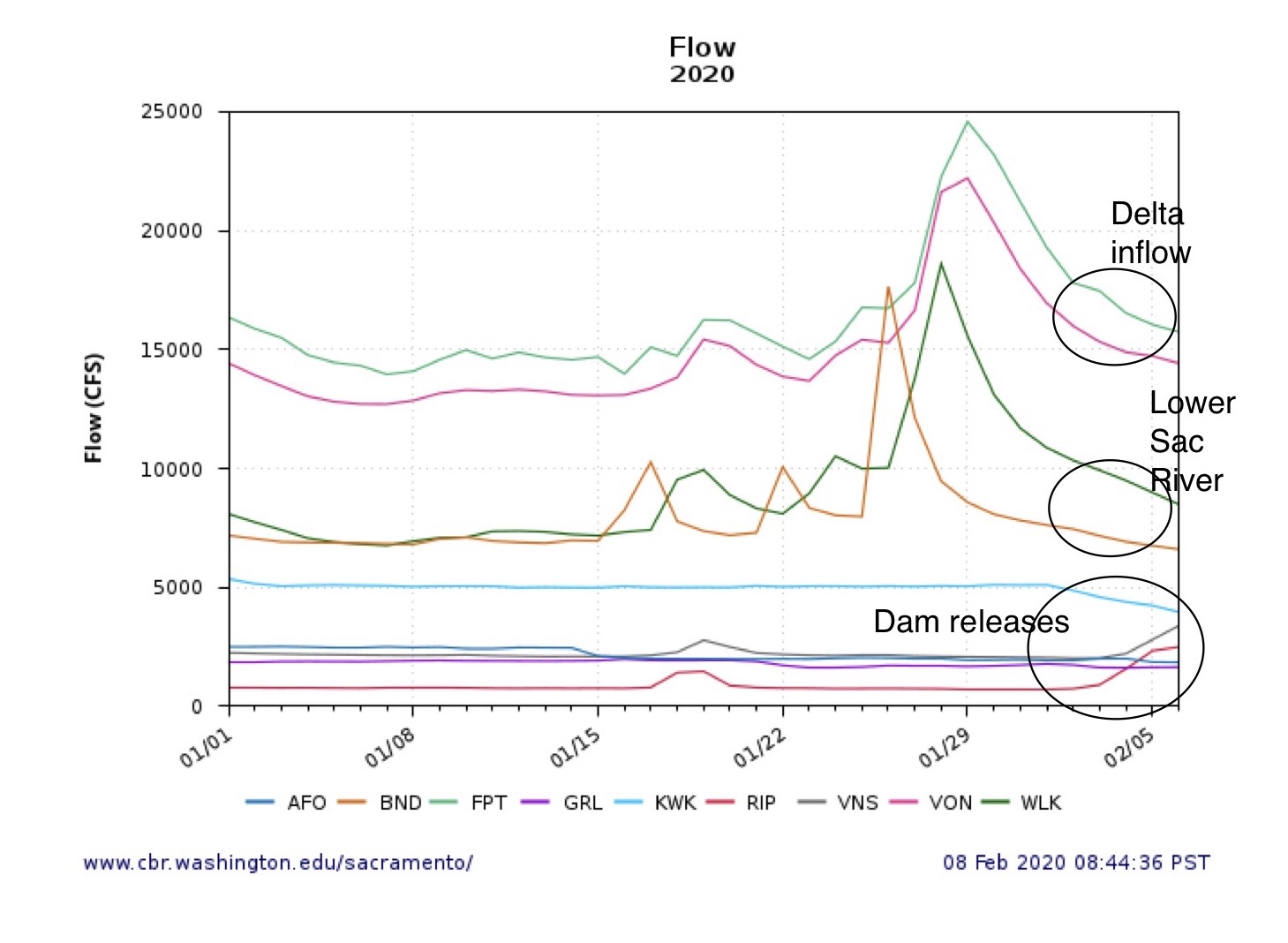
Figure 4 shows the complete lack of such storage releases in 2020, even after a wet water year when storage was well above average. Pulse flows are needed below all the main storage reservoirs: Shasta, Whiskeytown, Oroville, Folsom, Bullards Bar, Camanche, New Melones, etc. Fry movement from these prime tailwater spawning grounds would then take advantage of the natural rainfall in the main rivers moving through the Delta and on to the Bay nurseries.

Neither of the recent National Marine Fisheries Service’s (NMFS) consultations and the associated biological opinion with Reclamation on the Central Valley Project promotes such winter flow pulses.1 NMFS mandates spring pulses to help smolts (juveniles that are larger and older than fry) reach the Bay. Spring pulses are important, but they are not enough. While individual smolts are more likely to reach the Bay than individual fry, fry vastly outnumber smolts and should contribute substantially to the adult salmon populations. Winter flow pulses are needed because they will improve the survival to adulthood of wild salmon fry.

For more on the importance of increasing the survival rate of wild salmon fry in the Central Valley, see a recent paper by Sturrock et al. 2019. 2

Figure 1. Catch of salmon fry in screw traps and river flow (cfs) in Sacramento River near Red Bluff, January 2020. Data source: http://www.cbr.washington.edu/sacramento/data/juv_monitoring.html


Figure 2. Screw-trap catch rates for salmon fry and river conditions in lower Sacramento River near Colusa and Knights Landing winter 2020. Source: http://www.cbr.washington.edu/sacramento/data/juv_monitoring.html

Figure 3. Trawl and seine catch rates of salmon fry and river conditions in lower Sacramento River in north Delta near Sacramento winter 2020. source: http://www.cbr.washington.edu/sacramento/data/juv_monitoring.html

Figure 4. Winter 2020 flows in rivers and below dams in Central Valley. Lower Sacramento River: Red Bluff (BND), Wilkins Slough (WLK); Delta inflow at Verona (VON), Freeport (FPT). Dam releases to American River (AFO), Feather River (GRL), Stanislaus River (RIP), Sacramento River (KWK), San Joaquin River (VNS). source: http://www.cbr.washington.edu/sacramento/data/

Preserving and Restoring Wild Salmon Populations while Sustaining Commercial and Sport Fisheries with Hatcheries

The Problem

Hatcheries bypass the high mortality life-history phases of wild salmon populations.  As a result, hatcheries contribute far greater salmon smolt production to the ocean per number of eggs than do wild populations.  Without hatcheries, the replacement rate of Central Valley salmon populations would be less than 1-to-1, and the populations would move toward extinction.  Without hatcheries, there would be no commercial or sport salmon fisheries in California today.

But hatcheries bring many real problems for wild salmon.  These problems include in-breeding/domestication, disease transmission, and over-harvest of, competition for, and direct and indirect predation on wild salmon populations.  In-breeding has already had dramatic effects on the salmon populations, leading to the loss or degradation of many important life-history traits and of subpopulations that carry these traits (the “Portfolio Effect”).

Having lost many traits that nature provided over millions of years of natural selection, hatchery salmon today are simply less able to cope with the new world they now face.  They mature younger and smaller.  They are less able to adapt to changes in their food supply.  They often can’t compete and are less able to avoid predators.  Many arrive on spawning grounds too early, and others can’t find their natal streams.  Their offspring are also far less capable of coping with the stress and adversities, including harvest, pollution, and habitat loss and degradation.

Over-harvest, competition, and straying of hatchery fish has led to the dominance of hatchery fish in the Central Valley salmon populations and homogenization among the populations.  Some populations now survive only in hatcheries or in captive breeding programs.

The Solution

Many of elements of the problem have already occurred and are difficult to overcome.  While some elements are irreversible, it is not too late to limit or reduce some of the negative effects.  A comprehensive set of actions and strategies can avoid, minimize, mitigate, or even reverse these effects.  These actions and strategies should include:

1.      Reduce competition between hatchery and wild salmon in spawning, rearing, and migrating habitat.

  • Do not allow hatchery salmon to spawn in prime wild salmon spawning areas. Sorting at weirs can preclude passing hatchery spawners if hatchery fish are all marked.
  • Do not release hatchery juveniles into rearing and migrating habitats heavily used by remaining stocks of wild salmon. Programs throughout the range of Pacific coast salmon, including the Central Valley, now release hatchery smolts into net pens in rearing areas less frequented by wild salmon.  The best fishery returns to the Central Valley have been from smolts released from coastal net pens.

2.      Reduce straying of hatchery origin spawners into other spawning rivers.

  • Barge hatchery smolts to reduce competition and predation on wild juvenile salmon and decrease the straying of adults that results from trucking.  Barging can help imprint smolts on home rivers and hatcheries.
  • Monitor and sort adult salmon returns in rivers and hatcheries to further eliminate straying.
  • Focus more hatchery production on rivers and streams that do not support significant wild salmon.

3.      Increase harvest of hatchery salmon, while reducing harvest of wild salmon.

  • Focus harvest on hatchery stocks to help protect wild stocks. Release hatchery smolts into locations that focus harvest of adults in areas not frequented by wild salmon.  Adult hatchery salmon tend to stay in or return to areas where smolts were released.
  • Increase existing efforts to reduce the mixed-stock harvesting problem by reducing mixed-stock fishery exploitation rates to levels that are sustainable by wild stocks. Promote selective harvest of hatchery fish by permitting sport fishermen to retain only hatchery fish or to retain more hatchery fish than wild fish.  This would require marking most or all hatchery smolts.

4.      Improve disease control.

  • Hatchery fish experience greater susceptibility to infectious diseases due to higher rearing densities, higher levels of stress and poorer water quality. Diseases/infections can be spread to wild population elements, though research is needed to determine the extent of this threat.
  • Improve filtration systems at hatcheries to reduce the disease threat. This will also alleviate concerns about reintroducing salmon and steelhead upstream of hatcheries.

5.      Improve the genetic makeup of hatchery (and wild) salmon

  • Reverse engineer aspects of genetic diversity that has been selected out. Preferentially spawn 4-5 year-old adults at hatcheries.  Diversify timing of adult runs by breeding hatchery fish throughout the spawning run.  The Mokelumne Fish Hatchery is already implementing many such practices.  “Bad alleles can be purged.”
  • Use conservation hatchery actions to enhance the genetic diversity and fitness to help recover depleted wild populations.
  • Use more wild fish for hatchery broodstocks, particularly fish with more favorable traits.
  • Do not allow adult hatchery fish into spawning habitat used by wild fish.
  • Be more selective in choosing spawners for hatcheries.
  • Develop and support pure strains of wild salmon above dams through trap and haul programs.
  • Promote populations and subpopulations that protect or increase diversity (improve the Portfolio).
  • Develop captive stocks with desired natural traits – with less genetic drift, inbreeding and domestication,
  • Increase monitoring, research, experimentation, and adaptive management on the extent and consequences of domestication selection, as well as steps that may be taken to reduce its effects.
  • Evaluate and operate each hatchery program independently to address its program and its contribution to the overall problem.

Conclusion

Wild salmon populations in California’s Central Valley are already compromised to various degrees by hatchery salmon, over-harvest, and habitat degradation.  More can be done to protect wild salmon production and minimize the threat from hatcheries, while continuing to provide valuable commercial and sport fisheries supported by hatcheries.  We can save our salmon and eat them too.

For a more comprehensive scientific review of these subjects see Sturrock et al. 2019 and Nash et al. 2007.
NEW FEDERAL BIOLOGICAL OPINIONS IN ACTION

New federal biological opinions (BO’s) for the long-term operation of the Central Valley Project and the State Water Project in the Delta have been “protecting” salmon and smelt for several months. The record in practice is not good.

The ostensible purpose of the new BO’s is to protect native fishes, including ESA-listed salmon and smelt. A key focus in the new BO’s (as in prior BO’s) is on regulating reverse flows in Old and Middle River channels of the central Delta (Figure 1). Reverse or negative net upstream flows are caused by south Delta federal and state exports. Rules limiting negative OMR flows limit south Delta exports.

The U.S. Fish and Wildlife Service summarizes OMR operation, in part, as follows:1

Old and Middle River Flows

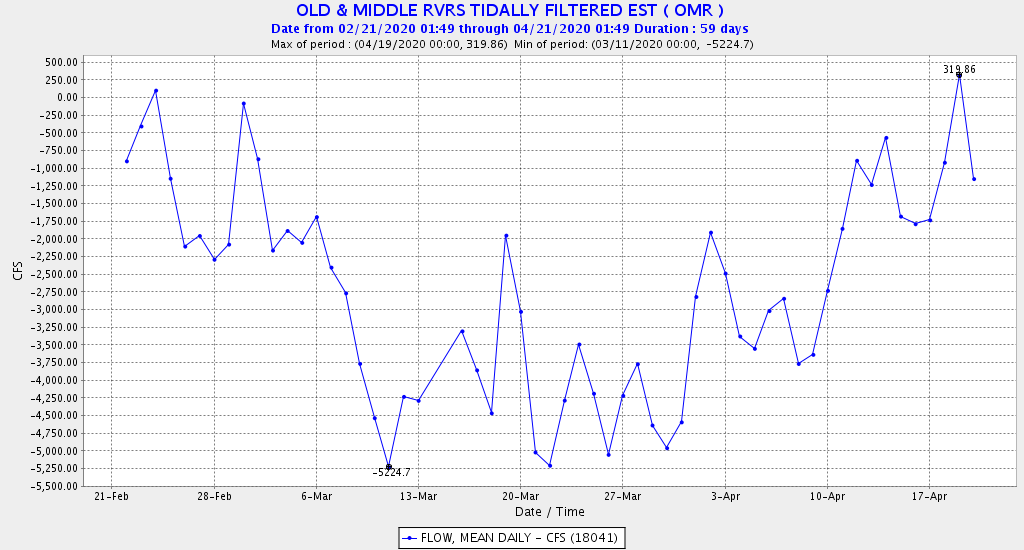
The new BO’s make a commitment to stay within the Delta pumping-related loss experienced under the 2008-09 BO RPA’s. Old and Middle River Reverse flows are to be limited based on timing (no greater than -5,000 cfs Jan-Jun); water quality conditions (short term protections for first flush events); storm event flexibility (can increase beyond -5,000 cfs if there is not a risk to the species); observed annual salvage and loss (specific triggers for loss values similar to those seen under the 2009 RPA); cumulative loss and outcomes from independent review panels.


Controlled OMR Flows

The action is consistent with Action 1 of the 2008 RPA by providing for integrated early winter pulse protection which requires reducing exports for 14 consecutive days so that the 14-day averaged OMR index for the period shall not be more negative than -2,000 cfs, in response to “First Flush” conditions in the Delta. In addition, once OMR management begins, Reclamation and DWR will operate to an OMR index no more negative than a 14-day moving average of -5000 cfs, unless a storm event occurs, until that point in which OMR management ends in a season (when temperatures in south Delta become lethal or June 30, whichever is earlier). The Integrated Early Winter Pulse Protection action may occur more frequently than Action 1 in the 2008 RPA, providing equal or greater protection.

To evaluate whether the new BO’s met these new commitments in December 2019 and January 2020, the reader should review Figures 2, 3, and 4 below, and also https://www.usbr.gov/mp/cvo/vungvari/OMR_Jan2020.pdf.

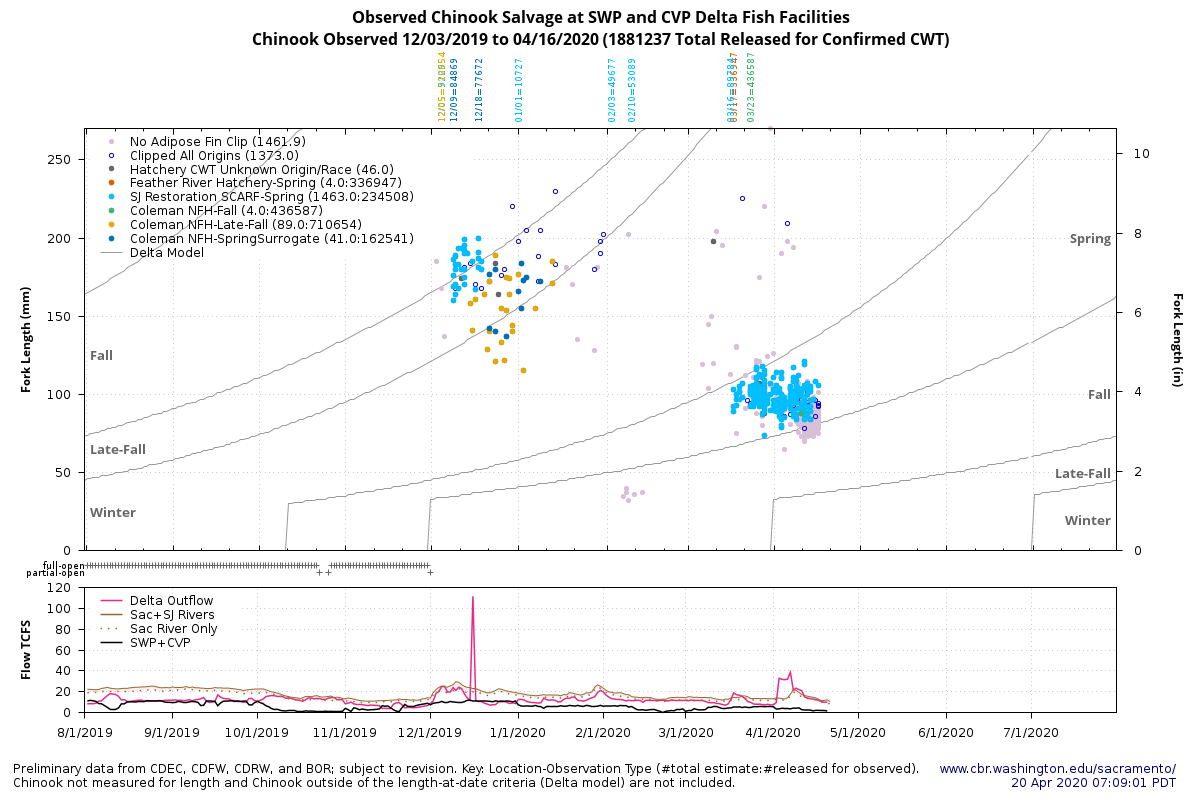
My own review indicates that what looked like, walked like, and quacked like a “first flush” occurred in mid-December. The lack of OMR limit protections and the allowance of maximum exports during and after the first flow pulse under the new BO’s in December 2019 led to what appear to have been grave risks to endangered salmon and smelt.2 The highly negative OMR flows in December were highly unusual and were not the norm under the prior BO’s (Figures 5 and 6). Regardless of the purported commitment to protect Delta native fishes in the new BO’s, Figure 4 shows the real effect of the new BO’s: the export of more water to southern California.

Figure 1. Old and Middle River and direction of negative net OMR flows.

Figure 2. Net daily-average OMR flows in the south Delta 11/11/19-1/17/20. Note the extremely negative flows during December that occurred because high south Delta exports are permitted under the new BO’s. Flow remained highly negative even during the period of higher outflow in early December shown in Figure 3. Source: CDEC.

Figure 3. Net Delta outflow 11/11/19-1/17/20. Note pulse of outflow from spate of storms in first half of December. Source: CDEC.

Figure 4. Export rates (cfs) at the federal Tracy (TRP) and state Harvey Banks (HRP) pumping plants in November-December 2019. Rates were near maximum throughout December.

Figure 5. Middle River flow 11/15/2019-1/20/2020 with average for prior 21 years.

Figure 6. Old River flow 11/15/2019-1/20/2020 with average for prior 22 years.

  1. Biological Opinions for the Reinitiation of Consultation on the Long Term Coordinated Operations of the Central Valley Project and State Water Project – Summary (USFWS 10/1/2019).  https://www.fws.gov/sfbaydelta/cvp-swp/documents/ROC_on_LTO_Summary_FINAL.pdf
  2. http://calsport.org/fisheriesblog/?p=2981, http://calsport.org/fisheriesblog/?p=2991, http://calsport.org/fisheriesblog/?p=3006