Yuba River Chinook Salmon – Status 2018

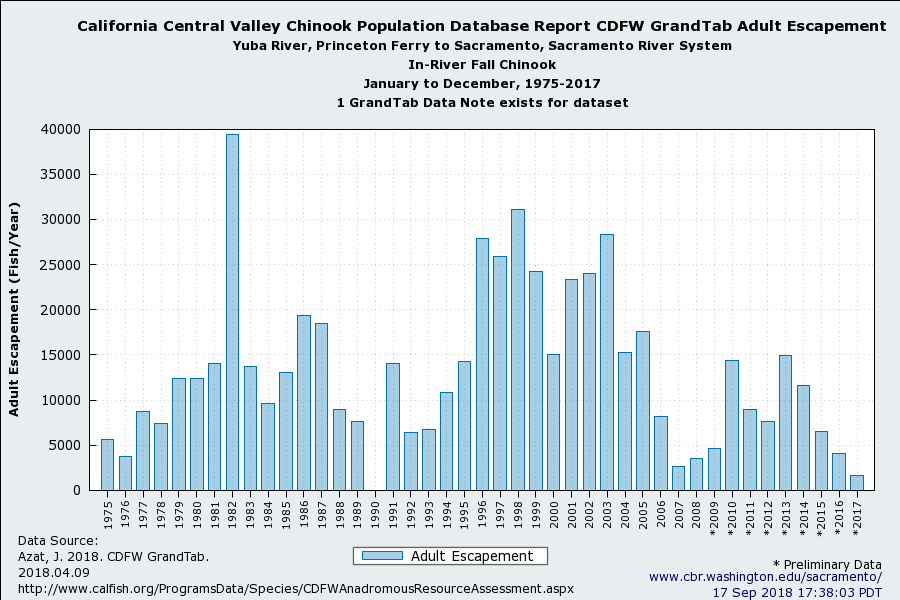
The Yuba River had a record low fall Chinook salmon run in 2017 (Figure 1). Why are our salmon populations plummeting in the Yuba River and many other rivers in the Central Valley watershed? It is because hatchery and wild salmon survival was poor in rivers, the Bay-Delta, and ocean during the historic 2013-2015 drought.

What is it about the Yuba salmon run that can tell us something about the overall salmon decline in the Central Valley?

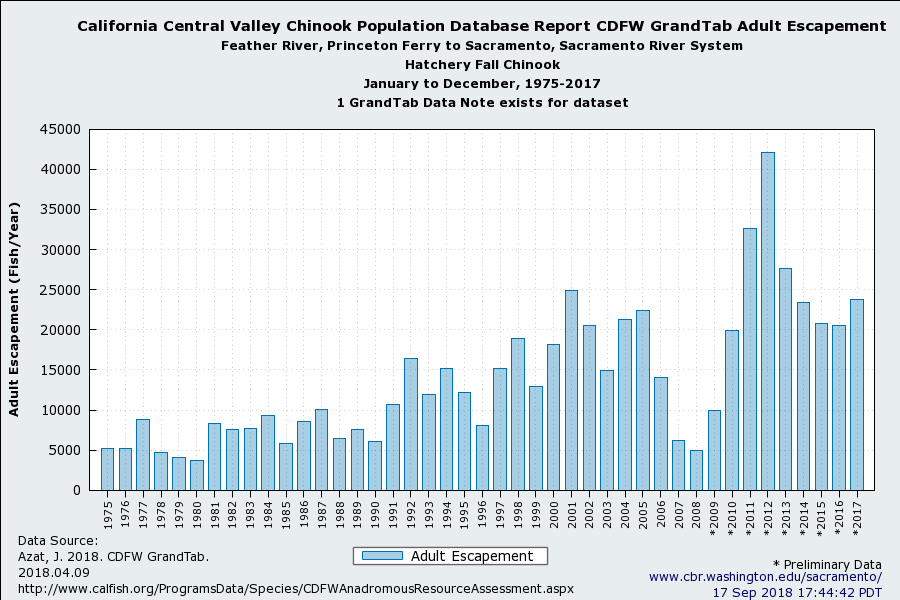
  1. First and foremost, the Yuba run consists predominantly of strays from many of the Central Valley salmon hatcheries. The Yuba has no hatchery. Many of the adult salmon in the Yuba have their origin from smolts produced at Battle Creek, Feather River, American River, Mokelumne River, and Merced River hatcheries. Hatchery salmon survival and production was generally lower in the drought, thus contributing fewer strays to the Yuba. Feather River Hatchery production was an exception (Figure 2) because its managers trucked and barged many of its smolts to the Bay.
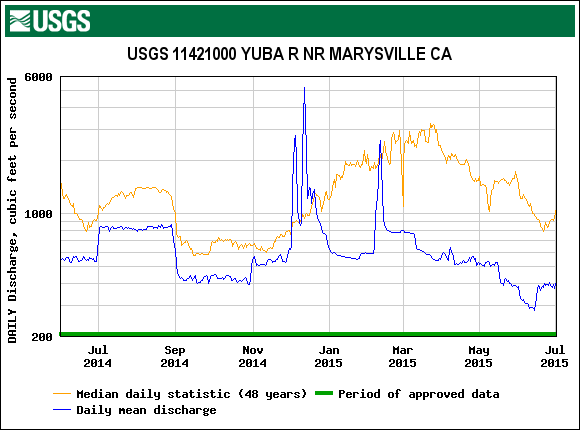
  2. Second, production of wild salmon was lower during the drought on the Yuba and other Valley rivers. During the spawning runs in late summer and fall 2014, flows were low (Figure 3) and water temperatures were high, leading to high pre-spawn mortality and poor egg viability. Low flows led to less available and lower quality spawning habitat. Spawning in low-flow gravel beds led to redd scouring in late fall and early winter storm flow events. Low winter and early spring flows led to poor rearing and emigration survival.
  3. Third, salmon spawning and rearing habitats (gravel beds, riparian vegetation, channel morphology, large woody materials, etc) are lacking or declining in quantity, quality, and availability. The Yuba’s prime spawning and rearing habitats above Daguerre Point Dam suffer from lack of gravel replacement supply below Englebright Dam in the upper reach and confinement of the river channel and floodplain in the lower reach within the historic dredge-pile levees of the Goldfields. Likewise, habitats in the lower river below Daguerre also suffer, while favoring native and non-native predatory fishes that further limit survival of young salmon.
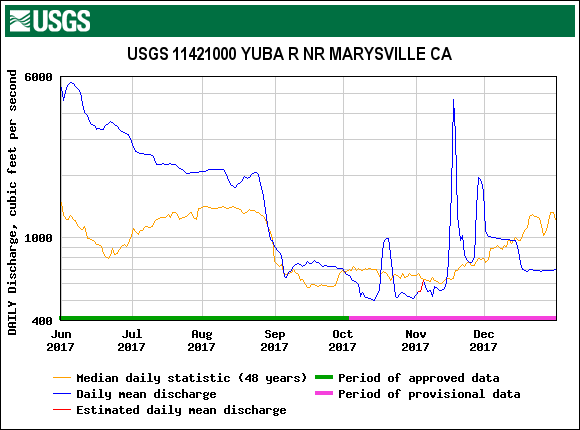
  4. Fourth, low fall flows in 2017 (Figure 4) also likely reduced attraction of adult spawners, and possibly caused redd dewatering and subsequent redd scouring.

So what needs to be done to increase the Yuba (and other Valley rivers) salmon runs?

  • Increase survival of all Valley hatchery smolts by trucking and barging. Battle Creek Hatchery strays are regularly the greatest component of the Yuba run.
  • Increase fall base flows into the upper portion of their optimal spawning flow range (from 500 cfs to 700 cfs) to attract spawners, lower water temperatures, maximize spawning habitat, and reduce potential redd dewatering and scour after spawning. Lower summer-fall base flows also contribute to exaggerated thalweg channel scour and downcutting, and loss of side channels because of the confined channel.
  • Increase winter-spring flows to improve fry/fingerling/smolt survival during rearing and transport to Bay-Delta and to reduce predation by pikeminnow, striped bass, trout, and shad in the lower Yuba River below Daguerre Point Dam.
  • Improve winter fry rearing habitat available at low winter flows by improving riparian vegetation, adding large woody materials to the low flow channel, and opening the channel and floodplain to increase surface area, increasing distributary channel networks, and lowering channel velocities.
  • Add gravel to the upper spawning reach downstream of Englebright Dam.
  • Capture some of the natural juvenile salmon production at Daguerre Point Dam and transport to Verona for barge or truck transport to the Bay.
  • Stock Feather River Hatchery smolts into the lower Yuba River.
  • Rear Feather River Hatchery fry in lower Yuba River floodplain habitats including managed rice fields.
  • Recover naturally produced juvenile salmon trapped in floodplain habitats after high flow events.

For more on Yuba River salmon and their habitat see:

http://www.yubaaccordrmt.com/Annual%20Reports/Spawning%20Analysis/Chinook_spawning_habitat_report_20140505_with_appendices.pdf

http://calsport.org/fisheriesblog/?p=1559

https://www.fws.gov/Lodi/instream-flow/Documents/Yuba%20River%20Spawning%20Final%20Report.pdf

Figure 1. Chinook salmon fall run Chinook salmon population estimates from 1975 to 2017 for the Yuba River.

Figure 2. Hatchery returns to Feather River 1975 to 2017.

Figure 3. Yuba River flow at Marysville June 2014 through June 2015 with 48-year average flow. Note low summer-fall flows and high December flows in 2014, and low spring flows in 2015; these stresses likely contributed to record low 2017 salmon run.

Figure 4. Yuba River flow at Marysville June 2017 through December 2017 with 48-year average flow. Note low October to mid-November flows followed by high flows in late November.

Record low 2018 juvenile salmon index for fall-run salmon

In a 9/20/18 Maven’s Science News an article describes a record low index of juvenile salmon from this past winter-spring Red Bluff screw trap survey. The article states that the poor juvenile numbers foreshadow a poor Sacramento River salmon run in 2020. The article is vague as to the cause. The article implies that a likely cause for the poor 2017 adult run and record low 2018 Red Bluff trap index was the trucking of Coleman Hatchery smolts to the Bay during the 2014 drought, which then did not find their way back to Coleman as adults.

The article fails to mention two likely primary causes of the record low index:

  1. Poor rearing and migrating conditions in the lower Sacramento River in winter-spring 2018.1
  2. A 50% reduction in the number of smolts released by the Coleman Hatchery in 2018 (6 million instead of the normal 12 million) from lack of eggs.2

Regardless of the cause, the prognosis for the 2020 run remains grim, as stated in the article. What the article does not forecast is a likely grim forecast for 2018 and 2019. These runs are likely to be low because:

  1. All the Coleman releases in 2016 and 2017 were at the hatchery, with none trucked to the Bay which ensured poor survival of the smolts prior to reaching the ocean;
  2. There were poor juvenile rearing and migrating river conditions in winter-spring in 2016 and 2017,
  3. There were poor spawning run river conditions in summer/fall 2015 and 2016, and
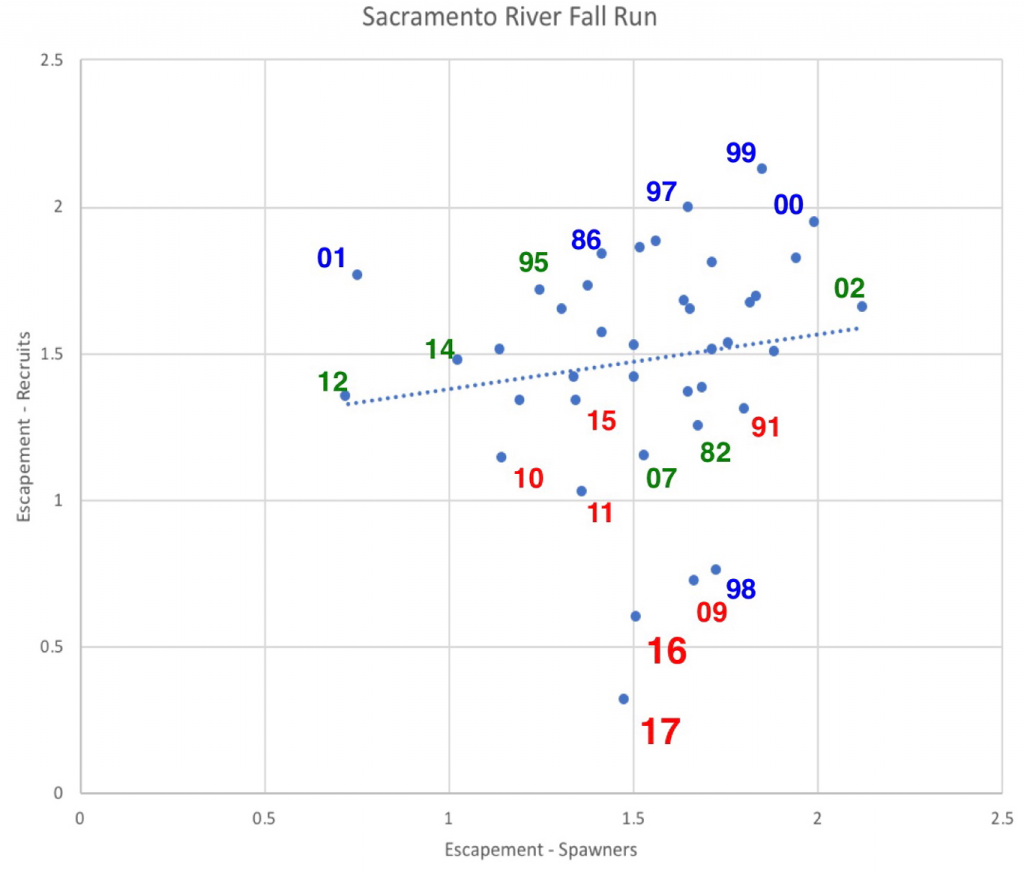
  4. There were poor spawner numbers in 2016 as in 2017 (Figure 1).

Figure 1. Spawner-recruit relationship for fall-run in-river estimates of run size. Number indicates spawner estimate for that year (y-axis) as derived from spawners three years earlier (x-axis). Color indicates winter-spring rearing andmigration conditions for that brood (winter-spring 2015 for spawners in 2017). Red denotes dry year in first winter-spring. Green denotes normal years. Blue denotes wet years. Source: http://calsport.org/fisheriesblog/?p=2205 ).

Lower Sacramento River Water Temperatures A 5-Year Adaptive Management Study of Lower Sacramento Summer Flows and Water Temperatures

Nearly three decades ago, state and federal regulators made prescriptions that required the maintenance of water temperatures in the lower Sacramento River below 68oF (20oC) in summer to protect salmon, sturgeon, steelhead, and water quality. The condition was put in water right permits, anadromous fish restoration plans, and in the state’s water quality plan for the basin. Summer is the season when once-abundant spring, fall, and winter run salmon ran up the river and to tributaries to spawn. It is also the rearing season for spring-spawning sturgeon, striped bass, American shad, splittail, and trout, all once abundant in the lower Sacramento River watershed.

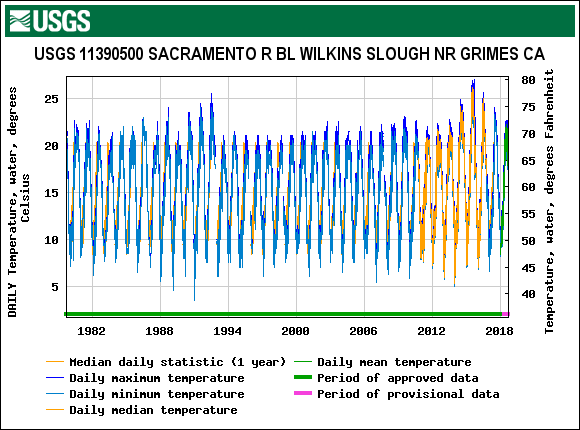
The effect of how the prescription was administered in the early 1990’s can be seen in water temperature record for Wilkins Slough in the lower Sacramento River near Grimes (Figure 1). The gradual erosion in the application of the prescription is also apparent over the past two decades. Lack of enforcement of the prescription by federal and state regulating agencies in the last five years is also apparent even in the recent wetter years following the critical drought years of 2013-2015.

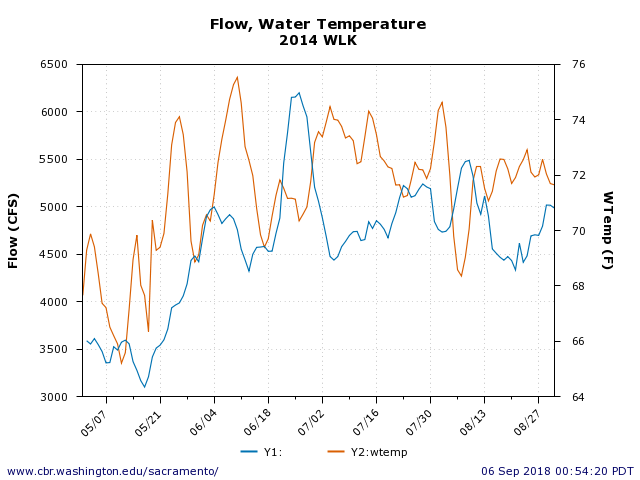
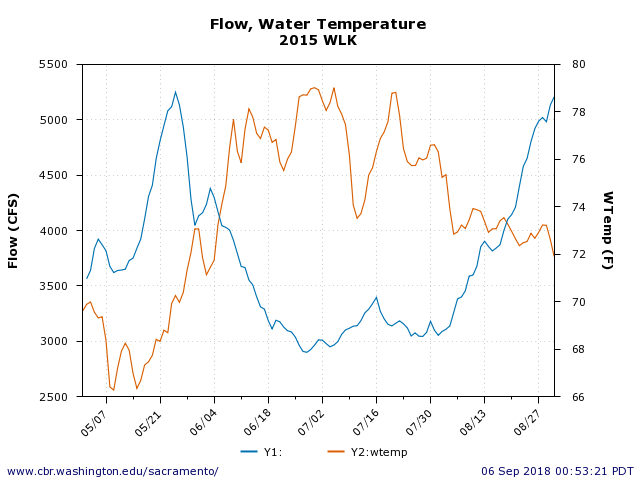
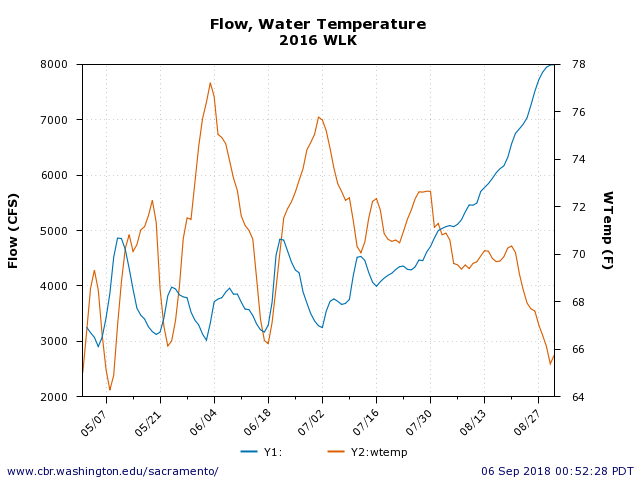
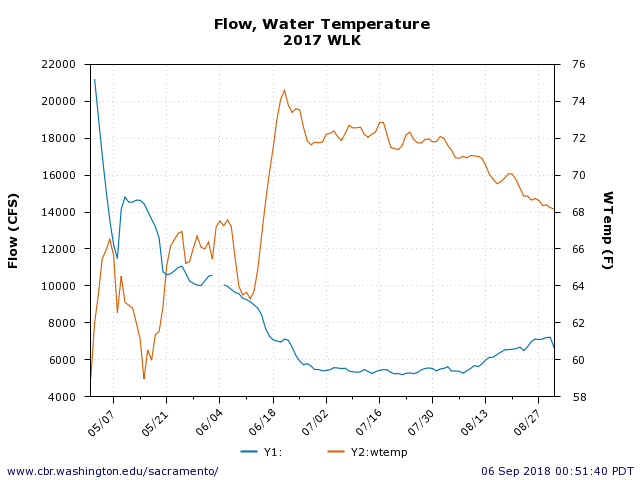
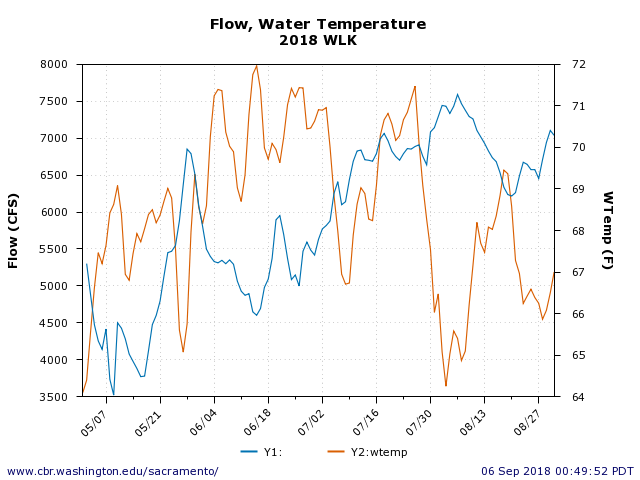
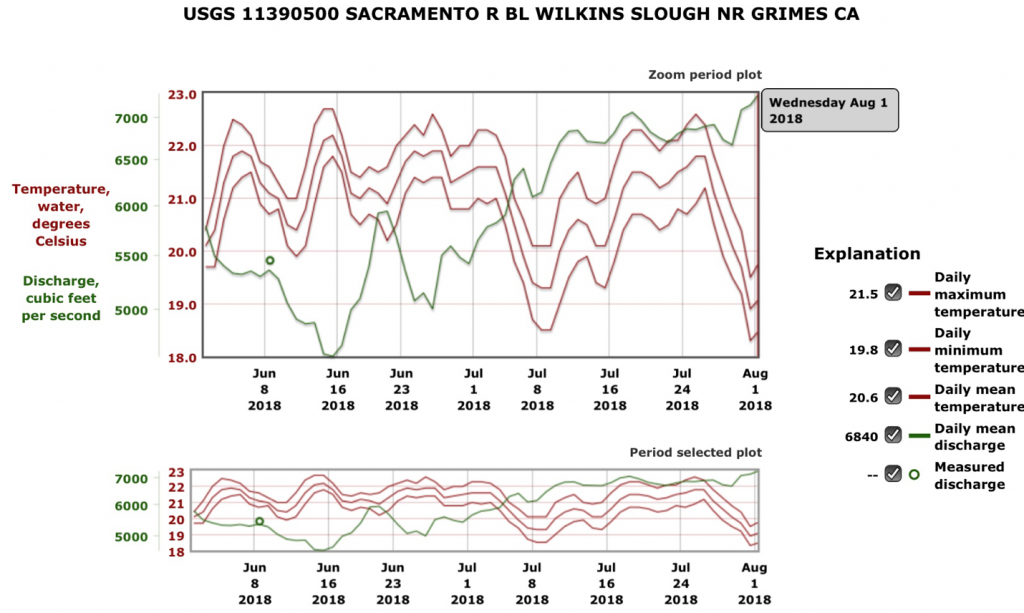
I looked at the last five years, 2014-2018, as an adaptive management study to determine how to maintain the 68oF prescription. Plots of water temperatures and river flow from Wilkins Slough (Figures 2-6) are unequivocal evidence that river flow is the primary driver of summer water temperatures in the lower Sacramento River near Wilkins Slough. Air temperature is a lesser factor in summer because it is nearly always warm. A rise in flow over the summer of 2018 (Figure 6) shows clearly that keeping flows in the 6000-8000 cfs range (depending on air temperature) can maintain water temperature near the 68oF target. Flows in the 3000-5000 cfs range lead to water temperatures of 72oF or higher, which are very detrimental to the dependent fish.

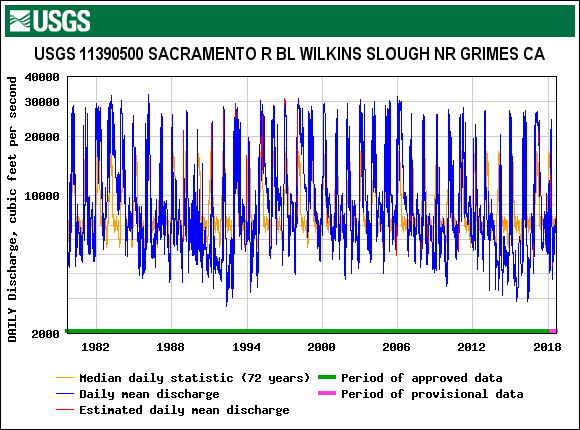
Finally, the gradual decline in summer river flow at Wilkins Slough over the past two decades (Figure 7) matches the rise in summer temperatures (Figure 1). It is not a question of changing water quality standards to protect fish. It is simply a question of enforcing the existing standards and water right permit requirements. Increasing Shasta Reservoir releases, limiting water diversions, or some combination thereof, could provide the necessary flows.

Figure 1. Water temperatures recorded at Wilkins Slough in the lower Sacramento River from 1980 to 2018.

Figure 2. Water temperature and river flow at Wilkins Slough May-August 2014.

Figure 3. Water temperature and river flow at Wilkins Slough May-August 2015.

Figure 4. Water temperature and river flow at Wilkins Slough May-August 2016.

Figure 5. Water temperature and river flow at Wilkins Slough May-August 2017.

Figure 6. Water temperature and river flow at Wilkins Slough May-August 2018.

Figure 7. River flow recorded at Wilkins Slough in the lower Sacramento River from 1980 to 2018.

“Epic” Salmon Fishing this Summer

Reports on the July 15 opener on the lower Sacramento fall-run salmon season are good.1 Reclamation and Sacramento River farmers have provided the flows needed to keep water temperatures down (Figure 1), allowing what appears to be a good run up the river from the Golden Gate. Openers in recent years have been poor because of low flows and high water temperatures, as well as low salmon numbers. Numbers are up, and water temperatures are down – good for fishing.

Figure 1. Higher flows in July have cooled the river despite many 100+ degree days. Source.

Sacramento Valley Salmon Resiliency Strategy

The Sacramento Valley Salmon Resiliency Strategy, June 2017, is the state’s strategy to improve the resilience of listed salmon to its activities, including water rights permits, State Water Project actions, CESA implementation, and CDFW management.

The document states on page 2:

Specific biological objectives have been identified for the Sacramento River that support the general need to increase survival and productivity of salmonids in the Sacramento Valley and to increase life history and genetic diversity. A summary of these biological objectives:

  1. Increase productivity by improving spawning and incubation conditions (habitat and water quality).
  2. Increase productivity by increasing juvenile salmonid survival.
  3. Support the full range of juvenile migration conditions to maintain life history diversity.
  4. Support the full range of adult migration conditions to maintain life history diversity.
  5. Maintain genetic integrity by limiting genetic influence from hatchery-produced fish and interbreeding of genetically or behaviorally distinct runs.

The Strategy is an aggressive approach to improving species viability and resiliency by implementing specific habitat restoration actions. (Emphasis and bullet numbering added)

The Strategy is defined as a “resiliency” strategy and not a recovery strategy for a reason. It does not include the actions necessary for recovery. It won’t fix the activities that caused the crisis in the first place. Over the past several decades, much restoration has occurred, yet fish populations continue to decline. Much stronger and more immediate management actions are needed to save the salmon populations. Habitat restoration alone will simply not suffice.

So what is missing?

  1. Spawning and incubation conditions – Missing are actions to maintain cold water temperatures and sufficient spawning flows in the reaches below all the major dams during spawning and incubation. A. Eliminate the water temperature increases caused when water from Whiskeytown Reservoir is routed through Spring Creek Powerhouse to Keswick Reservoir. B. Maintain cold water in the Sacramento River downstream to Red Bluff, not just to Redding. C. Eliminate dewatering of winter, spring, and fall–run salmon redds in the Sacramento River. D. For the American and Feather rivers, take actions similar to A through C that maintain cold water and eliminate redd stranding. E. Better manage reservoirs to place more emphasis on cold water pools and less on water deliveries.
  2. Juvenile salmon survival – Maintain adequate flows and water temperatures in rearing reaches to sustain growth and to reduce stress and predation.
  3. Full range of juvenile migration conditions – Maintain adequate flows and water temperatures in the lower rivers and the Delta throughout emigration seasons. Do not shave off early and late seasons.
  4. Adult migrations – Maintain adequate flows and water temperatures to assure adult survival, egg survival and gonad development during migration. Do not shave off early and late seasons.
  5. Genetic integrity – Move more toward conservation hatchery activities, reduce straying by barging smolts, implement natural floodplain rearing, mark all hatchery smolts, and introduce mark-selective recreational fisheries.

As for other planned actions like completing projects on Battle Creek and reintroducing salmon upstream of Central Valley rim reservoirs, let’s get on with it. If we keep the present snail’s pace, there is little hope for future salmon generations.