Where have all the salmon gone?

Based on early indicators, it appears that salmon populations in the Central Valley are in critical condition. First, there was poor smolt production from the 2014 and 2015 drought-year salmon runs in the Central Valley. That led to last fall’s (2017) runs being so poor that Coleman Hatchery had to get eggs from state hatcheries on the Feather and American rivers to meet its needs.1 CDFW believes poor ocean conditions have led to low adult salmon numbers for 2018 fisheries and runs. The weak runs may eliminate 2018 salmon fisheries. 2

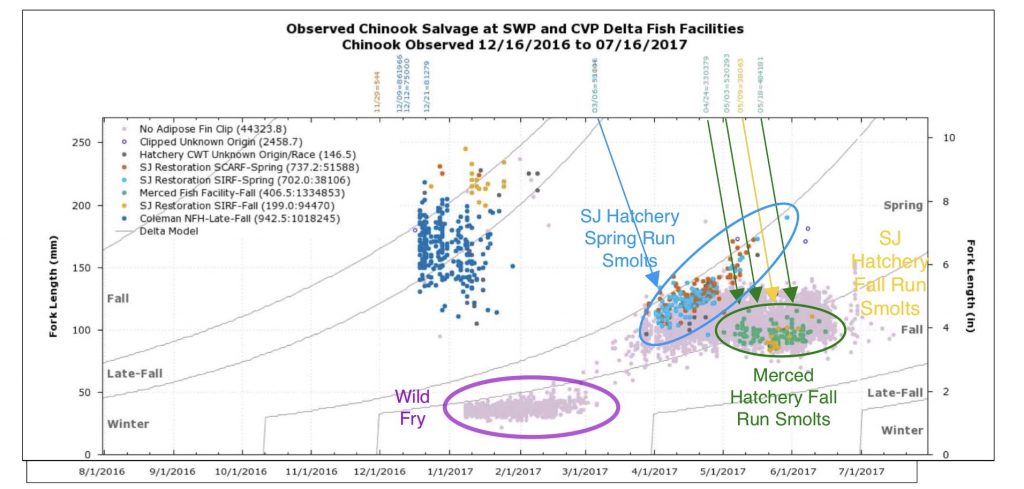
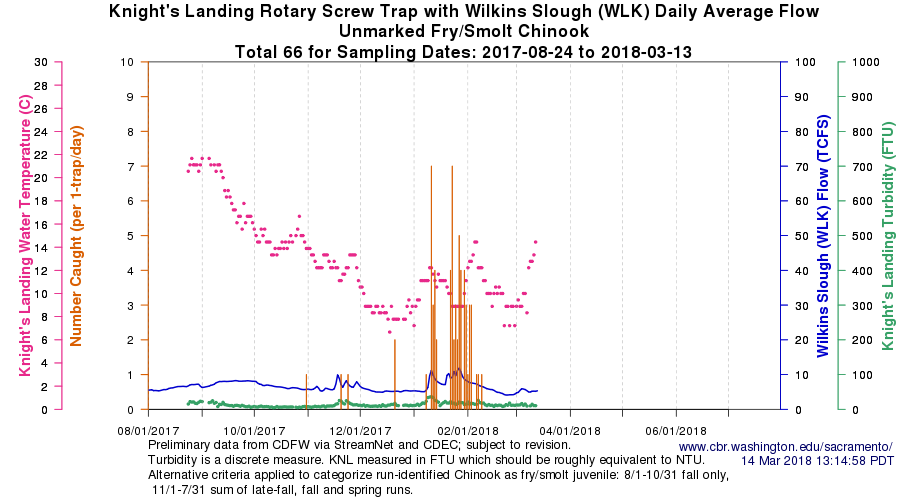
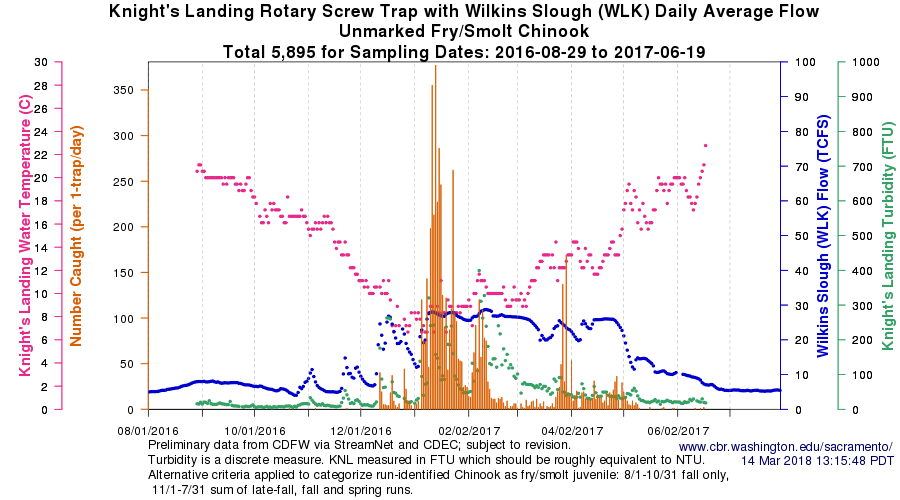
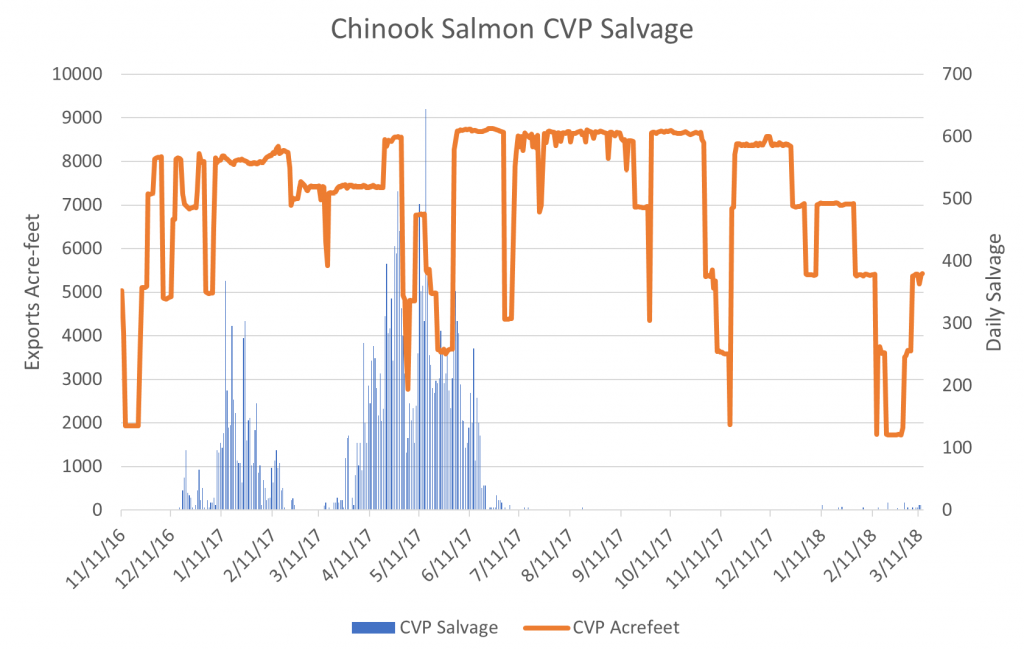
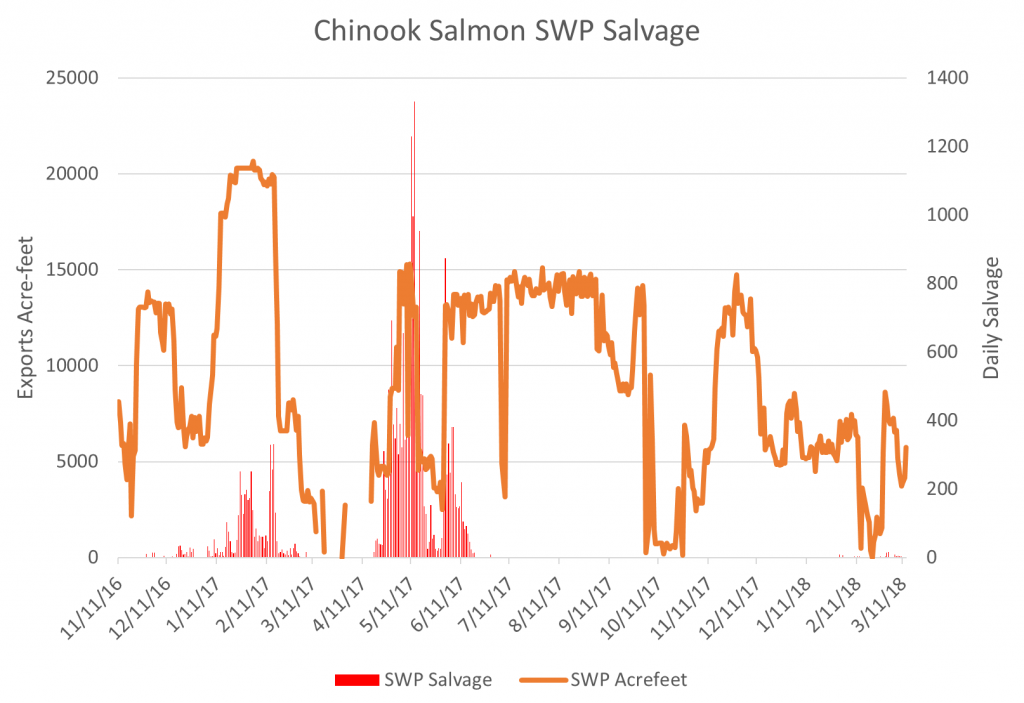
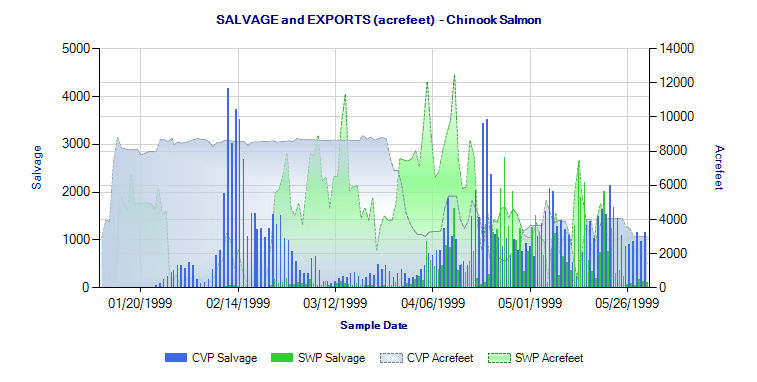
The evidence based on initial surveys is that brood year 2017 salmon (born last summer and fall) fry-smolt production was extremely poor. First, lower Sacramento River screw trap catches are low in early 2018 compared to 2017 (Figures 1 and 2). Winter screw trap catch-per-trap-day (and Sacramento trawl catch not shown) in the lower Sacramento River in 2018 are only 2% of 2017. Note flows and turbidities were very low in 2018 compared to 2017. I warned that these conditions with warmer water would lead to slower migration rates, starvation, and high predation by stripers. Second, salmon salvage at the south Delta pumping plants has been extremely low in 2018 (Figure 3) compared to 2017 (Figure 4). Salvage is a strong indicator of relative abundance. Third, compared to historical levels (Figure 5), salvage numbers in 2018 are two orders of magnitude lower than in 1999 when salmon runs were last strong.

You can blame the problem on the 2012-2016 drought, poor ocean conditions, or poor river-Delta flow management as I do. Whatever the cause, strong measures are needed to recover the salmon populations. Without strong measures, future brood year production will be so low there will be few salmon and no salmon fishing.

Figure 1. Knights Landing screw trap catch Aug 2017 to Mar 2018.

Figure 2. Knights Landing screw trap catch Aug 2016 to Aug 2017.

Figure 3. Chinook salmon salvage at CVP fish facilities in south Delta Nov 2016 to March 2018, along with export rate at Jones Plant. Note very small, nearly unperceivable numbers in winter 2018.

Figure 4. Chinook salmon salvage at SWP fish facilities in south Delta Nov 2016 to March 2018, along with export rate at Clifton Court. Note very small, nearly unperceivable numbers in winter 2018.

Figure 5. Chinook salmon salvage at CVP and SWP fish facilities in south Delta Jan 1999 to June 1999, along with export rate at south Delta pumping plants.

Winter-Run Chinook Salmon – What Really Caused Their Decline

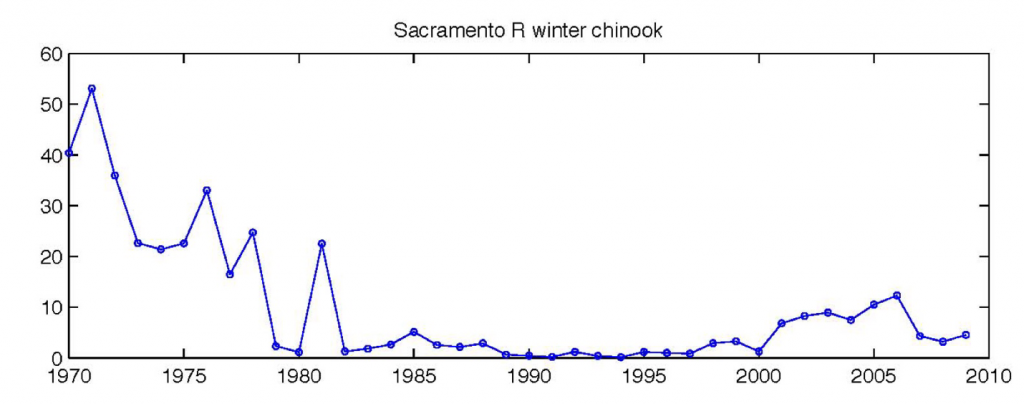
The winter-run Chinook salmon population crashed around 1980 and has not recovered (Figure 1). The population started coming back from 2001-2006 but fell to 827 in 2011. It remained in the 1500 to 6000 range from 2012-20161 with the help of the Livingston Stone federal hatchery near Redding. Hatchery fish make up an increasing proportion of the population each year.

In a 2011 review, NMFS attributed the general population decline to “blockage of access to historic habitat, other passage impediments, unscreened water diversions, heavy metal pollution from mine runoff, disposal of contaminated dredge sediments in San Francisco Bay, ocean harvest, predation, drought effects, juvenile losses at the CVP and SWP Delta pumping facilities; and elevated water temperatures in spawning grounds.”  Droughts and the loss of cold water pool in Shasta are generally considered the primary cause of the decline over the past four decades starting with the 1976-1977 drought.  The decline continues despite “reduced harvest impacts, Iron Mountain Mine clean up, screening of water diversions, altered CVP water operations that improve passage and reduce predation, and construction of a temperature control device on Shasta Dam”. 

A range of actions is being implemented to help recover this NMFS-designated “Species in the Spotlight.”  The problem is the actions do not include the one key factor that was a major cause of the original decline and the primary cause of the lack of recovery:  high late-fall and early-winter Delta exports cause high juvenile salmon mortality in the Delta.

The problem starts from the fact that winter-run juveniles leave the upper Sacramento River rearing area for the Bay-Delta and eventually the ocean with the first fall or early winter rains that produce flow pulses from undammed Sacramento River tributaries.  These same untamed flows are also a primary target of the state and federal export facilities in filling south-of-Delta storage depleted from the summer.  Delta exports have few restrictions in fall.  The allowed export-to-inflow ratio is 65% (compared to 35% in winter-spring).  There are no OMR limits.  Interior Delta flows caused by high exports reach -10,000 cfs, compared to -5000 cfs in winter-spring.  The Delta Cross Channel is usually open through the fall and closed in winter, allowing salmon to move from the Sacramento River to the interior Delta more easily in fall.  Higher fall exports are also a consequence of increasing winter-spring protections (in water quality control plans and endangered fish biological opinions) for fish that led to reduced exports in those seasons.  Fundamentally, higher fall exports were a result of the state export facilities coming on line in the mid-1970s, which increased the export capacity from 4,400 cfs to 15,000 cfs.

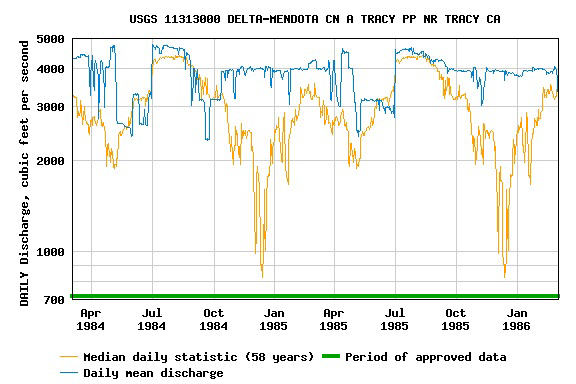
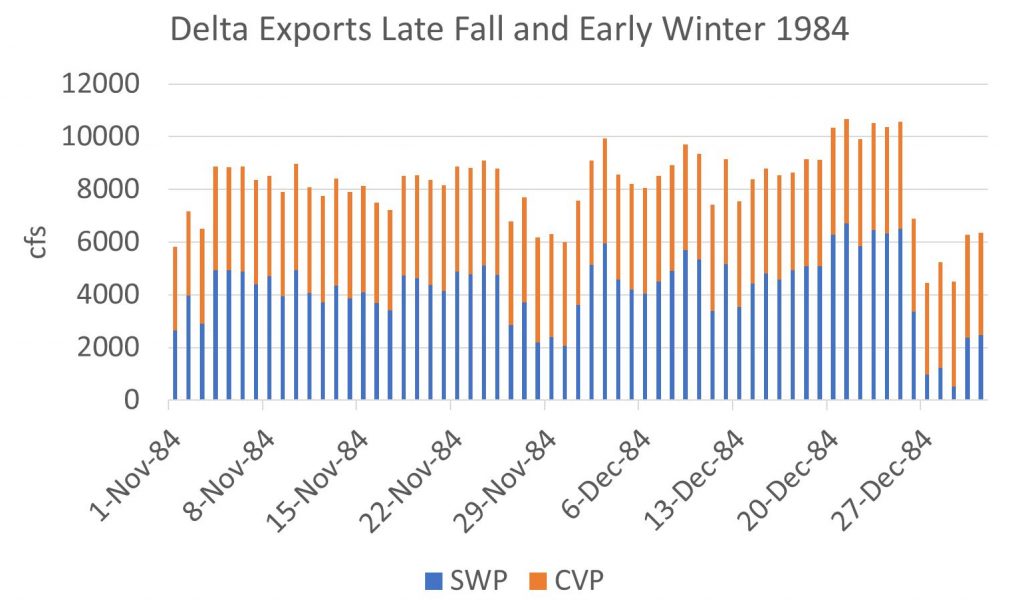
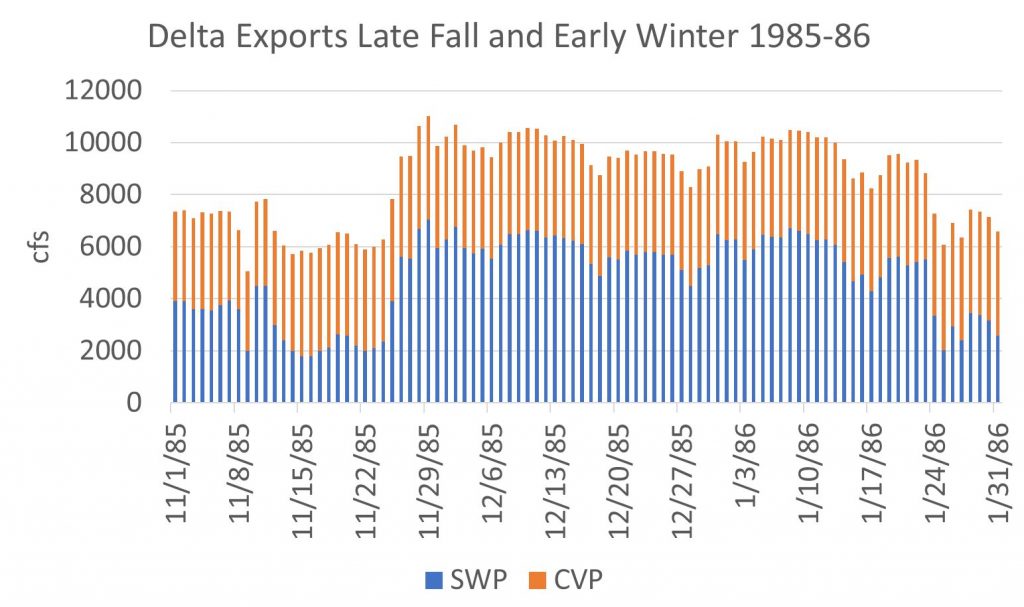
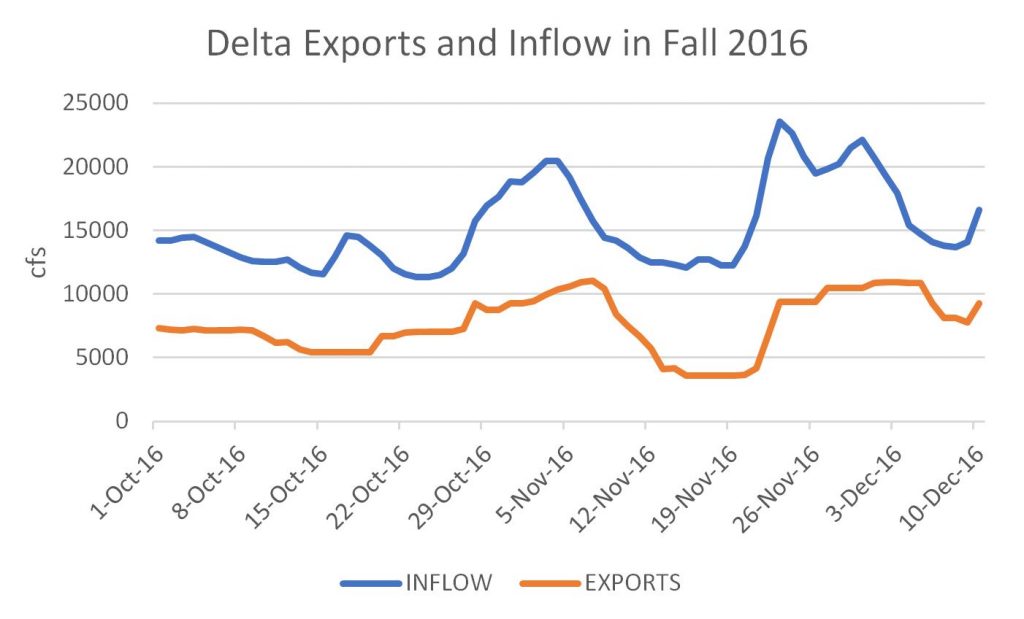
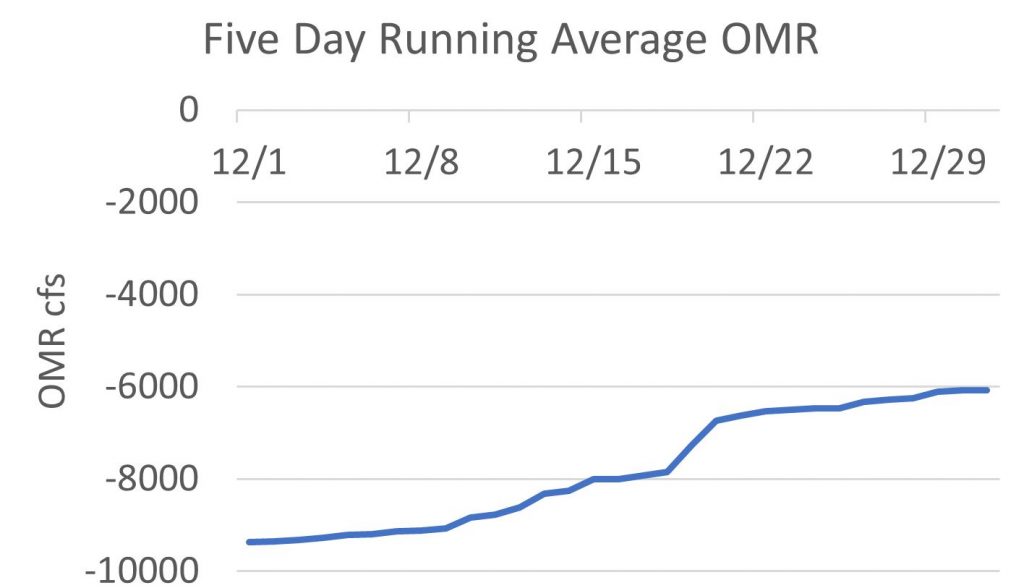
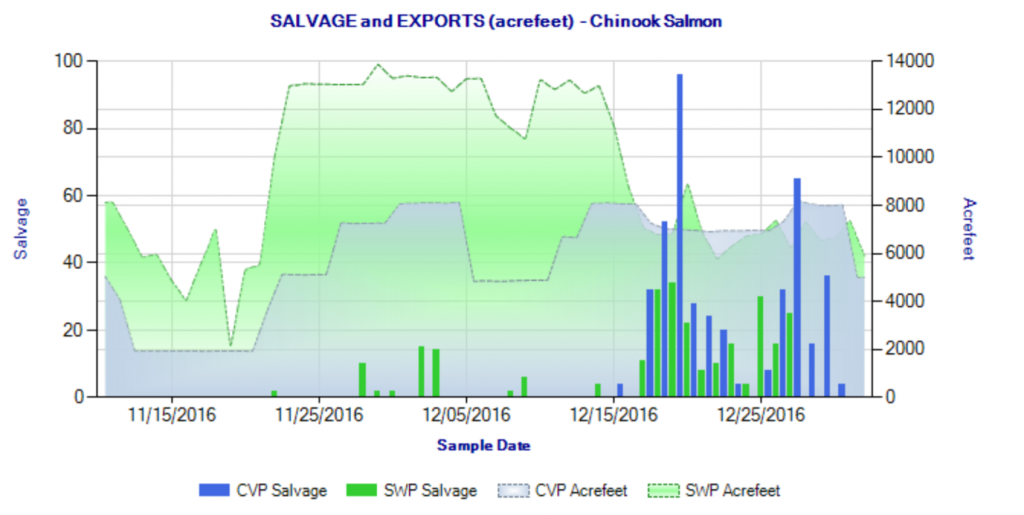
One need only look at the increase in fall export rates and juvenile salmon salvage in the south Delta to see the association with the decline of winter-run.  Figure 2 shows CVP exports in 1984-1985 compared with the historical average.  Figures 3 and 4 show fall exports in the example years.  Figure 5 shows fall 2016 exports and Delta inflow, which is compelling proof that the problem continues.2  Figure 6 shows high negative Old and Middle River (OMR) flows caused by high exports.  Figure 7 shows December Chinook salmon salvage at south Delta fish facilities.  Further evidence of the association between fall exports and the decline of winter-run is available in the long-term fish salvage data that dates back to the 1970s historical period depicted in Figure 1.  Further discussion on the risk of high fall and early winter risks to salmon from exports is presented in http://calsport.org/fisheriesblog/?p=1949 .

Figure 1. Trend in winter-run salmon escapement to the Sacramento River below Shasta Reservoir 1970-2009 in thousands of adult salmon. Source

Figure 2. Tracy (federal) export rate in 1984-1986, with mean daily export rate 58-year average. Note marked increase in Nov-Dec period over historical average.

Figure 3. Federal and state export rates in fall 1984.

Figure 4. Federal and state export rates in fall 1985.

Figure 5. Delta export and inflow rates in fall 2016.

Figure 6. OMR December 2016.

Figure 7. Chinook salvage fall 2016.

  1.  https://nrm.dfg.ca.gov/FileHandler.ashx?DocumentID=84381
  2. Exports were greater than 10,000 cfs from 11/19/17 to 12/8/17.

A “Winter-Run Critical Habitat Conundrum”

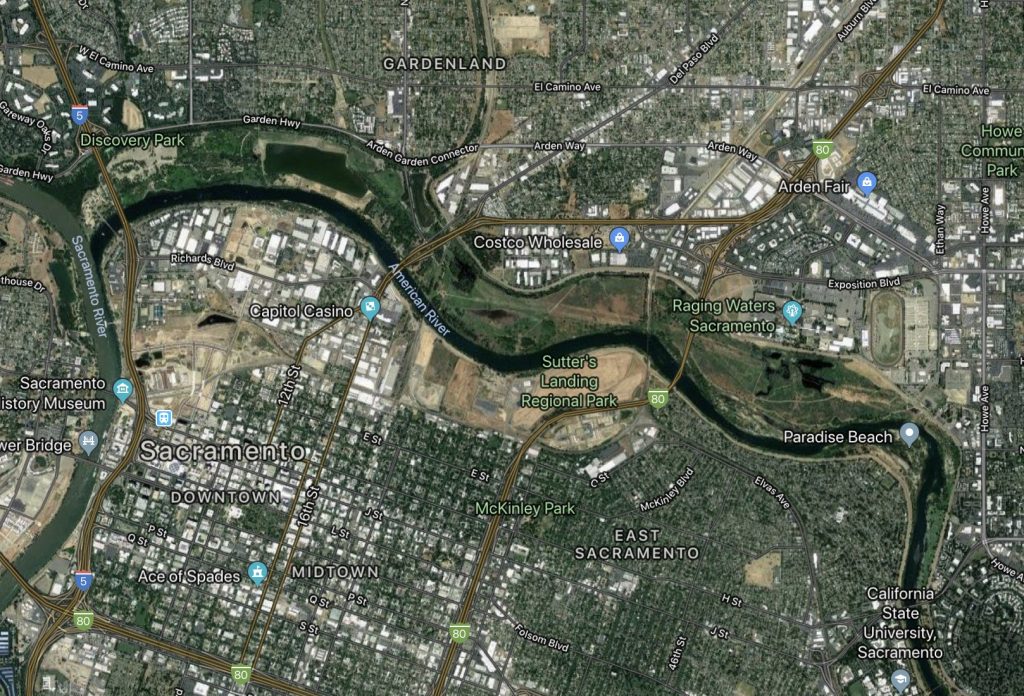
Figure 1. Lower American River floodplain referenced in recent science paper as non-natal rearing habitat of endangered winter-run Chinook salmon. Note the many borrow pits from Paradise Beach downstream to Discovery Park, remnants of a historical levee-building era.

Conundrum: A confusing and difficult problem.

The consulting firm FishBio reported in a February 12, 2018 blog post: “Just when you think you’ve got a species figured out, sometimes they show up where they’re “not supposed to be” and make you reconsider. This recently happened in the fish world, when adult winter-run Chinook salmon, an endangered fish previously thought to only inhabit the mainstem Sacramento River downstream of Keswick Dam, were found to have actually reared in multiple Sacramento River tributaries as juveniles.” The study referenced by FishBio found that roughly half of the returning adult winter-run had reared as juveniles for a several weeks or more in habitats other than the mainstem Sacramento River. It has long been known that winter-run had used these habitats1, but the proportion of the population that had done so was not known. The recent study has helped answer that question. Such a life-history pattern is obviously important, as proven by this study.

Juvenile winter-run salmon have frequently been detected in winter in habitats along the Sacramento River from Redding to Rio Vista in habitats where they are not commonly expected to be. In wet years, winter-run are carried into the Butte-Sutter and Yolo bypasses (and other Sacramento River floodplain areas like the lower American River) where they rear as noted in the recent study. I personally have collected large numbers of winter-run juveniles in the 1990’s in Butte Basin, the Bypasses, and the lower American River floodplain (Figure 1). In many cases, floods had carried or backed-up water along with winter-run juveniles into these areas. I have also collected winter-run juveniles (and other juvenile fall/spring salmon) in Suisun Bay, downstream of the Delta. A 2013 report by biologist Michael Healey of the California Department of Fish and Wildlife found that winter-run migrate up Auburn Ravine in Sutter County to rear.2

“These newly identified areas, called “non-natal habitats” because they differ from where the fish was born, can be divided into four distinct groups, including the Mount Lassen tributaries (Mill, Deer, and Battle creeks), the Sacramento-San Joaquin Delta and Feather River, the American River, and a final group rearing in an uncertain location that is not in the Sacramento River.” Again, these are not “newly” identified. Non-natal refers to rearing in adjacent river systems where fish were not born. These habitats are part of the lower Sacramento River floodplain and other accessible habitat of winter-run.

“So even though we might think winter-run are “not supposed to be” using these tributaries, the fish are actually spreading the risk of extinction across multiple habitats to safeguard their future.” These are the natural floodplain and tributary rearing habitats of winter-run. The problem is that there is not enough of these habitats left, and those that are left are often too ephemeral or are in poor condition. In many cases, the young salmon are gain access to floodplains but are later blocked from exiting, only to eventually die and not contribute to the population. Juveniles that enter the lower reaches of tributaries of the Sacramento River are sometimes cut off by seasonal dams or stranded in fields by unscreened irrigation diversions. Often, non-natal habitats (e.g., dredger ponds and borrow pits) are also winter refuges and permanent habitat for predatory warm water fish.

Yes, these non-natal rearing habitats should be recognized, protected, restored, fixed, enhanced, and created where possible to help save the winter-run salmon population. In the meantime, such habitats will continue to support winter-run as they have in the past. There is no “conundrum”.

  1. P.E. Maslin, W.R. McKinney, T.L. Moore. 1996. Intermittent streams as rearing habitat for Sacramento river Chinook salmon. Anadromous Fish Restoration Program, Stockton, CA, United States Fish and Wildlife Service (1996), pp. 1-29
  2. https://plummerj.files.wordpress.com/2015/01/healey-cdfw-2013-auburn-ravine-rotary-screw-trap-monitoring-report-rs.pdf

Hatchery Salmon Are Trained to Be Dysfunctional

Research has often shown that hatchery salmon perform less well than their wild counterparts.  The reason for this has often been attributed to genetic factors such as parent selection or to the lack of opportunity for Mother Nature to cull misfits.

Recent research indicates that poor performance of hatchery fish may stem more from the their environmental experiences than from their genetics.  Some older theories that suggested that hatchery fish were just raised dumb now have gained a new following.  New research from Canada suggests that atypical food and feeding combined with overcrowding in hatcheries weakens inherent genetic abilities to cope with the natural environment.

In California’s Central Valley, we have added the burden of releasing hatchery smolts late in the natural emigration season outside of peak flow periods, into warmer waters that are full of other fish that want to eat them.  When the salmon from the hatcheries get hungry,  there is no flood of fresh food pellets.  Their new environment results in starvation, thermal stress, and much higher vulnerability to predation.  Still, hatchery fish make up 70-90% of California’s salmon runs, because Valley habitats no longer support historic levels of wild salmon production.

In recent posts, I have advocated raising hatchery fry in Valley floodplain habitats.  UC Davis studies have shown high rates of growth of hatchery fry raised in flooded rice fields during the winter.  New planning efforts call for more flooded Valley habitats, including rice fields, but these efforts focus primarily on wild juvenile salmon.  There has been no testing to date of the performance of hatchery fry that rear under controlled floodplain conditions.  In light of the recent Canadian research, the ability of floodplain-reared hatchery fish to survive, and the degree to which they stray, warrant evaluation.

How do we increase salmon runs in 2018 and beyond?

Over the past few months, I wrote posts on the status of specific runs of salmon in rivers throughout the Central Valley. In this post, I describe the overall status of salmon runs and the general actions to take to increase both escapement and fish available for commercial and sport harvest.

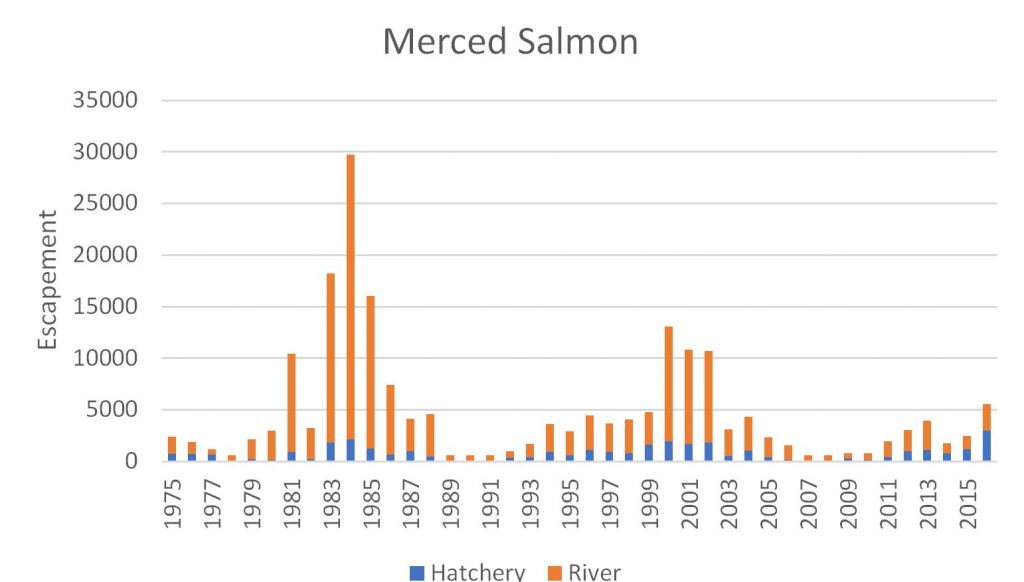
It was just over a decade ago that there were nearly one million adult salmon ascending the rivers of the Central Valley (Figure 1). At the same time, there were a millions more Central Valley salmon being harvested each year in sport and commercial fisheries along the coast and rivers of the Central Valley. Improvements in salmon management in the decade of the 1990s by the Central Valley Project Improvement Act, CALFED, and other programs had paid off handsomely with strong runs from 1999 to 2005. New and upgraded hatcheries, along with trucking hatchery smolts to the Bay, significantly increased harvest and escapement to spawning rivers.

Figure 1. Central Valley salmon runs from 1975 to 2016 including fall, late fall, winter, and spring runs. Source of data: CDFW GrandTab.

By 2008-2009, escapement had fallen by over 90% to a mere 70,000 spawners of the four races of salmon.  Fishery harvests were greatly restricted by 2008.  The winter run, the most threatened of the four runs fell from 17,296 to 827 spawners in just five years.  Drier years from 2001-2005, poor ocean conditions in 2004-2005, record-high Delta water diversions, and the 2007-2009 drought were contributing factors in the declines.  Impacts to coastal communities and the fishing industries were severe.

Extraordinary recovery measures included closing fisheries and trucking most of the hatchery smolt production to the Bay or Delta.  Federal salmon biological opinions (2009, 2011) limited winter-spring water-project exports from the Delta.  Hundreds of millions of new dollars were spent on habitat and fish passage improvements in the Valley to increase salmon survival and turn around the declines in runs.  A look at Figure 1 indicates that these efforts proved effective in limiting run declines from the 2012-2015 drought compared to the 1987-1992 and 2007-2009 droughts.

However, the prognosis for the future is again bleak, especially for wild, naturally produced salmon.  The consequences of the 2012-2015 drought  have not fully played out.  Once again, projected runs are low, and harvests are likely to be restricted.  Actions are needed to minimize long-term effects and to help bring about recovery of wild salmon productivity and fisheries in general.

Actions for 2018:

  1. Reduce harvest: Sadly but necessarily, the Pacific Fisheries Management Council and states are likely to take this first step of– restricting the 2018 harvest in the ocean and rivers to protect wild runs.
  2. Improve spawning, rearing, and migrating conditions: Sadly, this past year’s rearing and migrating conditions in the Sacramento River were unnecessarily compromised.   Water temperature at Red Bluff reached above the 56oF prescribed in the biological opinion and Basin Plan.  The higher temperatures resulted from low Shasta Reservoir releases (less than 5000 cfs – Figure 2) despite a virtually full Shasta Reservoir.  The low flow and higher water temperatures likely affected salmon egg incubation, rearing, and emigration-immigration success.  Reservoir releases will be necessary to meet flow and temperature targets in all Central Valley rivers and the Delta.
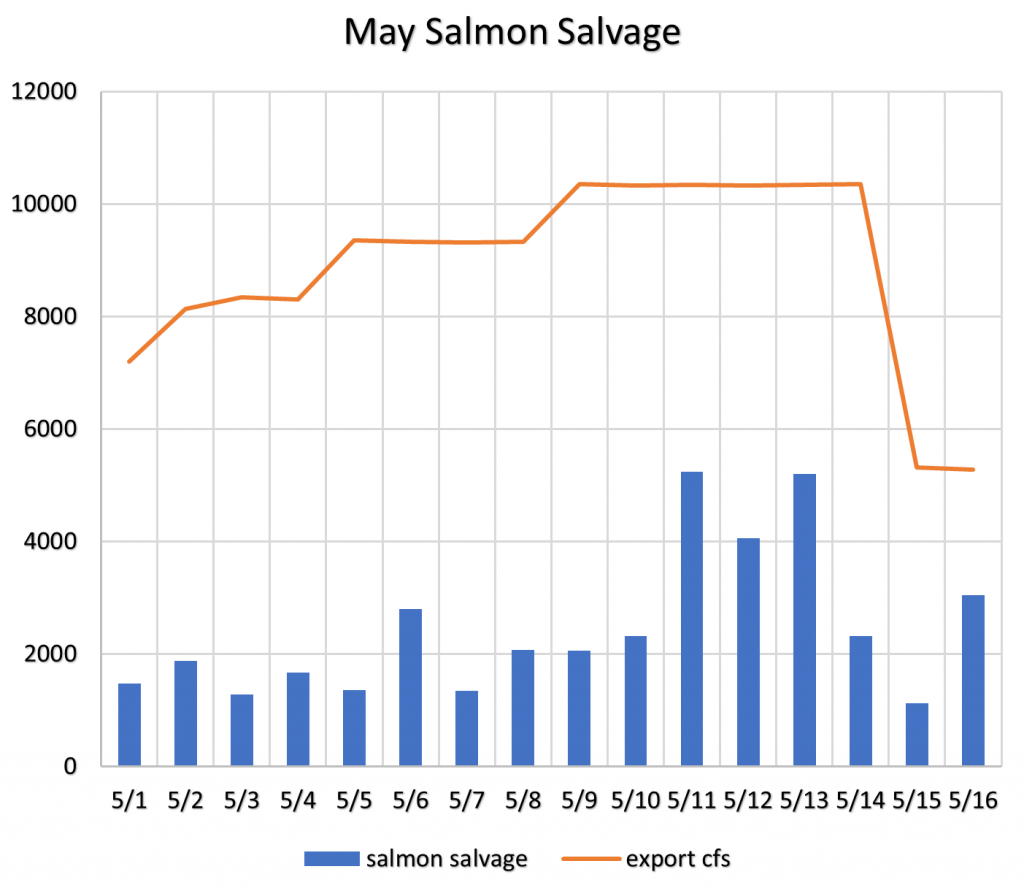
  3. Limit Delta exports: Delta exports this past spring reached unprecedented highs not seen in recent decades, resulting in high salmon salvage rates at the Delta fish facilities (Figure 3).1 With high water supplies from this past wet water year 2017, there will be high exports again unless there are some constraints.  If anything, winter-spring exports should be reduced to allow salmon to recover.  April-May exports should be reduced, like they were in the 1990’s and 2000’s, to 1500 cfs.

Near term actions over the coming year:

  1. Transport hatchery smolts to Bay: The transport of millions of fall-run smolts from state hatcheries on the Feather, American, and Mokelumne rivers to the Bay provides higher rates of escapement and contributions to the fishery and low rates of straying.  Barge transport to the Bay offers potentially lower rates of predation and straying for federal hatcheries near Redding.
  2. Raise hatchery fry in natural habitats: Recent research indicates that rearing hatchery fry in more natural habitat conditions increases growth rates, survival, and contributions to escapement and fisheries.  Raising hatchery fry in rice fields is one potential approach.
  3. Restore habitats damaged by recent record high flows in salmon spawning and rearing reaches of the Central Valley rivers and floodplains: In nearly every river, habitats were damaged by the winter 2017 floods, requiring extraordinary repairs and maintenance to ready them again to produce salmon.
  4. Take further actions to enhance flows and water temperatures to enhance salmon survival throughout the Central Valley: Actions may include higher base flows, flow pulses, or simply meeting existing target flow and temperature goals.

In conclusion, managers should take immediate actions to minimize the damage to salmon runs from the recent drought and floods, using this past year’s abundant water supply.  They should avoid efforts to exploit the abundant water in storage for small benefits to water supply at the expense of salmon recovery, and should make every effort to use the water in storage for salmon recovery.

Figure 2. Upper Sacramento River flows and water temperatures in May 2017. The target water temperature for Red Bluff is 56oF. Source of data: USBR.

Figure 3. Export rate and young salmon salvage at South Delta federal and state export facilities in May 2017. The target export rate limit for May should be 1500 cfs. Source of data: USBR.