American River Salmon and Steelhead – Update

In a September post I opined about the state of the American River salmon and steelhead.  I am more inclined now to scream.  This beautiful river running through the state’s capital city, Sacramento, one of the Central Valley’s top three producers of salmon and steelhead, is now the most abused.  Water temperatures and flows have reached critical limits  because of high summer releases from Folsom Reservoir, leaving this year’s salmon run in the lower American River in jeopardy.

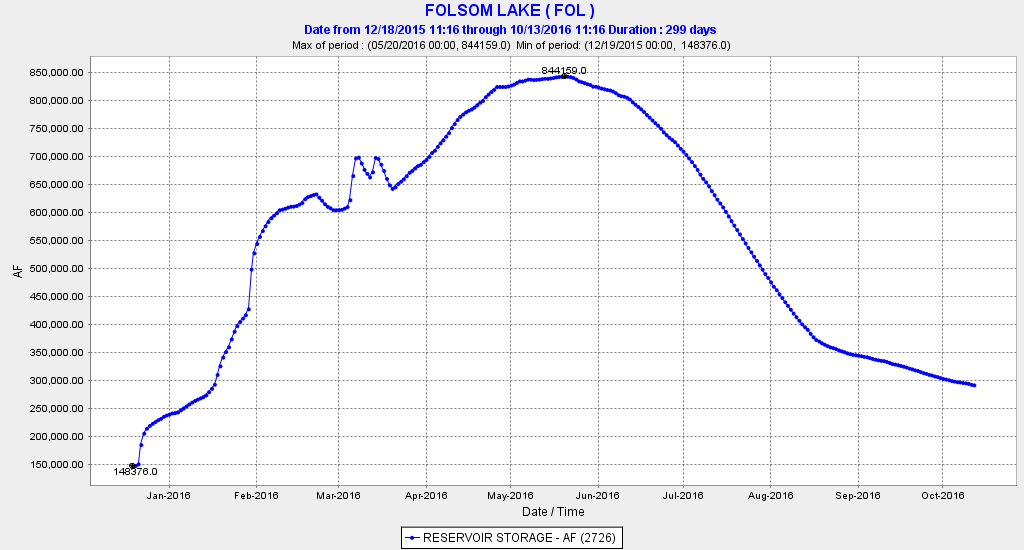
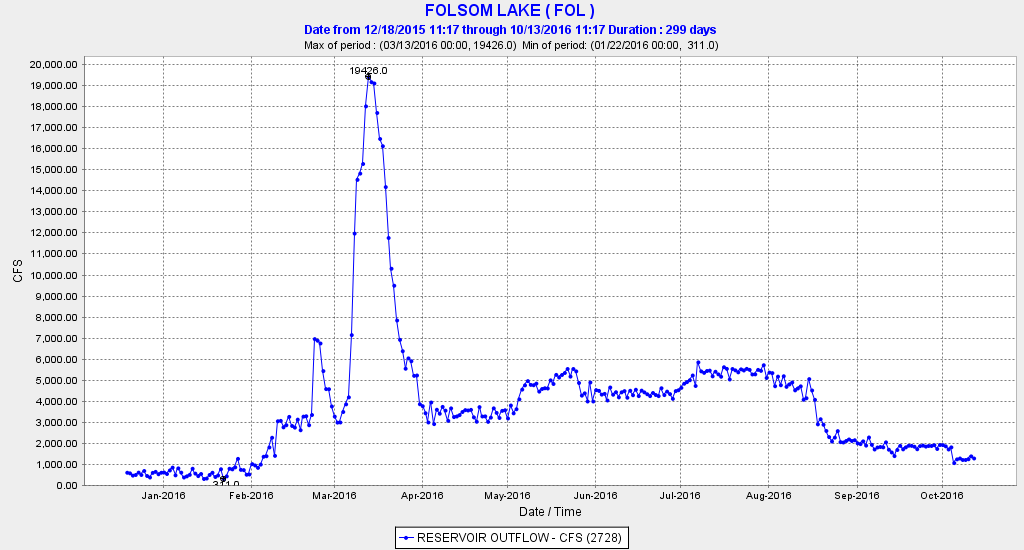
After nearly filling this past spring, Folsom Reservoir was drained of an unprecedented 550,000 acre-ft of water (and most of its cold-water pool) over the summer (Figure 1) in support of cities and farms in central and southern California.  Fall flows from Folsom Lake to the 20 miles of the lower American River have been cut to drought levels (Figure 2) to conserve what minimal storage is left and to have some cool water for late fall salmon spawning.

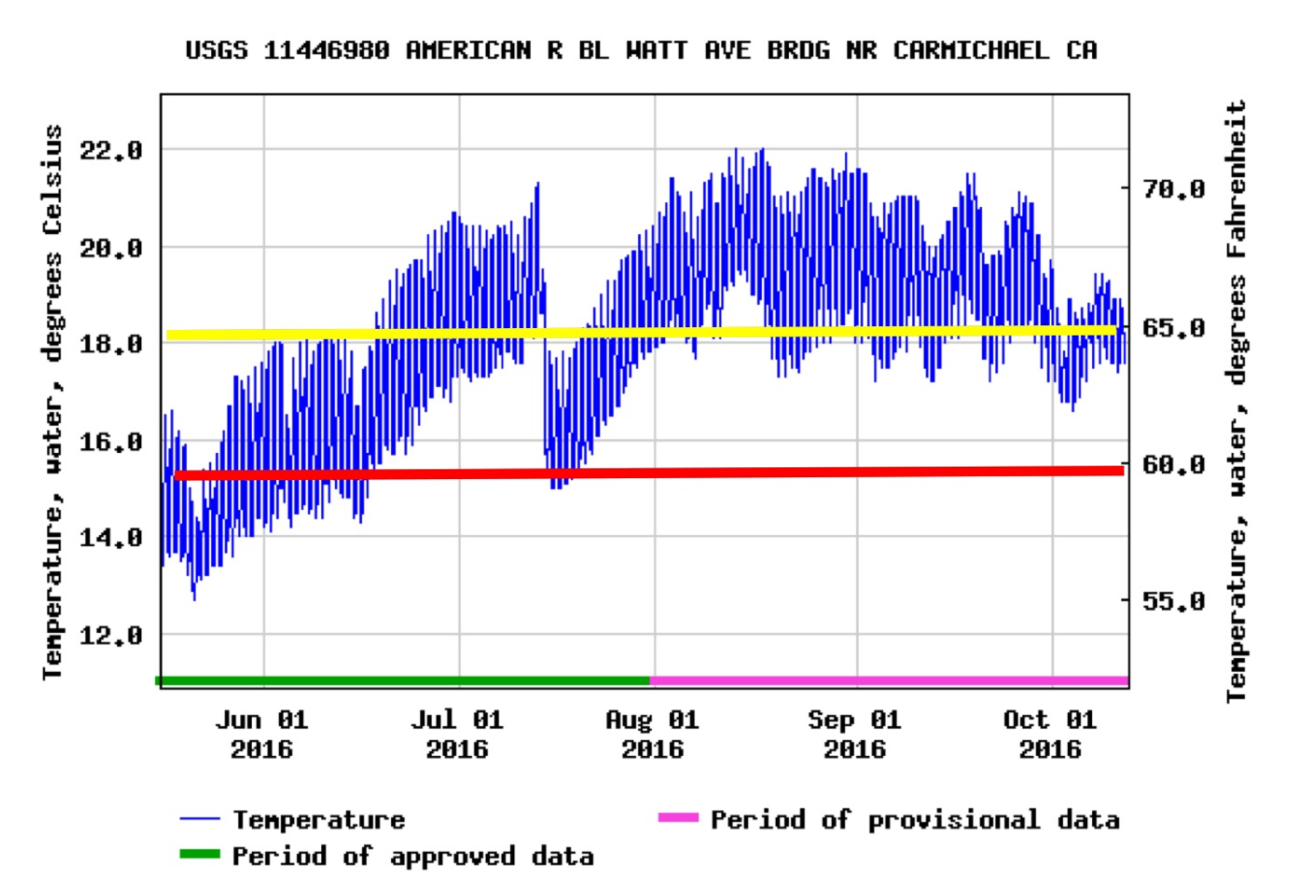
The lower American River is now host to tens of thousands of adult Chinook salmon that have migrated into the river to spawn.  These salmon are now “holding” for their eggs to mature and for water temperature to fall below 60°F so that their spawned eggs can survive.  Scientific research has led the National Marine Fisheries Service, the Environmental Protection Agency, the California Department of Fish and Wildlife, and the State Water Resources Control Board to recommend “holding” water temperature be less than 60°F to ensure the health of the holding, pre-spawn salmon and the viability of their eggs.

At a time when nearly all the Central Valley spawning rivers are near 60°F or below, the lower American remains warmer (Figure 3), with daily average water temperatures of 65°F.

While fishing the lower American River on October 12, an adult female salmon swam up to me “gasping” for air.  Other than a raw lamprey scar, she appeared healthy.  I tried to revive her by holding her steady in a slight current, but she eventually died.  It took less than an hour for the carcass to be covered by silt and become unrecognizable.  I wondered how many more like her were on the bottom of the river.

I can only assume that fisheries agencies are desperately trying to manage the river to save as many salmon as possible given the warm, low water levels in Folsom Lake and the limited options that now remain available to them.  The main problem is this past summer’s draining of Folsom’s cold-water pool.  In future years, the Bureau of Reclamation and the fisheries agencies need to fully implement the requirements of the CVP/SWP biological opinions  as copied verbatim in my September post, linked above.

Figure 1. Folsom Lake storage in acre-ft in 2016. Maximum is 975,000 acre-ft. (Note: flood control limits in spring often keep the reservoir from filling.)

Figure 1. Folsom Lake storage in acre-ft in 2016. Maximum is 975,000 acre-ft. (Note: flood control limits in spring often keep the reservoir from filling.)

Figure 2. Flows from Folsom Lake to lower American River in 2016. Note the average of about 5000 cfs per day (10,000 acre-ft per day) released from early May to mid-August (roughly 1 million acre-ft from storage and reservoir inflow).

Figure 2. Flows from Folsom Lake to lower American River in 2016. Note the average of about 5000 cfs per day (10,000 acre-ft per day) released from early May to mid-August (roughly 1 million acre-ft from storage and reservoir inflow).

Figure 3. Summer to early fall water temperatures in the lower American River in 2016. Yellow line is target maximum-allowed standard. Red line is recommended maximum-allowed holding temperature limit for adult Chinook salmon.

Figure 3. Summer to early fall water temperatures in the lower American River in 2016. Yellow line is target maximum-allowed standard. Red line is recommended maximum-allowed holding temperature limit for adult Chinook salmon.

2015 Winter-Run Salmon Progress Report – Lessons Learned and Not Learned

The Sacramento River Temperature Task Group’s report on water year 20151 released at the end of last year prematurely proclaimed successful operations for 2015 under its Temperature Control Plan (TCP). If the Group had waited a few more months, it would have reported utter failure, with the poorest survival and production of winter-run salmon yet recorded.2 Below, I excerpt from the Report, and offer some observations.

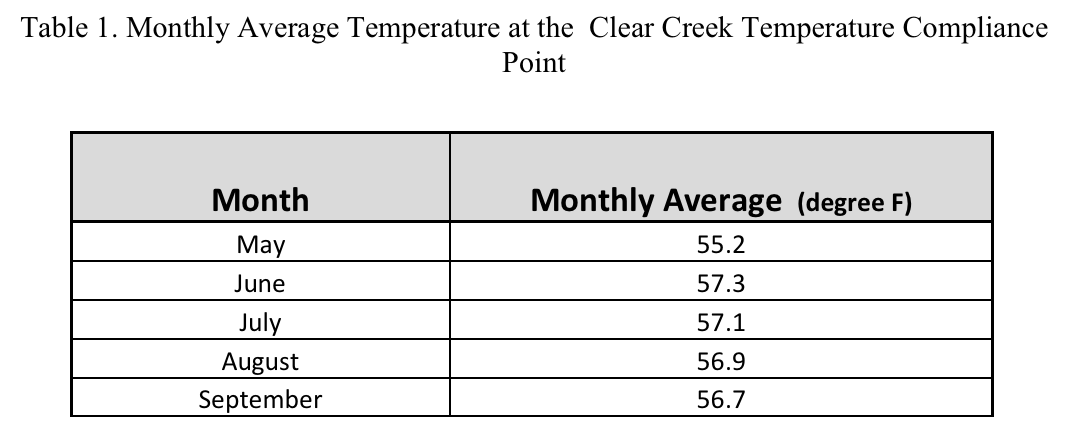
In summary, water year 2015 has been one of the driest years in decades and it followed three consecutive dry years throughout the state. Shasta Reservoir was projected to have end of year storage of 1.1 MAF in the May 90% forecast. Due to such low storage in Shasta Reservoir, Reclamation utilized Trinity River water to conserve Shasta Reservoir storage. The amount of water brought over from Trinity River through the Spring Creek Tunnel into Keswick Reservoir was a great benefit to the temperature operations on the Sacramento River. In all, Reclamation achieved meeting the TCP at Clear Creek (see Chart 1) of 57°F not to exceed 58°F through October 1, 2015, as indicated in the Temperature Management Plan, when 90% of the redds were emerging.

Comment: The Trinity water brought into Keswick Reservoir was 58-59°F, warmer than even the downstream criteria, resulting in more of the Shasta cold-water pool being used to cool it. The problem was recognized by the parties, as it resulted in demands to replace the existing Whiskeytown temperature curtain to cool the Trinity water before it was released into Keswick Reservoir. Achieving the 2015 goal of not exceeding 58°F turned out ineffective as well. Less than normal amounts of Trinity water have been brought into Keswick so far in 2016.

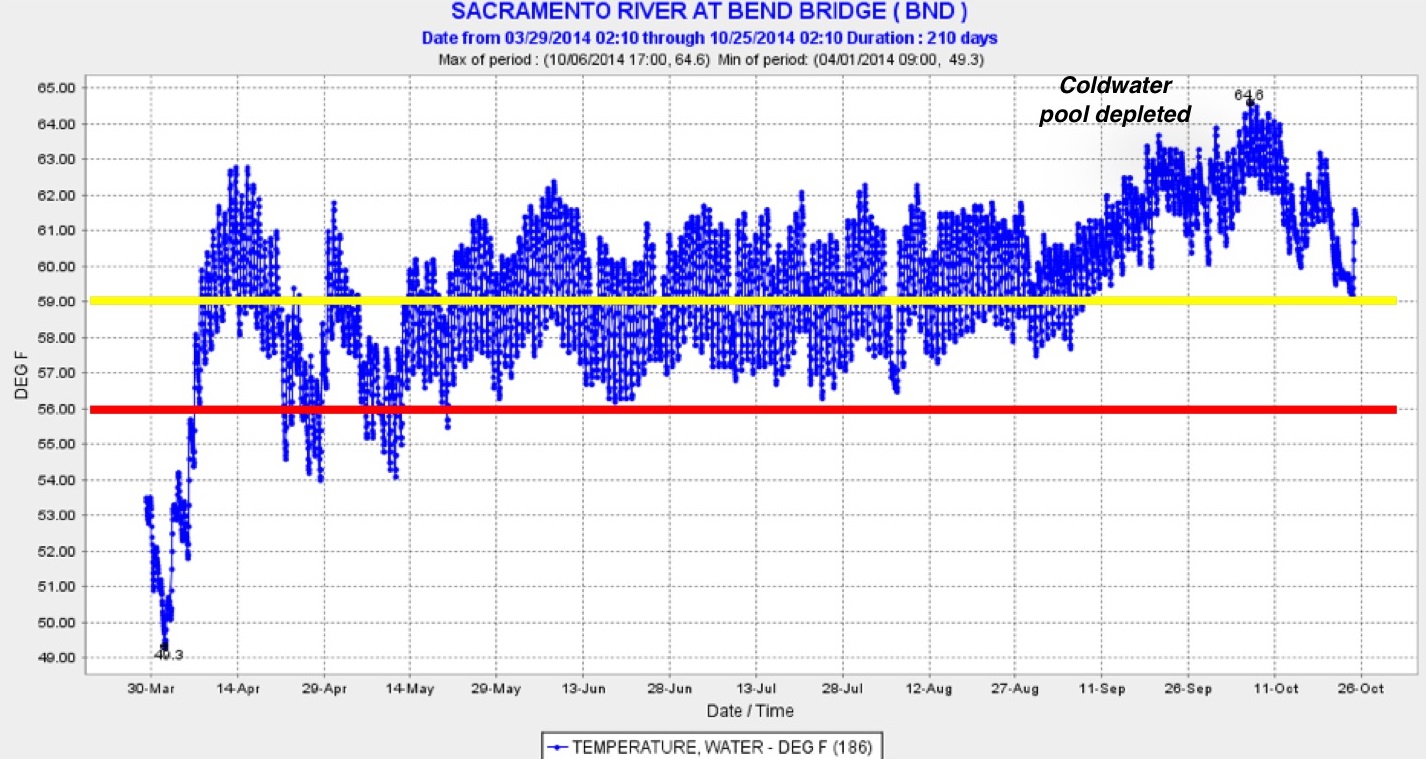
Despite the SRTTG best projection and modeling efforts to manage Sacramento River water temperature for winter-run spawning and egg incubation in water year (WY) 2014, winter-run brood year (BY) 2014 was considered a year class failure. One hundred percent of BY 2014 redds were exposed to temps above 56°F daily average temperature (DAT) at the Sacramento River above Clear Creek California Data Exchange Center monitoring station temperature compliance point (CCR) at some time period during WY 2014. Of significant concern were those eggs, alevin, and fry exposed to the elevated DAT above 56°F (and as high as 62.3°F) throughout September and October when the cold water pool out of Shasta Reservoir was depleted.

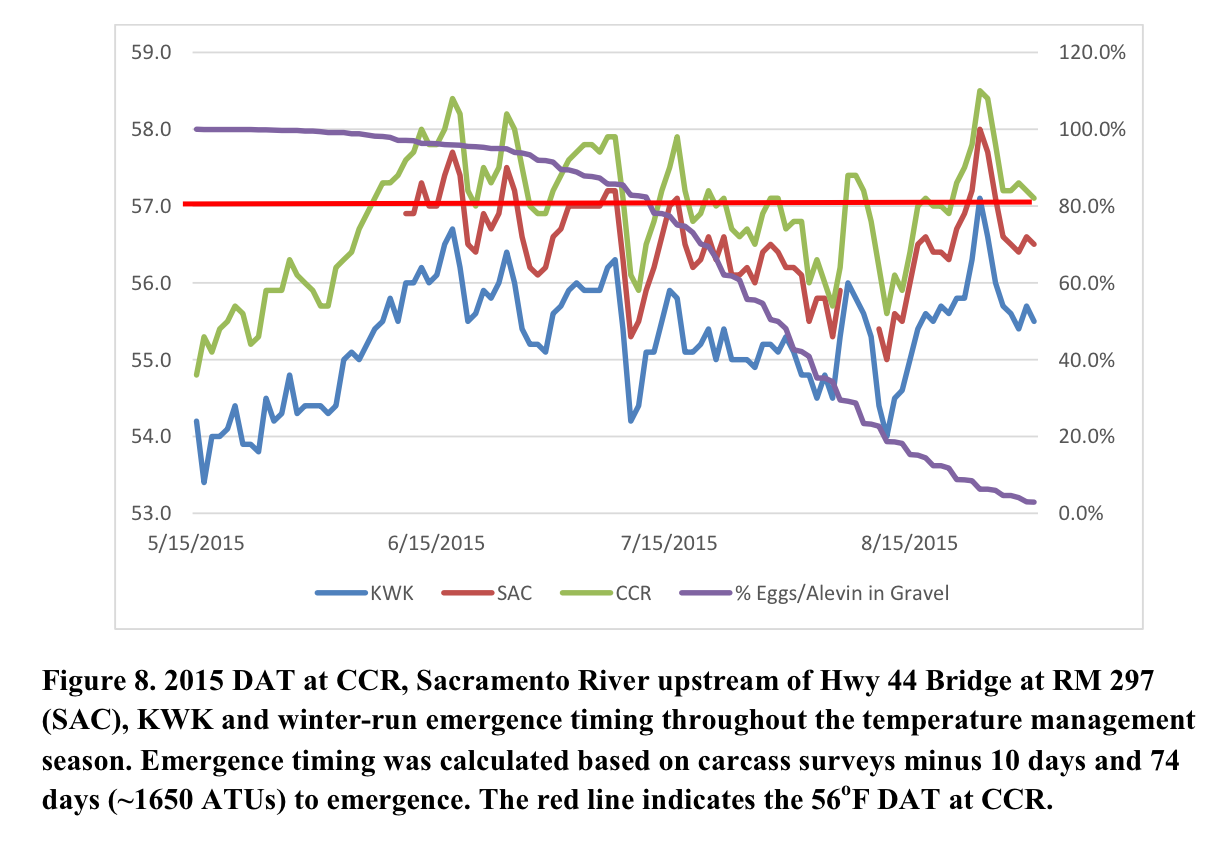
Comment: So the Task Group met the monthly average but allowed the daily average temperature to exceed 58°F in summer 2015 (Charts 2 and 3). The Report suggests improvement compared to 2014 conditions, but 2015 was also above 56°F. On 10% of the days in summer 2015, hourly water temperature exceeded 60°F at the CCR gage at Bonnyview Bridge in Redding during warm afternoons. On 60% of the days, water temperature reached or exceeded 59°F, the tolerance limit for salmon eggs and embryos. 3

Temperature monitoring results of 70 loggers indicated slight variation and stratification in temperature between in-river, backwater, and deep pools, but in general all winter-run salmon eggs and alevins were exposed to poor water quality due to warm water temperatures.

Comment: If they knew this, why did they allow it?

The plan called for real-time operations that targeted 57° at the Clear Creek compliance location not to exceed 58°F with minimized flows. By targeting 57°F not to exceed 58°F, where the majority of the redds were above Hwy 44, we were able to extend the use of the cold water pool.

Comment: By targeting the Clear Creek compliance location, the Task Group pretty much assured that adult winter-run salmon would seek out cooler waters near Redding, essentially confining their spawning to the uppermost 10 miles of their historic 60 mile spawning reach. The Group extended the cold-water pool by creating low survival conditions in the spawning reach. Reclamation was able to bring in warmer Trinity water for water supply (at the expense of Shasta’s cold-water pool) and did not have to sacrifice hydropower or peaking hydropower using Shasta Dam’s warm-water bypass (an operation which most likely would have been required if the target had been the appropriate 56°F). Reclamation was also able to meet its water supply commitment of 75% allocation to the Sacramento River settlement contractors in the fourth year of drought. So far in 2016, Reclamation has met its commitment of 100% allocation to the settlement contractors.

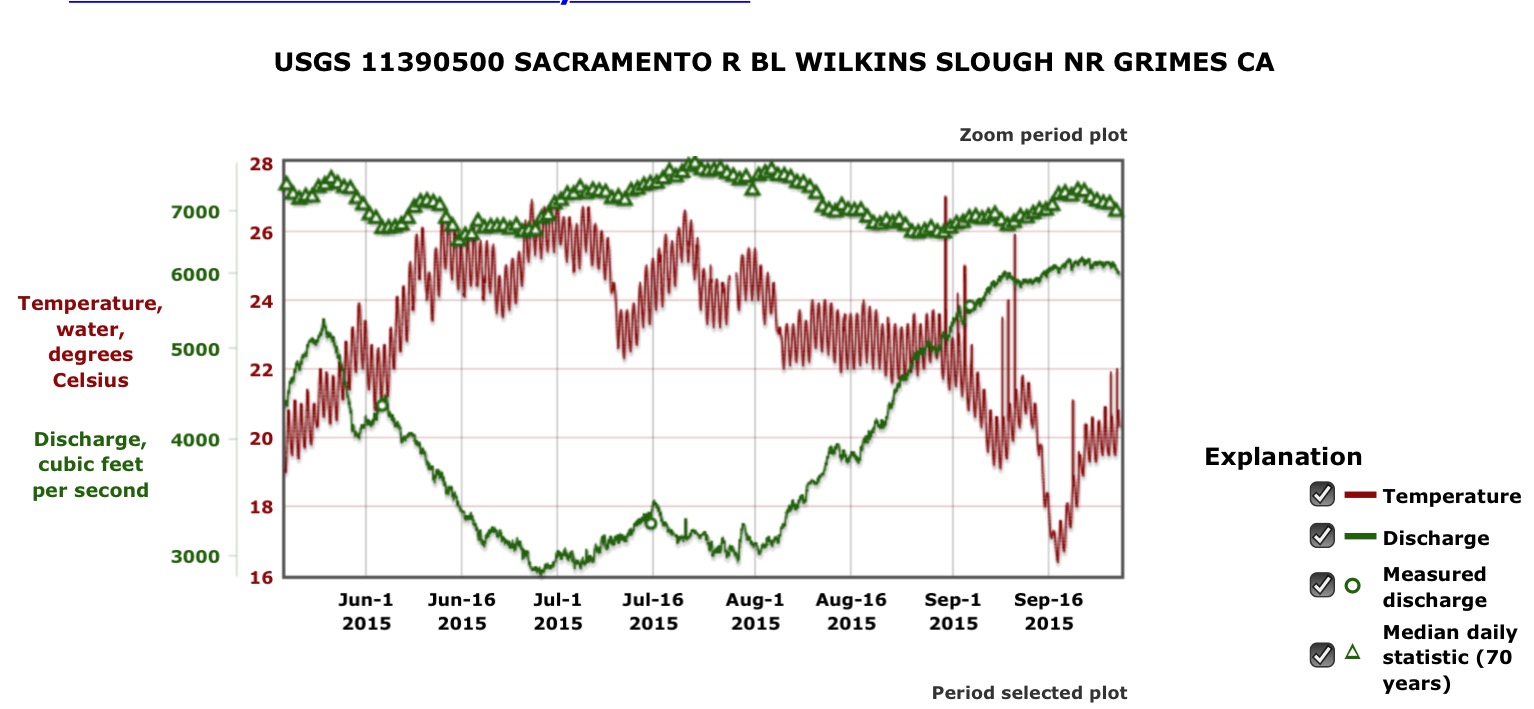
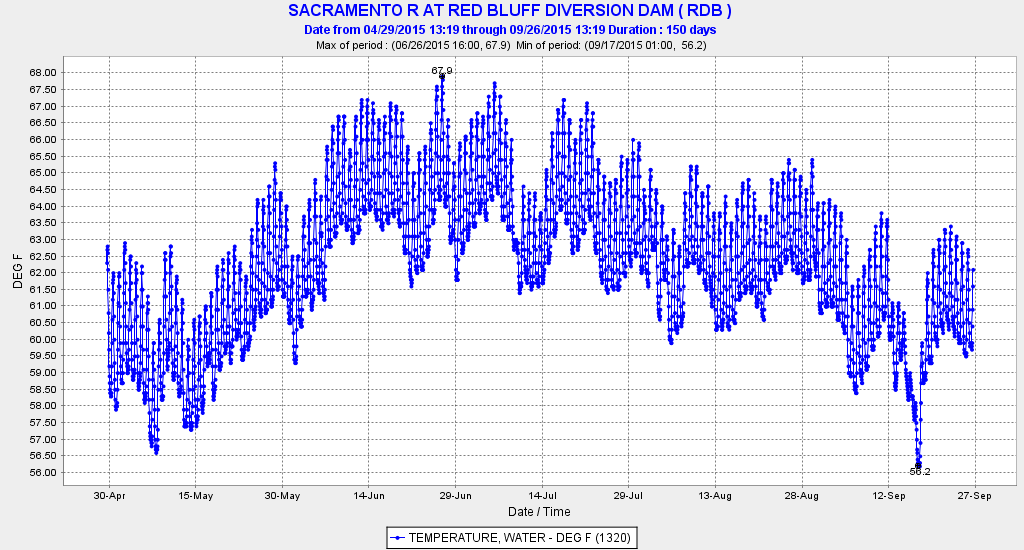
Perhaps more perplexing is what was left out of the report: water temperature and flow conditions in the salmon-migration and sturgeon-spawning reach in over 100 miles of the Sacramento River below Red Bluff. There was no mention of the Basin Plan’s targets for this reach of the river where water temperatures were too high (>22°C, 72°F) to allow adult salmon migration, while creating lethal conditions (>20°C, 68°F) for juvenile sturgeon4 (Chart 4). There was a complete disregard for the winter-run salmon objective of 56°C at Red Bluff in the Basin Plan, Water Right Order 90-05, and the NMFS BO: all 150 days from May through September failed to meet the objective (Chart 5). So far in 2016, the objective has yet to be met, despite the fact that Shasta was nearly full at the beginning of May.

Hopefully, the Winter Run 2016 report will be more comprehensive and complete than the Report for 2015. The 2016 Report should include not only the consequences for spawning habitat near Redding, but should also analyze the condition of rearing and migratory habitat below Redding through the fall and winter. The report should also cover consequences to the other salmon, including the ten million federal hatchery salmon smolts released near Redding.

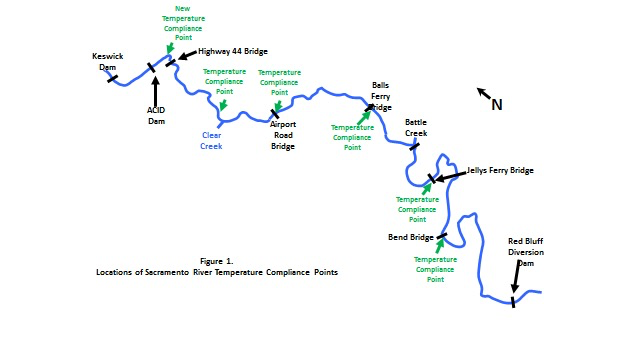
Chart 1. Map of 60 miles spawning reach below Keswick Dam on Sacramento River. Various temperature compliance points are noted. The NMFS BO specifies Bend Bridge with relaxation allowed in drier years. In 2015 the compliance point was above Hwy 44 bridge. Clear Creek 58F DAT was the compliance point in spring 2016. Balls Ferry 56°F is present compliance point in summer 2016.

Chart 1. Map of 60 miles spawning reach below Keswick Dam on Sacramento River. Various temperature compliance points are noted. The NMFS BO specifies Bend Bridge with relaxation allowed in drier years. In 2015 the compliance point was above Hwy 44 bridge. Clear Creek 58F DAT was the compliance point in spring 2016. Balls Ferry 56°F is present compliance point in summer 2016.

Chart 2. Summary of 2015 spring-summer monthly average temperature at Clear Creek compliance point.

Chart 2. Summary of 2015 spring-summer monthly average temperature at Clear Creek compliance point.

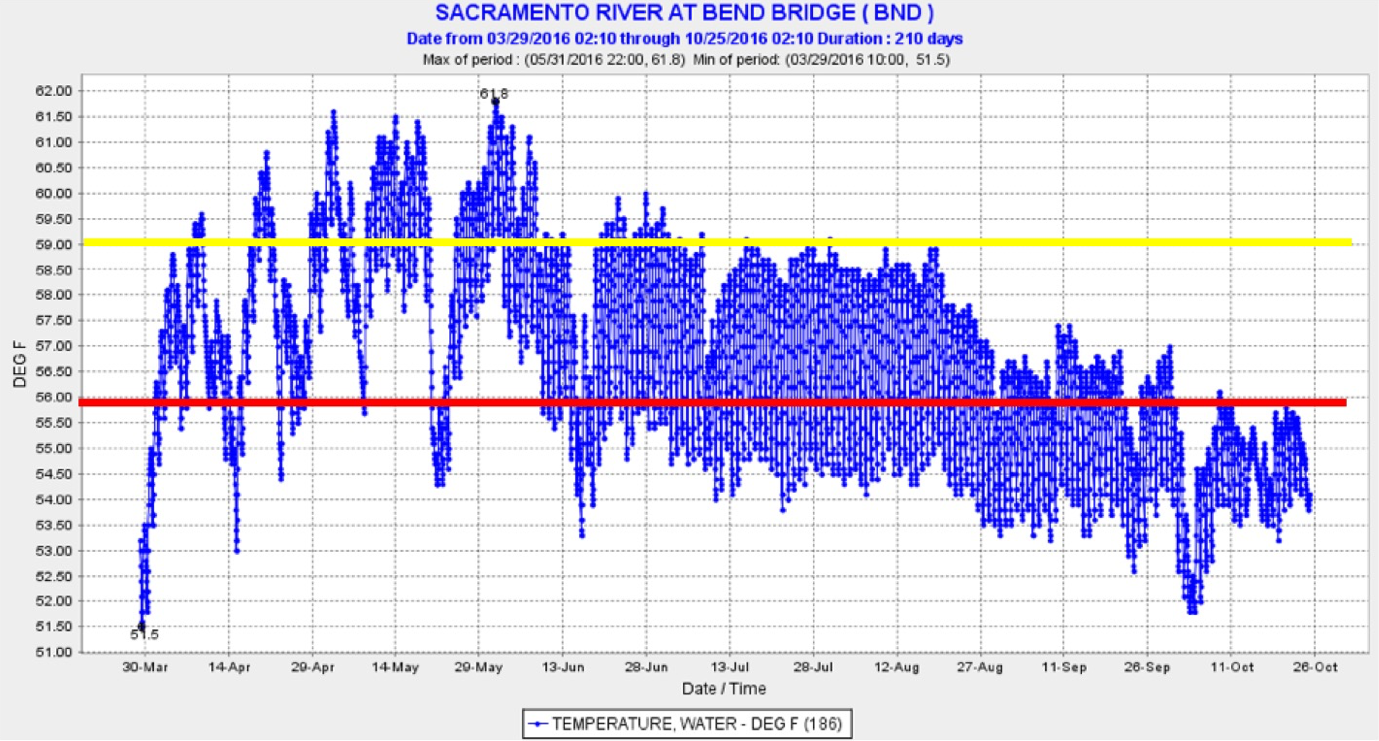
Chart 3. Summer 2015 spring-summer water temperatures at compliance locations. Note the red line is one degree above the target 56°F they noted.

Chart 3. Summer 2015 spring-summer water temperatures at compliance locations. Note the red line is one degree above the target 56°F they noted.

Chart 4. Water temperature and river flow at Wilkins Slough at RM 125 on the Sacramento River May-September 2015. Historical average flow shown by green triangles.

Chart 4. Water temperature and river flow at Wilkins Slough at RM 125 on the Sacramento River May-September 2015. Historical average flow shown by green triangles.

Chart 5. All 150 days from May through September were higher than the 56°F Basin Plan objective for Red Bluff.

Chart 5. All 150 days from May through September were higher than the 56°F Basin Plan objective for Red Bluff.

My comments on: “SLDMWA Response to Environmentalists’ August 9, 2016 Request to the SWRCB for Even More Water Aimed at Protecting Delta Smelt”

On August 11, Jason Peltier, executive director of the San Luis-Delta Mendota Water Authority, offered comments on a letter from environmental groups to the State Board that requested more water for Delta Smelt. Below, I provide some of Mr. Peltier’s statements, and a response to each:

1. “As environmental special interests request the State Water Resources Control Board expand failed policies on Delta Smelt, Californians are calling on the Board to implement new science-based, common sense approaches to protect the species. It is disheartening to see once credible environmental organizations calling for a “more of the same” approach – one that has so miserably failed for a quarter century – in a misguided attempt to help the imperiled delta smelt.”


Comment: The environmental organizations were proposing what the state has also offered as its new strategy for the Delta Smelt. It is not the old misguided “failed” strategy of diverting more and more water and providing less and less Delta outflow to the Bay. The state’s new strategy derives from some of the same actions suggested in this past April’s science workshop on Delta Smelt held at UC Davis, which Mr. Peltier attended.

2. “[t]he Projects have compensated for Mother Nature’s stinginess with water released from reservoirs, making the Delta far fresher than it would have been naturally.”

Fact: Just the “natural” summer inflow to Shasta Reservoir in the past four years of drought nearly equaled the amount allocated for summer Delta outflow. If you add up all the Central Valley’s “natural” inflow it would far exceed the Delta outflow allotted, even without accounting for use above the rim reservoirs.

3. “This dedication of water for fish from what was stored for drought relief has resulted in unprecedented socio-economic and environmental harms to towns, farms, and numerous species living in the largest wetlands in the West.”

Fact: Most of the water stored is for agriculture and released for agriculture. Mr. Peltier’s organization is simply last in line for stored water and thus gets less water allocated during droughts. In June and July, nearly 30,000 cfs of water was released on average from Central Valley reservoirs, but only 7000-8000 cfs reached the Bay to repel salt intrusion. Because Shasta releases were reduced to protect salmon (not smelt), Mr. Peltier’s organization was unable to receive more than a minimal allocation. Again, this is because its water rights are junior to those of other users, not because of water allocated to smelt (none).

4. “Since the most severe cuts were imposed on the Projects nine years ago, less water has been diverted, and thus more Projects’ water has gone out to the ocean, than at any other time in the past 35 years.”

Fact: Seven of the last nine years were drought years. The only water consistently reaching the ocean in large amounts during those seven years was uncontrolled river flows and reservoir spills during and after sporadic winter storms. The only reservoir water that reached the ocean (Bay) in those seven dry years was the water necessary to hold back salt intrusion into the Delta so Delta diversions and exports remained possible.

5. “Farmers, fishermen, and environmentalists – everyone that truly cares about the status of our imperiled fisheries – should be furious.”

Comment: The fishermen and environmentalists are “furious” because of government mismanagement of the Shasta Reservoir cold water pool that has nearly wiped out the Sacramento salmon runs, and because of the weakening of Delta water quality standards in 2014 and 2015 that allowed excess salt into the Delta and just about exterminated the Delta smelt population.

6. “Decades old state and federal policies have failed and brought delta smelt and salmon to the brink of extinction. The last thing we need is more of the same.”

Comment: Yes, decades-old policies of increasing exports from the Delta has brought near-extinctions. It started with the massive State Water Project that came on line in the 1970’s. Yes, the last thing we need is “more of the same” – increasing exports promised with the WaterFix.

7. “Like delta smelt, we need shelter, we need food, and we need safety from predators, toxics, and invasion. The state and federal regulatory agencies have ignored for far too long the full needs of delta smelt, only willing to do what is easy, and we have all suffered for it.”

Fact: Delta smelt need the cool, brackish, wind-blown turbid waters of Suisun Bay provided when Delta outflow is sufficient to keep the low salinity zone out of the warm, confined channels of the Delta and away from its massive export pumps.

8. “We can continue to ignore decades of sound scientific advice, or we can embark on a bold new initiative, one that is transparent and inclusive of stakeholders working with state and federal agencies to save delta smelt.”

Comment: We have ignored the scientific advice. It has always been there. What “bold new initiative?”

9. “Now is not the time for desperate action, it is the time for thoughtful action.”

Fact: Giving the Delta Smelt 1000 or 2000 cfs in June and July this year – instead of nothing (Delta outflow was allocated to repel salt) – would entail only 3-6% of the water released from reservoirs and 5-10% of Delta inflow. After all, the Delta Reform Act of 2009 mandates that the state must implement the “co-equal” goals of providing a reliable water supply and protecting, restoring and enhancing the Delta ecosystem.

American River Salmon and Steelhead

 Sacrificed and Unprotected

Where are the newspaper articles about the American River “trout?”1 Water supplies and fish are suffering all across the Central Valley, but there is no mention of American River salmon and steelhead being sacrificed so that southern California reservoirs can be filled.

The Santa Clarita Valley Signal reported on August 31, 2016:

“Castaic Lake’s water levels increased due to a rainfall and snowpack in Northern California. Castaic Lake is part of the California State Water Project and is maintained by the California Department of Water Resources as one of the state’s 34 storage facilities. Water collected by the agency is moved around the state to provide drinking and agricultural water to two-thirds of California’s inhabitants. On average, Castaic Lake holds 264,908 acre-feet of water during this time each year. It is currently holding 241,689 acre-feet of water, which is 120,467 acre-feet more than the lake was holding this day in 2015.” 2

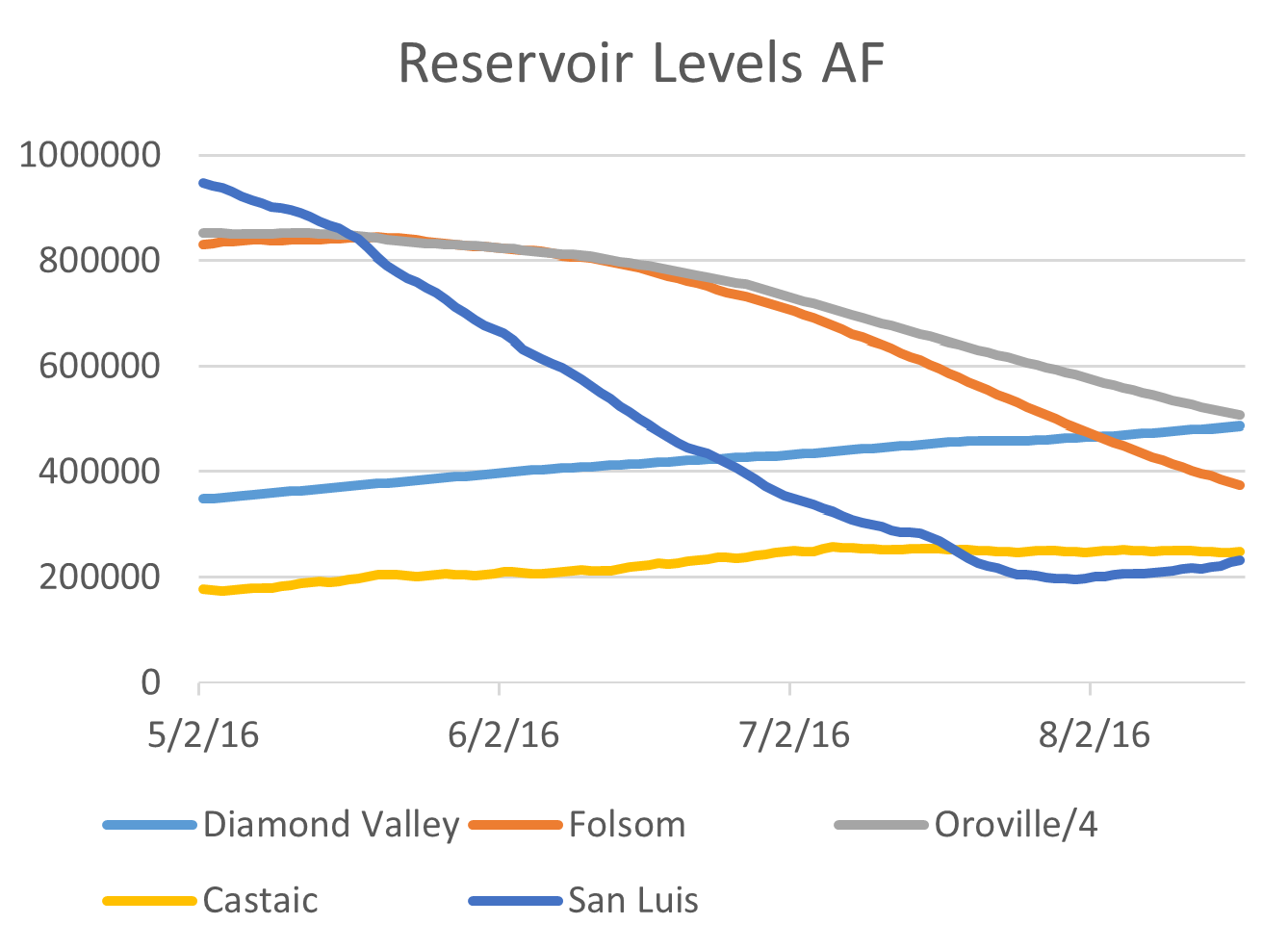
Yes, Southern California reservoirs are being filled at the expense of northern California reservoirs (Figure 1). Folsom Reservoir in particular was drained of over half its water over the summer, which has put this year’s steelhead and salmon spawns at great risk, not to mention future water supply and hydroelectric production needed by the Sacramento region.

Figure 1. Reservoir levels in acre-feet of storage from May-August 2016.

Figure 1. Reservoir levels in acre-feet of storage from May-August 2016.

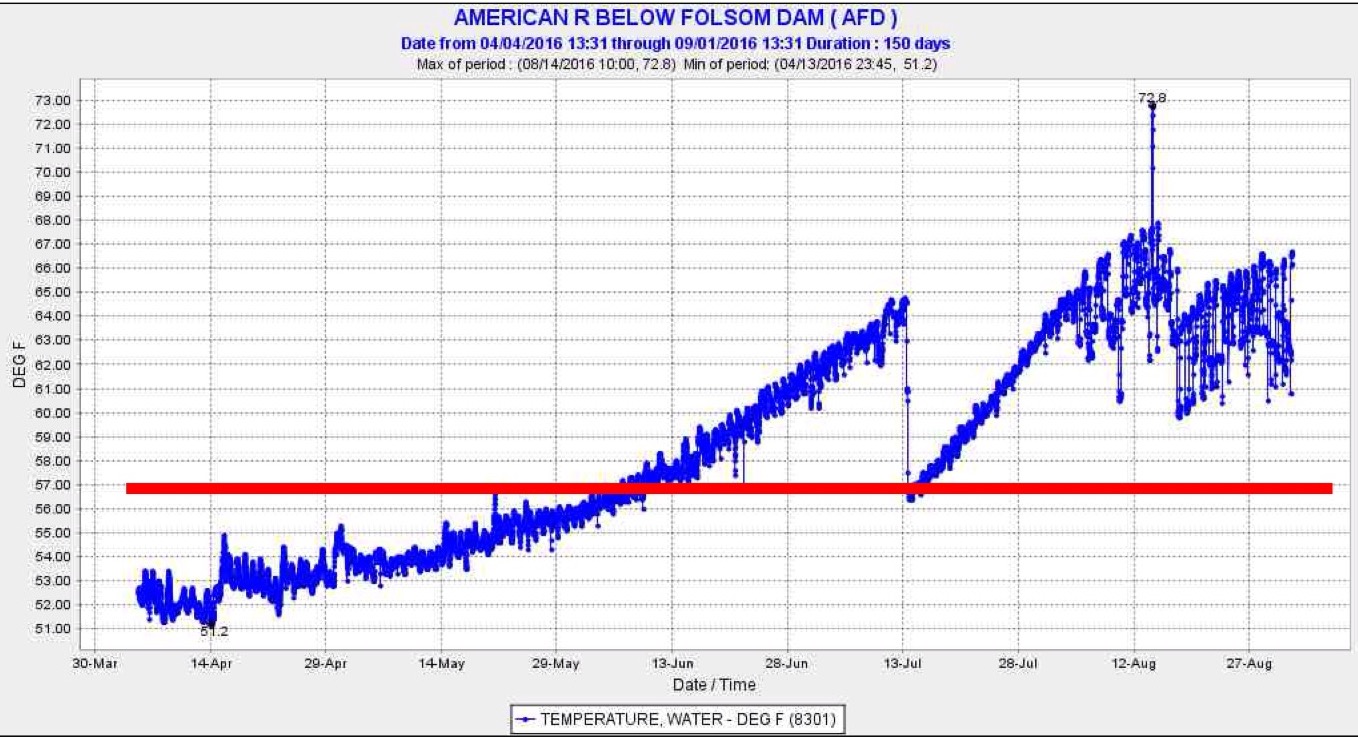
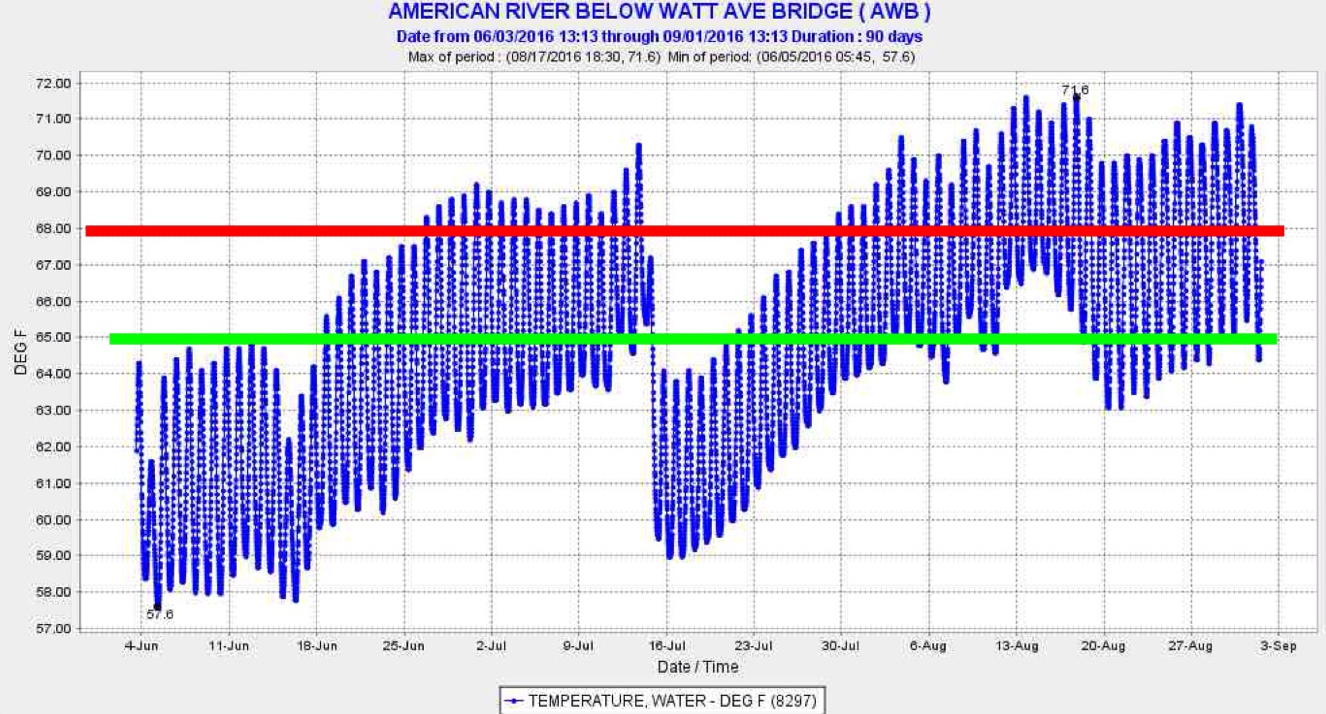
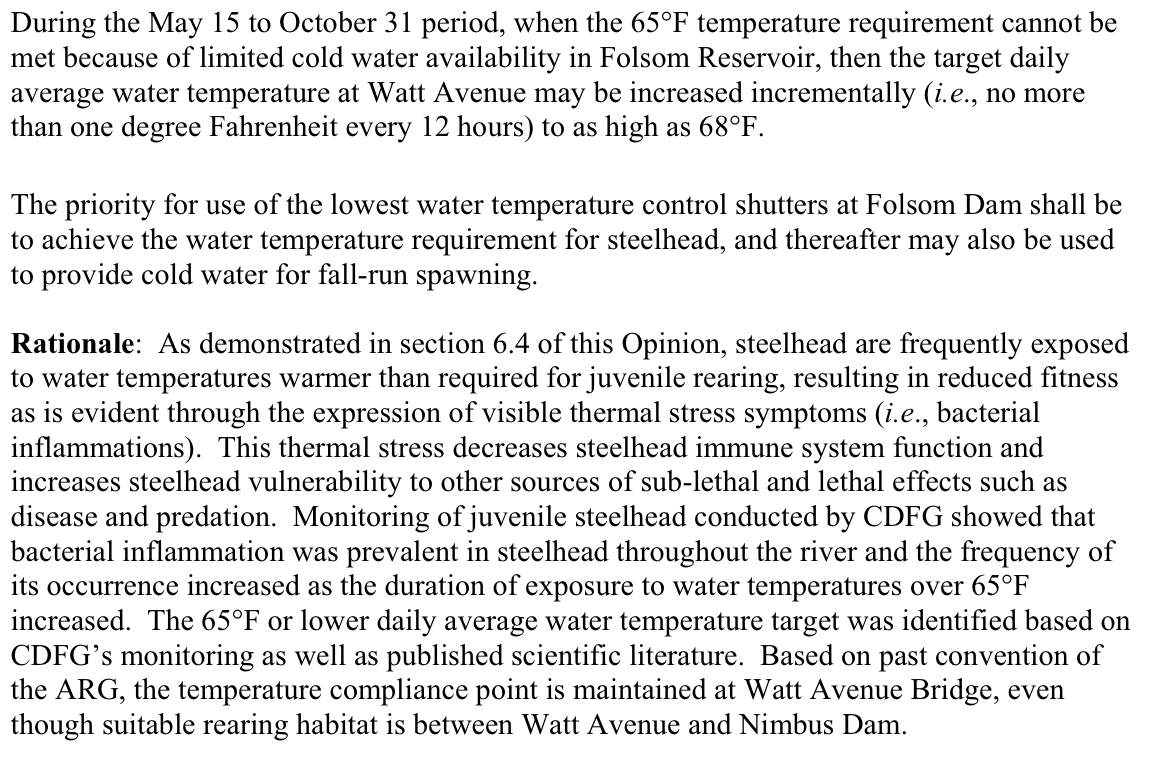
While regional water districts are screaming foul about the declining level of storage in Folsom and San Luis reservoirs, no one seems concerned about the American’s salmon and steelhead. We can understand (but not accept) the sacrifices in the extremes of the 2012-2015 drought (Figure 2), but not in 2016 a normal water year for the American River (Figure 3). Because Reclamation has drawn down Folsom Reservoir too far even in 2016, it lost the ability to use the available cold-water pool to maintain downstream cool river water temperatures (Figure 4). Also because Reclamation drew down the reservoir level, it allowed a provision for extreme conditions to kick in: an allowed increase in the water temperature requirement from 65°F to 68°F at Watt Avenue (Figure 5). That change in the federal biological opinion for operation of Folsom Reservoir (Figure 6) is designed for extraordinary circumstances and should not have occurred in 2016.

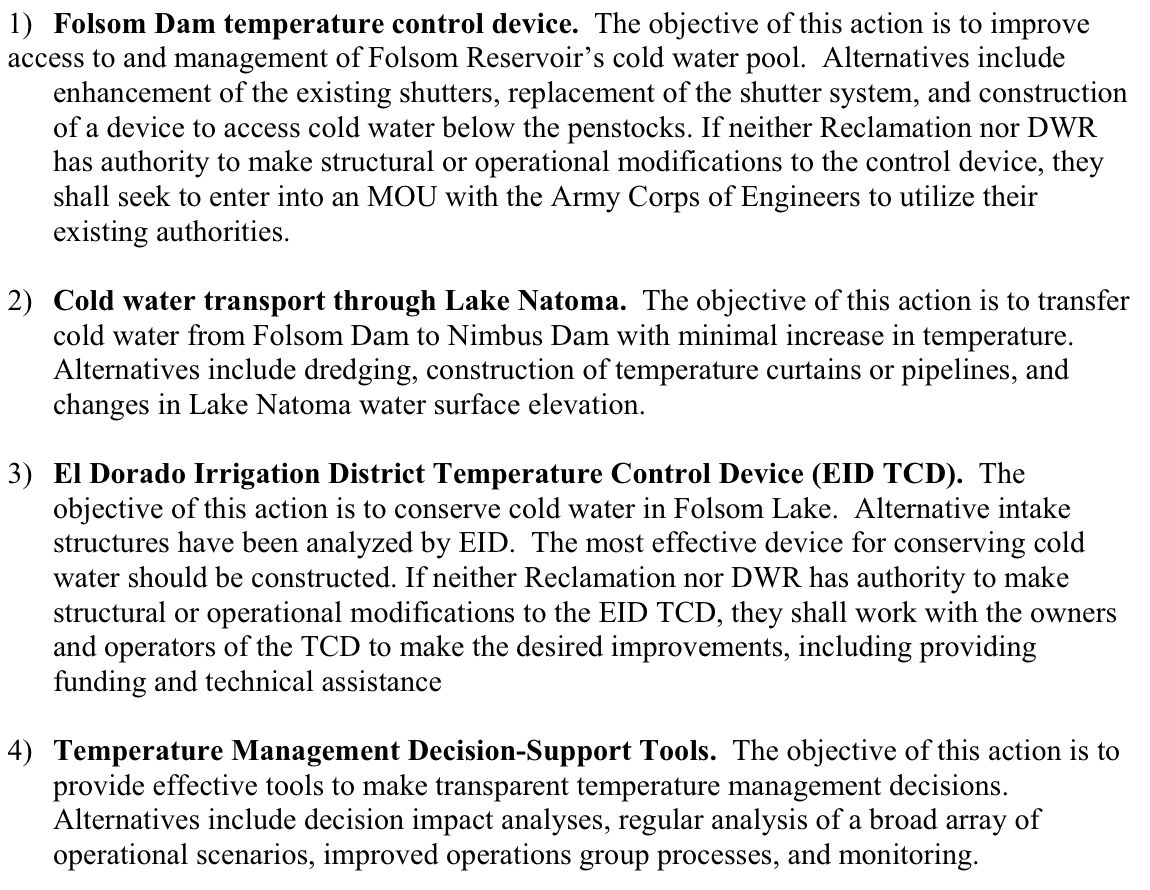
Reclamation has also made little progress toward other requirements to fix the Folsom problem (as shown in Figure 7).

After four years of drought and the mismanagement of Folsom Reservoir this summer by Reclamation, we can expect greatly reduced natural production of salmon and steelhead from the American River in the coming years.

For more information on this subject check out: http://www.safca.org/protection/NR_Documents/LARTF_2014_09_ Folsom_TCD_VPD_Ghoring.pdf .

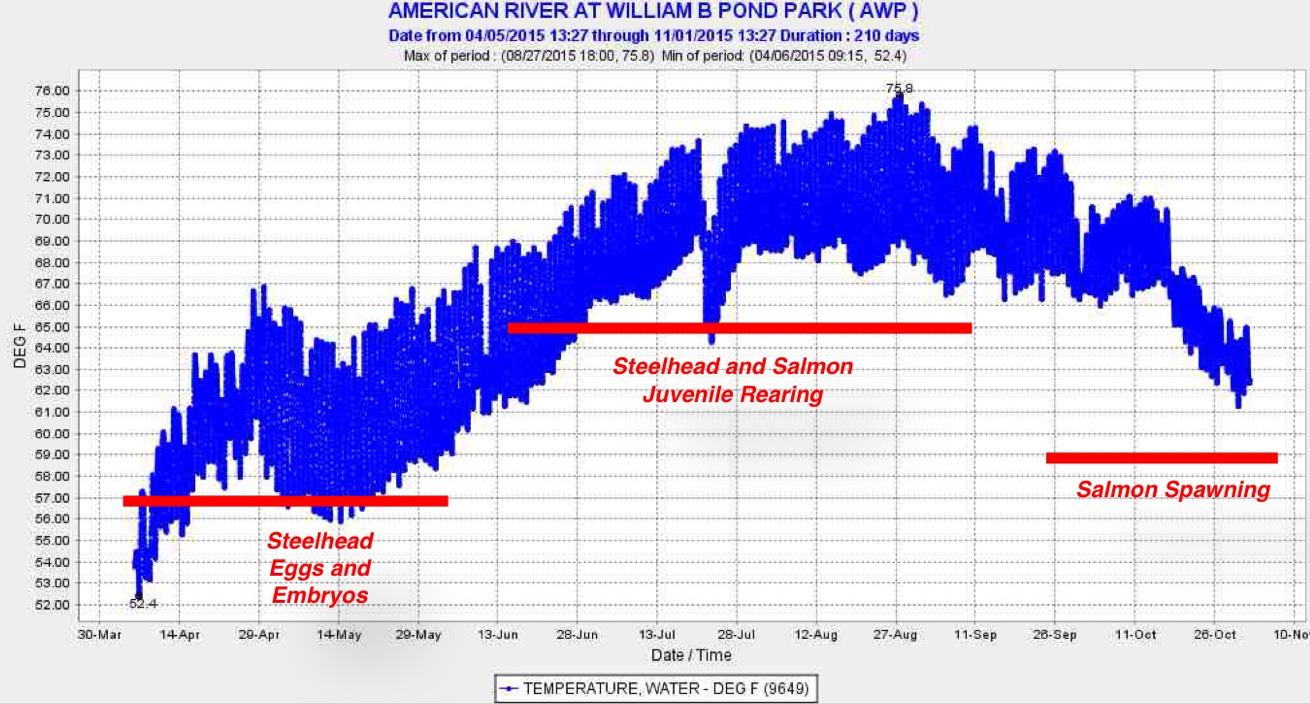
Figure 2. Water temperature in the American River at William Pond Park at the downstream end of the river’s spawning reach in 2015. Red lines depict water temperature objectives set for salmon and steelhead spawning and rearing.

Figure 2. Water temperature in the American River at William Pond Park at the downstream end of the river’s spawning reach in 2015. Red lines depict water temperature objectives set for salmon and steelhead spawning and rearing.

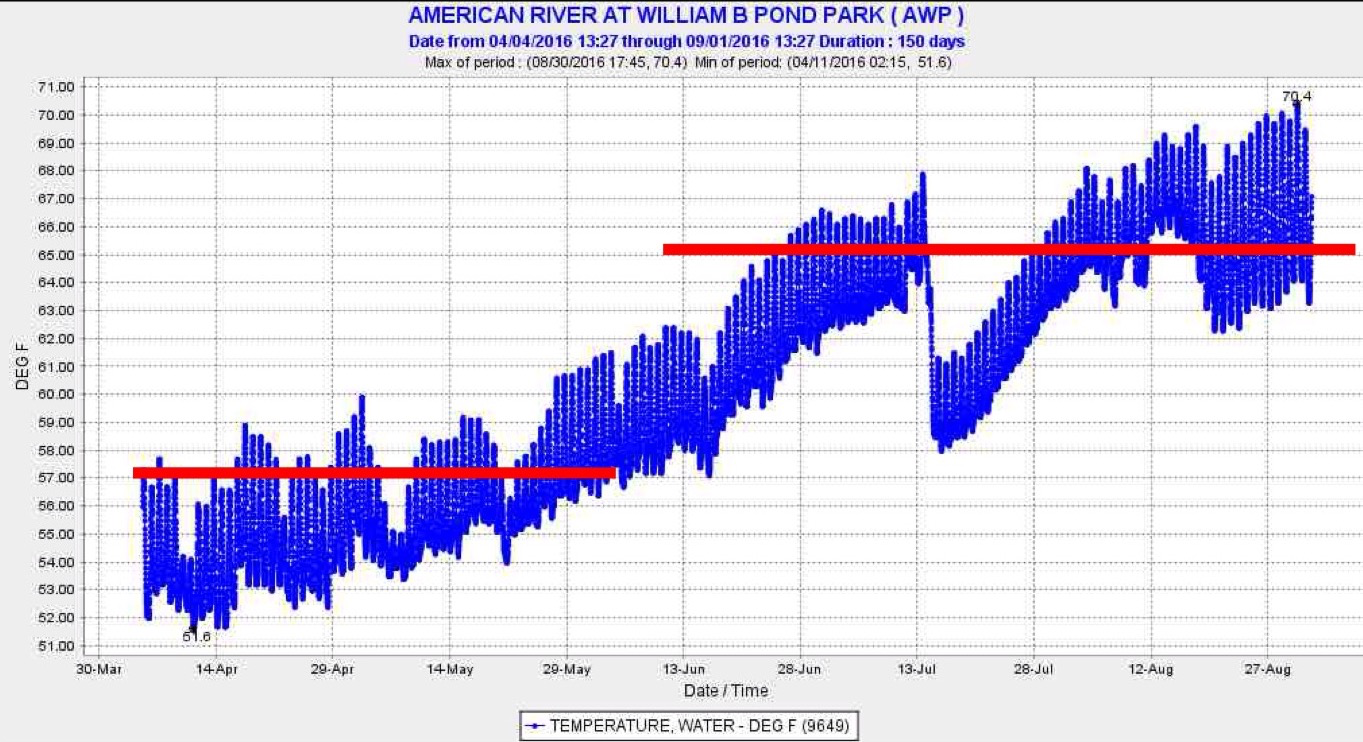
Figure 3. Water temperature in the American River at William Pond Park at the downstream end of the river’s spawning reach in 2016. Red lines depict water temperature objectives set for salmon and steelhead spawning and rearing.

Figure 3. Water temperature in the American River at William Pond Park at the downstream end of the river’s spawning reach in 2016. Red lines depict water temperature objectives set for salmon and steelhead spawning and rearing.

Figure 4. Water temperature of water released from Folsom Reservoir April-August 2016. Red line is maximum temperature objective. Note July 13 attempt to release water from lower colder-water level outlet.

Figure 4. Water temperature of water released from Folsom Reservoir April-August 2016. Red line is maximum temperature objective. Note July 13 attempt to release water from lower colder-water level outlet.

colder-water level outlet. Figure 5. Water temperature in the American River at Watt Avenue in 2016. Green line is normal objective. Red line is relaxed standard for drought years.

Figure 5. Water temperature in the American River at Watt Avenue in 2016. Green line is normal objective. Red line is relaxed standard for drought years.

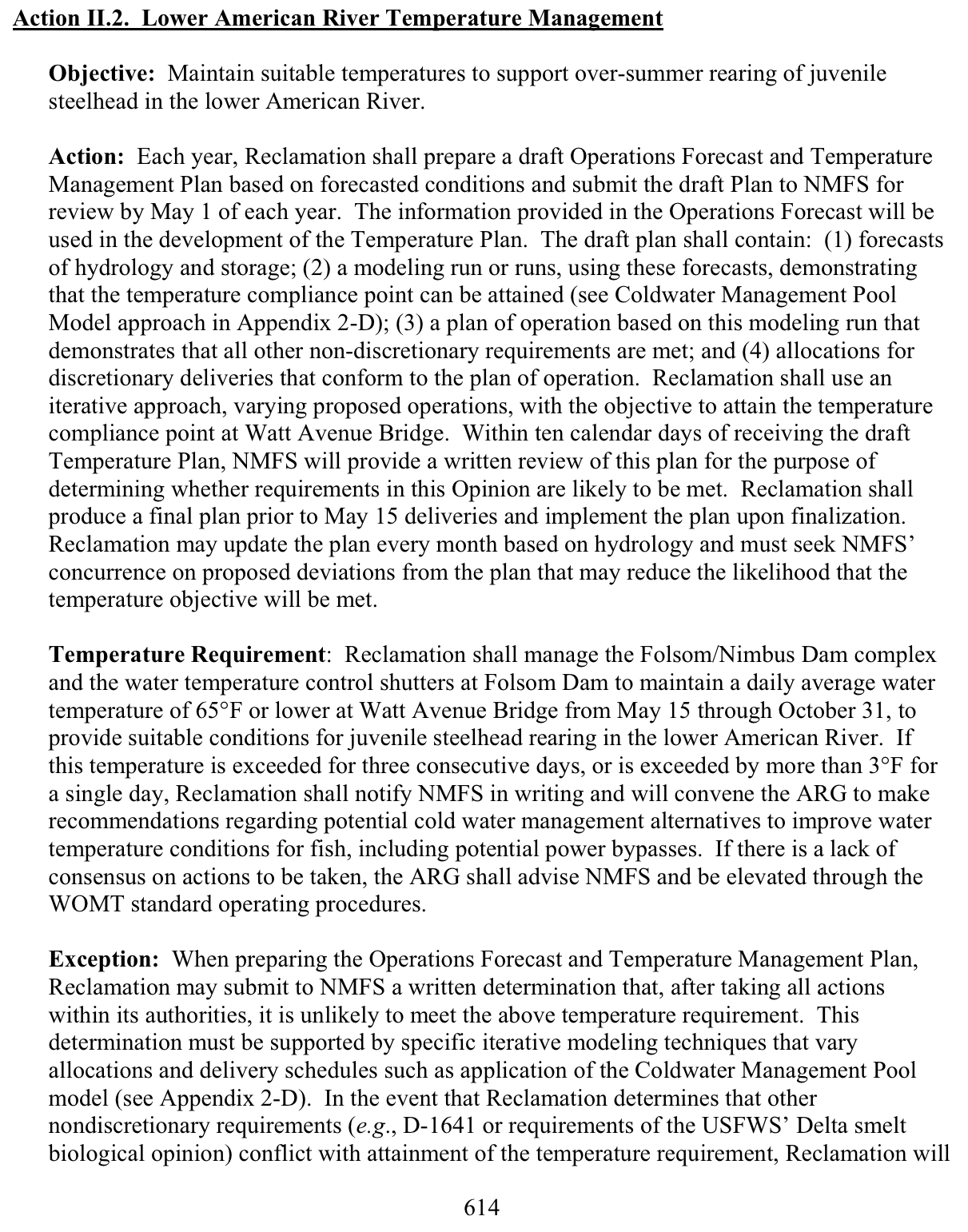
Figure 6. NMFS Biological Opinion excerpt from p615.

Figure 6. NMFS Biological Opinion excerpt from p615.

Figure 7. NMFS Biological Opinion excerpt from p616.

Figure 7. NMFS Biological Opinion excerpt from p616.

Figure 8

Sac River Salmon Opener a Bust

The salmon season on the lower Sacramento River opened on July 16 with a yawn. As described in the Chico Enterprise, “the salmon aren’t biting”. One fish was confirmed caught. The article paraphrased an analysis by CDFW biologist Rob Titus, who referred to a plan to hold back releases from Shasta Reservoir to help juvenile salmon to migrate to the ocean. The article also stated that “the drought has had a deep impact on the fish population.”

CDFW could have told everyone to stay home. The river flow was too low and the water temperatures were too high for salmon to move up the river. In a July 2 post, I warned about the low flows and warm water. In the lower river, flow was only 4000 cfs. Water temperature reached 72-74°F on opening day (see chart below), high enough to block migrating salmon. No CDFW biologist mentioned that while 10,000 cfs was being released from Shasta at the time, only 4,000 cfs was reaching the lower river.1 No one mentioned that the State Water Board is not enforcing the State standard of 68°F for the lower Sacramento.

image1

  1. As of 7/23, Sacramento River flow below Wilkins Slough had increased only slightly, to about 4400 cfs.