Increasing Salmon Rearing Habitats in the Upper Sacramento River – A Long-Overdue Management Action

Large amounts of rearing habitats for young salmon were lost in the upper Sacramento Valley Basin when Shasta and Keswick Dams were built. Loss of this rearing habitat (located in smaller, shallower river channels upstream of the dams – like the McCloud River) was considered one of the numerous reasons for the listing of the winter-run Chinook as endangered. Since dam construction, young salmon emerging from main-stem spawning areas downstream of the dams must now contend with the severe rigors of a large, deep river channel. It is generally acknowledged that the quality of rearing habitats in those upstream areas was superior to habitats below the dams (Vogel 2011).

Although significant efforts have been made to increase the quantity and quality of spawning habitats below the dams, minimal progress has occurred on rearing habitats. Massive amounts of spawning gravels have been added to the upper Sacramento River downstream of Keswick Dam, but there are indications that rearing habitats may be an equally important, if not more-important, factor limiting the fish populations. As pointed out by the U.S. Fish and Wildlife Service (USFWS),“ … there would be little value in increasing the quantity of available spawning gravel if the problem that actually limits juvenile production is lack of adequate rearing habitat” (USFWS 1995). Astonishingly, more than two decades later and despite over 1 billion dollars spent on salmon restoration, that potential dilemma remains unresolved.

Present-day rearing habitats are considered very limited and predation during juvenile rearing is believed to be a stressor of very high importance (NMFS 2014). The best habitats, in conventional theory, would be on the channel fringes. Indeed, some such areas with desirable attributes do exist, but are sparse. However, due to the nature of the river reach where most winter-run salmon spawn in deep water, many of the ideal habitat characteristics for rearing are lacking (e.g., appropriate velocities and cover). Subsurface structures like woody debris are severely deficient and would be challenging to restore due to lack of significant recruitment and periodic extremely high-flow events (Shasta Reservoir flood-control releases) that would dislodge this essential feature. In many areas where salmon spawn, the river is wide (e.g., 500 feet) and channel edges are deep (Figure 1). Fry emerging from redds in the main-stem riverbed encounter a paucity of velocity and predator refugia. Underwater observations and sonar camera footage near artificial structures in deep water (e.g., bridge piers) have frequently shown extensive salmon rearing activity, but may suggest the fish are utilizing those areas because insufficient other natural structures on the riverbed are limited or absent (Vogel 2011).
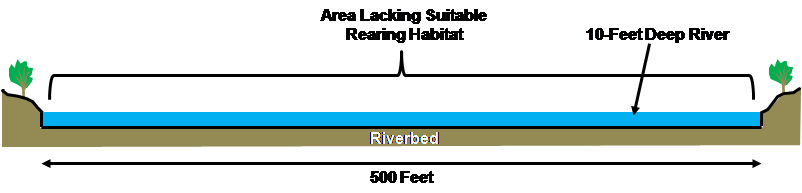
Figure 1. Cross-sectional profile of the upper Sacramento River in an area 500 feet wide and 10 feet deep (scale is approximate).

Figure 1. Cross-sectional profile of the upper Sacramento River in an area 500 feet wide and 10 feet deep (scale is approximate).

Based on many years of observations in the main-stem Sacramento River, large schools of young salmon exhibit a very strong affinity for specific habitats unique in a large, deep river channel. This circumstance is a quandary for salmon fry upon emergence from redds positioned in deep water and long distances from channel edges. The weak-swimming fry are immediately exposed to high near-bed water velocities and minimal refugia to escape from predatory fish such as rainbow trout that are very abundant in areas where winter-run Chinook spawn. The region where young salmon have been observed in deep channel areas include behind tail spills of redds and bridge piers, and in eddies adjacent to vertical bedrock walls. It is particularly evident that large schools of salmon choose areas where eddies exist adjacent to high water velocity shear zones. This provides the fish necessary velocity refugia while simultaneously gaining ready access to drift food organisms, thereby minimizing energy expenditure. Unfortunately, those same areas do not provide refuge from predatory fish.

The following are examples of salmon rearing in the deeper waters of the upper Sacramento River. [It must be noted that an enormous amount of sonar camera footage (not shown here) has been taken along near-shore shallow areas that did not show significant rearing utilization.] After viewing each video, stop or click “cancel” on the YouTube player to allow viewing of subsequent videos in this blog entry. For the sonar camera footage, juvenile Chinook can be discerned by largely maintaining their positions in the current, exhibiting visible swimming movements. Ensonified objects moving with the current are debris drifting downstream (e.g., algae and weed fragments).

  • A school of winter-run Chinook fry rearing on the riverbed adjacent to an Interstate-5 bridge pier and woody debris in the Sacramento River at water depths of 10 feet: http://www.youtube.com/watch?v=BP_szST5REo&NR=1
  • School of juvenile Chinook salmon rearing behind a Lake Redding bridge pier in the Sacramento River at water depths approximately 10 feet deep: https://youtu.be/g0dFA8V4-sc
  • School of juvenile Chinook salmon rearing in the Sacramento River in very deep water alongside a vertical bedrock wall and behind woody debris and filamentous algae or weeds: https://youtu.be/Tv0TtOCdzNY
  • School of juvenile Chinook salmon rearing in the Sacramento River behind the remnants of a concrete bridge pier on the riverbed in water depths approximately 12 feet deep with a large fish swimming through the school: https://youtu.be/uAT9Wkx-nSY

An action identified in the 2014 National Marine Fisheries Service (NMFS) Salmon Recovery Plan is: “Using an adaptive management approach and pilot studies, determine if instream habitat for juvenile salmon is limiting salmonid populations, by placing juvenile rearing-enhancement structures in the Sacramento River.” Evaluation of such measures is also a priority in the USFWS Anadromous Fish Restoration Program (USFWS 2001). Most recently, NMFS (2016) identified “a lack of suitable rearing habitat in the Sacramento River” as an “important threat” to winter-run Chinook. Therefore, a proposal to place rearing habitat structures in some deeper-water areas (approximately > 8 feet) of the main-stem upper Sacramento River was recently developed. Using guidance from the California Department of Fish and Wildlife’s (CDFW) Stream Habitat Restoration Manual (CDFW 2010), woody debris heavily anchored to the riverbed using large, angular boulders has been recommended for this initial step and has received favorable response from the fishery resource agencies. Angular boulders would provide the dual benefits of firmly securing woody debris and providing velocity refugia for young salmon; woody debris would provide predator refugia.

It is important to emphasize that this proposal is a pilot project and not intended to create nearshore, shallow-water habitat attributes similar to those that existed in upstream areas prior to dam construction or were lost in downstream riparian areas afterwards. There are already separate plans to construct small, shallow-water side channels in the main-stem river to address that issue. In contrast, this project is intended to place structures in completely different rearing habitat zones in deeper water where large numbers of young salmon have been observed. Given the ecological realities of the specific and unique environmental conditions in the upper Sacramento River, deep-water rearing habitats could very well be one of the most important environmental variables affecting the survival of main-stem spawning salmon progeny. If the pilot project determines high rearing utilization, the project could easily be expanded.

Sites chosen for rearing habitat placement should be in the vicinity and downstream of known spawning sites that are currently lack good rearing habitats. To provide the most benefit to young salmon, placement of rearing structures is focused on the approximate 12-mile reach of the upper Sacramento River below Keswick Dam. This area is where nearly all the endangered winter-run Chinook have been spawning in recent years and also supports the other three Chinook runs as well as the threatened steelhead.

Hopefully, a pilot project will be implemented in early 2017 … stay tuned.

Literature Cited

California Department of Fish and Wildlife. 2010. California Salmonid Stream Habitat Restoration Manual. July 2010. http://www.dfg.ca.gov/fish/Resources/HabitatManual.asp

National Marine Fisheries Service. 2014. Recovery plan for the Evolutionarily Significant Units of Sacramento River winter-run Chinook salmon and Central Valley spring-run Chinook salmon and the Distinct Population Segment of California Central Valley steelhead. California Central Valley Area Office. July 2014. 406 p. http://www.westcoast.fisheries.noaa.gov/publications/recovery_planning/salmon_steelhead /domains/california_central_valley/final_recovery_plan_07-11-2014.pdf

NMFS. 2016. Species in the Spotlight. Priority Actions: 2016 – 2020. Sacramento River Winter-Run Chinook Salmon, Oncorhynchus tshawytscha. 16 p.
http://www.nmfs.noaa.gov/stories/2016/02/docs/sacramento_winter_run_chinook _salmon_spotlight_species_5_year_action_plan_final_web.pdf

U.S. Fish and Wildlife Service. 1995. Working paper: habitat restoration actions to double natural production of anadromous fish in the Central Valley of California. Volume 1. May 9, 1995. Prepared for the U.S. Fish and Wildlife Service under the direction of the Anadromous Fish Restoration Program Core Group. Stockton, CA. https://www.fws.gov/lodi/anadromous_fish_restoration/documents/WorkingPaper_v1.pdf

U.S. Fish and Wildlife Service. 2001. Final Restoration Plan for the Anadromous Fish Restoration Program. A plan to increase natural production of anadromous fish in the Central Valley of California. Released as a revised draft on May 30, 1997 and adopted as final on January 9, 2001. 106 p. plus appendices. https://www.fws.gov/cno/fisheries/CAMP/Documents/Final_Restoration_Plan_for_the_AFRP.pdf

Vogel, D.A. 2011. Insights into the problems, progress, and potential solutions for Sacramento River basin native anadromous fish restoration. Report prepared for the Northern California Water Association and Sacramento Valley Water Users. Natural Resource Scientists, Inc. April 2011. 154 p. http://www.norcalwater.org/wp-content/uploads/2011/07/vogel-final-report-apr2011.pdf
Barging Hatchery Smolts to the Bay

In this blog I often recommend barging hatchery and even wild salmon from spawning rivers to the Bay up to 200 miles or more over conventional trucking or direct releases from hatcheries. The theory is that continuous recirculation of water in the barge (or boat) holding tank helps the young salmon remember from where they came and imprint the route back to their home river or hatchery.  Trucking directly to the Bay is believed to cause straying to non-natal rivers, resulting unnatural mixing of stocks, hatchery fish straying into wild fish spawning rivers, and less salmon returning to their home hatcheries where their eggs may be needed to meet quotas.  It is well documented that trucking and pen acclimation significantly increases the contribution of hatchery smolts to the ocean fishery up to two or three fold or more.  Concern over straying has kept the practice to a minimum.

Well it turns out from studies conducted with tagged hatchery salmon beginning with releases in 2008 that trucking, at least of American and Feather hatchery smolts, does not lead to significant amounts of straying.  Also, barging does not significantly reduce the already low straying rate.  So trucking to Bay net pens for acclimation remains the chosen strategy for the two largest State hatcheries, and probably the other two on the Mokelumne and Merced rivers.

The jury is still out on the Coleman and Livingston Stone federal hatcheries near Redding.  Straying rates are higher and the benefits of trucking over 200 miles seem questionable.  One concern I have is the high straying rate encountered for Coleman (Battle Creek) fish includes fish that move past Battle Creek further up in the Sacramento River and its upper tributaries.  Most of the spawning fish in these areas come from Coleman and Livingston Stone national fish hatcheries.  Because Coleman was built to mitigate for the loss of fish to those areas, I question their inclusion in the straying estimates.  The USFWS, which manages the two hatcheries, continues to be reluctant to truck and barge fish.

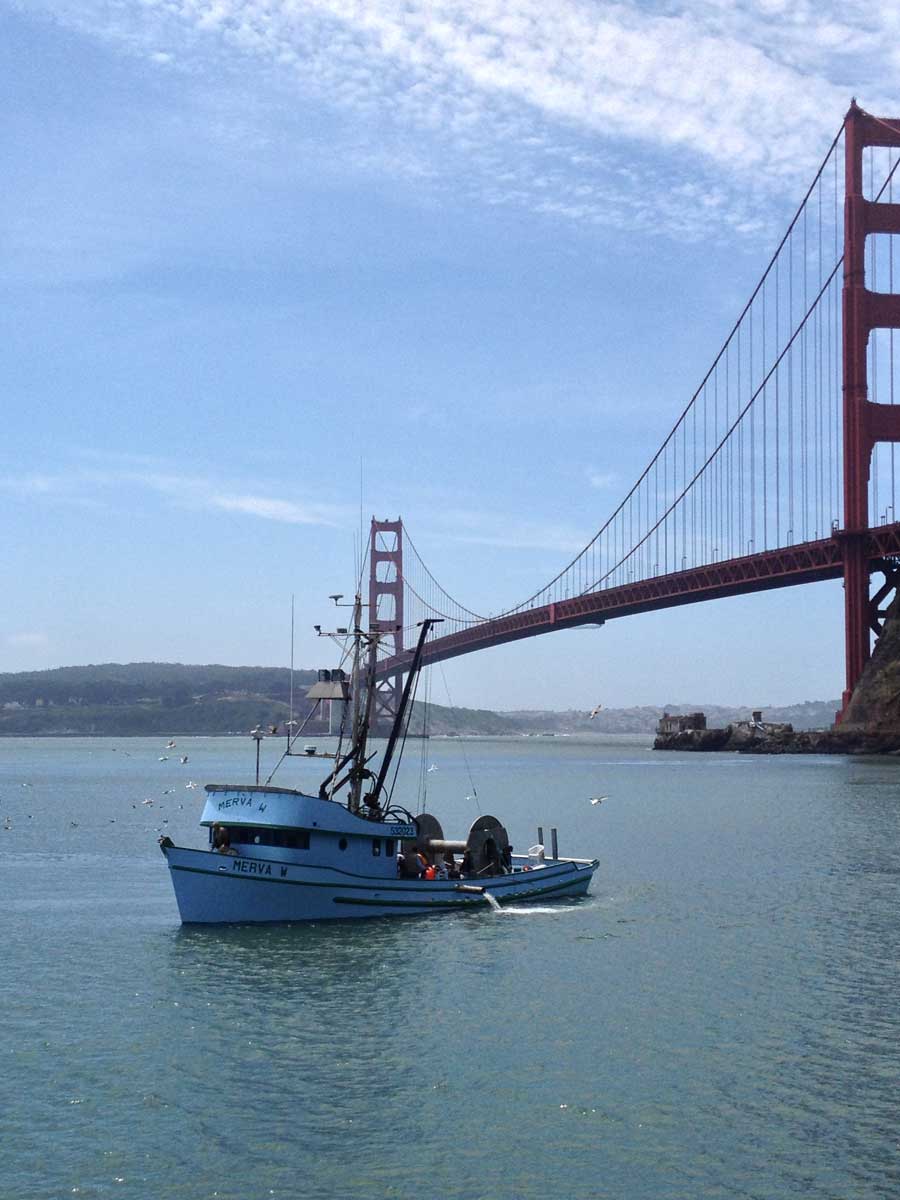
Though barging may not be needed for the Feather and American River hatcheries, it still holds potential for improving survival and reducing straying overall.  So far, there is no evidence that barging improves survival over trucking to Bay net pens.  I reviewed subsequent tag returns for a barge release group in early May 2012 with returns from two net pen groups released at the same time in the Bay.  I found the subsequent return percentage of the barge group  to be in between the two trucked pen release groups.  In the notes of the barge release, high predation by birds was noted.  In the photo of a barge release below many birds can be seen.  I wonder if the barge release would also benefit from the same pen acclimation that is employed after trucking, which significantly improves trucked fish release survival and subsequent contribution to the fishery.  (Note: I have been present at numerous truck releases to the Bay and have observed obvious extreme predation on the disoriented and confused hatchery fish, often released into warmer, saltier water than was present at the hatchery by a horde of well-trained and waiting birds and predatory fish.  Release to net pens at variable locations for acclimation and tow to open waters for underwater release seemed to greatly reduce predation, which proved true in subsequent tag returns.)

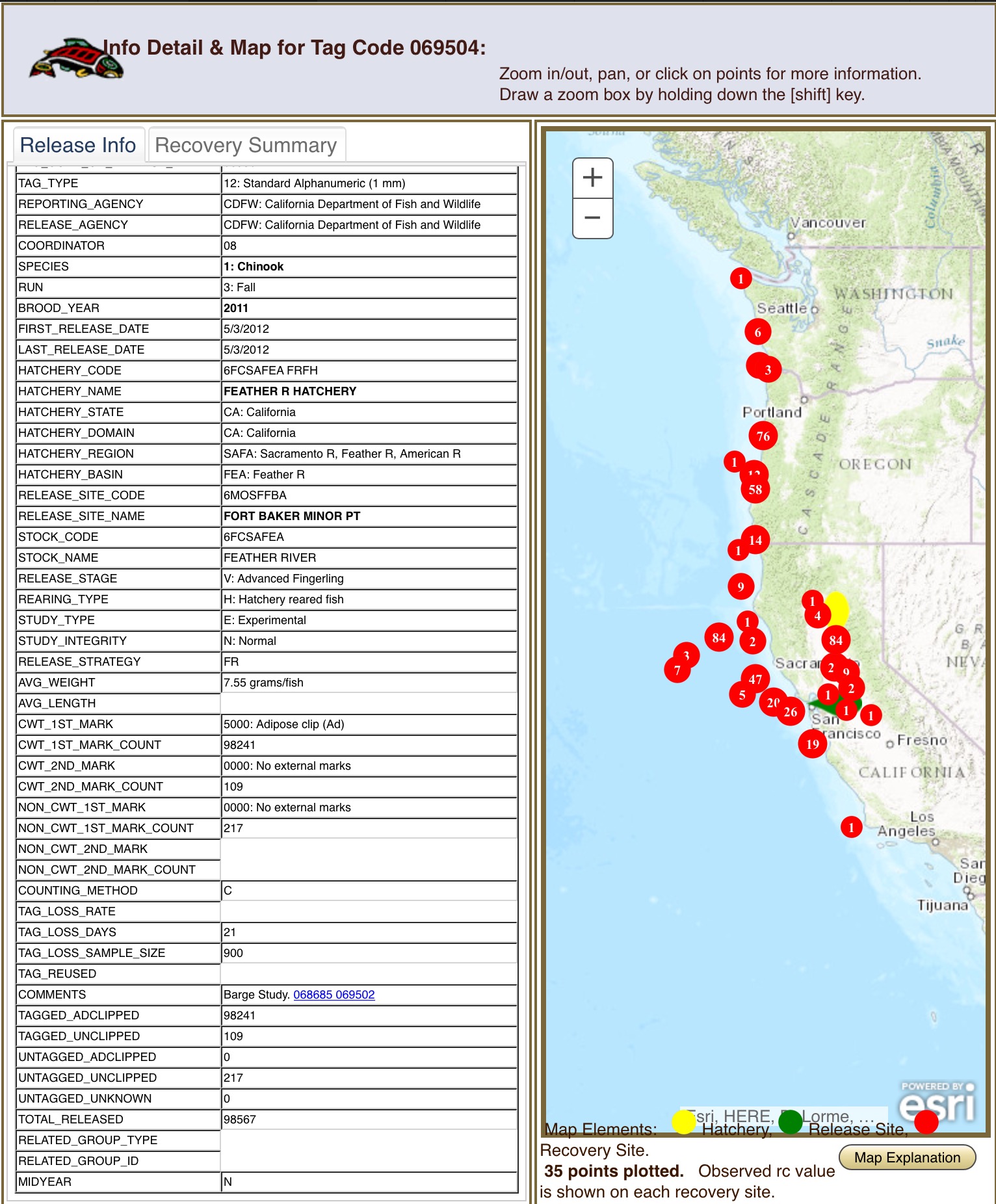
A closer look at the tag-release-recovery data and further experimentation would better answer the questions, concerns, and hypotheses.  There were nine barged groups released into the Bay from 2012-2014.  With some tags still out or not processed (tags are in noses of adult fish returns 2-4 years after release), information continues to come in.  The nearly million or so coded-wire-tags released from the nine barge groups swam with approximately 30 million other tagged fish from the six Central Valley hatcheries.  Furthermore, records are meticulously kept with other tagged groups from Washington and Oregon, as well as from other California watersheds (e.g., Klamath), by the Pacific States Marine Fisheries Commission.  An example of the type of information available is shown in the map-chart below for just the one barge release group from 2012.  The California Department of Fish and Wildlife has its own team and program to keep track of California immense database on releases and recoveries.  The Department’s report from November 2015 provides an excellent review of the whole process and results to date.

Barge in SF Bay

image2

Central Valley Salmon Require Improved Resilience

A suite of disturbances in the Central Valley has eroded many of the inherent characteristics that once conferred resilience1 in historically abundant salmon populations.  Resilience is provided by natural abundance, diverse run timing, multiple habitats, and broad habitat availability and connectivity.  Last November, I recommended a dozen specific actions to save winter-run salmon.  This post focuses on long-term actions to restore resilience in Central Valley salmon populations and fisheries.

Resilience has declined due to the narrowing of optimal adult migration conditions, the confinement of spawning to localized areas and time periods, the limitation of outmigration periods and regional conditions, the confinement of rearing periods, and the amount of and connectivity of geographical habitats.

Confinement of salmon below dams constructed in the 1940’s  took away much of the resilience in the salmon populations.  In the past 70 years, the populations have depended upon a narrowing range of habitat conditions in time and space in the limited spawning habitat below Shasta and other major rim dams, as well as in the migration and rearing habitat between these spawning areas and San Francisco Bay.  The development of the State Water Project further diminished Central Valley salmon’s remaining resilience.

Resilience has been lost in following ways:

  1. Spawning habitat has gradually declined below dams due to lack of new gravel recruitment and the gradual armoring of spawning riffles.
  2. Spawning habitat has declined with weakened management of water temperature below Shasta, narrowing the spawning reach from 40 miles to as little as 10 miles. Early spawning of winter-run salmon in April and May has been lost even in wetter years like 2016 because of flow reductions in these months and because the temperature of water released from Shasta in these months has been increased.
  3. Embryo survival in redds and fry survival in rearing reaches has been compromised by low, warm summer and fall flows. More redds are dewatered with more frequency as water deliveries for irrigation taper off in the fall.
  4. Winter flows that carry juveniles to and through the Delta are lower and more sporadic. Fall and early winter flows and pulses that occurred historically and enhance smolt emigration no longer occur to the extent they once did, particularly in the spawning reaches immediately below the major reservoirs that regulate all the inflow.
  5. With lower and warmer river and Delta flows, salmon predators have become increasingly more effective.
  6. The quality of the physical habitat of salmon, and winter-run salmon in particular, has been adversely modified over time.

Hatcheries can reduce resilience over time if specific precautions are not taken to avoid weakening the gene pool and population diversity, and to avoid interactions with wild fish.  But hatcheries can also be used to strengthen resilience by increasing genetic diversity and spreading populations in time and geographical range.

Habitat restoration can increase resilience by limiting bottlenecks such as lack of spawning gravels or migration corridor connectivity.  Flow and water temperature remain the two most important habitat factors in the Central Valley.  The availability of floodplain rearing habitat is also important.  Reduced winter flooding resulting from global warming and lower reservoir carryover storage levels has reduced habitat resilience over time.  The gradual decline of large wood in Valley rivers over the decades has reduced the rearing capacity of streams and rivers.  River and stream channels have gradually degraded due to scour and the lack of large wood and natural sediment supplies.

A resilience-based approach is likely to be more successful than traditional mitigation or restoration approaches “by seeking to rebuild suites of disturbance-resistant characteristics” that were historically present in the Central Valley.  A resilience-based strategy “emphasizes the diversification of life history portfolios” and “would seek to maintain a diversity of habitat types, including less productive habitats that may have primary importance only as refugia or alternate spawning habitat during disturbances.”  The ultimate goal is to get salmon smolts to San Francisco Bay and the ocean, which offer cold waters and abundant food.

Historically, resilience occurred at all life stages, beginning with an abundance of adults.  With the present depressed adult runs, resilience is thus already handicapped.  Building runs requires restoring resilience of all life stages, starting with egg survival.  Turning around the decades of decline in resilience and increasing it, especially in the short term to avoid extinctions, is a therefore a major, expensive undertaking.  First, we should focus on stopping further declines in resilience.  Second, we should improve resilience where we can to begin the healing.  The following are some suggestions:

  1. Increase the salmon spawning reach below Shasta in time and space by providing better flows and water temperatures. Extend the spawning reach back down to Red Bluff and diversify timing with better early season conditions (e.g., April-May winter run spawning).  Improve physical habitat further downstream toward Red Bluff, not just near Redding.  Extend habitat improvements where possible into tributaries (e.g., Clear and Battle Creeks).
  2. Extend the range of salmon into former habitats, such as the planned improvements on Clear and Battle creeks, and in the reaches above selected rim dams.
  3. Expand the conservation hatchery program to diversify genetics and support expanded range. Select for specific natural genetic traits that have been lost or changed to increase diversity.
  4. Develop and implement a river flow management plan for the Sacramento River downstream of Shasta and Keswick dams that considers the effects of climate change and balances beneficial uses with the flow and water temperature.
  5. Increase the range in time and space of rearing and migratory habitats that accommodate diversity.
  6. Develop and implement a long-term large wood and gravel augmentation2 plan consistent with existing plans and flood management to increase and maintain spawning habitat for salmon and steelhead downstream of dams. Diversify habitats and reduce habitat bottlenecks.  Expand rare and important habitat types.
  7. Counteract where possible the effects of climate change. Where changes in flow and water temperature changes delay smolting, make changes that return diversity.
  8. Provide a more natural diversity of flow pulses immediately below major dams during the emigration season (i.e., December-April) to diversify the timing and life stages of the emigration of juvenile salmon.

A final note:

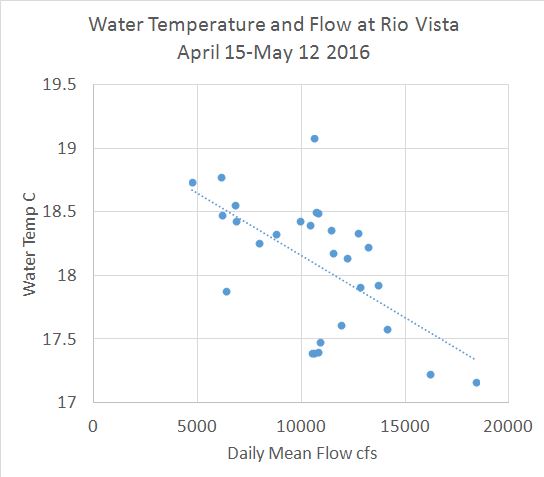
Instead of improving resilience, the Delta “WaterFix” will only cut further into and adversely modify the resilience of the salmon populations.  There will be more demands on Shasta storage to meet new Tunnel diversion capacity.  Flows below the Tunnel intakes will be lower, further reducing resilience by warming through-Delta spring migration routes (Figure 1).  Less freshwater flow into the Delta will further alter Delta habitats and make them more conducive to non-native invasive species of plants and animals.  Delta habitat will be warmer earlier in the season, less turbid, and more brackish.

Figure 1. Water temperature versus mean daily flow at Rio Vista in spring 2016. (Source of data: CDEC). Resilience in terms of Delta migration survival would be reduced by the effects of the proposed WaterFix on water temperature in the Delta spring migration route.

Figure 1. Water temperature versus mean daily flow at Rio Vista in spring 2016. (Source of data: CDEC). Resilience in terms of Delta migration survival would be reduced by the effects of the proposed WaterFix on water temperature in the Delta spring migration route.

  1. Resilience Approach or Portfolio Effect – The “portfolio effect,” is the coexistence of multiple life history strategies within a population – how diversity in life history can increase resilience and stability.
    http://fisheries.org/2016/03/a-resilience-approach-can-improve-anadromous-fish-restoration/
  2.  http://www.redding.com/news/local/gravel-work-to-aid-salmon-2bcbc5bc-999f-2cba-e053-0100007fbf34-369363581.html

State Board: Increase Sacramento River Flow

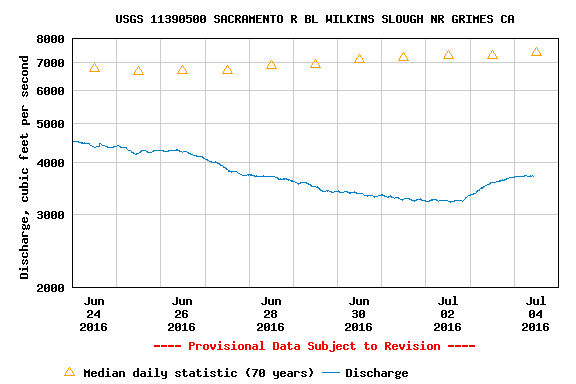
The State Water Resources Control Board is responsible for enforcing water rights and the Sacramento River Basin Plan that protects beneficial uses including fish and water quality.1 The Basin Plan’s 68°F objective for the lower Sacramento River is clearly being violated right now because of low Sacramento River flows brought about by lower than normal Shasta releases and a 100 % allocation of water to Sacramento Valley water contractors. The State Board has jurisdiction over both of these factors through control of water rights. The State Board is about to review Reclamation’s Water Temperature Plan (WTP) for summer 2016, which calls for a 10,500 cfs release in July, several thousand cfs below normal, to conserve Shasta’s cold-water pool for salmon through the summer and fall. The WTP however has no provisions for cutting downstream water use. Thus, flows in the lower Sacramento River will be lower, with higher water temperatures that violate the Basin Plan. The flows must be raised at Wilkins Slough (RM 125) by either increasing Shasta releases or reducing water diversions, or a combination thereof.

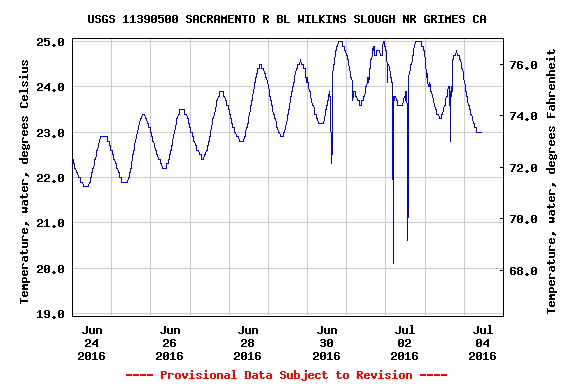
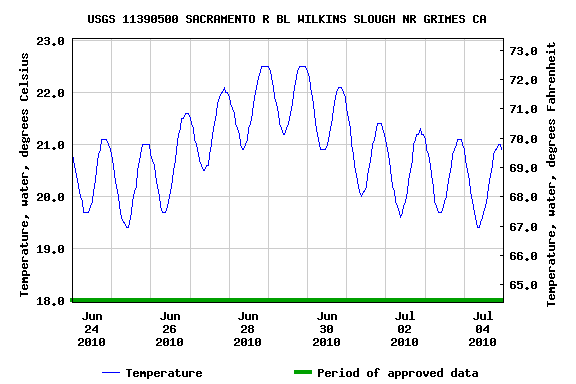
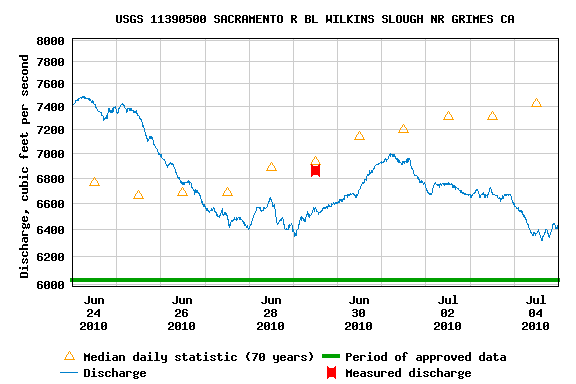
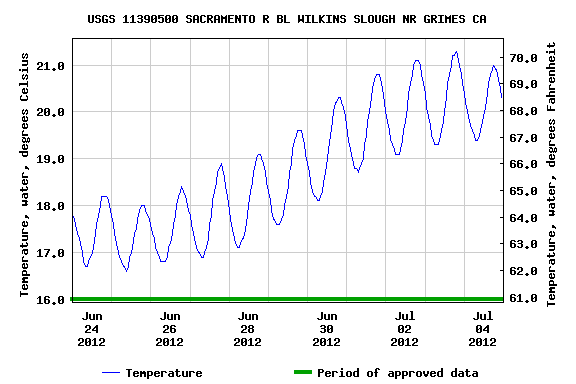
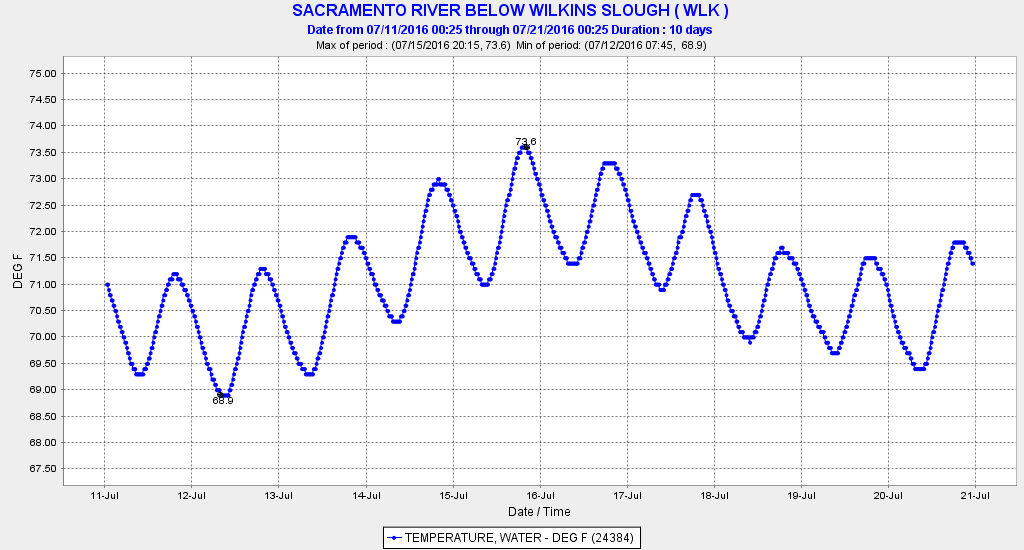
The Basin Plan objective of 68°F is there to protect salmon and sturgeon migrating and rearing in the lower Sacramento River. Water temperatures above 68°F are stressful to the fish, affecting growth, survival, and subsequent reproduction. Present water temperatures in the lower river (Figure 1), caused in part by low flow (Figure 2), are lethal to salmon and sturgeon. In 2010 and 2012, water years similar to 2016, flows were higher and water temperatures were lower in early summer (Figures 3-6).

The State Board, in reviewing the WTP, must explicitly consider flows and water temperatures in the lower Sacramento River under its broader responsibilities to protect fish as prescribed in the Basin Plan and in various water rights orders.

 Figure 1. Water temperature of lower Sacramento River at Wilkins Slough (RM 125) in early summer 2016.


Figure 1. Water temperature of lower Sacramento River at Wilkins Slough (RM 125) in early summer 2016.

Figure 2. Sacramento River flow at Wilkins Slough (RM 125) in early summer 2016.

Figure 2. Sacramento River flow at Wilkins Slough (RM 125) in early summer 2016.

Figure 3. Water temperature of lower Sacramento River at Wilkins Slough (RM 125) in early summer 2010.

Figure 3. Water temperature of lower Sacramento River at Wilkins Slough (RM 125) in early summer 2010.

Figure 4. Sacramento River flow at Wilkins Slough (RM 125) in early summer 2010.

Figure 4. Sacramento River flow at Wilkins Slough (RM 125) in early summer 2010.

Figure 5. Water temperature of lower Sacramento River at Wilkins Slough (RM 125) in early summer 2012.

Figure 5. Water temperature of lower Sacramento River at Wilkins Slough (RM 125) in early summer 2012.

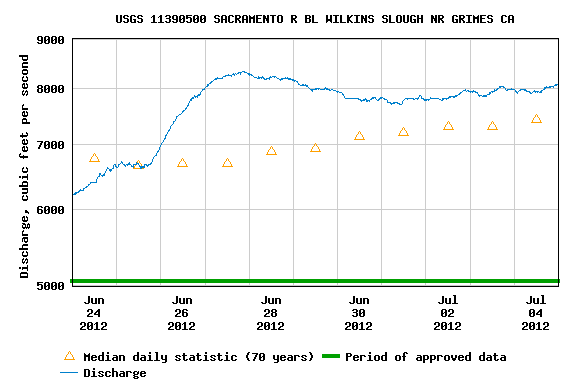
Figure 6. Sacramento River flow at Wilkins Slough (RM 125) in early summer 2012.

Figure 6. Sacramento River flow at Wilkins Slough (RM 125) in early summer 2012.

Salmon Season Opens July 16

The Sacramento River salmon season opens on July 16 in the lower Sacramento River below Red Bluff, and in the lower Feather and American Rivers, as well as in the Bay-Delta. Will the Sacramento River remain cold enough to allow the fall-run salmon to leave the Bay and Delta for the rivers? Are the lower rivers warming into the 72-75°F range that blocks migration and stresses the adult salmon?

Salmon will be headed for the upper river reaches where water temperatures are cool, near 60°F. The Bay and west Delta remain below 70°F. At Rio Vista and Freeport on the Sacramento River in the north Delta water temperature have reached 70°F and are slowly rising. Upstream of the Delta, downstream of the points of relatively cool inflow from the Feather and American rivers, the Sacramento River remains just below 70°F.

Upstream from the mouth of the Feather, water temperatures in the Sacramento River are increasingly problematic. The hundred miles of river upstream from the mouth of the Feather to Hamilton City (RM 200) have a Central Valley Basin Plan upper temperature limit of 68°F in summer to protect the salmon during their run up the river in summer and fall. The only water temperature recorder is at Wilkins Slough, about mid-way in the reach, about 20 miles below Colusa (RM 143). Water temperature at Wilkins Slough has risen from 65°F to 72°F in the past week.

Summer water temperatures at Wilkins Slough vary with air temperatures, but are also determined in part by river flow. In the critically dry year last summer, water temperatures in July approached the lethal level for salmon of 80°F (Figure 1) under very low river flows (Figure 2). In below-normal year 2010, water temperatures were cooler (Figure 3) under higher river flows (Figure 4).

The flow at Wilkins Slough has increased over the past week from 3500 cfs to 5000 cfs, but the water temperature has continued to rise to 72°F with higher air temperatures. With even warmer air temperatures forecasted in the coming weeks, river flow should be increased to 6000 cfs or higher as in 2010 to maintain water temperature below 72°F. Temperatures above this level impede migration and stress adult salmon. A flow of 8000 cfs, as occurred in the summer of dry year 2012, would be more protective (Figures 5 and 6).

Figure 1. Water temperature at Wilkins Slough on the Sacramento River (RM 125) in June-July 2015, a critically dry year.

Figure 1. Water temperature at Wilkins Slough on the Sacramento River (RM 125) in June-July 2015, a critically dry year.

Figure 2. Sacramento River flow at Wilkins Slough in June-July 2015.

Figure 2. Sacramento River flow at Wilkins Slough in June-July 2015.

Figure 3. Water temperature at Wilkins Slough on the Sacramento River (RM 125) in June-July 2010, a below normal year.

Figure 3. Water temperature at Wilkins Slough on the Sacramento River (RM 125) in June-July 2010, a below normal year.

Figure 4. Sacramento River flow at Wilkins Slough in June-July 2010.

Figure 4. Sacramento River flow at Wilkins Slough in June-July 2010.

Figure 5. Water temperature at Wilkins Slough on the Sacramento River (RM 125) in June-July 2010, a dry year.

Figure 5. Water temperature at Wilkins Slough on the Sacramento River (RM 125) in June-July 2012, a dry year.

Figure 6. Sacramento River flow at Wilkins Slough in June-July 2012.

Figure 6. Sacramento River flow at Wilkins Slough in June-July 2012.