June Update and Possible Solution to 2016 Fish Woes

Over the past month I related water issues involving Delta and longfin smelt, striped bass, green and white sturgeon, and winter-run and spring-run salmon. All of these species need river flow and cooler water over the next several months. Shasta releases to the upper Sacramento River need to be cold, stable, and sufficient to sustain winter-run salmon eggs in the river near Redding and to sustain moderate flows and cooler water temperatures for 200 miles of river to protect sturgeon and other lifestages of salmon. Sufficient flows needs to pass through the Delta to keep the low salinity zone downstream of the Delta in the cool waters of eastern Suisun Bay, away from Delta exports.

Shasta releases are now 8000 cfs, with Bend Bridge water temperature near the Red Bluff target of 56°F. In June and July of drought years 2012 and 2013, releases were 11,000-14,000 cfs. However, concern over carryover storage and sustaining cold-water releases through summer has led to a more conservative management strategy in 2016. The cold-water pool in Shasta Reservoir is being rationed to make it through the summer. Flows will rise over the next six weeks to 9,000 or 10,000 cfs to satisfy irrigation demands in the upper river.

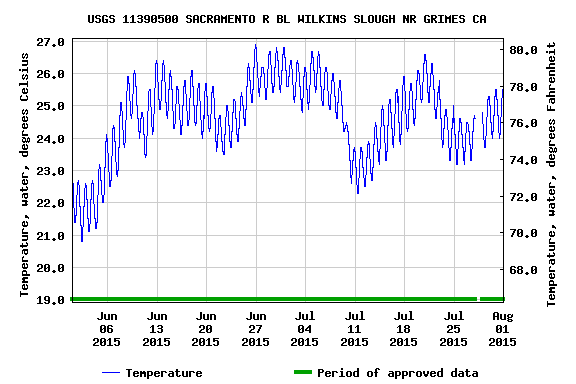
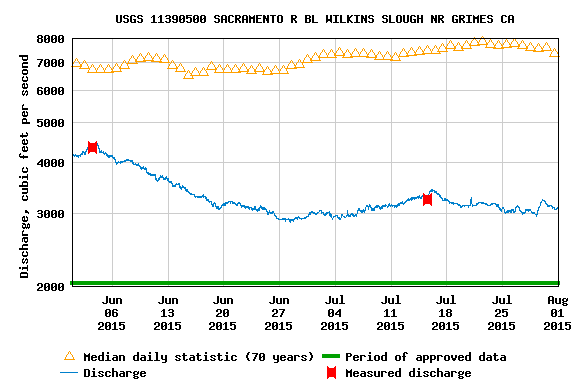
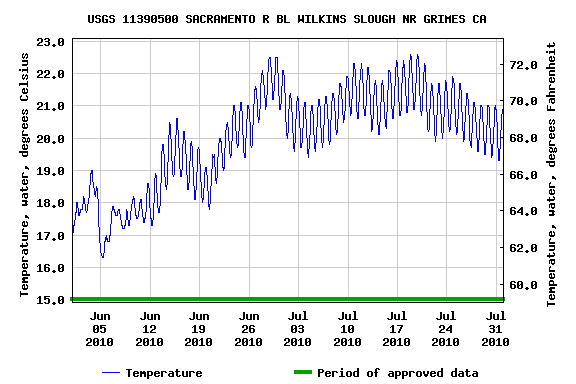
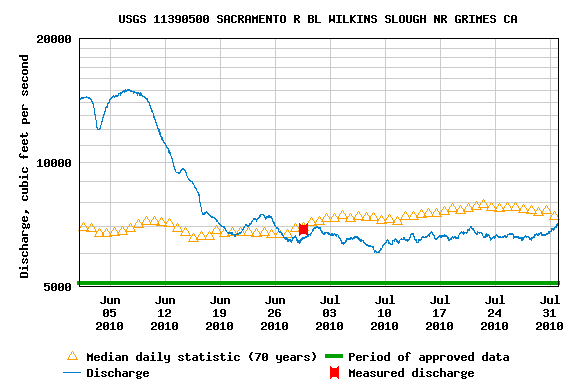
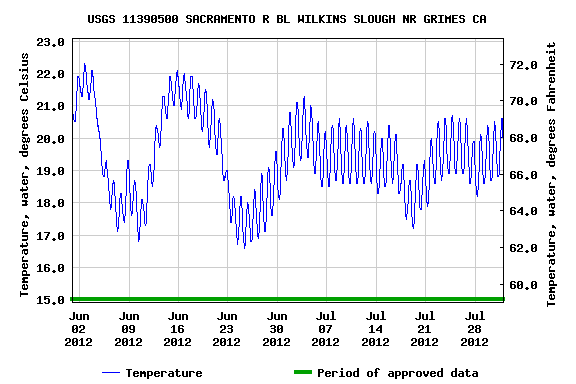
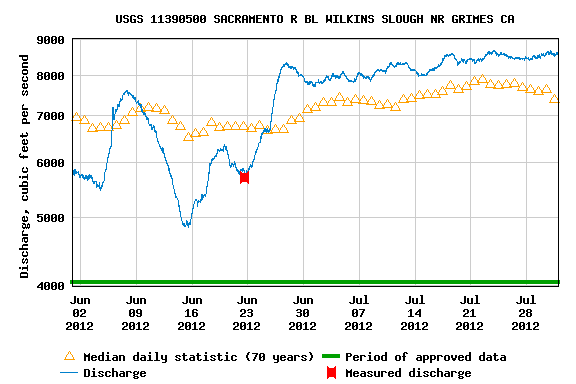
Flows in the lower Sacramento River at Wilkins Slough need to be greater than 5000 cfs in summer, if only to keep water temperature down closer to the Basin Plan’s 68°F. Flows are now 3000-4000 cfs, with water temperatures up to 75°F. In dry years 2012 and 2013, flows at Wilkins Slough were 6000-9000 cfs, and water temperatures were cooler, as some of Shasta’s storage was allocated for Delta export. This year’s management strategy to hold back Shasta releases will, if continued, keep both Wilkins Slough flows and Delta exports down.

Delta outflows need to be sustained near 10,000 cfs to keep the low salinity zone and X2 (2 ppt salinity) near Collinsville in eastern Suisun Bay. However, July outflow to the Bay required by water quality standards will be only about 8000 cfs. To help save the last of the two smelt species, 10,000 cfs would be far better.

A reasonable solution is apparent: raise Shasta releases through most of the summer by 2000 cfs to 10,000-12,000 cfs and require that the extra release be passed down the river to and through the Delta. While such a management strategy would benefit the fish, it would decrease Shasta storage by 120,000 acre-ft of water per month. At present, Shasta is 90% full at 4.1 million acre-feet (the cold-water pool volume is about 2.4 maf). At 12,000 cfs, the total Shasta release would rise to 600,000 acre-feet per month, which is about the current total release from Oroville (Feather River) and Folsom (American River) reservoirs. NMFS and USBR have determined that a 10,000 cfs Shasta cold-water release can be sustained through the summer, while a 12,000 cfs release could be problematic. Protests would no doubt come from water users who would want the extra 2000 cfs. But note that of the 20,000 cfs being released today from the three main Sacramento Valley reservoirs, only 8000 cfs is reaching the Bay.1

This solution of raising total reservoir releases to 22,000-24,000 and Bay outflow to 10,000 cfs is reasonable to help the fish after four years of drought. In 2014-2015, water quality standards were drastically reduced, with catastrophic effects to fish. The continuing legacy of these catastrophic effects creates the urgency to do better in 2016.

If higher releases from Shasta become problematic for whatever reason, then some compromise should be achievable, noting that water deliveries of Shasta water are to be provided only after the needs of the fish are first considered, including conservation of Shasta’s cold-water pool through the summer and early fall (Water Rights Orders 90-05 and 92-02). Further, Central Valley water rights are provided via the Trinity River trans-basin diversion to Keswick Reservoir on the Sacramento River below Shasta Dam, but the Trinity supply is much in doubt because Trinity storage has failed to recover after the drought, unlike Shasta storage. A lack of Trinity supply this summer will further limit water available for irrigation in the Central Valley. Yet another constraint is whether the available storage in Oroville and Folsom reservoirs is able to satisfy Delta demands without compromising the needs of endangered fish in the Feather and American rivers.

Sorting out these conflicts and needs is the responsibility of the State Water Resources Control Board. The Board’s top priority should be the basic needs of the endangered salmon, sturgeon, and smelts of the Central Valley. At minimum, the Board should require the following conditions this summer:

  1. Below Shasta – Stable flows of 9,000 to 10,000 cfs and 56°F average daily water temperatures near Red Bluff (Jellys Ferry or Bend Bridge).
  2. Lower Sacramento River – minimum 5000 cfs at Wilkins Slough (RM 125 on the Sacramento River)
  3. Delta Outflow – 9,000 cfs in July, 5,000 cfs in August, and 4,000 cfs in September.
  1.  A further complication is that South Delta export criteria allow an increase from 35% of inflow to 65% starting July 1.  Exports in June are limited to 5000 cfs.  In July, exports can be raised to 65% of inflow, but only if outflow is kept at 8000 cfs.  Delta ag diversions are also near 4000 cfs.  Thus July Delta inflow of  20,000 cfs or more (compared to the present inflow of 15,000 cfs) would be needed to allow 10,000 cfs of Delta export.  

Spring 2016 Efforts to save Salmon in the Sacramento River below Shasta

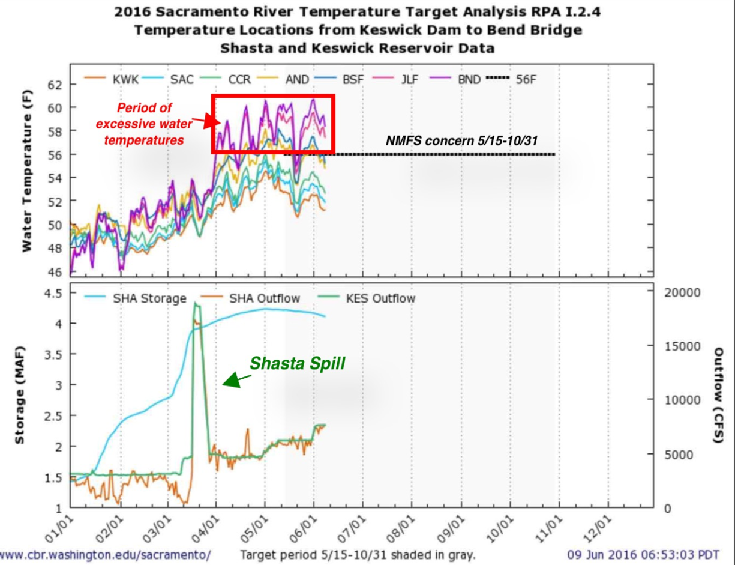
Management of flows and water temperatures in the upper Sacramento River near Redding for endangered salmon is frequently presented to the public as complicated, but it is really not that difficult to understand.  Chart 1 below depicts about everything that is involved with Sacramento River flows and their history so far this spring.  The box outlined in red indicates what has been wrong this spring.  The high temperatures shown in this box have hurt winter-run salmon, spring-run salmon, late-fall-run salmon, and green sturgeon, as well as fall-run salmon, steelhead, trout, and white sturgeon.  All of these species have suffered unnecessarily from this spring’s water management below Shasta.

Graph of Management of flows and water temperatures in the upper Sacramento River near Redding for endangered salmon is frequently presented to the public as complicated, but it is really not that difficult to understand. Chart 1 below depicts about everything that is involved with Sacramento River flows and their history so far this spring. The box outlined in red indicates what has been wrong this spring. The high temperatures shown in this box have hurt winter-run salmon, spring-run salmon, late-fall-run salmon, and green sturgeon, as well as fall-run salmon, steelhead, trout, and white sturgeon. All of these species have suffered unnecessarily from this spring’s water management below Shasta.

Chart 1. Latest update (6/9/16) from USBR on management of the upper Sacramento River below Shasta for winter-run Chinook salmon. The “spill” in late March was a managed flood release of over 200,000 acre-feet of storage, which kept Shasta (SHA) from filling (4.5 MAF). A key list of the location abbreviations pictured can be found in Table 1 at end of this post. A map of the locations is shown in Chart 3.

The red box in Chart 1 shows that water temperatures since April 1 have exceeded the 56°F target water temperature as defined in the State’s Sacramento Valley Basin Plan, the State’s Water Right Order 90-05 for Shasta Reservoir, and NMFS’s Biological Opinion for salmon and sturgeon as it applies to Shasta operations. These standards have been in place for many decades and are based on sound science.

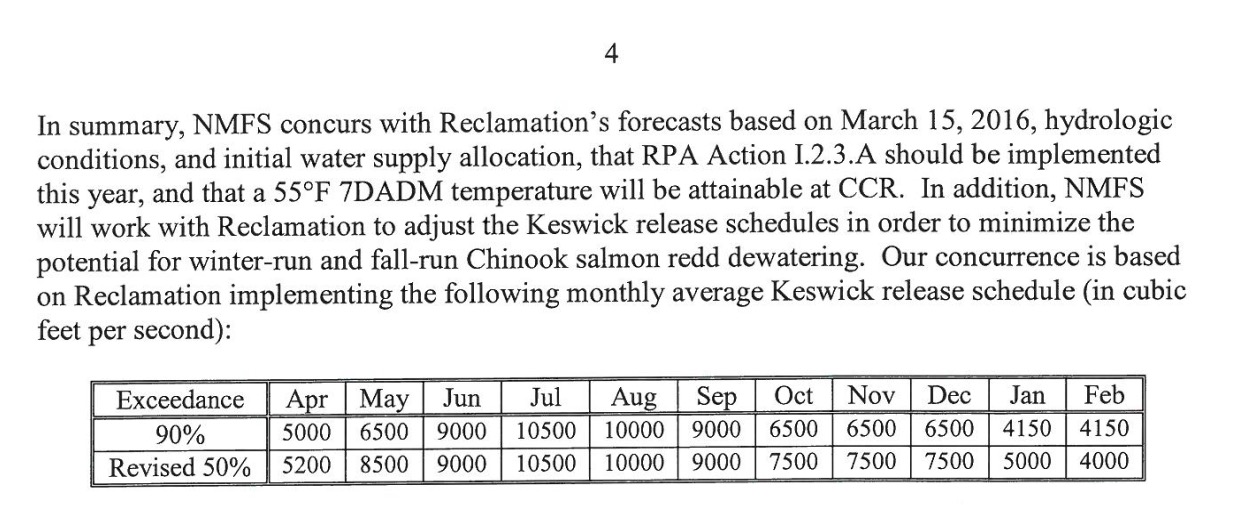
In a March 31, 2016 letter to Reclamation1, a week after the flood control release from Shasta, NMFS stated: “Winter-run brood years in 2014 and 2015 experienced very low egg-to-fry survival to Red Bluff as a result of high water temperatures during their egg and alevin incubation stages. As brood year 2016 is the third of three winter-run cohorts, it is very important to operate Shasta Reservoirs conservatively to provide and maintain adequate water temperatures throughout the winter-run early life stages.” The letter concludes as shown immediately below:

Conclusion of NMFS Letter

So, within a week of the flood release, and based on a pre-spill March 15 forecast by Reclamation, NMFS changed the management compliance point to 55°F 7-day-average-daily-maximum at CCR (Bonneville Bridge in Redding) as a surrogate for a 56°F daily compliance at Balls Ferry (BSF) and Jellys Ferry (JLF). Note that Chart 1 above shows that this surrogate did not satisfy the requirements for either BSF or JLF. Note also that none of the flows prescribed in the table above for April (was 4700), May (6000), or June (7500 so far) have been met. (These flows should have been daily average minimum flows, not monthly averages.)

In an April 22 letter to Reclamation, the Pacific Fisheries Management Council recommended a 56°F compliance point at Jellys Ferry (JLF). That too has been exceeded in May and June.

In a May 2 letter, NMFS changed the compliance point to Keswick Dam: “We will continue to use the maintenance of 52°F daily average temperature (DAT) at Keswick Dam as an indicator of the ability to meet 55°F 7-day average of the daily maximum temperatures (7DADM) at the Bonnyview Bridge temperature compliance point (CCR CDEC location) throughout the temperature management season.” Note this new Keswick criterion was not met in late April or early May, but seems to be controlling after mid-May (Chart 1).

So why has there been so much compromise this spring (red box, Chart 1)? Why not simply meet the longstanding objective of keeping the daily average water temperature at Bend (BND) near Red Bluff? The reason is an unfounded fear by the managing agencies that they will run out of cold water in Shasta before the end of summer, as occurred in 2014 and 2015. Storage in Shasta in spring 2016 started with 4.2 maf. In contrast, storage in Shasta in spring 2014 and 2015 started out at 2.4 and 2.7 maf, respectively. Storage in Shasta in spring 2013 started out at 3.8 maf and met the standard. Storage in Shasta in spring 2009 started out at 3.2 maf and met the standard. There was more cold-water volume stored in Shasta this spring than the total spring storage in 2009 or 2013.

Between March 18 and March 28, 2016, a “flood release” of over 200,000 AF occurred, but the reservoir storage still rose from 3.9 to 4.0 maf. Most of the water released during the flood release was warmer surface water (Chart 2). Even then, the average water temperature from the surface outlets (upper gates) was only 48-50°F.

There is simply no information that indicates the reservoir will run out of cold water by the end of summer. Even Reclamation’s own conservative modeling indicates that a compliance point of 56°F at Balls Ferry can be met, which appears to be the present target in early June (Chart 1).

In conclusion, there is no reason why the Bend or at least the Jellys Ferry 56°F compliance point cannot be met. Perhaps more important is NMFS’s prescribed 9000 cfs June Keswick release. The lower release of 7500 cfs so far in June has resulted in (and allowed) the increased water temperature at Bend (and Red Bluff). These low flows and higher temperature (60-62°F at Red Bluff and higher downstream) have, in addition to adding stress on winter-run salmon, also jeopardized green sturgeon, white sturgeon, spring-run salmon, and steelhead (see previous post). Of the present 7500 cfs release, over 5000 cfs is diverted by downstream Sacramento CVP water contractors. An extra 2000 cfs Keswick release would increase mid-river flows at Wilkins Slough from the existing level of 3000-4000 cfs to 5000-6000 cfs, which would lower Water temperature at Wilkins at least several degrees from daily highs of 75-78°F, which are lethal to migrating adult salmon and young sturgeon.

Chart 2

Chart 2. Shasta Dam Temperature Control Device configuration on March 15, 2016.

Upper Sacramento Monitoring Stations

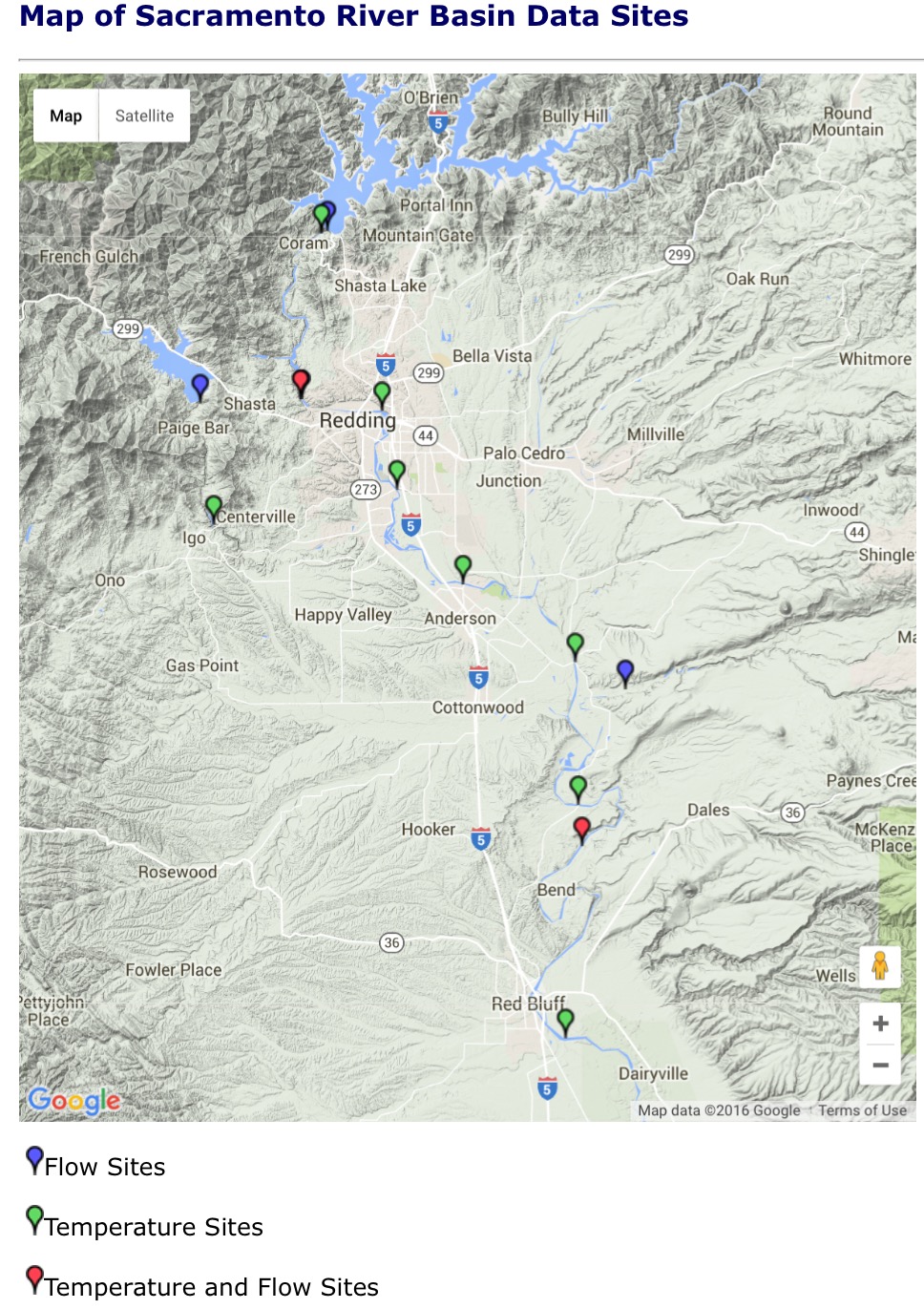
Chart 3. Map of key monitoring stations in upper Sacramento River below Shasta.

abbreviations list

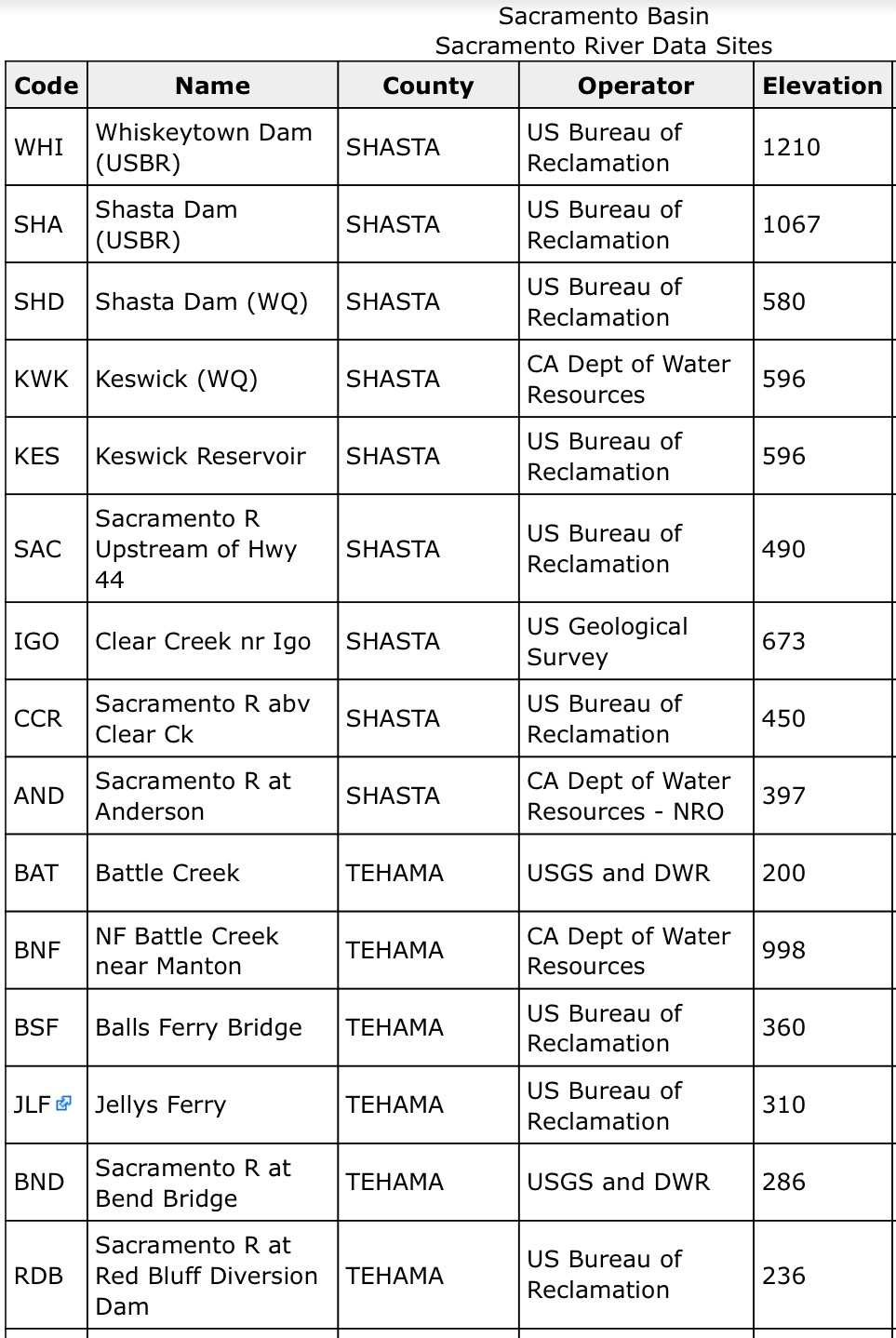
Table 1. List of abbreviations for locations in Chart 1. A map of locations is shown in Chart 3 above.

Spring-Run Chinook Salmon – why they fail to recover

Spring-run are the most prized of the four runs of Central Valley, West Coast, and Alaska Chinook because they leave the ocean with the biggest stores of fat energy and strength to sustain them through to spawning. They are prized for sport and table value.

Spring-run are perhaps best adapted of the four runs to California’s Central Valley because they migrated upstream with the snowmelt in spring. Dependable high cold flows allowed access to colder-summer mountain habitats. Yearling smolts emigrated to the ocean in the same snowmelt period.

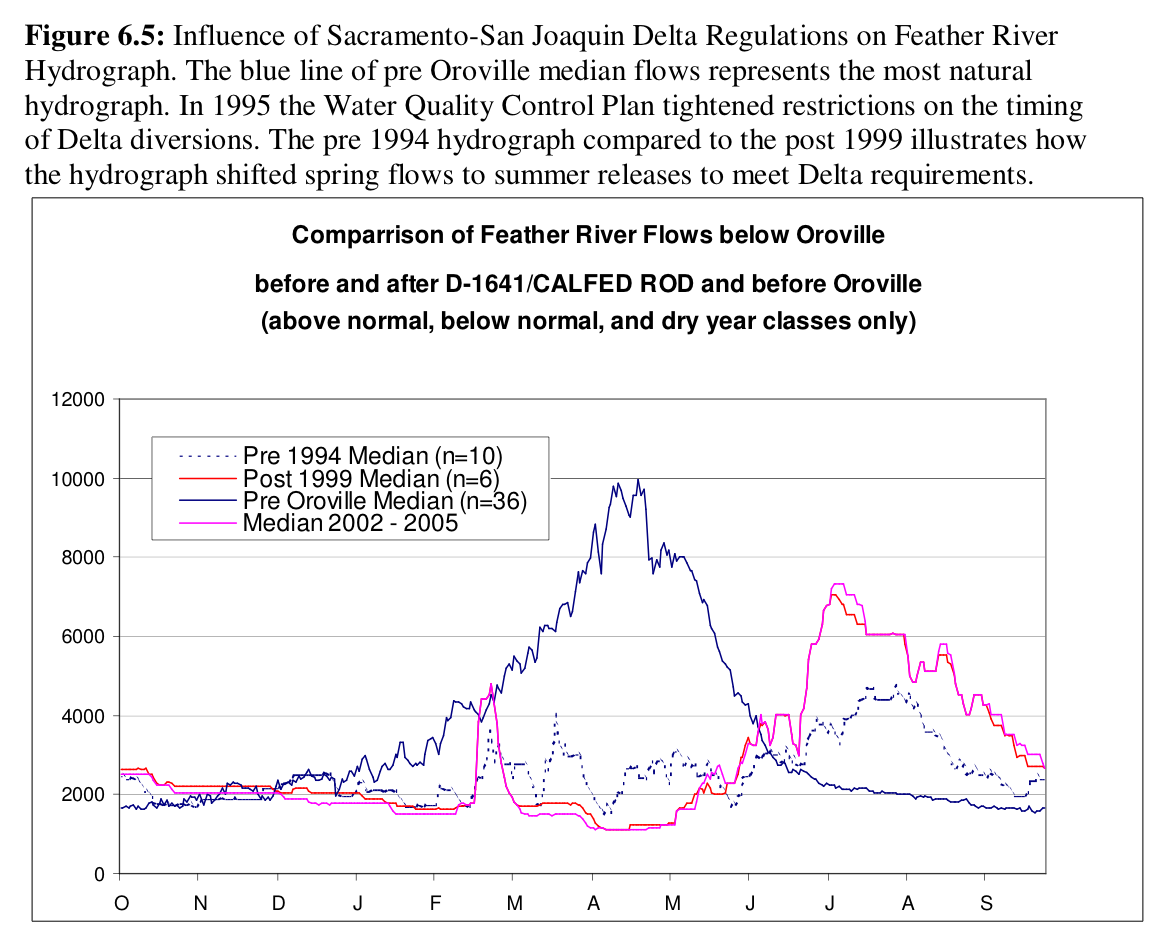
Construction of rim dams captured the snowmelt and blocked migrations, leading to dramatic declines in run size. Runs were confined to a few un-dammed streams (e.g., Mill and Deer creeks) or below dams (e.g., Shasta Dam). Reservoir storage and water diversions in many Valley streams further blocked migrations and reduced flows (Chart 1) and raised water temperatures.

Central Valley runs that once numbered in the hundreds of thousands or more are now down to a few thousand. Multimillion dollar efforts have been underway now for several decades to restore spring-run. The spring run goal for the Central Valley Project Improvement act of 1992 is 59,000 spring-run below Shasta in the Sacramento River. The average run size from 1992-2012 was 684. The primary reason for lack of recovery is low flow and high water temperatures in spring in the lower Sacramento River and spawning tributaries. No river or creek has been unaffected, and so the spring-run have rapidly declined. (See references for early reports on spring-run and their decline.)

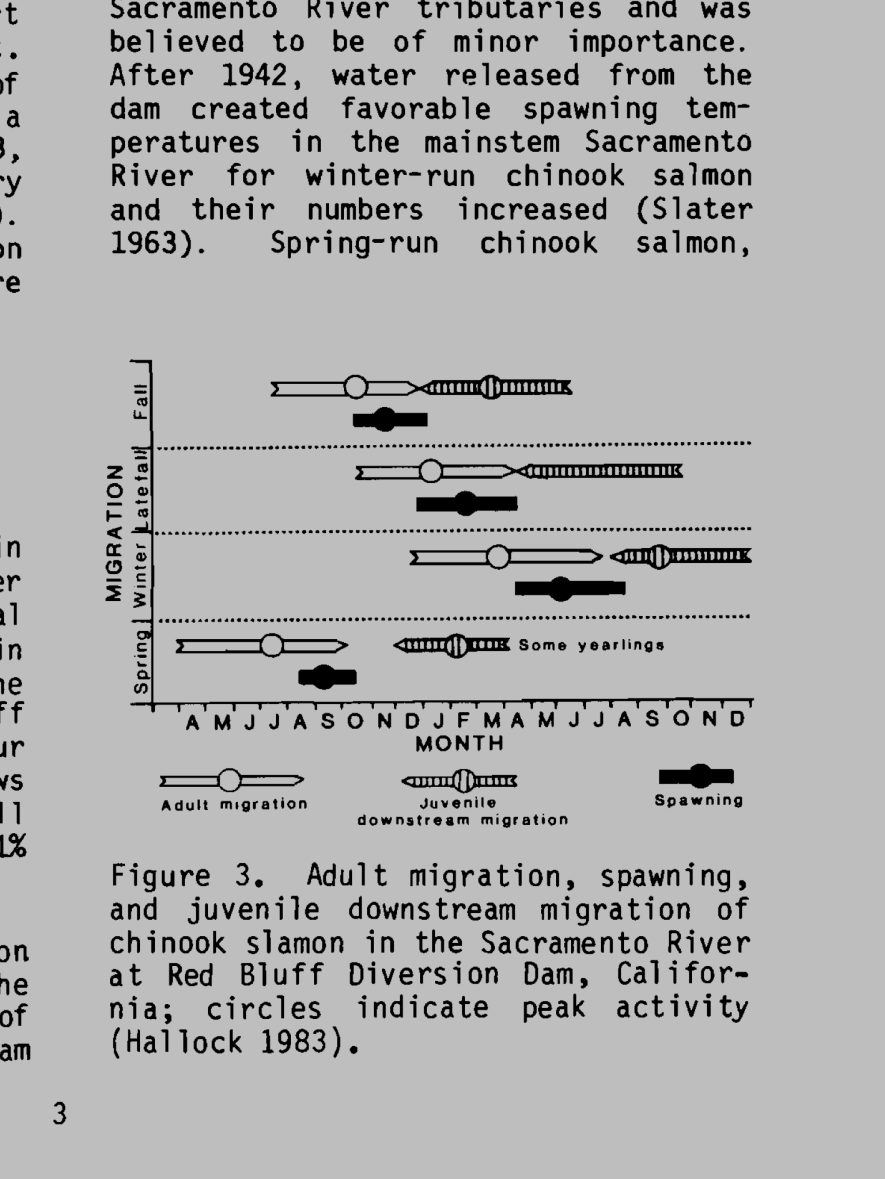
Peak migration of adult spring-run Chinook into the upper Sacramento occurs in May and June.1 About 80% of the spring-run passes Red Bluff after May 15. The adults oversummer in the upper Sacramento River and its tributaries before spawning in September and October. During migration and oversummering they require cold-water habitat for survival and the maturation of their gonads. Lack of cold water habitat reduces the viability of their eggs and sperm and subjects adults to poor survival from disease, energy loss, and heat stress.
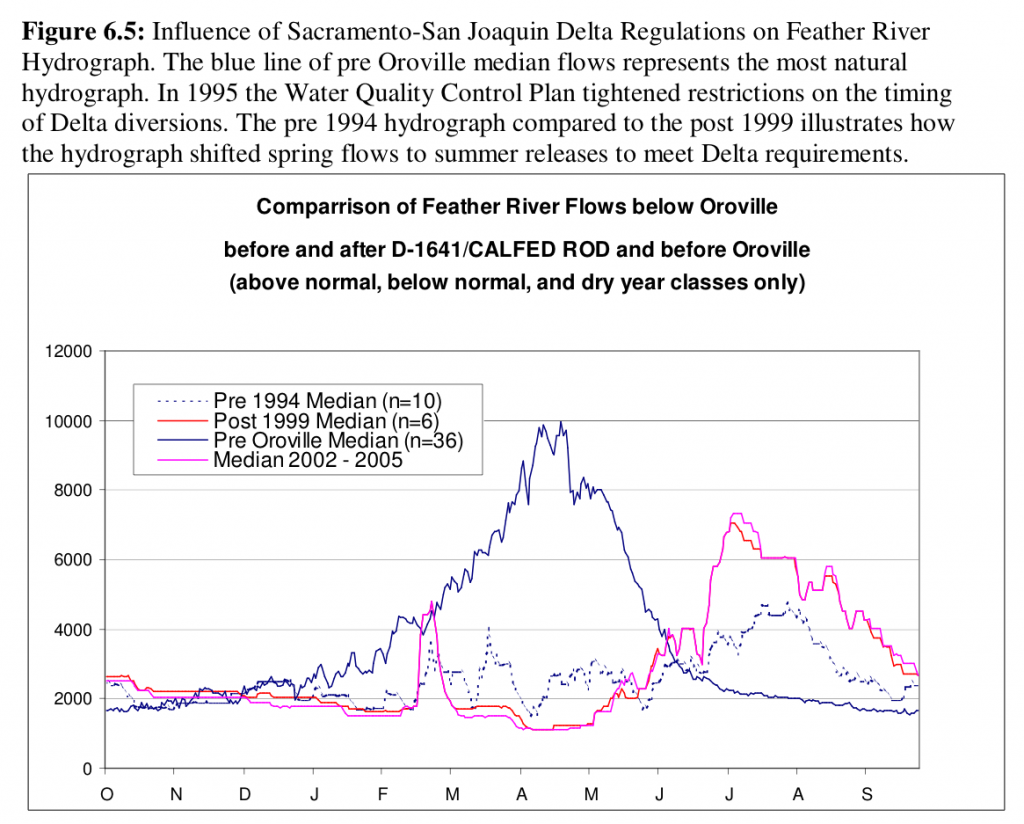
Chart 1. Example of spring snowmelt being captured by dams – Feather River. (Source: NHI 2008 )

Chart 1. Example of spring snowmelt being captured by dams – Feather River. (Source: NHI 20082)

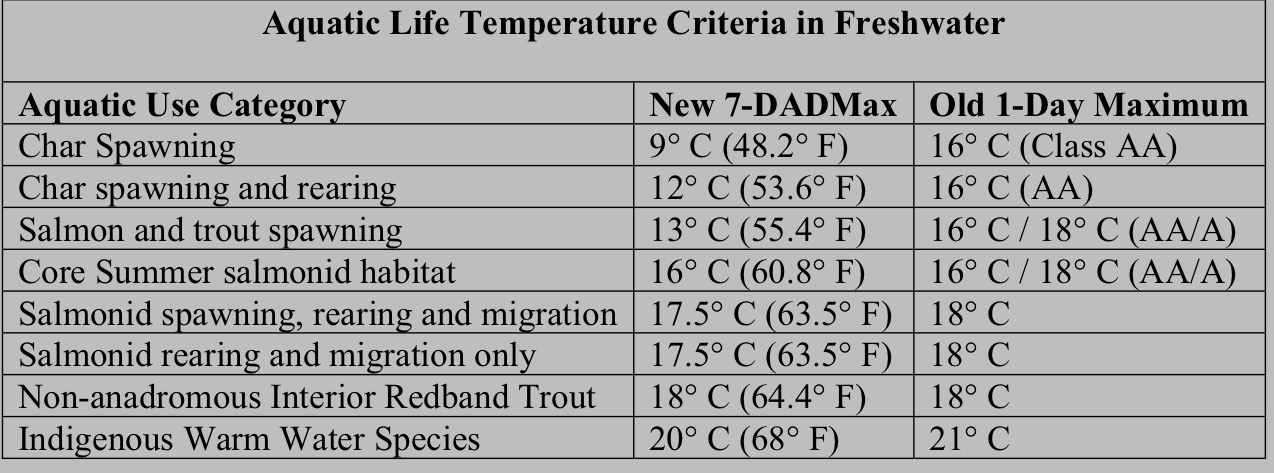
Of the four runs, spring-run are also the hardest to recover. The main reason is because they migrate from the ocean to their spawning rivers in spring, they are increasingly at risk to warm spring water temperatures in the lower Sacramento River. Water temperatures of 70°F or higher are detrimental to migrating salmon, and spring-run are especially at risk because much of the Valley’s cold snowmelt is captured and held in rim dam reservoirs. Those spring-run headed for un-dammed tributaries must still pass through the lower Sacramento River. NMFS’s criteria that define water temperature habitat degradation are shown in Chart 2 below. Water temperatures above 65°F are unsafe for salmon migration. In the Basin Plan the water temperature standard set by the State for the lower Sacramento River is 68°F to protect migrating salmon and other cool-water dependent fish (e.g., sturgeon and steelhead). Water temperatures of 72-74°F can block or severely delay migration.3 An excellent review of water temperature requirements of salmon by CDWR and Stillwater Sciences4 describes water temperatures above 65°F as being detrimental to migrating spring run salmon.
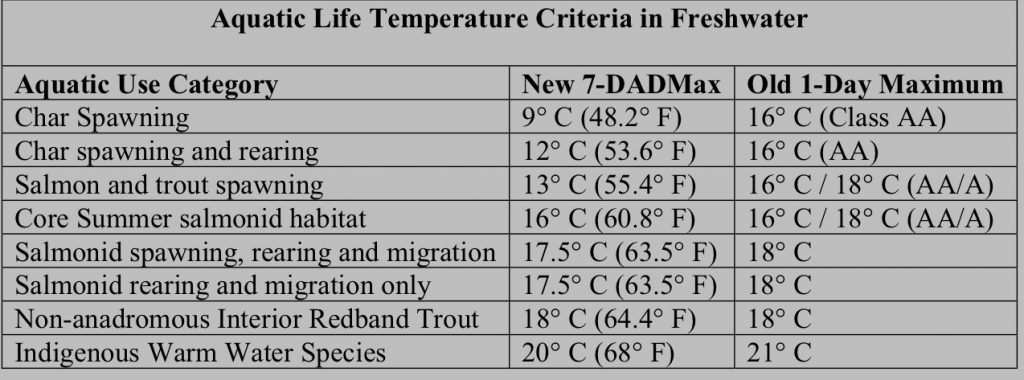
Chart 2. Aquatic life temperature criteria for freshwater. 7DADMax is the seven running average of the daily maximum water temperature. 1-Day Maximum is the daily average water temperature. (Source: NMFS).

Chart 2. Aquatic life temperature criteria for freshwater. 7DADMax is the seven running average of the daily maximum water temperature. 1-Day Maximum is the daily average water temperature. (Source: NMFS).

Water temperatures typically exceed 68°F in spring in the lower Sacramento River (Charts 3 and 4). In drier years high water temperatures may even block migration (72-74°) or kill adult salmon (>75°F). The high spring water temperatures are due in large part to low flows above (3000-5000 cfs) and below (5000-7000 cfs) the mouth of the Feather River at Verona (RM 80). A closer look at 2016 at Wilkins Slough (Charts 5 and 6) and Verona (Charts 6 and 7) show the relationship between flow and water temperature. While air temperatures and tributary water temperatures (particularly the Feather River at Verona) likely also played a part in patterns observed, the overall pattern from 2008 to 2016 indicates higher water temperature are a consequence of low river flows. Flows of 10,000 cfs and higher in May-June of 2010 and 2011 led to to water temperatures below 65°F. Intermediate flows (8000-10,000 cfs) in May-June 2012 and 2013 led to water temperatures from 68-70°F.

The issue of low river flows and high water temperatures in spring has received little consideration in drought management plans, salmon biological opinions, and the NMFS Central Valley Recovery Plan. The only consistent attention has been centered around reducing Shasta releases and lowering flows at Wilkins Slough to save Shasta storage and cold-water pool in dry years. Even this spring, with a full Shasta Reservoir, the overwhelming concern for saving the Shasta cold-water pool has led to minimum releases and Wilkins Slough flows near 3000 cfs. Mention is rarely made of meeting the Basin Plan 68°F criterion for the lower Sacramento River. If anything was mentioned, it was for allowing a reduction in spring flows below Keswick and at Wilkins Slough to 3000-4000 cfs to save Shasta storage and cold-water pool. Most of the required water for Delta inflow has come from the Feather and American Rivers.

Another problem rarely mentioned is warm water discharges, especially agricultural drainage into the lower Sacramento River in spring. Water temperatures from these considerable sources can easily exceed 80°F. The Knights Landing Outfall of the Colusa Basin Drain is one such source. I once measured 80°F on May 1 at the mouth of the Feather River during the peak season of the Feather’s substantial spring-run.

The operations that imperil spring-run create a serious issue that deserves much more attention. Increasing Wilkins Slough flows by several thousand cfs would go a long way to reducing this year’s problem. This would require up to 200,000 acre-ft of Shasta storage, or about 5% of the 4.2 maf of present storage. The added flow would help maintain winter-run spawning near Redding in June and improve Delta inflow/outflow and perhaps exports. At present, 7,000 cfs is being released at Keswick, with only 3000 cfs reaching Wilkins Slough. The difference is being diverted from the upper river by CVP water contractors.
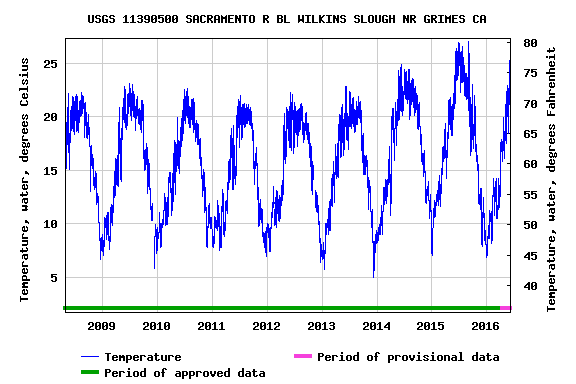
Chart 3. Water temperature of the Sacramento River at Wilkins Slough (RM 125) from May 2008 to early June 2016. Higher water temperature in May-June 2014 and 2015 drought years and 2016 occurred at May flows of 3000-5000 cfs.
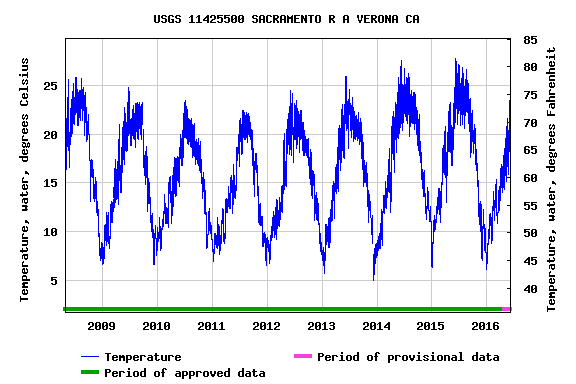
Chart 3. Water temperature of the Sacramento River at Wilkins Slough (RM 125) from May 2008 to early June 2016. Higher water temperature in May-June 2014 and 2015 drought years and 2016 occurred at May flows of 3000-5000 cfs.

Chart 4. Water temperature of the Sacramento River at Verona (RM 80) from May 2008 to early June 2016. Higher water temperature in May-June 2014 and 2015 drought years occurred at flows of 5000-7000 cfs.
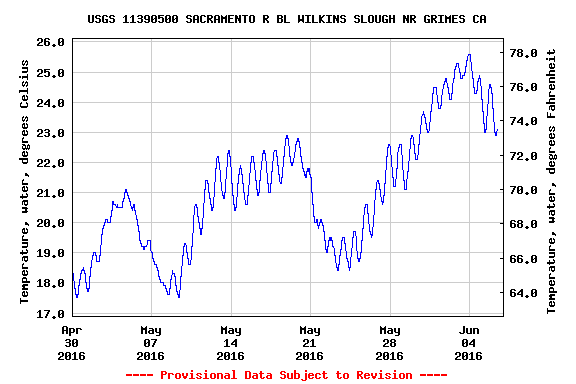
Chart 4. Water temperature of the Sacramento River at Verona (RM 80) from May 2008 to early June 2016. Higher water temperature in May-June 2014 and 2015 drought years occurred at flows of 5000-7000 cfs.

Chart 5. Water temperature of the Sacramento River at Wilkins Slough (RM 125) from May to early June 2016.
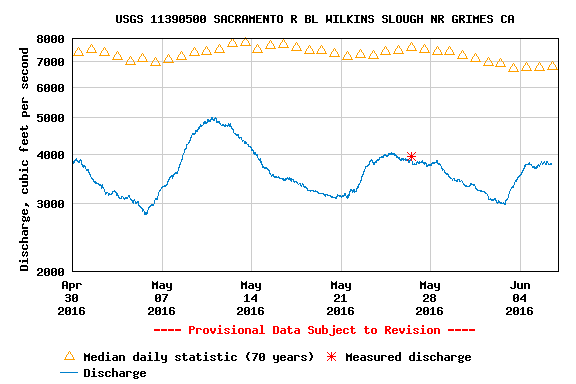
Chart 5. Water temperature of the Sacramento River at Wilkins Slough (RM 125) from May to early June 2016.

Chart 6. Flow in the Sacramento River at Wilkins Slough (RM 125) from May to early June 2016.
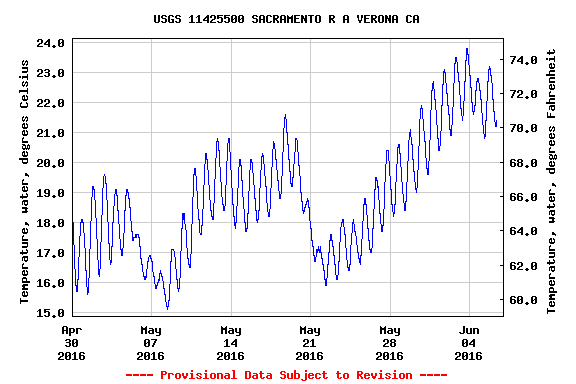
Chart 6. Flow in the Sacramento River at Wilkins Slough (RM 125) from May to early June 2016.

Chart 7. Water temperature of the Sacramento River at Verona (RM 80) from May to early June 2016.
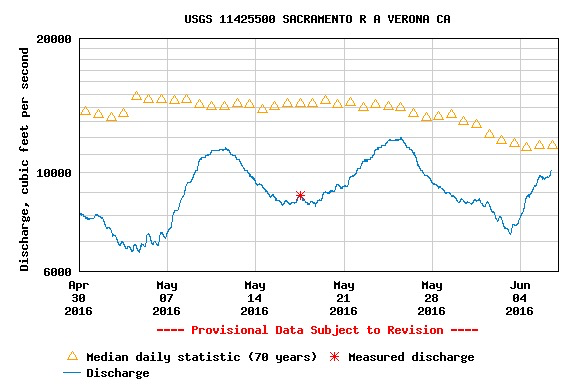
Chart 7. Water temperature of the Sacramento River at Verona (RM 80) from May to early June 2016.

Chart 8. Flow in the Sacramento River at Verona (RM 80) from May to early June 2016.

Chart 8. Flow in the Sacramento River at Verona (RM 80) from May to early June 2016.

References

Hallock, R.J. 1983. Sacramento River king salmon life history patterns a t Red Bluff, California. Unpubl. Central Valley Project report, California Department of Fish and Game, Red Bluff.

Hallock, R.J.., and D.H. Fry. 1967. Five species of salmon, Oncorhynchus, in the Sacramento River, California. Calif. Fish Game 53:5-22.

Hallock, R.J., and W. F. Van Woert. 1959. A survey of anadromous fish losses in irrigation diversions from the Sacramento and San Joaquin Rivers, Calif. Fish Game 45:227-296.

Hallock, R.J., R.F. Elwell, and D.H. Fry. 1970. Migrations of adult king salmon, Oncorhynchus tshawytscha, demonstrated by the use of sonic tags. Calif. Fish Game Fish Bull. 151. 92 pp.

Anadromous Fish Restoration Program of CVPIA – http://www.fws.gov/stockton/afrp/
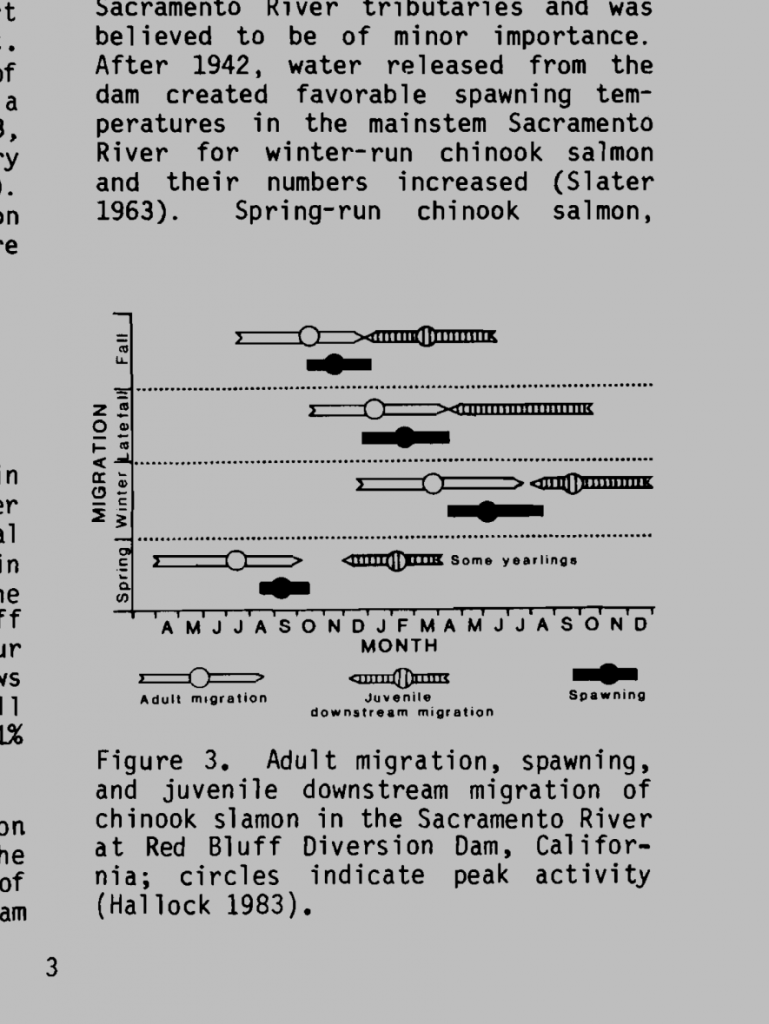
image10

image9

  1. Yoshiyama, R. M., F. W. Fisher, and P. B. Moyle. 1998. Historical abundance and decline of Chinook salmon in the central valley region of California. North American Journal of Fisheries Management. 18(3):487–521.
  2. http://www.n-h-i.org/uploads/tx_rtgfiles/FINAL_Sacramento_and_Feather_Env_Flows_Doc.pdf
  3. http://www.tandfonline.com/doi/abs/10.1577/T09-171.1?journalCode=utaf20
  4. http://www.water.ca.gov/pubs/environment/fish/ upper_yuba_river_watershed_chinook_salmon_and_ steelhead_habitat_assessment/yuba_salmon.pdf

Puget Sound Salmon Fishing – Closed Until Further Notice

For the first time in almost 30 years, there may be no salmon fishing in Puget Sound in 2016.  Several reasons are apparent for this situation.  First, the Coho salmon returns this year are projected to be very poor as a result of unfavorable ocean conditions and the drought in many Washington streams that occurred last year.  The projected returns of adult Coho salmon are very low (particularly for non-hatchery or wild fish that are listed as “threatened” under the Endangered Species Act).  There are also concerns about low returns of wild Chinook salmon.

Seasons in Washington are set on an annual basis by the co-managers of the resource.  These co-managers are the Washington Department of Fisheries (WDFW), which represents the non-Indian sport and commercial fishermen on one side and the Indian tribes in Puget Sound, which represent the interests of about 20 different tribes.  This co-management approach evolved after the Judge Boldt decision in 1974 that established the 50/50 split on harvest between the two entities.  Initially, the court system set regulations, but the co-management approach evolved shortly thereafter to let the resource managers set the seasons rather than the court system.

Under the co-management process, seasons have been negotiated and set in the early spring each year.  The co-managers meet, present their positions based on the information each has (including models of the fish returns), discussions are conducted, and the seasons are mutually agreed upon.  These negotiated regulations are then forwarded to the North Pacific Fisheries Management Council, which then provides final review and approval.  Then the National Oceanic and Atmospheric Administration (NOAA) issues permits for the seasons.

This process has worked in finalizing the seasons, until this year.  When the co-managers first met in late April, the WDFW proposed a restricted season that would allow a “selective fishery” for hatchery Chinook salmon along with possible fishing for hatchery Coho.  (Hatchery fish are marked by the removal of their adipose fin).  The Tribes, however, proposed a total closure for all salmon fishing in Puget Sound to protect wild Coho and all Chinook salmon.

In the first two meetings, the co-managers showed no movement toward an agreement on the Puget Sound situation.  (However, agreement was reached on seasons for the Columbia River and the outer coast of Washington and included severely restricted quotas accompanied with selective fishing for marked fish.)   WDFW walked out of the meetings regarding Puget Sound.   Although the two sides have been in further discussion, as of this date – May 19 – no agreement has been made.

To further complicate the situation, WDFW and the Tribes have decided to submit separate proposals to the NOAA in order to obtain separate permits for their proposed seasons.  (NOAA issues the final permits as part of the Endangered Species Act).  NOAA’s response to this has been “WDFW and the Tribes must come to agreement with NOAA offering assistance to the process, but it will not make a decision on the proposals”.  To process these permit submittals, NOAA has estimated that the Tribal proposal (which does include some limited fishing in some isolated situations) could possibly be processed in time for this co-manager’s reduced seasons to go forward.  However, NOAA has indicated that the WDFW proposal could be lengthy (due to the need for public review and comment) and likely could not be processed this year.

In general, the salmon seasons for both Tribal and non-Tribal fishermen in Puget Sound have been severely reduced over the past several decades as a result of lower returns resulting from habitat losses, dramatic increases in predators (birds, seals, sea lions, etc.), and the 50/50 split with the Indian Tribes.  If no agreement can be reached in the next few weeks, there will be no sport/commercial fishing for Puget Sound salmon in 2016.  This outcome will likely result in major regional economic impacts (a sporting goods store has already closed).  There are about 200,000 salmon anglers that have held licenses in the Puget Sound region.  If the closures continue, these fishermen would have no opportunity to fish for salmon in the Puget Sound basin – only ardent fishermen will likely travel to the coastal ports of Washington or the Columbia River to participate in their sport.

In a related development, the WDFW has closed all fishing (all species) in all Puget Sound streams, rivers, and lakes accessible to Coho or Chinook salmon.  These closures include large lakes such as Lake Washington where there is a popular fishery for bass and other warm water species.  In addition, the summer-run steelhead season, another very popular fishery in many Puget Sound streams, usually opens in early June (which is only a few weeks from this date).  This fishery is also destined to remain closed if no agreement can be reached.

Although NOAA has been the Federal agency that was presumed to issue the final permits for the Tribal and the non-Tribal sport/commercial fisheries, much to the surprise of many fishermen and non-fishermen, the Bureau of Indian Affairs approved a separate permit for a limited Tribal fishery for spring Chinook salmon in the Skagit River (a major tributary of Puget Sound).  The fishery was conducted and resulted in several demonstrations by non-Tribal fishermen, both on the Skagit River and at the state capitol in Olympia.

Most of the Tribes favor some type of agreement.  However, two of the Tribes do not favor any agreement except no fishing.  This has complicated the entire negotiation process because all Tribes in the co-management process must agree to the final regulations before they can be submitted for approval.

As a result of this convoluted process, the likelihood of a salmon fishery in Puget Sound this year is clearly in doubt.  Many of the non-Tribal fishermen believe the current negotiation process needs to be overhauled.

Hatcheries Release Salmon Smolts into Low Flows and Warm Water – April and early May, 2016

April 13. CBS San Francisco reports:

The federal government is funding the release of millions of Baby Chinook salmon into Battle Creek at the Coleman Federal Hatchery outside Red Bluff. Brett Galyean, deputy project leader at Coleman Federal Hatchery, said, “It’s a big day. It’s the first time in two years that we were able to release all the fish on station…. Because of the drought the last two years, the environmental conditions in the Sacramento River — warm water, low flow — caused us to truck fish.”… However, of the 12 million fish released, only one percent are expected to return to Battle Creek in three years to spawn.

April 29. Recent fishing report states:

This spring’s striper fishing on the Sacramento River has been going very well with daily limits of large Sacramento River striped bass. Most of the action has been from Colusa downriver through Verona as the Sacramento River is very low due to minimal releases from Keswick Dam and high volumes of irrigation pumping from the lower Sacramento River. Stripers mostly 18 to 24 inches are coming in daily with some very large female stripers 15 to 25 pounds coming in as well. Drifting live jumbo minnows has been working best in the daytime while black worms or white swim baits are working at night. The Coleman National Fish Hatchery has released the remaining 6 million fall-run juvenile salmon smolt into the Sacramento River. With low flows coupled with the massive irrigation pumping, the lower Sacramento River from Butte City downriver through Verona is extremely low, leaving exposed sand and gravel bars across the river. This is setting the stage for an incredible striper fishing as the smolts arrive in the lower Sacramento River. Striper fishing should be incredible as the stripers feed day and night on the hatchery salmon smolt just like last month when the first round of hatchery Sacramento River salmon smolt were released. Sacramento fishing.com fishing guide Dave Jacobs has witnessed countless striper boils as the spawning stripers have fed around the clock on the salmon smolts from Butte City downriver through Verona.

May 1. Yet another fishing report notes:

The striper action has been incredible for the past several weeks. While many of the stripers are post spawn they are hanging out and destroying recent salmon plants coming out of the hatcheries…. Before the past weekend, he found great action on the Feather River, but heavy boat traffic over the weekend slowed down the Feather since an armada showed up. Salmon smolts were released in the Feather this past week, and the combination of low flows and clear water made for a killing zone for the smolts…. The bite lasted until most of the baby salmon made it to the Sacramento River, and I was able to follow them down the Sacramento a couple of miles until the fishing got tough…. The California Department Fish and Wildlife hatchery on the Feather river is planning on releasing their final stock of 1 million into the Feather river instead of trucking them around the river and Delta pumps to the Suisun Bay. The Federal hatchery on Battle creek released 4 plus million salmon fry this past week and will dumping an additional 1.9 million fall run fish into Battle Creek this coming Friday. The is [sic] opposed to these releases due to the current lower flows and clear water. With high numbers of spawning stripers and low / clear flows most of these fish will never make it as far as Sacramento. Past studies have shown that 94% of hatchery salmon released on the upper Sac never make it to San Pablo bay in these conditions.

May 2. SacBee Fishing continues the theme:

SACRAMENTO RIVER, Red Bluff to Colusa – Salmon smolts have been released from Coleman National Fish Hatchery, and are expected to fuel a hot striper bite from Butte City to Verona. The river is dropping, which caused many of the stripers to drop downstream last week. Anglers now expect stripers to move upriver to feed on the salmon smolts.

Sacramento River Conditions

The Sacramento River water quality Basin Plan objective requires no water temperature greater than 56°F upstream of Hamilton City and no temperature greater than 68°F upstream of Sacramento. Water temperature Red Bluff (upstream of Hamilton City) has already reached a daily average of 62°F, well above the required limit (and this with Shasta full of cold water). Water temperatures below Hamilton City have reached 69°F (at Wilkins Slough). Downstream-migrating smolts are stressed and more vulnerable to predation as water temperatures approach 60°F, yet managers continue to release hatchery smolts from the Battle Creek and Feather River hatcheries. Adult winter-run and spring-run Chinook salmon, now migrating upstream in the Sacramento River, are also being stressed by water temperatures greater than 65°F. The 60-65°F range is optimal for striped bass feeding and metabolism. ARE THE HATCHERY SMOLTS SIMPLY CHUM FOR STRIPERS???

Sac at Red Bluff