Loss of Salmon in the Sacramento River Floodplain

The loss of juvenile and adult salmon in the Sacramento River floodplain has been a problem for many decades. The problem is largely the result of the construction of dams, agricultural drains, and flood control systems. The problem is acute, and although well documented and quite obvious, little has been done to resolve it. The fixes are not cheap and no one wants to get stuck paying for them. In addition, potential fixes have been hoarded as potential mitigations for large public works projects like the Bay Delta Conservation Plan and its associated Delta Tunnels.

The Problem

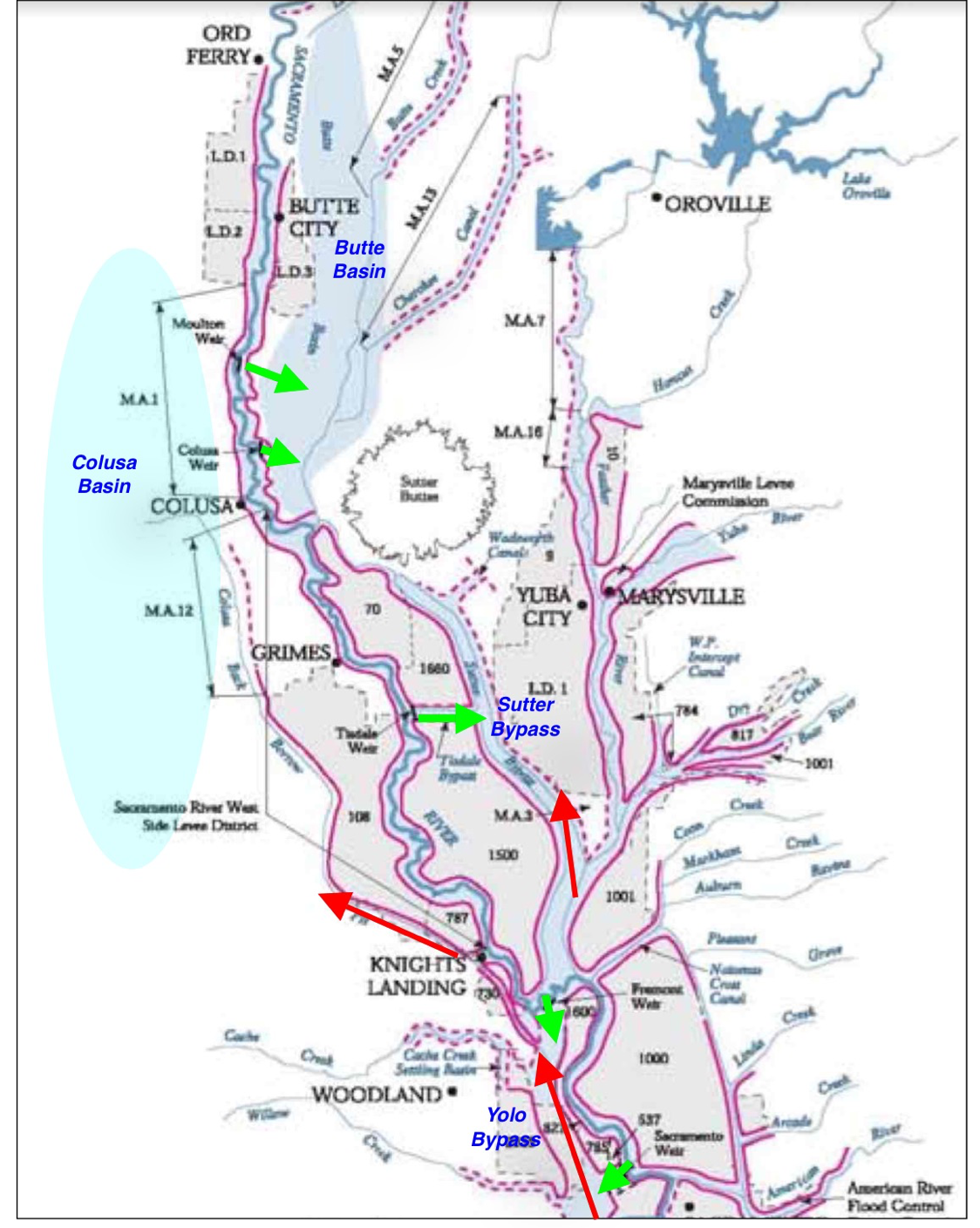
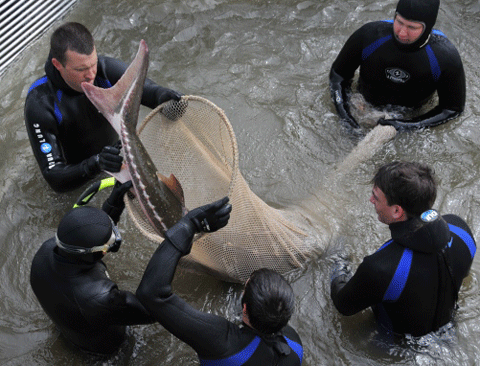
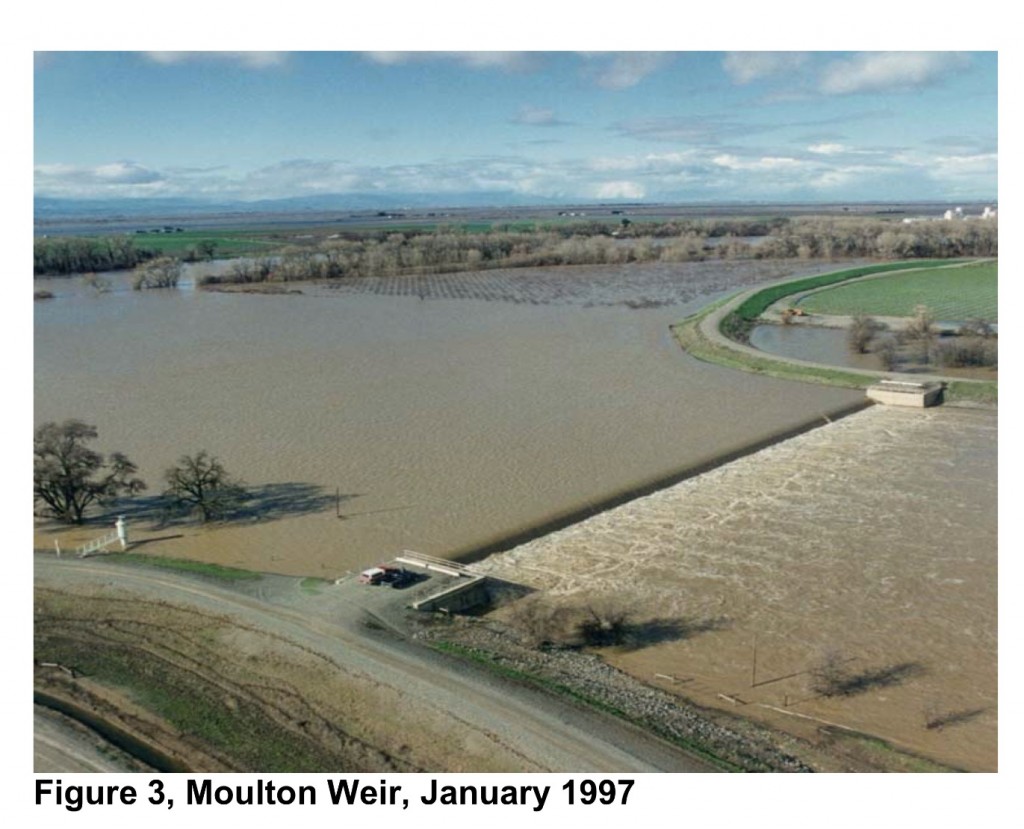
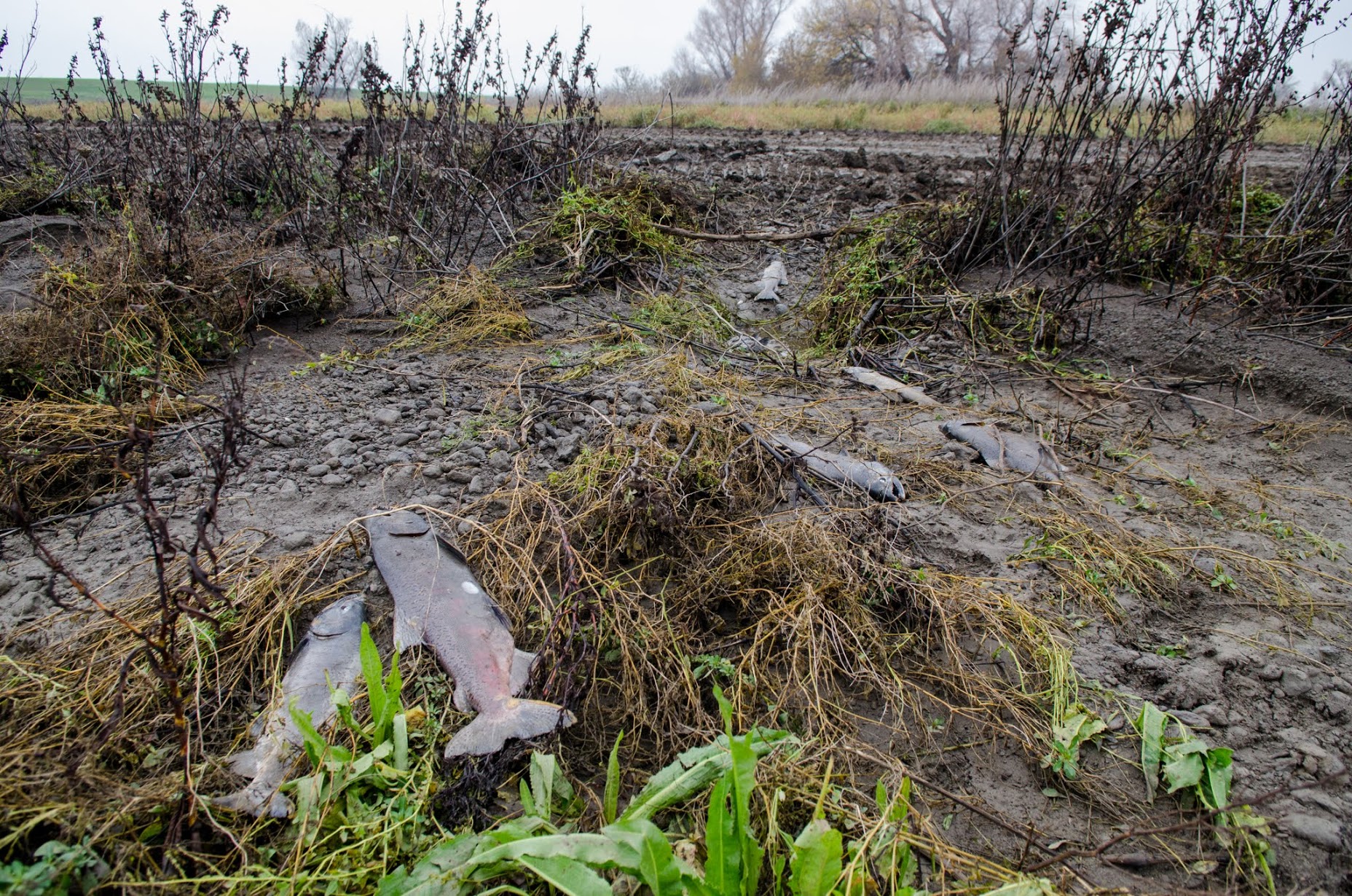
Figure 1 is a map of the Sacramento Valley with arrows showing some of the major locations of the problem. Much of the problem is the result of limitation or blockage of fish passage; another major factor is stranding. Adult salmon, sturgeon, and steelhead migrating up the Sacramento River become attracted to the high volumes of Sacramento water exiting the Sutter and Yolo Bypasses (adult fish movement is shown by red arrows in Figure 1), only to be blocked at the high weirs at the upstream end of the bypasses (Figures 2 and 3). Even modest bypass flows in drought years can cause attraction and subsequent mortality (Figure 4).

Young salmon emigrating downstream from upriver spawning grounds pass into the bypasses (green arrows in Figure 1) and adjacent basins in huge numbers. Many become stranded and lost when flows and water levels decline when weirs quit spilling (the river can drop ten feet overnight and quickly cease spilling into bypasses).

Landowners Seek Solution

In one of the areas, the Yolo Bypass, local landowners and stakeholders are seeking a solution. They are addressing three critical issues:

  1. Blockage of upstream migrating fish behind the Fremont Weir at the head of the Bypass.
  2. Blocked fish migrating to their deaths into the Colusa Basin from the Bypass via the Knights Landing Ridge Cut1. Adult migrants are also attracted directly to Colusa Basin Drain outlet even when Fremont Weir does not spill.
  3. Increasing survival of young salmon spilled into the Yolo Bypass by augmenting flows and improving habitats and habitat connectivity.

The first issue often occurs each time the weir spills at flood stage (generally one in three years, although it has not spilled significantly since 2006 because of drought). The bandaid treatment is shown in Figure 2. Stakeholders have advocated a short-term solution for passing fish via a “small notch” in the Fremont Weir to pass fish over the weir into the river; however, long-term agency plans call for a more contentious “large notch” in the weir.

The second issue requires the opposite solution, placing a fish-blocking weir at the outlet of the Knights Landing Ridge Cut to stop adult salmon, sturgeon, and steelhead from migrating upstream into the Colusa Basin. Landowners are working with the California Department of Water Resources and Reclamation toward building such a weir. For now the bandaid is a fish trap and fish rescues such as that shown in Figure 2.

The third issue can be resolved by engineering the bypass floodplain to provide better habitat and connectivity for the salmon including high and longer-sustained flows from the Fremont Weir (via a “notch”). Local landowners have developed an array of actions to provide habitat and connectivity.

In my experience, placing leadership and responsibility for developing and implementing actions in the hands of local stakeholders has worked best to help save fish. “Locals” can be surprisingly adept at coming up with viable solutions to fisheries problems.

Map of Sacramento Valley showing levees and flood control system weirs and bypasses

Figure 1. Map of Sacramento Valley showing levees and flood control system weirs and bypasses. Gray area agricultural basins are generally below the elevation of the river and bypasses. The flood control system was initially designed to convey flood water and historic foothill mining debris through the Valley. Adult salmon (as well as sturgeon and steelhead) are attracted to the high flows entering, passing through, and exiting the Sutter and Yolo Bypasses (such adult migration is shown with red arrows). Many cannot successfully complete their passage either becoming lost or blocked at the upstream end by weirs (located at the blunt end of the green arrows). Many young salmon become stranded in the basins and bypasses after entering in spill over weirs during floods. (Map source: http://baydeltaconservationplan.com/Libraries/Dynamic_Document_Library/Fact_Sheet_-_Sac_River_System_Weirs_and_Relief_Structures.sflb.ashx )

Figure 2. Sturgeon being rescued below a Sacramento River bypass weir

Figure 2. Sturgeon being rescued below a Sacramento River bypass weir

Moulton Weir 1997

High storm flows in late December 2014 into the Yolo Bypass from the Knights Landing Ridge Cut attracted many salmon to the northern end of the Bypass

Figure 4. High storm flows in late December 2014 into the Yolo Bypass from the Knights Landing Ridge Cut attracted many salmon to the northern end of the Bypass. When storm flows receded after several days, hundreds of adult salmon became stranded in winter-fallow fields that had been flooded. Many more salmon likely passed successfully into the Colusa Basin drain system only to find no route to spawning grounds in the upper Valley.

Reclamation continues to threaten Klamath-Trinity-Sacramento Salmon with transfer of Trinity water to Sacramento basin

Minimum carryover storage for Trinity Reservoir is supposed to determine Trinity exports to the Sacramento River basin. In the driest years (certainly 2015 would be considered such a year), exports to the Sacramento are to be minimized to meet minimum instream flow and water temperature requirements on the Trinity River to save Klamath-Trinity salmon from mass die-offs as occurred in 20021. The low probability of refilling of Trinity Reservoir, as compared to Shasta Reservoir, necessitates the restriction. Yet this summer, three-quarters of the 2000-cfs of water being released from Trinity Reservoir is going to the Sacramento River. Low flows in the Trinity and lower Klamath are again threatening Klamath-Trinity salmon, resulting in Reclamation having to triple Trinity River flows as of August 22 (Figure 1). The added water is coming from the already-depleted Trinity Reservoir, while the 1500-cfs export to Sacramento Basin water users continues.

Figure 1

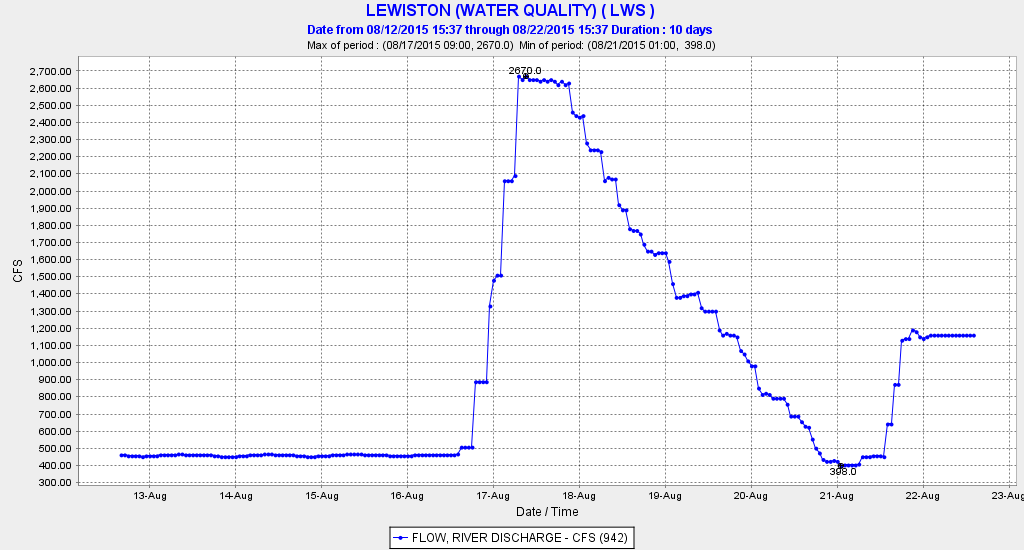
Figure 1. Trinity-Lewiston Reservoir releases to lower Trinity River in mid August 2015. Base required minimum flow is 450 cfs. Flow pulse from August 17-20 was for Hoopa tribal ceremony. New release (1150 cfs) to cool river commenced on August 21.

Reclamation tries to justify the transfer of Trinity water as needed to save Sacramento Winter Run Chinook salmon below Shasta Reservoir, when the transfer actually puts the Sacramento salmon at greater risk2. The transfer water passes through Whiskeytown Reservoir, from which it is released to the Spring Creek Powerhouse to the Sacramento below Shasta. The 50°F water from the Trinity Reservoir cold-water pool transferred to Whiskeytown warms nearly 10 degrees (58.5-59.5°F) before passing through the Spring Creek Powerhouse on Keswick Reservoir. Water from Whiskeytown would be even warmer if not for a floating water curtain installed at the reservoir outlet in 2011 to reduce water temperature of releases to the Sacramento basin (Figure 2).3

Figure 2

Figure 2. Floating boom of water curtain in Whiskeytown Reservoir outlet cove to Spring Creek Powerhouse in Sacramento basin.

The 59°F water entering Keswick Reservoir must be cooled by Shasta 50°F cold-water pool water to meet the 54-56°F required release temperature of the 7000 cfs prescribed release of water into the Sacramento River above Redding. Because Shasta releases are a blend of cold and warm water to meet downstream required temperatures, the added burden of cooling the Trinity water adds to the demands on the critically low cold-water pool remaining in Shasta Reservoir.

The limited Shasta cold water pool has already resulted in the State Board’s weakening of the average daily water temperature standard of 56°F to protect Winter Run salmon eggs to 58°F at Redding. The weakened standard will result in some egg mortality. There remains concern whether the cold water pool releases can be sustained through the summer, unlike last summer when coldwater ran out in early September leading to the loss of 95% of the salmon production.

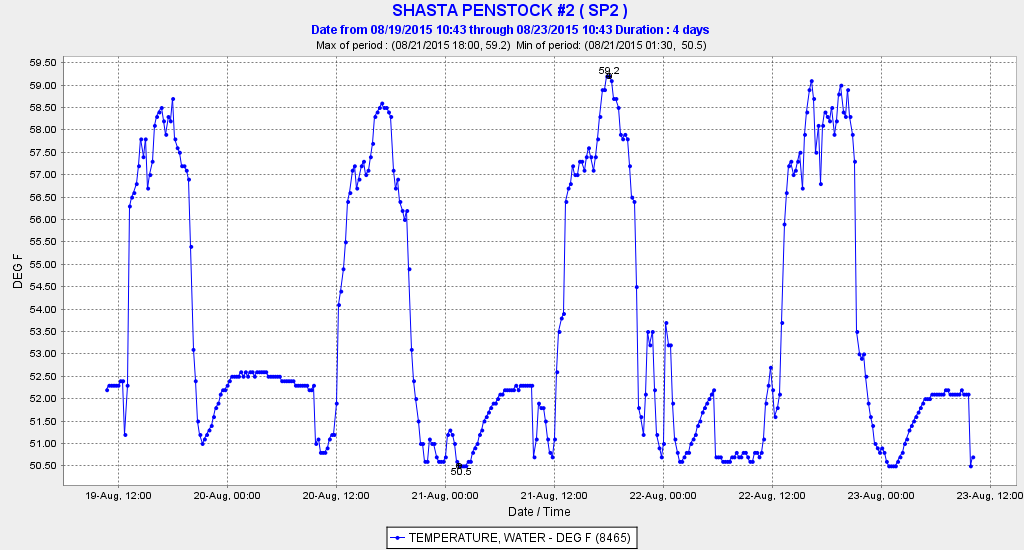
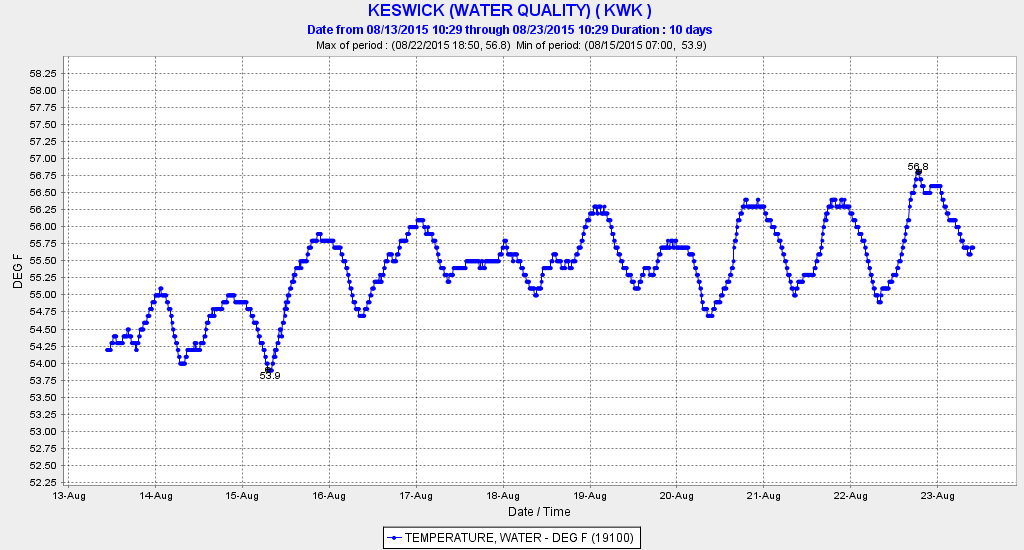
Further exacerbating the above problems is the continuing operation of all three storage reservoirs (Trinity, Whiskeytown, and Shasta) for peaking power (Figure 3). Releases for peak power demands occur during afternoon hours when reservoir waters are at their warmest (Figure 4). This specific operation pattern has lead to high afternoon water temperatures in Keswick releases to the Sacramento River, and most recently to higher night release temperatures (Figures 5 and 6). The standard remains 58°F average daily water temperature. Egg mortality increases above 56°F.

Figure 3

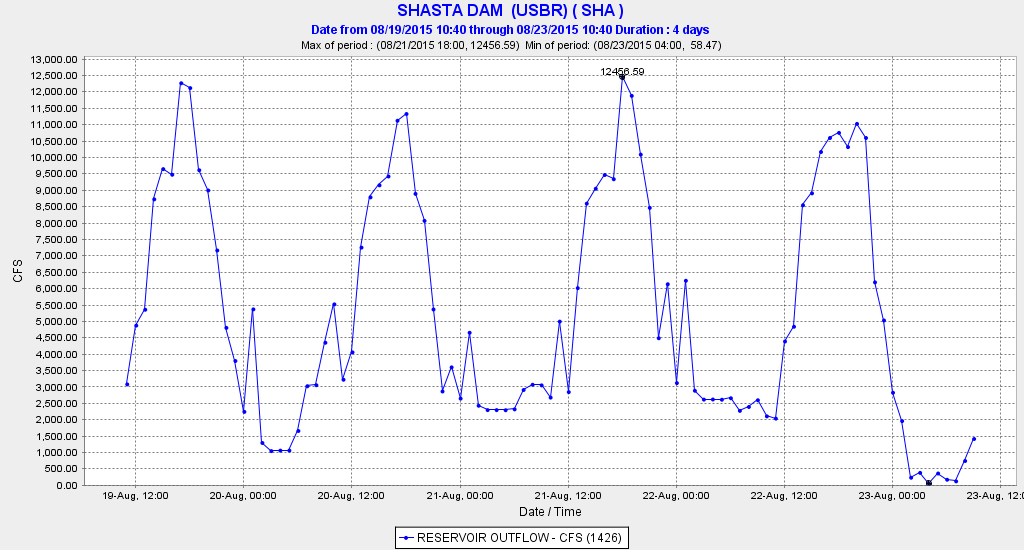
Figure 3. Release pattern at Shasta Dam in recent days. Peak releases to five powerhouses occurs in afternoon consistent with power demands. Note night releases having virtually been eliminated on August 23 in favor of daytime releases.

Figure 4

Figure 4. Temperature of water in penstocks to powerhouse from Shasta Reservoir. Note warmest water occurs during peak flows in afternoons.

Figure 5

Figure 5. Water temperature of water released from Keswick Dam to upper Sacramento River.

Figure 6

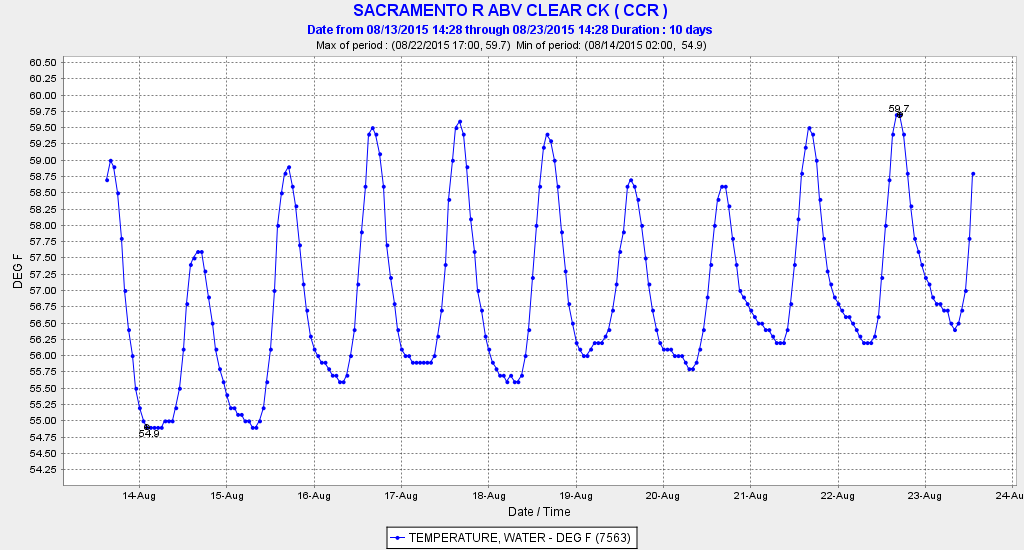
Figure 6. Water temperature of Sacramento River in Redding at CCR gage compliance point. Note average daily temperature approaches 58°F standard. Salmon egg mortality increases above 56°F.

  1. Trinity exports are also to be minimized to save carry-over storage for future Sacramento basin needs.
  2. http://calsport.org/fisheriesblog/?p=384
  3. To date, the curtain is performing as designed. It achieves an approximate 2 to 4 degree drop in water temperature.
    http://www.fabricatedgeomembrane.com/wp-content/docs/articles/fgi_jan2012_whiskeytown%20temp%20curtain%20pub%20file%20FI.pdf

Reclamation helps Klamath-Trinity Salmon with flow release

Tribal Ceremonial Release

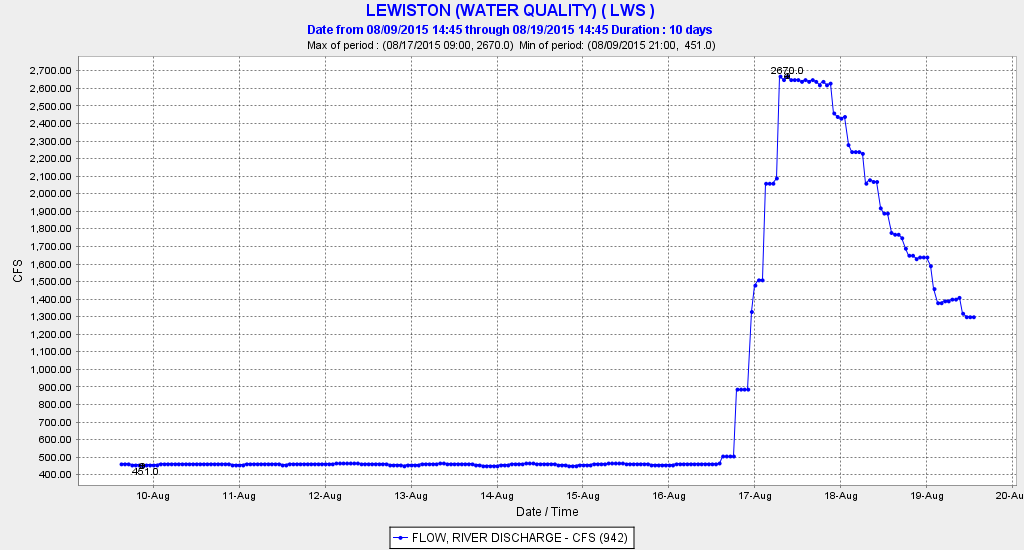
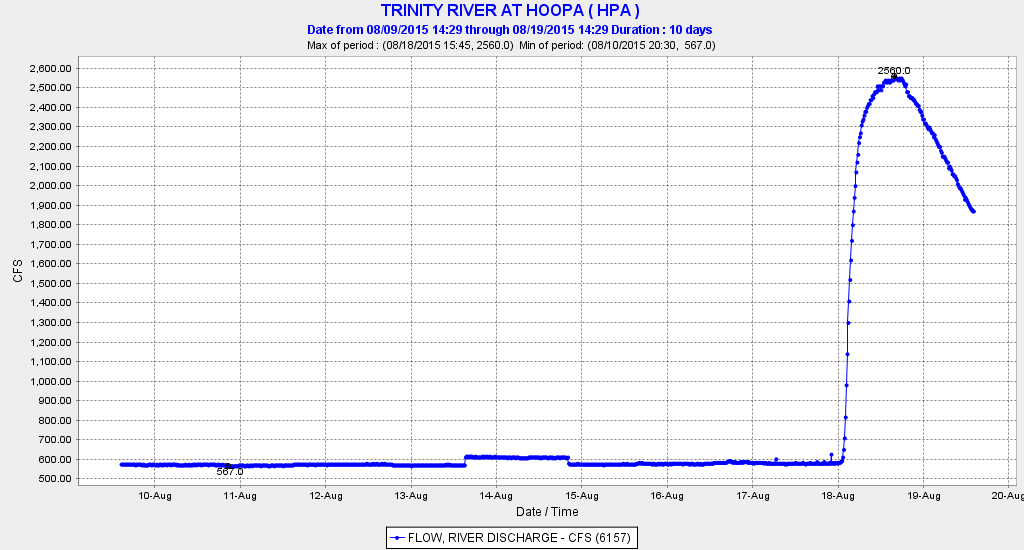
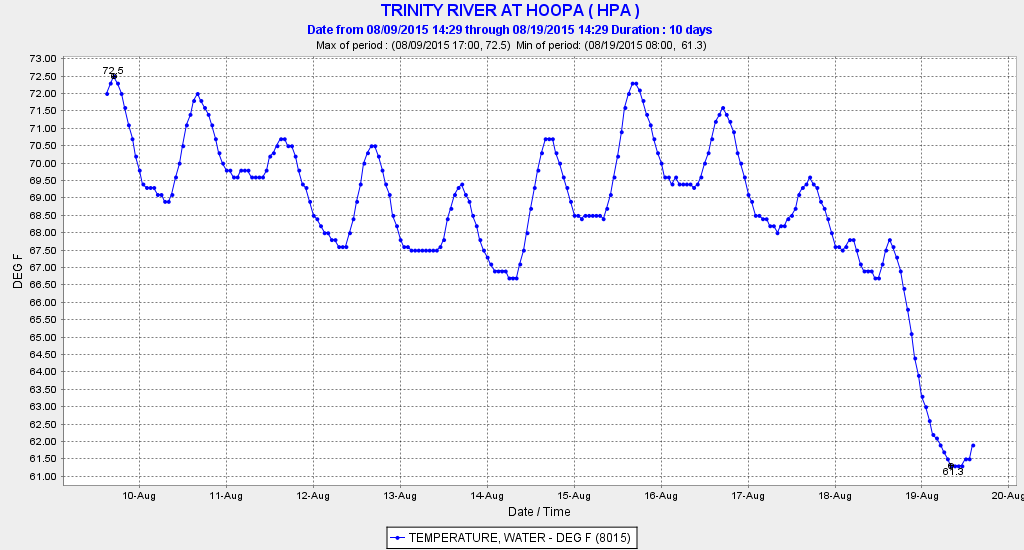
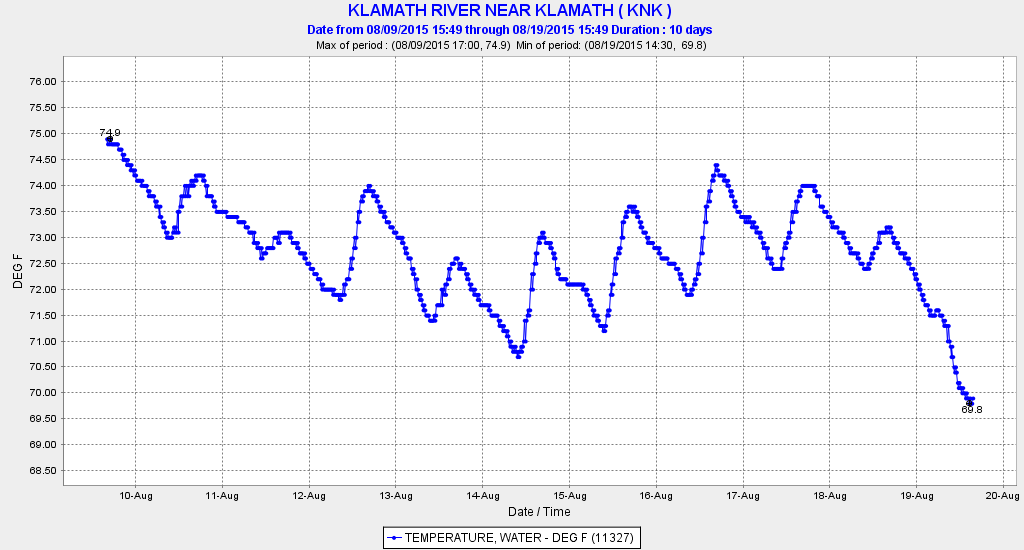
Reclamation recently provided a “ceremonial release” of water from Trinity Reservoir for the Hoopa Valley Tribe’s bi-annual Boat Dance Ceremony1. The release is for the period of August 17-20. The added flow increased the total flow in the upper Trinity River from 450 cfs to a peak of 2670 cfs on August 17 (Figure 1). The flow pulse reached Hoopa at the mouth of the Trinity River on the lower Klamath River one day after the initial release (Figure 2). The flow pulse also had a dramatic effect on the water temperature in the lower Trinity and Klamath Rivers (Figures 3 and 4).

Supplemental Flows

The flow pulse is the first of several anticipated this summer2 to cool the lower Klamath and Trinity Rivers, which have been plagued with high water temperatures (70-80F) this summer due to low water supplies related to the fourth year of drought. Low flows and their associated warm water temperatures are thought to be the cause of salmon deaths. These deaths are attributed to: (1) pathogens Ich and Columnaris; and (2) warm water temperatures, low water velocities and volumes, high fish density, and long fish residence times which likely contributed to the disease outbreaks and subsequent mortalities. Adult salmon crowd into limited thermal refuges and become susceptible to disease.

Figure 1. Release of water from Lewiston Dam into the upper Trinity River near Lewiston from August 10-20, 2015.

Figure 1. Release of water from Lewiston Dam into the upper Trinity River near Lewiston from August 10-20, 2015.

Figure 2. Streamflow at Hoopa on the lower Trinity River from August 10-20, 2015

Figure 2. Streamflow at Hoopa on the lower Trinity River from August 10-20, 2015

Figure 3. Water temperature of lower Trinity River at Hoopa August 10-20, 2015

Figure 3. Water temperature of lower Trinity River at Hoopa August 10-20, 2015

Figure 4. Water temperature of lower Klamath River at Klamath August 10-20, 2015

Figure 4. Water temperature of lower Klamath River at Klamath August 10-20, 2015

Reclamation Jeopardizes Klamath and Sacramento Salmon

By now you have probably heard that Klamath salmon are again threatened by warm water and ICH disease. You may also know that Sacramento River winter run salmon are again threatened with warm water below Shasta at Redding. You may not know that both are related, caused by the US Bureau of Reclamation’s operation of the Central Valley Project (CVP) and in particular Shasta and Trinity reservoirs.

Low flows in the lower Klamath are resulting in warm water and disease, shaping up as having the potential to repeat the massive 2002 die-off of salmon. Water temperatures in the lower Klamath and Trinity near 80°F are killing salmon and blocking their migrations.

Below Shasta on the Sacramento River near Redding, Winter Run Chinook salmon eggs are dying because excessively warm water is being released from Keswick Reservoir near Redding. Water temperatures near or above 60°F occur from Redding down to Red Bluff, the traditional spawning reach of Winter Run Chinook in summer. Egg mortality increases above 56°F.

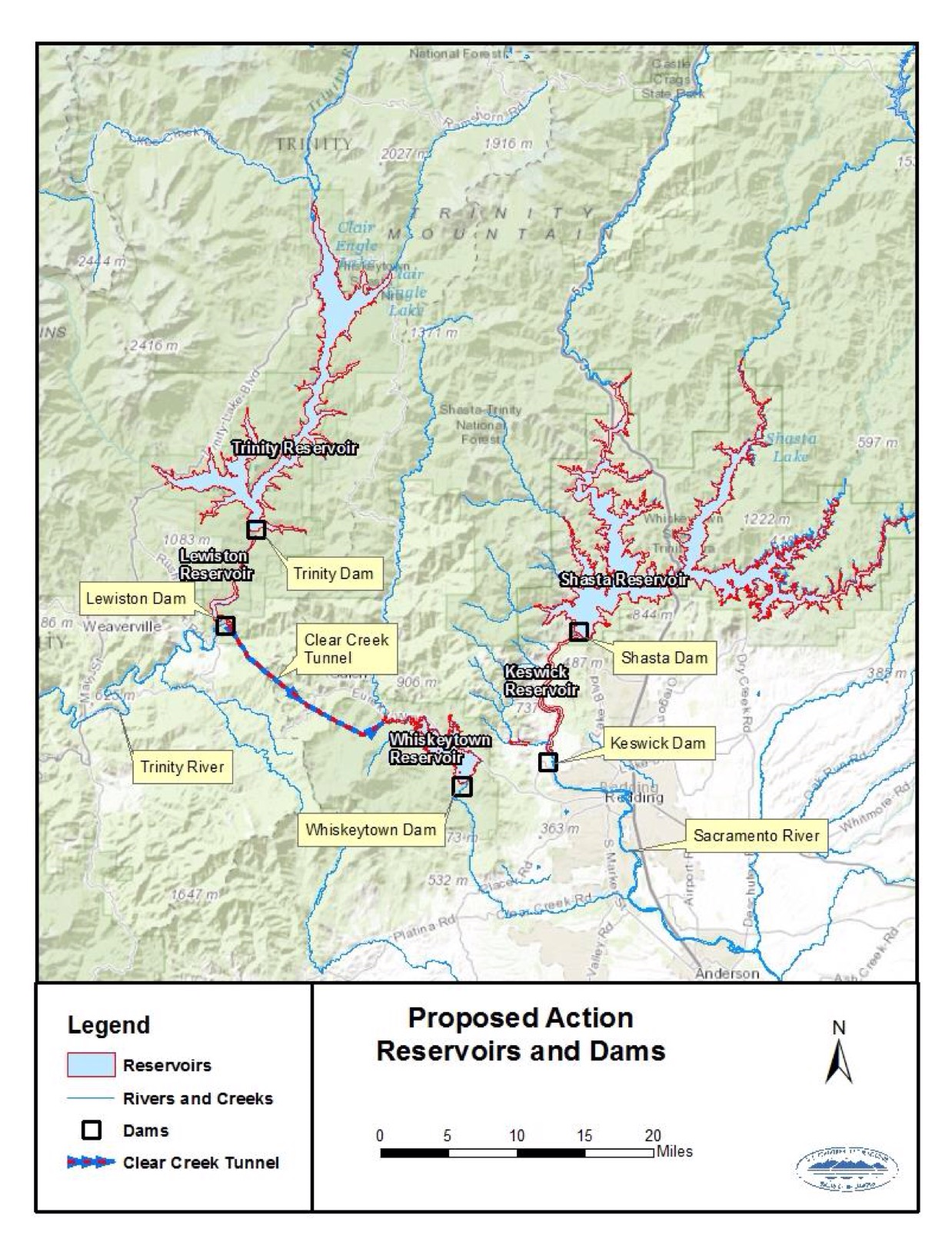
Here is how the two events are related. The map below shows how the Shasta andTrinity projects are connected as part of the CVP. Trinity Reservoir is presently releasing about 2000 cfs, of which a little less than 500 cfs (52-59°F) is released down the Trinity into the lower Klamath where total flow is 2200 cfs and water temperatures approach 80°F. The other 1500 cfs from Trinity Reservoir is going to Keswick Reservoir via Whiskeytown Reservoir. This 59°F water from Whiskeytown mixes with 5500 cfs of 52°F water released from the Shasta cold-water pool to provide a release of 7000 cfs of 54-56°F water into the Sacramento River from Keswick Dam above Redding. Water temperatures in the Redding spawning reach are 56-60°F.

So the flows diverted from the Trinity are not only contributing to low flows and warm water in lower Klamath, they are also contributing to the water in the Sacramento at Redding that is too warm for salmon eggs. The need to cool Trinity water before it is released into the Sacramento below Keswick is also contributing to the depletion of the limited cold water pool in Shasta reservoir.

Klamath River tribes are asking for more water down the Trinity. Reclamation is offering a small pulse when salmon start to die. A better solution would be to equally split the Trinity release, providing an immediate benefit to the Klamath-Trinity salmon and also saving some of the cold water pool in Shasta. This would require the State Board to reduce deliveries to Sacramento Valley farmers by an additional 500 cfs.

Proposed Actions Reservoirs and Dams

Recent Delta Action Further Degrades Low Salinity Zone

Recently, Reclamation closed the Delta Cross Channel (DCC) (Figure 1) near Walnut Grove to reduce salinity at the State Board’s compliance point at Threemile Slough. Normally, the DCC is open in summer to allow fresh water into the central, east, and southern Delta to maintain low salinity water for exports and for agricultural and municipal diversions. However, low fresh water inflows to the Delta due to the drought have resulted in salinity levels exceeding the required 2.78 EC level at Threemile Slough. Closing the DCC effectively forced more of the fresh -+water inflow from the Sacramento River toward the western Delta and Threemile Slough, reducing EC at Threemile Slough significantly (Figure 2).

Figure 1. Flow through the Delta Cross Channel in July and August 2015

Figure 1. Flow through the Delta Cross Channel in July and August 2015. Zero flow indicates the gates are closed. Gates are normally open in summer.

Figure 2. Salinity (EC) at Threemile Slough compliance point in western Delta

Figure 2. Salinity (EC) at Threemile Slough compliance point in western Delta. Salinity (EC) must be maintained below 2780 EC on a seven day average. Salinity exceeded the target on July 18. Closing the DCC on July 19 immediately reduced salinity to the compliance level. Subsequent closing of the DCC on July 25 brought salinity back up to and exceeding pre-closure levels. As the seven day compliance target was again exceeded August 1-3, the DCC was again closed on August 4 to again bring the salinity into compliance.

This rollercoaster salinity management in the Delta causes serious degradation to the Low Salinity Zone in the western Delta in the form of higher water temperatures. The higher water temperatures occur when warm northern Delta waters are moved west with the higher flows. These higher temperatures are evident at all the western Delta gages maintained by the Department of Water Resources and the US Geological Survey. The water temperatures change is approximately 2°F, which is significant and detrimental to the remnants of the Delta Smelt population trying to survive this extreme summer drought. Water temperatures have increased from 73° to 75°F, essentially creating lethal conditions for the remnant smelt.

The influx of warm water is apparent at Rio Vista where the Sacramento River enters the western Delta (Figure 4). Not only did the water temperature immediately rise with the higher flows on July 19, but the higher temperatures were sustained after the flows receded on July 25.

Overall, the unprecedented closure of the DCC in summer leads to rapid and significant changes in flow, salinity, and water temperature in the Delta that are likely detrimental to Delta native fishes including the Delta Smelt.

Figure 3. The map annotations depict changes from recent closures of the DCC

Figure 3. The map annotations depict changes from recent closures of the DCC (located at blue X). The closure reduced flow in the Mokelumne channels (dotted red line) by 3000 cfs. Georgiana Slough (west side of Tyler Island) flow increased 1000 cfs. Flow into the Sacramento channel at Rio Vista increased 2000 cfs. Net water temperature increase throughout the western Delta was about 2°F.

Figure 4. Water temperature at Rio Vista Bridge in July-August 2015

Figure 4. Water temperature at Rio Vista Bridge in July-August 2015. Note sharp increases after July 19 and August 4 closures of DCC.