Predator Fish Control Again Rears Its Ugly Head

The predator-control movement in the Delta got started around the turn of this century when efforts were initiated to reduce the Central Valley Striped Bass population by removing them from Clifton Court Forebay in the South Delta and by stopping the hatchery and pen rearing supplementation programs. Efforts under the Central Valley Project Improvement Act of 1992 (CVPIA), specifically the Anadromous Fish Restoration Program (AFRP), were beginning to make progress at restoring Central Valley fish populations including winter, spring, fall, and late-fall run Chinook, Steelhead, sturgeon, and Striped Bass. Of course, these efforts had been enormously aided by Mother Nature in the form of a series of wet years following the disastrous 1987-1992 drought that precipitated the CVPIA (and many of the endangered species listings).

Striped Bass supplementation had reached its apex. Hatchery raised yearlings were stocked by the millions. Millions of wild young stripers salvaged at South Delta federal and state pumps were placed in pens in the Bay and fed for one to two years and then released.

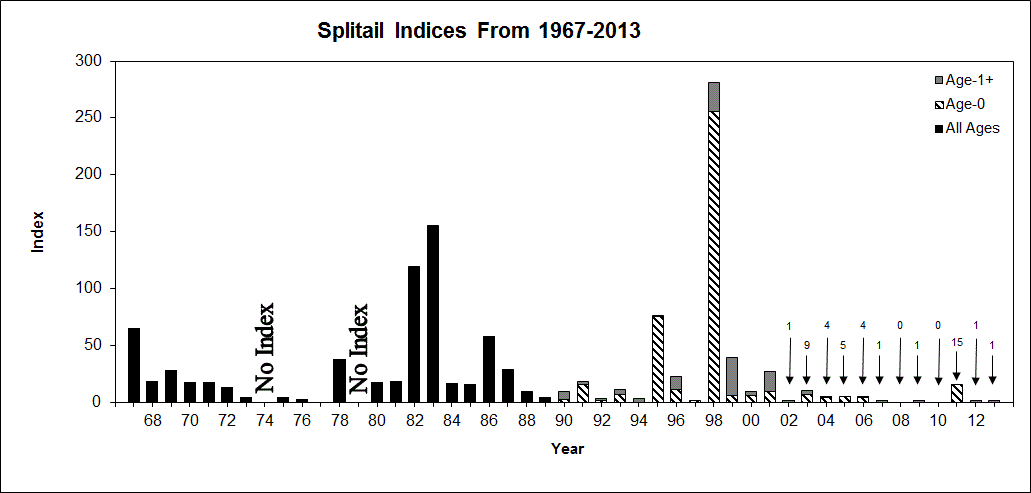
The end of the wet years and the beginning of the Pelagic Organism Decline in the early 2000s brought out “predator control” for the Central Valley. Federal and state water contractors planted the seed as their Delta diversions reached record levels of 6 million acre-ft. The first effort was to develop a predator removal program at the State Water Project’s Clifton Court Forebay in the south Delta. A further effort forced California Department of Fish and Wildlife (CDFW) to prepare a Habitat Conservation Plan (HCP) for its Striped Bass Supplementation Program (which was approved and the program continued for several years). CDFW did not undertake predator removal in the Forebay.

The 2007-2009 drought brought a water contractor sponsored lawsuit against CDFW, and when that failed, an approach to the California Fish and Game Commission to eliminate sportfishing regulation restrictions on Striped Bass. Relying on sound science, the Commission unanimously rejected their efforts.

The recent Bay Delta Conservation Plan (BDCP) included predator control at “hotspots” in the Delta. But BDCP has been cast aside in favor of Governor Brown’s “water fix.”

This past week FISHBIO Inc., a major contractor for the water districts in the Central Valley, posted “Can Predator Control Help California’s Native Fishes?”1 The post relates the passage of a bill in the House specifically regarding predator control to protect endangered species. While most (hopefully the Senate) will see the bill as part of the water contractors’ “smoke screen”, the bill exemplifies continued efforts on the part of water contractors in the Central Valley to place the blame and solution elsewhere. The post relates about a recent San Joaquin restoration program meeting where information on predators was presented. No mention was made of the recent record low flows in the San Joaquin or the fact that salmon numbers are directly related to flows, or that salmon cannot survive their migrations in the warm polluted waters of the San Joaquin in drier years.

The post mentions a modeling study that shows Striped Bass could eat all the San Joaquin salmon. However, it fails to mention the abundance of young hatchery salmon prey dumped into streams at the same time that Striped Bass and other predators are attracted into the cooler tributaries by the same warm polluted waters of the San Joaquin that block young salmon from moving to the ocean. It fails to acknowledge that upstream dams intercept the early natural pulse flows of cold water that would enable wild salmon fry to move out of the tributaries before waters warm sufficiently for predators to become active. It fails to mention that Striped Bass are also at record low levels. It fails to mention that hundreds of thousands of recovery program hatchery smolts have been dumped into the San Joaquin that serve to encourage predators to switch to salmon (these hatchery fish should be barged to and through the Delta to the Bay – an action that should be funded by the water contractors). And, for the record, it ignores the fact that aquatic life is a mutual eating society and hatchery salmon and steelhead smolts prey on wild salmon fry.

The post concludes with “This month’s actions to amend the Commerce, Justice and Science Appropriation Act may finally open the door to predator control programs in California – a hopeful step towards remedying a long-term problem that continues to spin out of control.” FISHBIO had better prepare for interviews on FOXNEWS.

(AUTHOR’S NOTE: predators including native fishes, birds, and marine mammals, as well as non-native fish like the Striped Bass and other state protected gamefish, take a huge toll on our native endangered salmon, steelhead, trout, smelt, and sturgeon. Predation is probably a primary causal factor as an indirect effect of water diversions on native fish. What is needed is a comprehensive recovery program like that on the Columbia River2. That program addresses the full spectrum predators like pikeminnow, terns, cormorants, marine mammals, and even non-native shad, stripers, smallmouth, walleye, and northern pike. However, unlike California erratic efforts to manage fisheries, the Columbia success-story, at least to date, can be attributed to progressive water management and hatchery-wild fish, science-based, recovery programs.)

Summer 2015 Temporary Urgency Change Petition: Deadly for Delta Smelt

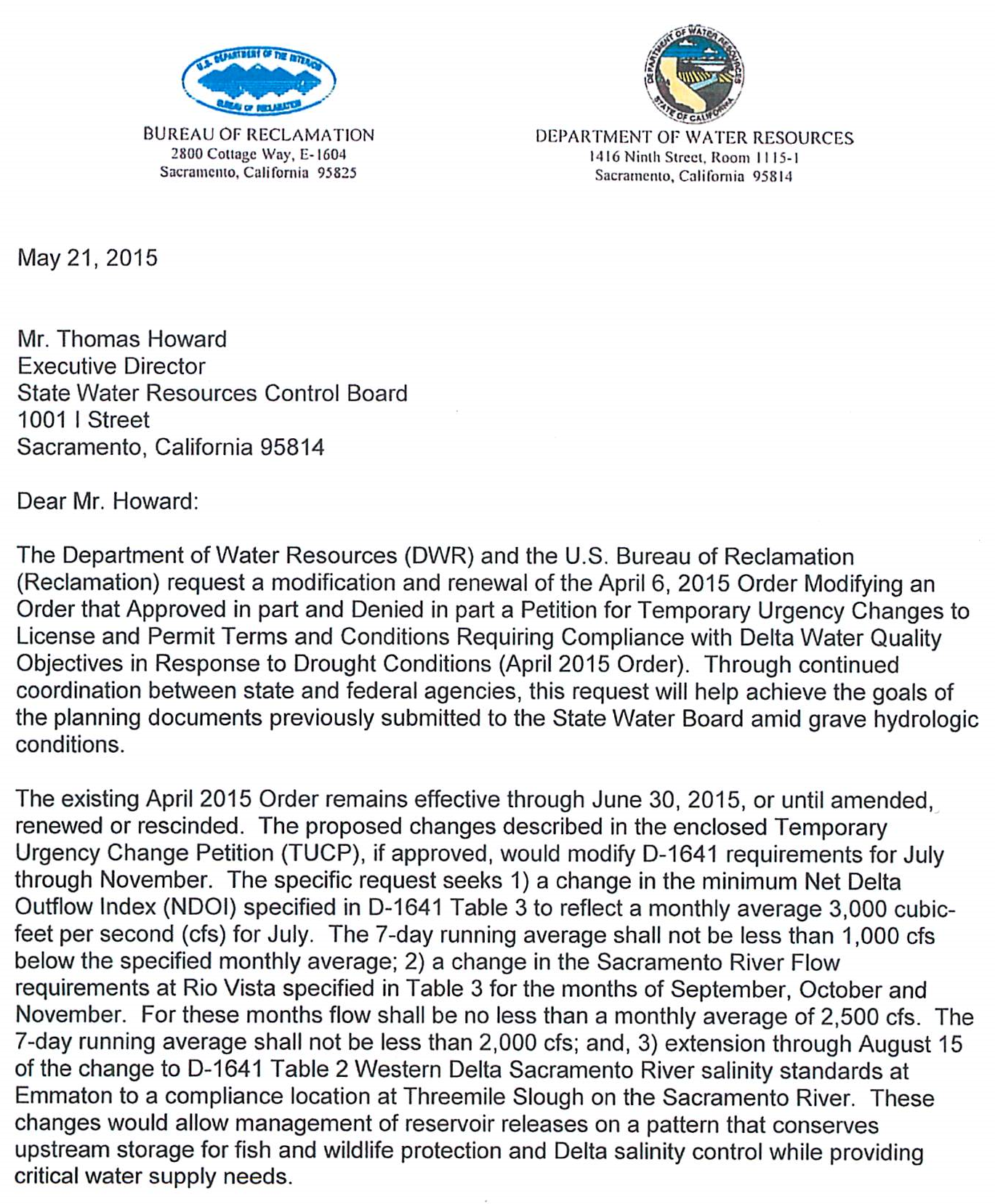
What does the May 21 TUCP mean for the Delta if the State Board adopts it for the summer? What would be the consequences of weakening the outdated standards for outflow and salinity do to the Bay-Delta ecosystem?

letter

Location of X2 and Delta Outflow

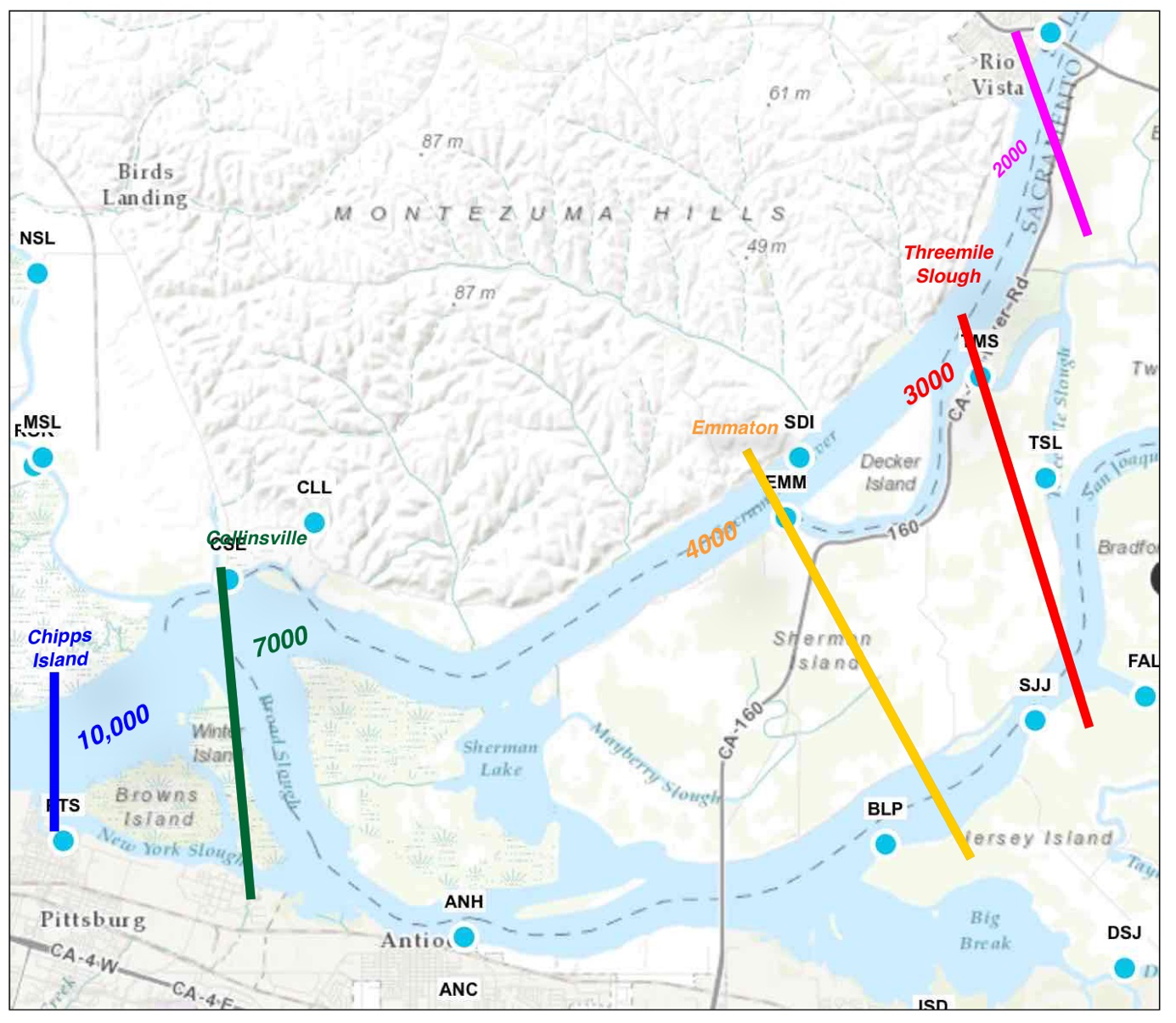
The location of X2, the critical location of the Low Salinity Zone center where salinity is 2 parts per thousand (ppt), is shown below for various Net Delta Outflow Indices (NDOI). The existing standards and proposed changes are as follows:

  • 4000 cfs NDOI in July – 3000 cfs proposed
  • 3000 cfs NDOI August – 2500 cfs proposed for September
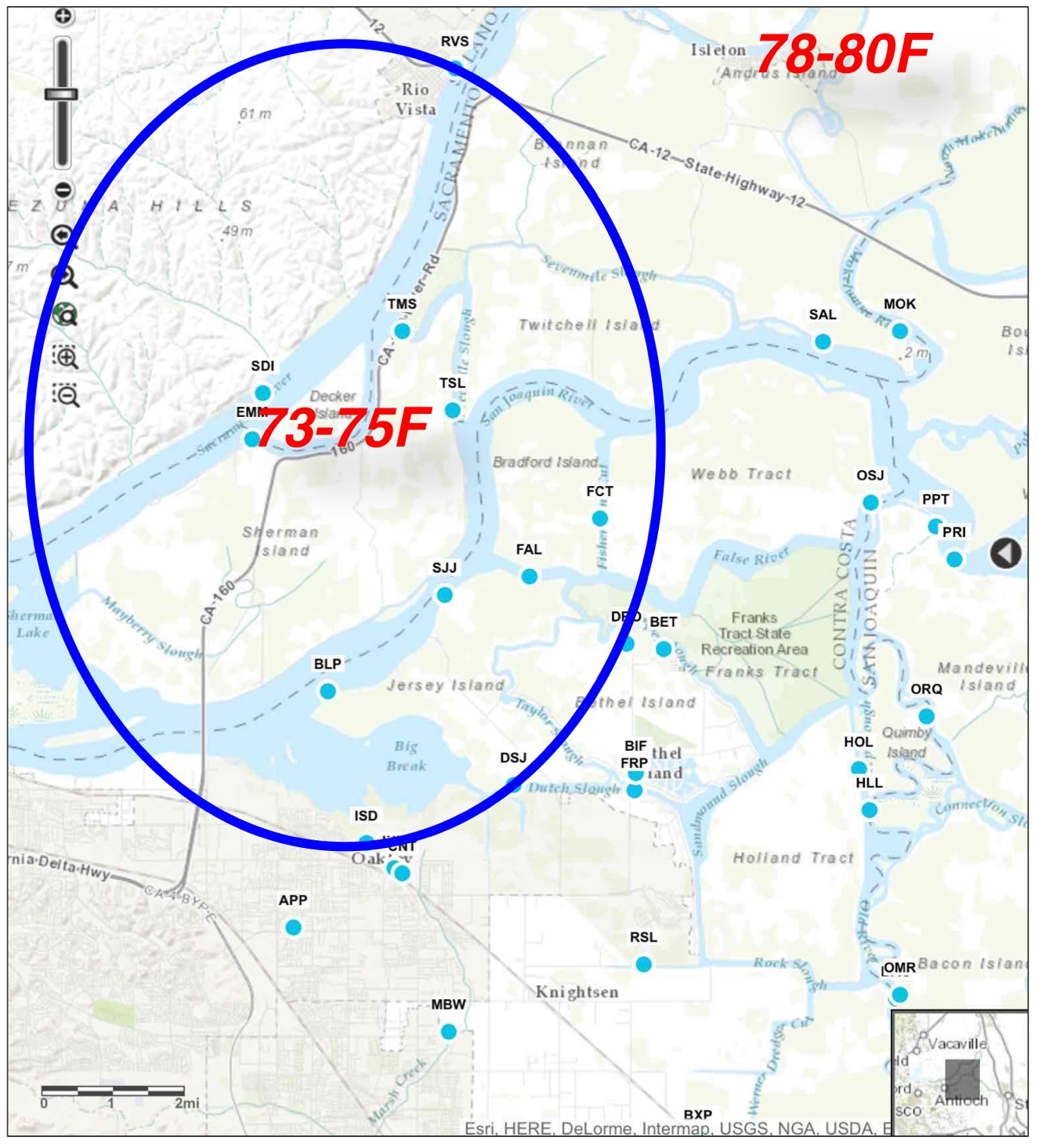
  • X2 (2.78 mmhoes EC) required at Emmaton (EMM) moved upstream to Threemile Slough (TMS) through August 15 (no limit thereafter)
Location of X2 in Bay-Delta at various Delta outflows (NDOI cfs).

Location of X2 in Bay-Delta at various Delta outflows (NDOI cfs).

Effect on Water Temperature

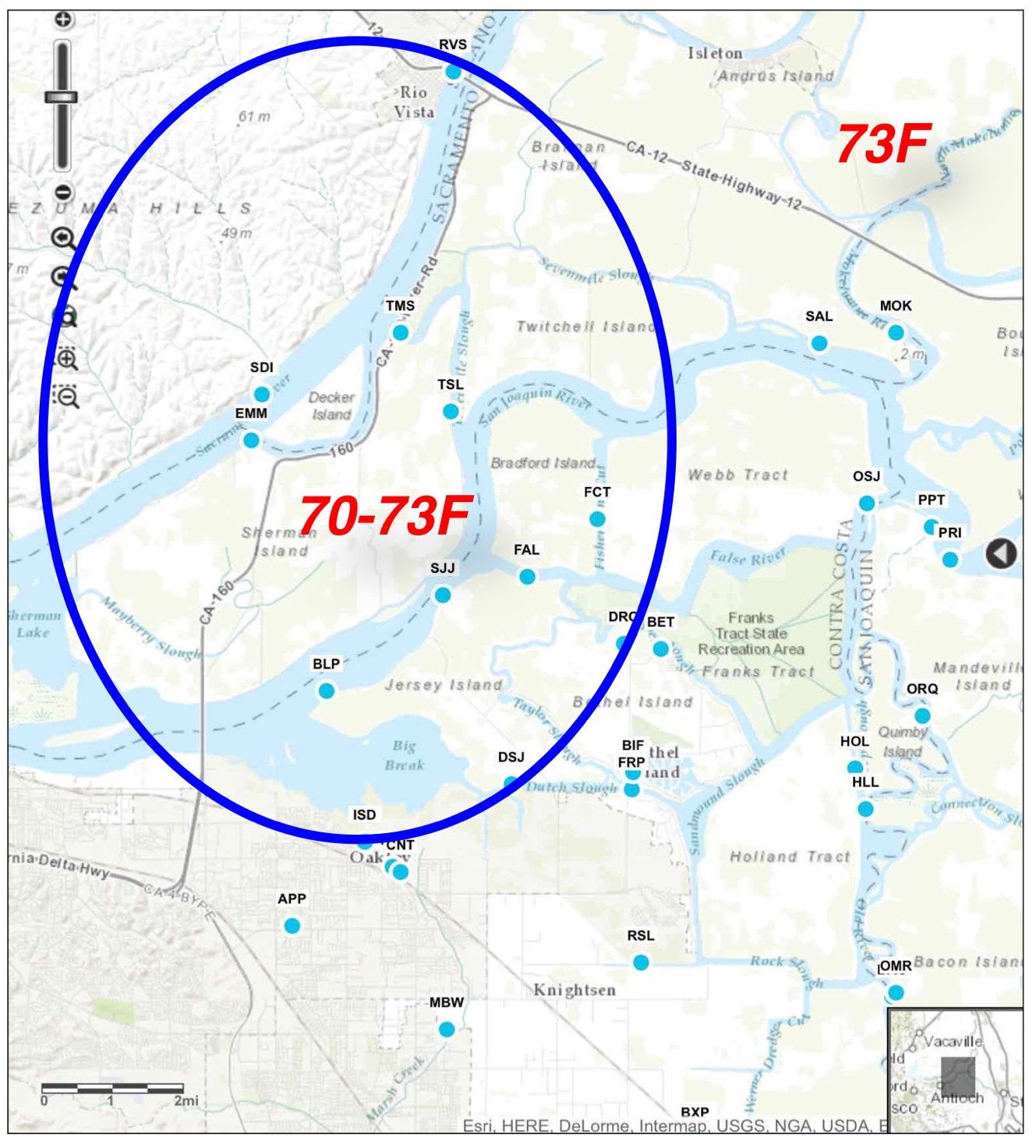
In June weakened standards from a previous TUCP were 4000 cfs NDOI, with X2 allowed at TMS. Water temperature at X2 location by mid-June reached 70-73°F, levels considered sublethal but stressful on Delta Smelt.

stressful on Delta Smelt.   Early June 2015 water temperatures in X2 region.

Early June 2015 water temperatures in X2 region.

On June 12, 2015, X2 reached Rio Vista Bridge (for first time this year) on high tide after midnight at 72°F (NDOI was 5200 cfs). Afternoon water temperatures at bridge at low tide had been >74°F. When EC was 2000 at TMS, the water temperature was 72°F. On this date in 2012, the X2 location was downstream of EMM, with an NDOI of 7100 cfs and a water temperature of 69°F. On this date in 2013, X2 was downstream of EMM, with an NDOI of 7500 cfs and a water temperature of 68°F. On this date in 2014, X2 was upstream of EMM, with an NDOI of 3150 cfs and a water temperature of 72°F. The pattern is consistent with the hypothesis that the further X2 is east, the warmer the water temperature will be. The pattern also indicates that the normal standard of 7100 cfs keeps water temperatures at X2 below 70°F, at least in late spring.

My prediction for water temperature for July through September in the X2 region is shown below. This conservative prediction is based on June 2015 and June-September 2014 data.

Predicted summer water temperatures in X2 region of the Delta under proposed weakened standards.

Predicted summer water temperatures in X2 region of the Delta under proposed weakened standards.

Consequences to Smelt and Salmon

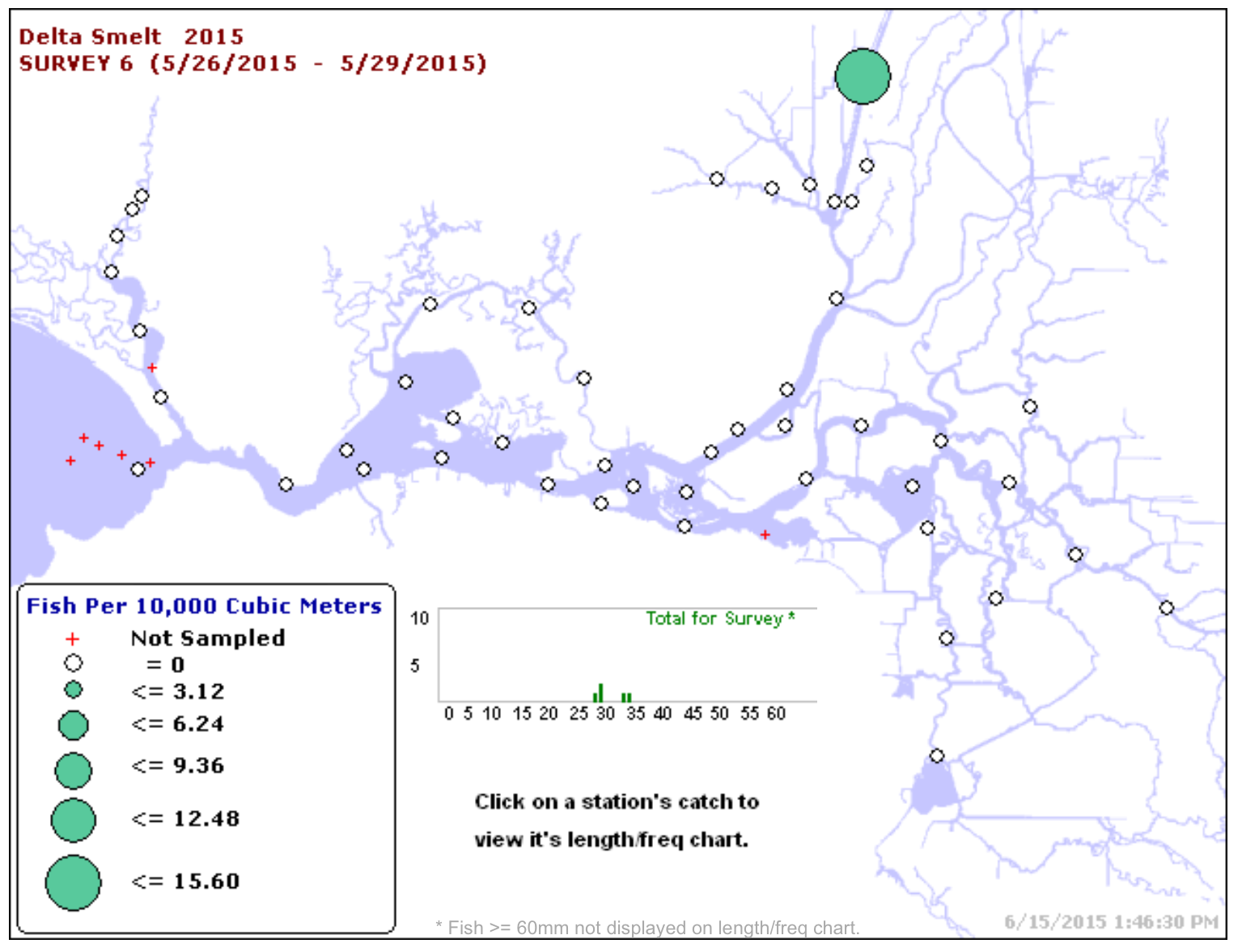
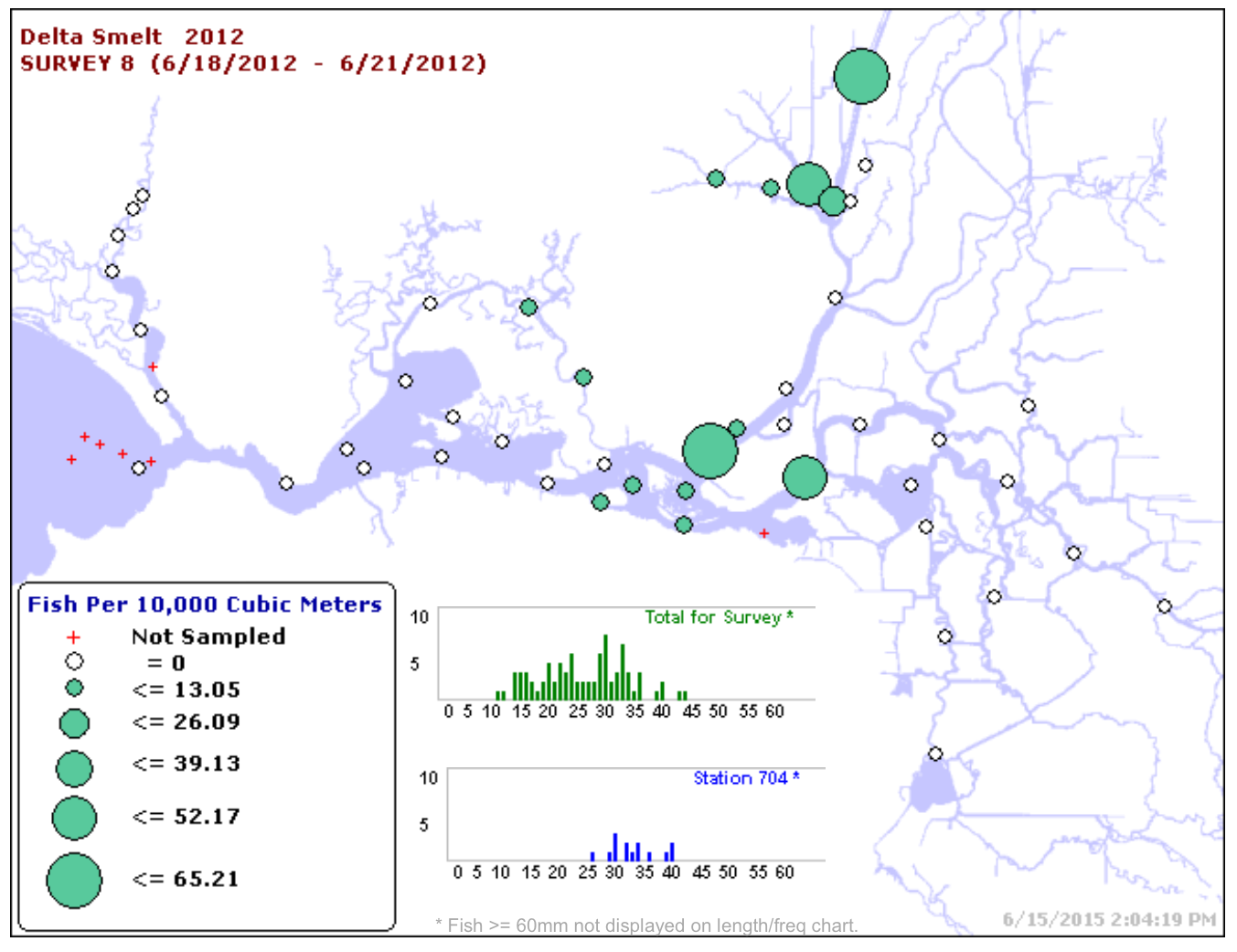
Delta Smelt, already on the brink of extinction, will be further stressed by near lethal water temperatures in the X2 region. We can assume that only a small number of smelt remain in the X2 zone going into summer 2015, as compared to 2012 (see following charts). Any remaining smelt in the X2 zone must be protected at least at the normal standards as in 2012. Any weakening of the critical year standards will jeopardize the existence of the species.

No Delta Smelt were collected from the X2 zone in late May 2015.  Only 5 were collected at the northern Deep Water Ship C

No Delta Smelt were collected from the X2 zone in late May 2015. Only 5 were collected at the northern Deep Water Ship Channel station.”

 In contrast to 2015, the distribution of Delta Smelt in late spring 2012 shows higher numbers collected in the X2 zone below Emmaton under NDOIs of 8000-10,000 cfs.  Water temperatures at that time in the X2 zone were <70°F.


In contrast to 2015, the distribution of Delta Smelt in late spring 2012 shows higher numbers collected in the X2 zone below Emmaton under NDOIs of 8000-10,000 cfs. Water temperatures at that time in the X2 zone were <70°F.

Fall Run Chinook Salmon enter the Bay-Delta on their spawning migrations from the ocean in August-September. Expected near -lethal water temperature (>77°F) will delay and stress these fish. Expected water temperatures greater than 70°F will stop migrations and degrade subsequent adult salmon pre-spawn survival and egg viability. The proposed 2500 cfs outflow standard for September will result in water temperatures of 73-75°F in the X2 zone near Rio Vista in mid-September. In contrast, in mid -September 2012, outflow was 7100 cfs and water temperatures at Rio Vista and the X2 zone near Emmaton were <70°F.

Are Winter and Spring Run Salmon being protected below Shasta? Absolutely Not!

By now it is common knowledge that 95% of last year’s endangered Winter Run Chinook salmon production in Sacramento River below Shasta-Keswick Dams was lost due to low flows and high water temperatures in summer. Large losses also occurred to Spring Run and Fall Run salmon. As they did last year, the US Fish and Wildlife Service, National Marine Fisheries Service, US Bureau of Reclamation, California Department of Fish and Wildlife, and California State Water Resources Control Board are managing water releases from Shasta Reservoir to ensure flows and water temperatures are adequate for Spring Run and Winter Run salmon spawning adults and eggs and alevins in gravel beds. This year they all assured us they had adequate water and cold water pool to maintain flow and cool water temperatures to protect the salmon in the upper spawning reach near Redding. They acknowledged there was insufficient water to protect the lower spawning reach below Redding (down to Red Bluff).

Already two months into the irrigation season and after a quarter million acre-feet of water released to water contractors (about 10% of Shasta storage and 25% of the cold water pool), Reclamation has determined they overestimated the available amount of cold water pool and their ability to maintain flow and water temperatures for salmon into the fall. Fearing the worst, storage releases have been reduced, and protective water temperature limits in the Redding spawning reach have been raised to conserve the cold water pool.

We only have to look at the State Board’s own science review of water temperature effects on salmon1  to see if water management in the spawning reach is protecting salmon.

  1. Mean Weekly Maximum Water Temperature (MWMT) should not exceed 13C (55.4F) – generally referred to as 56°F limit.
    1. Keswick Dam releases have been slightly higher than 56°F MWMT.
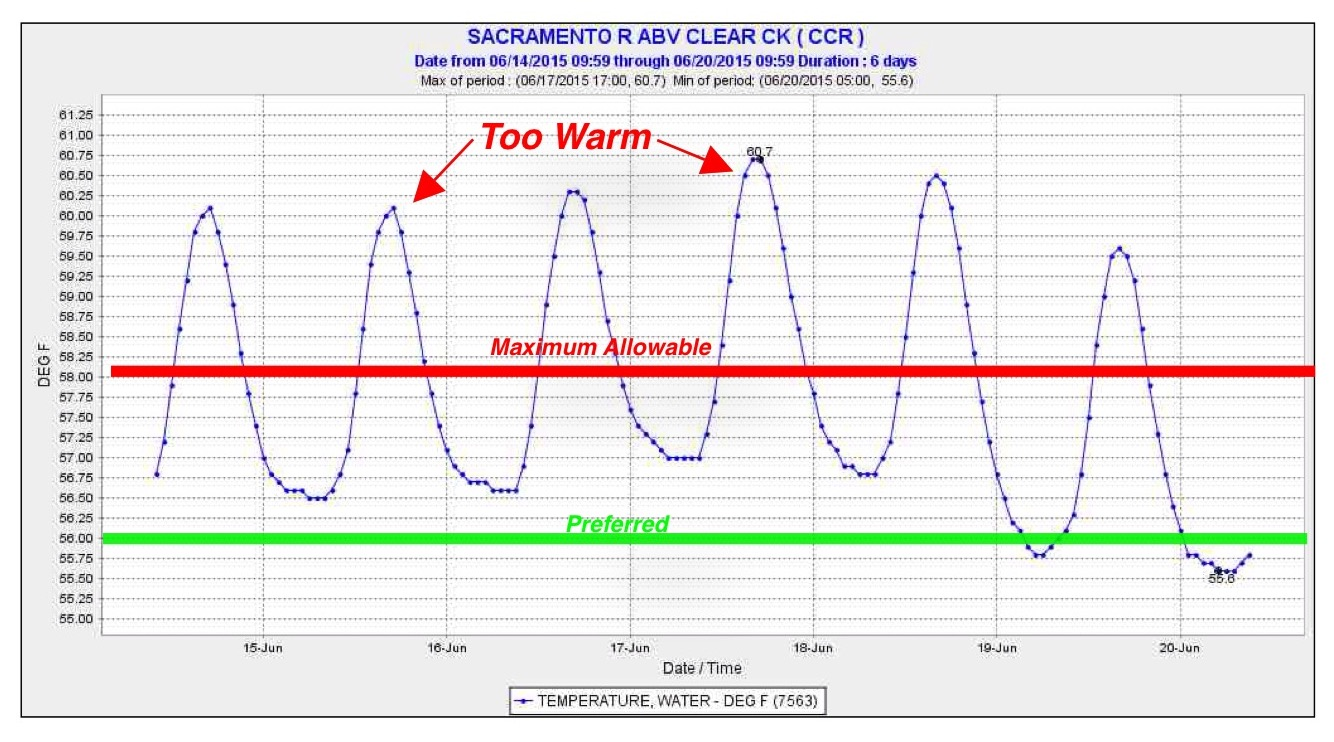
    2. Sacramento River compliance point above Clear Creek has MWMT of 60°F.
    3. Clear Creek upstream of mouth has a MWMT greater than 60°F.
    4. Sacramento River below Clear Creek at Anderson has MWMT OF 62°F.
  2. Daily maximum water temperature should not exceed 13.5-14.5°C (56-58°F) from fertilization through fry development.
    1. Keswick releases have reached 56°F.
    2. Sacramento River at compliance point above Clear Creek has reached 60.7°F.
    3. Sacramento River below Clear Creek at Anderson has reached 62°F.
  3. Optimal temperatures for egg incubation is <13°C (55°F).
    1. Exceeded throughout spawning reach.
  4. Water temperature when pre-spawning mortality of adult Chinook becomes pronounced in ripe adult salmon – 13-15.5°C (55-60°F)
    1. Exceeded throughout spawning reach.

Obviously the 56-60°F maximum daily water temperatures in the primary spawning reach above the mouth of Clear Creek at Redding are a concern. The State Board has raised compliance from 56°F to 58°F in attempt to conserve cool water through the summer. They have also reduced allowed Keswick releases from 8000-9000 cfs to 7500 cfs for the summer to save storage and the cold water pool. Reclamation is keeping Keswick releases near 7000 cfs.

Our concern is for pre-spawn ripe adult mortality and egg viability, as well as egg viability and embryo survival in redds. The agencies seem to think maximum daily temperatures near 60°F are ok, when they are not. Destroying this year’s egg production before the cold water pool is exhausted should not be the approach. Maximum temperatures should not exceed 56°F above Clear Creek. A maximum temperature of 58°F should be the absolute limit.

Far more important is the water temperatures in the redds, which tend to occur in shallow pool tailouts that are often warmer than average river temperatures. There must be a margin of protection for this difference. Redd temperatures should also be carefully monitored.

Clear Creek at Redding Tempratures

Puget Sound Winter Steelhead Sport Fishing – Gone for Good?

Puget Sound is a large inland marine system whose rivers and streams have historically had excellent populations of winter steelhead (both native and hatchery fish) that supported important sport fishing opportunities. Many anglers would brave rain, cold and snow to stand in a stream for hours, trying to hook onto one of these prized fish (up to a trophy size of 20 lbs). Sadly, over the last few decades, this sport fishery has been slowly disappearing and is now almost gone, maybe for good. How come?

A little bit of background on major events that have affected this sport fishery. First was the Judge Boldt decision in 1972, where the judge ruled that the salmon/steelhead resources within Puget Sound must be shared 50-50 between Native Americans and non-Native Americans. This immediately decreased the number of steelhead and salmon available to the sport fishermen. It also led to the co-management of the resources. Various positive and negative opinions have been expressed over the Boldt decision. However, it set the management in a different direction with more people involved. It also set new and untested legal issues in motion.

A second event that affected this fishery was the Endangered Species Act (ESA). Through many legal battles, protection of “wild” or “native” steelhead became paramount because studies with various results showed that hatchery steelhead were/were not as viable as the “native” fish. You can pick which side you want on this one, because studies with both positive and negative results exist. It has been claimed, however, that hatchery fish are not good for the native fish (even though they swim around in the Pacific Ocean for several years and return to their stream of origin to spawn). Likely, most sport fishermen and the general population would like to see strong returns of “native” fish, with no need for hatcheries.

In addition to the Boldt decision and the ESA, other legislation has also affected the salmon and steelhead populations of Puget Sound (and elsewhere along the Pacific Coast). Of particular interest is the protection of seals, sea lions, and other predators (such as birds) under the Marine Mammal Protection Act and other legislation.

How have these events affected the winter steelhead sport fishery? First, as noted above, the Boldt decision diminished the number of fish available to the sport fishery. To some degree, this was mitigated by a very active program to develop mark-selective fishing on hatchery steelhead. Though details changed, the general approach was to mark outmigrating steelhead at hatcheries by removing the adipose fins (a small fin near the tail of the fish). With this clearly visible “mark”, the fishermen were allowed to keep marked fish, but unmarked fish (i.e., fish with a visible adipose fin) had to be returned to the stream (i.e., not kept). Other measures, such as using barbless hooks and reduced seasons, were implemented to further protect the “native” fish. These efforts allowed a viable winter steelhead fishery to occur, although the success rate per angler in Puget Sound streams has diminished, likely due to population growth and increased interest in this fishery.

The ESA has been used to eliminate much of the hatchery production of winter steelhead in Puget Sound streams. In a recent legal dispute, the “Wild Fish Conservancy” fought for the elimination of hatchery production of winter steelhead in Puget Sound streams. The case was settled with the Washington Department of Fisheries and Wildlife (WDFW) paying the legal fees and several thousand dollars to the Conservancy (the funds likely came out of sport fishermen’s money paid for license fees). As part of the settlement, the WDFW also agreed to not release any outmigrant steelhead from hatcheries in many Puget Sound streams. In 2014, the outmigrants that were already being reared in the hatcheries were released to lakes or other water bodies where they could not migrate to the ocean and return as adults. That left only one year of young hatchery fish to keep the hatchery system operable. So, what happened in 2015? The WDFW again released the outmigrants into non-migratory lakes. With no winter steelhead in the mark/selective approach returning as brood stock, the hatchery program has essentially dissolved, and future prospects for any revival are dependent on a determination by the National Marine Fisheries Service on whether or how hatchery management can be made compatible with recovery of wild Puget Sound steelhead.

The protection of predators on steelhead (as mentioned above) is only one additional step down for future steelhead recovery. The virtual explosion of marine mammal populations with little or no control (because of protection under the MMPA) further diminishes the populations available for any future sport fishing.

Is this situation (i.e., elimination of the sport fishery for steelhead in certain Puget Sound streams) a universal event? The answer is no. Some streams in Washington support very important winter steelhead sport fisheries through hatchery production. A good example is the Cowlitz River in southwest Washington. The returns of adult winter steelhead this year were so good that the limit was raised from 2 fish to 3 fish per day, mainly because the hatchery had sufficient numbers of returning adults for its program. Another example is the Columbia River system, which has increasing or record returns of a number of hatchery salmon/steelhead runs that support a very viable sport fishing program.

So, what’s the bottom line on the differences between the decline in Puget Sound sport fishing opportunities in Puget Sound (ongoing for many years) and programs that are currently very successful? In my opinion, the successful programs (through many years of negotiations, discussions, and back-and-forth efforts) have established recovery plans that have established goals of re-establishing and increasing salmon/steelhead and have put in the efforts to achieve those goals. It takes time and effort plus considerable amounts of money to make these plans work. On the Columbia, for example, millions of dollars have been spent on research, habitat restoration and enhancement, management, and other planning efforts. This money has been derived from water users, hydropower producers, and others. The sport fishermen also provide additional funds by paying an additional license fee if they fish in the Columbia River basin. Overall, a mix of both hatchery fish and native fish are part of the planning goals.

There are many very positive efforts in Puget Sound to recover steelhead and other anadromous fish populations. However, hatchery fish are not currently in the mix on some streams, and planning efforts appear to be bogged down. What appears to the general public is that winter steelhead sport fishing, for the foreseeable future, will continue to decline and perhaps entirely disappear because no releases of outmigrants have been made to continue the cycle. In addition, it is likely that with the large number of people now in the Puget Sound area, wild fish will not recover to a level that could support a sport fishery.

Are there possible solutions to the challenges of decreased opportunities for sports fishermen? This is a complex question, and many diverse opinions have been expressed. The diversity of environmental conditions and resource utilization play a large role in maintaining or recovering wild steelhead and salmon populations along the Pacific coast. For example, in Alaska, most of the salmon/steelhead populations are wild even though significant commercial fisheries (and localized sport fisheries) exist. In general, the watershed conditions and climate offer favorable conditions for these populations to be sustained.

In contrast to Alaska, the often severe environmental challenges faced by wild salmon/steelhead populations in other Pacific coast states (i.e., Washington, Oregon, and California) need to be realistically factored into the management plans (they are often considered, but the discussion often bogs down before plans are completed or implemented). For example, can wild steelhead/salmon populations be maintained in California if drought conditions leave only dry and impassable stream conditions for outmigrants or returning adults? The answer, of course, is no, unless some type of intervention (e.g., transport around critical areas) is provided. Similarly, under such conditions, can wild fish populations be maintained without some type of intervention such as hatchery supplementation or transport around dry stream beds? If the answer is to eliminate consideration of supplementation (where needed) and other interventions such as transport, the probability is that wild populations can’t support even a limited sport fishery or that the populations will disappear altogether (such as the case where streams run dry due to drought conditions). If the answer is to actively pursue measures to at least maintain populations through some type of interventions in hopes that conditions future conditions become more favorable, there may be a probability that stressed populations can survive.

In Puget Sound, the loss of two years of winter steelhead hatchery production (i.e., no outmigrants) in some streams clearly will diminish the probability of a sport fishery in those streams affected. Environmental conditions such as streamflow are still somewhat favorable to maintenance of residual wild populations which, in general, cannot by themselves sustain a sport fishery.
Hatchery Reform – Part 4

Previously… Part 1: Central Valley Salmon and Steelhead Hatchery Program ReformPart 2: Hatchery Reform, & Part 3: Hatchery Reform

Golden Gate Salmon Association (GGS) Project D.3 Improve Trucking Techniques for Hatchery Salmon Background and Scientific Analysis December 4, 20131

The goal of this project is to improve trucking results especially at the Federal Coleman Hatchery on Battle Creek where there are poor hatchery returns and high straying rates from trucking… The survival of trucked and acclimated fish was substantially higher than that of fish released at the hatchery basin. The combined average trucking improvement from all the hatcheries was 3.49 to 1. The improvements ranged from a high of 71 to 1 at the Feather River hatchery to a low of 1.8 to 1 at Coleman. These figures mean trucking produces many thousands of additional adults for harvest or for return. But, the returns are still very low when compared to the losses that are avoided by trucking the fish around the rivers and the Delta. Studies of the mortality of juveniles migrating down the Sacramento River and through the Delta range up to 90%. Avoiding this loss indicates that the survival of trucked fish should be more in the order of 10 to 1 over basin released fish. Current science cannot explain this difference. More research is needed.

Clearly, their Exhibit 1 below depicts the benefits of trucking in avoiding the many risks in the up to 200 mile trip to the Ocean for Central Valley salmon. Trucking bypasses much of risk, but results in high straying rates. As described previously, barging and out-planting offer potential reduction in straying without giving up the huge advantage in survival and production.

Exhibit 1

Smolt Production from hatchery adults. Kathryn E. Kostow , Anne R. Marshall and Stevan R. Phelps. 2011.2 Naturally Spawning Hatchery Steelhead Contribute to Smolt Production but Experience Low Reproductive Success

Our data support a conclusion that hatchery summer steelhead adults and their offspring contribute to wild winter steelhead population declines through competition for spawning and rearing habitats.

There is considerable scientific study that indicates that the offspring of hatchery salmon and steelhead have lower reproductive success than wild native fish. Wild native fish have many general and locally adapted traits that are often missing in hatchery fish. For Central Valley salmon and steelhead, many of these native traits were lost long ago. Tribes in northern California hope to bring some traits back from wild salmon sent from California to New Zealand a hundred years ago. Recently, special traits involving greater growth and longevity of Lahontan Cutthroat Trout were restored to Pyramid Lake in Nevada from an outside source.

In the end, we can only hope that restored “wild” populations will begin the natural selection process in restoring traits that contribute to higher survival and production. At minimum, hatcheries should discontinue practices that degrade natural diversity and genetic inheritance, and should focus on improving diversity and traits that enhance the ability to survive Valley conditions now and in the future.