Central Valley Salmon and Steelhead Hatchery Program Reform

Dr. Peter Moyle of the University of California, Davis commented last year commented on California salmon and steelhead hatchery reform at the California Fish and Game Commission’s Workshop on Strategic Improvement in California’s Anadromous Hatcheries, held in Sacramento on February 4, 20141.

Dr. Moyle remarked that hatcheries fail to meet their primary dual purposes of sustaining commercial and sport fisheries and assisting in recovery of wild (naturally spawning) salmon and steelhead. Hatchery strategies have led to the complete dominance (90%) of hatchery salmon and steelhead in most rivers, which will ultimately lead to “periodic shut-downs of the fisheries and extinction of most runs, even those supported by hatcheries.” He concluded that a much more radical reshaping of hatchery policy is needed.

He recommends two types of hatcheries: conservation hatcheries that focus on recovery of wild populations, and production hatcheries that focus on sustaining commercial and sport fisheries. He suggests abandoning wild salmon and steelhead management in favor of production hatcheries for some runs (e.g., Fall Run Chinook salmon).

Only the federal Sacramento River hatcheries near Redding operate in the recommended manner. The federal Livingston Stone Hatchery is a model conservation hatchery for endangered Winter Run Chinook Salmon. The Coleman National Fish Hatchery on Battle Creek is a production hatchery for Fall Run, Late Fall Run, and Spring Run Chinook, as well as steelhead. Only wild Late Fall Run, Spring Run, and Winter Run Chinook and steelhead are allowed to pass Coleman’s diversion dam to spawn in upper Battle Creek. Upper Battle Creek thus serves as a wild fish conservation hatchery.

The state hatcheries on the Feather, American, Mokelumne, and Merced rivers operate as production hatcheries, mitigating for the blockage of these major Central Valley salmon tributaries by dams. These hatcheries focus on Fall Run Chinook and steelhead, although the Feather River Fish Hatchery also supports Spring Run Chinook.

Only undammed Sacramento Valley tributaries Deer, Mill, Big Chico, Antelope, and Butte creeks support reliable native runs of wild Spring Run Chinook. Native-wild Spring Run are sustainable in these streams because habitats are accessible at higher elevations where over-summering habitat with deep, cool-water holding pools exists.

One way to improve production of wild fish is to develop conservation hatcheries that combine trap-and-haul programs with over-summering habitats above the dams, as recommended in the Central Valley Salmon Recovery Plan2. This would require a capture-sorting effort, as is presently done at Coleman Hatchery on Battle Creek. Wild fish would be trucked above the dams. Juvenile fish produced above the dams would be trapped and trucked downstream for release below the dams. Conservation hatchery components could be established initially at the four state hatcheries to get the program started with appropriate “wild” genetic stocks.

Wild populations of Winter Run and Spring Run could be established above Shasta Reservoir on the Sacramento River. Spring Run could be established on some combination of the upper Feather, Yuba, American, Mokelumne, Tuolumne and Merced rivers. Wild steelhead could be established above the dams in any of these rivers.

Meanwhile, production hatcheries of salmon and steelhead could continue below the dams. Marking production fish would allow separation of wild and hatchery fish, as well as mark-selective fishery harvest to preserve wild fish until such time wild stocks are sustainable. Trucking/barging of production smolts to Bay would reduce predation and competition with wild fish while increasing populations of production fish for harvest.

Dr. Moyle also recommended establishing wild salmon sanctuaries, as is currently being established on upper Battle Creek. The areas above the dams are good candidates for such sanctuaries. Undammed Valley Spring Run rivers are also good candidates. Isolated tailwaters on the lower Yuba, Mokelumne, and San Joaquin rivers may also be candidates.

More on hatchery reform options can be found at: http://cahatcheryreview.com/summary-conclusions/.
Bay-Delta Fisheries Devastated by Weakened Protections

Water quality standards under the jurisdiction of the State Water Resources Control Board provide bare minimal protections to the State’s major ecosystems in Critically Dry years. But with the extended drought in seven of the past nine years, protections have been weakened to the point where ecosystems and fisheries dependent on them have been devastated. Yes, rice acreage is down 25%1, but fish production is down 95%, with some species lost forever. Salmon numbers have been maintained by hatcheries and trucking hatchery production to the Bay, but not without a huge mortgage on future wild populations. Hatchery salmon already make up over 90% of ocean and river fisheries. Delta Smelt, Longfin Smelt, Steelhead, Green and White sturgeon, Striped Bass, and wild Chinook Salmon populations have declined another 90% in the past four years, after losing 90% in each in the past several decades. Farm production will return, but some fish will not. The ecosystem will return, but with a much different makeup of new food web plankton species from Asia, greater proportions of non-native sport and pan fish, and a greater assortment of the invasive aquatic plants that already fill waterways. The Delta will be featured more often on the Bass Masters Classic.

And what about the Bay? Only a few hundred thousand acre-feet of water of the millions released from reservoirs this summer will reach the Bay. Water quality and marine fish and shellfish will soon show signs of decline. The Bay-Delta is a major nursery for anchovies, herring, and Dungeness crab. Anchovy stocks are already collapsing2. Sea lions are starving and dying.

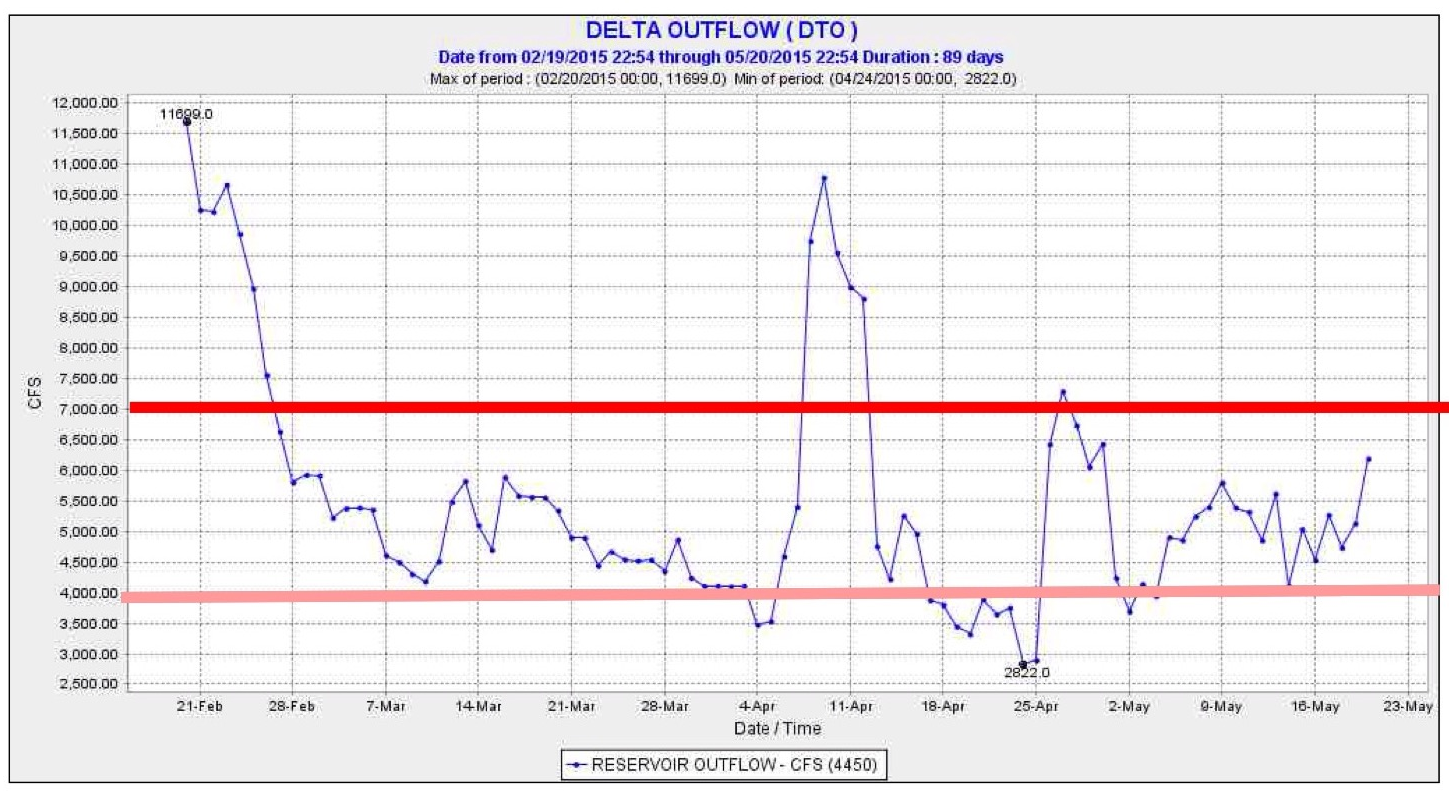
How hard would it be to at least maintain the antiquated minimum protections adopted in 1995 Bay-Delta Standards? The Bay is “allocated” a base of about 5 million acre-feet of water each year in the form of a base Delta outflow of 7,100 cfs. This standard for critically dry years is the first to suffer from State Board drought orders. The Board has reduced outflows requirements to 3000-4000 cfs (Figure 1). Such low outflows are in reality closer to zero (see earlier blog3). The amount of water “short” from the critical year base in the important February – June period is approximately 300,000 acre-feet. This amounts to less than 5% of the total 10 million acre-feet of reservoir releases into the Central Valley in 2014 and expected in 2015. The amount is less than 10% of the 5 million acre-feet presently in storage in Central Valley reservoirs. The water could be restored to the Bay by reducing water contractor allocations and/or reservoir storage.

The Delta had one plankton bloom that came and went this spring4. Plankton blooms are needed to drive the Bay-Delta food chain. Without freshwater flow to the Bay there will be no blooms and little food through the summer for Bay-Delta fishes. Water quality will suffer as well. The prognosis for the Bay-Delta and other California ecosystems is grim. California fisheries will suffer for decades to come.

Figure 1. Delta outflow as calculated by the California Department of Water Resources for Feb-May, 2015. Top red line represents 7100 cfs minimum standard. Lower red line represents typical weakened level of protection.

Debate on Salmon Trucking Heating Up

A recent FISHBIO blog post1 reported on the CalNev American Fisheries Society annual meeting, where AFS members considered the subject of “off-site” release of hatchery salmon smolts. The general perception is that releases away from hatcheries and the natal river leads to high stray rates, with some estimates of stray rates as high as 90%. The blog post discusses the problems caused by straying to non-natal rivers. The blog post states a concern that the practice of off-site releases will lead to reduced population fitness and genetic diversity, and that reproductive success will be half of wild-origin fish:

“Such losses in biocomplexity are dangerous because of the many threats salmon face in the highly altered Central Valley, and the potential inability of this species to persist if faced with a major environmental disaster, which the current drought in California may foreshadow. Yet despite recommendations from the California Hatchery Scientific Review Group, who warned about increases in straying rates due to off-site releases as early as 2010, managers from across the state have responded to drought conditions by trucking salmon from hatcheries to release sites in the Delta and Bay.”

While FISHBIO’s concerns about straying and genetics are well-founded, it is a little late for the Central Valley Fall Run Chinook. Studies have shown that populations across the Valley are homogeneous, with little or no genetic diversity, and consist mainly of hatchery fish and some natural offspring of hatchery fish. There really are no viable “wild” Fall Run Chinook populations left in the Central Valley. Even runs on rivers with no hatcheries (e.g. Yuba and Cosumnes rivers) are made up almost entirely of hatchery strays.

In making the decision to truck hatchery smolts to the Bay-Delta, Federal and State fisheries managers have recognized the harsh reality that having some salmon is better than having none. No one wants to go back to the bleak escapement years of 2007 to 2009, when less than 100,000 adult salmon per year returned to the Central Valley (compare with 870,000 in 2000 and 200,000-400,000 fish per year since 2009). Recent improvements were in large part due to the smolt trucking program in which 50-80% of Central Valley hatchery smolts were trucked to the Delta or Bay.

Can we have our cake and eat it too? Are there measures we can undertake to improve diversity and reduce straying? Yes, there are many, but they come with costs and with no guarantees.

The hatcheries can be more selective in the genetic material (parents) they use in producing smolts. Hatchery managers can barge smolts to the Bay to reduce straying (during barging, the smolts are suspended from barges in net pens, and thus imprinted on their natal waters during their trip downstream). Hatcheries can mark all hatchery fish to clearly differentiate between wild fish and hatchery fish (generally, hatcheries currently mark only 25% of hatchery juveniles). The Fish and Game Commission could establish mark-selective sport fisheries that allow sport harvest only of hatchery fish. The fisheries agencies could develop Wild Fall Run sanctuaries on some tributaries.

Ultimately, long-standing aspects of Delta operations must change to allow more juvenile salmon to get out of the system and more adult salmon to find their way back to natal streams. Delta exports during the spring are particularly devastating to juvenile outmigrants from the San Joaquin tributaries, including the Mokelumne, because these juveniles are drawn to the south Delta pumps. Low Delta outflow, particularly during spring, magnifies the effects of exports. Opening the Delta Cross Channel during spring may actually improve survival of San Joaquin and Mokelumne juveniles, but only when combined with high Delta outflow. Closure of the Delta Cross Channel gates during the fall, either by design or through fortuitous operational decisions, has reduced straying of Mokelumne River salmon adults to the American River, allowing multiple small pulse flows from the Mokelumne in the fall to help improve adult returns.

Early May Prognosis for Smelt

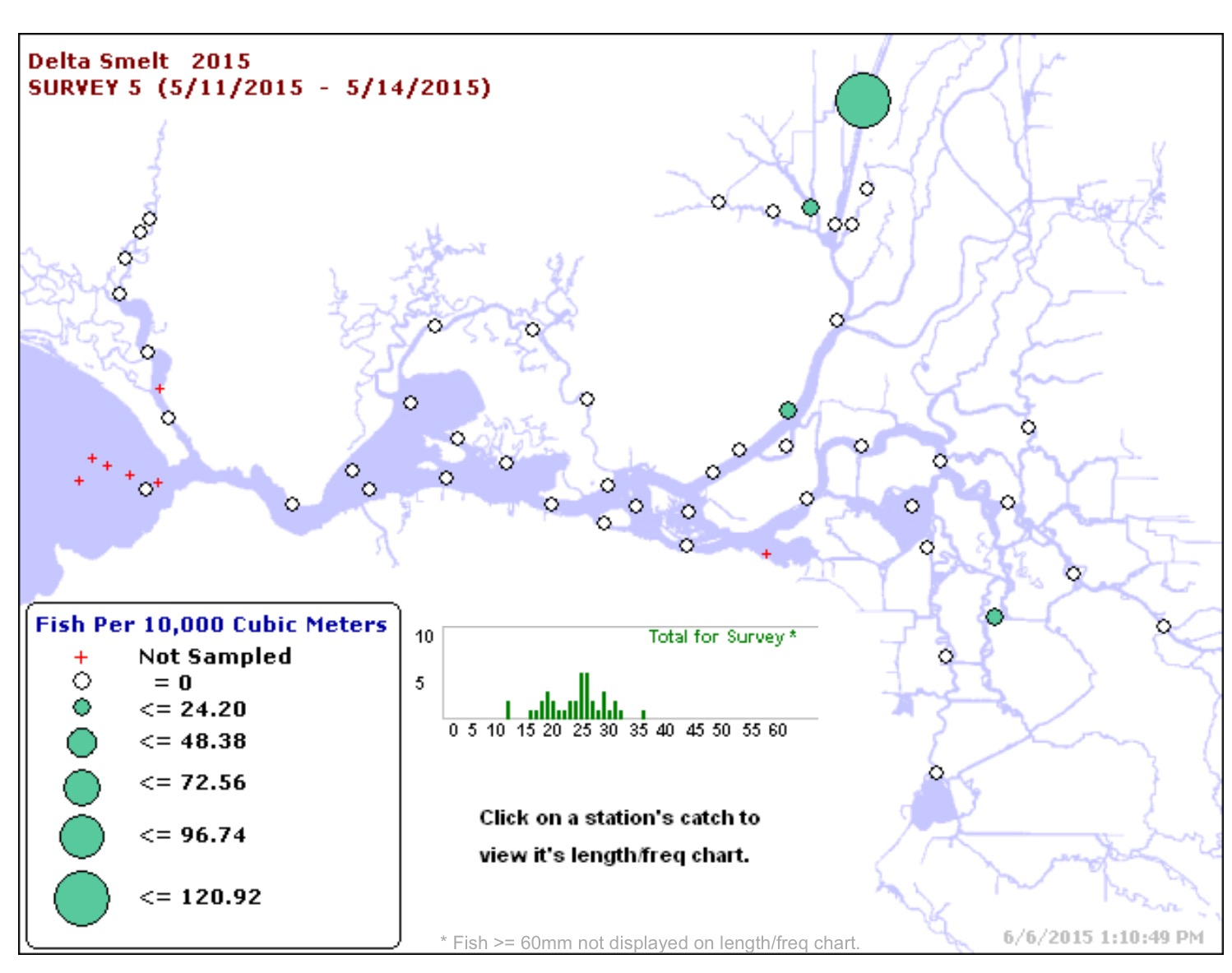
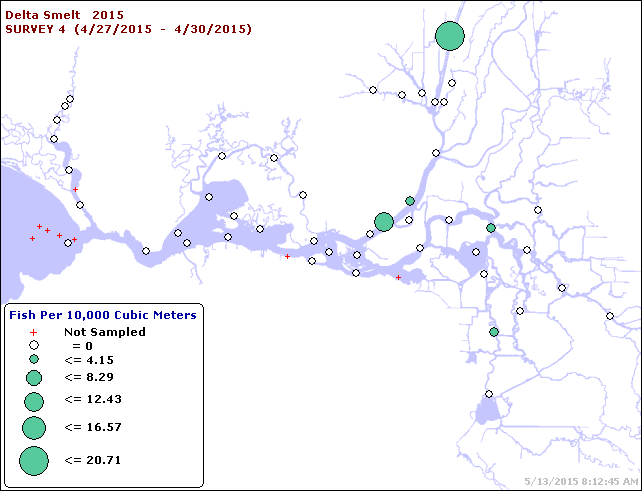
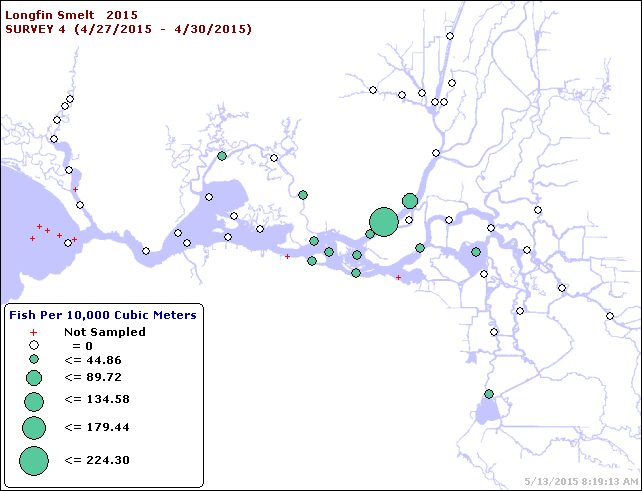
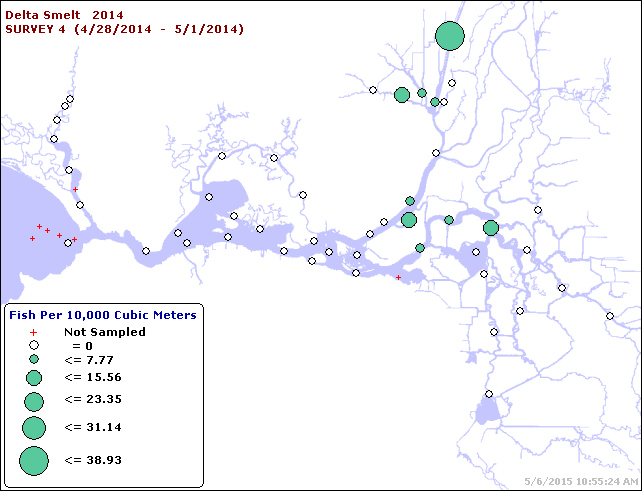
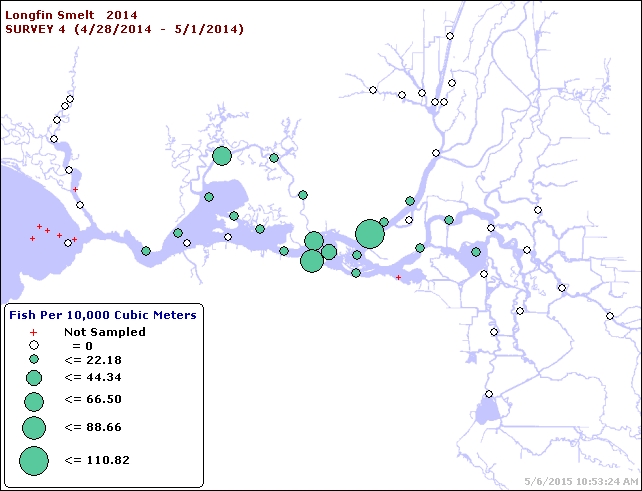
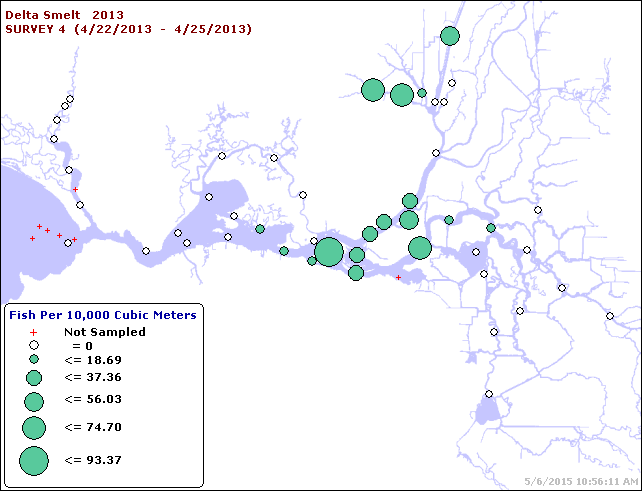
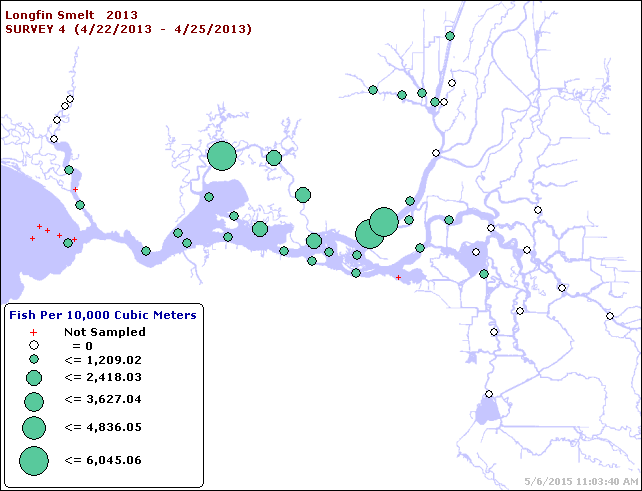
How are Delta and Longfin smelt doing after my earlier March and April poor prognoses? As predicted, late April – early May surveys indicated extremely low numbers (Figures 1 and 2), far fewer than the record low numbers of 2013-2014 (Figures 3-6).

In the May 4, 2015 Smelt Working Group meeting1, “Members did make a note of the single Delta Smelt larva from April 23, as well as the three Delta Smelt observed during the primary channel CO2 treatment [at Tracy Fish Salvage Facilities], providing that this is evidence of entrainment. These collections occurred despite at or below minimum exports levels, as defined in the Biological Opinion; OMR flows were also at or close to the most positive flows indicated in the Biological Opinion….Salvage of juvenile Longfin Smelt increased to 52 for the week of April 27 through May 3. Some increase was expected as south Delta water warmed. Between April 13 and 15, four juvenile Longfin Smelt were salvaged at the CVP and 12 at the SWP, at the same time, a single larva was observed in the larval fish samples at the CVP and four larvae at the SWP. During the period of April 17 through 23, seven Longfin Smelt larvae were observed at the SWP and one larva at the CVP in larval fish collections. Continued collections in salvage are expected. Overall, catches in the central and south Delta were not sufficient to reach concern levels based on density or distribution… Longfin Smelt larvae and small juveniles will continue to be detected at the salvage facilities until water temperatures surpass 22 deg C.” The fact that any smelt were collected at the two south Delta export facilities should be a grave warning of a larger and very significant “take” of smelt. As stated many times before, the odds of any young smelt reaching the south Delta export facilities without succumbing along the way are infinitesimal. In addition, no smelt will survive in any part of the Delta where water temperature reaches 25°C.

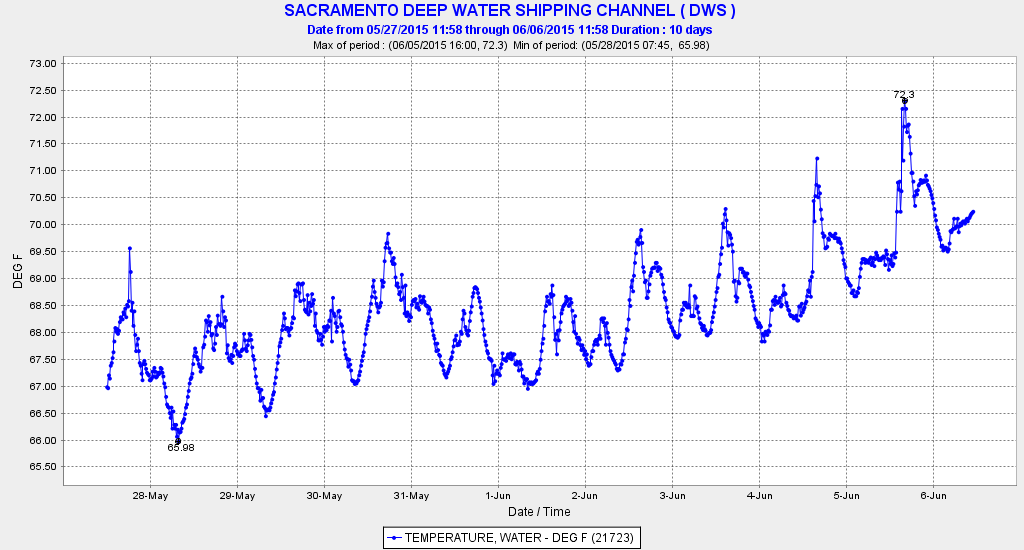
With the prescribed Net Delta Outflow Index at only 4000 cfs and measured outflow nearer to zero, the low salinity zone critical habitat of smelt is in the central Delta. Remaining smelt are being drawn across the Delta from north to south to the export pumps. Under these conditions the first heat wave of late spring will heat the central Delta to lethal 23-25°C levels for smelt. Unless these conditions are changed by increasing outflow and reducing exports, both smelt species may go virtually extinct2 this spring.

Figure 1.  Delta Smelt density distribution in late April 20-mm Survey.  Only three were captured in Sacramento Deep-Water Ship Channel, compared to 20 in previous week’s survey.

Figure 1. Delta Smelt density distribution in late April 20-mm Survey. Only three were captured in Sacramento Deep-Water Ship Channel, compared to 20 in previous week’s survey.

Figure 2.  Longfin Smelt density distribution in late April 20-mm Survey

Figure 2. Longfin Smelt density distribution in late April 20-mm Survey

Figure 3.  Delta Smelt density distribution in late April, 2014 20-mm Survey.

Figure 3. Delta Smelt density distribution in late April, 2014 20-mm Survey.

Figure 4.  Longfin Smelt density distribution in late April, 2014 20-mm Survey

Figure 4. Longfin Smelt density distribution in late April, 2014 20-mm Survey

Figure 5.  Delta Smelt density distribution in late April, 2013 20-mm Survey.

Figure 5. Delta Smelt density distribution in late April, 2013 20-mm Survey.

Figure 6.  Longfin Smelt density distribution in late April, 2013 20-mm Survey.

Figure 6. Longfin Smelt density distribution in late April, 2013 20-mm Survey.

  1. http://www.fws.gov/sfbaydelta/documents/smelt_working_group/swg_notes_5_4_2015.pdf
  2. Virtually extinct means we should not expect to see any next year.

Spring Actions to Save Delta Smelt

The Smelt Working Group in its April 13 meeting notes1 confirmed that the Spring Kodiak Trawl Survey has recorded record low numbers of adult Delta Smelt in both its March and April surveys. The record lows are consistent with the record low 2014 Fall Midwater Trawl Index. The Group also noted few young Delta Smelt have been collected in the April Smelt Larval and 20-mm surveys. No fisheries agency has objected to State Water Board’s April 6 Order in which the Board reduced the spring Delta outflow standard to 4000 cfs, reduced San Joaquin flow to 200-300 cfs, and moved the salinity standard location for X2 upstream to Threemile Slough provided South Delta exports are held to 1500 cfs.

Given the present state of the smelt populations, the expected habitat conditions this spring and summer will be extremely stressful to the minimal population of this year’s brood of young smelt. As was the case last year, young smelt will be confined to western, central, and northern Delta portions of the lower Sacramento River, lower San Joaquin River, Cache Slough, and Threemile Slough. Exports of 1500 cfs may be insignificant when Delta inflows are 20,000 cfs, but they are not insignificant when inflows are only 6000 cfs. In low inflow conditions, exports pull warm water into the Low Salinity Zone (LSZ), which along with its upstream position leads to lethal or near lethal water temperature (>23C) by the end of spring. Already, May water temperatures will reach or exceed 20°C. The exports also reduce the food productivity of the LSZ through the export of nutrients and plankton.

Mid-April conditions were not extreme (Figure 1) because a mandated San Joaquin River pulse flow kept flows moving in a general downstream direction. However, as the pulse flow ended in late April and the State Board Order took full effect, conditions for Delta Smelt deteriorated quickly (Figure 2). There were three primary negative effects:

  1. Reduced Delta outflow, which results in X2 and LSZ moving upstream. (Magenta arrow in Figure 2.)
  2. Negative net flow in Threemile Slough, which pulls Delta Smelt into the central Delta from the north Delta. (Red arrow located just south of Rio Vista in Figure 2.)
  3. Net flow from the north and central Delta toward south Delta export pumps (Figure 3).

Spring Actions

The following actions would reduce the negative effects on Delta Smelt:

  1. Increase Delta outflow by 1000-2000 cfs, at least during “spring tides”.
  2. Open the Delta Cross Channel during the daytime to increase inflow into the central Delta from northeast by 1000 cfs. (This would reduce net negative flows from north Delta to central Delta via Threemile Slough). Any effect on migrating Sacramento River salmonids can be largely mitigated by keeping the DCC open only in daytime.
    Install Head-of-Old-River Barrier near Vernalis to limit movement of San Joaquin River salmonids into the south Delta.
  3. Install False River Barrier to eliminate tidal pumping of LSZ and young Delta Smelt from Jersey Point into Franks Tract/Old River via False River (slough just north of Bethel Island).
Figure 1.  Mid-April 2015 approximate hydrology conditions in Delta.  Blue arrows depict flow (cfs) in positive downstream direction.  Red arrows depict OMR and export flows.  Green line depicts location of head of Low Salinity Zone (500 EC) at low tide.  Magenta line depicts average daily location of X2 (2700 EC).  Delta Smelt young generally concentrate between the magenta and green lines in spring. (Map source:  USGS with monitoring stations)

Figure 1. Mid-April 2015 approximate hydrology conditions in Delta. Blue arrows depict flow (cfs) in positive downstream direction. Red arrows depict OMR and export flows. Green line depicts location of head of Low Salinity Zone (500 EC) at low tide. Magenta line depicts average daily location of X2 (2700 EC). Delta Smelt young generally concentrate between the magenta and green lines in spring. (Map source: USGS with monitoring stations)

igure 2.  Expected late-April through May 2015 approximate hydrology conditions in Delta.  Blue arrows depict flow (cfs) in positive net downstream direction.  Red arrows depict OMR and export flows.  Green line depicts location of head of Low Salinity Zone (500 EC) at low tide.  Magenta line depicts average daily location of X2 (2700 EC).  Delta Smelt young generally concentrate between the magenta and green lines in spring.

Figure 2. Expected late-April through May 2015 approximate hydrology conditions in Delta. Blue arrows depict flow (cfs) in positive net downstream direction. Red arrows depict OMR and export flows. Green line depicts location of head of Low Salinity Zone (500 EC) at low tide. Magenta line depicts average daily location of X2 (2700 EC). Delta Smelt young generally concentrate between the magenta and green lines in spring.

Figure 3.  Location of Delta Smelt larvae in late April – early May 2014 from Smelt Larvae Survey.  Arrows indicate primary net flow routes of larval smelt from North and Central Delta to South Delta.

Figure 3. Location of Delta Smelt larvae in late April – early May 2014 from Smelt Larvae Survey. Arrows indicate primary net flow routes of larval smelt from North and Central Delta to South Delta.

  1. http://www.fws.gov/sfbaydelta/documents/smelt_working_group/swg_notes_4_13_2015.pdf