Can Winter Run Chinook Salmon be Saved in 2015?

Various resource agencies are scrambling to protect Winter Run Chinook Salmon this year after last year’s debacle, in which water “saved” in Shasta Reservoir wasn’t cold enough to keep Winter Run eggs and fry alive1. Higher, colder flows are necessary to keep the eggs and fry alive in their spawning and early rearing areas near Redding, but were unavailable last summer because Shasta’s cold-water pool was depleted by the end of August.

The five charts included below tell the story of what happened last year. In summary, these are the main reasons why the Bureau of Reclamation ran out of cold water in Shasta Reservoir…

  • First, approximately 200,000 acre-feet (AF) of cold-water pool storage was released to senior water rights contractors in May. (Amount calculated from Figure 1 and Table 1).
  • Second, approximately 500,000 AF of cold-water pool storage was released in June and July that could be argued was needed for maintaining river temperature control below Redding. However, I would argue that given the precarious state of the Shasta cold-water pool in June and July, federal and state agencies should have released less (to maintain 58°F at Clear Creek instead of the chosen target temperature of 56°F) to sustain Shasta’s cold-water pool. My guess is they could have saved 2000 cfs or about 240,000 AF of total storage in June and July. This water would have come out of the Sacramento River Settlement Contractors’ 560 TAF deliveries for June-July (Table 1).
  • Third, somewhat less cold-water pool water could have been saved in early weeks of August.

If the Bureau of Reclamation had saved this 440,000 AF from May-July (about a third of deliveries), there would have been no extreme mortalities of Winter Run Chinook Salmon in the late August-October period from low flows and high water temperatures. Contractors could have made up some of their loss in the late August-October period when higher colder flows would have been released from Shasta for fish. If Sacramento River contractors were unable to use this water late in season, the water could have been used to maintain Delta water quality standards or left as carryover storage in Shasta Reservoir.

In summary, cold-water pool releases from Shasta Reservoir from May through August of 2014 were too great to support the cold water resource, resulting in the loss of much of the year’s production of Winter Run eggs and fry to low flow, warm water conditions. In similar conditions in 2015, releases for contractor irrigation deliveries should be reduced in order to sustain Shasta’s cold-water pool through the summer. Such protections should be the cornerstone of the Drought Operations Plan being developed by the agencies. NMFS and DFW should not approve the Plan without this element to protect Winter Run.

Figure 1

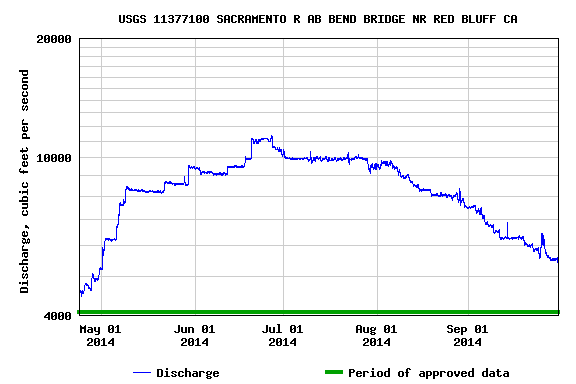
Figure 1. Mainstem flow of the Sacramento River below Redding, May-Sept 2014. Flows generally reflect releases from Shasta Reservoir. (Source: USGS Mobile Data Site)

Figure 2

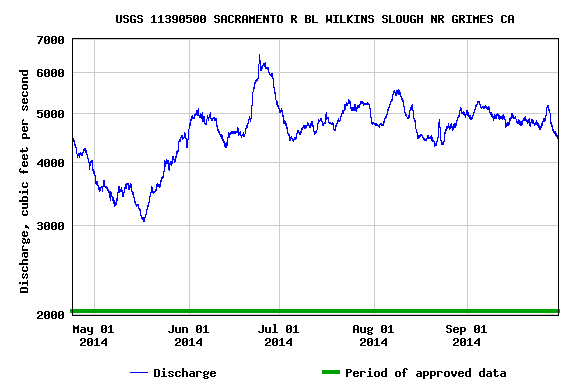
Figure 2. Mainstem Sacramento River flows at Wilkins Slough gage below most of the contractor diversions. (Source: USGS Mobile Data Site)

Figure 3

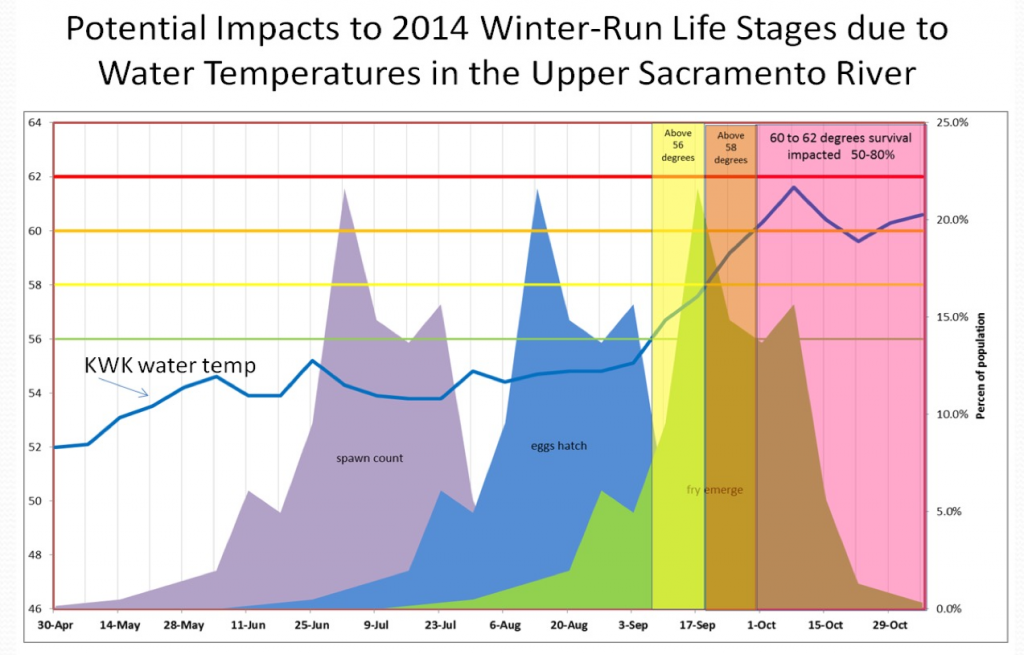
Figure 3. Power-Point slide of risk to Winter Run adults, eggs, and fry as a function of water temperature in Shasta Reservoir releases (as measured Keswick Reservoir releases – KWK).2

Figure 3

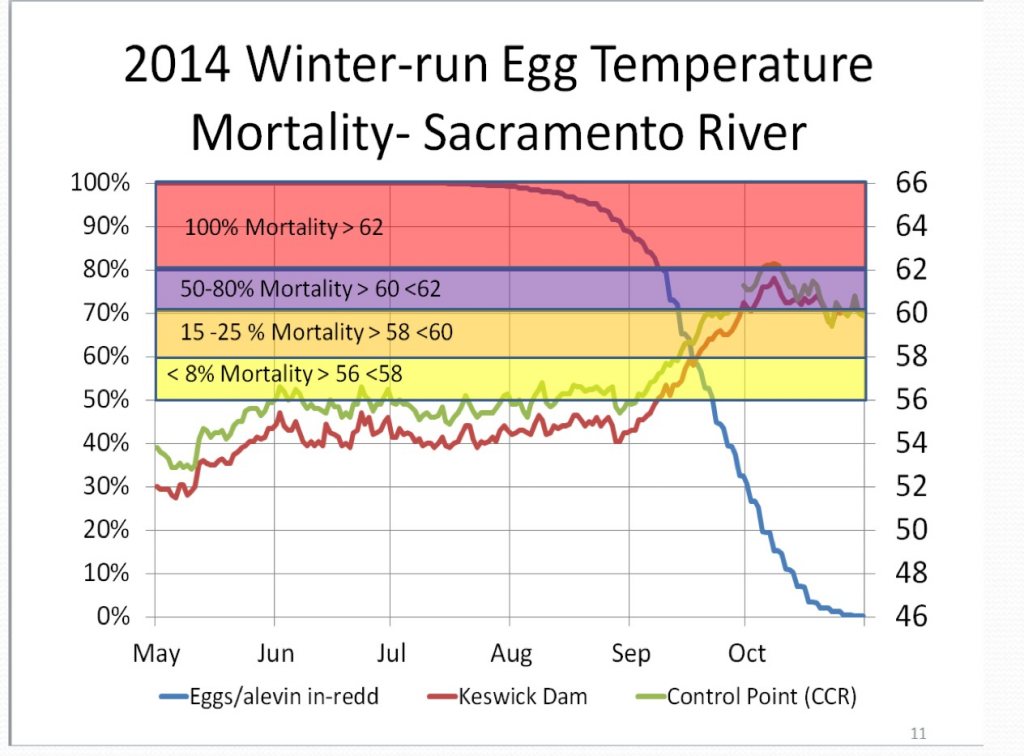
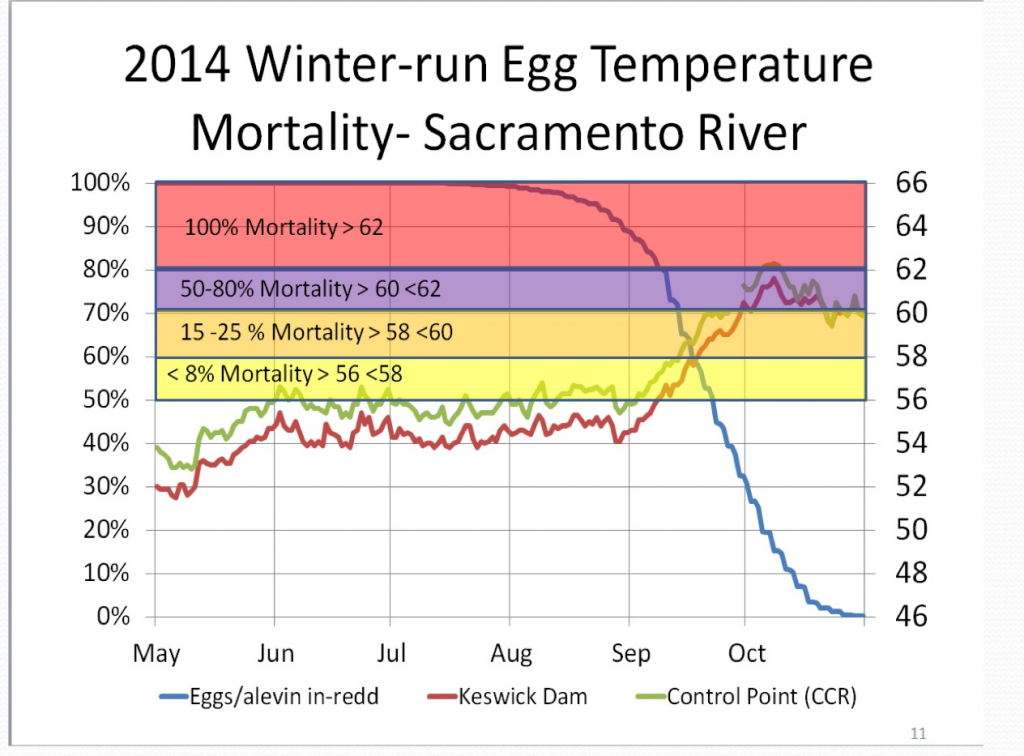
Figure 4. Power-Point slide of risk to Winter Run eggs as a function of water temperature in Shasta Reservoir releases (as measured Keswick Reservoir releases – KWK) and temperature in the river below the mouth of Clear Creek near Redding.3

Table 1

Table 1. Water deliveries from Reclamation to Sacramento River contractors in 2014.
(Source: http://www.usbr.gov/mp/cvo/vungvari/table_28_2014.pdf)

  1. See, for instance, https://cdfgnews.wordpress.com/2015/01/26/agencies-taking-measures-to-protect-winter-run-chinook-preparing-to-release-approximately-600000-fish/
  2. Source: NOAA’s National Marine Fisheries Service’s (NMFS) Update to the State Water Resources Control Board by Garwin Yip, February 18, 2015
  3. Source: NOAA’s National Marine Fisheries Service’s (NMFS) Update to the State Water Resources Control Board by Garwin Yip, February 18, 2015

Central Valley Hatchery Steelhead Program Misdirected

Approximately 1.3 million yearling Steelhead smolts are released each year in rivers below our three state and one federal Central Valley Steelhead hatcheries. The hatcheries include Coleman Hatchery (federal) on Battle Creek near Redding, Feather River Hatchery (state) near Oroville, Nimbus Hatchery (state) on American River near Folsom, and Mokelumne River Hatchery (state) near Lodi. The smolts are generally released as yearlings in February at about 4 to-the-pound and 6-10 inches in length. In some drought years (e.g., 2014), Nimbus Steelhead are also released to the American River as several-month-old fingerlings in June because hatchery source water from Lake Natoma is too warm to carry the fish through summer until the normal February release date.

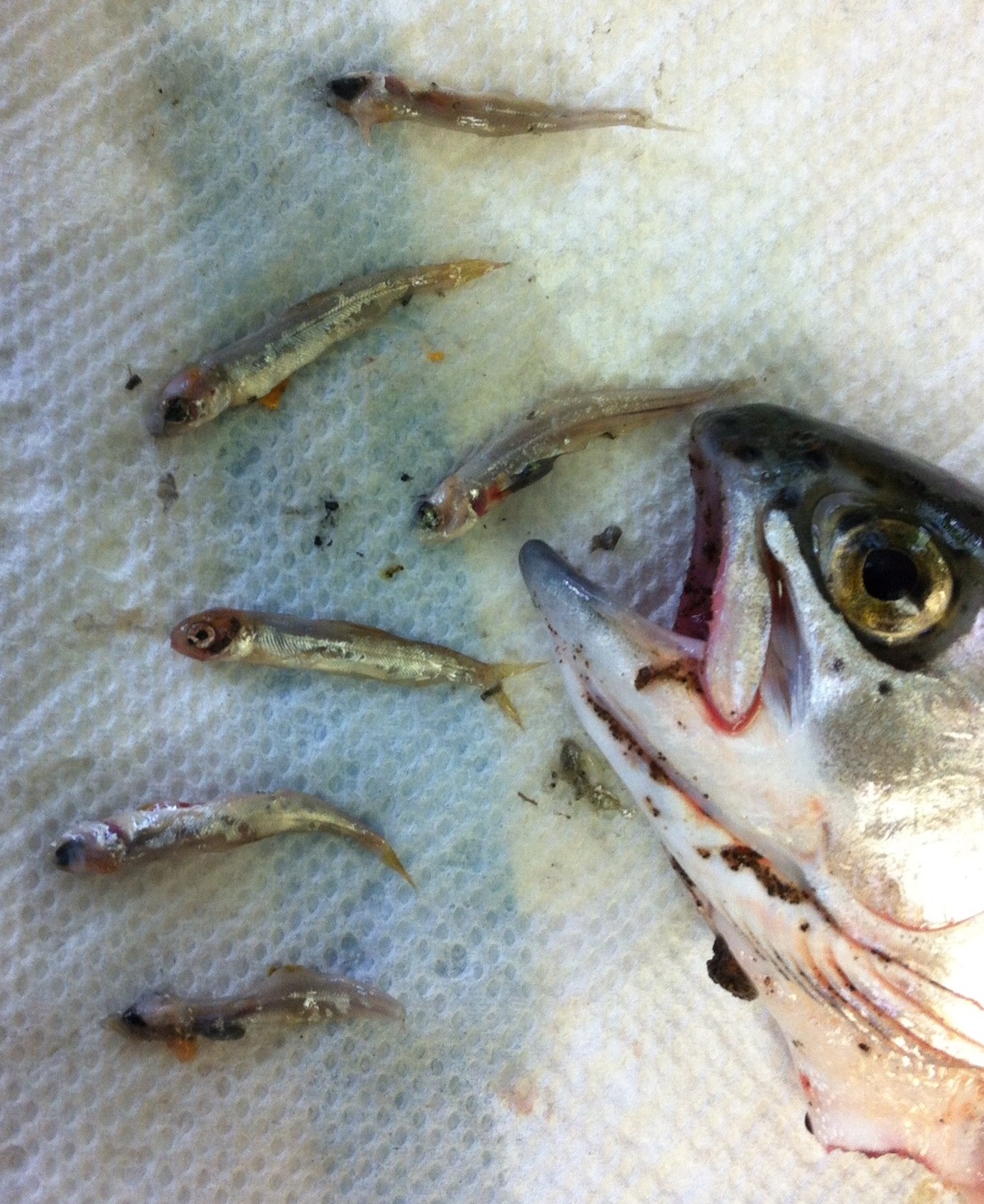
The problem with releasing over a million hatchery Steelhead smolts into the rivers in the spring is that wild Spring-Run and Fall-Run Chinook salmon fry emerge or have recently-emerged from redds at this time. The one-inch salmon fry are ready-made prey for the hatchery Steelhead smolts. Figure 1 shows the partial stomach contents (six salmon fry) of a hatchery Steelhead smolt caught in early March in the lower American River.

Figure 1.

Figure 1. Partial stomach contents of an American River hatchery steelhead smolt (head at right) captured in early March 2015 near Sunrise Bridge. There were partial remains of twenty salmon fry in various stages of digestion in the stomach.

While many hatchery Steelhead likely migrate from the rivers towards the Bay-Delta soon after release, many also stay in the rivers. This is especially true in the American River, where they may be released early as fingerlings prior to summer and are thus likely to take up residence in the river. Many Feather hatchery smolts take up residence in the lower Yuba River. Smolts released in rivers also are more prone to becoming permanent river residents in drought years when there are fewer pulses of flow to stimulate emigration to the sea, especially in the Feather, American, and Mokelumne Rivers. Salmon fry may become prey of the hatchery Steelhead smolts for a few days to a month or more.

Releasing hatchery Steelhead into the lower rivers in such large numbers also impacts wild Steelhead that are present in much smaller numbers. The hatchery smolts compete with the wild smolts. Hatchery smolts attract large numbers of predatory birds and fish (e.g., Striped Bass). Hatchery smolts also feed on wild Steelhead fry that emerge from redds from April to June.

What can be done to help solve the problem?

  1. Hatchery Steelhead smolts should be trucked to the lower Sacramento River rather than being released in their natal rivers.
  2. The trucked hatchery smolts should be placed in barges, then barged from the Sacramento River to low salinity waters of the Bay to reduce the probability of their immediately returning to their natal rivers (and to maximize their survival to the ocean). Barging is necessary to minimize subsequent adult straying to non-natal rivers, a problem if smolts are trucked all the way to the Bay.
  3. Fingerlings should also not be released into natal rivers below the hatcheries. They too should be trucked then barged to the upper Bay.
  4. Pre-smolts could be released in early winter to natural floodplain habitats or even to specially designed flooded rice fields to grow to smolt size.

These actions, if taken, will both reduce predation on wild salmon and Steelhead fry and markedly increase survival of hatchery Steelhead to the Ocean and subsequent escapement of adult Steelhead to the rivers. Record low numbers of Steelhead returned to Central Valley rivers in winter 2015. More on this subject will come in later posts.

For more details on the Steelhead hatchery programs see the following website: http://cahatcheryreview.com/summary-conclusions/

Mark-Selective Chinook Fishery in Puget Sound

Puget Sound is a large inland marine water body in Washington State that supports runs of five Pacific salmon, steelhead, and multiple marine fish species. Chinook salmon are a very popular recreational and (in the past) commercial species in Puget Sound. To support the naturally spawning Chinook salmon runs, numerous hatcheries were built in throughout the Pacific coast area.

As a result of the Endangered Species Act, the Chinook salmon fisheries were very restricted or completely closed to protect wild (“naturally spawning”) fish. This included closure for all (both hatchery and wild) Chinook salmon.

Through various planning efforts by sports fishermen, Native American tribes, Washington Department of Fisheries and Wildlife (WDFW) and others, a mark-selective approach for providing some fishing opportunities for Chinook salmon was developed. The approach involved marking of hatchery fish by removal of the adipose fin (a small fin near the tail) to identify hatchery fish from wild ones. Once removed, the fin does not normally regrow, and therefore, if caught by a fisherman, the fish can be identified as a hatchery fish and retained (if it meets other restrictions such as size limit, season, etc.). Wild fish (with the adipose fin) can then be readily identified and released. In addition, a certain percentage of hatchery fish may have a small “coded-wire tag” inserted into their heads. This provides additional information about the fish such as which hatchery it was reared in. WDFW has also added rules that wild salmon cannot be brought aboard a vessel (i.e., inside the gunwale) to assist in releasing the wild fish unharmed.

Each year, the WDFW and Native American tribes (co-managers of the fisheries in Washington State) set quotas on the number of marked Chinook salmon that may be taken in Puget Sound (which is divided into several subareas to assist in management for various runs of Chinook salmon. For example, one subarea may be dominated by a run to a specific hatchery. Depending on the projections for adult returns to that hatchery, a quota for take is established and considered in the overall quota for that subarea).

The quotas for each subarea are monitored through dockside sampling. They are also supported by WDFW staff that fish for Chinook salmon with methods similar to those used by private and charter sport fishing groups. This “on the water” sampling provides key information about take, wild/hatchery fish ratios, and fishing effort. The information is used to support the overall development of quotas.

Seasons and quotas are set early in the year so that some planning by fishermen (e.g., vacations, days off, etc.) can be made. However, if the quota is reached early, the season may be closed early.

Overall, the mark-selective approach has re-opened fishing opportunities. These have been very popular with fishermen, as noted by the large groups that are currently observed on the water. This has also helped support economically important aspects such as charter fishing, tackle shops, boat sales, etc.

The WDFW has provided very detailed information about the mark-selective Chinook salmon fishery in Puget Sound (and elsewhere in Washington State) in multiple publications and press releases (see wdfw.wa.gov/publications). These publications provide information on the overall program, sampling techniques, quota development, and other pertinent aspects of the mark-selective approach.

Several issues have arisen about the approach, which are of interest. These include costs associated with marking millions of hatchery fish and monitoring programs, incomplete or non-marking of hatchery fish, mortality associated with capture and release of wild fish, and other aspects of the program. However, overall, this approach has helped to provide fishing opportunities that would not be possible under the no-take restrictions that were originally imposed by the Endangered Species Act.

Hatchery Chinook salmon

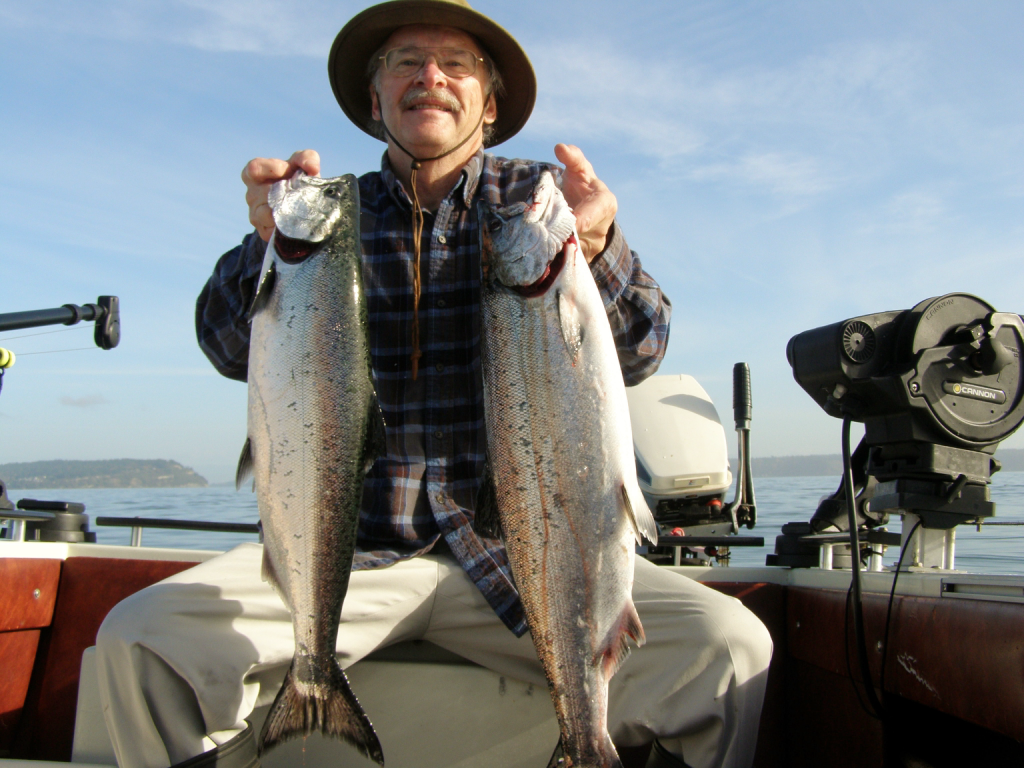
Hatchery Chinook salmon taken in a Puget Sound mark-selective fishery. Photo by the author.

What is wrong with summer water transfers?

Summer water transfers are predominantly made with water released from Shasta and Oroville reservoirs.  Instead of being used by Sacramento Valley CVP and SWP contractors, water is sold to South of Delta contractors who take the water via the South Delta CVP and SWP export pumps.  Non-project water transfers are also facilitated by CDWR.  Transfers usually occur in drought years when allocations to South of Delta contractors are low and excess export capacity exists at the South Delta pumping plants.  Purchasers must also pay for an additional 15-25% of “carriage” water to limit salinity intrusion into the Delta that would occur with export of transfer water.

Under existing “rules”, up to 600,000 AF of water may be transferred through the Delta during the allowed summer transfer “window”.  In 2014, 110,000 AF of CVP water from Shasta Reservoir was transferred from July through November (Reclamation was granted a temporary change to transfer water in the Oct-Nov period in 2014).  In 2014, approximately 300,000 AF of transfers were conducted by CDWR during the summer.  In 2015 CVP transfers of Shasta water are expected to be 240,000 AF, while SWP transfers are expected to be less than they were in 2014.

So what are the problems with water transfers from an ecological perspective1?

  1.  Transfer water is released from reservoirs in summer where during drought years there may be a limited cold-water pool to sustain downstream fish populations through the summer and fall. In 2014, the brood year for Winter Run Chinook Salmon was lost when the Shasta cold-water pool was exhausted at the end of August (Figure 1).  Some would argue that the water would have been released in any case to downstream ag contractors.  However, there are other options that would keep the water in the reservoir (e.g., fallowing programs, water purchase, deferring transfers).
  2. The water is released from multi-year storage, thus limiting the amount of carry-over storage in the coming years that is needed to sustain fish and their habitat, as well as water supplies for public health and safety.
  3. Transfer water exported from the Delta is not the same water released from the reservoirs. Water exported is a combination of Sacramento River inflow, San Joaquin River inflow, and Delta low-salinity (brackish) water from the North, Central, and West Delta.  Sacramento River inflow includes flows from the Feather, Yuba, and American rivers, as well as many smaller rivers.
  4. The already inadequate protections that apply to “normal” export water don’t apply to transfer water. Transfers increase the flow towards the Delta pumps, pulling fish with them.  But the ratio of inflow to outflow that generally limits exports doesn’t count transfer water; there are no restrictions in moving transfer water through the Delta other than carriage water requirements.  Transfer water can make up 25% or more of Delta inflow.
  5. Transfer water exported thus takes water with fish from many Central Valley habitats. Most prominently is the taking of Delta Smelt from the brackish and freshwater zones of the North, Central, and West Delta. Transfer water essentially must pass through the Delta’s designated critical habitats to get to the South Delta export facilities (Figure 2).
  6. When water quality standards for inflow, outflow, and salinity are relaxed, the process is further aggravated. Adding transfers during drought conditions with barriers, DCC open, low exports, low inflows, and low outflows worsens the effects of transfers by bringing in added warm, fresh, low turbidity water to the Low Salinity Zone from the north, while exporting turbid, brackish, higher turbidity, more biologically productive water from the south (Figure 2).
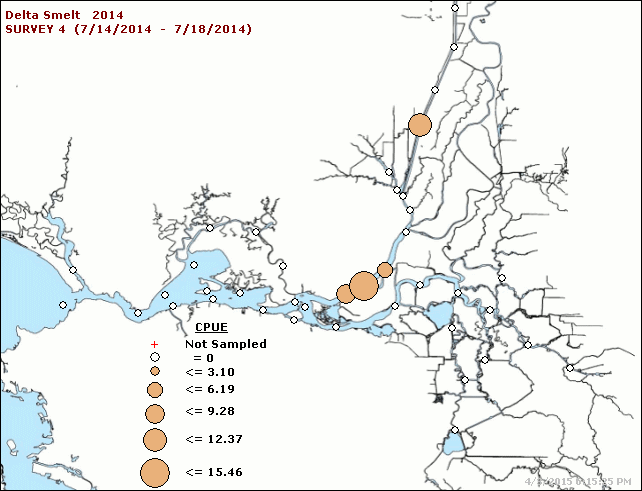
  7. Delta Smelt are highly vulnerable in the summer of drought years because the entire population is within the Delta (figure 3), where water temperatures are near or above lethal levels.
Figure 1.  Water temperature of Keswick Dam releases in summer 2014.  Chart depicts rapid rise in water temperature in early September as Shasta cold-water pool was exhausted. (Chart Source: NMFS)

Figure 1. Water temperature of Keswick Dam releases in summer 2014. Chart depicts rapid rise in water temperature in early September as Shasta cold-water pool was exhausted. (Chart Source: NMFS)

Figure 2.  Freshwater inflows to the Delta (blue arrows) including transfer water must mix first with many other source waters including brackish waters (green lines) from San Francisco Bay.  South Delta exports draw water across the Delta (red arrows).

Figure 2. Freshwater inflows to the Delta (blue arrows) including transfer water must mix first with many other source waters including brackish waters (green lines) from San Francisco Bay. South Delta exports draw water across the Delta (red arrows).

igure 3.  Catch distribution of Delta Smelt in CDFW Summer Townet Survey, July 2014.  (Source: http://www.dfg.ca.gov/delta/data/townet/ )

Figure 3. Catch distribution of Delta Smelt in CDFW Summer Townet Survey, July 2014. (Source: http://www.dfg.ca.gov/delta/data/townet/ )

CDFW proposes to close the Sacramento River above Redding to sport fishing from April 27 to July 31

The California Department of Fish and Wildlife proposes to close fishing in the 5.5 miles of the Sacramento River above Hwy 44 Bridge from April 27-July 31 this year.1 These upper few miles of the river below Keswick Dam provide a world-class sport fishery for rainbow trout (salmon fishing in this river reach is permanently closed). The premise of the ban is to reduce mortality on endangered Winter Run Chinook Salmon. The reach is where most of the Winter Run spawn, eggs incubate, and fry emerge in gravels from late spring through early fall (Figure 1). Last summer 95% of the 2014 Winter Run brood year perished from redd dewatering and high water temperatures.

The proposed closure would inappropriately place the drought-management burden on sport anglers when the problem is poor water management in the present drought. The low flows and high water temperatures in 2014 were caused by depletion of Shasta Reservoir’s cold-water pool to meet water demands of Central Valley Project Settlement Contractors in the Sacramento Valley. These senior water rights holders received 1.3 million acre-ft of Shasta storage during 2014. An additional 110,000 acre-ft released was sold to south of Delta contractors via water transfers from July through November. Shasta Reservoir storage peaked last year near 2.4 million acre-ft in early May, then declined to 1.1 million acre-ft in October.

Shasta Reservoir releases were over 6000 cfs from early May through August (Figure 2). Most of the Winter Run spawned in June and July at flows in excess of 8000 cfs. During the August through September incubation period, flows fell to near 4000 cfs, resulting in the dewatering of many salmon redds. Redd dewatering coupled with high water temperatures resulted in the loss of 95% of the brood year production during September, according to CDFW and NMFS.

Closing the fishery this summer implies that sport fishing activities would otherwise contribute to Winter Run mortality when there is no scientific evidence to support this assumption. Boat traffic is mainly drift boats, which minimally disturb fish. The most obvious risk from fishermen would be trampling redds in the low water period in the August-September incubation period, which is not included in the proposed ban. Even that risk is low, since few anglers wade the spawning reaches.

DFW’s blog states: “Given the gravity of the current situation, it is imperative that each and every adult fish be given maximum protection.”2
The “maximum protection” standard would be much better applied if the Department unequivocally supported measures to protect all life stages of Winter Run. Instead of burdening sport fishermen with the proposed ban, the solution is for the State Water Board to reduce deliveries from Lake Shasta to water contractors this summer. If releases had been cut by a third from May-July last year, the Winter Run could have been saved. Yes, this would have come at a substantial cost to state’s agricultural production (Settlement contractors were already cut 25%), but the drought is unprecedented. Winter Run salmon extinction should not be the price paid to keep rice production high this year in the Sacramento Valley.

Figure 1.  Water temperature (degrees F) in Redding reach below Keswick Dam (KWK) in 2014, along with percent of Winter Run life stage present.  Red line shows water temperature where egg/alevin survival is less than 50%.  Source: NMFS

Figure 1. Water temperature (degrees F) in Redding reach below Keswick Dam (KWK) in 2014, along with percent of Winter Run life stage present. Red line shows water temperature where egg/alevin survival is less than 50%. Source: NMFS

Figure 2.  Shasta Reservoir releases from April through October 2014.

Figure 2. Shasta Reservoir releases from April through October 2014.