Welcome to the California Fisheries Blog

The California Sportfishing Protection Alliance is pleased to host the California Fisheries Blog. The focus will be on pelagic and anadromous fisheries. We will also cover environmental topics related to fisheries such as water supply, water quality, hatcheries, harvest, and habitats. Geographical coverage will be from the ocean to headwaters, including watersheds, streams, rivers, lakes, bays, ocean, and estuaries. Please note that posts on the blog represent the work and opinions of their authors, and do not necessarily reflect CSPA positions or policy.

Water Transfer Workshop and Klamath-Trinity-Sacramento Salmon

Water transfers are allowed through the Delta under federal biological opinions during the summer, but in 2015 the period was extended through the fall by the State Water Board, with the approval of the federal fisheries agencies responsible for administering the Endangered Species Act (ESA). There are many types of water transfers, but I am referring specifically here to transfers of federal Shasta-Trinity storage through the Sacramento-San Joaquin Delta to state and federal water contractors south of the Delta. Water released from Trinity and Shasta reservoir storage is passed down the Sacramento River into the Delta where it is exported in the south Delta and then delivered to south-of-Delta water contractors (who purchased the water from northern California contractors who have priority on the Shasta-Trinity water). This was the largest component of water transfers in the Central Valley in 2015.

This week, the Delta Stewardship Council held a workshop on these transfers through the Delta. The Council concluded: “On the issue of single-year water transfers and whether they impacted the coequal goals and therefore should be subject to the Delta Plan’s covered action process, the Council did not feel they had all the information they needed, so a determination was made to exempt single-year transfers from the covered action process until December 31, 2016, and a request made for further information.” 1In other words, the Council decided it needs more information before it can support these single-year water transfers.

At the workshop, DWR’s representative Bill Croyle stated: “2014 was a banner year. People needed the water, there was a little bit more water in the system, it was the third year of a drought, and I think the water transfer system, the market, the experience, the education, and some new tools and also a high level of involvement as necessary from the executive offices of all of our agencies resulted in over 400,000 acre-feet of water being moved to where it was really needed.”

Tom Howard, Executive Director of the State Water Board stated: “Really the concern is in the Delta, and then the question becomes how do you protect Delta resources. The way the water board has been looking at it is if you are meeting all your Delta objectives, then that’s what the water board at least at one time considered adequate to protect public trust resources. We’re in the process of taking another look at that because there have been a lot of issues associated with the existing standards potentially. Also when we did the modeling for a lot of the development of these standards 20 years ago, we didn’t throw a lot of transfers in, so here we are throwing 500,000 – 700,000 acre-feet of transfers or more in a period in a four month period so as we work to update the Bay Delta plan, we will be assuming a large transfer load into the system as well beyond just operation of the projects and how they move water.

DWR’s Jerry Johns stated: “The Bureau when they did their EIR on long-term water transfers, they also evaluated these impacts and came to the conclusion that there wouldn’t be significant impacts, so I think it has been evaluated in a pretty robust fashion.

Representing the fish, Bruce Herbold, retired EPA biologist, offered: “So my recommendations on single year transfers is just don’t do them….We’ll have more water in storage upstream, we will have less streamflow modifications, and we’ll have less exports out of the Delta in each year.2

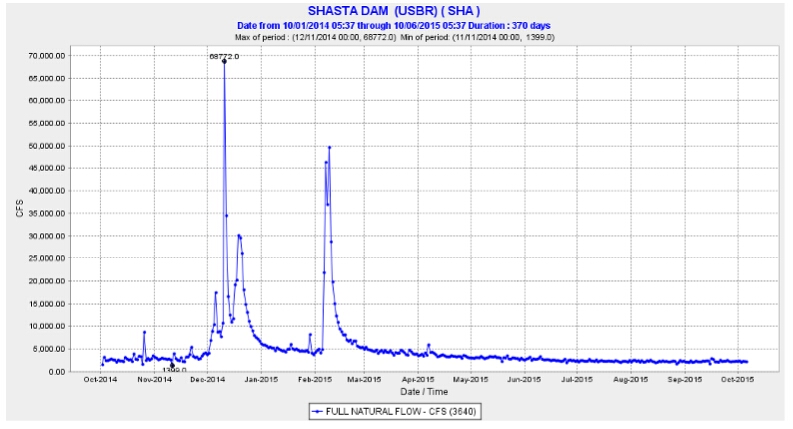
I agree with Dr. Herbold. The big impact is in the loss of Shasta-Trinity storage, which can be seen in the release of Keswick Reservoir water to the Sacramento River near Redding in the figure below.

Release of Keswick Reservoir water to the Sacramento River near Redding

Sacramento River releases recommended in the 2015 Salmon Plan developed by the State Water Board, fisheries agencies and the Bureau of Reclamation called for 6000 cfs for September and 5500 cfs for October. The 500-1000 cfs extra in September and 1000 cfs extra in October amount to approximately 80 TAF of “extra” storage releases that have gone to transfers so far this year in just six weeks.

The diversion from the Trinity River as seen below as Whiskeytown Reservoir power releases to the Sacramento River (most to Keswick Reservoir via Spring Creek Powerhouse) amounted to approximately 80 TAF between September 1 and October 14. This water represented over 10 percent of the remaining water in Trinity Reservoir, already at critical low levels after four years of drought. This new low level is well below the critical end of year storage level needed to sustain flows through the winter and next year’s cold-water pool for Klamath-Trinity salmon.

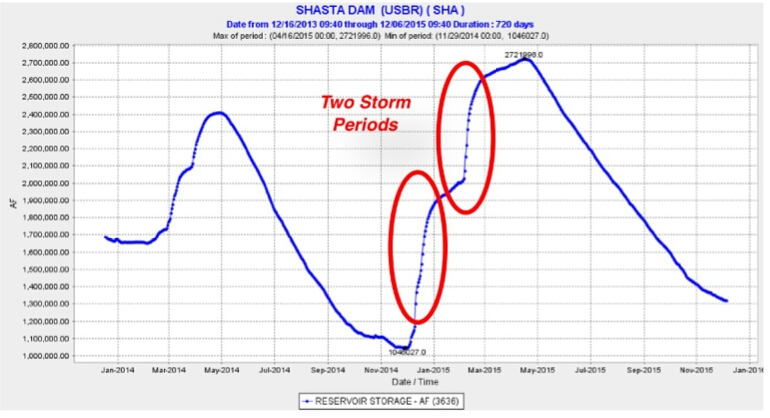
The diversion from the Trinity RiverBecause Shasta’s cold-water pool has been needed over these same six weeks since September 1 (and prior to that) to cool the warm Trinity water before it is released to the Sacramento River from Keswick Reservoir, Shasta’s cold-water pool and storage has also been used for the transfers. Shasta Reservoir’s cold-water pool and storage are needed to sustain salmon through the fall, but also the entire water supply for California next year. Shasta Reservoir is now down to 1.6 MAF out of its 4.55 MAF of capacity, its lowest level since the 1991-92 and 1976-77 droughts.

These transfers also have significant effects on the Delta and its low salinity zone critical habitat for native Delta fish species, including the Delta smelt. Delta exports are the mechanism for transferring water from the north to the south. Transfers are evident in recent Delta exports. As shown in the chart below, CVP exports increased in amounts between 600-1500 cfs in September and early October in response to CVP and other transfers. Most of the extra CVP export was sourced in Shasta and Trinity reservoirs. State Water Project transfers through the Delta also occurred (see next chart).

With flows through and out of the Delta to the Bay very low in this critical drought year, such exports have higher than normal environmental effects; however, transfers are exempt from restrictions applied to project exports   Even large volumes transferred at once do not trigger additional protections from the effects of pulling more water and more fish from the Sacramento River into the central Delta. We are glad to see that Mr. Howard has at least acknowledged these impacts. During drought workshops in 2014 and 2015, CSPA objected to this free pass for transfers through the Delta for years, calling them “the phantoms of the exports.” In early 2015, Mr. Howard explicitly re-authorized their special exempt status.

CVP Exports in summer 2015

CVP Exports in summer 2015. The total “extra” export is less than the total transfer by about 20 %, because some transfer water is required to pass through to the Bay as “carriage water” to repel salinity.

SWP Exports in summer 2015. Most of the SWP transfers were in early September.

SWP Exports in summer 2015. Most of the SWP transfers were in early September.

Environmental Water and the Cantankerous Bay-Delta

Challenges Facing the Sacramento-San Joaquin Delta

Repelling Salinity

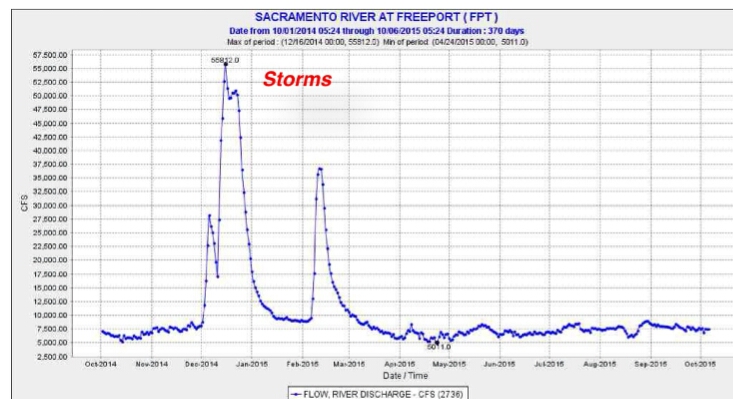
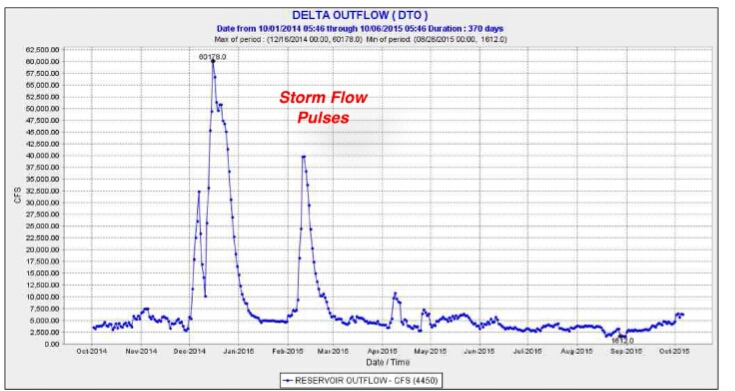
One often hears during this present four-year drought about all the water being “wasted” on the Bay-Delta environmental water. The fact is that, other than the millions of acre-feet going to water supply diversions, most of the so-called “environmental water” goes to repel salinity so that water entering the Delta may be exported. Very little water is going directly to help the Bay-Delta estuary ecosystem. Last winter and spring, storm water not captured by reservoirs did reach the Delta in modest pulses. These pulses were protected to some extent by restrictions on exports required by biological opinions and state water quality standards. Other than these environmental protections that served during these short pulses to help young salmon pass through the Delta, there has been little “environmental” water for the rivers or Bay-Delta since 2012. Outflow requirements, salinity standards, and export restrictions were weakened or simply not enforced during the past three years.

All the reservoir releases were designated for water supply diversions. Over 1 MAF of Shasta releases went to Valley water contractors. Over 2 MAF of reservoir releases went to the South Delta state and federal exports. Over 1 MAF went to Delta farmers. About 1 MAF went to repelling salinity to make the 3 MAF of Delta diversions possible.

Some excellent information and discussion was presented on the topic of repelling salinity this year. One of my favorites is a YouTube video (https://youtu.be/9M4XcLQkqEM ) that shows how salt attacks the Delta during a typical lunar tidal period. Another is an article in the San Francisco Estuary Partnership newsletter on the Delta salt-field (http://www.sfestuary.org/salt-field/ ). A great tool for viewing the dynamic Delta salinity field can be found at: http://www.baydeltalive.com/salinity.

The newsletter article recalls a recent ad hoc meeting of Delta scientists, modelers, and managers trying to come up with drought mitigation strategies that “wouldn’t burn so much water to keep the salt field at bay”. In other words, they were looking for ways to export more of the reservoir water entering the Delta. Those at the meeting discussed cutting exports, opening the Delta Cross Channel gates, and ceasing operation of the Suisun Marsh salinity control gates. Other than the obvious benefit of reducing exports (contrary to the meeting’s purpose), the other two options were to eliminate key environmental protections. Jon Burau (USGS) was quoted as saying: “these would be the quickest, least expensive things we could do to save water that would also have the least impact on the ecosystem.” The cross channel gate closures are required in biological opinions and water quality standards in winter-spring to keep endangered Sacramento River salmon and steelhead from entering the Central and South Delta and being lost. The Marsh salinity gates are critical in the management of the Marsh wetland ecosystem and maintenance of Montezuma Slough’s critical habitat for the two listed smelt species.

In 2015, Department of Water Resources (DWR) added a salinity barrier to the existing array of Delta barriers: the False River Barrier was eventually installed to keep salt from entering the interior Delta through Franks Tract. At the behest of DWR and the Bureau of Reclamation, the State Water Resources Control Board weakened the salinity standard by moving the compliance point five miles from Emmaton to Threemile Slough. The Board also weakened the Delta outflow standards that keep the Low Salinity Zone out of the Delta, “saving” up to several thousand cfs. In a completely unprecedented action this summer, Reclamation actually closed the Delta Cross Channel to keep salt from the salinity control site at Threemile Slough near Rio Vista. This action was possible because of the presence of the False River Barrier. The goal for managing the Delta this year was simply to keep the salt level of South Delta exports at or below the 800 EC level.

With the Delta “scientists, modelers, and managers” who manage the Delta water system thinking in terms of water “burn”, four independent Delta ecosystem scientists recently wrote a paper on the “Challenges Facing The Sacramento-San Joaquin Delta: Complex, Chaotic, or Simply Cantankerous? “1. They describe the “Delta Problem” in terms of “wicked problems” – “Such problems can’t be ignored, defy straight-forward characterization, and have no simple solutions. Yet they must be actively managed to maximize beneficial and minimize adverse outcomes”. (From ‘DeltaChallenges-v13,’ page 6). With such divergent philosophies managing the Delta, it is no wonder the Delta Problem is perceived as “wicked”. The four scientists further conclude that “opportunities exist to conserve and restore aspects of the native system and to structure the rest of the Delta to make it more hospitable to native species. Realizing those opportunities without jeopardizing water supply is the ultimate challenge in managing the Delta.” (From ‘DeltaChallenges-v13’, page 28).

It appears that one side is intent on minimizing water “burn”, while the other deals with the resulting “wicked problems” that come from the focus on water supply.

The Solution

It is a not “wicked problem.” It is a matter of switching the focus of Delta management away from minimizing “water burn” to maximizing ecosystem health and protecting endangered fish with the water available. The Valley river and Delta water quality standards for dry and critical water years were developed to provide minimal protections. Step 1 should be to maintain and enforce these standards for streamflow, water temperature, and Delta outflow and salinity. These standards could have been retained in each of the past three years with just 10% of the 4+ MAF of reservoir water delivered for water supply. If there are really “co-equal” goals, then the ecosystem getting 10% instead of near zero is a bargain. If we want to begin recovery of the Bay-Delta ecosystem from its present near-death state, we should be considering a much larger percentage of dry year water supply to meet the “co-equal” goal.

Climate change is putting a real hurt on California water supply that is very real and likely long lasting. Hard decisions and massive investments will be needed to adjust to a more reliable water supply system. However, the ecosystems and native species of California rivers, the Delta, and the Bay should not be sacrificed in the short term for the sake of water supply. The threatened and endangered fish depending on our California ecosystems cannot wait. They need the water now to survive.

Part 4 – Solutions to save Shasta-Trinity salmon

This is the last of four part series on the effects of the Shasta-Trinity Division on Sacramento and Klamath-Trinity River salmon. Part 1 introduced the problem: the failure of Reclamation to manage the Shasta-Trinity Division to protect the salmon resources of the Sacramento and Klamath-Trinity river systems. Parts 2 and 3 summarized the effects on salmon in the Sacramento River and Klamath-Trinity, respectively. In part 4, we suggest solutions to the problems.

The Reasonable and Prudent Alternative (RPA) in the NMFS 2009 Biological Opinion (NMFS OCAP BO) for operation of the federal Central Valley Project (CVP) and the State Water Project (SWP) simply does not go far enough to protect salmon resources affected by the Shasta-Trinity Division of the CVP. NMFS has concluded the RPA is all it can order, acknowledging that it is not enough in the driest years. But even in the worst years, there is much that could be reasonably done to save the salmon in both river systems, including action under Reclamation’s control and NMFS’s jurisdiction.

NMFS’s Biological Opinion states: “NMFS recognizes that the RPA must be an alternative that is likely to avoid jeopardizing listed species or adversely modifying their critical habitats, rather than a plan that will achieve recovery.”1 However, the RPA is not adequate to avoid jeopardy because the two long-term elements (reintroduction above Shasta and restoring Battle Creek) are too slow in developing. NMFS has also failed to petition the State Board to modify Water Right Order WR-90-05 to limit deliveries to Sacramento Valley Settlement Contractors in drought years, a need described in the BO. Continuing deliveries to the Settlement Contractors in summer of 2014 led directly to the loss of the 2014 Winter Run brood year.

“Providing fish passage at Shasta, Nimbus, and Folsom Dams, which ultimately is the only means of counteracting the loss of habitat needed for egg incubation and emergence, and steelhead over-summering habitat at lower elevations. This habitat loss has already occurred and will be exacerbated by climate change and increased water demands”. Habitat and CVP operations were adequate in the early 1970s, 30 years after Shasta Dam was constructed to sustain the Winter-Run population at 40 to 50 thousand spawners each year. It is the conditions below the dams that have changed to make sustaining salmon more difficult. Many of the effects are reversible through CVP operation changes and restoration of habitats below the dams. It was just over a decade ago the population had again reached 20,000 under the concerted funding and management afforded by the CVPIA and prescriptions of the previous NMFS BO.

“The effects analysis in this Opinion highlights the very challenging nature of maintaining an adequate cold water pool in critically dry years, extended dry periods, and under future conditions, which will be affected by increased downstream water demands and climate change. This suite of actions is designed to ensure that Reclamation uses maximum discretion to reduce adverse impacts of the projects to winter-run and spring-run in the Sacramento River by maintaining sufficient carryover storage and optimizing use of the cold water pool.” Reclamation has not used maximum discretion, and thus has not maintained sufficient carryover storage in Shasta or Trinity reservoirs and has failed miserably at managing the cold-water pools in both reservoirs.

There are many instances where Reclamation has misrepresented its abilities and intentions and has inadequately portrayed its underlying reasons for taking specific actions in the operation of the Shasta-Trinity Division. Its primary objective has been to meet the water demands of contractors and to generate the maximum amount of peaking power possible from the Division’s many hydropower plants.

“The effects analysis in this Opinion, and supplemental information provided by Reclamation, make it clear that despite Reclamation’s best efforts, severe temperature-related effects cannot be avoided in some years. The RPA includes exception procedures to deal with this reality. Due to these unavoidable adverse effects, the RPA also specifies other actions that Reclamation must take, within its existing authority and discretion, to compensate for these periods of unavoidably high temperatures. These actions include restoration of habitat at Battle Creek that may be support a second population of winter-run, and a fish passage program at Keswick and Shasta dams to partially restore winter-run to their historical cold water habitat.” The severe temperature related effects on the Sacramento and Klamath-Trinity rivers can be avoided by better balancing the water supply between contractor water demands, peaking power generation, and salmon.

5-mile reach between Redding and Keswick Dam

The BO allows sustaining Winter Run spawning to only the 5-mile reach between Redding and Keswick Dam in drought years like 2014 and 2015. Even in these years salmon were not protected in this minimal reach. (Map Source)

“An RPA must avoid jeopardy to listed species in the short term, as well as the long term.   Essential short-term actions are presented for each division and are summarized for each species to ensure that the likelihood of survival and recovery is not appreciably reduced in the short term (i.e., one to five years).  In addition, because the proposed action is operation of the CVP/SWP until 2030, this consultation also includes long-term actions that are necessary to address project-related adverse effects on the likelihood of survival and recovery of the species over the next two decades.”   The RPA prescribed in the NMFS BO obviously is inadequate to avoid jeopardy especially in the short term.  The following are further actions necessary to avoid jeopardy.

Reduce Reservoir Releases Designed to Meet Contractor Water Demands

Reclamation, NMFS and the State Board must reduce Shasta and Trinity reservoir releases to meet downstream water demands.  They have instead adopted the illegal and ineffective strategy of  weakening standards to satisfy demands during the present four-year drought, and salmon have gone unprotected.  Redistribution of water demands via use of spring and fall water transfers in the Central Valley has generally aggravated the problem by adding to water demands from August through November when cold water pools in reservoirs are limited.  Transfers are a further burden because of the need to add carriage water.  Export of Trinity water to the Sacramento River to meet contractor demands places a burden on both the Trinity and Shasta cold water pools.  Target end-of-September “safe” carryover storage levels have not been achieved in 2014 or 2015 at either Shasta or Trinity reservoirs.

Changes in Hydropower Operations

The Shasta-Trinity Division produces a lot of “green” energy through hydropower.  Having Lewiston and Keswick reservoirs below Trinity and Shasta reservoirs further allows hydro-peaking to meet daily patterns of electricity demands.  The two-step drop for Whiskeytown transfers from the Trinity to the Sacramento adds even more potential peaking power.  Trinity Reservoir water drops from a 2200-2400 ft elevation to 1900-ft at Lewiston Reservoir, to 1200-ft at Whiskeytown, to 600-ft at the Spring Creek Powerhouse on Keswick Reservoir providing a substantial potential for peaking hydropower.

Our analysis of operational data shows that peaking power generation leads to added heating of Lewiston, Whiskeytown, and Keswick reservoirs, and added loss of cold water pools from Shasta and Trinity.  Afternoon peaking generation pulls warmer water into penstocks than nighttime generation.  Generating more at night reduces the loss of cold water pools, but at the expense of the high-value peak power.  No mention of this option is included in the NMFS BO RPA.

The RPA does include Reclamation’s ability to bypass the hydropower systems at both Shasta and Trinity dams and releasing cold water via the lower level outlets.  The option was not employed effectively in 2014 or 2015 at either dam.

Installation of temperature control devices and temperature curtains at reservoir inlets to the hydropower systems has proven beneficial but not totally effective.  Planned improvements should be immediately implemented.  The Shasta Temperature Control Devise proved ineffective in late summer 2014.  The Whiskeytown temperature curtain fails to reduce water temperatures in water released to Keswick Reservoir below 58°F, thus requiring the added release of Shasta cold water pool to meet the 54-56°F required release from Keswick Reservoir to the Sacramento River.

Summary of Potential Measures

Changes in the operation of the Shasta-Trinity Division of the Central Valley Project in the following are necessary to preserve Sacramento and Trinity River salmon:

  1. Provide a better balance between water supply demands, hydropower production, and salmon needs.
  2. Improve management of reservoir storage, especially the amount of cold-water pool in reservoir storage
  3. Better manage the distribution of reservoir releases between power turbines (warmer) or lower level bypasses (colder)
  4. Improve the daily pattern of reservoir releases to meet peaking power demands for electricity while minimizing demands on reservoir coldwater pools.
  5. Improve blending capabilities in reservoir outlets to power turbines (Shasta has a Temperature Control Devise that allows pulling water from different lake levels)
  6. Improve water temperature mixing in the two re-regulating reservoirs (Keswick below Shasta and Lewiston below Trinity)
  7. Improve water temperature management of releases to the Sacramento and Trinity Rivers (do not relax water temperature standards)
  8. Better manage the export of Trinity Reservoir water via Lewiston and Whiskeytown reservoirs to Keswick Reservoir (to Sacramento River) to minimize the use of Shasta’s cold water pool to cool water originating in the Trinity .
  9. Truly address the NMFS BO RPA goals and objectives for the near-term:

“In the near term, adverse effects of project operations to winter-run will be reduced primarily through the following measures:  Modifications to Shasta reservoir management will result in more reliable provision of suitable water temperatures for spawning and egg incubation in the summer months.  The new year-round Shasta management program is expected to minimize frequency and duration of temperature related egg mortality in dry and critically dry years, thus reducing, though not eliminating, the population level stress of these temperature related mortalities.  The new Shasta program will allow for an expanded range of habitat suitable for spawning and egg incubation in wetter year types (i.e. through meeting downstream compliance points more often).  Over time, this will help to preserve diversity of run-timing and decrease the risk of a single event in a localized area causing a population level effect.  Temperature related effects on winter-run will persist into the future, and cannot be fully off-set through Shasta reservoir storage actions, due to physical and hydrological constraints on the CVP system, and the delivery of water to non-discretionary CVP contractors (e.g. Sacramento River Settlement Contractors).  Given a fixed supply of cold water in any given year starting in May, as an overall strategy, the RPA prioritizes temperature management in favor of winter-run due to their endangered status and complete dependence on suitable habitat downstream of Keswick for their continued survival.”

  1.   All italicized quoted text in this post is from the NMFS OCAP Biological Opinion.

Part 3 – Trinity River Salmon

This is part 3 of a four-part series on the effects of the Shasta-Trinity Division on Sacramento and Trinity-Klamath salmon. Part 1 is an introduction to the series. Part 2 is a discussion of the effects of the Shasta-Trinity Division on Sacramento River salmon. Part 3 is a discussion of the effects of the Shasta-Trinity Division operation on Trinity-Klamath salmon.

Operations of the Shasta-Trinity Division affects Trinity River salmon as well as salmon in the lower Klamath River downstream of the mouth of the Trinity River. The main effect on the Trinity-Klamath salmon comes from the export of approximately half of Trinity Reservoir’s inflow to the Sacramento River, resulting in lower Trinity storage. This in turn may cause lower Trinity-Klamath flows and higher water temperatures in the Trinity River and lower Klamath.

National Marine Fisheries Service (NMFS) is in the process of conducting a separate consultation on the effects of the Shasta-Trinity Division operations on listed Coho salmon in the Trinity River. NMFS is committed to ensuring appropriate coordination between the analysis and results of Sacramento Winter Run Opinion and the forthcoming Coho opinion. The NMFS OCAP BO RPA1 will be analyzed in the Trinity Coho Opinion, and the OCAP BO may be adjusted as necessary to avoid jeopardy to Trinity-Klamath Coho salmon and adverse modification of their critical habitat.

The biggest threat to Trinity salmon results from the drawdown of Trinity Reservoir as Trinity water is exported to the Sacramento River. Without adequate carryover storage, Trinity reservoir cannot be counted on to provide sufficient cold-water flow to the Trinity and lower Klamath Rivers. Without a sufficient cold water pool in Trinity Reservoir, warm water from the reservoir can threaten the Trinity, Lower Klamath, and Sacramento River salmon. While the large die-off of salmon in the lower Klamath in 2002 may not be directly attributable to low warm water flows to the upper Trinity River below Lewiston Reservoir, pulses of cold water from Trinity Reservoir in late summer under conditions like 2002 have averted similar die-offs in 2014 and 2015. Pulses of cool water released from Trinity Reservoir continue this month despite unsuccessful attempts by Central Valley water contractors to stop that action. So far, the cold water pool in Trinity Reservoir appears adequate to save Trinity and Klamath River this year despite its ongoing depletion by exports to the Sacramento River. Approximately three quarters of the water released from Trinity Reservoir this summer has gone to the Sacramento River.

Trinity Reservoir storage in acre-feet over the past three years.

Trinity Reservoir storage in acre-feet over the past three years.

Trinity Reservoir water export to Sacramento River via Whiskeytown Reservoir summer 2015.

Trinity Reservoir water export to Sacramento River via Whiskeytown Reservoir summer 2015.

Trinity Reservoir water released to Trinity River from Lewiston Reservoir summer 2015. Note recent flow releases to flush and cool the lower Trinity and Klamath.

Trinity Reservoir water released to Trinity River from Lewiston Reservoir summer 2015. Note recent flow releases to flush and cool the lower Trinity and Klamath.

Temperature of water released from Lewiston Reservoir in spring-summer 2015.

Temperature of water released from Lewiston Reservoir in spring-summer 2014.

Temperature of water released from Lewiston Reservoir in spring-summer 2015.

Temperature of water released from Lewiston Reservoir in spring-summer 2015.

  1.  The Reasonable and Prudent Alternative(s) in the National Marine Fisheries Service’s Biological Opinion for the long term Operations and Criteria Plan for the State Water Project and the Central Valley Project.

Summer 2015 – Delta Smelt Update

Delta Smelt are virtually extinct from the Bay-Delta. Few have survived the extreme conditions of Delta operations during this fourth summer of drought.

Early June Surveys

The catch of Delta smelt in the early June 20-mm survey for Delta Smelt was fourteen, twelve in the Sacramento Deep Water Shipping Channel (Figure 1). This compares to the record low of 22 last year.

Figure 1. The distribution of Delta smelt catch in early June 2015 20-mm Survey. (Source: CDFW)

Figure 1. The distribution of Delta smelt catch in early June 2015 20-mm Survey. (Source: CDFW)

The plots for the early June survey for the past four drought years are shown in Figures 2-5. Obviously the numbers are down even from last year. The main difference is that only one was captured in the low salinity zone (in Sacramento River channel on north side of Sherman Island). This zone of brackish water, generally with cooler water and high productivity, is again in poor condition due to lack of freshwater inflow from weakened water quality standards during the present drought. The effect of weakened standards in 2014 and 2015 (4000 cfs Delta outflow instead of 7000 cfs) is quite evident by comparing these last two years with the previous three drought years when standards were not weakened.

Figures 2-5. Distributions of Delta smelt in early June 20-mm surveys in 2009 and 2012-14. (Source CDFW)

Figures 2-5. Distributions of Delta smelt in early June 20-mm surveys in 2009 and 2012-14. (Source CDFW)

Late June and Early July Surveys

The July standard of 4000 cfs Delta outflow was also weakened to 3000 cfs. The lower outflows lead to a smaller, warmer low salinity zone (further upstream in the hotter Central Valley away from the Bay “breeze”). In addition, under lower flows, more of the low salinity zone is drawn into the central Delta by Delta exports. Surveys #8 (late June) and #9 (early July) each captured only one Delta smelt, as compared to 20 and 2 in the respective surveys in record low 2014.

Initial results of the Summer Townet Survey (CDFW unpublished data) for June indicated record low numbers of Delta smelt (near zero).

July and August Surveys

The final 20-mm Survey in July and the July and August Townet Surveys only caught one Delta Smelt each. Both fish were caught in the Sacramento Deep Water Ship Channel (same site as large green dot in Figure 1). None were captured this summer in their normal nursery grounds in the Low Salinity Zone in any surveys. The poor prognosis for Delta smelt has been downgraded to miserable. For previous recommendations on improving conditions for Delta smelt see a previous post1.