Welcome to the California Fisheries Blog

The California Sportfishing Protection Alliance is pleased to host the California Fisheries Blog. The focus will be on pelagic and anadromous fisheries. We will also cover environmental topics related to fisheries such as water supply, water quality, hatcheries, harvest, and habitats. Geographical coverage will be from the ocean to headwaters, including watersheds, streams, rivers, lakes, bays, ocean, and estuaries. Please note that posts on the blog represent the work and opinions of their authors, and do not necessarily reflect CSPA positions or policy.

Puget Sound Salmon Fishing – Closed Until Further Notice

For the first time in almost 30 years, there may be no salmon fishing in Puget Sound in 2016.  Several reasons are apparent for this situation.  First, the Coho salmon returns this year are projected to be very poor as a result of unfavorable ocean conditions and the drought in many Washington streams that occurred last year.  The projected returns of adult Coho salmon are very low (particularly for non-hatchery or wild fish that are listed as “threatened” under the Endangered Species Act).  There are also concerns about low returns of wild Chinook salmon.

Seasons in Washington are set on an annual basis by the co-managers of the resource.  These co-managers are the Washington Department of Fisheries (WDFW), which represents the non-Indian sport and commercial fishermen on one side and the Indian tribes in Puget Sound, which represent the interests of about 20 different tribes.  This co-management approach evolved after the Judge Boldt decision in 1974 that established the 50/50 split on harvest between the two entities.  Initially, the court system set regulations, but the co-management approach evolved shortly thereafter to let the resource managers set the seasons rather than the court system.

Under the co-management process, seasons have been negotiated and set in the early spring each year.  The co-managers meet, present their positions based on the information each has (including models of the fish returns), discussions are conducted, and the seasons are mutually agreed upon.  These negotiated regulations are then forwarded to the North Pacific Fisheries Management Council, which then provides final review and approval.  Then the National Oceanic and Atmospheric Administration (NOAA) issues permits for the seasons.

This process has worked in finalizing the seasons, until this year.  When the co-managers first met in late April, the WDFW proposed a restricted season that would allow a “selective fishery” for hatchery Chinook salmon along with possible fishing for hatchery Coho.  (Hatchery fish are marked by the removal of their adipose fin).  The Tribes, however, proposed a total closure for all salmon fishing in Puget Sound to protect wild Coho and all Chinook salmon.

In the first two meetings, the co-managers showed no movement toward an agreement on the Puget Sound situation.  (However, agreement was reached on seasons for the Columbia River and the outer coast of Washington and included severely restricted quotas accompanied with selective fishing for marked fish.)   WDFW walked out of the meetings regarding Puget Sound.   Although the two sides have been in further discussion, as of this date – May 19 – no agreement has been made.

To further complicate the situation, WDFW and the Tribes have decided to submit separate proposals to the NOAA in order to obtain separate permits for their proposed seasons.  (NOAA issues the final permits as part of the Endangered Species Act).  NOAA’s response to this has been “WDFW and the Tribes must come to agreement with NOAA offering assistance to the process, but it will not make a decision on the proposals”.  To process these permit submittals, NOAA has estimated that the Tribal proposal (which does include some limited fishing in some isolated situations) could possibly be processed in time for this co-manager’s reduced seasons to go forward.  However, NOAA has indicated that the WDFW proposal could be lengthy (due to the need for public review and comment) and likely could not be processed this year.

In general, the salmon seasons for both Tribal and non-Tribal fishermen in Puget Sound have been severely reduced over the past several decades as a result of lower returns resulting from habitat losses, dramatic increases in predators (birds, seals, sea lions, etc.), and the 50/50 split with the Indian Tribes.  If no agreement can be reached in the next few weeks, there will be no sport/commercial fishing for Puget Sound salmon in 2016.  This outcome will likely result in major regional economic impacts (a sporting goods store has already closed).  There are about 200,000 salmon anglers that have held licenses in the Puget Sound region.  If the closures continue, these fishermen would have no opportunity to fish for salmon in the Puget Sound basin – only ardent fishermen will likely travel to the coastal ports of Washington or the Columbia River to participate in their sport.

In a related development, the WDFW has closed all fishing (all species) in all Puget Sound streams, rivers, and lakes accessible to Coho or Chinook salmon.  These closures include large lakes such as Lake Washington where there is a popular fishery for bass and other warm water species.  In addition, the summer-run steelhead season, another very popular fishery in many Puget Sound streams, usually opens in early June (which is only a few weeks from this date).  This fishery is also destined to remain closed if no agreement can be reached.

Although NOAA has been the Federal agency that was presumed to issue the final permits for the Tribal and the non-Tribal sport/commercial fisheries, much to the surprise of many fishermen and non-fishermen, the Bureau of Indian Affairs approved a separate permit for a limited Tribal fishery for spring Chinook salmon in the Skagit River (a major tributary of Puget Sound).  The fishery was conducted and resulted in several demonstrations by non-Tribal fishermen, both on the Skagit River and at the state capitol in Olympia.

Most of the Tribes favor some type of agreement.  However, two of the Tribes do not favor any agreement except no fishing.  This has complicated the entire negotiation process because all Tribes in the co-management process must agree to the final regulations before they can be submitted for approval.

As a result of this convoluted process, the likelihood of a salmon fishery in Puget Sound this year is clearly in doubt.  Many of the non-Tribal fishermen believe the current negotiation process needs to be overhauled.

USBR – Increase Shasta Cold Water Releases

Water Year 2016 on the Sacramento River has been designated a “Below Normal” year.  Water Year 2010 was also a Below Normal year.  Both years followed multiyear droughts.  In both years, Shasta Reservoir was nearly full at the end of April (2010 was 4.4 maf; 2016 was 4.2 maf).  In early May 2010, Keswick releases were 7500 cfs, and release water temperatures were 50-52°F.  In early May 2016, Keswick releases have been 5200-6200 cfs, and release water temperatures have been 53-55°F.

In April and May, 2010, water temperatures in the upper river remained below 56°F.  In contrast, the warmer, lower flows in 2016 have led to excessively warm water temperatures in the upper Sacramento River.  Water temperatures have reached 60-62°F in the upper river (Figure 1), which are well above the prescribed water quality standard of 56°F necessary to protect spawning salmon and sturgeon.  Winter-run salmon began spawning in late April.  Green and white sturgeon spawn in May.

Figure 1. Water temperature in the upper Sacramento River below Shasta Reservoir in early May 2016. In contrast, water temperatures at these locations during early May 2010 were 56°F or lower.

Figure 1. Water temperature in the upper Sacramento River below Shasta Reservoir in early May 2016. In contrast, water temperatures at these locations during early May 2010 were 56°F or lower.

Reclamation’s CVP operations should strive to maintain the 56°F standard through the spring and summer, as prescribed in the Basin Plan and in the NMFS biological opinion for Shasta operations. This temperature can be achieved by increasing Shasta releases or by lowering the water temperature of releases using the temperature control tower/device (TCD) at the dam, or by a combination of these elements. In the last few days, Reclamation has increased releases and has added colder water, resulting in slightly colder Keswick releases (Figure 1). Reclamation has decreased the temperature of releases by opening one the six middle outlets of the Shasta Temperature Control Device (Figure 2). However, downstream temperatures remain high, because air temperatures and water diversions downstream are also increasing.

While there is some logic behind Reclamation’s decision to minimize reservoir releases to save Shasta storage, it is inappropriate to jeopardize endangered fish in the upper Sacramento River with excessively warm water this year, given the abundance of cold water in the reservoir. 1

With Shasta releases expected to increase soon to meet increasing irrigation demands, it will be imperative that water temperatures upstream of Red Bluff remain below 56°F to protect spawning salmon and sturgeon and their young into and through the summer.

The “official” temperature target and control point since April 15, 2016 have been 58°F at Redding (station CCR). In 2010, the target temperature was 56°F, and the control point was at Jellys Ferry (RM 267), 20 miles downstream of Redding. The State Board and NMFS should immediately change the target temperature to 56°F, and move the control point at least downstream to Jellys Ferry. Preferably, the compliance point should be further downstream at Red Bluff, to be in compliance with the NMFS biological opinion (56°F at Red Bluff – RM 243). The Basin Plan puts the compliance point further downstream still, (56°F at Hamilton City – RM 200). 2

Following catastrophic losses of winter-run in the Sacramento below Shasta during the past two years, it is imperative to meet the summer water temperature goals as prescribed in the NMFS biological opinion. The Shasta cold-water pool and storage available are more than adequate to meet these objectives.

Figure 2. Shasta Dam’s temperature control tower/device or TCD has multiple options for releasing water from the reservoir. One middle outlet was recently opened to reduce the temperature of the water released to the Sacramento River. (Source: USBR MidPacific Division)

Figure 2. Shasta Dam’s temperature control tower/device or TCD has multiple options for releasing water from the reservoir. One middle outlet was recently opened to reduce the temperature of the water released to the Sacramento River. (Source: USBR MidPacific Division)

  1. A disproportionate amount of Sacramento River Delta inflow this spring has come from Oroville Reservoir (Feather River) and Folsom Reservoir (American River) storage releases. Excessive use of Folsom storage to meet Bay-Delta needs could lead to loss of its cold-water pool this summer and greater mortality of over-summering juvenile salmon and steelhead in the American River.
  2. A plan for summer operations from Reclamation is due by May 15, 2016

Rare Bay-Delta Spring Bloom may benefit Smelt

A rare Bay-Delta spring plankton bloom in 2016 may benefit longfin and Delta smelt (and other fish).  The bloom (a condition in which chlorophyll concentrations consistently exceed 10 micrograms per liter of water) commenced in late April.  Geographically, it extended from Suisun Bay up into the Delta to Rio Vista on the Sacramento River and to near Stockton on the San Joaquin River (Figure 1).

Figure 1. Bay-Delta phytoplankton bloom late-April to mid-May 2016. Plots show chlorophyll concentrations at selected stations from mid-April to mid-May. Source: CDEC.

Figure 1. Bay-Delta phytoplankton bloom late-April to mid-May 2016. Plots show chlorophyll concentrations at selected stations from mid-April to mid-May. Source: CDEC.

The bloom coincided with a drop in previously high early spring Delta inflow and outflow, as well as with low exports and the implementation of San Joaquin River pulse flows.1 Delta outflows were moderate, relatively steady, and higher than in recent drought years, and consistent with a “normal“ year pattern (Figure 2). San Joaquin River pulse flows occurred after mid-April (Figure 3). The Low Salinity Zone or LSZ (0.5-6 ppt) was located in Suisun Bay. X2 (2 ppt) migrated with the tides from Honkers Bay (northwest of MAL) to Sherman Island (northeast of ANH) within eastern Suisun Bay. The head of the LSZ (500-1000 EC) and the bloom extended upstream to Rio Vista on high tides (Figures 4 and 5). Water quality standards (D-1641) that require 14-day average X2 to be at Chipps Island (MAL) or further west helped to ensure consistent Delta outflow.

Longfin smelt concentrated near X2 and may benefit from plankton bloom (Figure 6). Remaining Delta smelt may also benefit as they too concentrate near X2. Maintaining the LSZ and X2 in Suisun Bay is generally thought to promote Bay-Delta productivity and higher smelt survival. In the past four years of drought, the LSZ and X2 during spring and summer have generally been upstream of Suisun Bay, in the Delta.

Figure 2. Delta outflow mid-April to mid-May 2016. Source: CDEC.

Figure 2. Delta outflow mid-April to mid-May 2016. Source: CDEC.

Figure 3. San Joaquin River inflow to the Delta at Mossdale April-May 2016. Source: CDEC.

Figure 3. San Joaquin River inflow to the Delta at Mossdale April-May 2016. Source: CDEC.

Figure 4. Bottom salinity in Sacramento River several miles downstream of Rio Vista in early May 2016. Source: CDEC.

Figure 4. Bottom salinity in Sacramento River several miles downstream of Rio Vista in early May 2016. Source: CDEC.

Figure 5. Chlorophyll concentrations at Rio Vista in early May 2016. Source: CDEC

Figure 5. Chlorophyll concentrations at Rio Vista in early May 2016. Source: CDEC

Figure 6. Catch distribution of young Longfin smelt in late April 2016 along with extent of plankton bloom (red boundary). Smelt were concentrated (larger green dots) near X2 in central and eastern Suisun Bay. Source: CDFW 20-mm Survey.

Figure 6. Catch distribution of young Longfin smelt in late April 2016 along with extent of plankton bloom (red boundary). Smelt were concentrated (larger green dots) near X2 in central and eastern Suisun Bay. Source: CDFW 20-mm Survey.

  1. The bloom also occurred after a winter of moderate Yolo Bypass flood spills that may have contributed nutrients to fuel the bloom. Elevated Bypass flows continued through mid-April.

Water Quality Standards Optional

On May 5, I reported on the “chumming of stripers” with the late season release of millions of hatchery smolts into the warm, low flows of the Sacramento and Feather rivers.  So what more could the state and federal managers do to improve conditions for our salmon, steelhead, smelt, sturgeon, and other fish resources?    They could start by obeying and enforcing the rules already on the books.

Because of the restrictions placed on South Delta state and federal water project exports by rules governing San Joaquin River steelhead, exports are now restricted to no more than about 2500 cfs.  Such low exports at this time of year have in fact been the norm for the past 20 years under water quality standards and endangered species biological opinions.  The steelhead biological opinion for the San Joaquin is relatively restrictive this year because of the San Joaquin’s dry-year designation.

So what is the problem?  Because it cannot export, the US Bureau of Reclamation is releasing minimum flows from the warm surface waters of a full Shasta Reservoir.

This causes violations of the standards for Sacramento River water temperature.  The upper Sacramento River standard of 56°F has been violated: water temperatures have been running 60-62°F.  The lower river standard of 68°F has also been violated. water temperatures are running 70-72°F.  These conditions contribute to:

  1. Poor survival adult winter and spring run salmon in their peak migration perio;,
  2. Poor egg survival of winter run in the first month of spawning season;
  3. Poor late fall run salmon fry survival;
  4. Poor sturgeon egg survival during their peak spawning season; and
  5. Poor hatchery and wild smolt survival to the Bay.

The Delta outflow-salinity standard under D-1641 requires salinity at Chipps Island to be no more than 2.64 mmhos on a 14-day running average; the most recent 14-day average is above 3.0 mmhos.  With minimal Sacramento River inflow, Delta outflow has reached as low as 8,000 cfs in early May 2016.  These conditions contribute to:

  1. Poor migratory flows for adult and juvenile fall, winter, and spring run salmon, steelhead, and green and white sturgeon;
  2. Poor longfin and delta smelt survival; and
  3. Poor Delta and Bay productivity.

The standards (rules) governing the Central Valley rivers and Delta are there for a reason: to protect water quality, fish, and ecosystem function.  They do not contain the caveat: ‘Comply when convenient.’  They don’t have an exception that reads: ‘No Exports?  No Problem.  Release what meets your sense of order.’  With such gross disregard for the rules, it is no wonder our fisheries resources are in such a poor state.

Water temperature in past month at Bend Bridge near Red Bluff. Note: in 2010, the last below normal water year, water temperature did not exceed 58°F during first 12 days in May.

Water temperature in past month at Bend Bridge near Red Bluff. Note: in 2010, the last below normal water year, water temperature did not exceed 58°F during first 12 days in May.

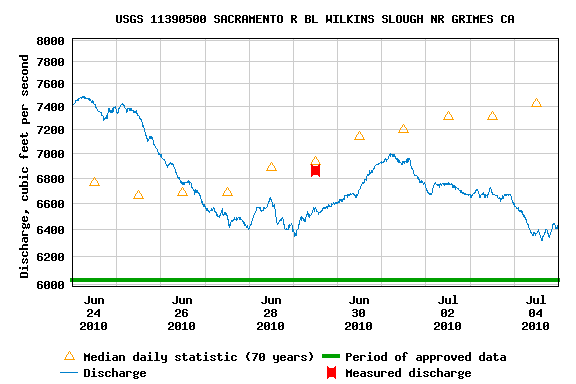
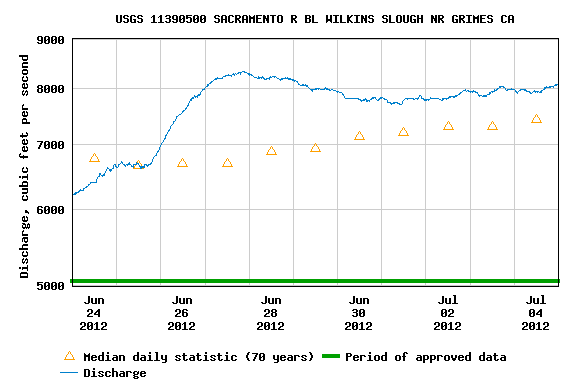
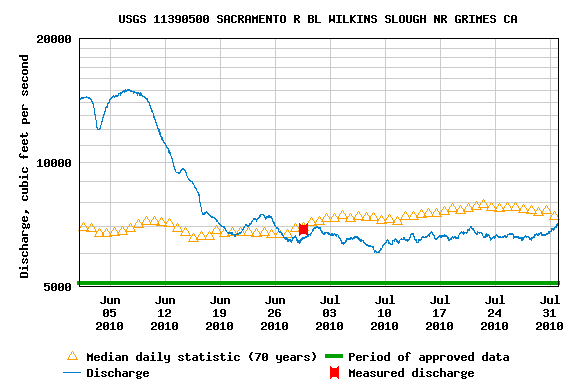
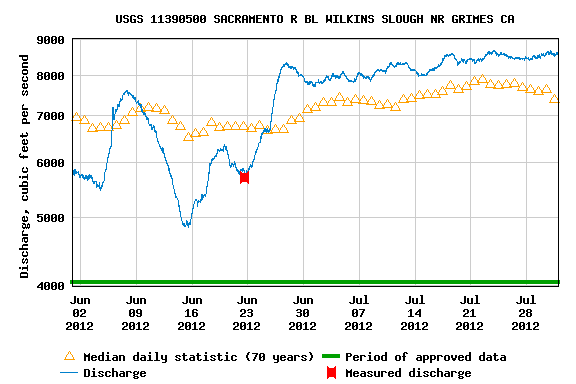
River flow in past month at Wilkins Slough below Colusa on middle Sacramento River. Note: flow was 7000-13,000 cfs during first 12 days of May 2010, the last below-normal water year

River flow in past month at Wilkins Slough below Colusa on middle Sacramento River. Note: flow was 7000-13,000 cfs during first 12 days of May 2010, the last below-normal water year

Delta outflow in past month. Note: outflow in the first 12 days of May 2010, the last below normal year, was 20,000-30,000 cfs.

Delta outflow in past month. Note: outflow in the first 12 days of May 2010, the last below normal year, was 20,000-30,000 cfs.

Hatcheries Release Salmon Smolts into Low Flows and Warm Water – April and early May, 2016

April 13. CBS San Francisco reports:

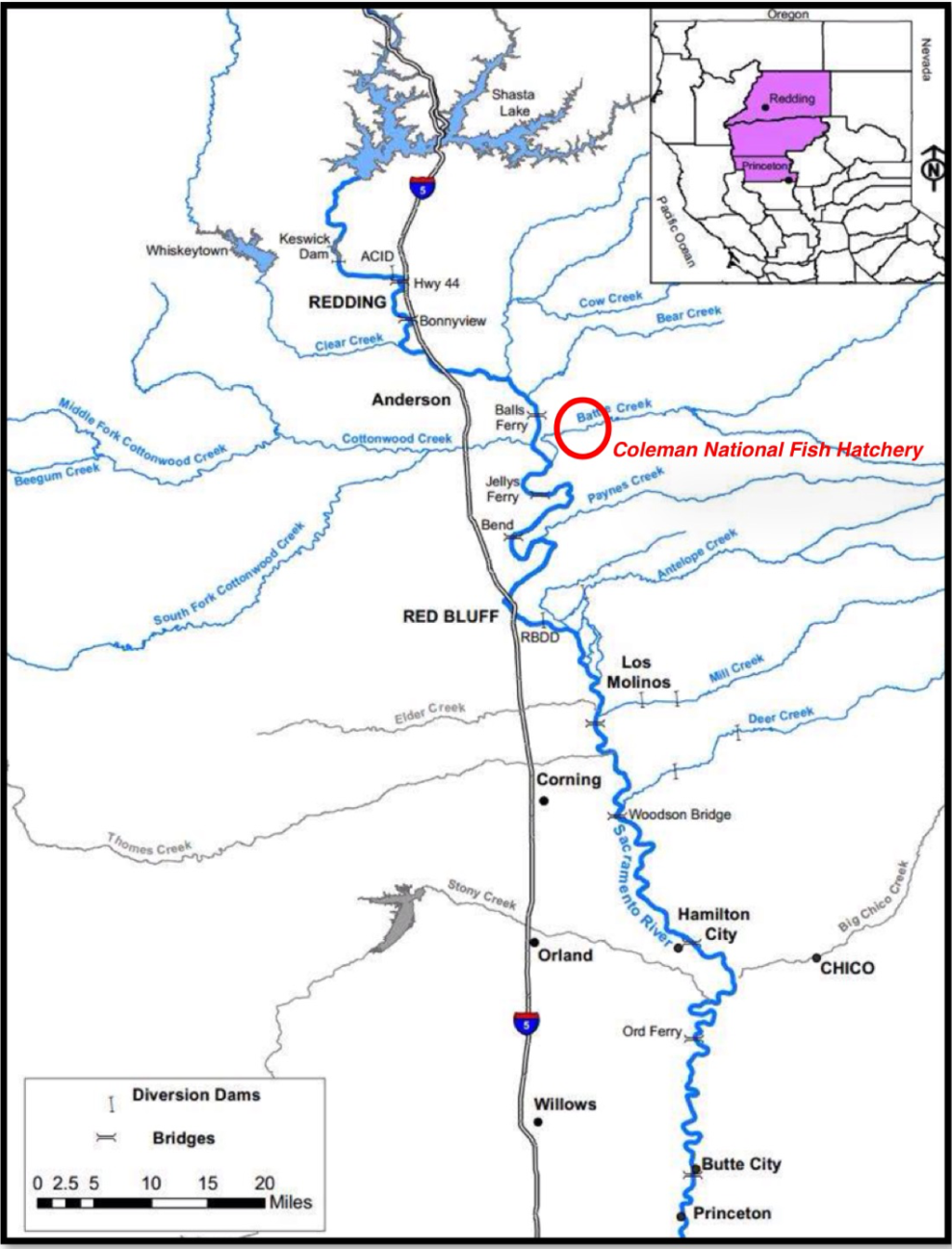
The federal government is funding the release of millions of Baby Chinook salmon into Battle Creek at the Coleman Federal Hatchery outside Red Bluff. Brett Galyean, deputy project leader at Coleman Federal Hatchery, said, “It’s a big day. It’s the first time in two years that we were able to release all the fish on station…. Because of the drought the last two years, the environmental conditions in the Sacramento River — warm water, low flow — caused us to truck fish.”… However, of the 12 million fish released, only one percent are expected to return to Battle Creek in three years to spawn.

April 29. Recent fishing report states:

This spring’s striper fishing on the Sacramento River has been going very well with daily limits of large Sacramento River striped bass. Most of the action has been from Colusa downriver through Verona as the Sacramento River is very low due to minimal releases from Keswick Dam and high volumes of irrigation pumping from the lower Sacramento River. Stripers mostly 18 to 24 inches are coming in daily with some very large female stripers 15 to 25 pounds coming in as well. Drifting live jumbo minnows has been working best in the daytime while black worms or white swim baits are working at night. The Coleman National Fish Hatchery has released the remaining 6 million fall-run juvenile salmon smolt into the Sacramento River. With low flows coupled with the massive irrigation pumping, the lower Sacramento River from Butte City downriver through Verona is extremely low, leaving exposed sand and gravel bars across the river. This is setting the stage for an incredible striper fishing as the smolts arrive in the lower Sacramento River. Striper fishing should be incredible as the stripers feed day and night on the hatchery salmon smolt just like last month when the first round of hatchery Sacramento River salmon smolt were released. Sacramento fishing.com fishing guide Dave Jacobs has witnessed countless striper boils as the spawning stripers have fed around the clock on the salmon smolts from Butte City downriver through Verona.

May 1. Yet another fishing report notes:

The striper action has been incredible for the past several weeks. While many of the stripers are post spawn they are hanging out and destroying recent salmon plants coming out of the hatcheries…. Before the past weekend, he found great action on the Feather River, but heavy boat traffic over the weekend slowed down the Feather since an armada showed up. Salmon smolts were released in the Feather this past week, and the combination of low flows and clear water made for a killing zone for the smolts…. The bite lasted until most of the baby salmon made it to the Sacramento River, and I was able to follow them down the Sacramento a couple of miles until the fishing got tough…. The California Department Fish and Wildlife hatchery on the Feather river is planning on releasing their final stock of 1 million into the Feather river instead of trucking them around the river and Delta pumps to the Suisun Bay. The Federal hatchery on Battle creek released 4 plus million salmon fry this past week and will dumping an additional 1.9 million fall run fish into Battle Creek this coming Friday. The is [sic] opposed to these releases due to the current lower flows and clear water. With high numbers of spawning stripers and low / clear flows most of these fish will never make it as far as Sacramento. Past studies have shown that 94% of hatchery salmon released on the upper Sac never make it to San Pablo bay in these conditions.

May 2. SacBee Fishing continues the theme:

SACRAMENTO RIVER, Red Bluff to Colusa – Salmon smolts have been released from Coleman National Fish Hatchery, and are expected to fuel a hot striper bite from Butte City to Verona. The river is dropping, which caused many of the stripers to drop downstream last week. Anglers now expect stripers to move upriver to feed on the salmon smolts.

Sacramento River Conditions

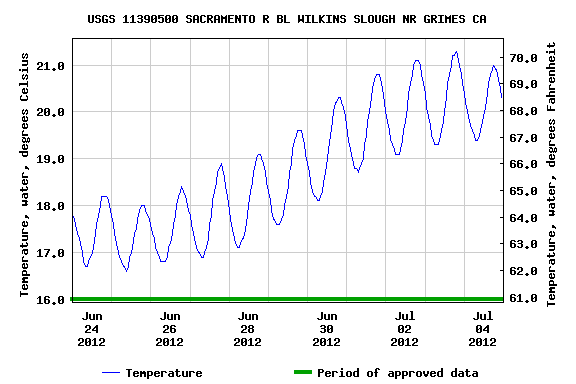
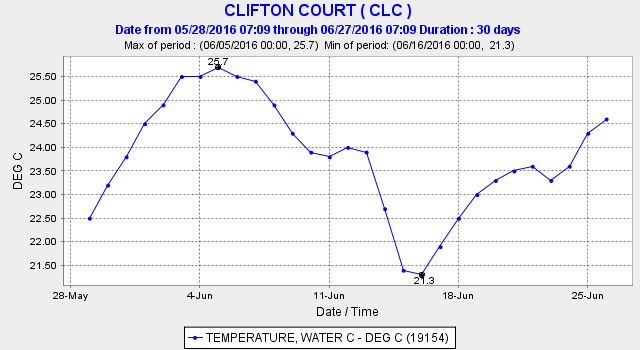
The Sacramento River water quality Basin Plan objective requires no water temperature greater than 56°F upstream of Hamilton City and no temperature greater than 68°F upstream of Sacramento. Water temperature Red Bluff (upstream of Hamilton City) has already reached a daily average of 62°F, well above the required limit (and this with Shasta full of cold water). Water temperatures below Hamilton City have reached 69°F (at Wilkins Slough). Downstream-migrating smolts are stressed and more vulnerable to predation as water temperatures approach 60°F, yet managers continue to release hatchery smolts from the Battle Creek and Feather River hatcheries. Adult winter-run and spring-run Chinook salmon, now migrating upstream in the Sacramento River, are also being stressed by water temperatures greater than 65°F. The 60-65°F range is optimal for striped bass feeding and metabolism. ARE THE HATCHERY SMOLTS SIMPLY CHUM FOR STRIPERS???

Sac at Red Bluff