Sites Reservoir —
Potential Benefits for Fish,
Potential to Worsen Conditions for Fish
Working Presumption: Thumbs Down

The proposed Sites Reservoir1 would be a new off-stream storage reservoir covering 12,000 -14,000 surface acres with 1.8 million acre-ft of storage capacity on the west side of the Sacramento Valley (Figure 1). The project would capture and store unregulated Sacramento River winter-spring runoff and some water previously stored in Shasta Reservoir. The diversion capacity to the reservoir would be 5400-6500 cfs, supplied by two existing river diversions (up to 1800 cfs at Red Bluff; up to 2100 cfs at Hamilton City) and a new diversion near Colusa (proponents are evaluating alternative capacities of 1500 and 3000 cfs, in addition to the currently preferred capacity of 2000 cfs). The Sites Authority webpage estimates that it could have diverted over 1 Million acre-ft to storage in Sites in 2018 and 1.8 Million acre-ft to storage in 2017; these figures assume bypass flow requirements at the diversion points and at Freeport, and sufficient storage capacity in the reservoir. The Draft Environmental Impact Report/Environmental Impact Statement (DEIR/DEIS) for the Sites Reservoir Project estimates the average annual diversion to Sites storage at about 500,000 acre-ft; actual diversions would vary depending on hydrology and regulatory constraints.

As an off-stream storage reservoir, Sites would store water behind a dam that is not on a major waterway. Water diverted to the reservoir would be pumped into canals from the Sacramento River, and then pumped into the storage reservoir from small holding reservoirs on the canals. The two existing diversions that would fill Sites have modern fish screening facilities. As currently envisioned, a pump-back hydroelectric operation would allow partial recovery of pumping costs.

The Sites project has potential benefits for fish, but also the potential to worsen conditions for fish.

Potential Benefits for Fish

  1. Under current operations, existing irrigation diversions on the Sacramento River draw water primarily in spring and summer via several major canal systems on the west side of the Sacramento Valley. These diversions draw mainly on water that was previously stored in Shasta Reservoir and released to the Sacramento River in part to keep river water temperatures cool. Shasta Reservoir’s cold-water pool varies in volume depending on storage and other factors, and can run out if it is not managed carefully. If the cold-water pool is depleted at the end of the summer, this threatens the viability of winter-run salmon. Under current operations, spring and summer irrigation diversions from the Sacramento River also cut flow and raise water temperatures in the lower river, which harms salmon, steelhead and sturgeon. Water diverted to storage in Sites in the winter could substitute for some of the spring and summer irrigation deliveries that currently come from Shasta. A greater percentage of water released from Shasta in spring and summer could then flow all the way to the Delta. More water could also be retained in Shasta Reservoir to protect the Shasta cold-water pool into the fall and as carryover for the following year.
  2. If more water were delivered to the Delta from Shasta Reservoir in the spring and summer, less water would theoretically be needed from Folsom and Oroville reservoirs to meet Delta water quality, outflow and other requirements. This could allow more targeted releases of water into the lower American and lower Feather rivers to protect fish in those waters. It could also allow better maintenance of cold-water pools and greater carryover storage in Folsom and Oroville, also very important for the respective fisheries downstream.
  3. Water stored in Sites could be delivered directly to the Delta via the Colusa Basin Drain (CBD) system and Yolo Bypass, reducing outflow demands from other Valley reservoirs. Water delivered directly to the Delta from Sites would be of higher potential productivity and could stimulate winter-spring Bay-Delta plankton blooms that would benefit Delta native fishes.

Potential to Worsen Conditions for Fish

  1. The proposal includes a new point of diversion on the Sacramento River with a capacity to divert 2000 cfs. This would give the project higher diversion capacity and the capability of diverting tributary runoff that would otherwise be unavailable to the two upper river diversions that now enters the Delta. This diversion would also affect flows and water temperatures in the lower Sacramento River, and subject migrating juvenile salmon, sturgeon, and steelhead to a third large screening facility. The new point of diversion would be particularly problematic if it diverted water outside the peak runoff season (late fall through spring).
  2. The new diversion and the reoperation of canal intakes at Red Bluff and Hamilton City to divert water in winter would compete for water with Delta diversions and would affect Delta outflow to the Bay.
  3. Water deliveries and hydropower releases from Sites Reservoir to the lower river at the new diversion site could affect water quality in the lower Sacramento River.
  4. With available winter off-stream storage, the existing diversions at Red Bluff and Hamilton City would be capable of diverting uncontrolled flows from tributaries that have otherwise remained relatively untouched down to the Delta.
  5. The greater diversion capacity may increase demands on Shasta storage and will increase diversion of uncontrolled tributary flows, further compromising fishes in the Sacramento River and the Bay-Delta.
  6. A small but potentially significant amount of water supply stored in Sites Reservoir would be lost to evaporation and groundwater seepage.

Above all, there is too much unknown to evaluate how Sites would affect fish.

As is the case for most proposed water supply projects, the project description in the draft DEIR/DEIS for Sites describes several potential configurations of project infrastructure and a description of proposed constraints. The DEIR/DEIS does not evaluate different constraints, such as different bypass flow requirements past each point of diversion; the DEIR/DEIS only evaluates one value for each point. In spite of numerous requests that the DEIR/DEIS evaluate project diversions with more stringent Delta flow and water quality requirements than the existing inadequate ones, the DEIR/DEIS only evaluates project yield with existing Delta constraints.

The benefit side is even more vague and conceptual. The entire construct of hypothetical Sites benefits would in fact require a new type of proscriptive rules and enforcement mechanisms that would be unprecedented for California water projects. There is simply no clue in any of the Sites literature what those rules would be or even could be.

The project description places no numbers on how much water stored in Sites the project’s operators would dedicate to actions designed to benefit fish. The project description defines no decision-making process for dedicating water to fish, other than to say that on an overarching basis fish agencies will decide. The project description defines no way in which project operators will apportion water for fish against water for water supply. For all the offsets that seem to comprise the lion’s share of fish benefits, the project description does not say how water from Sites will generate improvements in operation of state or federal reservoirs, or whether it will be Sites operators or state and federal operators who make the calls.

Then there is the question of whether there would be any offsets at all. There is no assurance that there will be any decreases at all in water use from Shasta or from other state and federal reservoirs. Water freed up by using Sites to meet Sacramento Valley water supply could simply allow Sac Valley water users to irrigate more land or sell more water for export at the Delta pumps. The DEIR/DEIS proposes no mechanism of enforcing offsets: who would regulate the project’s use of water, who would manage the interaction between Sites water and water from Shasta, Oroville, Folsom and perhaps Trinity reservoirs, and how and against whom any requirements would be enforced.

There are other problems. A shift to winter-spring diversions and use of canal systems would potentially change groundwater recharge and use patterns in the Sacramento Valley. The project would compete for water available to the proposed WaterFix Twin Tunnels project in the Delta. Sites and WaterFix have their “sights” on the heretofore untouched tributary inflows that are also protected by Delta export OMR limits so the flows reach the Bay. There will be a big fight over this uncontrolled water that now makes up a significant portion of the Bay’s freshwater input in drier years. Both projects have claimed future benefits of the same pot of water.

Conclusion

There are potential benefits from Sites project’s main features to Central Valley fishes, including salmon, steelhead, sturgeon, smelt, and striped bass. Most of the benefits would result from switching the diversion time period of the two existing upper river diversions and Shasta reservoir releases to these diversions. The added new diversion and increase in winter diversions will at important times reduce Sacramento River flow and Bay-Delta inflow and outflow, harming fish in certain but sometimes hard to quantify amounts.

Past water developments in the Central Valley have overwhelmingly made conditions for fish worse. The Sites project proponents claim that their project will be different. These proponents have not done themselves, the public, or public policy any favors by relying on generalities and politics as the centerpieces of their efforts to advance their project. At this time, there are too many unknowns to meaningfully evaluate the possibility that benefits might outweigh the harm and justify the costs. In the meantime, it is a reasonable working presumption that the Sites project will worsen conditions for fish as well.
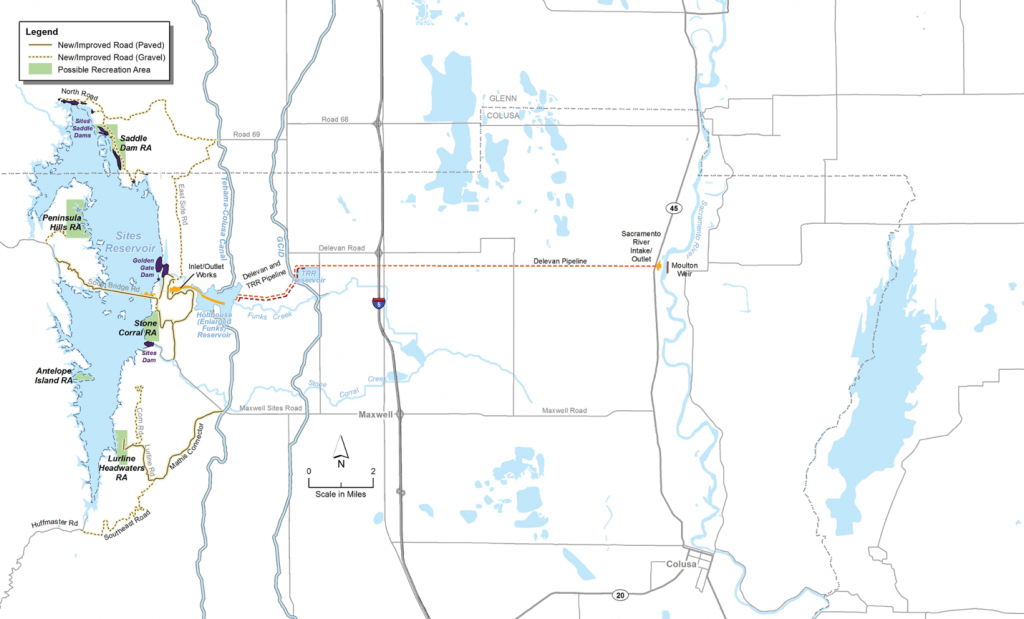
Figure 1. Proposed Sites Reservoir and associated infrastructure on west side of the Sacramento Valley.
More on the Winter-Run Salmon Decline

In a March 14, 2018 post, I discussed my long-held theory that the winter-run salmon decline was caused in large part by high fall exports from the Delta that began in the mid 1970s. In this post, I add some further insights on the theory and why it is so important.

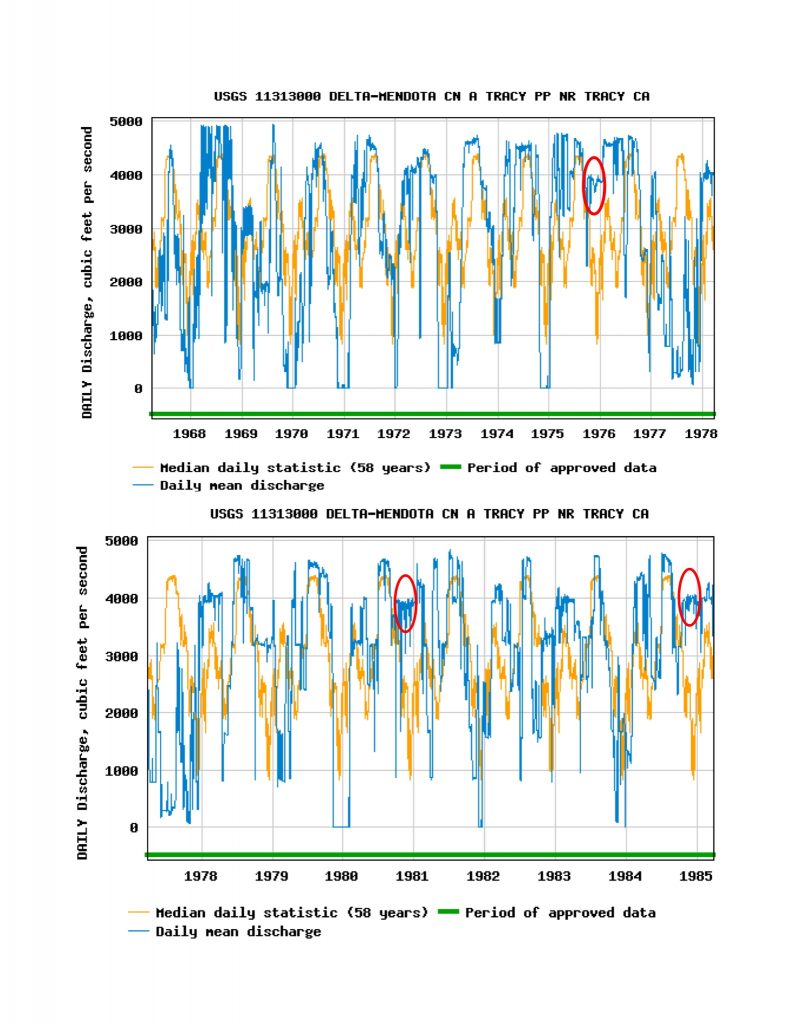
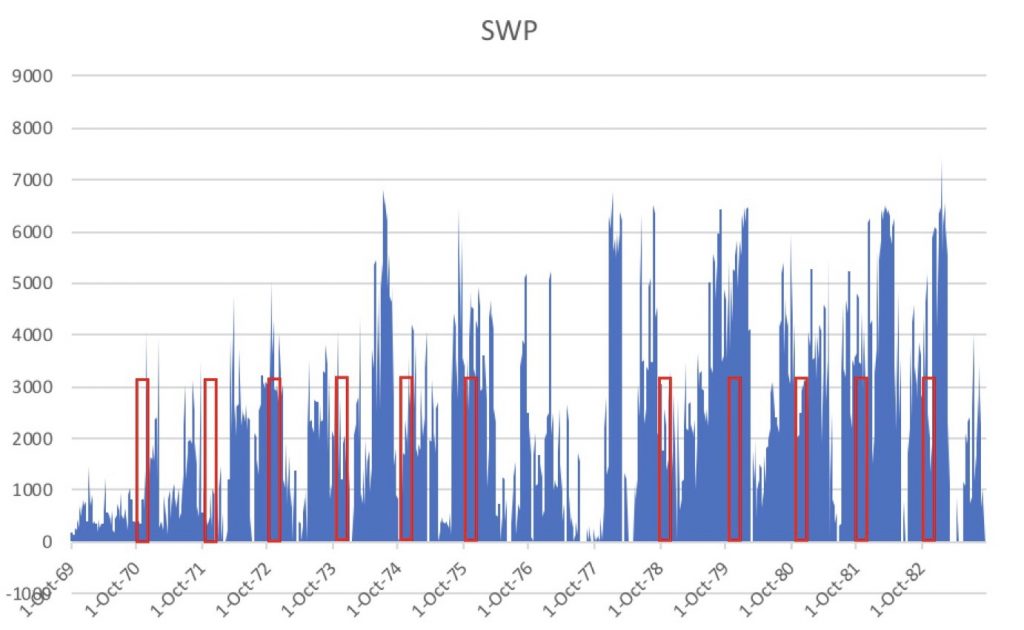
First, when the State Water Project came on line in the late 1960’s, potential export pumping more than tripled from 4,400 cfs to 15,000 cfs. In reality, increases in previously low federal fall exports, along with higher state exports, led to much sharper increases in fall exports, particularly in 1975, 77, 80, 82, and 84, coincident with the primary period of winter-run decline from 1975-85. The fall export increase is very evident in the federal export record (Figure 1) and state export record (Figure 2).

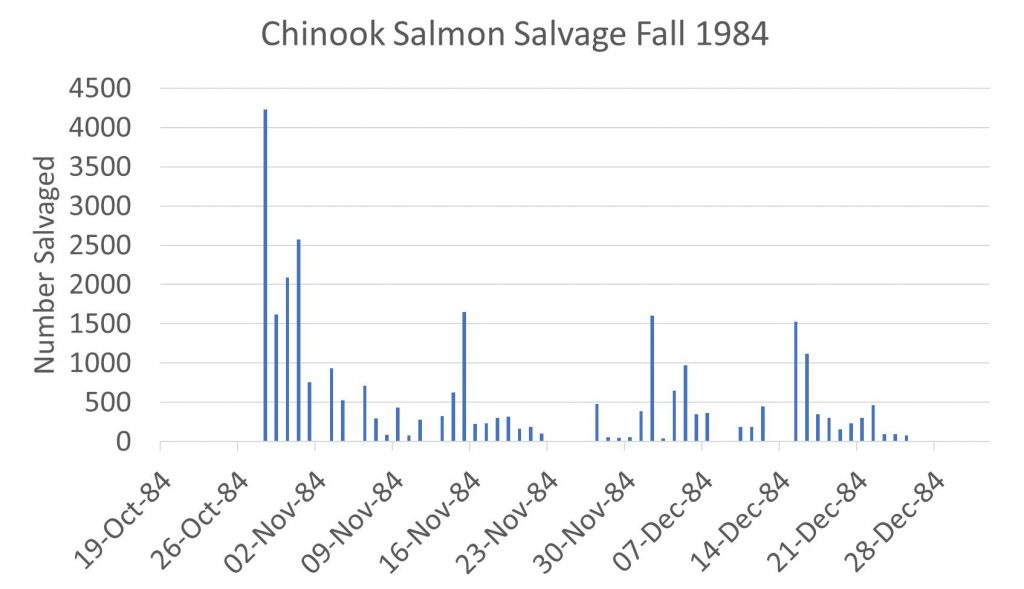
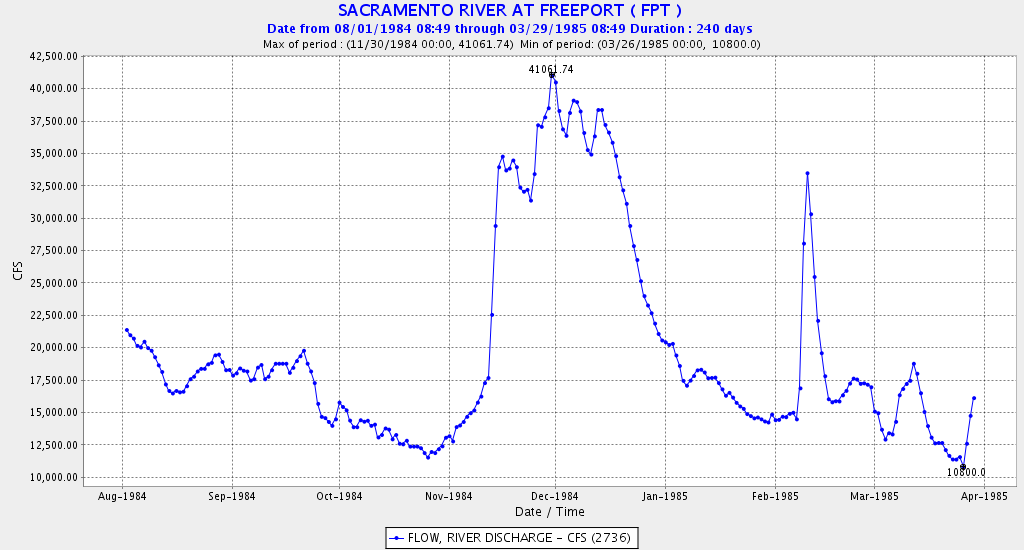
Second, the high exports and high salmon salvage observed were not always associated with high Delta inflows. High salvage of winter-run sized juvenile salmon at south Delta export intakes occurred at the end of October 1984 (Figure 3) under low Delta inflow/outflow conditions (Figure 4). This is important because DWR, in its assessment of the WaterFix Project, is maintaining that export restrictions during the first fall and winter flow pulses will be protective of migrating juvenile salmon. But pulse restrictions alone would not be protective.

WaterFix would nearly double the export capacity of the State Water Project. Actual fall exports could increase by 50%, with much of the increase coming from the trio of new North Delta Diversion tunnel intakes that lie directly in the migration path of young winter-run salmon.

Figure 1. Unusually high federal exports occurred in fall 1975, 1980, and 1984 (red circles).

Figure 2 Delta SWP exports in daily average cubic feet per second from 1969 through 1983.

Figure 3. Chinook salmon south Delta export intakes salvage in fall 1984.

Figure 4. Delta inflow from the Sacramento River August 1984 through March 1985.

2007-2009 Salmon Crash Revisited

Are Shasta Dam Release Patterns Contributing to Low Sacramento River Fall-Run Salmon Runs and Escapement? Yes.

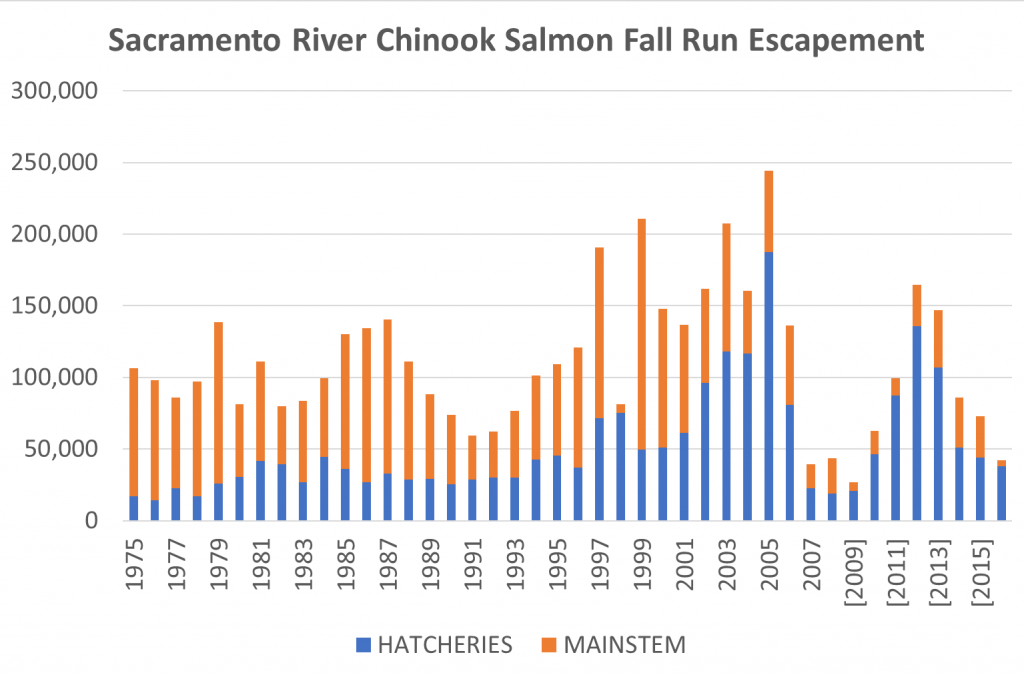
The 2007-2009 Sacramento River salmon crash (Figure 1) is well documented (Lindley 2009). The poor returns of brood years 2004-2005 in 2007-2008 from high 2004-2005 adult runs are particularly troubling. Lindley et al. looked closely at both the wild and hatchery components of brood years 2004 and 2005 to determine the potential causes of the crash. They focused on identifying “where and when in the life cycle abundance became anomalously low, and where and when poor environmental conditions occurred due to natural or human-induced causes.” Their review led to a conclusion that ocean conditions for brood years 2004-2005 was the primary cause of the crash: “all of the evidence that we could find points to ocean conditions as being the proximate cause of the poor performance of the 2004 and 2005 broods of SRFC.” They also came to the following conclusions:

  1. We recognize, however, that the rapid and likely temporary deterioration in ocean conditions is acting on top of a long-term, steady degradation of the freshwater and estuarine environment.
  2. The evidence pointed to ocean conditions as the proximate cause because conditions in freshwater were not unusual, and a measure of abundance at the entrance to the estuary showed that, up until that point, these broods were at or near normal levels of abundance.
  3. A broad body of evidence suggests that anomalous conditions in the coastal ocean in 2005 and 2006 resulted in unusually poor survival of the 2004 and 2005 broods of SRFC. Both broods entered the ocean during periods of weak upwelling, warm sea surface temperatures, and low densities of prey items.
  4. The cessation of net-pen acclimatization in the estuary in 2006 may have contributed to the especially poor estuarine and marine survival of the 2005 brood.

I revisited the information on the “crash” with the added information from the time of that crash, subsequent years, and the reoccurrence in what appears to be a 2016-2017 crash1. Lindley et al. only had limited information available for their 2009 report. A close look at Figure 1 provides several key clues:

  1. The crash involved both hatchery and wild fish production.
  2. The poor production of wild fish continued through 2011 and again in 2016.
  3. Brood year 2006 and 2013 wild fish had the poorest production, while brood year 2004 and 2005 production was actually higher than brood years 2006-2008.

Failure of Brood Years 2004 and 2005.

First a look at brood years 2004 and 2005. Both years’ 12 million hatchery-produced smolts were released at the hatchery from mid-April to early May. None were coded-wire tagged or trucked to Bay pens. Their success cannot be determined, other than being a contributor to poor hatchery adult runs from 2007-2009.

Brood year 2004 wild and hatchery smolts were subjected to low river flows (as low as 5000 cfs at Wilkins Slough in the lower Sacramento River) and high water temperatures (56-61oF) at Red Bluff and below in late April to mid-May. Such conditions are extremely poor and would have likely led to poor survival to the ocean. Keswick releases were very low in the winter-spring rearing and migrating period in 2005 (Figure 2), also likely contributing to low survival.

Brood year 2005 smolts had somewhat better conditions in wet year 2006, but still had to contend with high water temperatures (56-59oF) from Red Bluff and downstream in late April and early May. Brood year 2005 wild fish also were subjected to high late-December flood flows (Figure 2) that may have scoured redds in the spawning reach below Keswick Dam.

Both brood years had to contend with sharply falling flows during the fall spawning period (Figure 2) that likely led to redd stranding and poor embryo survival of the wild fish component. In addition, the Red Bluff Diversion Dam had closed gates after April 1, another low survival factor. Wild fish may have fared better overall because a majority of the juvenile salmon production for the year passed Red Bluff before the April 1 gate closure with generally better river conditions.

Failure of Brood Year 2006

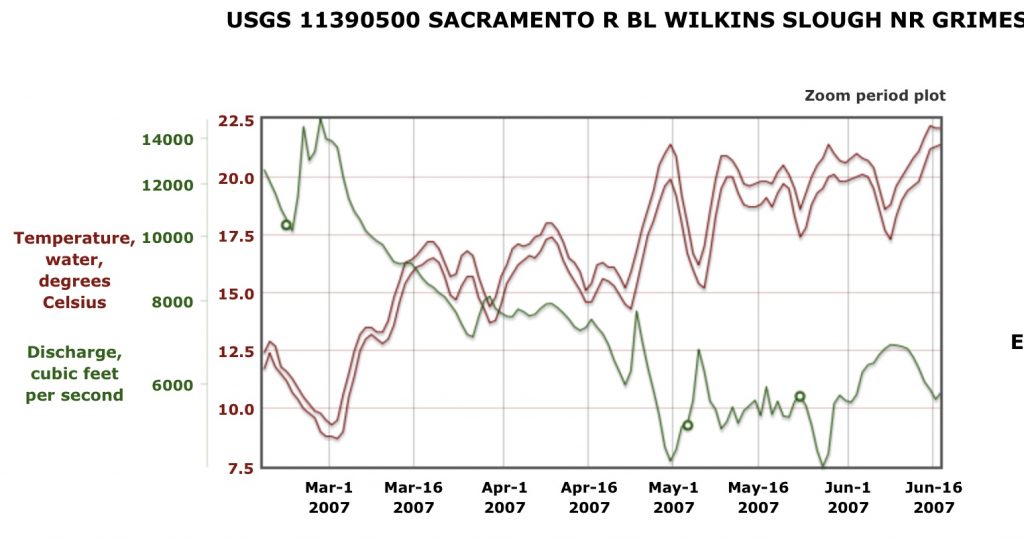
Brood year 2006 appears to have fared worse than brood years 2004 and 2005, in both the hatchery and wild components (2009 escapement in Figure 1). Unlike brood year 2004 and 2005 hatchery production, a quarter of the 12 million hatchery smolts (again all released at the hatchery in mid- to late April 2007) were coded-wire tagged. Of these, only 0.00 to 0.09 percent survived (1% or higher is good survival). In other words, less than 100,000 adults were produced with only about 20,000 escapement (Figure 1). Most of these 12 million smolts were released at the hatchery in the last week of April under generally low flow (5000 cfs) and high water temperature conditions (68-72oF after May 1) in the lower Sacramento River (Figure 3). The Red Bluff Diversion Dam was closed after April 1, as in 2005 and 2006. Such conditions likely led to very poor survival.

As a consequence, only about 5000 adult wild run fish contributed to the upper river mainstem escapement in 2009, compared to a range of 50,000 to 150,000 over the prior decade. The cause of the poor 2009 wild escapement (Figure 1) is best explained by a combination of factors: 1) poor numbers of spawners from brood year 2006; 2) poor egg/embryo survival from redd stranding in fall 2006 (Figure 2); 3) generally poor winter flows below Keswick Dam in drought year 2007 (Figure 2); and 4) generally poor ocean conditions outlined in Lindley et al. in years 2006-2008.

Brood Years 2007 and 2008

Brood years 2007 and 2008 had improved hatchery smolt survival and poor wild survival (years 2010 and 2011 escapement in Figure 1). Of the approximately 12 million hatchery brood year 2007 smolts released, approximately 1.5 million were trucked to the Delta or Bay pens with a subsequent survival of 0.10-0.14 %. The 10.5 million smolts released at the Coleman Hatchery had similar subsequent survival. Survival, though still poor, was about double that of brood year 2006, which led to double the hatchery fish escapement in the 2010 run over 2009 (Figure 1).

Brood year 2008 releases totaled approximately 15 million smolts, with about 10% trucked and released in San Pablo Bay pens. The Bay releases had a much improved survival of about 1%, as did the river releases (0.3-1.0%), leading to a doubling of the hatchery component in the 2011 run over 2010 (Figure 1). Installation of the Red Bluff Diversion Dam was delayed to late spring.

The wild fish contributions from brood years 2007 and 2008 remained poor (2010 and 2011 escapement in Figure 1). Poor runs (escapement) in 2007 and 2008 likely contributed to this; however, conditions were poor for eggs and fry in these brood years in the spawning reach in fall and winter (Figure 4).2 Hatchery river releases after April 1 had better conditions, with increased Keswick releases (Figure 4) and reduced operation of the Red Bluff Diversion Dam.

Brood Year 2009

Recovery from the 2007-2009 crash continued with the success of brood year 2009 (2012 escapement in Figure 1). The 12 million smolts, including 1.4 million released to Bay pens, had good survival rates of 1-4%. The Red Bluff Diversion Dam was decommissioned. In contrast, wild river escapement, though somewhat improved, remained poor. As for brood years 2007 and 2008, fall and winter conditions remained poor for wild fish (Figure 4). Redd stranding and low winter flows for rearing and emigration were significant problems.

Conclusions

  1. The Sacramento River fall-run salmon crash of 2007-2009 was caused by the combination of poor ocean conditions, fall redd stranding, poor winter Shasta/Keswick Reservoir releases, the December 2005 flood, upper river hatchery smolt releases in spring after Red Bluff Diversion Dam gates were closed, poor spring river flows and high water temperatures, and lack of Bay pen hatchery smolt releases.
  2. Recovery from 2010-2012 was mainly due to improved hatchery smolt survival from decommissioning of Red Bluff Diversion Dam, Bay pen releases, and improved ocean survival for brood years 2008 and 2009. Wild fish improvements were less marked because of poor spawner numbers and continuing poor river conditions (redd stranding and low winter flows), and poor Delta conditions (high exports and low inflow/outflow3).
  3. Over the past decade or so, there has been a concerted strategy to limit releases from Shasta Reservoir during the non-irrigation season (Nov-Mar), which has compromised survival of wild and hatchery salmon populations in the Sacramento River. This strategy, combined with drought and poor ocean conditions, led directly to population crashes of fall-run salmon in 2007-2009 and 2016-2017.4

Figure 1. Sacramento River fall-run salmon run escapement 1975-2016.

Figure 2. Shasta/Keswick reservoir releases spring 2003 through spring 2007, with emphasis on fall spawning and spring rearing periods for salmon brood years 2004 and 2005. Note sharp fall flow declines in both years (magenta circles), low spring 2005 flows, and late December 2005 flood (red circle).

Figure 3. River flow and water temperatures (daily high and low) in lower Sacramento River at Wilkins Slough Mar-Jun 2007.

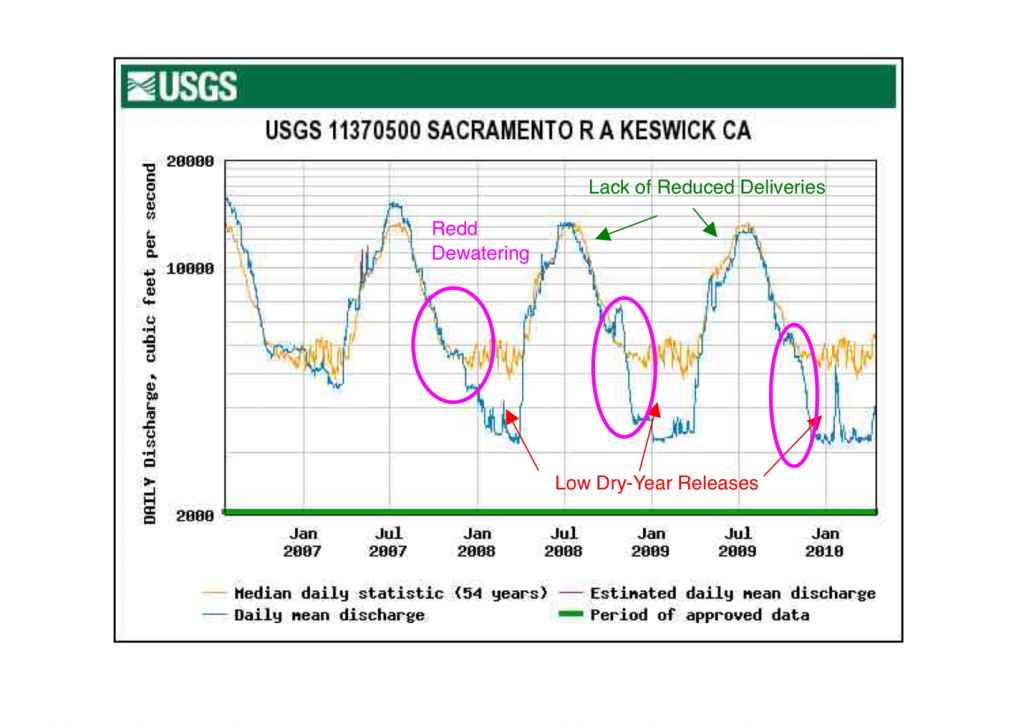
Figure 4. Shasta/Keswick reservoir releases fall 2007 through spring 2010, with emphasis on fall spawning and spring rearing periods for salmon brood years 2007-2009. Note sharp fall flow declines in the three years (magenta circles) and low winter flows (red arrows).

Spring Hatchery Salmon Releases – Feather River

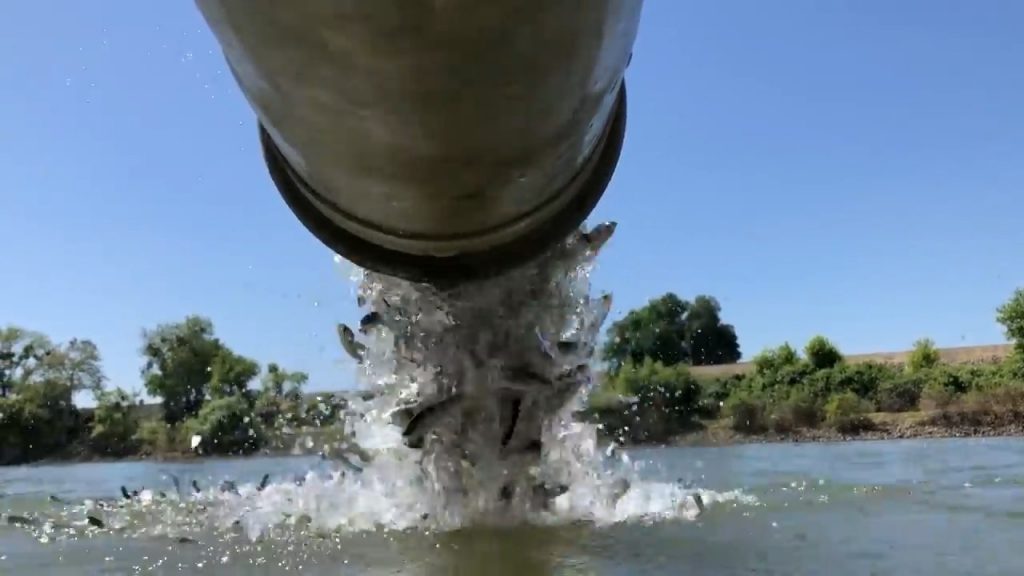
Hatchery fall-run salmon smolts being released into the Sacramento River at the mouth of the Feather River at Verona on May 2, 2018. SacBee photo.

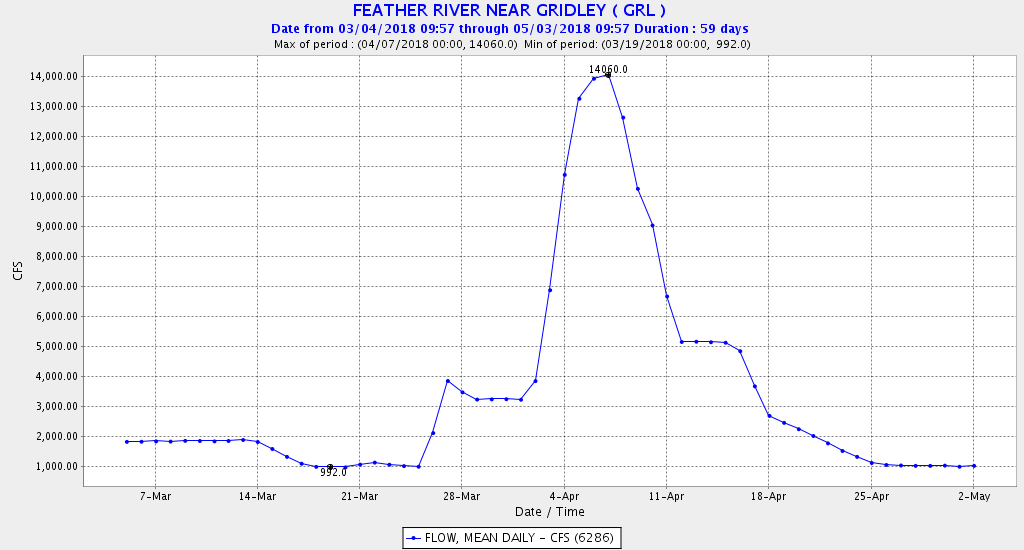
The California Department of Fish and Wildlife released spring-run and fall-run salmon smolts raised at the Feather River Hatchery into the lower Feather River from late March to early May 2018. The initial spring-run releases were accompanied by a flow pulse up to 14,000 cfs into the lower Feather River.1 The early May release2 of fall-run was made without the benefit of a flow pulse.

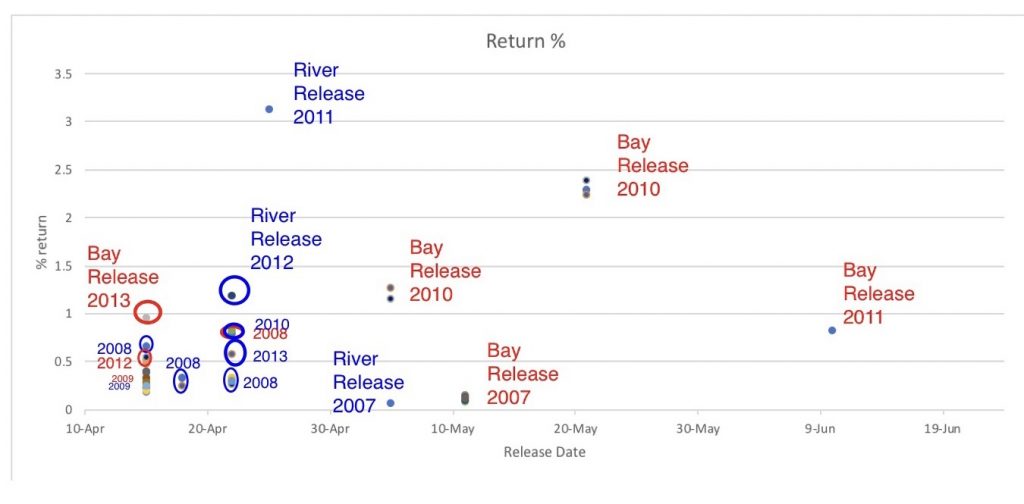
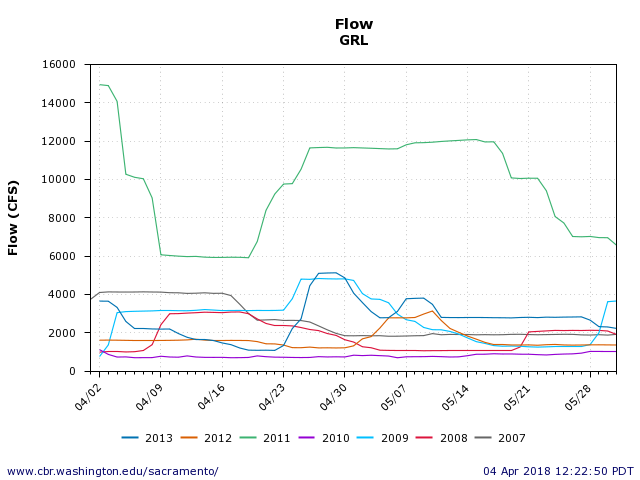
Past performance of hatchery spring-run smolt releases is shown in Figure 1. The 2011 successful smolt release was accompanied by 8,000-17,000 cfs Oroville Dam flows (Figure 2) and wet year conditions in the Bay-Delta. The 2012 modestly successful smolt release was accompanied by a 3000 cfs flow pulse. The 2007 to 2009 smolt releases also had an accompanying 3000-5000 cfs flow releases, but flows that followed fell to 1000-2000 cfs. There was no flow pulse in 2010.

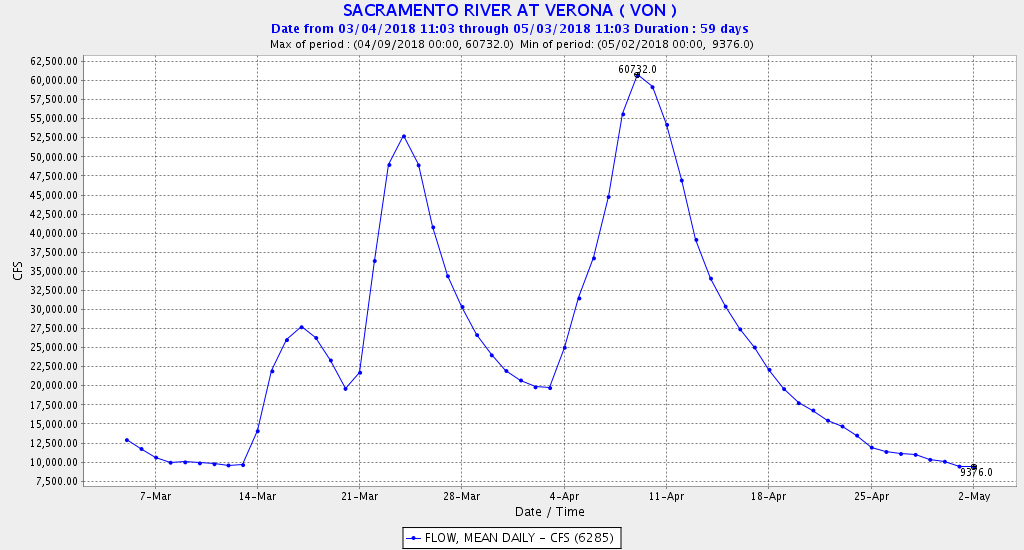
The early April 2018 flow pulse in the Feather River was followed by falling flows (14,000 cfs in early April down to 1000 cfs flow in late April – Figure 3). The latest release of fall-run smolts on May 2 was made near the mouth of the river because of low Feather River flows. Flows in the Sacramento River were also low (less than 10,000 cfs – Figure 4), and water temperatures were marginal at 65°F. The evidence summarized in Figures 1 and 2 suggests that smolts should be trucked to the Bay in non-wet years without strong flow pulses. Survival would be further increased if the smolts are barged from the mouth of the river.3

We can expect good survival from the earlier releases that were accompanied by flow pulses and poor survival from the early May release without a flow pulse. The latter release should have been trucked to the Bay.

Figure 1. Survival (% return) of spring-run salmon tag-release groups from 2007-2013 spring smolt releases. Source of data: http://www.rmpc.org/

Figure 2. Flow (cfs) in the lower Feather River at Gridley in Apr-May 2007-2013.

Figure 3. Flow (cfs) in the lower Feather River at Gridley in Mar-May 2018.

Figure 4. Flow (cfs) in Sacramento River just below mouth of Feather River at Verona in Mar-May 2018.

Sacramento River Salmon Passage Projects

Several years ago I wrote a post on the loss of fish in the Sacramento River floodplain. Last year marked the completion of the Knights Landing Outfall Gates (KLOG) and Wallace Weir screening projects that will hopefully keep adult salmon from entering the Colusa Basin Drain. In the coming years, the Fremont Weir Passage Facility will allow adult salmon to escape the Yolo Bypass back to the Sacramento River. That is progress, but there is more to do.

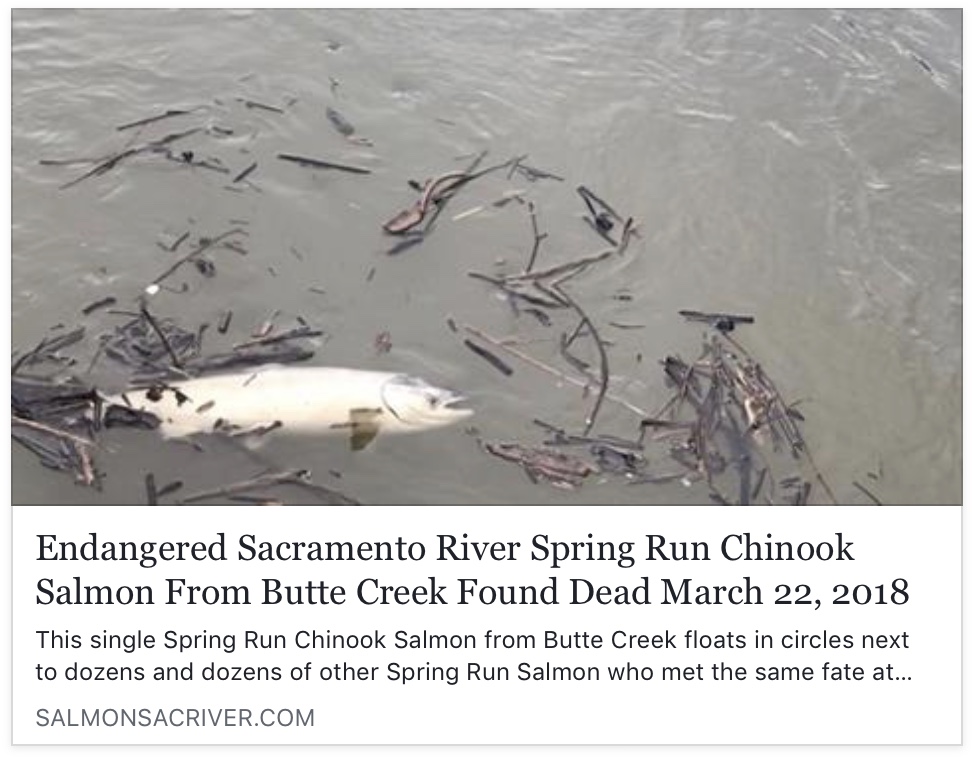
We now need to focus on the Sutter Bypass and Butte Basin to the east of the Sacramento River. Like the Fremont Weir, the Colusa, Moulton, and Tisdale weirs need fixing. Adult salmon are blocked at these weirs. Young salmon pass over the weirs into the Butte Basin and Sutter Bypass and become stranded or die in the bypass. Like the Knights Landing Outfall Gates (KLOG), the Butte Slough Outfall Gates (BSOG) need fixing. In March, many adult spring-run salmon died (photo above) at the BSOG1 as Butte Basin floodwaters exiting the BSOG attracted salmon migrating up the Sacramento River. The salmon died in passing through the flap gate from direct physical damage or from low oxygen. Hopefully, the planned upgrade of the BSOG by the state will fix the problem.

Though much progress has happened on the Butte Creek/Slough and Sutter Bypass to correct fish passage problems,2 more needs to be done, especially in the Sutter Bypas3. Weir #1 hinders spring-run salmon passage to Butte Creek. CalTrout is planning a fix for that weir.