
The Yuba River Fall-Run Chinook salmon population “crashed” in the last decade. Yuba River escapement ranged only from 2000-5000 spawners counted per year (Figure 1). Such low escapements were last encountered only during the Central-Valley-wide crash during the 2007-2009 drought.
The decade-long low escapement reflects the effects of two droughts (2013-15 and 2020-22). Though the 2023-to-2025 escapements have increased slightly1 despite the 2020-2022 drought, the higher escapement reflects the benefit of fishery closures from 2023-2025 (fisheries normally harvest more than 50% of the adult stock). Yuba escapement also reflects substantial numbers of hatchery strays from other rivers, including the Mokelumne and American River hatcheries, the Coleman hatchery on Battle Creek in some years, as well as the Feather River (Oroville) hatchery. Small numbers of spring-run Feather hatchery strays from release locations near the mouth of the Yuba on the Feather River are also included.
The highest number of strays in the 2020-2022 period were from one group of Mokelumne River hatchery smolts released in 2018 to Half Moon Bay on the coast south of San Francisco. The next highest group of strays are from American and Feather hatchery smolt releases to San Francisco Bay. The trucked hatchery smolts do very well during drought years and thus tend to bias high the Yuba returns from drought years. That is to say, drought effects on the natural Yuba run are even worse than indicated in escapement estimates.
I categorize the decade-long decline as a “crash” based on the population spawner-recruit (S/R) relationship (Figure 2). The S/R “curve” generally reflects a positive logarithmic relationship between spawner and recruitment numbers. The more eggs spawned generally leads to more adult returns three years later. The S/R ratio, at least in the Central Valley salmon populations, also reflects drought or habitat conditions wherein recruits are generally depressed from density-independent habitat factors like droughts. The six drought years in the last decade shown in Figure 2 as red dots have led to escapement levels in the lower-left quadrant of the S/R curve – a pattern often referred to as a population crash.
Often it is difficult for a population to recover from that situation because there are not enough spawners (eggs) to get the population out of the hole. It would take a lot of good years in sequence to make that happen, unless certain actions are taken to accelerate the recovery. For some suggestions on how this can be accomplished, see my past post on the subject.
Because of the supplementation of recruitment from other rivers and resulting mixed bag of spawners, the Yuba run is not threatened with extinction. However, in its present state, its poor contribution to the commercial and recreational fisheries is a problem. The Yuba is a magnificent salmon river that should contribute more salmon.
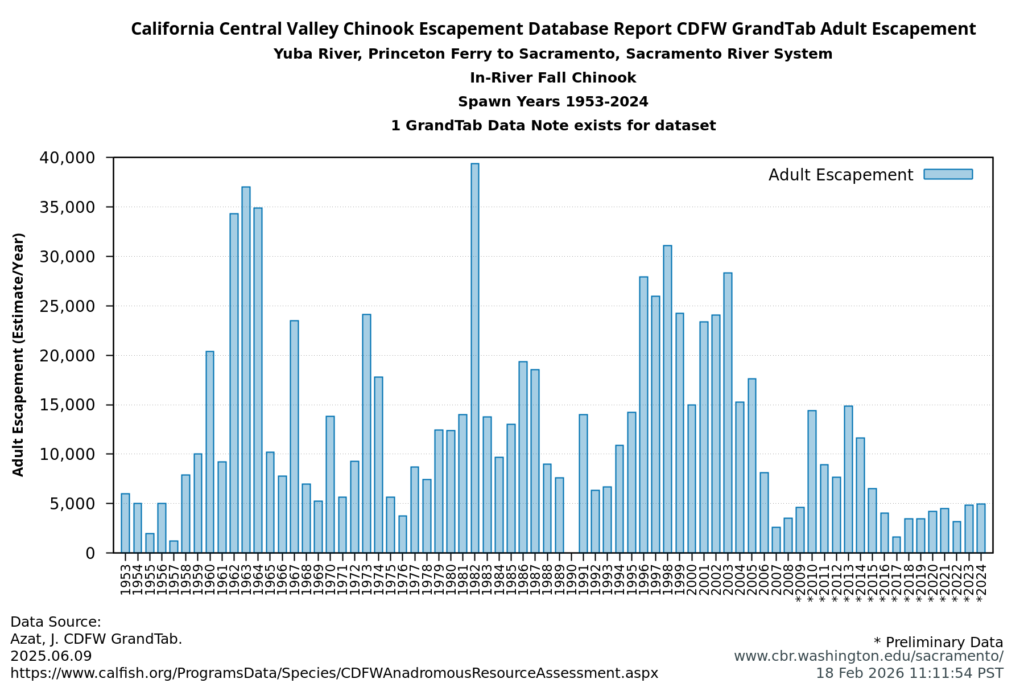
Figure 1. Yuba River Fall-Run Chinook salmon escapement estimates 1953-2024.
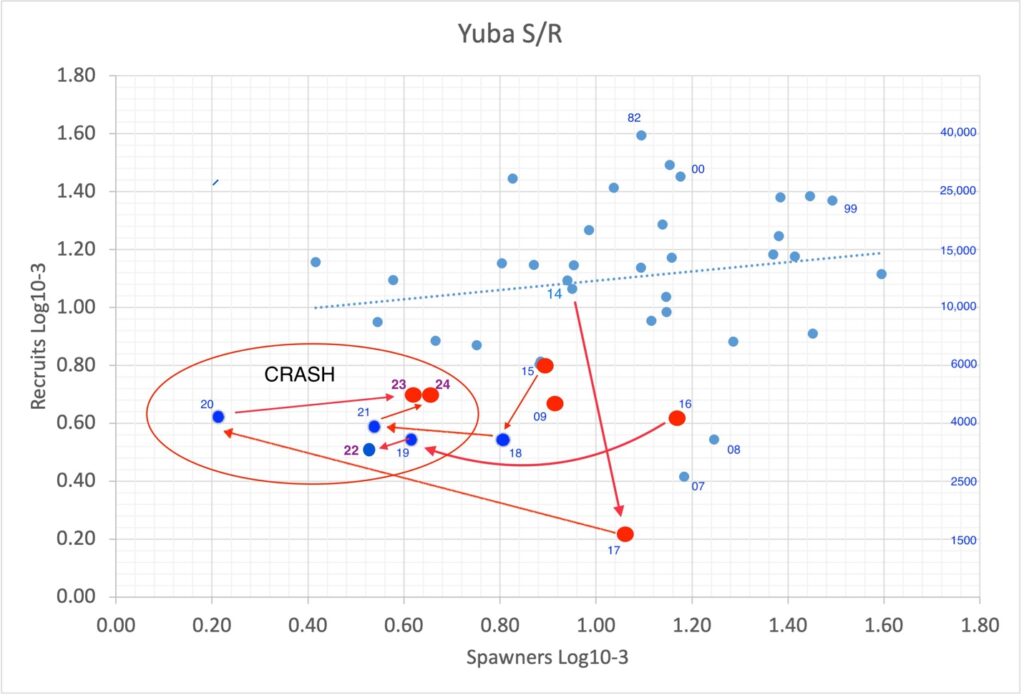
Figure 2. Yuba River Fall-Run Chinook salmon spawner-recruitment relationship wherein recruits are related to recruits three years earlier. Red dots represent escapement years where two years earlier it was a drought year during rearing and outmigration.
- The preliminary 2025 estimate is near 6000, https://yubariver.org/posts/yuba-river-salmon-return-numbers-september-december-2025/ ↩