Annual Runs in the Back Yard

Last week, the annual arrival of cedar waxwings hit my back yard near Sacramento. Each January, these magnificent birds fill my small back yard by the hundreds to feast for several days on the fermented fruit of three tall grape trees. The birds eat nearly every grape, likely a ton of fruit hanging from the branches. In several days the birds are gone, not to return for another year. I often wonder how important my little backyard piece of habitat is for this population of Cedar Waxwings, and how much of their winter energy comes from this small crop of fruit.

The birds remind me of another annual backyard run, the Cook Inlet Coho and Chinook salmon near Anchorage, Alaska, where I lived for three years in the mid-1980s. A large run of Coho showed up right on time each year at the end of summer in a creek that was literally in my back yard. Only kids were allowed to fish the city’s creeks for salmon, so I taught the neighborhood’s boys, including my 12-year-old son, how to catch and release the Coho. For a week or two, they could catch five or so bright ten-pounders in an hour or two a day. Me, I canoed down a tidal creek on the Kenai Peninsula side of the inlet and camp for a weekend to fish the fresh Coho run entering from the Inlet. I built a blind right on the creek within sight of the inlet. I could see the white backs of dozens of Beluga whales herding and feeding on the incoming salmon just a few dozen yards off the creek mouth. At night, the Coho approached the light of my Coleman lantern, even allowing a brief pet or two on my part, while maintaining steady and wary eye contact.

In the spring (late May), I often hitched a plane ride across the inlet (10 minutes and $40) to fish the spring Chinook run for a weekend of 24-hour daylight. At low tide, the small rivers were over 30-ft below the tule-lined channel. At high tide, the channel filled to the tules, along with seemingly bank-to-bank 30-lb spring-run salmon that obligingly hit any lure I put in front of them. This annual rush of spring Chinook lasted for a week or two before the fish moved upstream to await their late summer spawn.

Today, thirty years later, things are not so good. After 30 years of increasingly intense subsistence, personal use,1 sport, and commercial fishing pressure, and most importantly severe ecological drought, the salmon runs have sharply declined. No doubt global warming has hit Alaska worse than other parts of North America, with high temperatures and low precipitation.2

Many of the streams are now closed to fishing. Where open, the annual bag limit of Chinook is only one fish per year. The Cook Inlet Beluga that once numbered in the thousands are down to several hundred and were listed as endangered in 2008. This decline occurred despite the fact that much of the habitat remains virtually pristine and untouched by man, with little influence of hatcheries. Global warming, overfishing, natural cycles, or ocean conditions: no one knows the cause for sure. Regardless, Alaska’s fish agencies must now manage its fisheries very conservatively with intensive adaptive management science. If you asked these agencies, they would say they had already been doing that for decades. They would also admit they learned a hard lesson. For more on their situation see:
http://www.adfg.alaska.gov/index.cfm?adfg=wildlifenews.view_article&articles_id=516 .

  1. Each state resident family could use a gillnet in the Inlet to catch 50 salmon per year for “personal use”.
  2. https://nccwsc.usgs.gov/content/ecological-drought-alaska

PG&E Withdraws License Application on Butte Creek: Future of Spring-Run Salmon Uncertain

By Chris Shutes (CSPA) and Dave Steindorf (American Whitewater)

In a surprise move, PG&E announced on February 2, 2017 that it was withdrawing its application to relicense the DeSabla – Centerville Hydroelectric Project on Butte Creek and the West Branch Feather River.  The reach of Butte Creek affected by the Project is home to the only remaining viable population of spring-run Chinook salmon in California’s Central Valley.

Spring-run salmon in Butte Creek have seen a resurgence over the last twenty years.  A substantial part of this was due to investments and improvements downstream of the Project. In addition, since 2003, PG&E and state and federal resource agencies have greatly improved the management of the Project for the fish.

From 2004 to 2009, PG&E went through a formal relicensing process with the Federal Energy Regulatory Commission (FERC) to relicense the Project.  In 2016, the State Water Board issued a Water Quality Certification needed for a new license.  A new license from FERC was widely expected in 2017.

In a DeSabla – Centerville fact sheet and map that PG&E distributed with its announcement, PG&E describes the project as follows:

The Project diverts a portion of the natural flow of water from Butte Creek and West Branch of the Feather River (WBFR) into canals that carry the water for use in hydroelectric powerhouses. Once water is run through the powerhouses it is ultimately released to Butte Creek. During the summer, the natural flow of the WBFR is augmented by water releases from Round Valley and Philbrook reservoirs. Project diversions have provided additional flow to Butte Creek for more than 100 years. One of the beneficiaries of this additional flow has been the aquatic community in Butte Creek, including Central Valley spring-run Chinook salmon.

While it is true that water from the Project augmented flows below Centerville Powerhouse for 100 years, it is only since 1980 that the Project benefited fish in the eight miles of Butte Creek between DeSabla Powerhouse and Centerville (see map).  The 2016 Water Quality Certification requires all the Butte Creek water and the imported water to remain in Butte Creek once it exits DeSabla Powerhouse.

The DeSabla – Centerville Project facilities are built around infrastructure that dates to 1900 and in some cases before.  Commissioned in 1900, Centerville Powerhouse has been offline since 2011, and ran only partially for the five years previous to that.  To function at all, it would need a complete rebuild.  The estimated cost to rebuild was $39 Million in the mid-1990’s; it is almost certainly now double that, or more.  DeSabla Powerhouse, nine miles upstream of Centerville, is relatively modern and in good condition, but the small reservoir that feeds it allows water to heat up too much passing through.

In California’s modern energy market, the capability to regulate the grid gives hydropower its greatest value.  But unlike many other hydropower projects, powerhouses in the DeSabla – Centerville Project run at a constant rate, day and night, regardless of when power demand is high or low.  They also have no ability to help regulate the power grid, especially to respond to short-term changes in supply from intermittent renewable sources like wind and solar.

The real value of the Project is the water it imports from the West Branch Feather River to Butte Creek: value for the fish and value for the farms that use the water further downstream.  The fish can’t pay for this service; the farms have never been asked to pay and never have.

PG&E’s decision not to relicense the Project does not lead to a path that is simple.  In the next few months, moving into the next few years, PG&E will need to establish a stakeholder engagement process to help determine the Project’s long-term disposition.  PG&E will need to engage resource agencies, downstream water rights holders, interested NGO’s, and local residents.  The DeSabla – Centerville Project has been part of the community for over a century.  Its resource values are enormous.  The water that it supplies downstream is essential to the irrigation of thousands of acres of crops.

On September 19, 2015, PG&E bought an advertisement on the editorial page of the San Francisco Chronicle entitled:  “Of Bees, Birds and Chillin’ Chinook: All in a Sustainable Day at PG&E.”  Mr. Tony Earley, CEO of PG&E at the time, started the ad by extolling PG&E’s work to keep salmon in Butte Creek cool.  His major theme stated: “The days are long past when energy companies could afford to think of their mission as separate from conservation, sustainability and good management of our natural resources.  Our view must be for the long term.  That’s why we live our commitment to conservation through a number of programs.”

We look forward to the opportunity to help PG&E maintain this well-stated goal.

Winter-Run Chinook Salmon Status – End of 2016

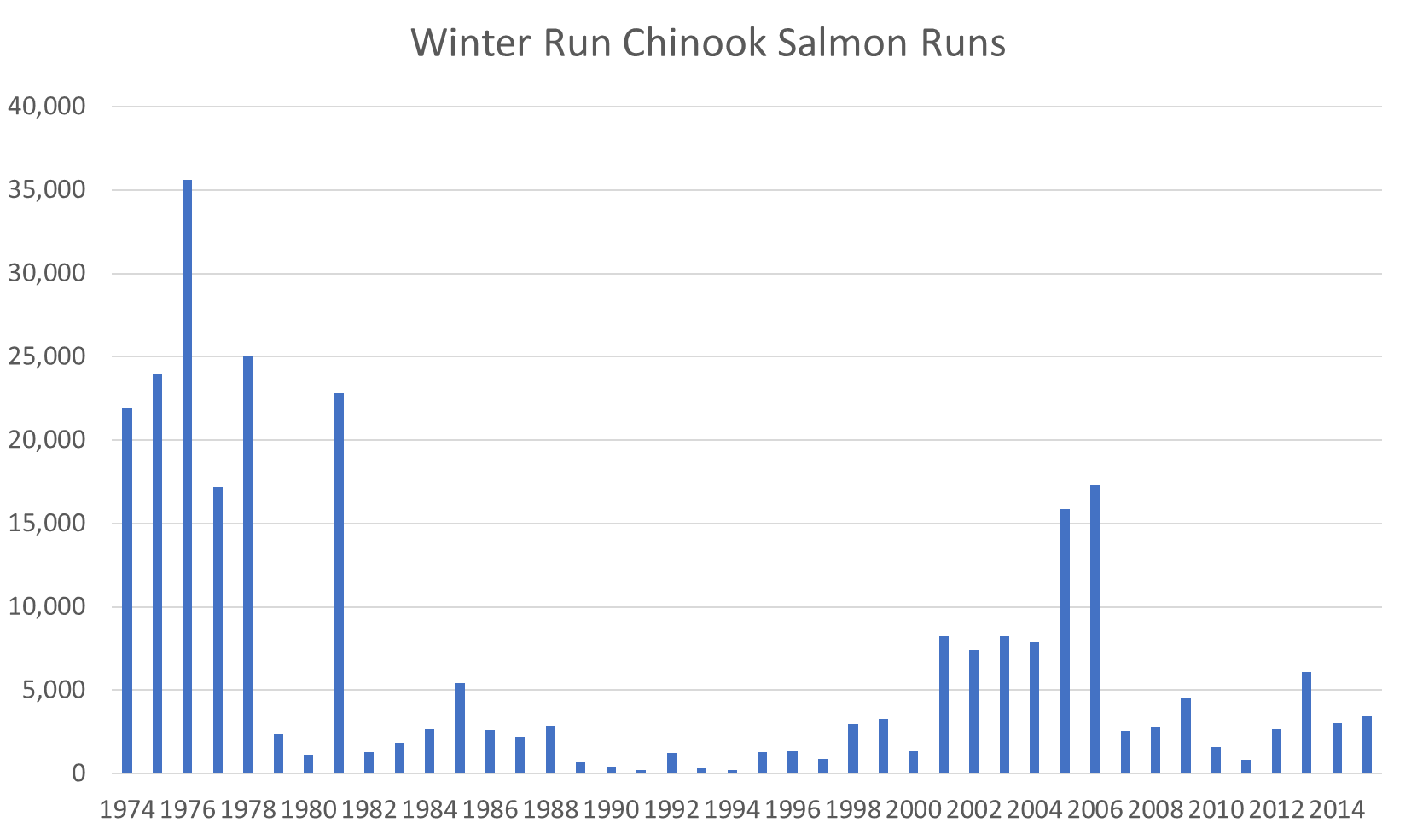
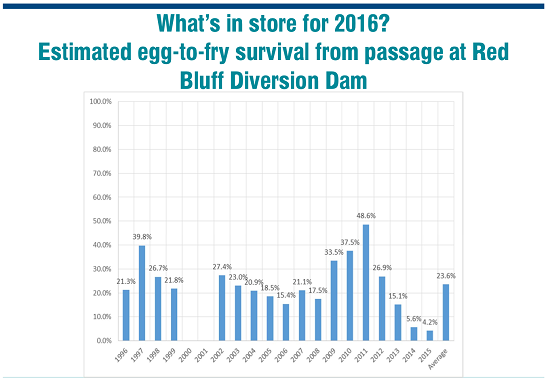
The prognosis for winter-run Chinook salmon is not good following very poor survival of the 2014 and 2015 spawns in the Sacramento River below Shasta Dam.   The run had been recovering after the 2007-2009 drought (Figure 1).  However, year class production suffered in the 2012-2015 drought, culminating with the year class (spawn) failures in 2014 and 2015 (Figure 2) caused by egg stranding and high water temperatures.  Run size and juvenile production/survival estimates for 2016 are as yet incomplete, but production of juveniles as estimated from Red Bluff rotary screw trap data indicates some improvement over 2014-2015.1 The somewhat higher number of recruits produced in 2013 likely boosted the spawning run in 2016.

With water year 2017 starting out as a wet year with considerable flooding, conditions for the emigration of the 2016 year class should be optimal.  If wet conditions persist, spawning and rearing this spring and summer for the 2017 year class should also be optimal.  Planned release of 600,000 winter-run hatchery smolts in the coming weeks coincident to high Sacramento River flows also bodes well for the 2016 spawn and the future 2019 run.  However, the prognosis for the 2017 and 2018 runs remains in doubt because of the above-mentioned 2014 and 2015 year class failures.

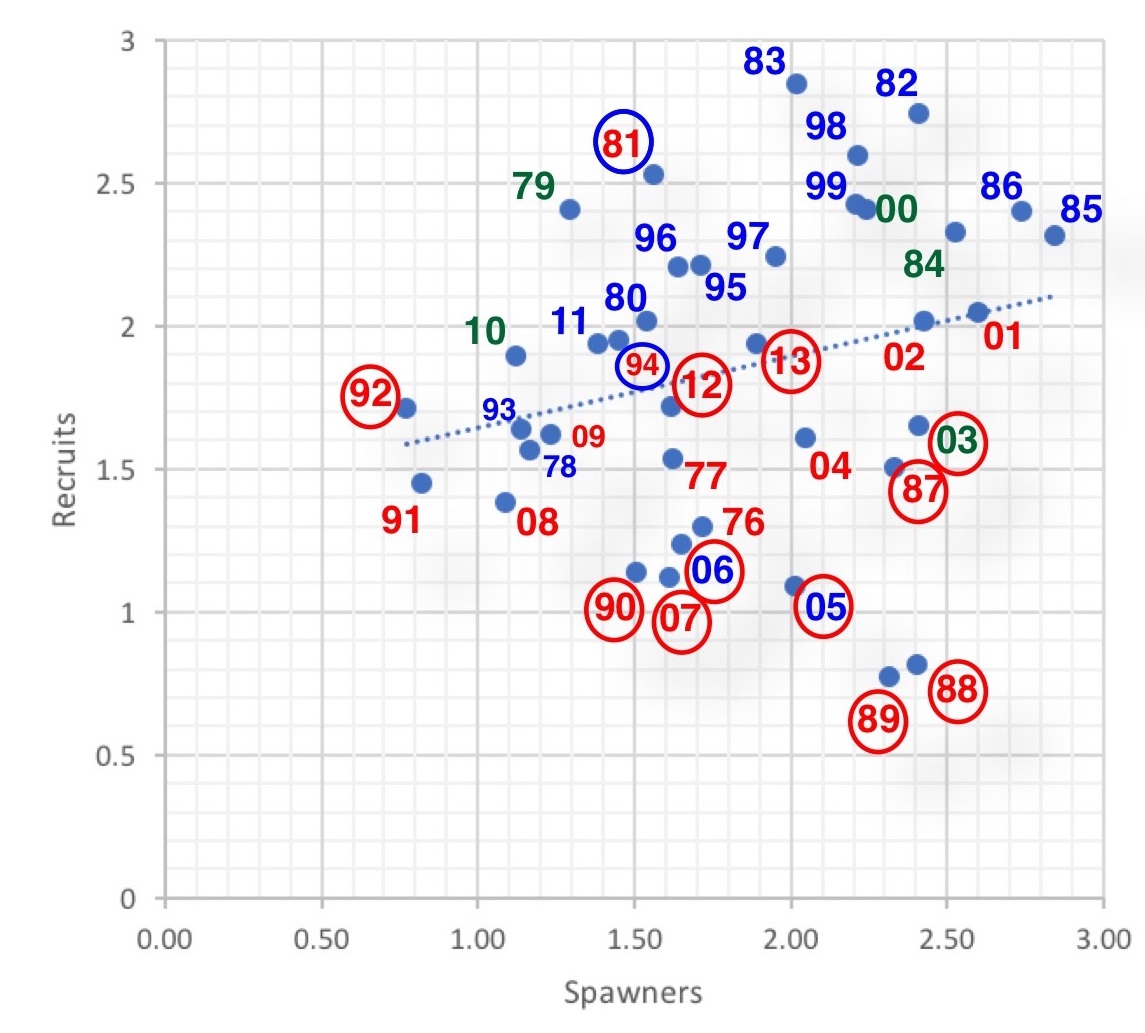
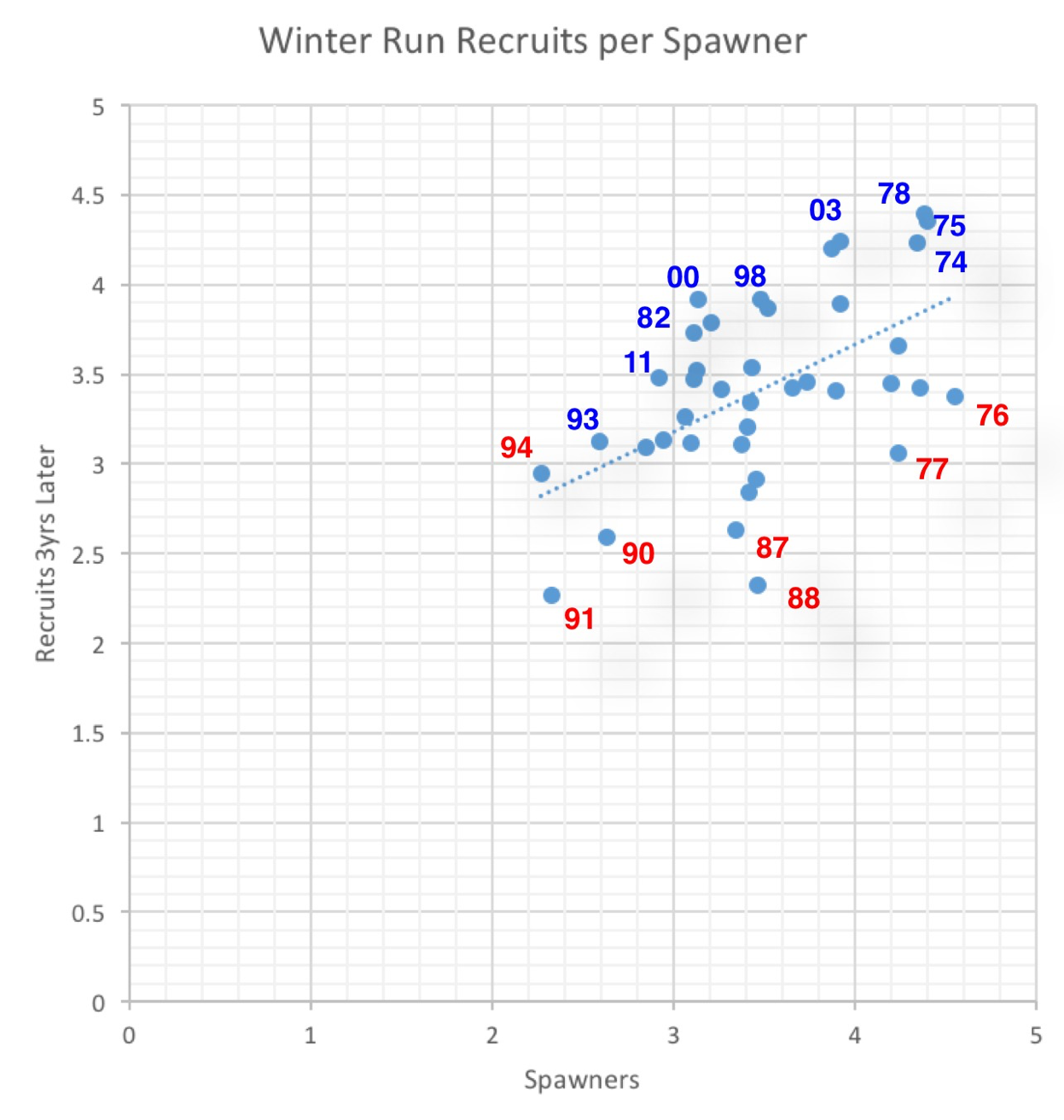
Additional insight into the future is possible by taking a closer look at the population’s spawner-recruit relationship that I prepared for the past four decades (Figure 3).  Recruitment appears to be a function of both the number of spawners three years prior to any given year and environmental conditions between spawning and emigration in a given year.  (Other factors such as ocean conditions may also add to variability in the data.)  The recruits-per-spawner ratio is higher three years after wet years than three years after dry years.  The runs in 2017 and 2018 are likely to be severely depressed because of extremely poor 2014 and 2015 recruitment, and may possibly be as low as those produced after the 1987-91 drought (only 100-200 wild spawners).

For further reading on winter-run status see:

  1. http://deltacouncil.ca.gov/sites/default/files/2015/11/Vogel%20White%20Paper-%20Potential%20effects%20of%20CVP %20Ops%20on%20winter%20run%20Chinook%20egg%20incubation%202015.pdf
  2. http://www.westcoast.fisheries.noaa.gov/stories/2015/23_12232015_winter_chinook_math.html
  3. http://www.nmfs.noaa.gov/stories/2015/09/spotlight_chinook_salmon.html
  4. http://mavensnotebook.com/2015/12/15/conserving-chinook-salmon-at-the-southern-end-of-their-range-challenges-and-opportunities/
Figure 1. Winter-run Chinook salmon escapement (run size) into upper Sacramento River near Redding, CA from 1974-2015. (Data Source: http://www.dfg.ca.gov/fish/Resources/Chinook/CValleyAssessment.asp)

Figure 1. Winter-run Chinook salmon escapement (run size) into upper Sacramento River near Redding, CA from 1974-2015. (Data Source: http://www.dfg.ca.gov/fish/Resources/Chinook/CValleyAssessment.asp)

Figure 2. Survival of winter-run year classes below Shasta Dam from 1996-2015. The water temperature standard for the Sacramento River near Red Bluff was weakened during 2012-2015 drought. The severely weakened water quality standard in 2014 and 2015 led to poor survival and virtual loss of two year classes. (Source: http://www.waterboards.ca.gov/waterrights/water_issues/programs/drought/sacramento_river/docs/nmfs_yip_03182016_ppt.pdf)

Figure 2. Survival of winter-run year classes below Shasta Dam from 1996-2015. The water temperature standard for the Sacramento River near Red Bluff was weakened during 2012-2015 drought. The severely weakened water quality standard in 2014 and 2015 led to poor survival and virtual loss of two year classes. (Source: http://www.waterboards.ca.gov/waterrights/water_issues/programs/drought/sacramento_river/docs/nmfs_yip_03182016_ppt.pdf)

Figure 3. Winter-run Chinook spawners versus number of spawners three years later (recruits) for years 1974 through 2012. Selected wet year spawn dates shown in blue. Selected dry year spawn dates shown in red. (Data source: http://www.dfg.ca.gov/fish/Resources/Chinook/CValleyAssessment.asp)

Figure 3. Winter-run Chinook spawners versus number of spawners three years later (recruits) for years 1974 through 2012. Selected wet year spawn dates shown in blue. Selected dry year spawn dates shown in red.
(Data source: http://www.dfg.ca.gov/fish/Resources/Chinook/CValleyAssessment.asp)

“Robust” San Joaquin Salmon Runs

The San Joaquin River appears to be seeing a boon in salmon runs this year despite the recent drought. Editor Dennis Wyatt of the Manteca Bulletin suggested on December 14 that “robust” salmon runs on the San Joaquin River in recent years “discredit” state claims that more of unimpaired flow of the Stanislaus, Tuolumne, and Merced rivers should be passed to the Bay-Delta:

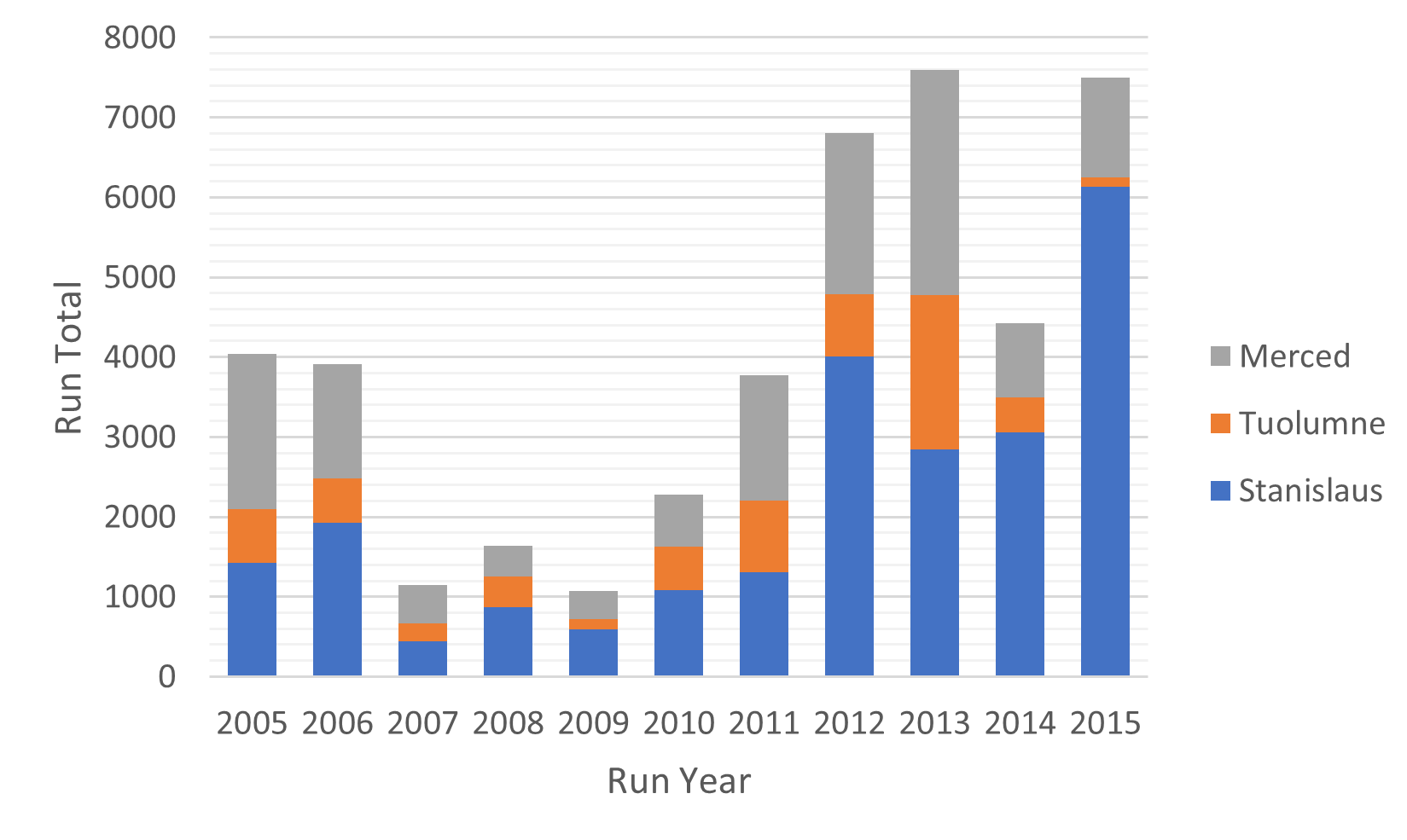
Spawning adult numbers after being in the 1,000 to 2,000 range from 2006 through 2011 now consistently surpass 5,000 despite the drought. The scientific research conducted by FISHBIO over the past decade and underwritten by the South San Joaquin Irrigation District and Oakdale Irrigation District is being used by the two water agencies to discredit state claims that the only way to increase salmon on the Stanislaus River — and the neighboring Tuolumne and Merced rivers — is by ratcheting up unimpaired flows to 40 percent between February and June. 1

This theory is circulating among supporters of water purveyors who draw water from the Stanislaus. For example, Mr. Wyatt’s editorial was reproduced verbatim on Congressman Jeff Denham’s website.2

One of the main reasons for the recent decade of run increases is most likely increases in flow requirements in the spring and fall as mandated in the National Marine Fisheries Service’s 2009/2011 biological opinion for the Central Valley Project. It is more logical that further flow improvements would lead to further salmon enhancements, perhaps even approaching target levels specified in the Central Valley Project Improvement Act of 1992 (CVPIA).

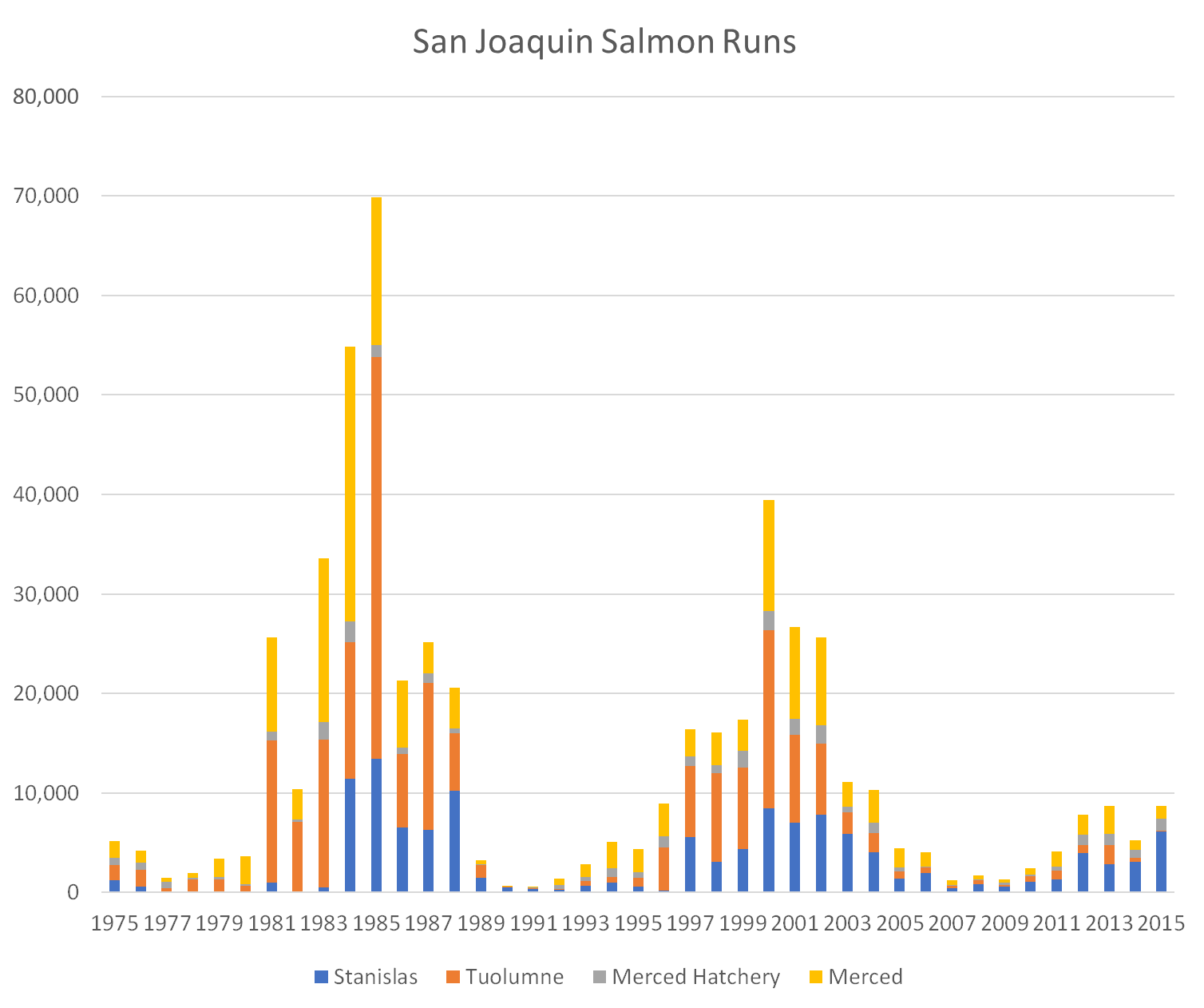
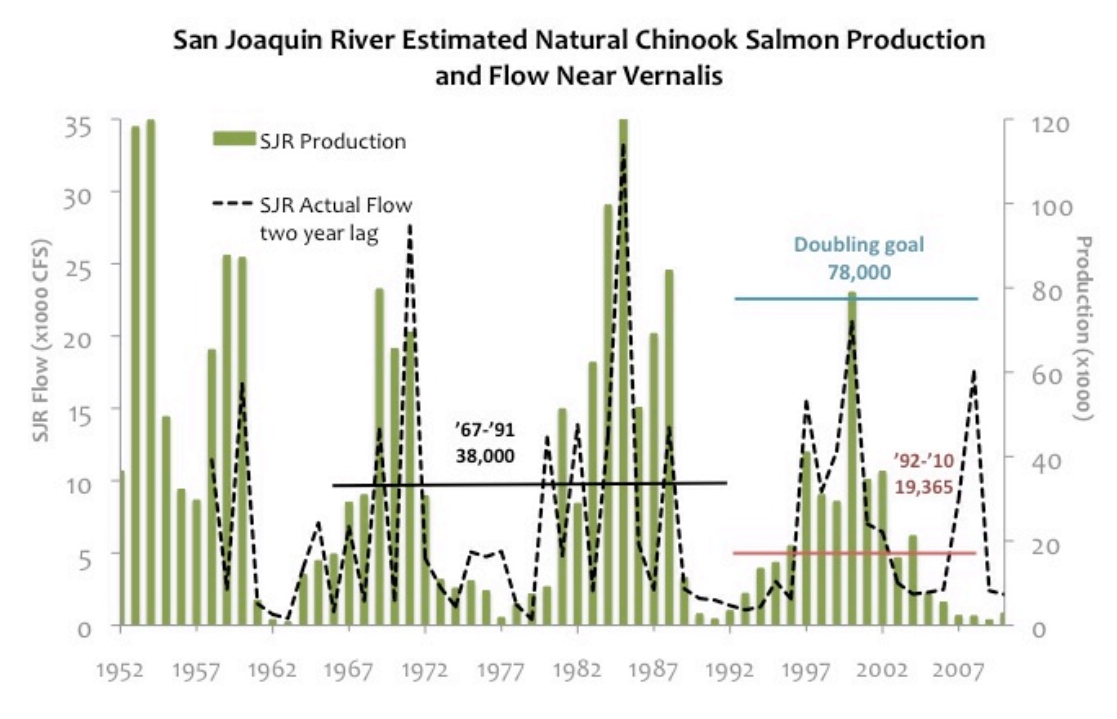
There is a long way to go. The so-called robust runs are far below the CVPIA target of 78,000 salmon for the San Joaquin, numbers that were most recently achieved in Water Year 2000 (Figure 1). While there have been improvements during the last ten years, eight of which were drought years (Figure 2), runs are still about 70,000 fish short of the doubling goal.

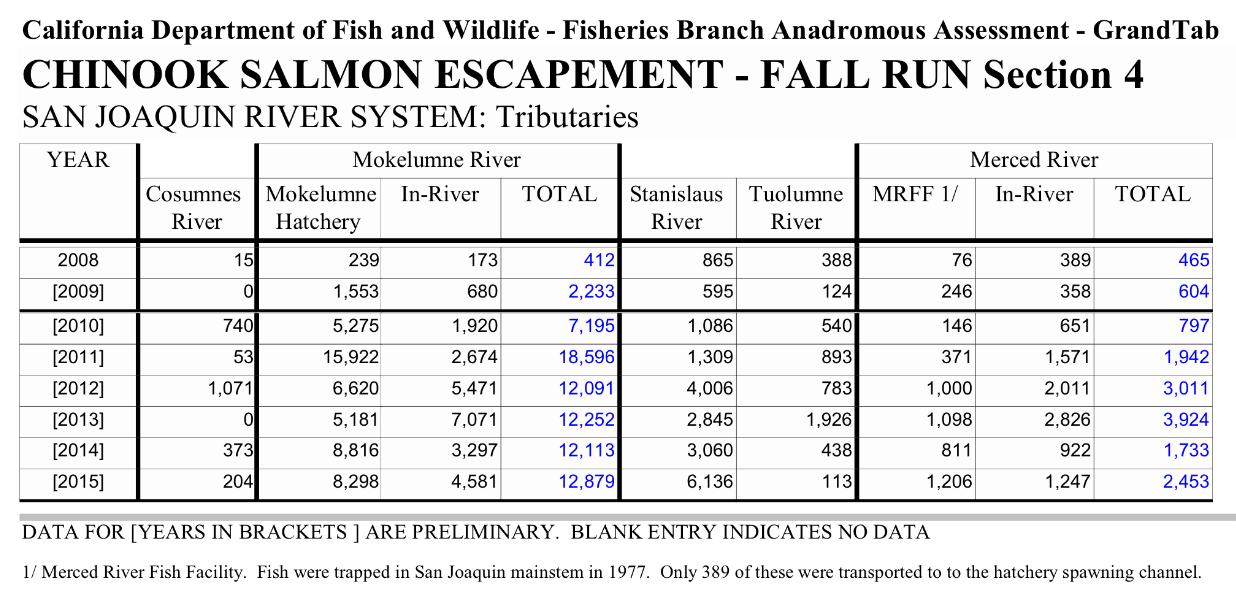
In addition, much of the recent improvement is related to increased hatchery production from the state hatcheries on the Mokelumne and Merced rivers (Figure 3). Hatchery production also benefits from trucking hatchery smolts to the Bay. Runs in the Stanislaus and Tuolumne also benefit from strays from the two hatcheries. The CVPIA doubling goal is for natural production.

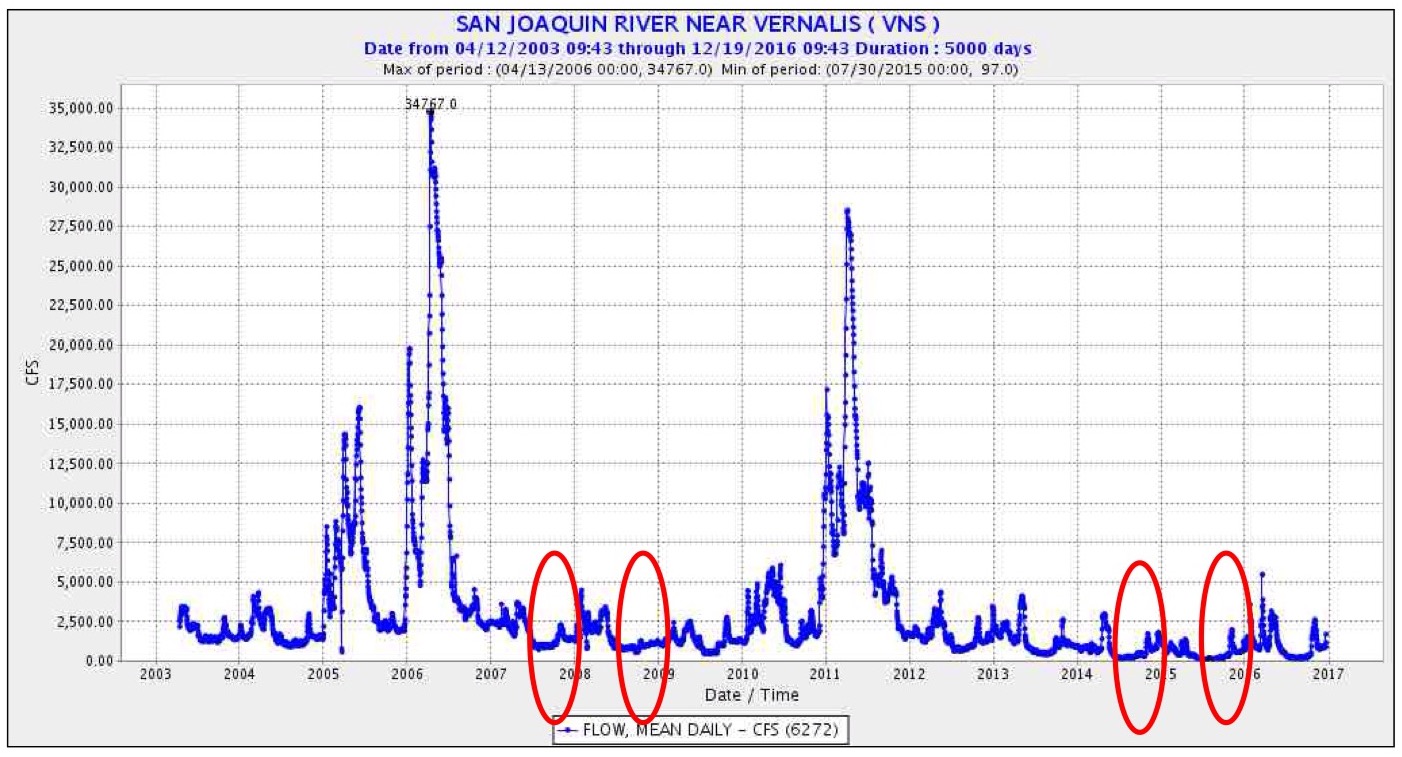
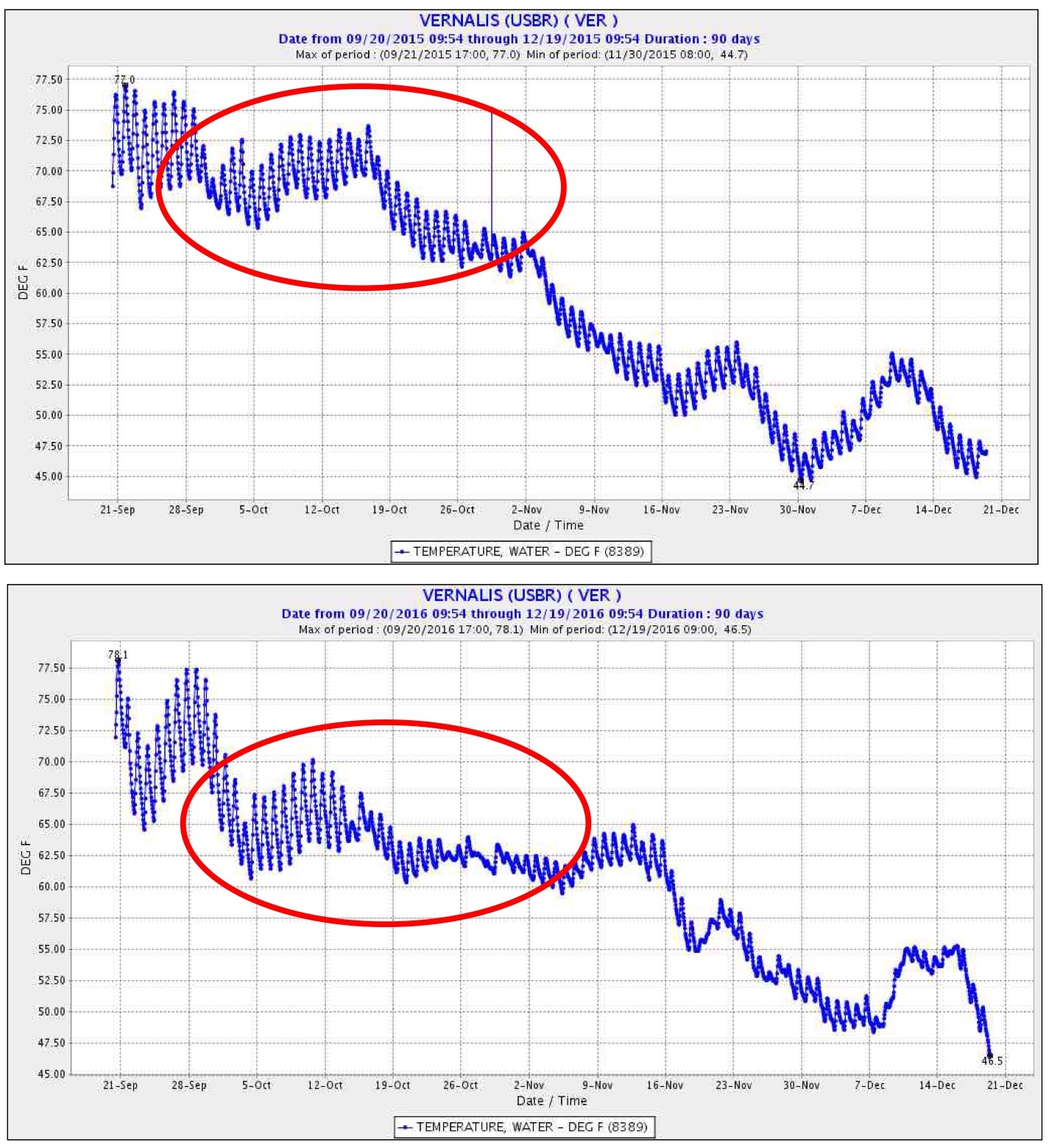
Finally, there needs to be defined fall flow pulses in addition to higher spring flows. Fall pulse flows reduce water temperature in the three tributaries and mainstem during the fall migration period. In the past, drought year fall flows were depressed (Figure 4). This made it harder for fish to find the San Joaquin tributaries and led to high fall water temperatures (Figure 5). High temperatures can block or hinder adult salmon migration, reduce adult pre-spawn survival, and lower egg viability. Lack of fall flow pulses in 2014 and 2015 led to poor salmon escapement, especially in the Tuolumne and Merced Rivers. Higher flows and lower water temperatures in the Stanislaus in 2015 likely led to a greater proportion of the overall San Joaquin run choosing the Stanislaus River (Figure 2). Fall flows from tributary reservoirs should be sufficient to maintain tributary water temperature below 60°F and San Joaquin River temperatures below 65°F. These goals are achievable in most water years, and were for the most part achieved in the San Joaquin River in October, 2016 (Figure 5).

Sorry, folks. Flow matters.

Figure 1. San Joaquin salmon production 1957-2010 as related to flow two years earlier. Source: Appendix C, SWRCB 2012.

Figure 1. San Joaquin salmon production 1957-2010 as related to flow two years earlier. Source: Appendix C, SWRCB 2012.

Figure 2. Salmon run totals (escapement) from the Stanislaus, Tuolumne, and Merced rivers 2005-2015. Data source: CDFW.

Figure 2. Salmon run totals (escapement) from the Stanislaus, Tuolumne, and Merced rivers 2005-2015. Data source: CDFW.

Figure 3. San Joaquin salmon escapement from 2008 to 2015. Source: CDFW.

Figure 3. San Joaquin salmon escapement from 2008 to 2015. Source: CDFW.

Figure 4. San Joaquin River flow 2003-2016 at Vernalis (downstream of confluence with Stanislaus, Tuolumne, and Merced rivers). Red circles denote drought years lacking adequate fall flow prescriptions.

Figure 4. San Joaquin River flow 2003-2016 at Vernalis (downstream of confluence with Stanislaus, Tuolumne, and Merced rivers). Red circles denote drought years lacking adequate fall flow prescriptions.

Figure 5. Fall water temperature of San Joaquin River at Vernalis in 2015 (top) and 2016 (bottom). Red circles denotes key salmon migration period when fall flow prescriptions occur. Note higher water temperature in 2015 compared to 2016, which had higher fall flows. Source: CDEC.

Figure 5. Fall water temperature of San Joaquin River at Vernalis in 2015 (top) and 2016 (bottom). Red circles denotes key salmon migration period when fall flow prescriptions occur. Note higher water temperature in 2015 compared to 2016, which had higher fall flows. Source: CDEC.

Winter in the Delta – Salmon and Smelt

December and January have traditionally been the months when salmon and smelt enter the Delta in large numbers with late fall and early winter storms. Juvenile and yearling salmon pour out of the rivers into the Delta. Heavy rains wash fry, parr, and smolts from their river spawning grounds into the Delta. Sub-yearling winter-run, yearling late-fall, spring-run, and fall-run, and newly hatched spring and fall-run fry abound. Adult longfin and Delta smelt migrate up from the Bay, surfing the tides on their annual spawning runs.

These same storms whet the appetite for December exports from the south Delta. In the two decades from 1990 to 2010, December and January exports often reached 11,000 cfs and at times exceeded 12,000 cfs. High salvage events occurred for salmon and smelt, reflecting both the abundance of fish and the strong pull of reverse flows toward the south Delta pumps. Precipitous population declines followed, forcing severe winter export limitations (only 1500-5000 cfs) imposed since 2008-2009 by ESA biological opinions to reduce fish losses. Winter salvage at the south Delta export facilities dropped sharply as a result of the limitations, but salmon and smelt populations had already reached record lows, and most remained so or got even worse during the 2012-2015 drought.

This year’s fall storms and high December Delta inflows has brought a new regulatory reality to Delta exports. The federal and state governments, under new mandates in the recently-passed federal water legislation, have kept exports high (9000-11,000 cfs) or moderate (5000-7000 cfs) through December, hoping fish would still be protected but allowing water supply deliveries to increase after four years of drought. South Delta salvage has remained relatively low so far, but there are signs of that potentially changing.

Smelt surveys indicate a small potential resurgence of the Delta smelt population and the presence of pre-spawning adult Delta smelt in the west and central Delta. The Smelt Working Group (SWG), state and federal biologists charged with advising water project managers, have recommended cutting exports to protect the smelt. Their concern stems not only from the risk of salvage at the pumps, but also from the fact that high exports may draw the smelt spawners into the central Delta where their offspring will be more susceptible to entrainment at the export pumps.

All the SWG risk factors appear to be in play in mid-December 2016 (Figure 1). Adult smelt have been captured in net surveys in the central Delta (yellow highlight). The turbidity front (>10 ntu) is approaching the south Delta. Old-and-Middle-River reverse flows (OMR) and exports are about -7000 cfs. Delta inflow and outflow are relatively high.

We will all be watching in the coming weeks to see whether what was billed as a “compromise” in the just-passed federal water legislation is protective of salmon and smelt.. If not, we will also be watching to see whether we are in the midst of an important adaptive management experiment that will adjust exports to protect fish, or whether federal managers will instead expect us to adapt our expectations and watch more fish die.

Figure 1. Mid-December 2016 Risk factors assessed by the Smelt Working Group in advising federal and state water project managers.  Under these conditions, adult Delta smelt are apt to enter the central Delta as they have so far in mid-December 2016 (smelt distribution shown as yellow highlight).  Direct risk to adult smelt will increase when the turbidity front reaches the export pumps.

Figure 1. Mid-December 2016 Risk factors assessed by the Smelt Working Group in advising federal and state water project managers. Under these conditions, adult Delta smelt are apt to enter the central Delta as they have so far in mid-December 2016 (smelt distribution shown as yellow highlight). Direct risk to adult smelt will increase when the turbidity front reaches the export pumps.