Salmon Fishermen Protest

The Golden Gate Salmon Association1 and other sport fishing and commercial salmon organizations are protesting the release of Feather River Fish Hatchery salmon smolts into the Feather River near Marysville. In 2016, all four major salmon hatcheries are releasing most of their fall-run salmon smolts into the rivers near the hatcheries. In the drier (and some wet) years of the past two decades, many hatchery smolts have been trucked to the Bay or west Delta and released there after holding in acclimation pens. With higher water releases in this wetter year, hatcheries will now depend on the smolts reaching the Golden Gate in the higher river flows (Sacramento 4500 cfs, Feather 3000 cfs, and American 3000 cfs).

Federal and State fisheries scientists continue to believe it is better to release the fall-run hatchery smolts in the rivers to reduce straying. This logic for this poor management strategy is weak, for the following reasons:

  1. The fall-run stocks are all of the same genetic makeup. Many runs, including those to the San Joaquin tributaries, depend heavily on hatchery fish that have strayed from other rivers. To think that high stray rates of fall-run is the paramount problem is simply crazy. In my own carcass surveys on the Yuba River (no hatchery) and the Cosumnes River (no dam or hatchery), almost all the fall-run were hatchery strays.
  2. Trucking the smolts to the Bay increases survival and fishable stocks in the rivers and the ocean 5 to 10 fold. The socio-economic benefits of salmon fishing depend almost entirely on trucking smolts. Without trucking, ocean and river fisheries will be closed, as occurred during the past decade.
  3. Releasing the smolts in rivers in late April and May is a waste of the resource because only a few percent reach the Golden Gate, compared with 99% that are trucked or barged. The rivers are too warm, even with this year’s higher flows. The Delta remains a black hole for hatchery smolts. Predators are much more active in spring than in the winter, when fall-run naturally migrate through the Bay and Delta. Feather River fall-run hatchery fry stocked in Yolo Bypass rice fields at the beginning of February smolted and emigrated by the first of March.
  4. Releasing smolts in the rivers only encourages and benefits predators, training them to feast in rivers on salmon rather than other normal prey, and increasing growth and survival of predators including birds, striped bass, pikeminnow, and black bass. Stripers now leave their normal habitats in the Bay and Delta for the feast in the rivers. Spawning stripers stay longer in the rivers, feeding on the smolt bounty. A recent video from the Feather River near the hatchery smolt release site shows stripers feeding on hatchery smolts, visual evidence of the negative aspects of the strategy.2 It does not take fishermen long to catch on either.3
  5. The hatchery smolts, including millions of steelhead yearlings, compete with and prey upon wild salmon and steelhead juveniles. The wild late-fall-run salmon in the Sacramento River and all the wild steelhead in the Central Valley rivers are all small fry in spring, and are tasty morsels for the big hatchery smolts.

If straying is such a concern of federal and state fisheries scientists, then why not barge the smolts from the rivers, through the Delta to the Golden Gate, as I have previously suggested?4 Otherwise these scientists should stop wasting tax dollars and license fees of California sport fishermen in the bad practice of releasing hatchery smolts in Central Valley rivers. Furthermore, federal, state and other biologists should quit blaming the problem on stripers that have been around for over a hundred years. Stripers are not as stupid as this hatchery strategy is.

Questions for Bay-Delta Science

The Interagency Ecological Program (IEP) for the Bay-Delta is about to hold its annual workshop on their science program and their plans for 20161.  Science is based on hypotheses and hypothesis testing – or in other words, addressing questions.  Here are some questions that would be appropriate for the Bay-Delta Science team to address, if it is not already addressing them:

  1. Montezuma Slough is the critical waterway connecting Suisun Marsh with Suisun Bay. It begins near the confluence of the Delta outlets of the Sacramento River and San Joaquin River near Collinsville.  It ends at its outlet in west Suisun Bay near the Mothball Fleet.  It is about 16 miles long, with strong tidal flows and salinity gradients.  The salinity control structure (gates) installed in 1988 at the upper end opens on an ebb tide to let freshwater from the Sacramento River downstream into the Slough and Suisun Marsh, and closes on the flood tide to keep saltier water from entering at the bottom to replace the fresher water.  The Slough has always been an important nursery for Bay-Delta fish including longfin and Delta smelt, as well as striped bass.  In wet years it is fresh much of the year, while in drier years it is brackish.  Questions:  How has the Slough’s role changed as a nursery area, especially in spring and summer, with changes in the Bay-Delta water quality standards after 1994, with operation off the Salinity Control Structure, with implementation of biological opinions in 2008-09, and with changes related to the Temporary Urgency Change Petitions during the 2012-2015 drought?  Have changes in and to the Slough contributed to the possible extinction of the smelts and reductions in estuary productivity?
  2. Cache Slough is a backwater tributary of the lower Sacramento River channel in the northern Delta. It is the outlet of the Yolo Bypass and the outlet entrance of the Deep Water Ship Channel and Port of Sacramento. It changed permanently with the breaching of adjacent Liberty Island in the late 90’s.  In the past, it received freshwater inflow from the Port, but the Ship Channel gates were closed permanently several decades ago.  The North Bay Aqueduct diverts freshwater from the west end of the slough complex.  The Cache Slough Complex plays an important role in the north Delta ecosystem with its freshwater inputs, shallow water habitats, and large tidal exchange.  In wet years, it receives large flood flows of the Yolo Bypass of the Sacramento River.  It is an important spawning and nursery area of both smelts and splittail, and is an important nursery of salmon in winter-spring of both dry and wet years.  Many very deep holes in the complex are known habitat areas of adult and juvenile sturgeon.  The deep water of the Ship Channel appears to support a significant portion of the Delta smelt population.  The Complex has more productivity and food than the adjacent Sacramento River channel.  The Complex is thought to contribute significant nutrients and organic carbon sources to the northern Delta.  Questions:  Are plankton blooms in the Complex a function of shallow tidewaters with long residence times or high nutrients or both?  Has the role and ecology of the Complex changed over the past several decades with changes in Liberty Island, operation of the Yolo Bypass, operation of the North Bay Aqueduct and Ship Channel, and changes to Delta standards (including recent TUCP’s)?  Would proposed drought year barriers on Miners and Steamboat sloughs cause additional changes to lower Cache Slough?  Would added streamflow through the Bypass and Ship Channel provide benefits to the ecology and fisheries dependent on Cache Slough and the northern Delta?  Would more flow through the Bypass improve habitat and habitat use by young salmon moving upstream from the lower Sacramento River channel?  Is there more smelt spawning in the Complex in drought years because of salt intrusion into western Delta?  Can the isolated population element of Delta Smelt in the Complex survive the warm summer conditions?  Would the Complex benefit from more tidal marsh and supratidal floodplain?  Does the Complex benefit from nutrient inputs of local and regional treatment plants and agricultural drainage?  Do water supply diversions by agriculture and the North Bay Aqueduct affect habitat benefits to the Complex and the Delta?
  3. The Delta Cross Channel (DCC) that connects the lower Sacramento River channel in the north Delta with the San Joaquin River channel in the central Delta via the forks of the Mokelumne River can be opened or closed to control the amount of Sacramento channel water that reaches the central and south Delta. Closing the DCC forces more water and juvenile salmon down Georgiana Slough.  Questions:  Would opening the DCC in spring benefit smelt and salmon?  In particular, would salmon outmigrating from the San Joaquin River benefit?  Would Sacramento salmon that pass into central Delta via Georgiana Slough benefit from open DCC?
  4. The Head of Old River Barrier (HORB) reduces the flow of the San Joaquin River into the head of Old River near Stockton. HORB keeps most juvenile salmon that are moving down the San Joaquin channel out of Old River water that is drawn to South Delta export pumps.  However, while HORB keeps San Joaquin salmon moving toward the central Delta, the reduction of San Joaquin flow into the head or Old River increases flow toward the pumps from the central Delta (increasing negative OMR flows up to 1000 cfs).  Questions:  Would HORB function improve with installation of False River Barrier and opening of the DCC?  How would the tradeoff in export potential balance with benefits to San Joaquin salmon?
  5. The False River Barrier blocks tidal flows from the lower San Joaquin River channel at Jersey Point into Franks Tract in the Central Delta. This reduces flow of brackish water and nursery habitat of smelt into the central and south Delta in dry years.  Questions:  Would placement of the False River Barrier in spring of wet years provide benefits to smelt and Delta habitats of smelt and reduce entrainment of smelt into the south Delta?
  6. Summer Delta Outflow and Exports are unrestricted except for salinity standards based on agricultural use. Summer exports from South Delta are generally maximized unless they are restricted by high salinities in drought years (low reservoir releases during droughts).  Questions:  Would higher summer outflows that keep the LSZ west of the Delta during periods of high export protect smelt and LSZ habitat?  Should summer salinity standards be changed to protect LSZ from moving east into the central Delta?  Would higher Delta outflow in summer be beneficial to Bay nursery of many estuary and marine fish including herring and anchovy?  Would higher summer outflow improve productivity of the LSZ?
  7. Conditions for salmon rearing in the Delta during the Winter can likely be improved. Nearly all the salmon runs in the Central Valley spend part of their first year rearing in the Delta in the winter and migrating through the Delta to the Bay and ocean.  Winter Run and Late Fall Run hatchery and wild smolts come through in December-January with the first flow pulses from the upper Sacramento River.  Spring and Fall Run fry, parr, and smolts come through from January to March or even into April.  The fry and parr depend on the Delta and upper Bay, rearing there during the winter before smolting.  Questions: How can migration period flows be optimized to improve survival?  Can optimal rearing habitats be identified and improved?  How can Delta inflows from the San Joaquin River be improved during winter to enhance San Joaquin salmon survival?
  8. Delta Water quality standards are monthly, biweekly, or weekly. Questions:  What are the upsides and downsides of moving to more frequent real-time management of Delta water quality standards, as well as management of fish and fish habitat?  Have existing requirements to change operations “when fish are present” been effective?  What are the ecosystem effects of shortening the time-step for management decisions and relying on short term response for changes in operations?  What structural measures would allow managing agencies to better maintain their independence from conflicting pressures? 
  9. Smelt growth and survival could be enhanced by improving pelagic habitats within and downstream of spawning areas. Water temperature, turbidity, and zooplankton production/biomass/concentrations are key factors in growth and survival.  Question: Can Bay-Delta habitats be managed on a real-time basis to optimize smelt growth and survival?
  10. Green and White Sturgeon spawning as well as egg, larvae, and juvenile survival are dependent on flows and water temperatures in the Sacramento River between Red Bluff and the Delta. Question:  How can the middle reaches of the Sacramento River be better managed to improve sturgeon survival?
  11. Cache Slough/Yolo Bypass salmon and sturgeon adult migrations are attracted by strong tidal exchange, but those attracted may stray into Bypass tributaries (Putah and Cache Creeks) or the Colusa Basin Drain, or become stranded below Fremont Weir at the northern end of the Bypass. Young salmon enter the Bypass during Fremont Weir spills under high river flows.  Questions:  How can migration conditions be enhanced without increased straying and stranding in the Bypass?  How can the Bypass become a beneficial corridor for adult sturgeon and salmonids targeting upper Sacramento River spawning grounds?  How can more flow and young salmon be routed through the Bypass to improve growth and survival of the overall populations?
  12. San Joaquin salmon and steelhead migrations through Delta are disrupted by the nearly total loss of San Joaquin River water to exports in drier years. Questions:  Does placement of the Head of Old River Barrier enhance the signature of the River reaching the Bay?  Would enhanced San Joaquin River flow and reduced exports at key times of the year benefit migrating San Joaquin River salmon and steelhead?
  13. Delta primary and secondary productivity has declined over the past several decades. Questions:  Do exports remove nutrients, planktonic habitat, or adversely disrupt the Low Salinity Zone by entraining pelagic habitat from the west and central Delta via Dutch Slough, Threemile Slough, False River, and the mouth of Old River?  Is the replacement of an entrained LSZ and freshwater pelagic habitat by unproductive, warmer reservoir water detrimental to Delta pelagic habitat productivity?  Has the invasion of rooted and floating aquatic plants reduced pelagic habitat productivity?  Is the invasion of non-native plants related to shorter residence time and continued replacement of entrained pelagic habitat and replacement of reservoir water?  Has the invasion of aquatic plants been aided by reduced phytoplankton productivity and influx of low turbidity reservoir water?
  14. Dutch Slough and other Central Delta habitat restoration projects would expand intertidal and subtidal habitats. Questions: Would such projects expand habitats of non-native fish and aquatic plants? Would the new pelagic habitats be subject to entrainment by south Delta exports?
  15. Survival of salmon and steelhead juveniles in the Delta and lower rivers upstream of the Delta is poor because of degraded habitat, poor flows, poor water quality, and predators. Questions:  Would barging hatchery and wild salmon to the Bay particularly in drier years when flows are low improve survival and minimize straying? Would out-planting wild and hatchery salmon to more optimal Bay-Delta floodplain rearing habitats improve overall production?

San Joaquin Salmon Restoration – Update

On March 8, I posted some questions about the San Joaquin salmon restoration program and its upcoming release of hatchery smolts. On March 18, CDFW released 105,000 hatchery smolts into the San Joaquin River near Merced.1

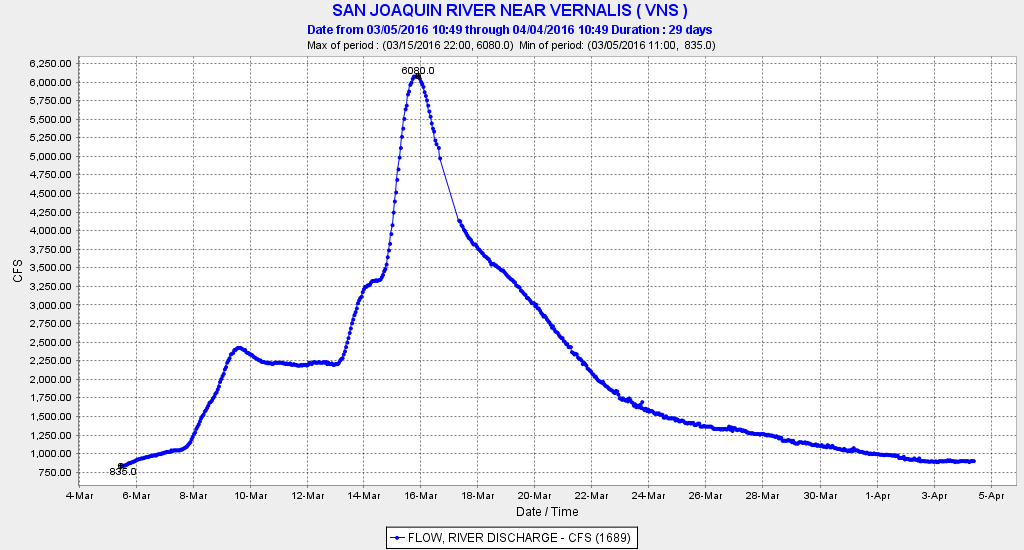
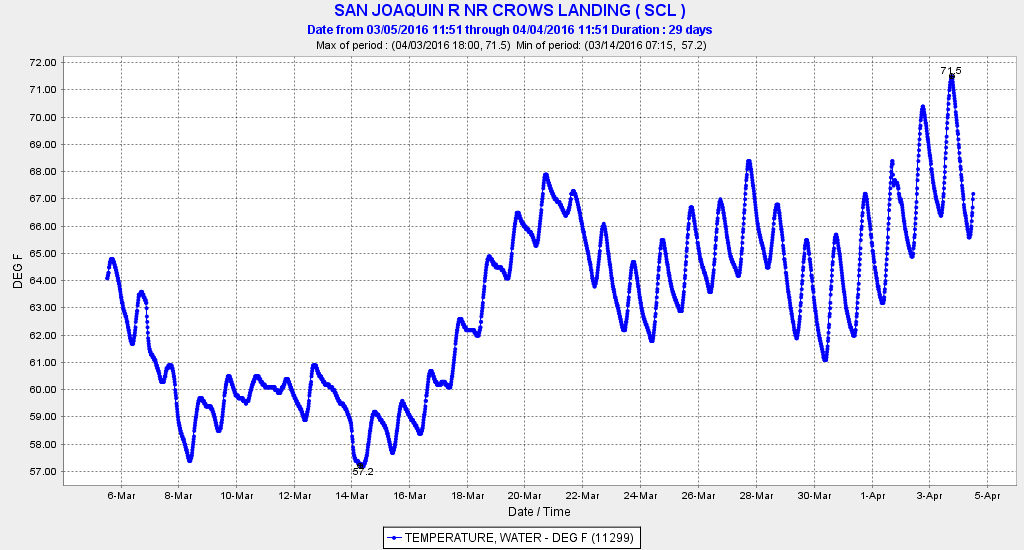
The release coincided with the modest peak in annual San Joaquin River flow (Figure 1). Delta outflow peaked near 70,000 cfs at that time. Water temperatures were also below the stressful level of 68°F (20°C) (Figure 2). Smolt releases in the past two years did not have such good conditions, and few survived to reach the Delta. In contrast, in the week following this year’s release nearly 500 of these marked Spring-Run smolts have shown up in fish salvage at the South Delta export facilities , a clear indication that many survived to the Delta. The salvage numbers also indicate the released smolts had to take a tough route through the Delta with no assurance that they were successful in reaching the Bay even under the high wet year Delta outflows. It remains to be seen how well these smolt releases from the past three years fare in terms of survival to the Bay (Chipps Island Trawl Survey) and Ocean (coastal fisheries returns). I stand by my recommendation of barging the smolts to the Golden Gate, which would assure 99% survival to the Ocean.

Figure 1. Hourly flow in the San Joaquin River near Vernalis from March 5 to April 4, 2016.

Figure 1. Hourly flow in the San Joaquin River near Vernalis from March 5 to April 4, 2016.

Figure 2. Water temperature (Deg F) in the San Joaquin River below Merced from March 5 to April 4, 2016.

Figure 2. Water temperature (Deg F) in the San Joaquin River below Merced from March 5 to April 4, 2016.

Winter Run Salmon – “Species in the Spotlight”

Winter Run

Species in the Spotlight

The National Marine Fisheries Service (NMFS) has included the Sacramento River Winter-Run Chinook Salmon in its “Species in the Spotlight,”1 one of the eight species under NMFS’s jurisdiction nationwide that are most at risk of extinction.

On its website, NMFS describes the condition of Winter-Run (in italics below):

State and Federal Agencies, public organizations, non-profit groups and others in California’s Central Valley have formed strong partnerships to save Sacramento River winter-run Chinook salmon. Efforts to protect winter-run Chinook salmon include restoring habitat, utilizing conservation hatchery programs, closely monitoring the population, and carefully managing scarce cold water. Additional key actions needed to safe guard winter-run Chinook salmon from further declines include:

  • Improving management of Shasta Reservoir’s storage in order to provide cold water for spawning adults, eggs, and fry, stable summer flows to avoid de-watering redds, and winter/spring pulse flows to improve smolt survival through the Delta. (Note: badly needed as these actions have been generally lacking especially in the past two years.)
  • Completing the Battle Creek Salmon and Steelhead Restoration Project and reintroducing winter-run Chinook salmon to the restored habitat. (Note: Badly needed with little progress made in regard to Winter Run.)
  • Reintroducing winter-run Chinook salmon into the McCloud River. (Note: Badly needed with little progress made.)
  • Improving Yolo Bypass fish habitat and passage so juveniles can more frequently utilize the bypass for rearing and adults can freely pass from the bypass back to the Sacramento River. (Note: Badly needed with little progress made.)
  • Managing winter and early spring Delta conditions for improved juvenile survival. (Note: During the past four years of drought, Delta outflow has almost always been inadequate for emigrating juveniles.)
  • Conducting landscape-scale restoration throughout the Delta to improve the ecosystem’s health and support native species. (Note: Little progress has been made.)
  • Expanding LSNFH facilities to support both the captive broodstock and conservation hatchery programs; (Note: In progress. The hatchery program released 600,000 smolts in February last year and 400,000 in February this year. The releases are made in Redding where flows have been too low for good survival because Shasta Reservoir is retaining all its inflow. Much greater survival would be achieved if the smolts were trucked downstream to mid-river and then barged to the Bay.)
  • Evaluating alternative control rules used to limit incidental take of winter-run Chinook salmon in ocean fisheries. (Note: Ongoing and in progress. Fishery harvest for all races of Chinook will likely be curtailed this year.)

Number One Threat

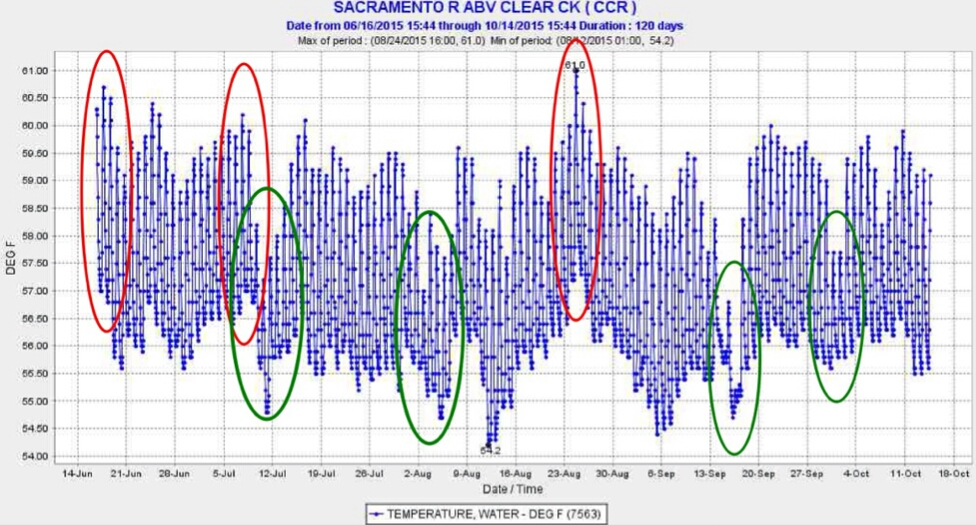
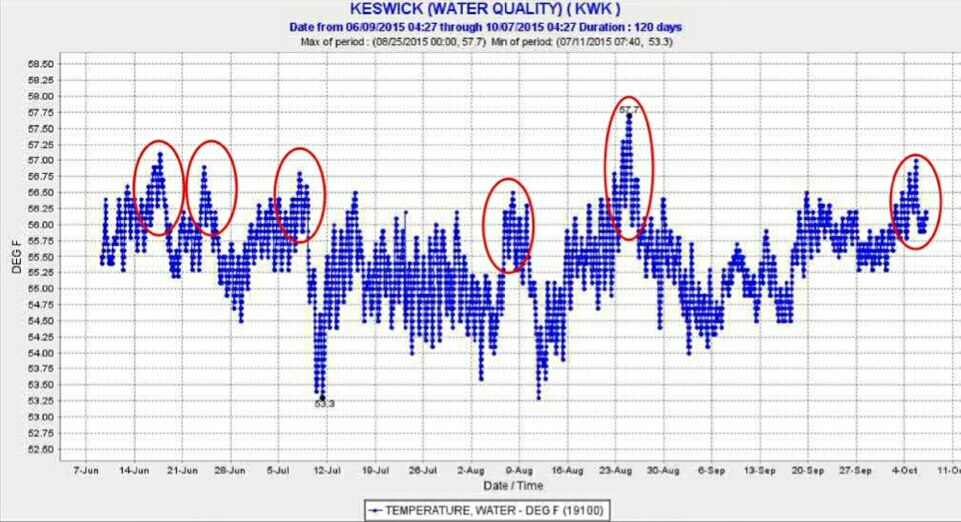
The most serious threat to Winter Run and the major cause of the nearly complete loss of the past two years’ production relates to the first item in the above list: improving management of Shasta Reservoir cold water storage is essential. The change from a 58°F daily-average water temperature standard at Redding (last summer) to 53°F as proposed by NMFS will greatly help by alleviating sporadic lethal conditions that occurred last summer (Figures 1 and 2).

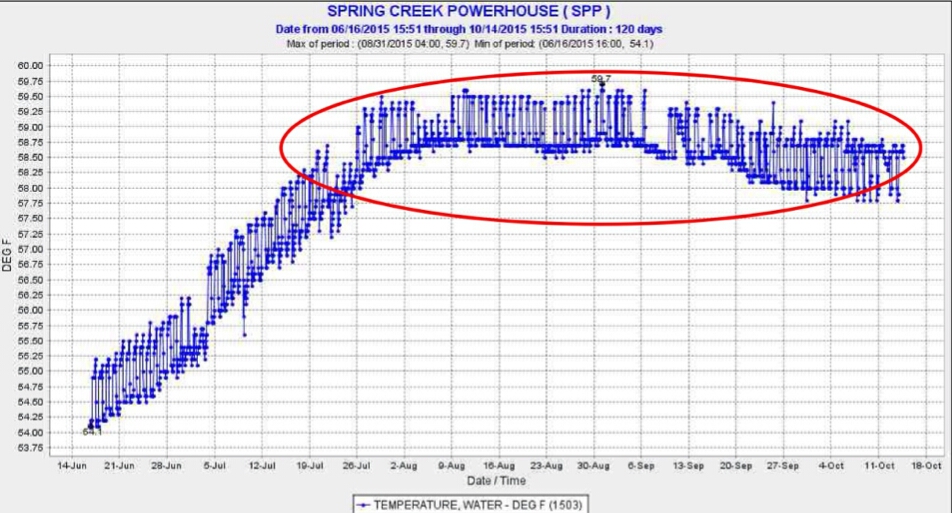
Achieving non-lethal conditions through the summer is possible by conserving Shasta Reservoir’s cold-water pool, which is best achieved by reducing inputs of warm water from Whiskeytown Reservoir (from Lewiston-Trinity reservoirs) into Keswick Reservoir via the Spring Creek Powerhouse (Figure 3). This source of warm water made up about 15% of the release to the Sacramento River from Keswick Reservoir, and required use of extra Shasta’s cold-water pool water to meet the relaxed temperature standard of 58°F in the upper Sacramento River below Keswick in Redding.

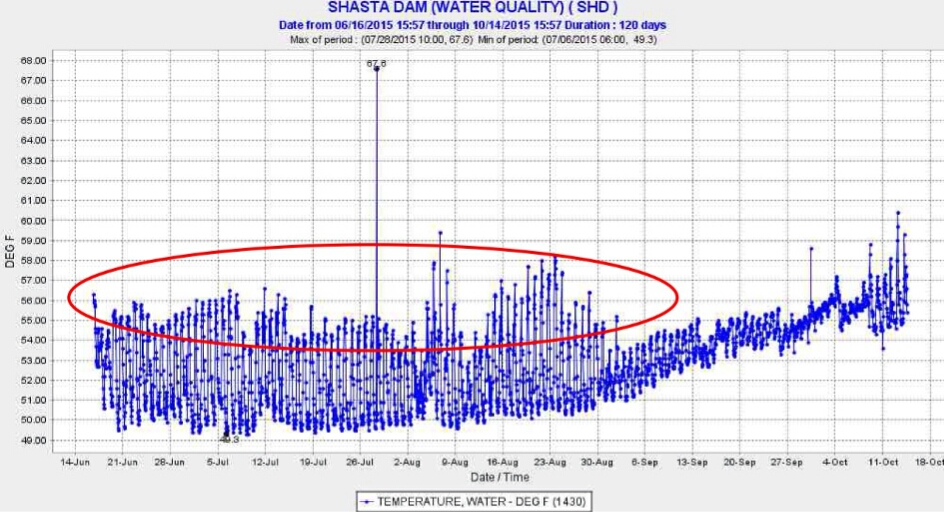
Another source of warm water to Keswick Reservoir was from daily afternoon peak power releases from Shasta Dam (Figure 4). High releases in afternoons raised water temperatures in Keswick Reservoir, requiring more cold-water pool release to compensate for warm water inputs. Apparently, the operations were too complicated for Reclamation to maintain the required 58°F average daily temperature at the mouth of Clear Creek (CCR gage: Figure 1). Operations at other times (e.g., first week in August) indicate clearly that Reclamation had the capability of keeping the water temperature well below lethal levels.

Figure 1. Lethal water temperature extremes for salmon eggs and fry (red circles) near Redding in summer 2015. Green circles denote non-lethal conditions that can be maintained with proper management of Shasta’s cold-water pool.

Figure 1. Lethal water temperature extremes for salmon eggs and fry (red circles) near Redding in summer 2015. Green circles denote non-lethal conditions that can be maintained with proper management of Shasta’s cold-water pool.

Figure 2. Episodes of high water temperature in Keswick Reservoir (red circles) in summer 2015. Peaks were due to hydropower peaking and specific operations of the Shasta Temperature Control Intake Tower to powerhouses at Shasta Dam.

Figure 2. Episodes of high water temperature in Keswick Reservoir (red circles) in summer 2015. Peaks were due to hydropower peaking and specific operations of the Shasta Temperature Control Intake Tower to powerhouses at Shasta Dam.

Figure 3. Warm water (red circle) entering Keswick Reservoir from Whiskeytown Reservoir via Spring Creek Powerhouse in summer 2015. Daily range of 1°F is due to hydropeaking operations.

Figure 3. Warm water (red circle) entering Keswick Reservoir from Whiskeytown Reservoir via Spring Creek Powerhouse in summer 2015. Daily range of 1°F is due to hydropeaking operations.

Figure 4. Warm water releases (red circle) from Shasta Reservoir during daily hydropeaking operations in summer 2015. Release water temperatures in the first week of August and September were lower because of lower afternoon hydropower peaking releases of warm water along with more night-morning cold water pool releases.

Figure 4. Warm water releases (red circle) from Shasta Reservoir during daily hydropeaking operations in summer 2015. Release water temperatures in the first week of August and September were lower because of lower afternoon hydropower peaking releases of warm water along with more night-morning cold water pool releases.


Fremont Weir Overflows Again – Prepare for Salmon and Sturgeon Rescues

fish rescuesIt is one of those wet springs when the Sacramento River has spilled over the Fremont Weir at the upstream (north) entrance to the Yolo Bypass near Verona. In a January post I summarized the need to fix salmon and sturgeon passage at the weir. In early April 2011 adult sturgeon and salmon were rescued at Tisdale and Fremont weirs1 under nearly the same circumstances that have developed since mid-March this year. In the coming weeks, many adult sturgeon and Winter Run salmon attracted by the high Bypass flows will again show up and become stranded at the Fremont Weir as the weir ceases to overflow. River levels are expected to drop as much as eight feet in the coming week. As the Bypass slowly drains in the coming days more and more salmon and sturgeon will migrate up the Bypass via Cache Slough near Rio Vista. Many will become stranded in the upper Bypass as far up as the Fremont Weir concrete apron, where rescues occurred in the past.

map of flowsOthers will make their way to the west side of the upper Bypass to outlet of the Knights Landing Ridge Cut (KLRC), and migrate up into the Colusa Basin via the Colusa Basin Drain where they will be lost. In spring 2013, many Winter Run salmon were found stranded in the Colusa Basin under similar circumstances. The peak migration of Winter Run and sturgeon is in March and April. So I expect many salmon have or will be headed up the Ridge Cut, which is flowing 500-600 cfs.2 The CDFW trap is removed from the Ridge Cut outlet at such high flows.

Fixes for both problems are in the works, as they are required in the Central Valley Salmon Biological Opinion for operating the state and federal water projects. Reclamation District 108 is working on the outlet solution for the KLRC. DWR, DFW, and others are working on Fremont Weir passage. 3

In the meantime, trapping and rescues are the only measures to save fish again this year. These efforts should start soon. Note similar problems occur at the Moulton, Colusa, and Tisdale weirs (see map and last photo).

Above Photo: Fremont Weir on March 13, 2016. Overflow to Yolo Bypass was 30,000-40,000 cfs. Overflow peaked at 65,000 cfs two days later, as river stage rose to 36 ft, two feet above that in photo. For video of overflow event and Bypass flooding see http://youtu.be/9hrn2bSgg8A .

Above Photo: Fremont Weir on March 13, 2016. Overflow to Yolo Bypass was 30,000-40,000 cfs. Overflow peaked at 65,000 cfs two days later, as river stage rose to 36 ft, two feet above that in photo. For video of overflow event and Bypass flooding see http://youtu.be/9hrn2bSgg8A .

Above Photo: Fremont Weir on March 20, 2016 when overflow temporarily ceased at river stage dropped to 33.5 ft. Insert: 2011 rescue photo.

Above Photo: Fremont Weir on March 20, 2016 when overflow temporarily ceased at river stage dropped to 33.5 ft. Insert: 2011 rescue photo.

Above photo: Moulton Weir in January 1997.

Above photo: Moulton Weir in January 1997.