Smelt Update – April 1, 2016

Since the last update, Delta and longfin smelt have continued their trends of record low numbers, as shown in the most recent Smelt Larvae Survey and 20-mm Survey. They are not yet gone, but close. It remains to be seen whether the good conditions provided so far in this wet winter 2016 can lead to some form of recovery for these two endangered species.

Longfin Smelt

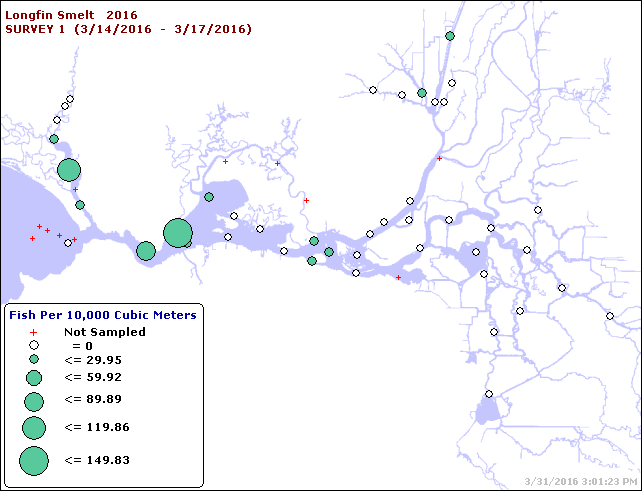
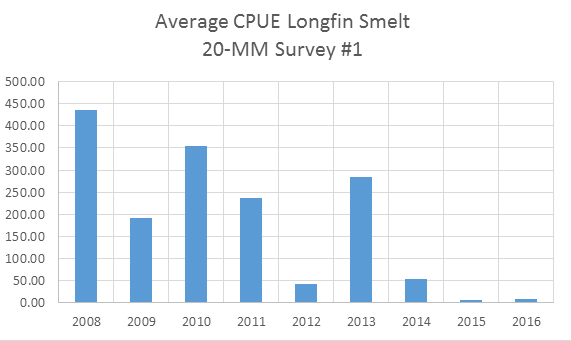
With the high winter flows, the young from this year’s spawn are now distributed well to the west, although some remain in the north Delta (Figure 1). Their numbers continue at record low levels (Figure 2) despite a wet winter.

Figure 1. Longfin smelt catch in mid-March in Survey #1 of 20-mm Survey.

Figure 1. Longfin smelt catch in mid-March in Survey #1 of 20-mm Survey.

Figure 2. Average catch-per-unit-effort of young longfin smelt in mid-March 20-mm surveys from 2008-2016.

Figure 2. Average catch-per-unit-effort of young longfin smelt in mid-March 20-mm surveys from 2008-2016.

Delta Smelt

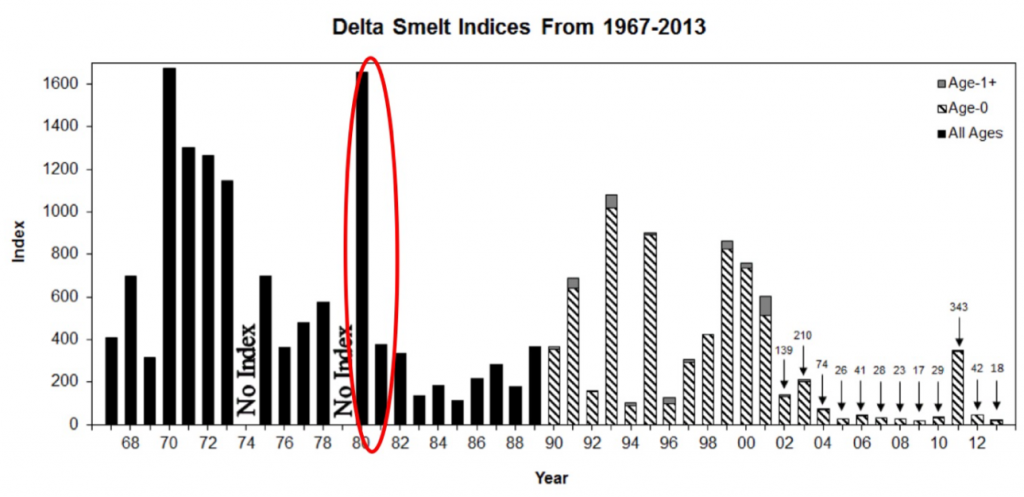
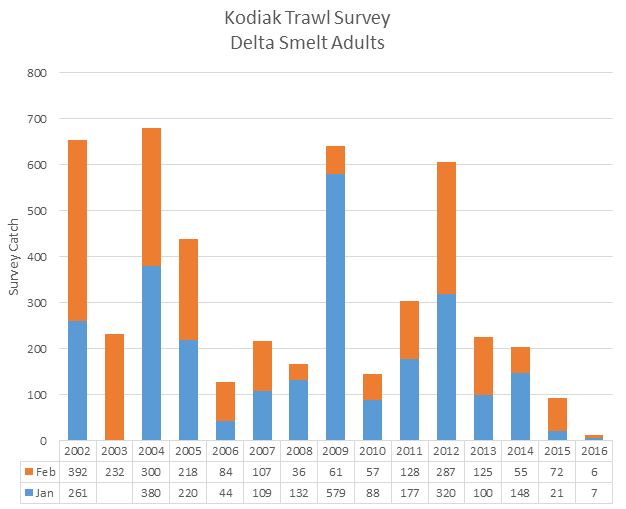
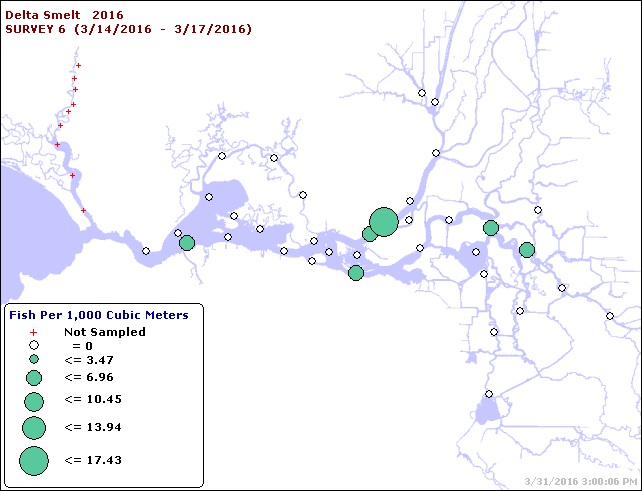
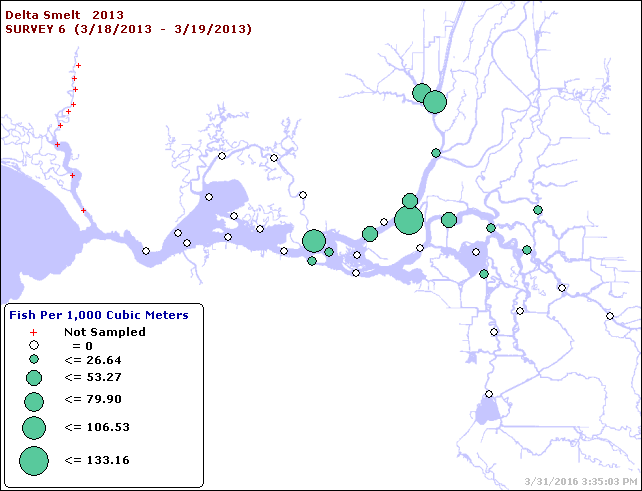
Delta smelt have yet to grow into the size range captured in the 20-mm Survey, but remain present in the last Smelt Larvae Survey (Figure 3). High winter through-Delta flows have resulted in a slightly more westward distribution than in recent drought years such as 2013 (Figure 4). Although numbers collected are very low, it is too early to determine relative production for 2016 compared to previous years in the Smelt Larvae Survey or the 20-mm Survey. Under similar wet winter-spring conditions in 2010 and 2011, Delta smelt had modest population improvements. It remains to be seen if the very low adult spawning population this year (in comparison to the populations in 2010 and 2011) can lead to some form of recovery in the population under this year’s relatively wet conditions.

Figure 3. Delta smelt larvae catch distribution in mid-March 2016 Smelt Larvae Survey.

Figure 3. Delta smelt larvae catch distribution in mid-March 2016 Smelt Larvae Survey.

Figure 4. Delta smelt larvae catch distribution in mid-March 2013 Smelt Larvae Survey.

Figure 4. Delta smelt larvae catch distribution in mid-March 2013 Smelt Larvae Survey.

Winter Run Salmon – “Species in the Spotlight”

Winter Run

Species in the Spotlight

The National Marine Fisheries Service (NMFS) has included the Sacramento River Winter-Run Chinook Salmon in its “Species in the Spotlight,”1 one of the eight species under NMFS’s jurisdiction nationwide that are most at risk of extinction.

On its website, NMFS describes the condition of Winter-Run (in italics below):

State and Federal Agencies, public organizations, non-profit groups and others in California’s Central Valley have formed strong partnerships to save Sacramento River winter-run Chinook salmon. Efforts to protect winter-run Chinook salmon include restoring habitat, utilizing conservation hatchery programs, closely monitoring the population, and carefully managing scarce cold water. Additional key actions needed to safe guard winter-run Chinook salmon from further declines include:

  • Improving management of Shasta Reservoir’s storage in order to provide cold water for spawning adults, eggs, and fry, stable summer flows to avoid de-watering redds, and winter/spring pulse flows to improve smolt survival through the Delta. (Note: badly needed as these actions have been generally lacking especially in the past two years.)
  • Completing the Battle Creek Salmon and Steelhead Restoration Project and reintroducing winter-run Chinook salmon to the restored habitat. (Note: Badly needed with little progress made in regard to Winter Run.)
  • Reintroducing winter-run Chinook salmon into the McCloud River. (Note: Badly needed with little progress made.)
  • Improving Yolo Bypass fish habitat and passage so juveniles can more frequently utilize the bypass for rearing and adults can freely pass from the bypass back to the Sacramento River. (Note: Badly needed with little progress made.)
  • Managing winter and early spring Delta conditions for improved juvenile survival. (Note: During the past four years of drought, Delta outflow has almost always been inadequate for emigrating juveniles.)
  • Conducting landscape-scale restoration throughout the Delta to improve the ecosystem’s health and support native species. (Note: Little progress has been made.)
  • Expanding LSNFH facilities to support both the captive broodstock and conservation hatchery programs; (Note: In progress. The hatchery program released 600,000 smolts in February last year and 400,000 in February this year. The releases are made in Redding where flows have been too low for good survival because Shasta Reservoir is retaining all its inflow. Much greater survival would be achieved if the smolts were trucked downstream to mid-river and then barged to the Bay.)
  • Evaluating alternative control rules used to limit incidental take of winter-run Chinook salmon in ocean fisheries. (Note: Ongoing and in progress. Fishery harvest for all races of Chinook will likely be curtailed this year.)

Number One Threat

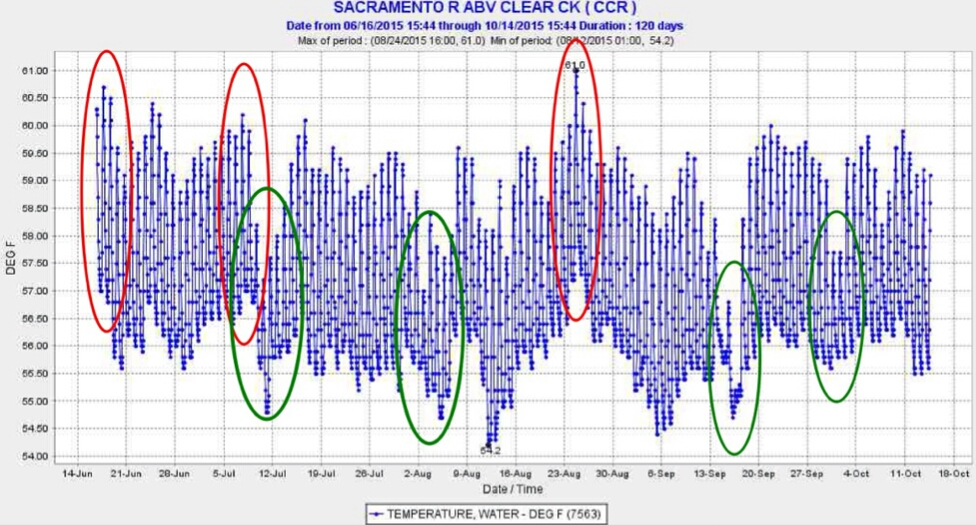
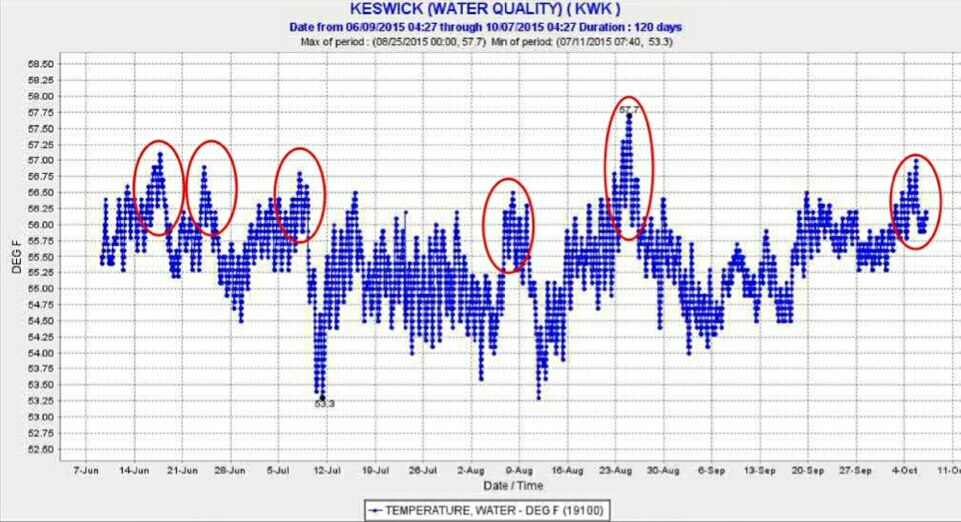
The most serious threat to Winter Run and the major cause of the nearly complete loss of the past two years’ production relates to the first item in the above list: improving management of Shasta Reservoir cold water storage is essential. The change from a 58°F daily-average water temperature standard at Redding (last summer) to 53°F as proposed by NMFS will greatly help by alleviating sporadic lethal conditions that occurred last summer (Figures 1 and 2).

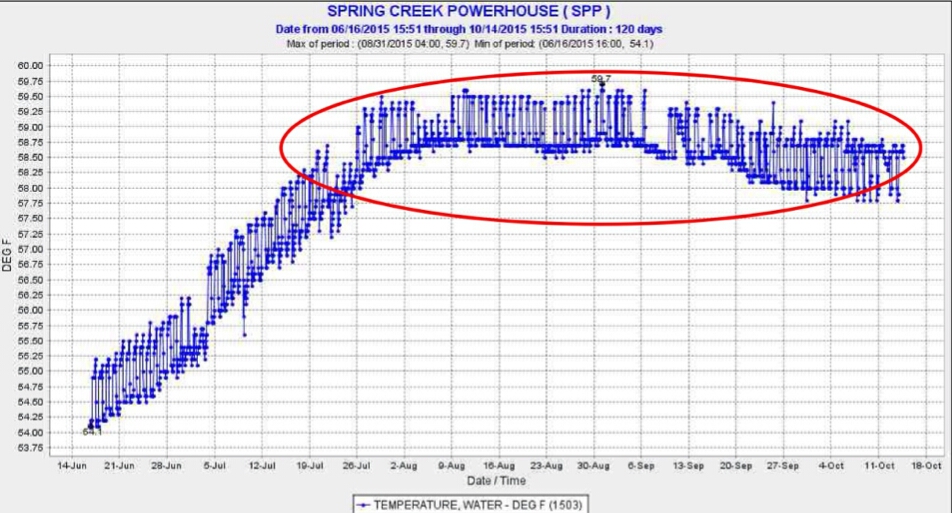
Achieving non-lethal conditions through the summer is possible by conserving Shasta Reservoir’s cold-water pool, which is best achieved by reducing inputs of warm water from Whiskeytown Reservoir (from Lewiston-Trinity reservoirs) into Keswick Reservoir via the Spring Creek Powerhouse (Figure 3). This source of warm water made up about 15% of the release to the Sacramento River from Keswick Reservoir, and required use of extra Shasta’s cold-water pool water to meet the relaxed temperature standard of 58°F in the upper Sacramento River below Keswick in Redding.

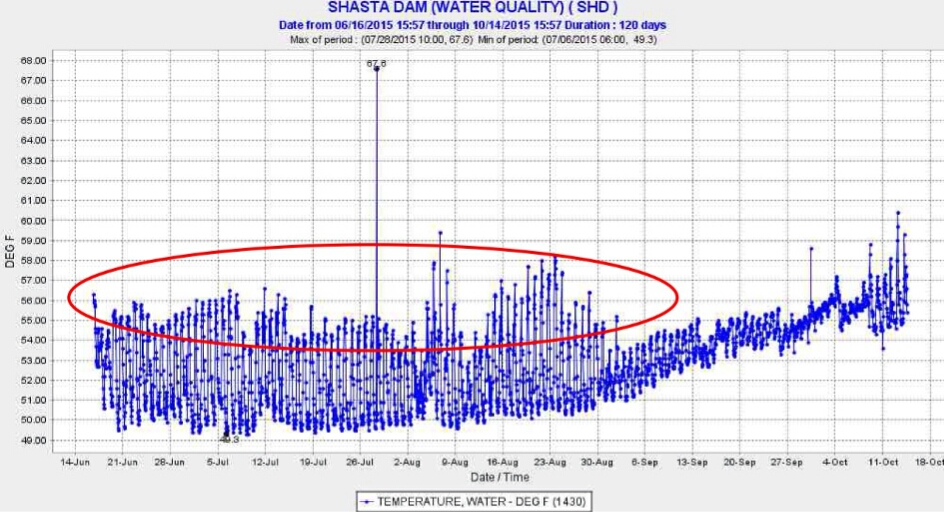
Another source of warm water to Keswick Reservoir was from daily afternoon peak power releases from Shasta Dam (Figure 4). High releases in afternoons raised water temperatures in Keswick Reservoir, requiring more cold-water pool release to compensate for warm water inputs. Apparently, the operations were too complicated for Reclamation to maintain the required 58°F average daily temperature at the mouth of Clear Creek (CCR gage: Figure 1). Operations at other times (e.g., first week in August) indicate clearly that Reclamation had the capability of keeping the water temperature well below lethal levels.

Figure 1. Lethal water temperature extremes for salmon eggs and fry (red circles) near Redding in summer 2015. Green circles denote non-lethal conditions that can be maintained with proper management of Shasta’s cold-water pool.

Figure 1. Lethal water temperature extremes for salmon eggs and fry (red circles) near Redding in summer 2015. Green circles denote non-lethal conditions that can be maintained with proper management of Shasta’s cold-water pool.

Figure 2. Episodes of high water temperature in Keswick Reservoir (red circles) in summer 2015. Peaks were due to hydropower peaking and specific operations of the Shasta Temperature Control Intake Tower to powerhouses at Shasta Dam.

Figure 2. Episodes of high water temperature in Keswick Reservoir (red circles) in summer 2015. Peaks were due to hydropower peaking and specific operations of the Shasta Temperature Control Intake Tower to powerhouses at Shasta Dam.

Figure 3. Warm water (red circle) entering Keswick Reservoir from Whiskeytown Reservoir via Spring Creek Powerhouse in summer 2015. Daily range of 1°F is due to hydropeaking operations.

Figure 3. Warm water (red circle) entering Keswick Reservoir from Whiskeytown Reservoir via Spring Creek Powerhouse in summer 2015. Daily range of 1°F is due to hydropeaking operations.

Figure 4. Warm water releases (red circle) from Shasta Reservoir during daily hydropeaking operations in summer 2015. Release water temperatures in the first week of August and September were lower because of lower afternoon hydropower peaking releases of warm water along with more night-morning cold water pool releases.

Figure 4. Warm water releases (red circle) from Shasta Reservoir during daily hydropeaking operations in summer 2015. Release water temperatures in the first week of August and September were lower because of lower afternoon hydropower peaking releases of warm water along with more night-morning cold water pool releases.


Feinstein Gets Some Water, but Smelt Get Some Back

In my March 12 post, I related that Senator Feinstein’s request for higher Delta exports would put the Delta Smelt population in the Delta at further risk of extinction. Well, she received her wish, and exports increased from 6000 cfs to 8000 cfs (11,400 cfs is maximum pumping capacity) in the week after her request when storms brought more inflow to Delta from the San Joaquin River.

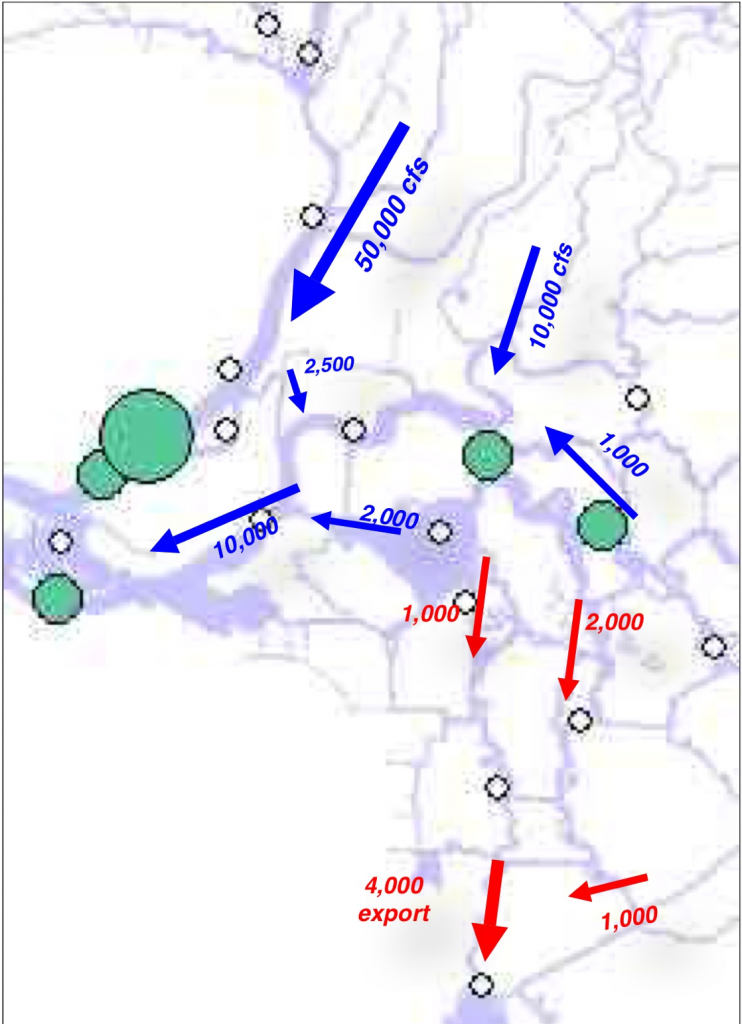
However, the higher exports were short–lived, because the 3/14-3/17 Smelt Larvae Survey picked up larval smelt for the first time this year (Figure 1 – green dots). Exports dropped below 5000 cfs again. Though only two newly hatched larvae were collected in the central Delta, their presence is a concern. The presence of larval smelt shows that smelt are spawning in the lower San Joaquin River in the central Delta. According to the Smelt Working Group the net negative flows shown in red in Figure 1 for late March indicate a “medium” risk to smelt and a likelihood that larval smelt will be drawn toward the south Delta export pumps.1 The -5000 cfs Old and Middle River (OMR) reverse flows are the maximum allowed under the Smelt Biological Opinion.

In its review of the results of particle tracking model runs, the Smelt Working Group concluded: “Members stressed the importance of weighing more heavily the results from inserting (particles) at Prisoner’s Point, given the consistent catch of adults there this year and the hydrologic proximity of that location to the south Delta (as compared to Jersey Point). For OMR flow of -5000 cfs, approximately 20% of the particles inserted at Prisoners Point were entrained into the South Delta. For an OMR flow of -2500 cfs, approximately 10% of particles inserted at Prisoners Point were entrained into the South Delta. For an OMR flow of – 1250 cfs, less than 10% of particles inserted at Prisoners Point were entrained into the South Delta.” Prisoners Point is the green dot from the right on the Figure 1 map. In all likelihood, larval smelt are now being drawn or will soon be drawn into the south Delta. It is too early to determine what portion of the population is subject to this risk. But given the unprecedented depressed condition of the smelt population after four years of drought, the risk is significant.

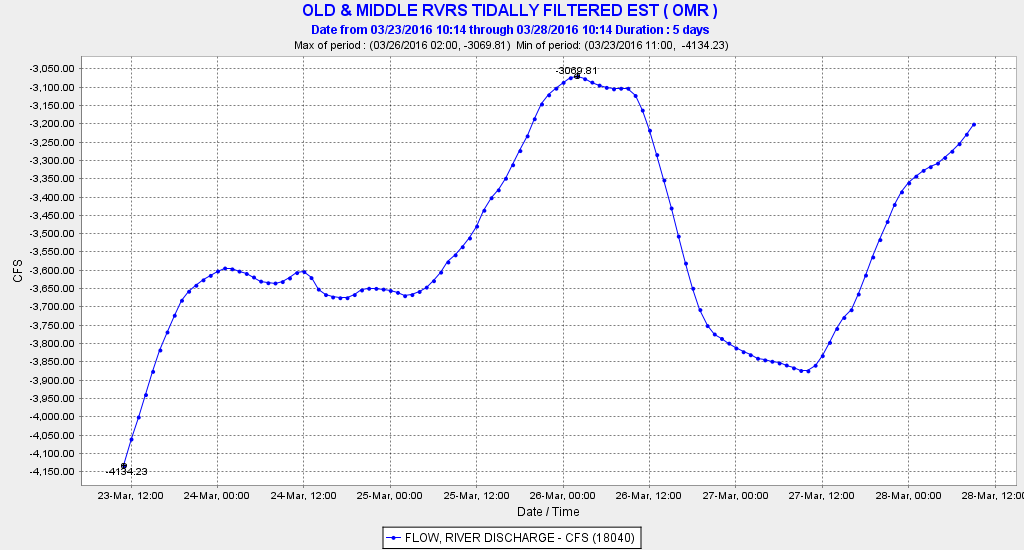
On March 24, after review of “Smelt Working Group’s March 21 recommendations,2 the U.S. Fish and Wildlife Service “determined”3 that the OMR should be no more negative than -2500 cfs on a 14-day average, and no more negative than -3150 cfs on a five-day average. Reclamation took a slightly more liberal interpretation in the subsequent week’s operations (Figure 2), staying nearer -3500 cfs most of the week with no apparent interest in reaching a -2500 cfs 14-day average. It could be that the Service meant to recommend a -3500 cfs OMR limit. Or maybe the Service got a call from Senator Feinstein’s office. We shall see what this week’s meetings and determinations offer.

In any event, the risk to Delta Smelt remains “medium” at combined exports of about 3500-4000 cfs. With an export capacity of 11,400 cfs, Delta outflow still exceeding 50,000 cfs, reservoirs continuing to release snowmelt, and San Luis Reservoir in the San Joaquin Valley only half full, there will be continued cry for more exports and for approval of the Tunnels. In the meantime, it appears from Figure 1 that some smelt larvae and a good amount of snowmelt are escaping west to Suisun Bay, while some larval smelt remain at risk in the central Delta.

Figure 1.  Net daily flow in Delta in late-March 2016. (Gage data source:  USGS). Green dots are location of seven Delta Smelt larvae collected in Survey 6 of Smelt Larvae Survey (http://www.dfg.ca.gov/delta/data/sls/CPUE_Map.asp ).

Figure 1. Net daily flow in Delta in late-March 2016. (Gage data source: USGS). Green dots are location of seven Delta Smelt larvae collected in Survey 6 of Smelt Larvae Survey (http://www.dfg.ca.gov/delta/data/sls/CPUE_Map.asp ).

Figure 2. OMR March 23 to March 28.  (Source: CDEC)

Figure 2. OMR March 23 to March 28. (Source: CDEC)

Fremont Weir Overflows Again – Prepare for Salmon and Sturgeon Rescues

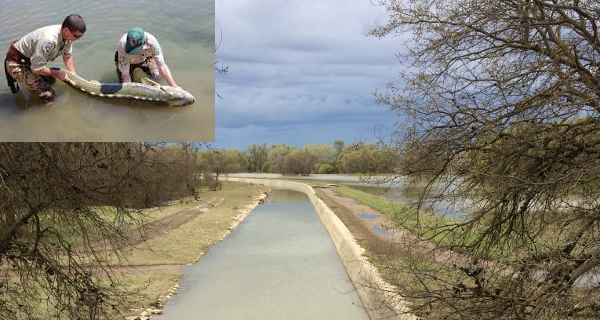
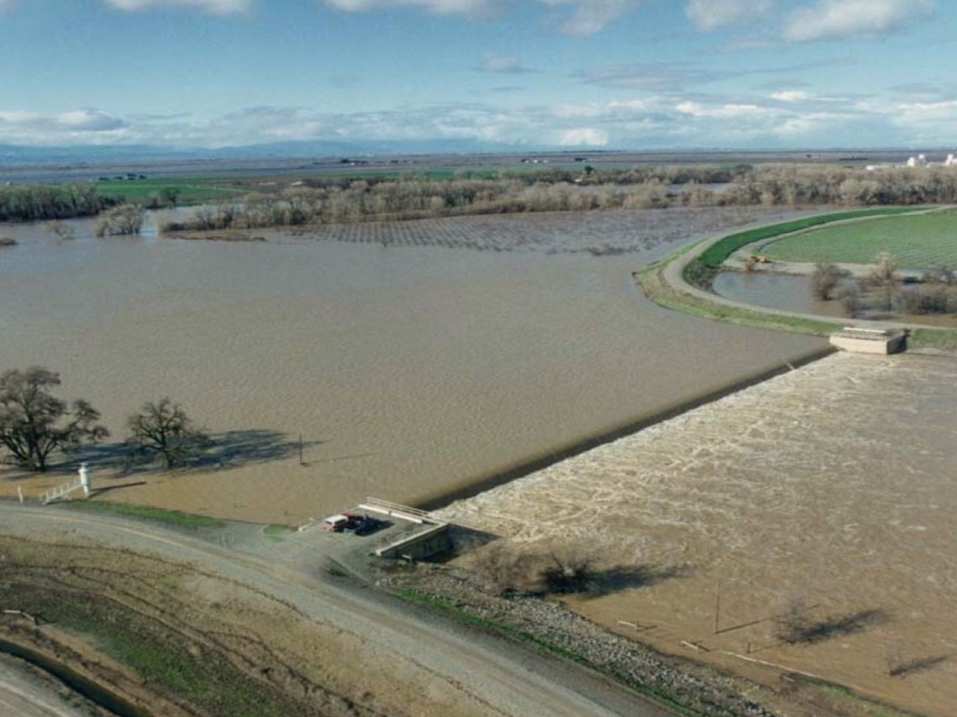
fish rescuesIt is one of those wet springs when the Sacramento River has spilled over the Fremont Weir at the upstream (north) entrance to the Yolo Bypass near Verona. In a January post I summarized the need to fix salmon and sturgeon passage at the weir. In early April 2011 adult sturgeon and salmon were rescued at Tisdale and Fremont weirs1 under nearly the same circumstances that have developed since mid-March this year. In the coming weeks, many adult sturgeon and Winter Run salmon attracted by the high Bypass flows will again show up and become stranded at the Fremont Weir as the weir ceases to overflow. River levels are expected to drop as much as eight feet in the coming week. As the Bypass slowly drains in the coming days more and more salmon and sturgeon will migrate up the Bypass via Cache Slough near Rio Vista. Many will become stranded in the upper Bypass as far up as the Fremont Weir concrete apron, where rescues occurred in the past.
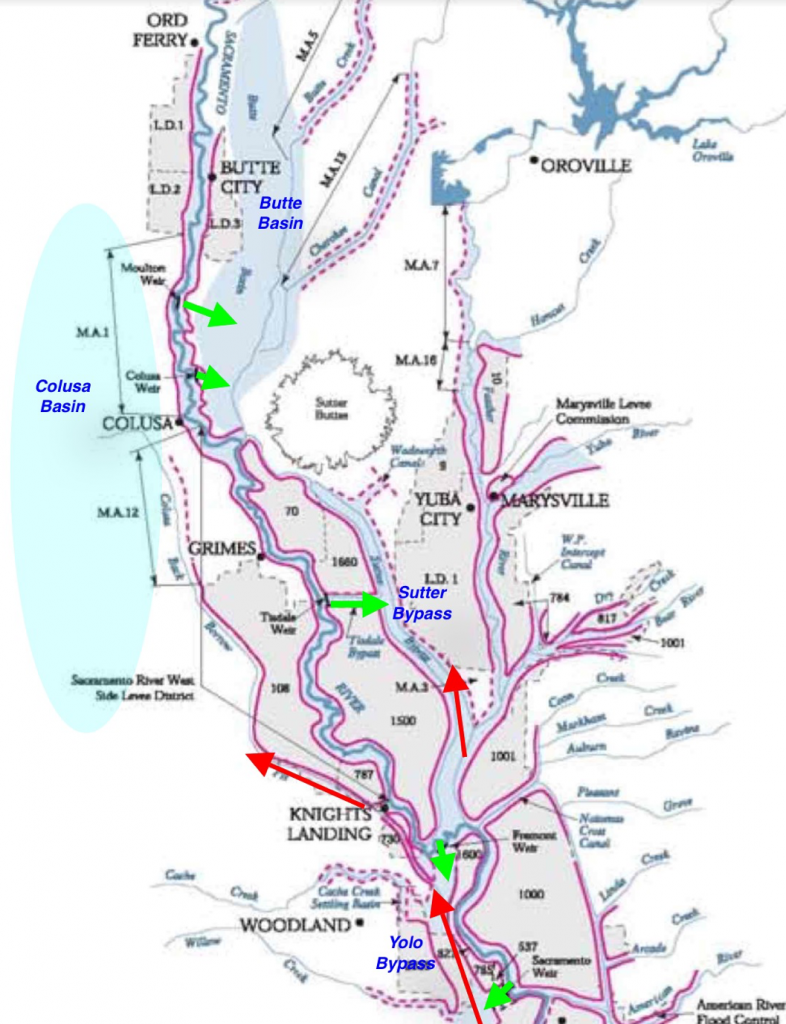
map of flowsOthers will make their way to the west side of the upper Bypass to outlet of the Knights Landing Ridge Cut (KLRC), and migrate up into the Colusa Basin via the Colusa Basin Drain where they will be lost. In spring 2013, many Winter Run salmon were found stranded in the Colusa Basin under similar circumstances. The peak migration of Winter Run and sturgeon is in March and April. So I expect many salmon have or will be headed up the Ridge Cut, which is flowing 500-600 cfs.2 The CDFW trap is removed from the Ridge Cut outlet at such high flows.
Fixes for both problems are in the works, as they are required in the Central Valley Salmon Biological Opinion for operating the state and federal water projects. Reclamation District 108 is working on the outlet solution for the KLRC. DWR, DFW, and others are working on Fremont Weir passage. 3

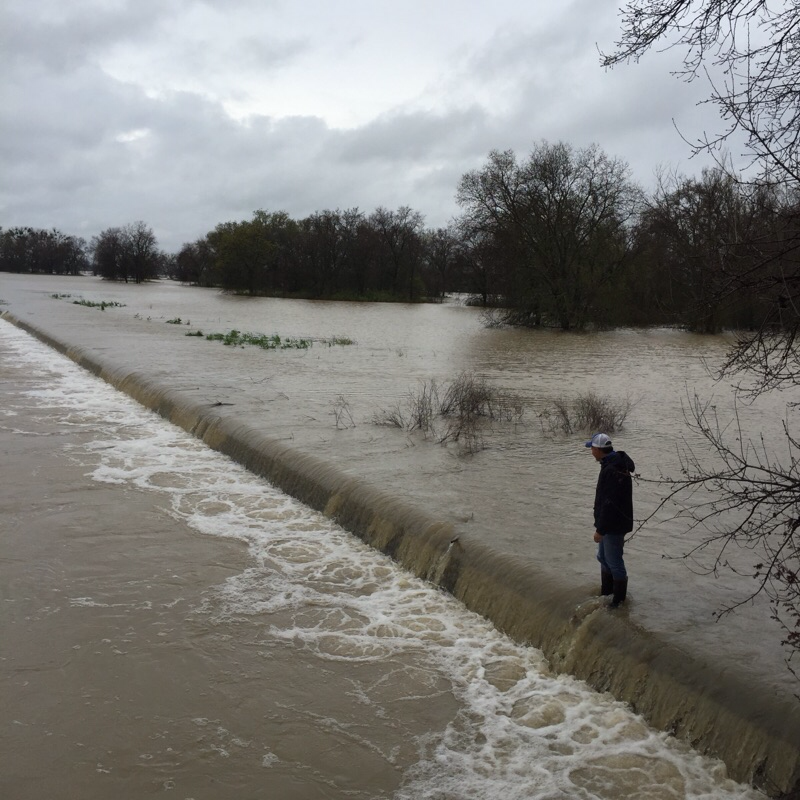
In the meantime, trapping and rescues are the only measures to save fish again this year. These efforts should start soon. Note similar problems occur at the Moulton, Colusa, and Tisdale weirs (see map and last photo).

Above Photo: Fremont Weir on March 13, 2016. Overflow to Yolo Bypass was 30,000-40,000 cfs. Overflow peaked at 65,000 cfs two days later, as river stage rose to 36 ft, two feet above that in photo. For video of overflow event and Bypass flooding see http://youtu.be/9hrn2bSgg8A .

Above Photo: Fremont Weir on March 13, 2016. Overflow to Yolo Bypass was 30,000-40,000 cfs. Overflow peaked at 65,000 cfs two days later, as river stage rose to 36 ft, two feet above that in photo. For video of overflow event and Bypass flooding see http://youtu.be/9hrn2bSgg8A .

Above Photo: Fremont Weir on March 20, 2016 when overflow temporarily ceased at river stage dropped to 33.5 ft. Insert: 2011 rescue photo.

Above Photo: Fremont Weir on March 20, 2016 when overflow temporarily ceased at river stage dropped to 33.5 ft. Insert: 2011 rescue photo.

Above photo: Moulton Weir in January 1997.

Above photo: Moulton Weir in January 1997.

FISHBIO Strikes Again – Predation Is the Problem, Not Water Diversions – Right or Wrong?

On Wednesday, February 10, 2016, the Water, Power and Oceans Subcommittee held a one-panel oversight hearing on “The Costly Impacts of Predation and Conflicting Federal Statutes on Native and Endangered Fish Species.” FISHBIO President Doug Demko was invited to provide testimony on the issue in reference to California’s Central Valley.

FishBio photo

FishBio photo

FishBio’s testimony begins: “California resource agencies sink tens of millions of dollars every year into a failing effort to protect native and endangered fish species, while also bolstering introduced top-level predators that are decimating the very fish they are required to maintain.”

  1. Failure to protect native and endangered fish species in the Central Valley has far more to do with water management within the federal Central Valley Project and State Water Project and lack of protections from water quality standards and biological opinions, especially during four multi-year droughts beginning in the late-1970’s. Over a billion dollars have been spent by federal and state agencies on fish recovery, with strongly positive results between droughts.
  2. In no way have the recovery efforts bolstered introduced top-level predators such as the striped bass. As noted in the testimony, stocking of striped bass ceased nearly two decades ago. Striped bass production had declined dramatically over the past three decades along with the native fish. Summer water quality standards that once protected striped bass were removed twenty years ago.
  3. The increases in stocking of hatchery salmon smolts to over 30 million annually in the Central Valley have encouraged and sustained the remaining striped bass, which now focus more on young salmon. Adult striped bass now concentrate in spring below all the Central Valley salmon hatcheries and dams. Remnants of the once prolific striped bass population await the fat hatchery smolts in all 300 miles to the Golden Gate. A shift in prey and location of prey has forced more Striped Bass into the rivers and tributaries for prey.
  4. Yearly Hatchery Steelhead Photo

    Photo: yearling hatchery steelhead smolt fed on wild salmon fry in American River. (Photo by author)

    The stocking of millions of large yearling salmon and steelhead smolts also contributes directly to predation on wild salmon and steelhead fry. (see photo at right)

  5. Research has shown that habitat changes have had more to do with increased predator populations like largemouth bass in the Delta. Controlling habitat change is the proven way to limit predators, rather than direct control of predators, which does not work (logistically impossible and very costly and inefficient).

“However, only recently has the existing body of science on predation been recognized among fisheries managers as a major source of juvenile salmon mortality.” This statement is simply not true. Hatchery salmon smolts have been trucked to the Bay for three decades to avoid the hundreds of miles of predator gauntlet. Predation studies at specific locations such as the Red Bluff Diversion Dam have long indicated predation problems. The dam was removed because it was a recognized predator “hot spot”.

There is no doubt that predation by non-native fish like Striped Bass and Largemouth Bass is a major factor in Chinook Salmon and Steelhead mortality in the Central Valley. However singling them out as the primary cause of native fish declines misses the key factor: water management. Salmon, smelt, and bass got along well until the State Water Project came on line in the 1970s and increased Delta exports from 2 million to 6 million acre-feet per year. There is no doubt that droughts and climate change have added to or sped up changes; however the underlying problem remains water diversions.

“It has now become clear that predation may significantly limit the success of salmon recovery efforts (NMFS 2009b; Dauble et al., 2010).” While this statement may be true under existing conditions where salmon production is limited by water management and habitat degradation (with predation exacerbated by these factors), the solution should be a broader range of risk factor management, not just a focus on predation. For example, spring reservoir releases can reduce predation risk by speeding emigration, increasing turbidity, and reducing water temperature.

“The survival estimate of 7% in 2012 was much lower than the 40-60% previously estimated by mark-recapture studies conducted by CDFW.” In drought years like 2012, reservoirs capture and retain nearly all winter-spring flows. No doubt this creates better conditions for Striped Bass (and resident Rainbow Trout and Pikeminnow) predation on young salmon that are programmed to emigrate when Mother Nature provides appropriate freshets. So is the problem predation or lack of natural flows? (This problem could be partly mitigated through a more comprehensive approach in the worst case drought years by capturing young salmon in migrants traps and transporting them to the Bay, thus avoiding the predators in the river (and Delta). In such dry years adult Striped Bass could also be effectively captured in upstream migrant traps and transported to the Bay where other types of prey are far more abundant.)

“[N]o changes in sportfishing regulations, and, to date, no meaningful actions of any kind have been taken to accept or address the problem.” Changing sport fishing regulations would be a drop in the bucket and alienate most sport fishermen. Why doesn’t CDFW take the hundreds of thousands of young striped bass salvaged each summer at the Delta export pumps (and returned to the west Delta) and stock them in a southern California reservoir? Because that would cripple the Bay-Delta striper fishery – an angler’s Catch-22. Why doesn’t CDFW take the catch from hundreds of bass tournaments each year in the Delta somewhere other than nice spots in the Delta? Because that would cripple the world-renowned bass fishery – another Catch-22. FishBio describes the bounty fishery on Columbia River predators that are less desired as gamefish. It is altogether different to put a bounty on Striped Bass and Largemouth Bass.

FishBio noted that harvest restrictions on non-native sport fish have recently been removed on the Columbia River to protect native salmonids. “A similar policy change in California, coupled with focused removal and suppression efforts, could lead to improved survival conditions for native species as has been demonstrated on the Columbia River.” Columbia River salmonid fisheries are far more valuable and popular than bass and walleye fisheries. Furthermore, there is little else managers can do on the Columbia to benefit salmon. Water diversions in the Columbia are far less of a problem, and managers on the Columbia have already severely limited hydropower production to provide spring spills for salmon. These actions have brought record or near record salmon and steelhead runs.

In conclusion, Striped Bass and Largemouth Bass are two of the top sportfish in the Central Valley. Destroying their populations and sport fisheries, and associated socio-economic benefits, without addressing water management, the real culprit, will not solve or defuse the problem.