Improving Water Temperature Management in Sacramento River Below Shasta for Salmon

Background

The Sacramento River below Shasta-Keswick near Redding is the spawning reach of Winter-Run Chinook salmon in summer. Winter-Run originally spawned in the cold, spring-fed reaches upstream of Shasta Reservoir. Since Shasta Dam’s construction over a half century ago, Winter-Run have spawned below in Shasta’s cold tailwater. However, in some dry years the cold water has run out and the Winter-Run spawn has failed, as was the case in late summer 2014. There simply are not sufficient guarantees in the State Water Right Order 90-5 (WRO-90-5) or the NMFS Biological Opinion (BO) to protect the Winter-Run: there weren’t in 2014 and there aren’t in 2015. Winter-Run need cold water (<56°F) through the summer to protect spawning adults, eggs laid in gravel, and fry developing in gravel beds throughout their spawning reach upstream of Red Bluff. In nearly all years there is sufficient cold water in Shasta to sustain cold water through the summer above Red Bluff, especially after construction of the Shasta Dam Temperature Control Device (TCD), which allows conservation of the coldest water in Shasta through the summer. The problem is that the cold water cannot be conserved because of downstream demands on the water.

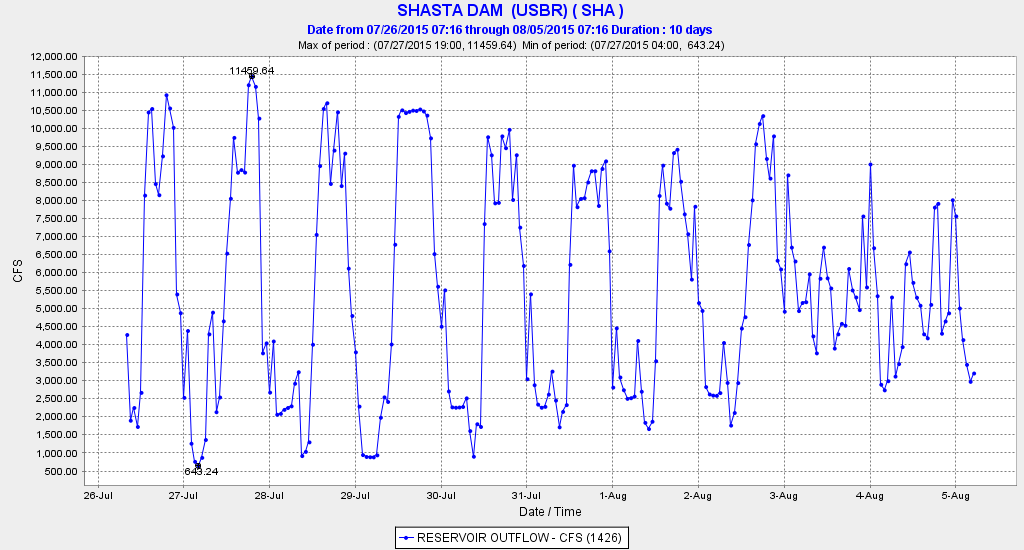
Downstream agricultural demands force the release of too much of the Shasta cold water pool in spring and summer, which in drier years like 2014 and 2015 results in exhaustion of the cold water pool by late summer. To complicate matters, warmer Trinity water is brought over for release below Shasta to meet some of the downstream demands, thus requiring even more of the Shasta cold water pool to maintain target temperatures above Red Bluff. Shasta releases also are highest in warm afternoons to meet peak power demands; this release pattern also requires more from the cold water pool.

The federal and state agencies develop a plan to operate the system each year in the winter prior to the irrigation season. Based on what they know and forecast for the upcoming season, they develop a plan to maintain cold water through the summer for the salmon, as well as a forecasted water supply for downstream users. Both the WRO-90-5 and BO contain provisions that allow the targets for salmon temperatures to be modified in dry years to allow downstream water users a portion of their normal water supply.

WRO-90-5 allows weakening of targets for water temperature by moving the compliance point upstream from Red Bluff, sometimes as far as Redding. In 2015 the State Board in a Temporary Urgency Change Order allowed the target temperature to be raised to a daily average of 58°F in Redding.

The Problem

Both the 2014 and 2015 plans failed to meet their objectives for a multitude of reasons, least among them inaccurate information and poor planning tools (e.g., mathematical models). Lack of conservative conditions in the plan and follow-up conservative decision-making were the key problems. In 2014, the plan and operational failure led to the loss of most of the 2014 Winter-Run salmon production; the Winter-Run perished in low flows and high water temperatures in late summer in the small spawning reach upstream of Highway 44 in Redding. By late spring of 2015, it became apparent, as predicted by CSPA and others, that the Bureau had allocated spring releases (already made to downstream users) based on a forecast that overestimated the size and quality of the Shasta cold water pool . So the State Board allowed the Bureau of Reclamation to adopt a new temperature management plan, raising the target to an average daily temperature of 58°F even in the tiny amount of the Sacramento River between Keswick Dam and Clear Creek.

What more can be done?

First, rescind the weakened numeric target because it does not protect salmon eggs and newly newly hatched fry. The 56°F target must be reinstated as far downstream as possible. The SWRCB should at the very least ensure that maximum water temperatures never exceed 58°F and that average daily and weekly average maximums do not exceed 56°F.
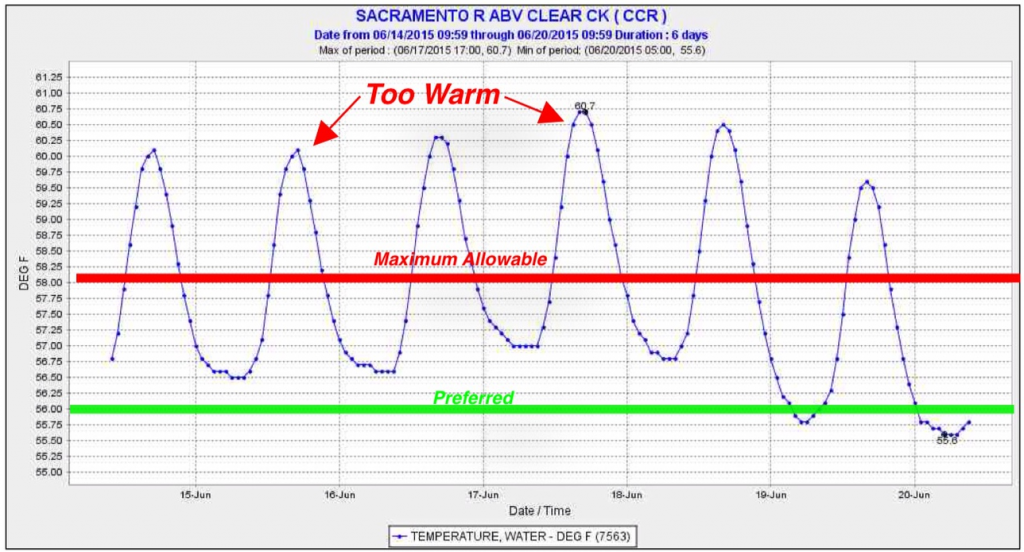
Minimum water temp chartSecond, reduce the input of warmer Trinity water via Whiskeytown and the Spring Creek Powerhouse. The chart of present conditions below shows that the warmer Trinity water entering Keswick Reservoir below Shasta makes up over 20% (1500/7000) of the water entering the Redding reach. Ensuring that the Redding reach target is maintained requires that more 50°F cold-water pool water from Shasta be mixed into the TCD than would be necessary to maintain the mandatory 58°F average daily target at Redding (CCR location) without the Trinity water. Cutting the Trinity input at this time would be especially prudent. Low flows in the Trinity (460 cfs release to river, compared to 1500 cfs diversion to Sacramento River) are contributing to disease and die-off of salmon in the lower Klamath-Trinity system. {Note: it may not be possible to reduce Trinity inputs without increasing Shasta releases because salmon have or are now spawning at these flows. Cutting Trinity inflow could still reduce demand on Shasta cold water pool water even if Trinity flow cuts are made up by Shasta water.}
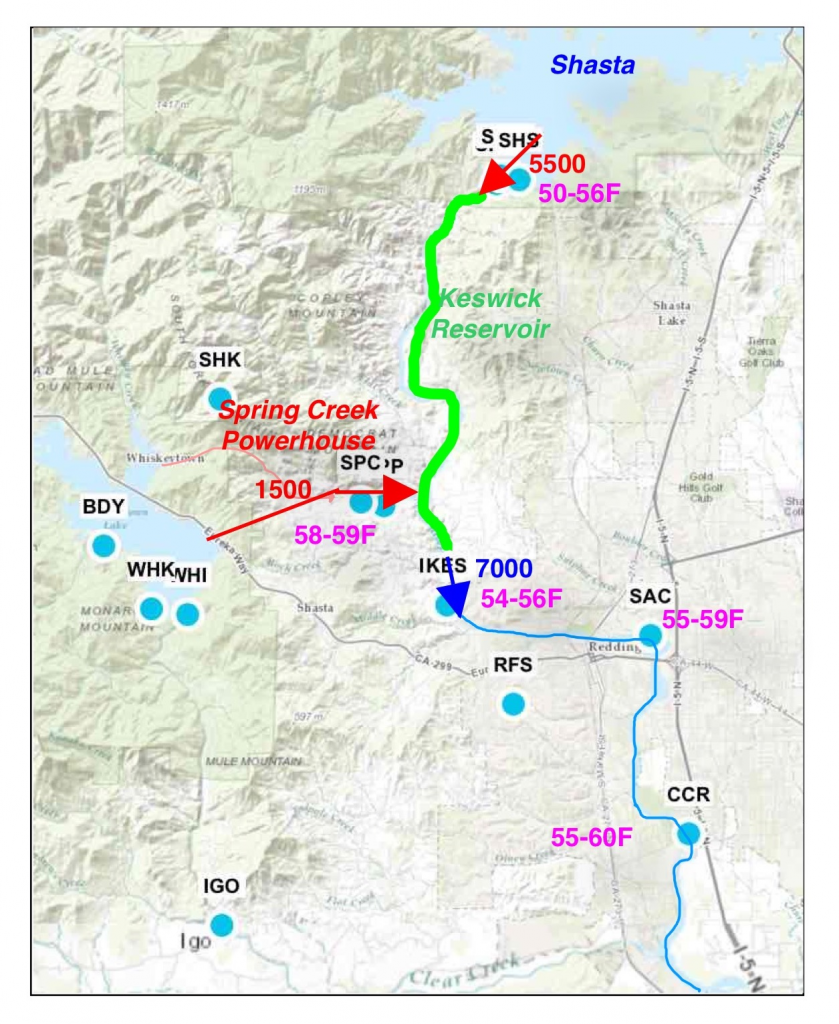
This map depicts conditions in the first week of August 2015.  Daily average Shasta releases to Keswick Reservoir are approximately 5500 cfs. Daily average Whiskeytown releases to Keswick are 1500 cfs.  Keswick release is approximately 7000 cfs.  The daily range in water temperatures is shown by location in magenta.  Gaging and recording stations are blue dots (from CDEC).

This map depicts conditions in the first week of August 2015. Daily average Shasta releases to Keswick Reservoir are approximately 5500 cfs. Daily average Whiskeytown releases to Keswick are 1500 cfs. Keswick release is approximately 7000 cfs. The daily range in water temperatures is shown by location in magenta. Gaging and recording stations are blue dots (from CDEC).

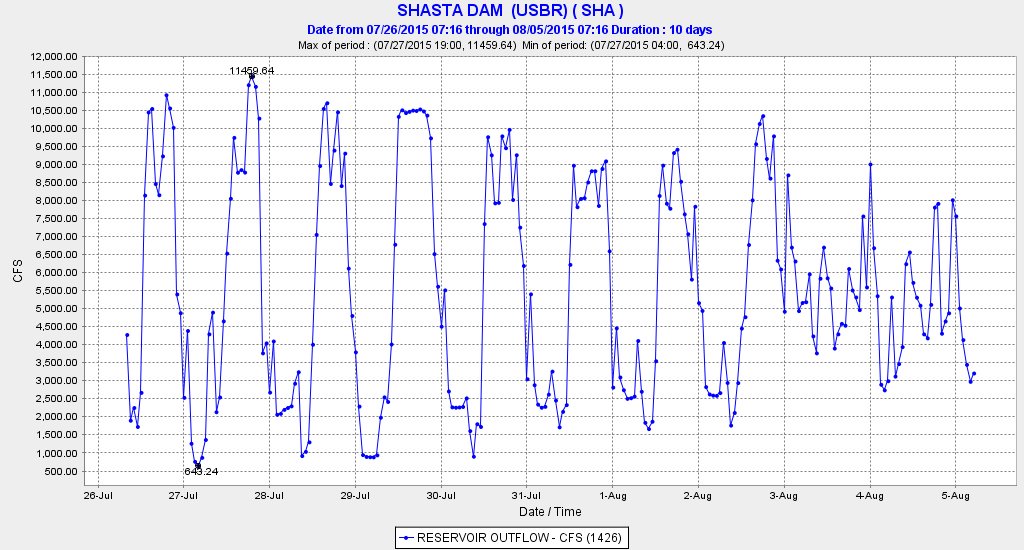
Third, reduce hourly peaking power releases from Shasta, because water released through the Shasta powerhouses is pulled from relatively high in the water column, and is thus relatively warm. Data from the past several days indicates Reclamation may already be instituting this measure – see figures below.
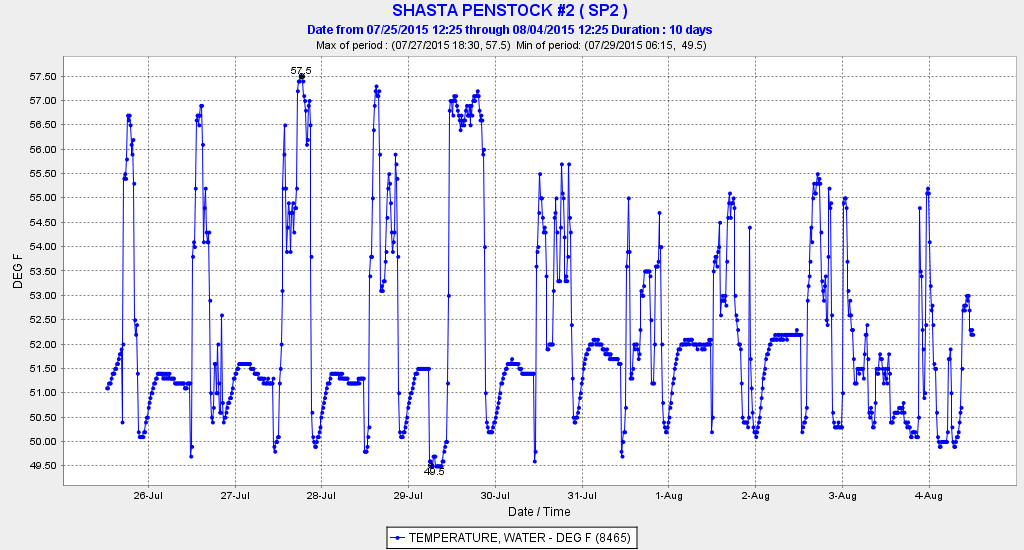
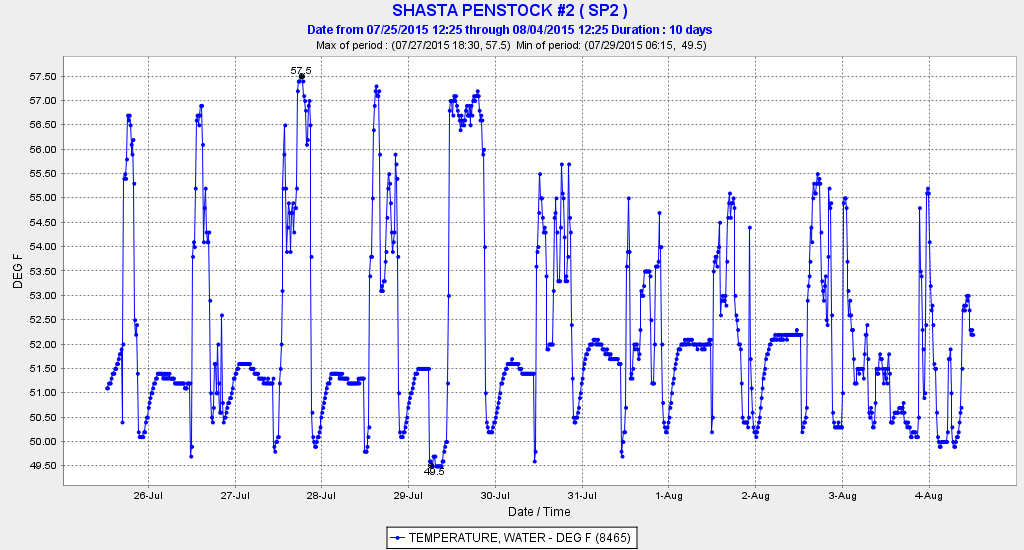
Water temperature recordings from one of five Shasta Dam penstocks over past ten days note high daytime water temperatures..  Lower maximum temperatures in last five days may be from reduced daytime releases or changes in TCD operation (see chart below).
Water temperature recordings from one of five Shasta Dam penstocks over past ten days note high daytime water temperatures.. Lower maximum temperatures in last five days may be from reduced daytime releases or changes in TCD operation (see chart below).

Note high daytime releases to meet peak power demands.  Note Reclamation has altered the normal pattern in the last two days, which apparently further reduced release water temperature (see chart above).

Note high daytime releases to meet peak power demands. Note Reclamation has altered the normal pattern in the last two days, which apparently further reduced release water temperature (see chart above).

In summary, saving Winter Run Chinook salmon this summer demands immediate action. This will require one or more of the following: reduced reservoir releases to downstream users, less transfer of warm water from Trinity Reservoir (via Whiskeytown and Spring Creek Powerhouse), reduced power generation, less peaking power operation, and/or the bypass of releases past Shasta’s power generation facilities (use of Shasta Dam’s lower level outlet).
Striped Bass Status

Striped Bass (stripers) came from New Jersey by train in milk cans 135 years ago to provide a vibrant commercial fishery and regional food supply. Today, stripers remain a prized gamefish in Central Valley rivers, the Delta, and the Bay. Like the native smelts, salmon, steelhead, herring, and sturgeon, stripers have undergone a dramatic decline over the past several decades (Figure 1). Many have blamed the stripers for these declines, when in fact the entire fish community and food-chain of the Bay-Delta has suffered from the man-made spring-summer droughts in the Central Valley. Stripers may prey on listed salmon, steelhead, and smelt, but are far more likely to prey upon native and non-native competitors and predators of these listed species.

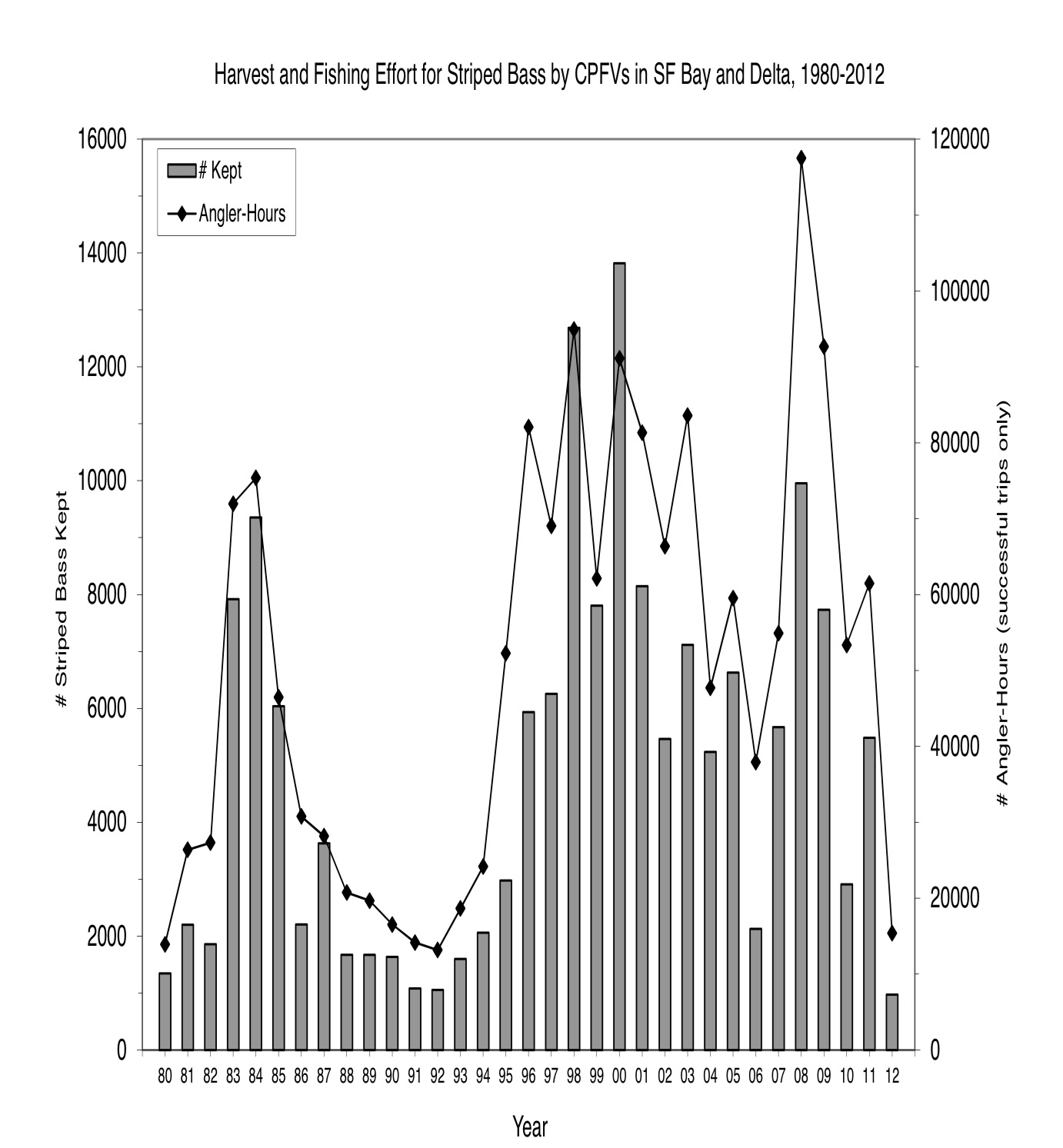
Despite their strong inherent ability to recover (high reproductive capacity and long life 1 ), stripers have declined in abundance from 3-5 million adult fish in the 60s and 70s to less than a half million adults in recent years (CDFW unpublished data). A hatchery and pen-rearing program in the late 1990s and early 2000s released millions of young stripers, which led to some recovery in young production (Figure 1) and adult catch (Figure 2). Today, all indications are that stripers are now at record low levels. Stripers are one of the species identified as suffering in the Bay-Delta’s Pelagic Organism Decline2. Their decline can be directly related to Delta water exports, especially in summers of dry years since 1995, when summer protections for stripers were removed from Bay-Delta water quality standards.

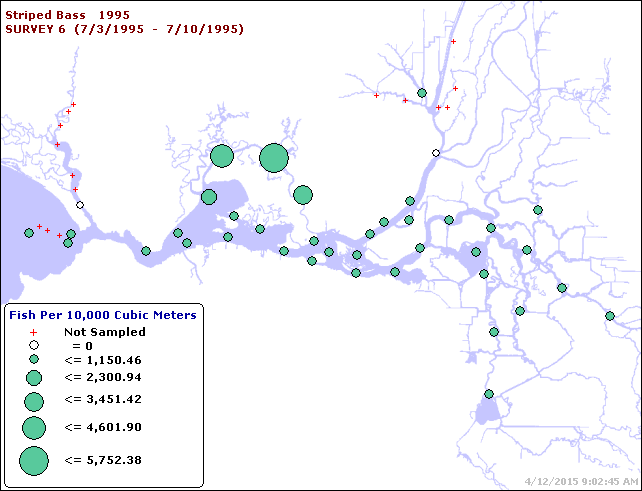
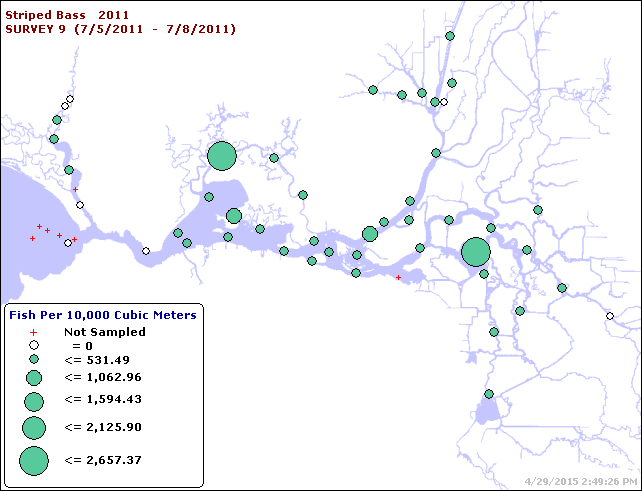
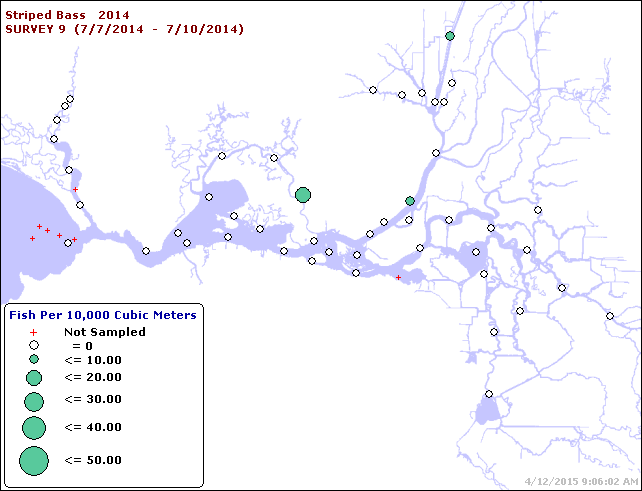
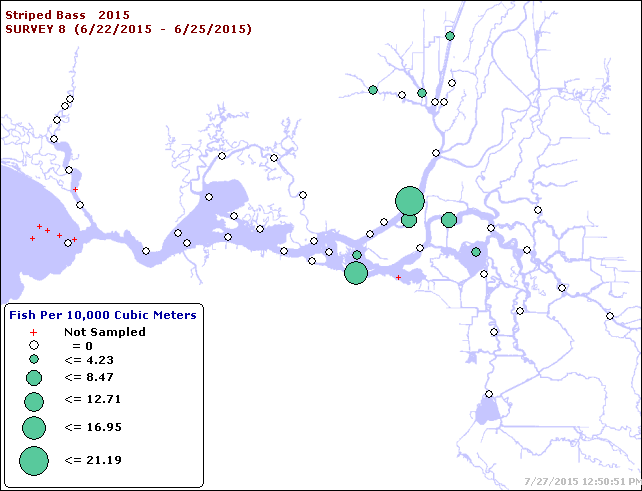
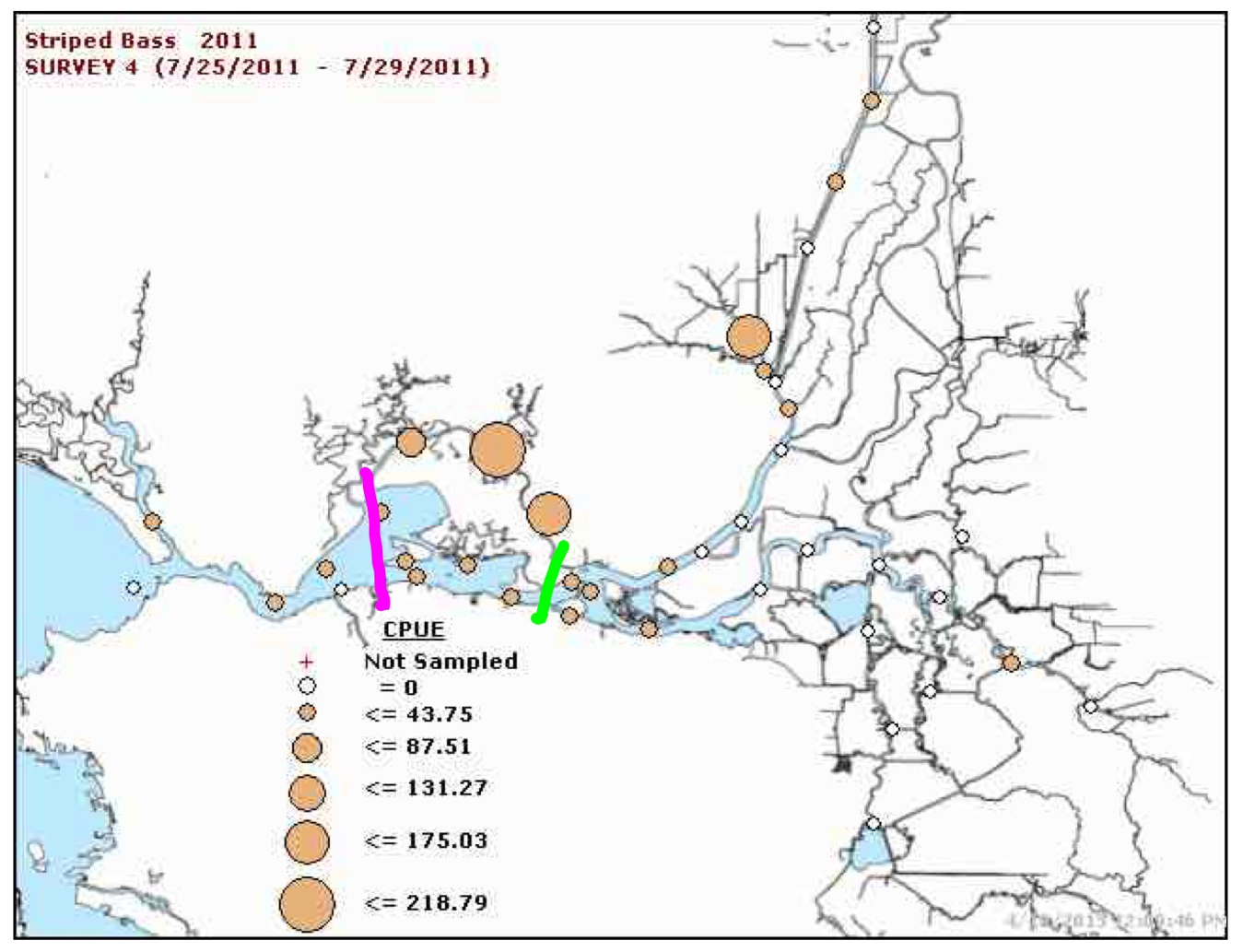
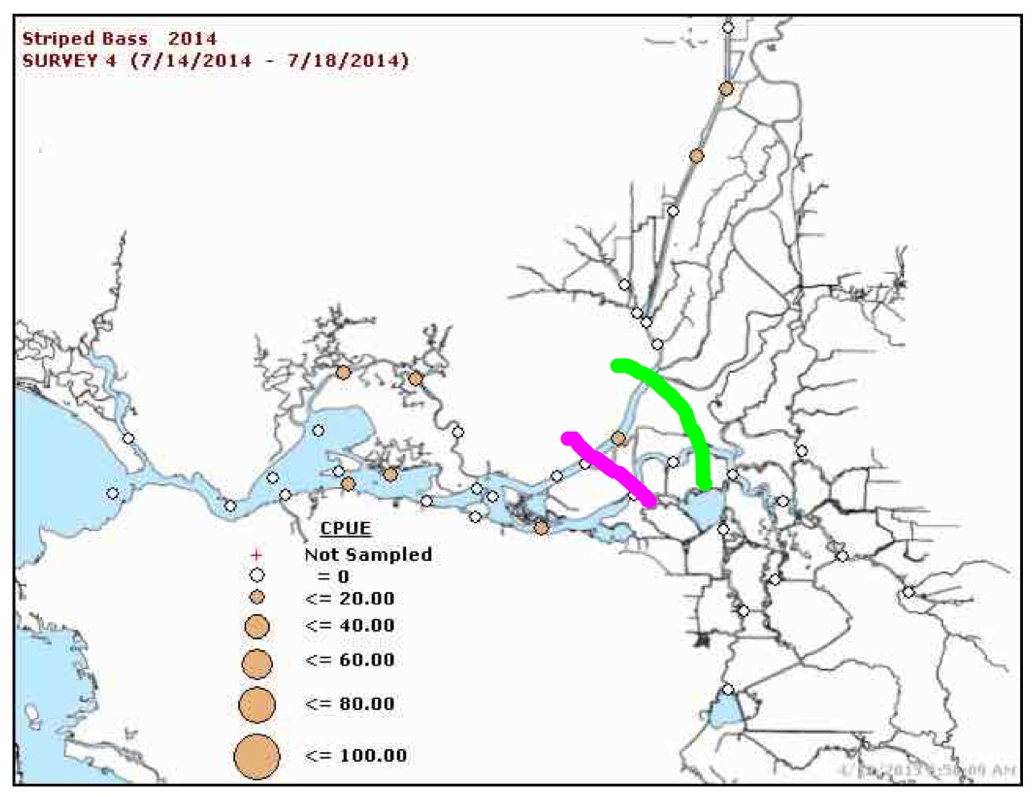
Despite low adult numbers and poor summer Delta habitat conditions, recent production of young stripers in wet years is consistent with recent historical levels (Figures 3 and 4). However, production of young is very low in dry years (Figure 5). The reason for the difference between wet and dry year survival is the location of low-salinity nursery habitat in the estuary (Figures 6, 7, and 8). Young stripers are more vulnerable to Delta exports in dry years when Delta inflows are low and their Low Salinity Zone3 nursery area is located in the Delta (Figure 9).

What can be done to help stripers and the striper fishery?

  1. The Low Salinity Zone of the estuary must be kept out of the central Delta by providing sufficient Delta outflow. This would help to keep Delta pelagic fishes and their planktonic food-chain (as well as salt) out of the export pumps.
  2. Stripers should be relocated from below Central Valley river diversion dams where stripers concentrate in summer and become a localized predatory nuisance. (Such locations are generally closed to fishing.) Stripers should be relocated to Central San Francisco Bay where they support a valuable sport fishery and there are other sources of prey.
Figure 1. Young Striped Bass summer (A) and fall (B) abundance indices.  (Source: CDFW)

Figure 1. Young Striped Bass summer (A) and fall (B) abundance indices. (Source: CDFW)

Figure 2.  Striped Bass adult catch pattern in Bay-Delta sport fishery. ( Source:  CDFW)

Figure 2. Striped Bass adult catch pattern in Bay-Delta sport fishery. ( Source: CDFW)

Figure 3.  Young Striped Bass density distribution in July 1995 20-mm Survey.

Figure 3. Young Striped Bass density distribution in July 1995 20-mm Survey.

Figure 4.  Young Striped Bass density distribution in July 2011 20-mm Survey.

Figure 4. Young Striped Bass density distribution in July 2011 20-mm Survey.

Figure 5.  Young Striped Bass density distribution in July 2014 20-mm Survey.

Figure 5. Young Striped Bass density distribution in July 2014 20-mm Survey.

Figure 6.  Young Striped Bass density distribution in June 2015 20-mm Survey.

Figure 6. Young Striped Bass density distribution in June 2015 20-mm Survey.

Figure 7. Catch distribution of young Striped Bass in Summer Townet Survey July 2011, a wet year.  Magenta line is 2640 EC salinity (commonly referred to as X2).  Green line in 500 EC salinity

Figure 7. Catch distribution of young Striped Bass in Summer Townet Survey July 2011, a wet year. Magenta line is 2640 EC salinity (commonly referred to as X2). Green line in 500 EC salinity

Figure 8.  Catch distribution of young Striped Bass in Summer Townet Survey July 2014, a drought year.  Magenta line is 2640 EC salinity (commonly referred to as X2).  Green line in 500 EC salinity.

Figure 8. Catch distribution of young Striped Bass in Summer Townet Survey July 2014, a drought year. Magenta line is 2640 EC salinity (commonly referred to as X2). Green line in 500 EC salinity.

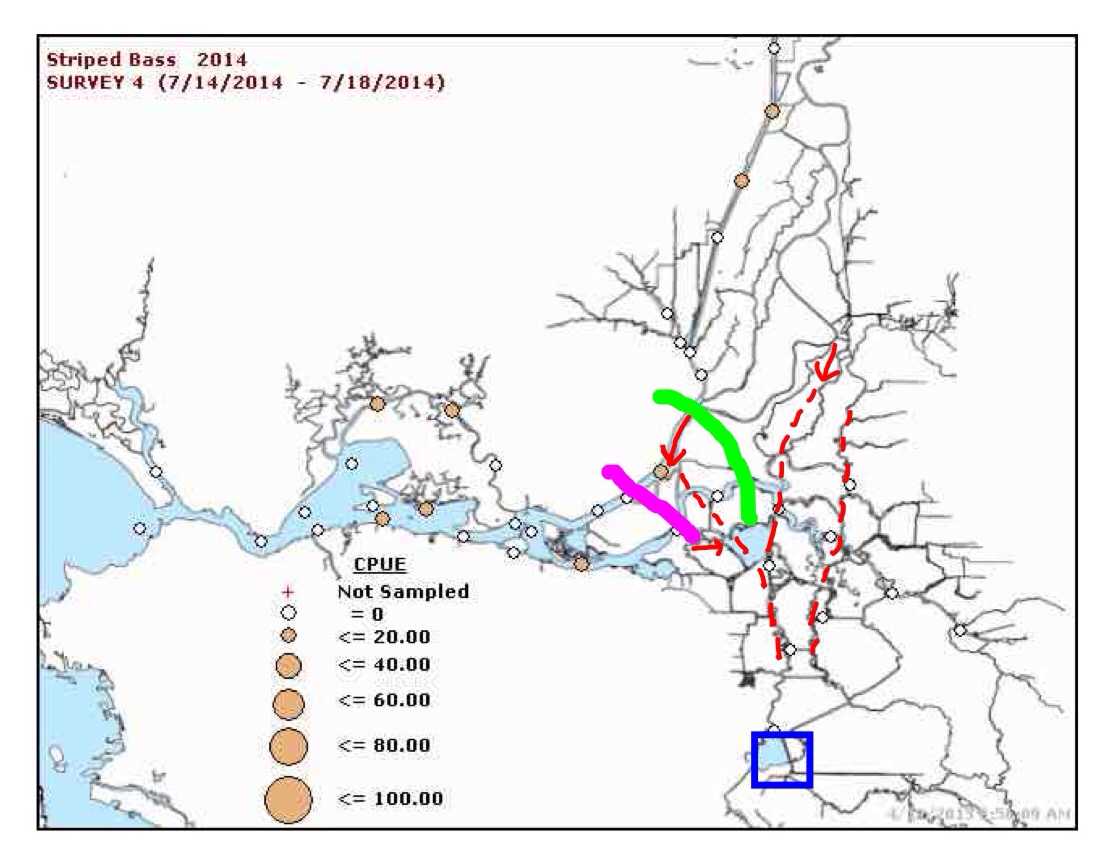
Figure 9.  The mechanism for poor Striped Bass survival in summers of dry years is larval and juveniles being drawn from north to south across the Delta to the south Delta export pumps (blue box).  The Low Salinity Zone is in Delta and is continually degraded by loss to pumps.  Magenta line is the approximate location of 2640 EC salinity (about 2 ppt salinity, commonly referred to as X2).  Green line is the approximate location of 500 EC salinity, generally considered the upper extent of the Low Salinity Zone.

Figure 9. The mechanism for poor Striped Bass survival in summers of dry years is larval and juveniles being drawn from north to south across the Delta to the south Delta export pumps (blue box). The Low Salinity Zone is in Delta and is continually degraded by loss to pumps. Magenta line is the approximate location of 2640 EC salinity (about 2 ppt salinity, commonly referred to as X2). Green line is the approximate location of 500 EC salinity, generally considered the upper extent of the Low Salinity Zone.

  1. http://www.dfg.ca.gov/fish/Resources/Striped_Bass/Biology.asp
  2. http://www.science.calwater.ca.gov/pod/pod_index.html
  3.  The Low Salinity Zone is defined as the location of brackish water with salinity of 1-6 parts salt per thousand in water as compared to 32 ppt in seawater.

Wild Salmon – A Superfood

salmon for dinnerRecently, I had fresh, wild, troll-caught1 Coho from Costco ($4.99/lb whole) with wild rice and fresh strawberry walnut salad. The salmon was truly delicious as is the usual case with fresh, wild, troll-caught salmon.

Wild salmon like this is a “Super Food”.

“Salmon is a great source of protein and is packed with omega-3 fatty acids, which are associated with a healthy heart and brain function. Look for wild salmon to get the biggest health boost.” http://partnersinhealth.kaiserpermanente.org/july-2015/national/10-superfoods-that-pack-a-nutritional-punch-nat-july2015#sthash.hUM61ZOx.dpuf.

“Fatty ocean fish such as salmon and tuna are high in omega-3 fatty acids and can help reduce cholesterol levels, especially when you eat fish instead of saturated fats from red meats. Herring, trout and sardines are also high in omega-3s. Fish is also high in protein and minerals.”
http://nutrition.about.com/od/cardiovascular/ss/Super-Foods-that-Lower-Cholesterol.htm#step10

Having wild salmon available in markets is a very strong reason for upgrading the Central Valley Fall Run Chinook Salmon hatchery program, as I have advocated in earlier posts. Demand for salmon will be increasing as more and more Californians become health conscious. With the public recognition that farmed salmon are not “wild” salmon, there will be further pressure to increase production of “wild”, “free range” salmon in our coastal waters. Central Valley salmon hatcheries can help meet this need.

Approximately 90% of the coastal “wild, free-range” salmon come from the many federal, state, and tribal hatcheries on Pacific Coast rivers.

However, hatchery salmon and the fisheries they support can be a threat to native non-hatchery wild salmon runs, many of which have been listed as threatened or endangered under federal and state endangered species acts. Fishery harvest pressure on these non-hatchery “wild” salmon like the listed Winter Run and Spring Run Chinook of the Sacramento River, potentially put these runs at greater risk of extinction. With the greater risk comes fishery restrictions and less harvest of hatchery salmon, and the need for careful planning and management of the hatchery programs and fishery harvest. Harvest can be focused on times and locations where endangered salmon are least frequently present, but often this may not be possible. Other measures such as gear and catch restrictions, terminal fisheries, and mark-selective fisheries could be employed, making it possible to “have our salmon and eat them too!”

  1. Troll-caught salmon are from regulated commercial fisheries in coastal waters from California to Alaska. They are caught live on trolling lines (in contrast to gill nets) and placed immediately on ice. I avoid purchasing “wild” salmon products from Russia or China that are available in grocery stores, because they come from “unregulated” fisheries, possibly even illegally from North American waters. Gill nets up to 50-miles long have been found fishing in ocean waters. I never purchase farmed salmon, which have little of the nutritional benefits of wild salmon.

It is time to save the Delta Smelt

Causes of the Decline of the Endangered Delta Smelt

There are multiple threats to the Delta Smelt population that contribute to its viability and risk of extinction. Chief among these threats are reductions in freshwater inflow to the estuary; loss of larval, juvenile and adult fish at the state and federal Delta export facilities and in urban, agricultural and industrial water diversions; direct and indirect impacts of the Delta Smelt’s planktonic food supply and habitat; and lethal and sub-lethal effects of warm water and toxic chemicals in Delta open-water habitats.

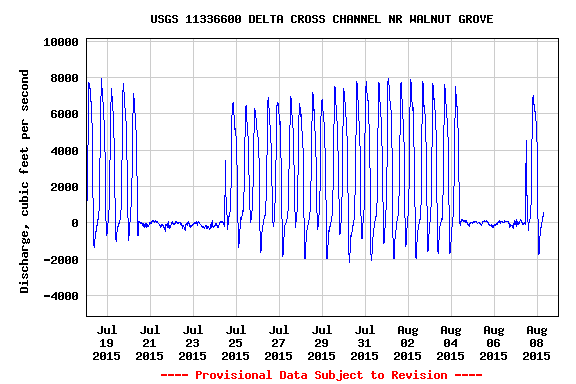
Temporary urgency change orders by the State Board have allowed reduced Delta outflow and increased Delta salinity. This has moved the Low Salinity Zone further upstream (eastward) into the Delta, thereby increasing the degree of each of these threats. During the past few drought summers, remnants of the population have been confined to a small area of the Low Salinity Zone where water temperatures barely remain below lethal levels. The change orders are an obvious and direct threat to the remnants living in the Low Salinity Zone. Further allowing these weakened standards to be violated is a direct disregard for the remnants of the population. It places them at extraordinary risk by bringing them further into the zone of water diversions, degrading their habitat into the lethal range of water temperature, further degrading their already depleted food supply, and increasing the concentrations of toxic chemicals being relentlessly discharged into the Delta.

Saving the Delta Smelt

The following are measures necessary to save the remnant Delta Smelt population:

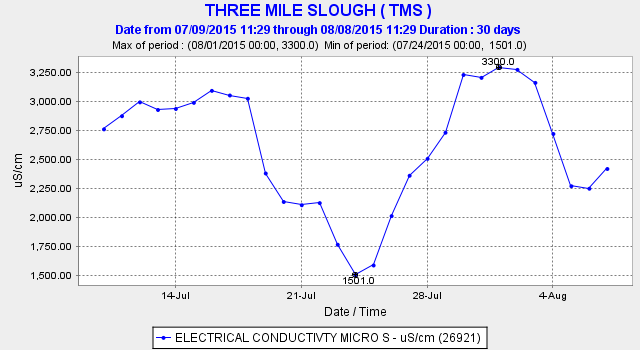
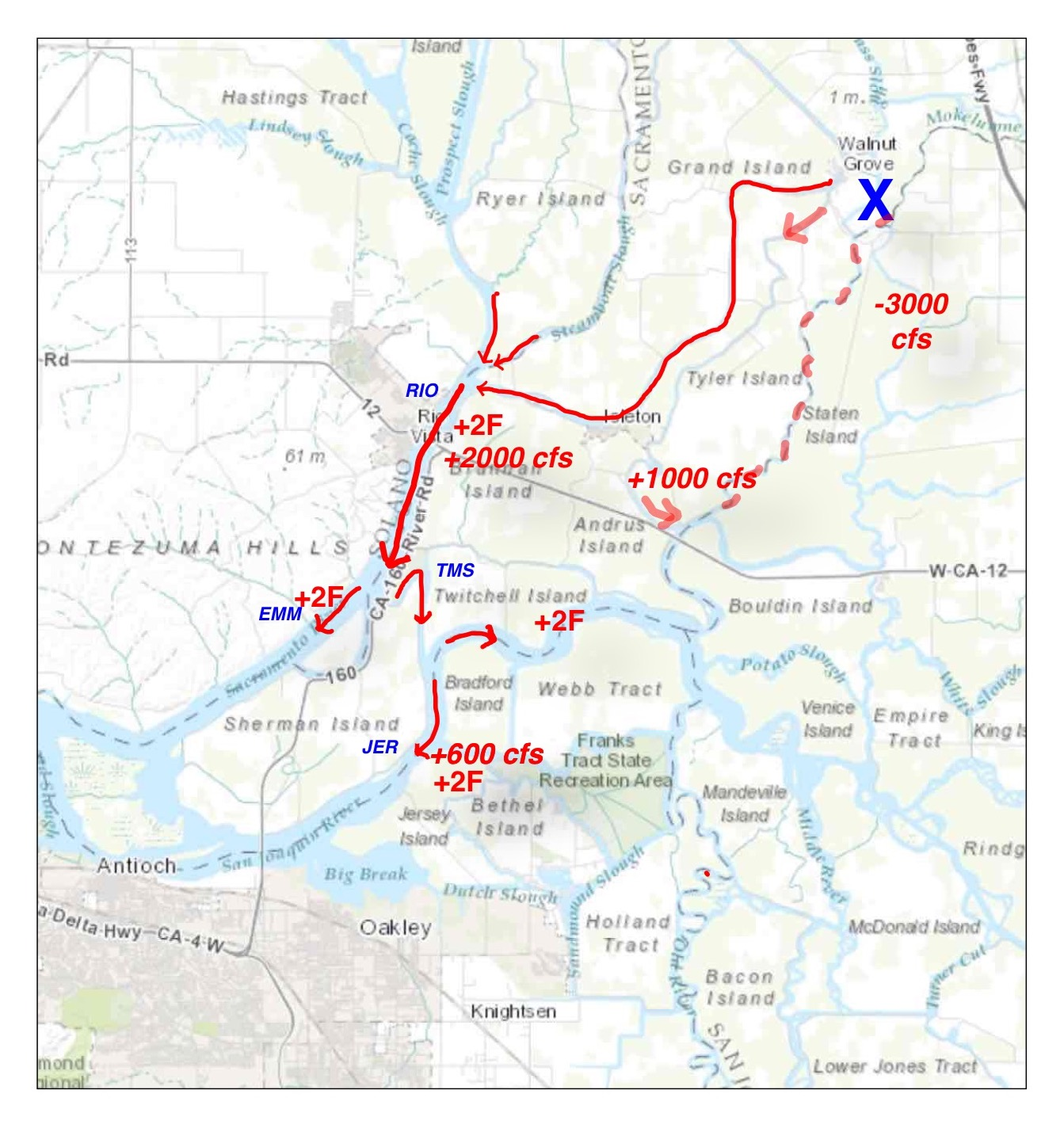
  1. Keep the low salinity zone (LSZ) out of the Delta as prescribed in State water quality control plans over the last several decades. This can be readily accomplished by meeting already defined flow and salinity standards and restrictions on Delta exports. The LSZ on the Sacramento channel side should be in the wide open reach of eastern Suisun Bay between Collinsville and the west end of Sherman Island (location of Emmaton standard). It must be kept out of the Emmaton-to-Rio Vista reach just upstream in the west Delta, because this reach is confined and continually degraded by reservoir releases and warm water passing through the North Delta via Three Mile Slough to the interior of the Delta and south Delta water diversions. On the San Joaquin (south) side, the low salinity zone belongs in the wide Antioch–to-Jersey Point reach as prescribed in standards. This can be accomplished in spring and summer of dry years by maintaining prescribed flows, salinity standards at Jersey Point, installation of the False River and Dutch Slough Barriers, and opening the Delta Cross Channel (which results in positive net outflow from the mouth of Old River downstream to Jersey Point in the Central Delta). Maintaining the net positive flows in west Delta channels helps tremendously in getting salmon, steelhead, sturgeon, striped bass, and smelt from upstream freshwater spawning areas to their downstream rearing area target, the estuary’s LSZ. Keeping the LSZ in eastern Suisun Bay, as has always been an objective Delta Water Quality Plans, has huge indirect benefits as well, including greater plankton production, lower non-stressful water temperatures (conducive to growth and survival of all the Delta fish including smelt and salmonids), higher turbidity levels in the LSZ (reduced predation on and improved feeding for Delta smelt), lower invasive Asian clam concentrations in eastern Suisun Bay (which siphon off plankton and larval fish), and lower concentrations of toxins in the LSZ.
  2.  Improve the physical habitat of the LSZ. Habitat in eastern Suisun Bay, though far better than that of the west Delta, has been continuously degraded over the past century. Fortunately, there are few levees along the north shore of the Sacramento side. However, the wave-swept shores along Antioch Hills have lost all riparian vegetation except pockets of invasive Arundo. Hillside windfarm and shoreline erosion have filled in shoreline shoals, shallows, bays and alcoves that provided rearing habitat for smelt and salmon (salmon fry are the most abundant fish in these shallows through the winter). Miles of shoreline bays, inlets, and tidal marshes east of Collinsville have been lost. On the south side of the Sacramento channel are the remnants of historic Delta marshes and islands of West Sherman Island and Sherman Lake. Gradually the riparian shoreline and shallow waters are washing away as a consequence of wind as well as ship-wake erosion. Lack of interior marsh channel circulation has also led to grand infestations of invasive non-native submergent, emergent, and floating aquatic vegetation. Like the north shore, the south shoreline of West Suisun Bay on the San Joaquin side is not leveed. Likewise, shoreline and shallow water habitats are degraded, but from industrialization. Large areas east of Antioch to Big Break are degraded much as in the area of Sherman Lake. Both the north and south East Suisun Bay channels are degraded by dredging of the two deep-water ship channels, which has resulted in the loss of shallow shoal, bay, and mudflat habitats. Virtually none of the habitats mentioned above were addressed in the grand BDCP restoration plans for the Bay-Delta. Though some of the areas have been prescribed for restoration in various mitigation plans, virtually no progress has been made toward their restoration in the last several decades.
  3. Stock hatchery raised smelt in the LSZ. The agency-sponsored Delta Smelt conservation hatcheries could be upgraded to production status to provide juveniles to be stocked in the LSZ in late spring and summer. The population is so low now (zero 20-mm and Townet survey indices) that stocking would be helpful if not necessary.
  4. Provide a spring pulse flow into and through the Delta to help smelt fry transport from freshwater spawning areas downstream to the LSZ. This could include passing some Sacramento River flow through the blocked entrance to the Deepwater Ship Channel at the Port of West Sacramento. Delta inflow pulses could be provided by reservoir releases coordinated with infrequent natural flow pulses through the Delta.
  5. Manage tidal flows and Delta hydrodynamics, as well as water quality, on a real time basis to help maintain the LSZ in east Suisun Bay and to stimulate and sustain plankton blooms. Real time management is possible because of the many satellite-accessible data recorders in the Delta, as well as the many frequent biological monitoring surveys being conducted throughout the Bay and Delta. Active adaptive management is possible with the many flow controls available on diversions, reservoir releases, and flow splits (e.g., Delta Cross Channel).

More on Longfin Smelt

Longfin Smelt have declined as other pelagic fish species have over the past two decades. The species was listed in 2009 under the California Endangered Species Act. In a previous blog1 I described trends in their abundance and distribution in the upper Bay and Delta. Below is a chart depicting the long-term trend in another standard CDFW survey, the San Francisco Bay Midwater Trawl Survey. The index is the average catch for the April and May monthly surveys at a basic array of 28-44 standard stations from San Francisco Bay upstream into the central Delta. Yearling smelt are dominant in the April surveys, while young predominate in the May surveys.

Longfin Smelt Average Catch Apr-May Baay Mid-water Trawl Surveys

As in other surveys, the index pattern clearly shows a sharp reduction in average catch since 2007. The average catch is particularly low in the last three years. There was no May survey in 2008. Similar patterns were evident in the Fall Midwater Trawl Survey, Summer Townet Survey, Winter Kodiak Trawl Survey, 20-mm Smelt Survey, and the Larval Fish Survey.