Welcome to the California Fisheries Blog

The California Sportfishing Protection Alliance is pleased to host the California Fisheries Blog. The focus will be on pelagic and anadromous fisheries. We will also cover environmental topics related to fisheries such as water supply, water quality, hatcheries, harvest, and habitats. Geographical coverage will be from the ocean to headwaters, including watersheds, streams, rivers, lakes, bays, ocean, and estuaries. Please note that posts on the blog represent the work and opinions of their authors, and do not necessarily reflect CSPA positions or policy.

Reclamation Jeopardizes Klamath and Sacramento Salmon

By now you have probably heard that Klamath salmon are again threatened by warm water and ICH disease. You may also know that Sacramento River winter run salmon are again threatened with warm water below Shasta at Redding. You may not know that both are related, caused by the US Bureau of Reclamation’s operation of the Central Valley Project (CVP) and in particular Shasta and Trinity reservoirs.

Low flows in the lower Klamath are resulting in warm water and disease, shaping up as having the potential to repeat the massive 2002 die-off of salmon. Water temperatures in the lower Klamath and Trinity near 80°F are killing salmon and blocking their migrations.

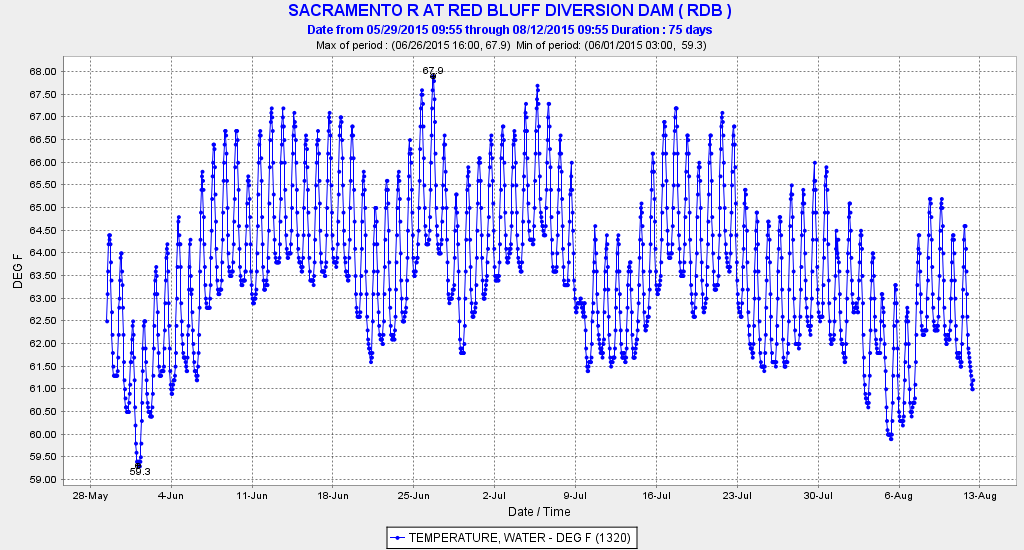
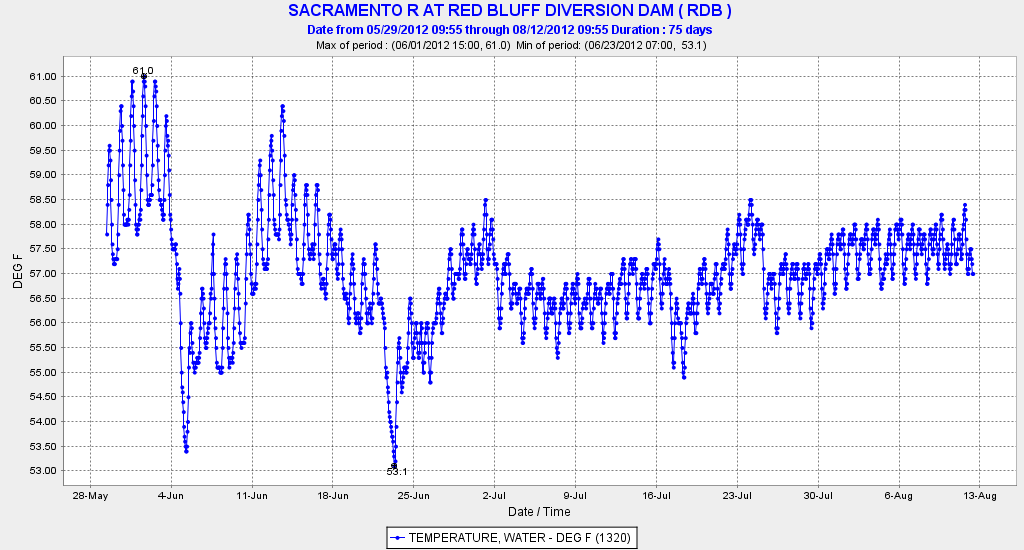
Below Shasta on the Sacramento River near Redding, Winter Run Chinook salmon eggs are dying because excessively warm water is being released from Keswick Reservoir near Redding. Water temperatures near or above 60°F occur from Redding down to Red Bluff, the traditional spawning reach of Winter Run Chinook in summer. Egg mortality increases above 56°F.

Here is how the two events are related. The map below shows how the Shasta andTrinity projects are connected as part of the CVP. Trinity Reservoir is presently releasing about 2000 cfs, of which a little less than 500 cfs (52-59°F) is released down the Trinity into the lower Klamath where total flow is 2200 cfs and water temperatures approach 80°F. The other 1500 cfs from Trinity Reservoir is going to Keswick Reservoir via Whiskeytown Reservoir. This 59°F water from Whiskeytown mixes with 5500 cfs of 52°F water released from the Shasta cold-water pool to provide a release of 7000 cfs of 54-56°F water into the Sacramento River from Keswick Dam above Redding. Water temperatures in the Redding spawning reach are 56-60°F.

So the flows diverted from the Trinity are not only contributing to low flows and warm water in lower Klamath, they are also contributing to the water in the Sacramento at Redding that is too warm for salmon eggs. The need to cool Trinity water before it is released into the Sacramento below Keswick is also contributing to the depletion of the limited cold water pool in Shasta reservoir.

Klamath River tribes are asking for more water down the Trinity. Reclamation is offering a small pulse when salmon start to die. A better solution would be to equally split the Trinity release, providing an immediate benefit to the Klamath-Trinity salmon and also saving some of the cold water pool in Shasta. This would require the State Board to reduce deliveries to Sacramento Valley farmers by an additional 500 cfs.

Proposed Actions Reservoirs and Dams

Recent Delta Action Further Degrades Low Salinity Zone

Recently, Reclamation closed the Delta Cross Channel (DCC) (Figure 1) near Walnut Grove to reduce salinity at the State Board’s compliance point at Threemile Slough. Normally, the DCC is open in summer to allow fresh water into the central, east, and southern Delta to maintain low salinity water for exports and for agricultural and municipal diversions. However, low fresh water inflows to the Delta due to the drought have resulted in salinity levels exceeding the required 2.78 EC level at Threemile Slough. Closing the DCC effectively forced more of the fresh -+water inflow from the Sacramento River toward the western Delta and Threemile Slough, reducing EC at Threemile Slough significantly (Figure 2).

Figure 1. Flow through the Delta Cross Channel in July and August 2015

Figure 1. Flow through the Delta Cross Channel in July and August 2015. Zero flow indicates the gates are closed. Gates are normally open in summer.

Figure 2. Salinity (EC) at Threemile Slough compliance point in western Delta

Figure 2. Salinity (EC) at Threemile Slough compliance point in western Delta. Salinity (EC) must be maintained below 2780 EC on a seven day average. Salinity exceeded the target on July 18. Closing the DCC on July 19 immediately reduced salinity to the compliance level. Subsequent closing of the DCC on July 25 brought salinity back up to and exceeding pre-closure levels. As the seven day compliance target was again exceeded August 1-3, the DCC was again closed on August 4 to again bring the salinity into compliance.

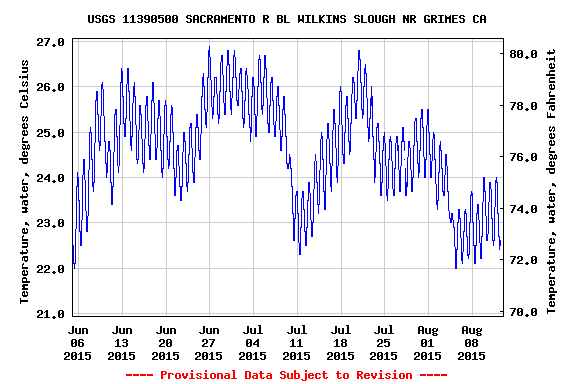
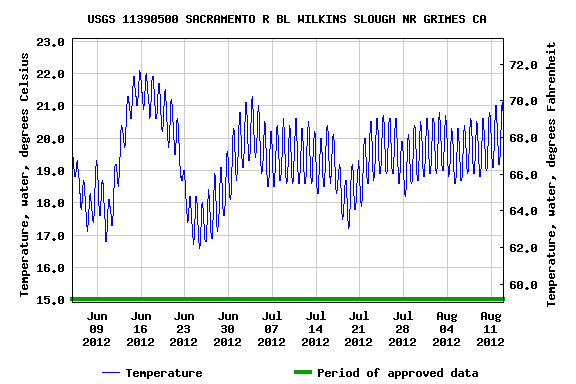
This rollercoaster salinity management in the Delta causes serious degradation to the Low Salinity Zone in the western Delta in the form of higher water temperatures. The higher water temperatures occur when warm northern Delta waters are moved west with the higher flows. These higher temperatures are evident at all the western Delta gages maintained by the Department of Water Resources and the US Geological Survey. The water temperatures change is approximately 2°F, which is significant and detrimental to the remnants of the Delta Smelt population trying to survive this extreme summer drought. Water temperatures have increased from 73° to 75°F, essentially creating lethal conditions for the remnant smelt.

The influx of warm water is apparent at Rio Vista where the Sacramento River enters the western Delta (Figure 4). Not only did the water temperature immediately rise with the higher flows on July 19, but the higher temperatures were sustained after the flows receded on July 25.

Overall, the unprecedented closure of the DCC in summer leads to rapid and significant changes in flow, salinity, and water temperature in the Delta that are likely detrimental to Delta native fishes including the Delta Smelt.

Figure 3. The map annotations depict changes from recent closures of the DCC

Figure 3. The map annotations depict changes from recent closures of the DCC (located at blue X). The closure reduced flow in the Mokelumne channels (dotted red line) by 3000 cfs. Georgiana Slough (west side of Tyler Island) flow increased 1000 cfs. Flow into the Sacramento channel at Rio Vista increased 2000 cfs. Net water temperature increase throughout the western Delta was about 2°F.

Figure 4. Water temperature at Rio Vista Bridge in July-August 2015

Figure 4. Water temperature at Rio Vista Bridge in July-August 2015. Note sharp increases after July 19 and August 4 closures of DCC.

Improving Water Temperature Management in Sacramento River Below Shasta for Salmon

Background

The Sacramento River below Shasta-Keswick near Redding is the spawning reach of Winter-Run Chinook salmon in summer. Winter-Run originally spawned in the cold, spring-fed reaches upstream of Shasta Reservoir. Since Shasta Dam’s construction over a half century ago, Winter-Run have spawned below in Shasta’s cold tailwater. However, in some dry years the cold water has run out and the Winter-Run spawn has failed, as was the case in late summer 2014. There simply are not sufficient guarantees in the State Water Right Order 90-5 (WRO-90-5) or the NMFS Biological Opinion (BO) to protect the Winter-Run: there weren’t in 2014 and there aren’t in 2015. Winter-Run need cold water (<56°F) through the summer to protect spawning adults, eggs laid in gravel, and fry developing in gravel beds throughout their spawning reach upstream of Red Bluff. In nearly all years there is sufficient cold water in Shasta to sustain cold water through the summer above Red Bluff, especially after construction of the Shasta Dam Temperature Control Device (TCD), which allows conservation of the coldest water in Shasta through the summer. The problem is that the cold water cannot be conserved because of downstream demands on the water.

Downstream agricultural demands force the release of too much of the Shasta cold water pool in spring and summer, which in drier years like 2014 and 2015 results in exhaustion of the cold water pool by late summer. To complicate matters, warmer Trinity water is brought over for release below Shasta to meet some of the downstream demands, thus requiring even more of the Shasta cold water pool to maintain target temperatures above Red Bluff. Shasta releases also are highest in warm afternoons to meet peak power demands; this release pattern also requires more from the cold water pool.

The federal and state agencies develop a plan to operate the system each year in the winter prior to the irrigation season. Based on what they know and forecast for the upcoming season, they develop a plan to maintain cold water through the summer for the salmon, as well as a forecasted water supply for downstream users. Both the WRO-90-5 and BO contain provisions that allow the targets for salmon temperatures to be modified in dry years to allow downstream water users a portion of their normal water supply.

WRO-90-5 allows weakening of targets for water temperature by moving the compliance point upstream from Red Bluff, sometimes as far as Redding. In 2015 the State Board in a Temporary Urgency Change Order allowed the target temperature to be raised to a daily average of 58°F in Redding.

The Problem

Both the 2014 and 2015 plans failed to meet their objectives for a multitude of reasons, least among them inaccurate information and poor planning tools (e.g., mathematical models). Lack of conservative conditions in the plan and follow-up conservative decision-making were the key problems. In 2014, the plan and operational failure led to the loss of most of the 2014 Winter-Run salmon production; the Winter-Run perished in low flows and high water temperatures in late summer in the small spawning reach upstream of Highway 44 in Redding. By late spring of 2015, it became apparent, as predicted by CSPA and others, that the Bureau had allocated spring releases (already made to downstream users) based on a forecast that overestimated the size and quality of the Shasta cold water pool . So the State Board allowed the Bureau of Reclamation to adopt a new temperature management plan, raising the target to an average daily temperature of 58°F even in the tiny amount of the Sacramento River between Keswick Dam and Clear Creek.

What more can be done?

First, rescind the weakened numeric target because it does not protect salmon eggs and newly newly hatched fry. The 56°F target must be reinstated as far downstream as possible. The SWRCB should at the very least ensure that maximum water temperatures never exceed 58°F and that average daily and weekly average maximums do not exceed 56°F.

Minimum water temp chartSecond, reduce the input of warmer Trinity water via Whiskeytown and the Spring Creek Powerhouse. The chart of present conditions below shows that the warmer Trinity water entering Keswick Reservoir below Shasta makes up over 20% (1500/7000) of the water entering the Redding reach. Ensuring that the Redding reach target is maintained requires that more 50°F cold-water pool water from Shasta be mixed into the TCD than would be necessary to maintain the mandatory 58°F average daily target at Redding (CCR location) without the Trinity water. Cutting the Trinity input at this time would be especially prudent. Low flows in the Trinity (460 cfs release to river, compared to 1500 cfs diversion to Sacramento River) are contributing to disease and die-off of salmon in the lower Klamath-Trinity system. {Note: it may not be possible to reduce Trinity inputs without increasing Shasta releases because salmon have or are now spawning at these flows. Cutting Trinity inflow could still reduce demand on Shasta cold water pool water even if Trinity flow cuts are made up by Shasta water.}

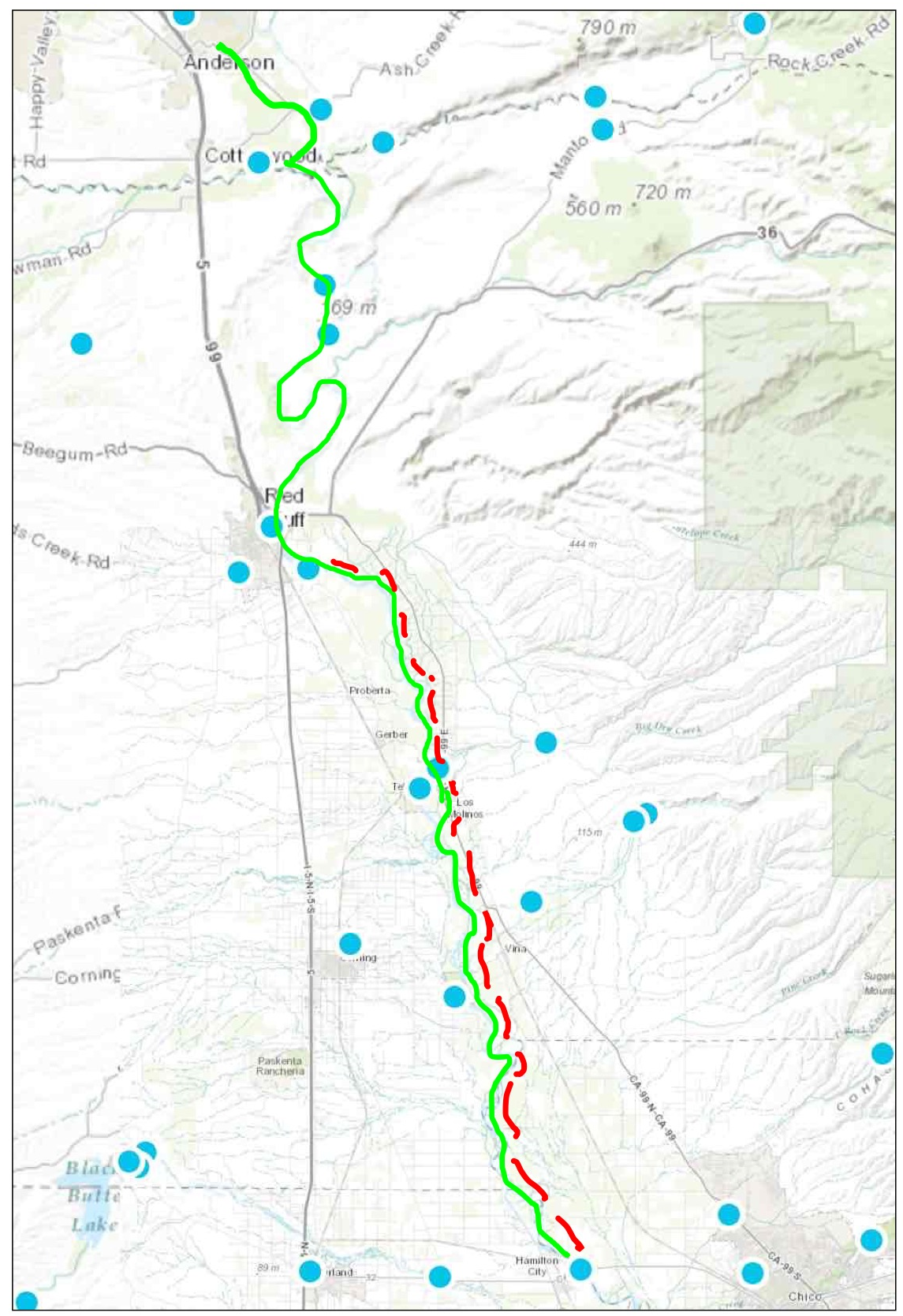
This map depicts conditions in the first week of August 2015.  Daily average Shasta releases to Keswick Reservoir are approximately 5500 cfs. Daily average Whiskeytown releases to Keswick are 1500 cfs.  Keswick release is approximately 7000 cfs.  The daily range in water temperatures is shown by location in magenta.  Gaging and recording stations are blue dots (from CDEC).

This map depicts conditions in the first week of August 2015. Daily average Shasta releases to Keswick Reservoir are approximately 5500 cfs. Daily average Whiskeytown releases to Keswick are 1500 cfs. Keswick release is approximately 7000 cfs. The daily range in water temperatures is shown by location in magenta. Gaging and recording stations are blue dots (from CDEC).

Third, reduce hourly peaking power releases from Shasta, because water released through the Shasta powerhouses is pulled from relatively high in the water column, and is thus relatively warm. Data from the past several days indicates Reclamation may already be instituting this measure – see figures below.

Water temperature recordings from one of five Shasta Dam penstocks over past ten days note high daytime water temperatures..  Lower maximum temperatures in last five days may be from reduced daytime releases or changes in TCD operation (see chart below).

Water temperature recordings from one of five Shasta Dam penstocks over past ten days note high daytime water temperatures.. Lower maximum temperatures in last five days may be from reduced daytime releases or changes in TCD operation (see chart below).

Note high daytime releases to meet peak power demands.  Note Reclamation has altered the normal pattern in the last two days, which apparently further reduced release water temperature (see chart above).

Note high daytime releases to meet peak power demands. Note Reclamation has altered the normal pattern in the last two days, which apparently further reduced release water temperature (see chart above).

In summary, saving Winter Run Chinook salmon this summer demands immediate action. This will require one or more of the following: reduced reservoir releases to downstream users, less transfer of warm water from Trinity Reservoir (via Whiskeytown and Spring Creek Powerhouse), reduced power generation, less peaking power operation, and/or the bypass of releases past Shasta’s power generation facilities (use of Shasta Dam’s lower level outlet).

Striped Bass Status

Striped Bass (stripers) came from New Jersey by train in milk cans 135 years ago to provide a vibrant commercial fishery and regional food supply. Today, stripers remain a prized gamefish in Central Valley rivers, the Delta, and the Bay. Like the native smelts, salmon, steelhead, herring, and sturgeon, stripers have undergone a dramatic decline over the past several decades (Figure 1). Many have blamed the stripers for these declines, when in fact the entire fish community and food-chain of the Bay-Delta has suffered from the man-made spring-summer droughts in the Central Valley. Stripers may prey on listed salmon, steelhead, and smelt, but are far more likely to prey upon native and non-native competitors and predators of these listed species.

Despite their strong inherent ability to recover (high reproductive capacity and long life 1 ), stripers have declined in abundance from 3-5 million adult fish in the 60s and 70s to less than a half million adults in recent years (CDFW unpublished data). A hatchery and pen-rearing program in the late 1990s and early 2000s released millions of young stripers, which led to some recovery in young production (Figure 1) and adult catch (Figure 2). Today, all indications are that stripers are now at record low levels. Stripers are one of the species identified as suffering in the Bay-Delta’s Pelagic Organism Decline2. Their decline can be directly related to Delta water exports, especially in summers of dry years since 1995, when summer protections for stripers were removed from Bay-Delta water quality standards.

Despite low adult numbers and poor summer Delta habitat conditions, recent production of young stripers in wet years is consistent with recent historical levels (Figures 3 and 4). However, production of young is very low in dry years (Figure 5). The reason for the difference between wet and dry year survival is the location of low-salinity nursery habitat in the estuary (Figures 6, 7, and 8). Young stripers are more vulnerable to Delta exports in dry years when Delta inflows are low and their Low Salinity Zone3 nursery area is located in the Delta (Figure 9).

What can be done to help stripers and the striper fishery?

  1. The Low Salinity Zone of the estuary must be kept out of the central Delta by providing sufficient Delta outflow. This would help to keep Delta pelagic fishes and their planktonic food-chain (as well as salt) out of the export pumps.
  2. Stripers should be relocated from below Central Valley river diversion dams where stripers concentrate in summer and become a localized predatory nuisance. (Such locations are generally closed to fishing.) Stripers should be relocated to Central San Francisco Bay where they support a valuable sport fishery and there are other sources of prey.
Figure 1. Young Striped Bass summer (A) and fall (B) abundance indices.  (Source: CDFW)

Figure 1. Young Striped Bass summer (A) and fall (B) abundance indices. (Source: CDFW)

Figure 2.  Striped Bass adult catch pattern in Bay-Delta sport fishery. ( Source:  CDFW)

Figure 2. Striped Bass adult catch pattern in Bay-Delta sport fishery. ( Source: CDFW)

Figure 3.  Young Striped Bass density distribution in July 1995 20-mm Survey.

Figure 3. Young Striped Bass density distribution in July 1995 20-mm Survey.

Figure 4.  Young Striped Bass density distribution in July 2011 20-mm Survey.

Figure 4. Young Striped Bass density distribution in July 2011 20-mm Survey.

Figure 5.  Young Striped Bass density distribution in July 2014 20-mm Survey.

Figure 5. Young Striped Bass density distribution in July 2014 20-mm Survey.

Figure 6.  Young Striped Bass density distribution in June 2015 20-mm Survey.

Figure 6. Young Striped Bass density distribution in June 2015 20-mm Survey.

Figure 7. Catch distribution of young Striped Bass in Summer Townet Survey July 2011, a wet year.  Magenta line is 2640 EC salinity (commonly referred to as X2).  Green line in 500 EC salinity

Figure 7. Catch distribution of young Striped Bass in Summer Townet Survey July 2011, a wet year. Magenta line is 2640 EC salinity (commonly referred to as X2). Green line in 500 EC salinity

Figure 8.  Catch distribution of young Striped Bass in Summer Townet Survey July 2014, a drought year.  Magenta line is 2640 EC salinity (commonly referred to as X2).  Green line in 500 EC salinity.

Figure 8. Catch distribution of young Striped Bass in Summer Townet Survey July 2014, a drought year. Magenta line is 2640 EC salinity (commonly referred to as X2). Green line in 500 EC salinity.

Figure 9.  The mechanism for poor Striped Bass survival in summers of dry years is larval and juveniles being drawn from north to south across the Delta to the south Delta export pumps (blue box).  The Low Salinity Zone is in Delta and is continually degraded by loss to pumps.  Magenta line is the approximate location of 2640 EC salinity (about 2 ppt salinity, commonly referred to as X2).  Green line is the approximate location of 500 EC salinity, generally considered the upper extent of the Low Salinity Zone.

Figure 9. The mechanism for poor Striped Bass survival in summers of dry years is larval and juveniles being drawn from north to south across the Delta to the south Delta export pumps (blue box). The Low Salinity Zone is in Delta and is continually degraded by loss to pumps. Magenta line is the approximate location of 2640 EC salinity (about 2 ppt salinity, commonly referred to as X2). Green line is the approximate location of 500 EC salinity, generally considered the upper extent of the Low Salinity Zone.

  1. http://www.dfg.ca.gov/fish/Resources/Striped_Bass/Biology.asp
  2. http://www.science.calwater.ca.gov/pod/pod_index.html
  3.  The Low Salinity Zone is defined as the location of brackish water with salinity of 1-6 parts salt per thousand in water as compared to 32 ppt in seawater.

Wild Salmon – A Superfood

salmon for dinnerRecently, I had fresh, wild, troll-caught1 Coho from Costco ($4.99/lb whole) with wild rice and fresh strawberry walnut salad. The salmon was truly delicious as is the usual case with fresh, wild, troll-caught salmon.

Wild salmon like this is a “Super Food”.

“Salmon is a great source of protein and is packed with omega-3 fatty acids, which are associated with a healthy heart and brain function. Look for wild salmon to get the biggest health boost.” http://partnersinhealth.kaiserpermanente.org/july-2015/national/10-superfoods-that-pack-a-nutritional-punch-nat-july2015#sthash.hUM61ZOx.dpuf.

“Fatty ocean fish such as salmon and tuna are high in omega-3 fatty acids and can help reduce cholesterol levels, especially when you eat fish instead of saturated fats from red meats. Herring, trout and sardines are also high in omega-3s. Fish is also high in protein and minerals.”
http://nutrition.about.com/od/cardiovascular/ss/Super-Foods-that-Lower-Cholesterol.htm#step10

Having wild salmon available in markets is a very strong reason for upgrading the Central Valley Fall Run Chinook Salmon hatchery program, as I have advocated in earlier posts. Demand for salmon will be increasing as more and more Californians become health conscious. With the public recognition that farmed salmon are not “wild” salmon, there will be further pressure to increase production of “wild”, “free range” salmon in our coastal waters. Central Valley salmon hatcheries can help meet this need.

Approximately 90% of the coastal “wild, free-range” salmon come from the many federal, state, and tribal hatcheries on Pacific Coast rivers.

However, hatchery salmon and the fisheries they support can be a threat to native non-hatchery wild salmon runs, many of which have been listed as threatened or endangered under federal and state endangered species acts. Fishery harvest pressure on these non-hatchery “wild” salmon like the listed Winter Run and Spring Run Chinook of the Sacramento River, potentially put these runs at greater risk of extinction. With the greater risk comes fishery restrictions and less harvest of hatchery salmon, and the need for careful planning and management of the hatchery programs and fishery harvest. Harvest can be focused on times and locations where endangered salmon are least frequently present, but often this may not be possible. Other measures such as gear and catch restrictions, terminal fisheries, and mark-selective fisheries could be employed, making it possible to “have our salmon and eat them too!”

  1. Troll-caught salmon are from regulated commercial fisheries in coastal waters from California to Alaska. They are caught live on trolling lines (in contrast to gill nets) and placed immediately on ice. I avoid purchasing “wild” salmon products from Russia or China that are available in grocery stores, because they come from “unregulated” fisheries, possibly even illegally from North American waters. Gill nets up to 50-miles long have been found fishing in ocean waters. I never purchase farmed salmon, which have little of the nutritional benefits of wild salmon.