Welcome to the California Fisheries Blog

The California Sportfishing Protection Alliance is pleased to host the California Fisheries Blog. The focus will be on pelagic and anadromous fisheries. We will also cover environmental topics related to fisheries such as water supply, water quality, hatcheries, harvest, and habitats. Geographical coverage will be from the ocean to headwaters, including watersheds, streams, rivers, lakes, bays, ocean, and estuaries. Please note that posts on the blog represent the work and opinions of their authors, and do not necessarily reflect CSPA positions or policy.

How many Delta Smelt Remain?

Because Delta smelt are now rarely being captured in regular CDFW fish surveys, the US Fish and Wildlife Service began the Enhanced Delta Smelt Monitoring Program (EDSM) in 2017.  Results for the first four years show adult Delta smelt are still around in winter spawning season – barely (Figure 1).  They continue to be found throughout the northern Delta and Suisun Bay/Marsh (Figure 2).  Hotspots (likely spawning concentrations) were in west Delta near Rio Vista and the Deepwater Ship Channel.  Juveniles continue to show up in EDSM summer surveys in the usual places (Figure 3).  There may be a few thousand adult Delta smelt left as of 2019/2020 based on US Fish and Wildlife Service estimates.

Figure 1. Catch of adult Delta smelt in winter EDSM Kodiak trawl surveys 2017-2020.

Figure 2. Locations where Delta smelt adults were captured in EDSM surveys in winter 2019 (yellow dots) and 2020 (green dots).

Figure 3. Locations where Delta smelt young were captured in EDSM surveys in July 2019. Circles represent regions. Numbers are total July catch in region. The 94 represents the young smelt captured in the Deepwater Ship Channel.


Delta Exports Reduced in Winter 2020 to Protect Salmon and Smelt

One of the ramifications of dry conditions in winter 2020 has been the need to cut Delta exports to protect salmon and smelt listed under the state and federal endangered species acts. Lack of rain has led to reduced Delta inflow and outflow (Figure 1), which in turn has required reductions in south Delta exports (Figure 1), per the state’s 2009 incidental take permit and the 2019 federal biological opinions.1

The state permit requirement is prescribed to protect longfin smelt, which need protection under the present circumstances (Figures 2 and 3). The permit’s mitigation prescription (Figure 4) is to limit exports by limiting how negative flows in Old and Middle River (OMR) in the central Delta can get. Under the permit, negative OMR flows have generally been limited as early in the year as February in dry years like 2020; this limits exports and maintains Delta outflow. OMR flows were limited this winter (Figure 5). The mid-February survey (Figure 6) indicated a continuing risk that smelt larvae would be drawn into the central Delta if exports were increased. Exports have in fact increased (Figure 1) and OMR flow has become more negative (Figure 5) in March, increasing the risk to smelt despite being within limits set (Figure 4). March surveys should portray the effect of the increased risk factors.

The new federal take permits (BOs) are supposed to protect listed winter-run and spring-run salmon, Delta smelt, and steelhead, as well as the essential habitat of all the salmon, whose young are found in large numbers in the Delta in winter (Figure 7). Protections for these fish under the new BOs are vague at best.

Meanwhile, the state is in the process of developing a new incidental take permit that will cover winter-run and spring-run Chinook salmon and Delta smelt as well as longfin smelt. The risks to Delta fish are real. To be effective, the new ITP at minimum should not let spring outflow from the Delta fall below 10,000 cfs, and it should require maintaining February OMR levels during periods of low Delta inflow at the levels they were in February 2020 (Figure 5). This greater level of export restrictions should be required in each year with low Delta inflows until such time as the longfin smelt have grown out of the larval stage and moved downstream into the Bay. Even this level of protection may not protect the population from significant losses.

Figure 1. Delta outflow and exports in winter 2020. TRP=federal exports , HRO=state exports, DTO=outflow, FPT=Freeport Sacramento River inflow.

Figure 2. The catch density distribution of longfin smelt larvae in early February 2020 Smelt Larva Survey. Red arrow denotes direction of net flow in central and south Delta toward south Delta export pumping plants during survey period.

Figure 3. The catch density distribution of longfin smelt larvae in early February 2012 Smelt Larva Survey. Red arrow denotes direction of net flow in central and south Delta toward south Delta export pumping plants during survey period.

Figure 4. Permit Condition #5.2 from 2009 state longfin smelt incidental take permit.

Figure 5. Combined Old and Middle River flows in winter 2020.

Figure 6. The catch density distribution of longfin smelt larvae in mid-February 2020.
Source: Smelt Larva Survey.

Figure 7. Daily Catch of juvenile salmon upstream of Delta at Knight’s Landing fall-winter of water year 2020.


How Protective is the State’s Plan for Delta Fishes?

California’s Attorney General has sued the federal government over the new federal biological opinions for the operation of the Central Valley Project (CVP) and the State Water Project (SWP). But in fact, the State’s plan for operating the Central Valley operations of the State Water Project is not much better than the Bureau of Reclamation’s federal plan in terms of protecting Delta fish. The State’s plan is built on the same theory that the water projects can divert more water by monitoring fish presence and backing off on diversions when monitoring detects fish. This so-called “real-time operation” was also the foundation of the Department of Water Resources’ (DWR) proposal to protect fish in the 2016-2019 hearings on DWR’s proposed Delta tunnels (“WaterFix”).

The major difference between the new state and federal plans for Delta operations is that the State plan retains a requirement for increased flow in the summer and fall of wetter water years to protect smelt. The State’s draft EIR for the Long Term Operation of the State Water Project (LTO EIR) describes the proposed Summer-Fall X2 Action for Delta outflow (Figures 1 and 2). The action/criteria proposed is to maintain “X2” (the location in the Bay-Delta where salinity measures ~2 ppt chloride, or 3800 EC) under prescribed limits in summer and fall months by water-year type.

The LTO EIR describes two alternatives: the Proposed Project and Alternative 4.1 Both would limit monthly average or 14-day average X2 at river kilometer 80 (near the CDEC Collinsville gage). The Proposed Project includes only September and October X2 objectives, while Alternative 4 also covers June-August for wet years. Under both alternatives, criteria also include opening the Suisun Marsh Salinity Control Gates (SMSCG), an action to reduce EC at Collinsville gage and in Suisun Marsh and Montezuma Slough, which would raise salinity in eastern Suisun Bay.

I discussed the ramifications of the federal Biological Opinions in a September 2019 post. The only major beneficial change that the LTO EIR proposes is adding summer X2 criteria in Alt 4 to extend outflow protection from June 20 to August 31. The new Fall X2 requirement (September-October) in the LTO EIR would be less protective than existing Fall X2 objectives, because the new state requirement would move the compliance point upstream from km74 to km80.

In order to understand how the state’s proposed new Summer-Fall X2 requirement would work, I examine below how the action might have applied in recent water years 2016-2019, two below normal water years and two wet water years..

Below Normal Water Years 2016 and 2018

Under the LTO EIR criteria (both the Proposed Project and Alt 4 alternatives), the X2 location and low salinity zone would be similar to historical 2016 conditions (Figure 3), except that outflow could be lower and salinity higher in June, when there would be higher exports, less outflow, and a warmer more upstream low salinity zone (Figure 4). The main benefit of the X2 Action under Alt 4 would be that it would extend the D1641 agricultural salinity standards past June 20 by making them also apply from June 20 through August. Both the D1641 and Alt 4 criteria allow significant daily variation in X2: 14-day and monthly averages.

In 2018 (Figure 5) there would be a similar potential negative effect in June and a positive benefit in August under Alt 4.

Wet Water Years 2017 and 2019

Under the proposed LTO EIR criteria for wet years, Fall X2 criteria (September-October) would be the same as described above for below normal years. This would weaken protection in comparison with the previous Fall X2 requirements in the 2008-09 biological opinions (Figures 6 and 7). Summer (June-August) criteria would be generally less protective than existing D1641 salinity standards for wet years. If the State were to adopt the LTO EIR summer criteria, salinities would be higher and the low salinity zone further upstream and warmer than occurred in June-August of wet years 2017 and 2019. This would allow higher exports.

Summary and Conclusion

Under both the Proposed Project and Alternative 4, the LTO EIR’s Summer-Fall Proposed Plan for Delta outflow (Figures 1 and 2), Delta outflows would be lower, south Delta exports would be greater, and the low salinity zone further upstream and warmer in the fall (Sep-Oct) of wet years. Such changes would be highly detrimental to salmon and smelt. In below normal years, outflows may be higher from June 20 through August under Alt 4. Such changes would be beneficial to salmon and smelt.

Operation of the SMSCG would lower EC at Collinsville and in Montezuma Slough and increased EC in eastern Suisun Bay. This would be detrimental to smelt rearing in Suisun Bay. For more detail on this issue, see http://calsport.org/fisheriesblog/?p=2813.

Overall, the State’s plan would weaken existing X2 compliance criteria and result in higher exports of water from the south Delta in September and October in wet years. Alternative 4 would potentially provide more summer outflow in below normal years, which currently have no summer ag-salinity standard.

Figure 1. Comparison of Summer-Fall actions for the Proposed Project and Alternative 4.

Figure 2. Proposed Summer-Fall Actions in LTO EIR Alternative 4 (Table 5, p I-2 in EIR).

Figure 3. Collinsville EC in below-normal water year 2016. Salinity (EC) at Collinsville (~km 80) June-Dec 2016, a below normal water year. Red line shows proposed monthly-average EC objective in Alt 4.

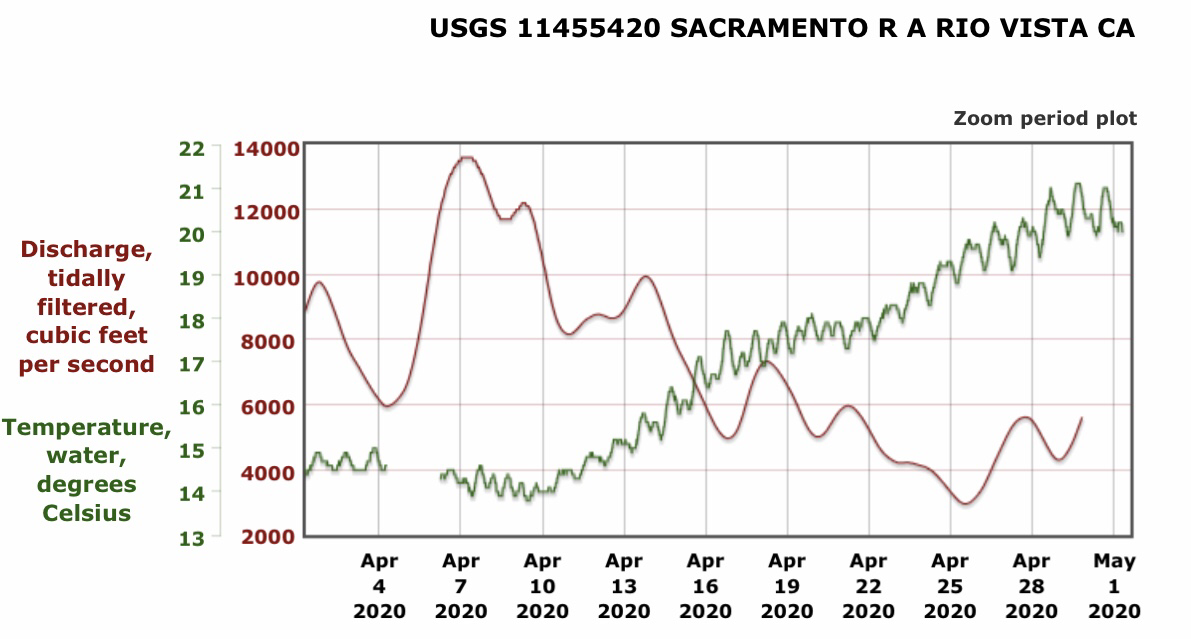
Figure 4. Summer water temperature at Rio Vista in northwest Delta in 2016. Note in early summer water temperatures tend to be higher in the lower range of net river flow and high seasonal tides.

Figure 5. Salinity (EC) at Collinsville (~km 80) June-Dec 2018, a below normal water year. Red line shows proposed monthly-average EC objective proposed only in Alt 4.

Figure 6. Salinity (EC) at Collinsville (~km 80) June-Dec 2017, a wet water year. Red line shows proposed monthly-average or 14-day EC objectives in the Proposed Project and Alt 4.

Figure 7. Salinity (EC) at Collinsville (~km 80) June-Dec 2019, a wet water year. Red line shows proposed monthly-average or 14-day EC objectives in the Proposed Project and Alt 4.


  1. According to the description in the EIR, Alternative 4 is a more smelt-friendly alternative than the Proposed Project.

Longfin Smelt – January 2020

The fall midwater trawl index of spawning adult longfin smelt in 2019 was below expectations for a wet year (Figure 1). In a January 8, 2020 post, I foreshadowed the reduced fall spawner index for 2019, and suggested a grim outlook for the future of the population. In addition, high December 2019 Delta exports forced more spawning upstream into the Delta, increasing the likelihood of larval entrainment into the south Delta export pumps.

January 2020 larval smelt surveys (Figures 2 and 3) indicate that the production of longfin smelt larvae was indeed low. However, modest improvement occurred in both 2018 and 2020 compared to recent drought years (2015 and 2016). Application of the Fall X2 Delta outflow prescriptions in wet years 2017 and 2019 (higher outflow in Figure 4) likely contributed to the higher numbers of longfin larvae in the Bay in January 2018 and January 2020.

The numbers of larvae in 2018 and 2020 were still well below those in January 2012 (Figure 2), when the spawning population (2011) was much higher. Also, December exports in 2011 were much lower than in 2019 (Figures 5 and 6).

In summary, the benefit of the Fall X2 Bay Delta water quality standard has shown up again in the Larval Smelt Survey in January 2020. High December south Delta exports continue to hinder recovery of the longfin smelt population.

Figure 1. Longfin Recruits (Fall Midwater Trawl Index) vs Spawners (Index from two years prior) in Log10 scale. The relationship is very strong and highly statistically significant. Adding Delta outflow in winter-spring as a factor makes the relationship even stronger. The 2019 brood year index was lower than expected given the potential number of spawners (from the relatively high 2017 index) and 2019 having been a wet year.

Figure 2. Average catch of larval longfin smelt in late January Smelt Larva Survey 2012, 2015, 2016, 2018, 2019, and 2020.

Figure 3. Catch distribution in late January over five years of larval longfin smelt from Smelt Larva Survey.

Figure 4. Fall Delta outflow in years 2016-2019. Note Fall X2 prescription (higher outflows in September and October) was applied in 2017 and 2019.

Figure 5. State exports from Harvey Banks pumping plant in December 2011, 2016-2019.

Figure 6. Federal exports from Tracy pumping plant in December 2011, 2016-2019.


Winter 2020 – Salmon need winter flow pulses

In a February 2019 post, I discussed the importance of winter flows for fall-run salmon in the Central Valley. The peak fry emergence from gravel spawning beds is in winter. Millions of fry move to river margins to await flow pulses to carry them from upper main river and tributary spawning grounds to lower river floodplain, Delta, and Bay nurseries. Without such pulses, the fry stay in the cold rivers competing for limited food and habitat, which leads to poor overall survival and fewer smolts reaching the ocean.

Two January storms in 2020 show the importance of flow pulses for the emigration of fall-run salmon fry (Figures 1-3). Figure 1 shows fry moving downstream from spawning grounds above Red Bluff. Figure 2 shows fry reaching the lower river 100+ miles downstream of Red Bluff. Figure 3 shows fry reaching the north Delta near Sacramento.

What is missing is reservoir releases through tailwater spawning grounds during the storms that create pulses from tributary inflow further downstream. The tributary inflow moves fry downstream from the tributaries. It also moves fry from the mainstem rivers downstream once fry reach the river reaches downstream of the tributaries. But reservoirs capture almost all the flow on the mainstem rivers upstream of the tributaries. During early winter storms, fry aren’t stimulated to move out of the spawning reaches directly downstream of dams.

Figure 4 shows the complete lack of such storage releases in 2020, even after a wet water year when storage was well above average. Pulse flows are needed below all the main storage reservoirs: Shasta, Whiskeytown, Oroville, Folsom, Bullards Bar, Camanche, New Melones, etc. Fry movement from these prime tailwater spawning grounds would then take advantage of the natural rainfall in the main rivers moving through the Delta and on to the Bay nurseries.

Neither of the recent National Marine Fisheries Service’s (NMFS) consultations and the associated biological opinion with Reclamation on the Central Valley Project promotes such winter flow pulses.1 NMFS mandates spring pulses to help smolts (juveniles that are larger and older than fry) reach the Bay. Spring pulses are important, but they are not enough. While individual smolts are more likely to reach the Bay than individual fry, fry vastly outnumber smolts and should contribute substantially to the adult salmon populations. Winter flow pulses are needed because they will improve the survival to adulthood of wild salmon fry.

For more on the importance of increasing the survival rate of wild salmon fry in the Central Valley, see a recent paper by Sturrock et al. 2019. 2

Figure 1. Catch of salmon fry in screw traps and river flow (cfs) in Sacramento River near Red Bluff, January 2020. Data source: http://www.cbr.washington.edu/sacramento/data/juv_monitoring.html


Figure 2. Screw-trap catch rates for salmon fry and river conditions in lower Sacramento River near Colusa and Knights Landing winter 2020. Source: http://www.cbr.washington.edu/sacramento/data/juv_monitoring.html

Figure 3. Trawl and seine catch rates of salmon fry and river conditions in lower Sacramento River in north Delta near Sacramento winter 2020. source: http://www.cbr.washington.edu/sacramento/data/juv_monitoring.html

Figure 4. Winter 2020 flows in rivers and below dams in Central Valley. Lower Sacramento River: Red Bluff (BND), Wilkins Slough (WLK); Delta inflow at Verona (VON), Freeport (FPT). Dam releases to American River (AFO), Feather River (GRL), Stanislaus River (RIP), Sacramento River (KWK), San Joaquin River (VNS). source: http://www.cbr.washington.edu/sacramento/data/