Welcome to the California Fisheries Blog

The California Sportfishing Protection Alliance is pleased to host the California Fisheries Blog. The focus will be on pelagic and anadromous fisheries. We will also cover environmental topics related to fisheries such as water supply, water quality, hatcheries, harvest, and habitats. Geographical coverage will be from the ocean to headwaters, including watersheds, streams, rivers, lakes, bays, ocean, and estuaries. Please note that posts on the blog represent the work and opinions of their authors, and do not necessarily reflect CSPA positions or policy.

Green Sturgeon Status – late summer 2016

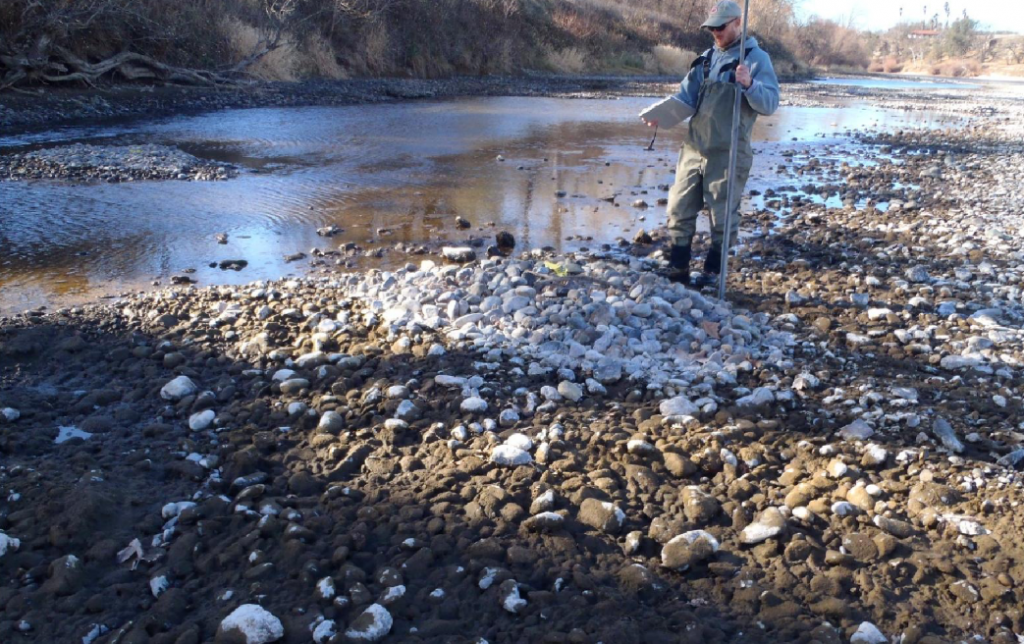
Young green sturgeon captured in Red Bluff trap. This specimen is quite large as most of the green sturgeon caught in the screw traps in late spring and early summer average one inch in length. Source .

Young green sturgeon captured in Red Bluff trap. This specimen is quite large as most of the green sturgeon caught in the screw traps in late spring and early summer average one inch in length. Source1 .

In an August 15, 2016 post on its Pacific Southwest Region website, the US Fish and Wildlife Service observed that the numbers of young green sturgeon have gone up this year in trap collections below the Red Bluff Diversion Dam.2 The article notes that this could represent an increase in the population. Joe Heublein, NMFS’s Green Sturgeon Recovery Coordinator, is also cautiously optimistic, according to the article.

Since 2012, gates at the Red Bluff dam have not hindered adult sturgeon from moving upstream past the dam to reach spawning grounds. Since 2016 was the first non-drought year since 2012, it seems likely that there should be an increase in the capture of recently spawned juveniles migrating downstream past the dam.

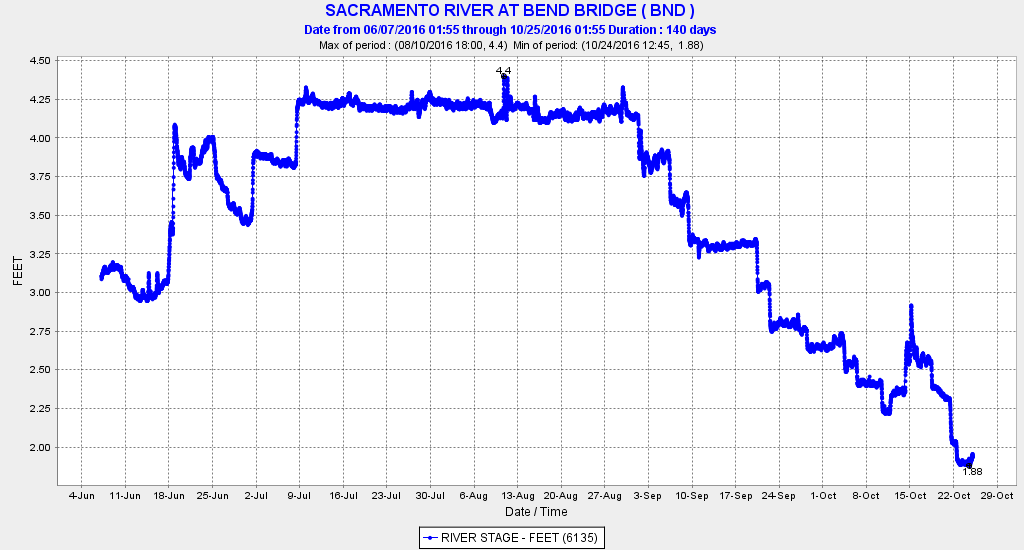
Missing from the story, however, is the fact that these juvenile sturgeon faced a particularly tough journey between Red Bluff and the Bay this summer, as discussed in my previous post on green sturgeon. Low flows and high water temperatures were a serious problem for the young sturgeon in the lower reaches of the Sacramento River in 2016. Unless their downstream rearing and migratory habitat is improved, the green and white sturgeon populations will have a bleak future.

The presence of young is a good sign. The species is long-lived, and thus it is not too late to recover this state and federally listed endangered fish. Getting rid of the Red Bluff diversion Dam five years ago was a big first step. The focus now should be on late spring through summer Lower Sacramento River habitat.

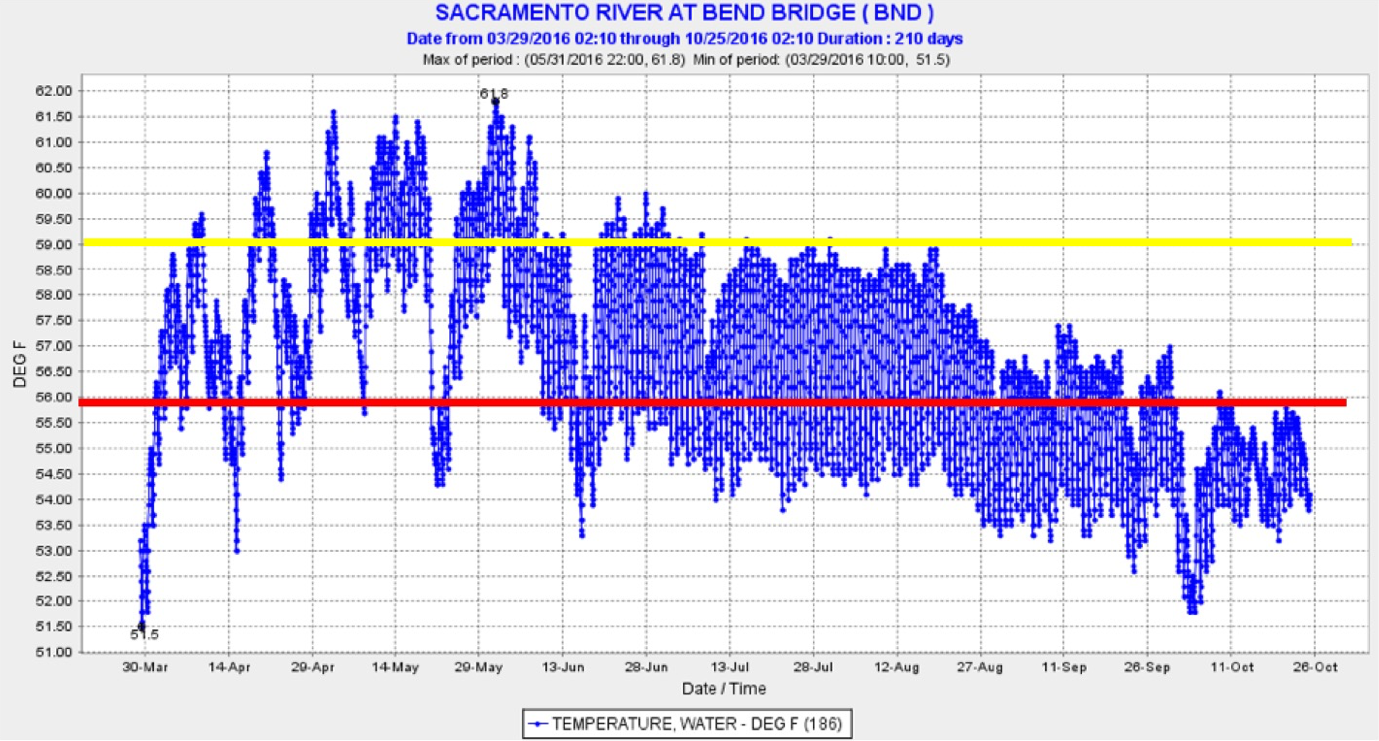
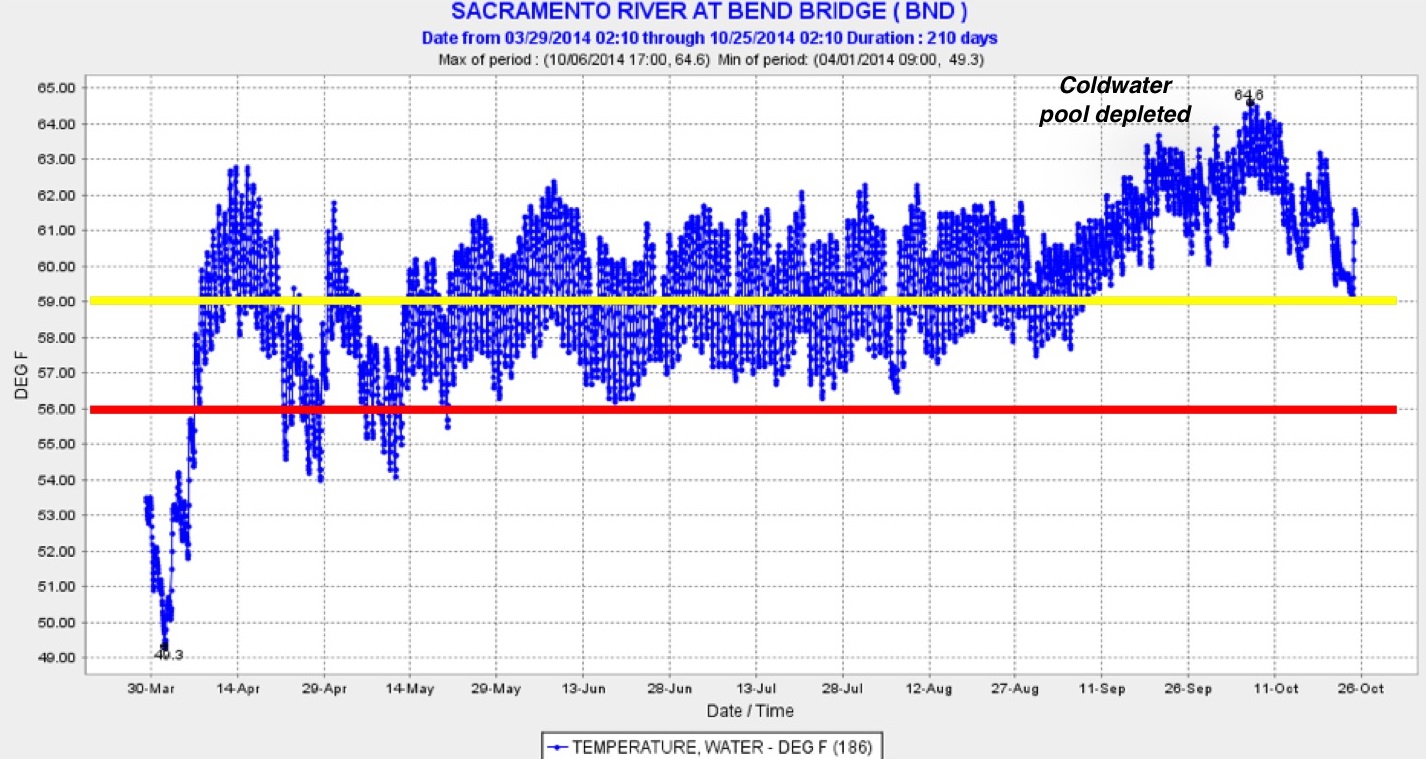
Since the beginning of summer 2016, conditions have improved (Charts 1 and 2). In August, flows at Wilkins Slough increased to 5000-7000 cfs, and water temperatures were down near 70°F. In late May and June, water temperatures at Red Bluff (Chart 3) were near lethal (68°F) for the really small fish, and were most likely worse not far downstream (Chart 2). Now temperatures are closer to the Basin Plan’s prescribed 56°F at Red Bluff and 68°F at Wilkins Slough.

The initial problem this year was the result of reduced releases from Shasta Reservoir to save its cold water pool for winter-run salmon, combined with normal agricultural water allocations in the Sacramento Valley. Recent improvements are the result of the normal late summer reductions in irrigation demands. In the future, Basin Plan objectives should be met by a reduction in Sacramento Valley water allocations when water is not sufficient to allow higher overall summer reservoir releases from Shasta.

Chart 1. River flow at Wilkins Slough (RM 125) late spring through summer 2016.

Chart 1. River flow at Wilkins Slough (RM 125) late spring through summer 2016.

Chart 2. Water temperature at Wilkins Slough (RM 125) late spring summer 2016.

Chart 2. Water temperature at Wilkins Slough (RM 125) late spring summer 2016.

Chart 3. Water temperature in Sacramento River at Red Bluff from late spring through summer 2016.

Chart 3. Water temperature in Sacramento River at Red Bluff from late spring through summer 2016.

Low Flows – Deadly Water Temperatures

Low flows in the Sacramento River and Delta lead to deadly water temperatures for Central Valley salmon, steelhead, sturgeon, and smelt, including six state or federally listed endangered species. Water quality standards and operating requirements for the state and federal water projects should include new flow limits to protect fish.

Sacramento River

Salmon, steelhead, and sturgeon are subjected to deadly spring and summer water temperatures when lower Sacramento River flows fall below 5000 cfs as measured at Wilkins Slough (Figure 1). Low flows and high water temperatures lead to poor survival and increased predation, and block migrations of adult salmon.

Delta

Low flows through the lower Sacramento River channel in the Delta also lead to deadly water temperatures for salmon and smelt. When Delta inflow falls below 10,000 cfs, water temperatures become deadly for Delta Smelt (Figure 2) and salmon (Figure 3).

Figure 1. Daily average water temperature and river flow in the Sacramento River at Wilkins Slough (RM 125) 2007-2016. Water temperatures greater than 75°F are lethal to salmon and sturgeon, and block salmon migration. The water quality standard for the lower Sacramento River is a limit of 68°F. Temperatures above 68°F are stressful to salmon, sturgeon, and steelhead, and lead to increased risk of predation, lower survival, and poor reproductive success.

Figure 1. Daily average water temperature and river flow in the Sacramento River at Wilkins Slough (RM 125) 2007-2016. Water temperatures greater than 75°F are lethal to salmon and sturgeon, and block salmon migration. The water quality standard for the lower Sacramento River is a limit of 68°F. Temperatures above 68°F are stressful to salmon, sturgeon, and steelhead, and lead to increased risk of predation, lower survival, and poor reproductive success.

Figure 2. Daily average water temperature and river flow in lower Sacramento River near Freeport. Water temperatures greater than 73°F are lethal to smelt and block salmon migrations.

Figure 2. Daily average water temperature and river flow in lower Sacramento River near Freeport. Water temperatures greater than 73°F are lethal to smelt and block salmon migrations.

Figure 3. Daily average water temperature in the south Delta at Clifton Court 2009-2016. Water temperatures greater than 25°C (77°F) are lethal to salmon and smelt.

Figure 3. Daily average water temperature in the south Delta at Clifton Court 2009-2016. Water temperatures greater than 25°C (77°F) are lethal to salmon and smelt.

Smelt Extinction and Recovery: The Path Forward

The March 29, 2016 Delta smelt symposium, part 4 (“Panel Discussion of the Path Forward”) offered some hope but few specific strategies for Bay-Delta smelt recovery.  My own presentation and other presentations earlier in Part 2, focused on how smelt got to the brink of extinction.  In Part 4, the panel of experts was asked to offer ways to bring smelt back from the brink.  Reading the transcript and watching the video of the discussion, there did not appear to be any specific array of actions or coherent strategy offered by the panel.  But on further review, I did find some nuggets that when put together sketch a reasonable course of action.

First, though, it is important to point out that over the past two decades there were two episodes that stopped extinction and brought some (albeit modest and short-lived) recovery with the help of Mother Nature.  The D-1641 water quality standards and the actions required by the Delta Smelt Biological Opinion actions did help.  The symposium should have focused more on those actions that helped, in order to see what further is needed.  Admittedly, the fact that recovery episodes were not more frequent makes this difficult.  It also does not speak well for 20 years of Bay-Delta adaptive management, which in large measure was a test to see how far the Bay-Delta ecosystem could be stressed by taking more and more water without breaking it.  Now that the ecosystem is broken, it is harder to see what helps and what does not.

Here is what I assembled from the panel’s discussion as a reasonable strategy to put the smelt and the Bay-Delta ecosystem back on a recovery course again.

Yolo Bypass – Cache Slough Complex

Simply putting more Sacramento River water down the Bypass might improve the Complex and transfer more of its nutrients, turbidity, and plankton (and smelt) to the north Delta and eastern Bay low salinity zone.  Available water sources include the Colusa Basin Drain and Fremont Weir.  The large Sacramento River agricultural diversions that feed the Drain are minimally used outside the April-October irrigation season.  Present mandates and plans to notch the Fremont Weir would provide a direct source of Sacramento River water to the Bypass.  A long-mandated relocation of the North Bay Aqueduct intake from the Cache Slough Complex to the Sacramento River would also help.

Sacramento Deep Water Ship Channel

Mentioned several times as the last refuge of Delta smelt, the Ship Channel from the Port in West Sacramento to the lower end of Cache Slough offers potential in improving conditions for smelt.  The closed gate at the upper end of the Ship Channel could be opened at key times to pass Sacramento River water into the upper channel to help flush smelt and nutrients into the north Delta, or simply to enhance smelt survival in the channel itself and in the lower Cache Slough Complex.  A panelist suggested dredging the channel.  Opening it in summer would cool the channel and possibly the lower Complex because the opening is near the mouth of the American River with its cool outflow.

Nutrients

The Panel suggested Increasing nutrients, specifically nitrogen, as a means of boosting plankton productivity and smelt survival in the Delta.  Ironically, the Sac Regional Treatment Plant is being forced to reduce its ammonia and nitrogen inputs to the Delta.  But the suggestion holds much promise because plankton blooms and turbidity from them are necessary staples of smelt critical habitat.  A recent spring plankton bloom coincident with a San Joaquin River flow pulse and low Delta exports suggests one option for increasing nutrients and plankton blooms.  Another option is the above-mentioned flow through the Bypass and Ship Channel.  Not exporting higher nutrient low salinity zone water is another.  Employing the Head of Old River Barrier would force more of the high nutrient San Joaquin water into the Central Delta and away from the south Delta export pumps.

More Delta Outflow to the Bay

Almost everyone on the panel suggested the need for more flow to the Bay to help the smelt.  The smelt are simply far better off in wet years.  But no one on the panel suggested upgrading the Delta Outflow requirements in the Bay-Delta D-1641 water quality standards, a process that has been ongoing for nearly a decade.  Relaxation of the outflow requirements in the past four years of drought proved disastrous for smelt, the kind of adaptive management experiment we could do without.  More outflow moves smelt into better habitat in Suisun Bay and Marsh.  It also keeps them away from the export pumps, Delta agricultural diversions, and the warmer lower-turbidity confines of the Delta channels with their profusion of warm water competitors and predators.  A panel member noted the difficulty of “finding” more water for outflow.  The water is there; the need to is export less of it.

Exports

Several panelists suggested there has been too much emphasis on Delta exports, and that we should be focusing more on other solutions like improving habitats.  While physical habitat improvements could help, the fact is that Delta pelagic habitat so essential to smelt and other Delta fishes has been severely degraded by exports (and lower outflows) at an ever increasing rate over the past four decades.  Global warming is further adding to the stress.  None of the panelists mentioned the benefits of export restrictions in the D-1641 standards or biological opinions.  The agricultural community screams to weaken these restrictions, in part from the lack of recognition of their benefits.

Hatchery

Several panelists expressed the opinion that the species is protected from extinction by holding them in captivity in two conservation hatcheries.  While that may be noble, it is not going to save the Delta or smelt.  The option of expansion to production hatcheries was barely discussed, because of an underlying concern of where to put the hatchery fish given the poor existing habitat.  But one panelist suggested stocking may be necessary to provide enough natural spawners to allow them to find one another during the spring spawn.  Regardless, there are times and places where better habitat occurs such that if more smelt were added, it would benefit the population (e.g., when X2 is downstream of the Delta in the fall).

Predators

The panel mentioned predators, but only as one of the negative changes that have occurred over the past several decades.  The panel discussed habitat enhancements as a means of reducing predators or their access to smelt.  There was mention of increasing nutrients to increase phytoplankton food and turbidity, to shade out aquatic plants that shield non-native predator fishes.  This holds promise if export operations do not replace good spatial habitat with incoming warm low turbidity river and reservoir water.  The panel thankfully did not speak of directly removing Delta predators as a solution to the problem, a suggestion fostered by the ag community.

The Solution Package

As a group, the strategies mentioned above offer a reasonable short-term solution package to save the Delta smelt.  Nearly all the actions can be immediately implemented, or at least started.  As a followup to the symposium, I suggest a workshop to develop a plan for such a solution package to guide recovery during the coming years of water battles over the WaterFix (Delta Tunnels), the update of the Bay-Delta Water Quality Control Plan, and the revision of the biological opinions for the long-term operation of the CVP and SWP.

Unprecedented July Experiment – Correction

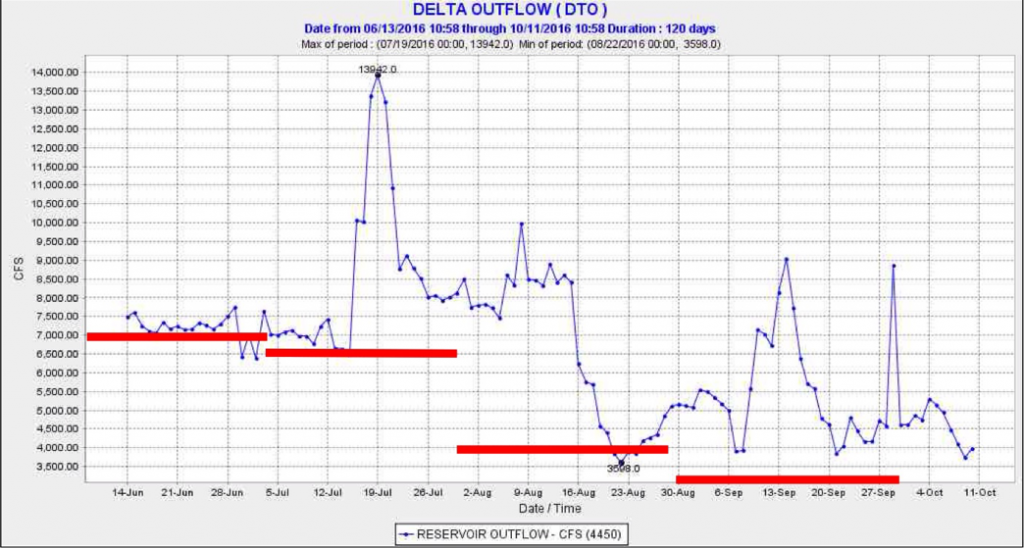
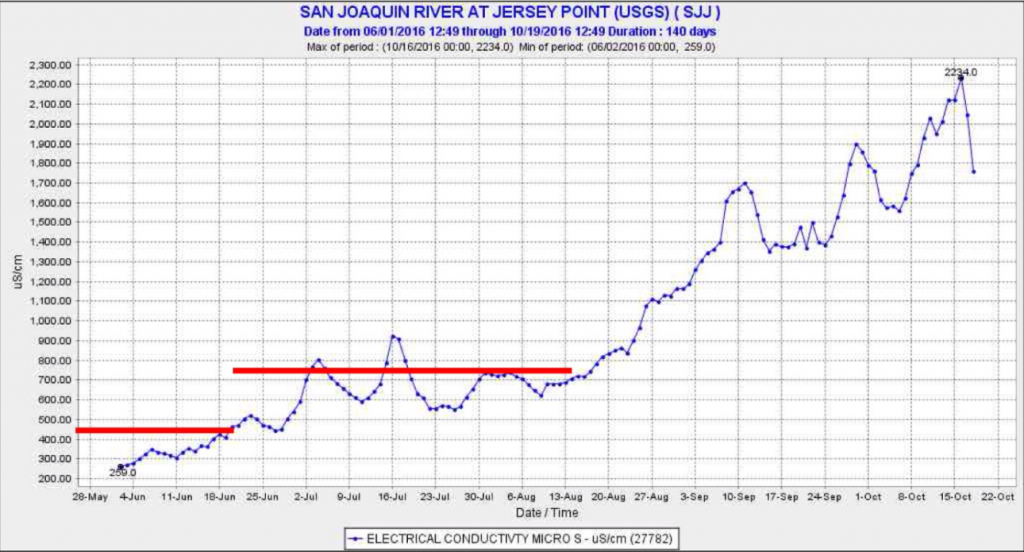
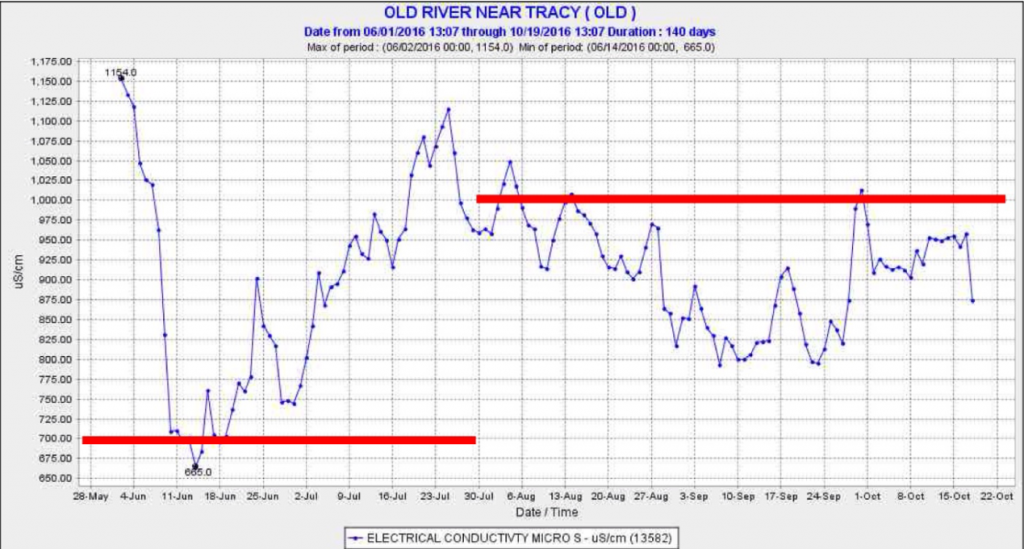
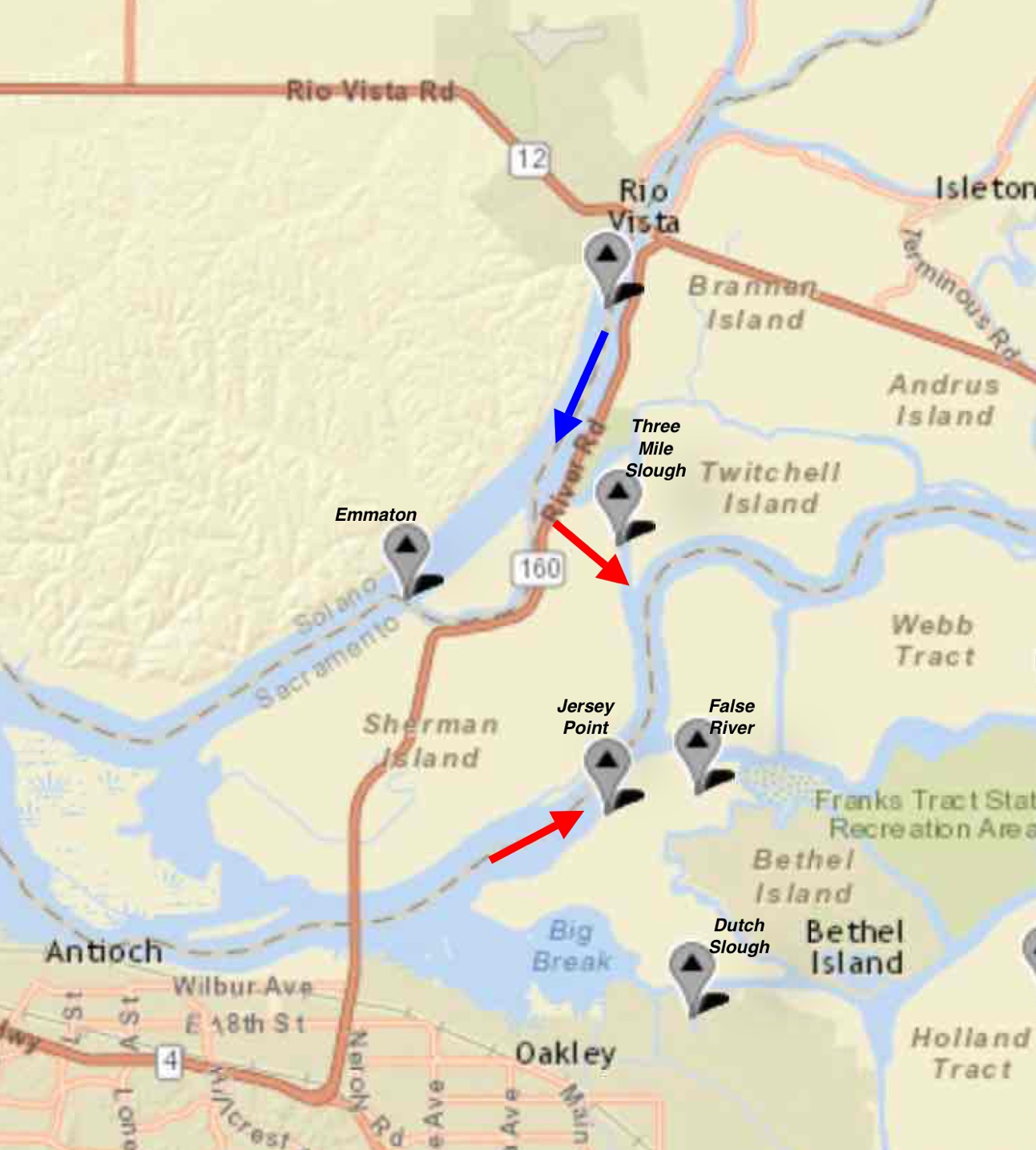
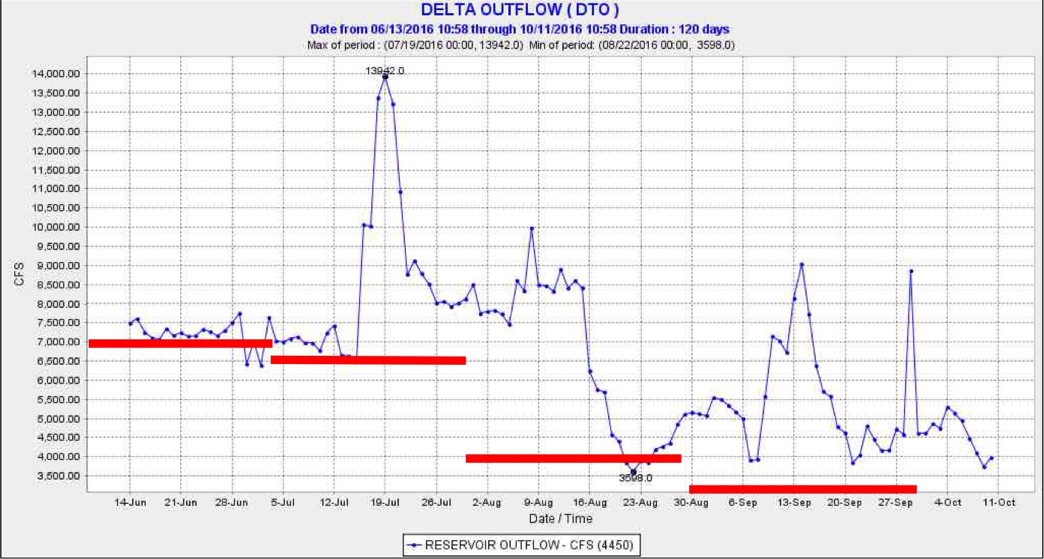
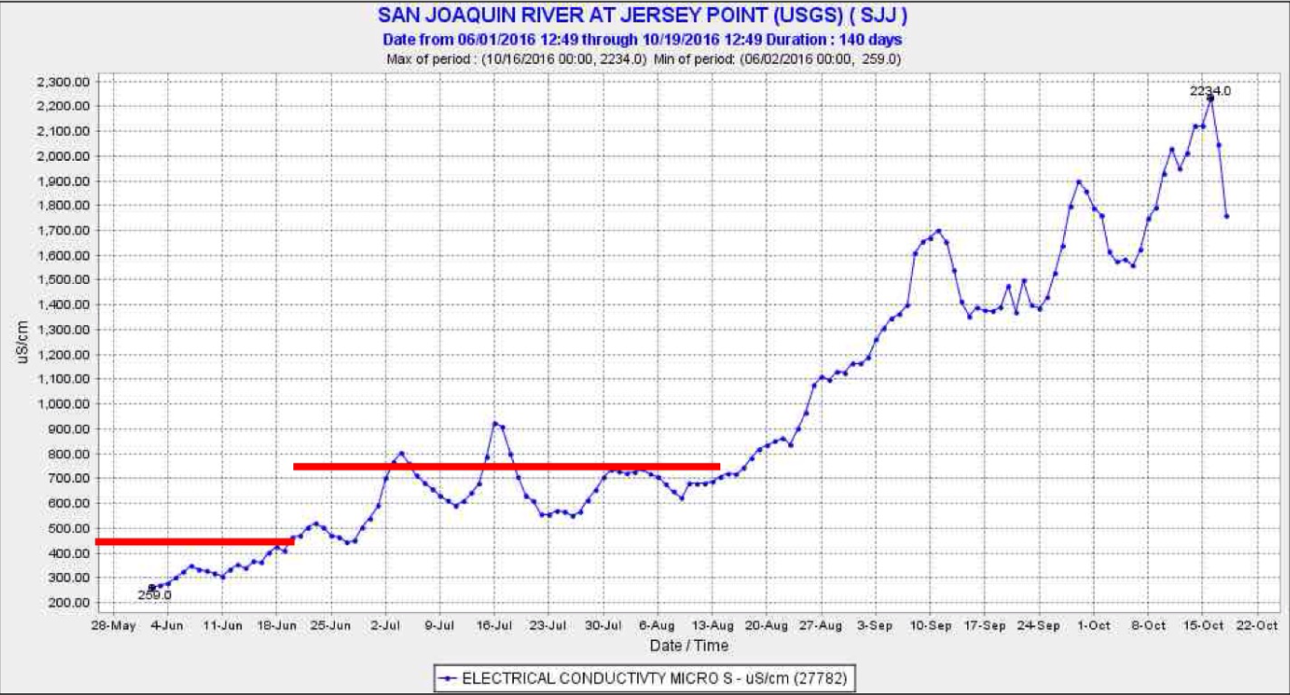
In a July 25 post, I wrote of an “unprecedented experiment” that released additional Delta outflow. I wrote that the pulse of Delta outflow in mid-July was in response to the state’s new Delta Smelt Resiliency Strategy July 2016.  Well, while the outcome of increased outflow did indeed create a valuable experiment in regard to smelt, the motivation for the release was simply to allow the water projects to be in compliance with State water quality standards for the Delta.  In this Below Normal water year, the required salinity (EC) at Jersey Point in the west Delta must be maintained below 740 EC on a 14-day average.  As the average EC crept up in mid-July (Figure 1), the water projects increased outflow (by limiting exports) beginning on July 16 (Figure 2).

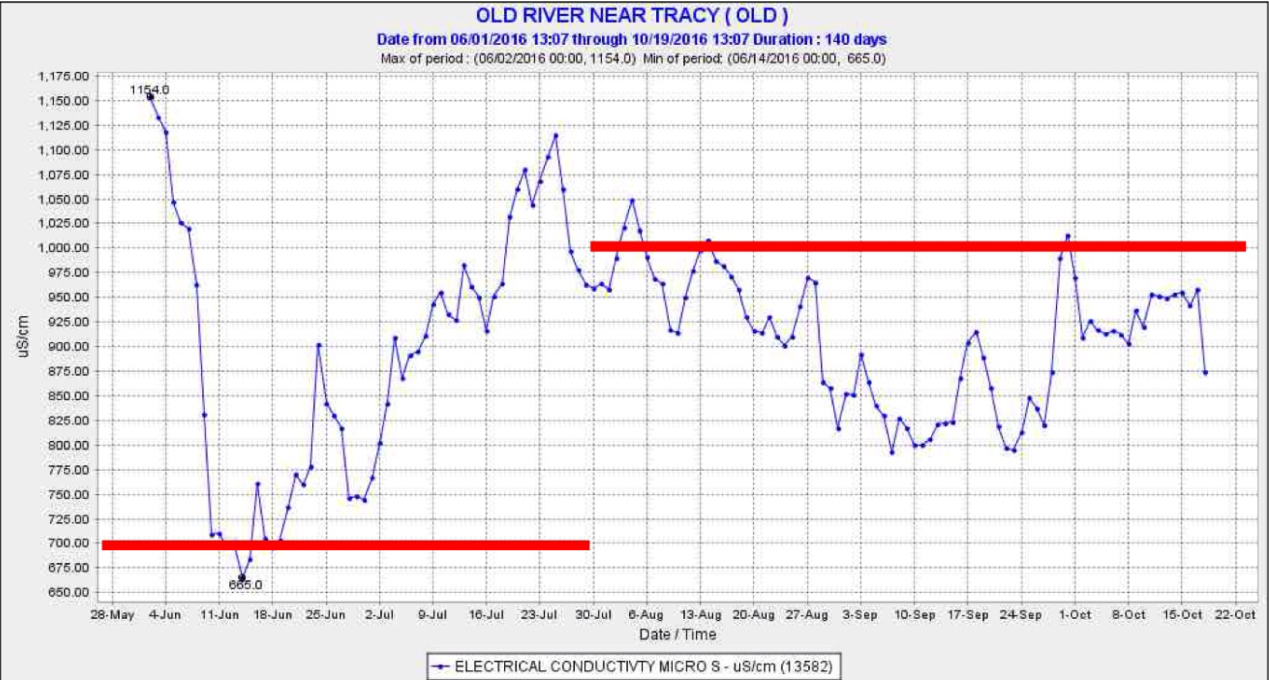
In a July 14 post, I had recommended 9000 cfs Delta outflow for July to keep smelt and the Low Salinity Zone west of the Delta.  If the projects had in fact maintained July outflow at 9000 cfs, the standard would have been met and the smelt and their habitat would have been better off for it.  A 9000 cfs outflow from July 1-15 would have cost 60,000 AF of water, roughly the cost of the one week of extra water necessary to comply with the standard (the monthly average outflow for July was 8400 cfs).  There was significant daily variation in outflow (Figure 2) that caused significant salt penetration into the Delta (Figure 3) with spring tides (Figure 4).

Perhaps better control of Delta outflow and salt field on a daily basis would benefit Irrigators (the standard is for agriculture) and reduce effects on fish and their habitat.  It also appears that project operators also used more water than was necessary to maintain a consistent 740 EC standard.  The extra water could be credited to the Strategy for helping smelt.

As it turned out, the event did provide an “unprecedented” adaptive management experiment whose effects bear close examination.  If anything, the “experiment” shows that large amounts of water manipulation in the Delta can be accomplished on short notice for whatever purpose.  I regret giving credit to the state and federal water projects for attempting to address the new Delta Smelt Strategy, when no such credit was in fact deserved.  Perhaps in the future the projects will actually seek credit for managing for Delta smelt, if only for that extra increment of water that assures compliance with water quality standards.

igure 1. July 14-day average EC at Jersey Point.

Figure 1. July 14-day average EC at Jersey Point.

Figure 2. Delta outflow (cfs) over past month.

Figure 2. Delta outflow (cfs) over past month.

Figure 3. Daily average Salinity EC at Jersey Point over past month.

Figure 3. Daily average Salinity EC at Jersey Point over past month.

Figure 4. Hourly water level (gage height) at Jersey Point over past month.

Figure 4. Hourly water level (gage height) at Jersey Point over past month.

Splittail Update

image1

Since I last posted about splittail, there has been little sign of their recovery in the Bay-Delta.  Flooding in the Sacramento Valley brought modest production in 2016, but a dry year in the San Joaquin Valley brought little there.  Numbers observed in summer south Delta pumping plant salvage are now very low (chart), with little evidence of recovery of the population.  The 2011 year class of 5 year olds, the last good wet-year year class, produced minimal offspring in the past three years.  It is fair to say that the recovery potential for the species is improbable.  The next several years will be the last for the 2011 year class, leaving the viability of the species in question.  As I stated in the earlier post, splittail should not have been removed from the federal list of endangered species.

Salvage of Splittail at south Delta export facilities from April 2011 to July 2016.

Salvage of Splittail at south Delta export facilities from April 2011 to July 2016.